Key Takeaways
- Food delivery marketplace vs grocery delivery marketplace models differ mainly in inventory handling, order preparation, fulfillment speed, basket size, supplier operations, and delivery economics.
- Food delivery usually connects customers with prepared meals from restaurants, while grocery delivery coordinates larger catalogs, store inventory, picking, substitutions, packing, and last-mile delivery.
- Both models can earn through commissions, delivery fees, subscriptions, promotions, and service charges, but their operational costs and unit economics can differ significantly.
Business Model Difference Signals
- Food delivery depends heavily on restaurant preparation time, menu availability, order acceptance, rider dispatch, meal freshness, and relatively short delivery windows.
- Grocery delivery adds SKU-level inventory, store picking, substitutions, weighted products, larger baskets, scheduled delivery, dark stores, and more complex fulfillment workflows.
- Revenue and margin planning should account for commission structure, average order value, delivery distance, picking cost, rider utilization, promotions, refunds, cancellations, and customer frequency.
Founder Planning Insights
- Founders should choose the model based on local supplier density, customer demand, inventory complexity, delivery radius, fulfillment infrastructure, expected order frequency, and operating margins.
- Key metrics can include order frequency, average basket value, commission revenue, delivery cost, preparation or picking time, substitution rate, rider utilization, repeat orders, and contribution margin.
- Miracuves develops customizable delivery marketplaces with customer ordering, restaurant or store management, rider operations, dispatch, payments, commissions, tracking, analytics, and admin controls.
Food delivery and grocery delivery may look similar from the outside. Both involve customers placing orders, local partners fulfilling demand, and riders completing last-mile delivery. But from a business model perspective, they are very different platforms.
A food delivery marketplace is built around restaurants, menus, prepared meals, peak-hour demand, and fast order movement. A grocery delivery marketplace is built around stores, catalogues, inventory accuracy, substitutions, basket size, delivery slots, and repeat household needs.
For founders, this difference matters because the wrong marketplace model can affect unit economics, technology planning, merchant onboarding, delivery operations, customer retention, and monetization. Before building a delivery platform, you need to understand whether your opportunity is driven by restaurant discovery, grocery replenishment, convenience commerce, or a hybrid model.
This guide breaks down how both models work, where they overlap, where they differ, and how founders can choose the right platform strategy.
What Is a Food Delivery Marketplace?
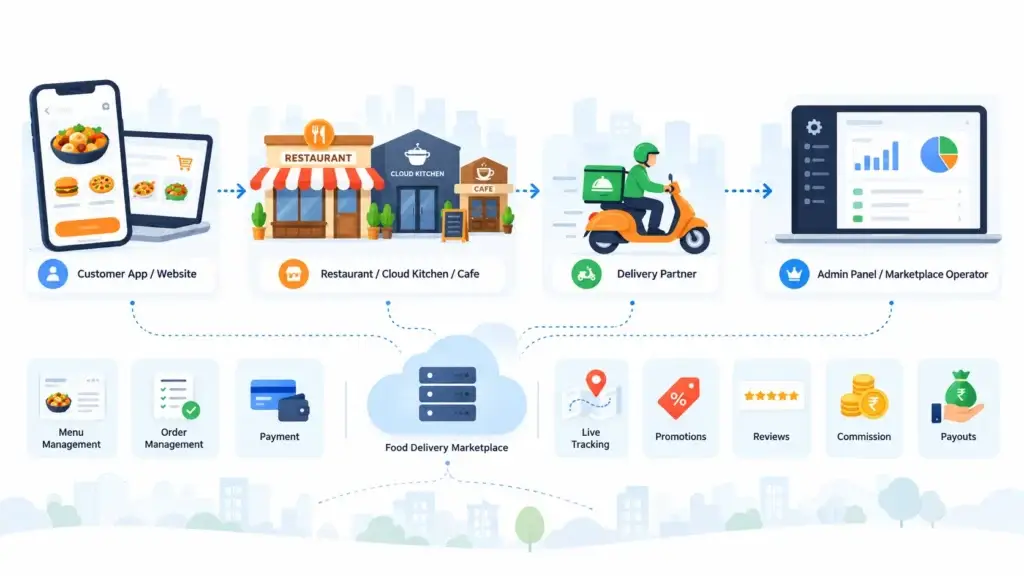
A food delivery marketplace connects customers with restaurants, cloud kitchens, cafes, and local food outlets. The platform manages discovery, ordering, payment, delivery coordination, customer support, and settlement workflows. For founders planning a restaurant-first delivery business, a restaurant delivery marketplace platform can provide the customer, restaurant, rider, and admin workflows needed to validate demand faster.
The core value is speed and convenience. Customers want to find nearby meals, compare menus, place an order quickly, track the rider, and receive food while it is still fresh. Restaurants want access to demand without building their own technology, logistics, and marketing engine from scratch.
A food delivery marketplace usually includes:
- Customer app or website
- Restaurant dashboard
- Delivery partner app
- Admin panel
- Menu management
- Order management
- Live tracking
- Commission setup
- Promotions and coupons
- Ratings and reviews
- Payout and settlement management
The business depends heavily on restaurant density, delivery zones, order frequency, preparation time, rider availability, and repeat ordering behavior.
What Is a Grocery Delivery Marketplace?
A grocery delivery marketplace connects customers with supermarkets, local stores, specialty shops, convenience stores, or warehouse-based fulfilment partners. Instead of prepared meals, customers order packaged goods, fresh produce, household items, personal care products, pantry items, and daily essentials. If your model depends on grocery catalogues, stock visibility, substitutions, and scheduled fulfilment, a grocery delivery platform is usually a better fit than a restaurant-only ordering system.
The core value is reliability. Customers expect the right products, correct quantities, fresh items, transparent pricing, and smooth replacement options when products are unavailable.
A grocery delivery marketplace usually includes:
- Customer app or website
- Store or vendor panel
- Shopper or picker workflow
- Delivery partner app
- Admin dashboard
- Product catalogue management
- Inventory availability
- Substitution handling
- Delivery slot management
- Order packing status
- Refund and replacement workflows
- Promotions and membership plans
The grocery model is more operationally complex because it deals with stock availability, SKU-level pricing, product variants, substitutions, packaging, expiry-sensitive items, and larger baskets.
Food Delivery vs Grocery Delivery Marketplace: Core Business Model Difference
Both models are delivery marketplaces, but their revenue logic and operational depth are not the same.
| Factor | Food Delivery Marketplace | Grocery Delivery Marketplace |
|---|---|---|
| Main supply side | Restaurants, cafes, cloud kitchens | Grocery stores, supermarkets, convenience stores, warehouses |
| Main customer need | Ready-to-eat meals | Household essentials and repeat replenishment |
| Order urgency | High urgency, often immediate | Mix of instant, same-day, and scheduled delivery |
| Basket size | Usually smaller | Usually larger |
| Fulfilment complexity | Preparation plus delivery | Picking, packing, substitutions, and delivery |
| Catalogue type | Menus and meal categories | SKU-based product catalogue |
| Inventory dependency | Lower, menu availability based | Higher, stock accuracy matters |
| Peak demand | Lunch, dinner, weekends, events | Mornings, evenings, weekends, household cycles |
| Monetization | Commission, delivery fee, ads, subscriptions | Commission, delivery fee, margin, memberships, promoted products |
| Operational risk | Late food, cold orders, restaurant delays | Out-of-stock items, wrong items, substitution issues |
The simplest way to understand the difference is this: food delivery is a time-sensitive restaurant logistics marketplace, while grocery delivery is an inventory-sensitive commerce and fulfilment marketplace.
Founders comparing both models should also evaluate the required food delivery marketplace features before deciding whether they need a restaurant-focused, grocery-focused, or hybrid delivery platform.
Revenue Streams in a Food Delivery Marketplace
A food delivery marketplace can earn from multiple sides of the ecosystem. The strongest model usually combines transaction-based revenue with partner-side monetization and customer retention plans. For a deeper breakdown of commissions, delivery charges, merchant promotions, subscriptions, and platform fees, explore this food delivery revenue model.
Restaurant Commission
The platform charges restaurants a commission on each completed order. This is one of the most common revenue streams because the restaurant pays for access to demand, ordering technology, payment processing, and delivery coordination.
For founders, the commission must be balanced carefully. If the commission is too high, restaurants may resist onboarding. If it is too low, the platform may struggle to cover operations, rider incentives, customer support, and marketing. A detailed food ordering business model guide can help founders understand how commission, delivery charges, subscriptions, and restaurant-side monetization work together.
Delivery Fees
Customers may pay a delivery fee based on distance, order value, delivery zone, weather conditions, or rider availability. Some platforms split this between rider compensation and platform revenue.
Delivery fee logic is critical because a flat delivery fee may work in dense urban zones but can fail in areas with longer distances and fewer orders per rider.
Restaurant Promotions and Sponsored Listings
Restaurants may pay for better visibility inside the app. This can include promoted listings, banner placements, sponsored search positions, or campaign-based exposure.
This revenue stream becomes more useful once the platform has enough restaurant supply and customer traffic. In the early stage, founders should focus first on quality supply, repeat customers, and reliable order fulfilment.
Customer Subscription Plans
A food delivery platform can offer subscription plans with free delivery, discounted service fees, loyalty rewards, or exclusive offers. This can improve retention and order frequency if customers already order multiple times per month.
The subscription model works best when the platform has strong restaurant coverage and enough repeat-use value.
Service Fees and Convenience Charges
Some platforms charge a small platform fee or convenience charge per order. This can support customer support, technology operations, payment handling, and platform maintenance.
The fee must be clearly communicated because hidden charges can damage trust and reduce repeat ordering.
Revenue Streams in a Grocery Delivery Marketplace
A grocery delivery marketplace has more monetization options because it operates closer to ecommerce, retail media, and household repeat buying.
Store Commission
The platform can charge stores a commission on each order. This works well when the platform brings demand, delivery coordination, and digital ordering infrastructure to offline retailers.
The commission percentage may vary depending on product category, fulfilment responsibility, store size, and whether the platform handles delivery.
Product Margin
In some grocery models, the platform buys inventory or controls pricing. In this case, revenue can come from the difference between purchase cost and selling price.
This model can increase margin potential but also increases operational responsibility. The founder must manage inventory, wastage, storage, procurement, and pricing accuracy.
Delivery and Handling Fees
Grocery orders often require picking, packing, bagging, and careful delivery. A handling fee can help cover the operational cost of preparing the order before it reaches the rider.
This is especially relevant when grocery baskets include many small items, fragile products, fresh produce, or weight-based goods.
Membership Plans
Grocery delivery has strong subscription potential because customers buy essentials repeatedly. A membership plan can offer free delivery, priority slots, lower handling fees, or special discounts.
This model works well when the platform becomes part of the customer’s weekly or monthly household routine.
Promoted Products and Retail Media
Grocery marketplaces can monetize shelf visibility inside the app. Brands, stores, or sellers may pay to promote products in category pages, search results, or recommendation sections.
This can become a strong revenue layer when the platform has meaningful traffic and purchase intent.
Operational Differences Founders Must Understand
The biggest mistake founders make is assuming that both delivery models require the same backend. They do not.
Food delivery is about restaurant readiness, order timing, rider dispatch, and customer experience during a short fulfilment window. Grocery delivery is about catalogue management, stock visibility, picking accuracy, replacement logic, and fulfilment reliability.
Food Delivery Operations
Food delivery operations revolve around timing. The order must move through confirmation, preparation, pickup, and delivery without losing quality.
Key operational workflows include:
- Restaurant onboarding
- Menu setup
- Order acceptance
- Preparation time management
- Rider assignment
- Pickup coordination
- Live order tracking
- Customer support
- Refund and cancellation handling
- Restaurant payout settlement
The main operational risk is delay. If food takes too long, customer satisfaction drops quickly.
Grocery Delivery Operations
Grocery delivery operations revolve around accuracy. The customer expects the correct items, correct quantity, fresh products, and fair substitutions.
Key operational workflows include:
- Store onboarding
- Product catalogue upload
- SKU management
- Stock availability
- Product variants
- Order picking
- Substitution approval
- Packing status
- Scheduled delivery
- Refund handling
- Store payout settlement
The main operational risk is mismatch. If the customer receives missing, wrong, damaged, or poor-quality items, trust declines.
Technology Requirements for Each Marketplace
A food delivery platform and grocery delivery platform may share customer apps, delivery apps, payment gateways, dashboards, and notification systems. But the product architecture should still reflect the model’s operational reality.
Food Delivery Technology Stack Priorities
A food delivery marketplace needs strong real-time flows. The system must handle active restaurants, live orders, rider availability, location tracking, and delivery zone rules. A practical food delivery app feature checklist can help founders separate must-have launch modules from features that can be added later.
Important modules include:
- Restaurant panel
- Menu management
- Order queue
- Real-time order status
- Rider dispatch
- Delivery tracking
- Zone-based delivery pricing
- Commission management
- Offers and coupons
- Customer reviews
- Admin dashboard
For a founder building a restaurant delivery marketplace, the most important backend layer is the dispatch and order lifecycle. The customer does not only buy food. They buy timing, predictability, and convenience.
Grocery Delivery Technology Stack Priorities
A grocery delivery marketplace needs stronger catalogue and inventory workflows. The system must handle thousands of SKUs, variants, brands, availability, pricing, substitutions, and order packing.
Important modules include:
- Store panel
- Product catalogue management
- Inventory availability
- SKU variants
- Product search and filters
- Cart and basket logic
- Substitution workflow
- Delivery slot management
- Picker workflow
- Refund management
- Admin dashboard
For grocery, search quality and product accuracy matter as much as delivery speed. If customers cannot find what they need or receive incorrect products, they may not return.
Customer Behavior: Impulse vs Routine
Food delivery is often impulse-driven. Customers may order because they are hungry, busy, tired, at work, hosting guests, or looking for convenience. Demand spikes around meal times and weekends.
Grocery delivery is more routine-driven. Customers may order weekly essentials, fresh produce, snacks, household items, baby products, or personal care products. Demand may be less emotionally urgent but more recurring when the service becomes reliable.
This difference affects marketing.
Food delivery marketing should focus on cravings, quick fulfilment, restaurant variety, offers, and local availability. Grocery delivery marketing should focus on reliability, savings, freshness, convenience, scheduled delivery, and household repeat needs. Once the platform model is clear, a strong food delivery growth strategy can help improve repeat orders, retention, and local demand generation.
Merchant Onboarding Differences
A restaurant delivery marketplace needs restaurant partners that can prepare orders quickly and maintain food quality. The onboarding process should verify menu readiness, preparation time, packaging quality, operating hours, and payout expectations.
A grocery marketplace needs store partners that can maintain product availability, pricing, product images, category mapping, and replacement handling. Store onboarding is more catalogue-heavy and operationally detailed.
| Onboarding Area | Food Delivery | Grocery Delivery |
|---|---|---|
| Partner setup | Restaurant profile and menu | Store profile and product catalogue |
| Key data | Menu items, prices, prep time | SKUs, variants, stock, units, brands |
| Quality control | Packaging and preparation speed | Stock accuracy and item freshness |
| Operational training | Accepting and preparing orders | Picking, packing, and substitutions |
| Payout logic | Commission per order | Commission, margin, or mixed settlement |
Delivery Logistics: Why Dispatch Rules Differ
In food delivery, the goal is to reduce the time between preparation and customer delivery. A rider should ideally arrive when the order is close to ready, not too early and not too late.
In grocery delivery, the rider may need to wait until the order is picked and packed. For scheduled orders, dispatch can be planned differently. For instant grocery, the system needs faster picking workflows and tighter store coordination.
Food delivery dispatch is meal-time sensitive. Grocery dispatch is fulfilment-stage sensitive.
This is why founders should not treat dispatch as a generic map feature. Dispatch logic directly affects customer satisfaction, rider utilization, refund rates, and operating cost.
Which Marketplace Has Better Repeat Potential?
Both can create repeat usage, but the reason for repeat usage is different.
Food delivery repeat usage comes from convenience, taste, restaurant variety, offers, and meal-time habits. Grocery repeat usage comes from reliability, household need, product availability, pricing, and delivery slot consistency.
A food delivery marketplace may generate frequent small orders. A grocery marketplace may generate fewer but larger baskets. The right choice depends on your city, target customers, supply partners, delivery density, and operating budget.
Which Model Is Easier to Launch?
Food delivery is usually easier to launch from a product and catalogue perspective because menus are smaller than grocery catalogues. It still requires strong restaurant onboarding, dispatch, delivery tracking, and customer support. Launch complexity also affects budget, so founders should review the main factors behind food delivery app development cost before finalizing scope.
Grocery delivery can be more complex because the platform must manage product data, stock updates, item substitutions, and packing workflows. However, grocery can create strong repeat behavior when customers trust the service.
For founders who want faster validation, a food delivery marketplace can be a practical starting point if the market has strong restaurant supply and delivery demand. A grocery marketplace can work well when the founder has reliable store partners, product availability, and a clear fulfilment process.
When Should Founders Choose a Food Delivery Marketplace?
A food delivery marketplace may be the better model when:
- Your target area has strong restaurant density
- Customers already order prepared meals frequently
- You can onboard local restaurants quickly
- Rider availability is manageable
- You want a faster restaurant-focused marketplace launch
- You plan to monetize through commissions, delivery fees, promotions, and subscriptions
- You want to build a branded local or regional delivery platform
This model is especially suitable for founders targeting restaurant delivery, cloud kitchens, franchise networks, food courts, campus delivery, office meal ordering, or local food communities.
For founders moving in this direction, a launch-ready food ordering marketplace from Miracuves can reduce build time by providing core apps, admin control, delivery workflows, and branded deployment in 6 days.
When Should Founders Choose a Grocery Delivery Marketplace?
A grocery delivery marketplace may be the better model when:
- Your target customers buy essentials repeatedly
- You have reliable store or warehouse partners
- You can manage product catalogues and stock accuracy
- Customers value convenience over instant impulse ordering
- You want higher basket sizes
- You can build trust around freshness and replacement handling
- You plan to monetize through delivery fees, commissions, memberships, product margins, or promoted products
This model is suitable for supermarkets, local grocery chains, convenience stores, fresh produce sellers, warehouse operators, and hyperlocal essentials platforms.
Can One Platform Support Both Food and Grocery Delivery?
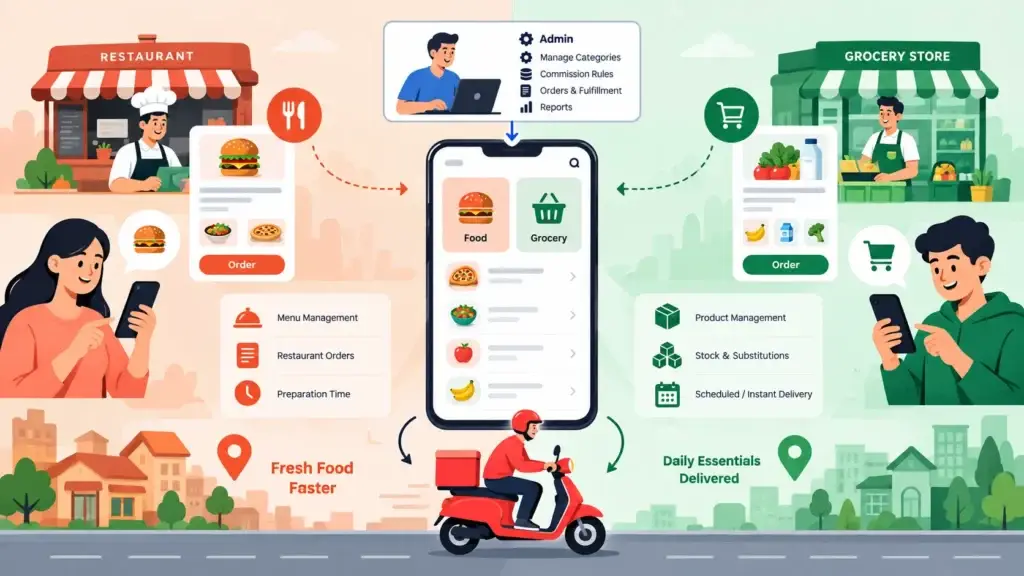
Yes, but founders should be careful. A hybrid delivery marketplace can support both food and grocery if the backend is designed with separate workflows for menus, products, preparation time, stock availability, substitutions, and delivery scheduling.
This is also where founders should watch changing food delivery app development trends, especially around multi-category ordering, automation, smarter dispatch, and flexible marketplace expansion.
The challenge is not simply adding more categories. The challenge is managing different operational rules inside one platform.
A hybrid model needs:
- Separate merchant types
- Separate catalogue structures
- Different order flows
- Category-specific commission rules
- Different delivery timing logic
- Different cancellation and refund policies
- Flexible admin controls
- Strong reporting by vertical
Miracuves can help founders build delivery marketplaces that support multiple on-demand categories while keeping the operational logic clear for each business model.
Founder Decision Framework: Food vs Grocery Delivery Marketplace
Use this framework before deciding which model to build.
| Question | Choose Food Delivery If | Choose Grocery Delivery If |
|---|---|---|
| What is the main customer need? | Quick prepared meals | Household essentials |
| What supply do you already have? | Restaurants and kitchens | Stores, supermarkets, or warehouses |
| What is harder in your market? | Restaurant onboarding and dispatch | Inventory accuracy and fulfilment |
| What revenue model fits better? | Commission, delivery fee, promotions | Commission, margin, membership, promoted products |
| What behavior are you targeting? | Impulse and convenience orders | Repeat replenishment orders |
| What technology layer matters most? | Real-time ordering and rider dispatch | Catalogue, inventory, substitutions, and slot management |
| What is your launch goal? | Fast local food ordering platform | Reliable grocery and essentials delivery platform |
Common Mistakes Founders Should Avoid
Treating Grocery Like Food Delivery
Grocery delivery needs product-level accuracy. A simple restaurant-style menu system will not be enough for large product catalogues, variants, stock updates, and substitutions.
Ignoring Unit Economics
Delivery businesses can grow orders and still lose money if commission, delivery cost, discounts, rider payouts, and support costs are not balanced. Founders should model revenue per order before scaling.
Building Without Admin Control
The admin dashboard is where the platform operator manages merchants, products, orders, riders, commissions, payouts, refunds, promotions, and disputes. Without strong admin control, every small operational change becomes developer-dependent. Founders should also review a delivery app security checklist before handling payments, user data, restaurant accounts, rider access, refunds, and dispute workflows.
Overloading the First Launch
Launching with food, grocery, pharmacy, parcel, and other categories at once can create operational confusion. It is usually better to validate one strong category first, then expand with better data.
Copying a Marketplace Without Understanding the Operating Model
A delivery marketplace is not just an app interface. It is a system of supply, demand, fulfilment, pricing, payouts, support, and trust. The business model must fit the market, not just the design.
How Miracuves Helps Founders Launch Faster
Miracuves helps founders build white-label delivery marketplaces with branded customer apps, merchant workflows, delivery partner apps, admin dashboards, source-code ownership, and faster deployment. If you are evaluating the right execution partner, this guide on choosing a food delivery app development company can help you compare technical readiness, demo depth, ownership, and launch support.
For founders choosing the food delivery route, Miracuves offers a practical path from idea to launch without building every module from zero. The ready-made approach can help reduce development time because core marketplace flows, ordering logic, delivery tracking, payment workflows, and admin controls are already structured.
If your goal is to validate a restaurant delivery marketplace quickly, you can explore Miracuves’ launch-ready food ordering solution here: build your own branded food delivery marketplace.
Final Thoughts
Food delivery and grocery delivery are both powerful marketplace opportunities, but they are not the same business.
Food delivery is built around prepared meals, restaurant discovery, speed, dispatch, and meal-time demand. Grocery delivery is built around catalogue depth, stock accuracy, picking, substitutions, scheduled delivery, and household repeat purchases.
For founders, the right choice depends on supply access, delivery density, operational capability, margin structure, and customer behavior. The smartest move is not to copy a popular platform pattern blindly. It is to choose the model that matches your market and launch with the control layer needed to operate it properly.
Miracuves helps founders move faster with ready-made, white-label delivery marketplace solutions that include branded apps, admin control, source code, and 6-day delivery for suitable ready-made deployments.
FAQs
What is the main difference between a food delivery marketplace and a grocery delivery marketplace?
A food delivery marketplace focuses on prepared meals, restaurant ordering, real-time dispatch, and quick delivery. A grocery delivery marketplace focuses on product catalogues, inventory availability, picking, packing, substitutions, and scheduled or same-day fulfilment.
Which business model is easier for founders to launch?
A food delivery marketplace is often easier to launch from a catalogue perspective because restaurant menus are simpler than grocery product inventories. Grocery delivery can be more complex because it requires SKU management, stock updates, and substitution workflows.
How does a food delivery marketplace make money?
A grocery delivery marketplace can earn through store commissions, product margins, delivery fees, handling fees, membership plans, promoted products, and category-based advertising.
How does a grocery delivery marketplace make money?
A grocery delivery marketplace can earn through store commissions, product margins, delivery fees, handling fees, membership plans, promoted products, and category-based advertising.
Can one delivery marketplace support food and grocery together?
Yes, one delivery marketplace can support both models if the platform has flexible merchant types, separate catalogue structures, category-specific workflows, delivery rules, commission settings, and admin controls.
What technology features are most important for a food delivery marketplace?
The most important features include restaurant onboarding, menu management, order acceptance, rider dispatch, live tracking, zone-based pricing, payment processing, promotions, reviews, and admin control.
What technology features are most important for a grocery delivery marketplace?
The most important features include product catalogue management, inventory availability, SKU variants, product search, substitution handling, delivery slots, picker workflows, refunds, and store settlement.
Why should founders compare these models before building?
Founders should compare these models because each has different operational risks, revenue streams, technology requirements, and customer behavior. Choosing the right model early helps reduce development waste and improves market validation.
Miracuves is an independent software development company. We are not affiliated with, connected to, sponsored by, or endorsed by any company or product named in this article.
Terms such as “X Clone” are used descriptively. It is how the software industry refers to building a platform with functionality comparable to a known service, and how clients search for it.
The entire design and codebase of our products is built by our own team. Our products contain no code, design, graphics, or content originating from any third-party website or applications.
All third-party names and marks referenced in this article are the property of their respective owners, referenced solely to identify the services discussed.