

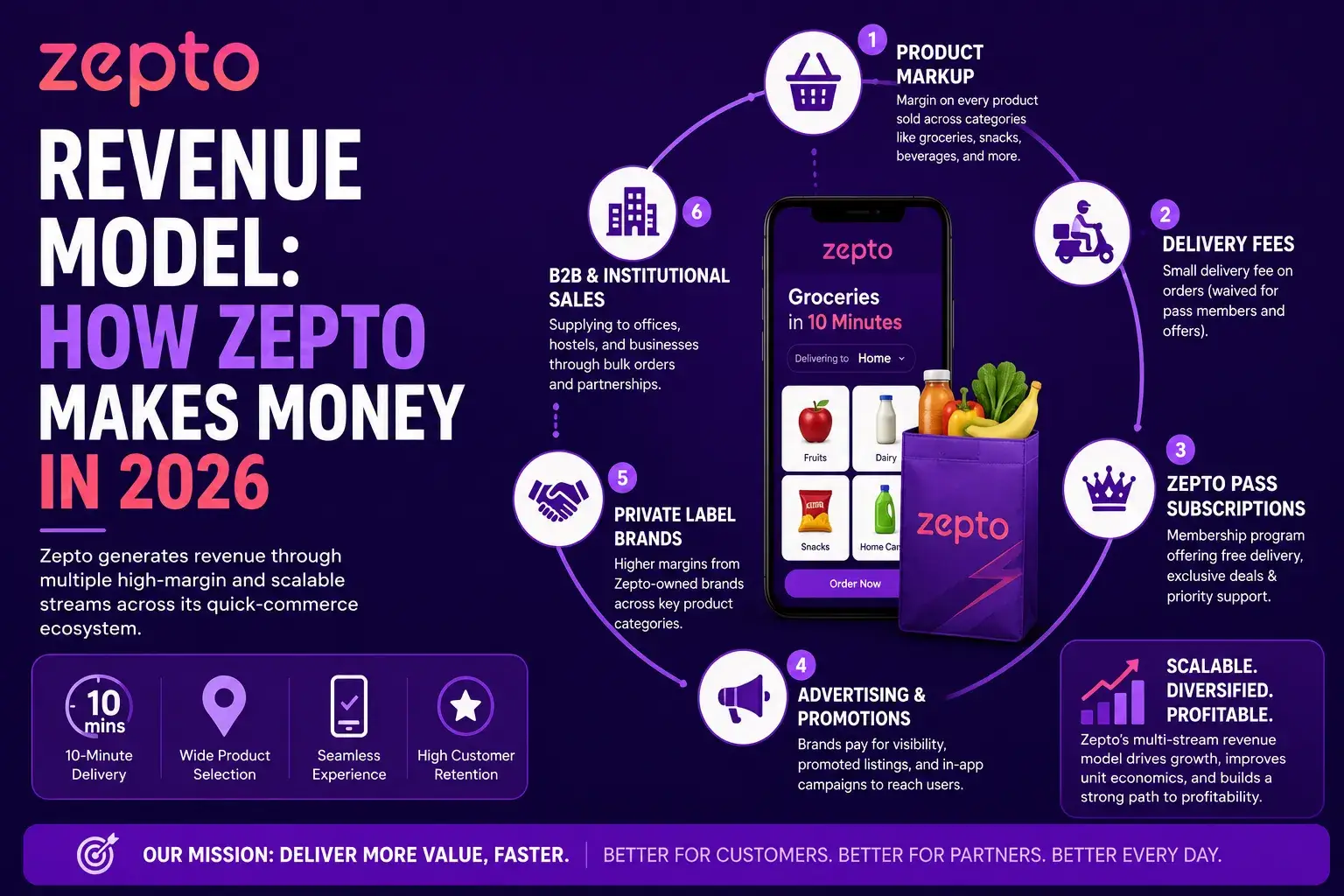
Key Takeaways
- Zepto operates on a quick-commerce delivery model.
- Product margins are a major revenue source.
- Delivery fees generate recurring operational income.
- Dark stores help improve delivery efficiency.
- Fast delivery drives customer retention and growth.
Revenue Signals
- Product markups contribute to overall profitability.
- Delivery charges add additional revenue per order.
- Brand advertising creates high-margin income streams.
- Subscriptions improve repeat purchase behavior.
- Private labels help increase profit margins.
Real Insights
- Quick-commerce depends heavily on operational efficiency.
- Inventory accuracy impacts profitability directly.
- Repeat customers drive long-term business sustainability.
- Dark store optimization improves delivery economics.
- Miracuves builds Zepto Clone apps with scalable quick-commerce workflows.
Zepto app , the 10-minute grocery delivery sensation, recorded an incredible ₹11,110 crore (~$1.3 billion) in FY 2025 — nearly 150% growth year-over-year. For entrepreneurs, Zepto’s rise showcases how speed, data, and convenience can be monetized at scale. Understanding its revenue model is vital if you’re exploring on-demand, delivery, or marketplace ventures. Zepto turned rapid fulfillment into serious profit potential — and its playbook is reshaping e-commerce logistics worldwide.
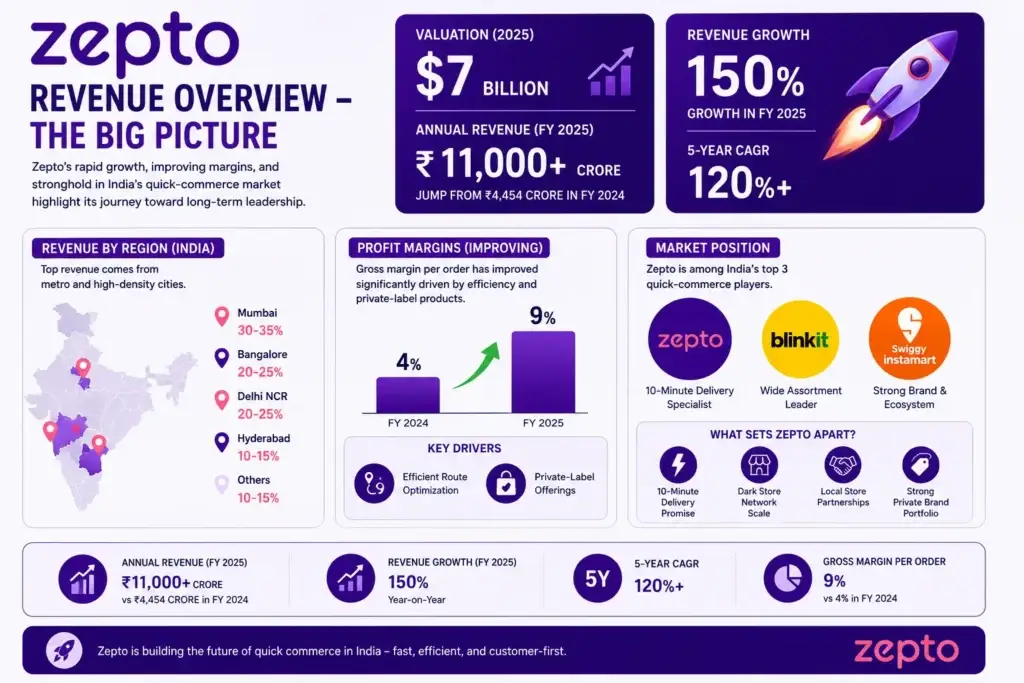
Zepto clone Revenue Overview – The Big Picture
Valuation and Revenue:
As of 2025, Zepto’s valuation is around $7 billion, with annual revenue exceeding ₹11,000 crore — a jump from ₹4,454 crore in FY 2024.
Growth Rates:
The company posted nearly 150% revenue growth in FY 2025 alone. Over the past five years, its compound annual growth rate (CAGR) exceeds 120%.
Revenue by Region:
Zepto currently operates almost entirely in India, with top revenue contributions from metro regions such as Mumbai, Bangalore, Delhi NCR and Hyderabad.
Profit Margins:
Though still investing heavily in infrastructure and dark-store expansion, Zepto’s gross margin per order has improved from 4% to 9% due to efficient route optimization and private-label offerings.
Market Position:
Zepto stands among India’s top three quick-commerce players alongside Blinkit and Swiggy Instamart. It dominates the 10-minute delivery niche by blending local-store partnerships, technology, and private-brand leverage.
Read More: What is Zepto App and How Does It Work?
Primary Revenue Streams Deep Dive
| Revenue Stream | Share of Total Revenue | Description |
|---|---|---|
| Delivery Commissions | 45% | Zepto earns commissions from partner retailers and FMCG brands for every fulfilled order. |
| Delivery Fees (Users) | 20% | Customers pay convenience or surge-based fees per order, usually ₹15 – ₹40. |
| Advertising & Sponsored Listings | 15% | Brands pay Zepto for sponsored visibility within the app. |
| Private-Label Products | 10% | Zepto’s in-house grocery lines generate higher margins. |
| Subscription & Loyalty Plans | 10% | Zepto Pass offers free delivery and priority access for a monthly fee. |
Revenue Stream #1 – Delivery Commissions
Zepto charges vendors a 10 – 20% commission on each completed order. With millions of daily orders, this remains the backbone of its business model.
Revenue Stream #2 – Delivery Fees (Users)
Users pay small convenience fees, dynamically adjusted by demand and delivery window. During peak hours or bad weather, fees rise 20 – 30%, directly boosting per-order profitability.
Revenue Stream #3 – Advertising & Brand Placements
FMCG companies bid for homepage banners, search placement, and category sponsorships. Sponsored listings account for roughly 15% of Zepto’s top line and grow at ~60% annually.
Revenue Stream #4 – Private Labels
Zepto launched its own grocery and essentials line in 2024. These in-house brands carry 25 – 40% margins, far higher than third-party items.
Revenue Stream #5 – Subscription Plans
Zepto Pass, priced around ₹99 per month, offers unlimited free deliveries above ₹199 order value. With over a million subscribers, it creates predictable monthly recurring revenue.
The Fee Structure Explained
| User Type | Fee Type | Typical Rate | Description |
|---|---|---|---|
| Customer | Delivery Fee | ₹15 – ₹40 | Varies by distance and time slot |
| Subscription Fee | ₹99 – ₹149 / month | Zepto Pass membership | |
| Merchant / Brand | Commission | 10 – 20% per order | Deducted from gross sales |
| Listing Fee | ₹2,000 – ₹5,000 / month | Sponsored visibility charges | |
| Advertising Packages | ₹50,000 – ₹10 lakh / month | Premium placement costs | |
| Others | Dark Store Markup | Variable | Pricing difference for logistics margin |
Hidden monetization methods include surge-based pricing, promotional revenue sharing, and last-mile service fees applied to certain zones.
How Zepto Maximizes Revenue Per User
Zepto’s average revenue per user (ARPU) has risen by 45% since 2023 due to data-driven monetization.
Segmentation & Personalization:
Customer data enables personalized offers and cross-category recommendations that raise basket sizes by 15–20%.
Upselling & Cross-Selling:
In-app banners suggest premium variants and bundle offers before checkout, converting over 30% of users.
Dynamic Pricing Algorithms:
AI models adjust delivery fees based on distance, traffic, and store load, improving profit per minute of delivery.
Retention Monetization:
Loyalty points and exclusive sales under Zepto Pass reduce churn and boost monthly spend.
Psychological Pricing:
Prices end in .99 or .49 to nudge impulse buys. Limited-time offers and “only 2 left” notifications boost urgency.
Read more : Zepto Revenue Model: How Zepto Makes Money in 2026
Future Revenue Opportunities & Innovations
Zepto plans to expand to Tier-2 cities and test new monetization methods such as:
- AI-Driven Dynamic Discounts for real-time margin optimization.
- Micro-Warehousing Partnerships reducing last-mile cost by 15%.
- Grocery as a Service API for B2B integration with retailers.
- AdTech and Data Monetization via brand insights dashboards.
- Subscription Bundles combining Zepto Pass with entertainment or bank offers.
Threats include delivery-cost inflation and intensifying competition from Blinkit and Swiggy Instamart, but Zepto’s data-first approach positions it for long-term dominance.
Final Thought
Zepto Clone journey proves that speed, efficiency and smart monetization can co-exist. For entrepreneurs, it’s not just about delivery — it’s about owning the customer moment and monetizing it from multiple angles. The next billion-dollar platform could emerge from adapting this playbook — and Contact us
FAQs
How much does Zepto make per transaction?
Zepto earns an average commission of 10–20% from merchants and ₹15–₹40 delivery fee from users, totaling ₹50–₹80 per order on average.
What’s Zepto’s most profitable revenue stream?
Private labels and brand advertising deliver the highest margins (25–40%).
What percentage does Zepto take from providers?
Between 10% and 20% commission per fulfilled order.
How has Zepto’s revenue model evolved?
It moved from pure commission-based to multi-stream — ads, subscriptions and private labels now power half its income.
Can small platforms use similar models?
Yes. Any on-demand service can replicate Zepto’s mix of delivery fees + brand ads + subscriptions.
What’s the minimum scale for profitability?
Around 25,000 daily orders with average ticket ₹500 can make operations EBITDA positive.
How to implement similar revenue models?
Use Miracuves’ ready-made clone solutions with customizable commission and ad modules.
What are alternatives to Zepto’s model?
Aggregator marketplace models, subscription-only models, and freemium delivery apps.
Miracuves is an independent software development company. We are not affiliated with, connected to, sponsored by, or endorsed by any company or product named in this article.
Terms such as “X Clone” are used descriptively. It is how the software industry refers to building a platform with functionality comparable to a known service, and how clients search for it.
The entire design and codebase of our products is built by our own team. Our products contain no code, design, graphics, or content originating from any third-party website or applications.
All third-party names and marks referenced in this article are the property of their respective owners, referenced solely to identify the services discussed.