


Key Takeaways
- AI features can help car rental platforms improve pricing, fleet utilization, fraud control, customer support, and overall profitability.
- For Turo-like marketplaces, AI is useful for host pricing guidance, renter risk scoring, damage detection, booking recommendations, and dispute support.
- For traditional rental companies, AI can support demand forecasting, vehicle allocation, predictive maintenance, and smarter branch-level operations.
- The strongest AI features are not decorative add-ons; they solve real business problems such as idle vehicles, revenue leakage, unsafe bookings, and manual support workload.
- Long-term success depends on combining AI automation with clean data, secure payments, fleet visibility, admin control, and reliable operational workflows.
AI Profitability Signals
- Dynamic pricing can adjust rental rates based on demand, location, vehicle type, booking window, seasonality, events, and competitor activity.
- Fleet utilization intelligence helps identify idle vehicles, underperforming categories, high-demand zones, and better vehicle placement opportunities.
- Predictive maintenance can reduce downtime by using mileage, trip history, usage patterns, and service records to flag vehicles before problems grow.
- Fraud detection can monitor suspicious accounts, risky bookings, payment issues, unusual trip behavior, fake documents, and repeat dispute patterns.
- AI support agents can answer booking questions, explain policies, manage common issues, guide users, and reduce pressure on customer support teams.
Real Insights
- AI works best when it is connected to actual platform data such as bookings, pricing, locations, vehicle status, payments, reviews, and support tickets.
- A Turo-like app can use AI to improve both sides of the marketplace: better earnings for hosts and better vehicle discovery for renters.
- Founders should avoid adding AI only for marketing value; every AI feature should improve revenue, safety, conversion, retention, or operational speed.
- Admin dashboards become more powerful when AI highlights risks, underused vehicles, pricing gaps, maintenance alerts, and customer behavior trends.
- The most profitable AI-ready car rental platforms combine smart pricing, fleet intelligence, fraud prevention, predictive maintenance, automation, and scalable marketplace control.
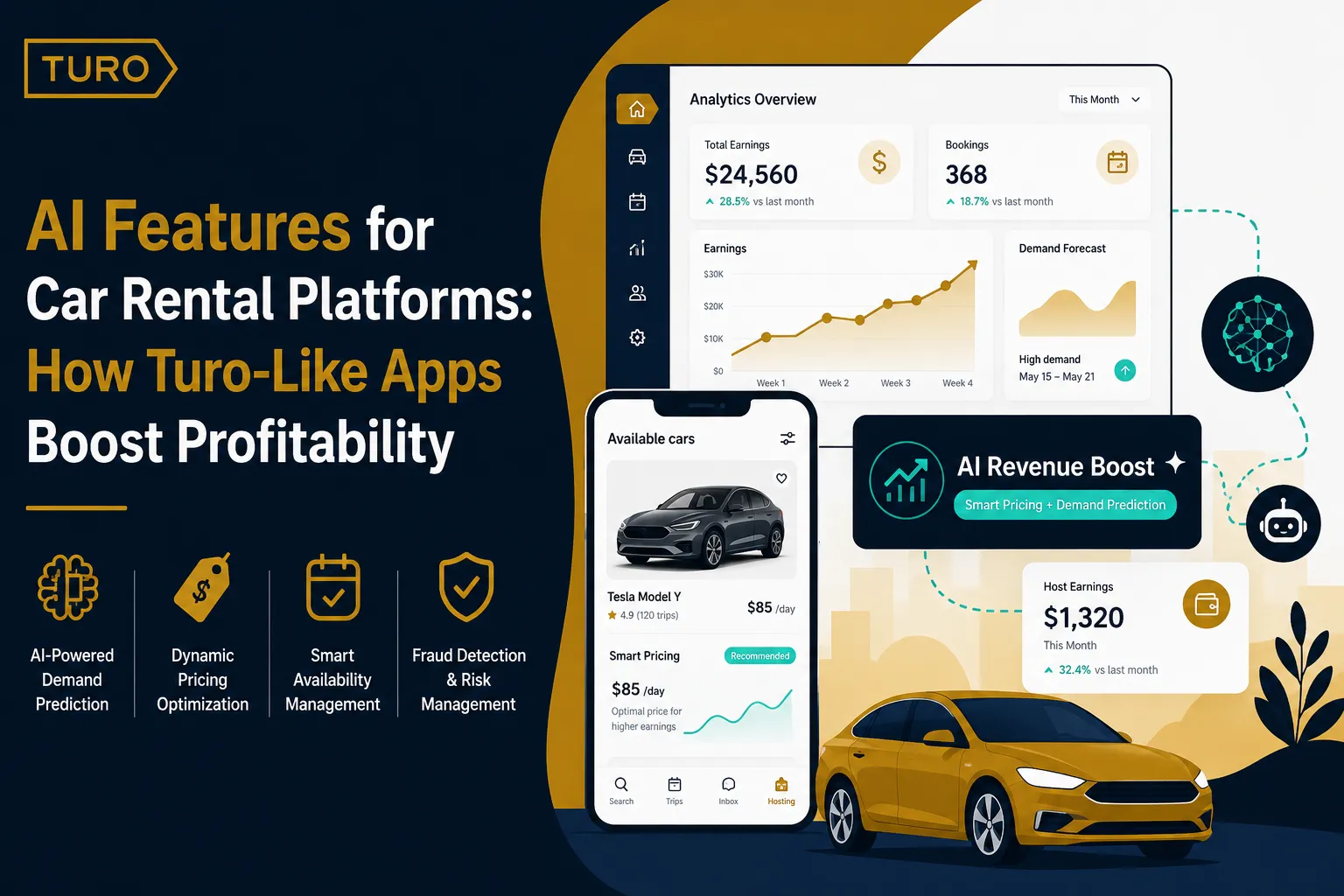
AI features for car rental platforms are no longer only about automation. For founders building Turo-like peer-to-peer car rental marketplaces, AI can directly influence pricing, host earnings, renter trust, vehicle utilization, damage dispute handling, and marketplace profitability.
Traditional car rental software usually focuses on inventory, bookings, payments, and fleet control. A Turo-like platform is different. It connects vehicle owners with renters, which means the business must manage two sides of the marketplace: hosts who want better earnings and renters who want safe, reliable, fairly priced vehicles.
That is where AI becomes a profit engine. It can suggest smarter rental prices, identify high-demand locations, detect risky renter behavior, support digital vehicle inspections, improve host recommendations, and help admins monitor marketplace health from one dashboard.
For founders planning to build a peer-to-peer rental marketplace, an AI-ready Turo clone platform can help combine vehicle listings, booking flows, host dashboards, dynamic pricing, KYC, GPS tracking, and admin controls in one connected system. Miracuves’ Turo Clone page already highlights real-time booking, dynamic pricing, secure identity verification, owner and renter profiles, admin control, and peer-to-peer vehicle sharing as core platform capabilities.
This guide explains which AI features matter most, how they improve profitability, and how founders should prioritize AI modules while building a scalable car rental marketplace.
Why AI Matters More in Turo-Like P2P Car Rental Platforms
AI works differently in a peer-to-peer car rental marketplace than in a traditional fleet rental business.
In a traditional rental company, the operator owns or controls most vehicles. Pricing, maintenance, and availability decisions are centralized. In a Turo-like marketplace, the platform must coordinate independent vehicle owners, renters, bookings, payouts, rules, reviews, disputes, and trust signals.
That makes AI more valuable because marketplace success depends on balance. Hosts need fair earning opportunities. Renters need reliable vehicle recommendations. Admins need visibility into risky bookings, poor-performing listings, pricing gaps, idle vehicles, and disputes.
In a Turo-like platform, AI can support:
| Marketplace Area | How AI Helps | Business Impact |
|---|---|---|
| Host pricing | Suggests rental prices based on demand, vehicle type, location, season, and booking patterns | Improves host earnings and platform commission |
| Renter matching | Recommends vehicles based on trip type, budget, location, preferences, and booking history | Improves conversion and user experience |
| Risk control | Flags suspicious bookings, fake documents, payment risks, and unusual user behavior | Reduces fraud and operational loss |
| Damage evidence | Uses image records and inspection workflows to support pre-trip and post-trip checks | Reduces disputes between hosts and renters |
| Vehicle utilization | Identifies idle cars, high-demand zones, and underpriced listings | Helps increase bookings per vehicle |
| Admin decisions | Converts booking, revenue, payout, dispute, and utilization data into dashboard insights | Improves platform control |
This is the key difference: AI should not be added as a decorative feature. It should help the platform operator make the marketplace more liquid, trusted, and profitable.
Why AI Is Becoming Important for Car Rental Profitability
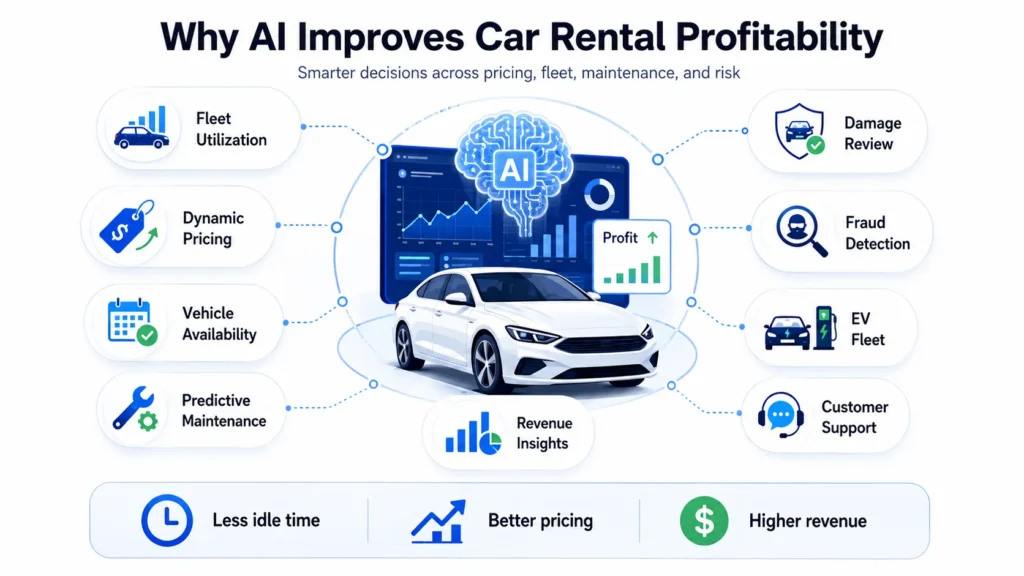
Car rental profitability depends on one simple factor: how well each vehicle is used, priced, maintained, and protected.
When vehicles stay idle, prices remain inaccurate, maintenance gets delayed, or damage disputes increase, the business starts losing revenue from multiple directions. A basic car rental app can manage bookings, vehicles, users, and payments, but it does not always help operators make smarter profit-focused decisions.
AI fills this gap by turning platform data into useful business insights. It studies booking patterns, vehicle usage, customer behavior, payment activity, location demand, maintenance history, and market trends to help rental businesses take better decisions in real time.
Instead of only showing what happened, AI helps predict what should happen next.
AI helps car rental businesses improve:
| Profit Area | How AI Helps |
|---|---|
| Fleet Utilization | Identifies idle vehicles and suggests better allocation to high-demand locations. |
| Daily and Hourly Pricing | Adjusts rental prices based on demand, supply, location, season, and booking time. |
| Vehicle Availability | Helps keep the right cars ready during peak booking periods. |
| Maintenance Planning | Detects early service needs and reduces sudden vehicle downtime. |
| Damage Dispute Handling | Uses inspection data and image records to reduce conflicts between users and operators. |
| Fraud Prevention | Flags suspicious bookings, risky users, fake documents, and unusual payment activity. |
| EV Fleet Management | Tracks battery health, charging cycles, range readiness, and EV availability. |
| Customer Support | Automates common queries related to booking, pickup, cancellation, refunds, and extensions. |
| Repeat Bookings | Improves the rental experience with faster service, smoother pickup, and better recommendations. |
| Revenue per Vehicle | Shows which vehicles are profitable and which ones need better pricing or placement. |
The real value of AI is not just automation. It helps car rental platforms make every vehicle more productive, every booking more profitable, and every operational decision more data-driven.
Read More ; How to Build an App Like Turo: A Developer’s Guide
Smarter Dynamic Pricing for Higher Revenue per Booking
Pricing is one of the biggest profit levers in a car rental business. If prices are too low during high demand, the company loses revenue. If prices are too high during low demand, vehicles remain idle. This is why AI-based dynamic pricing is becoming a powerful feature in modern car rental platforms.
Unlike fixed pricing, dynamic pricing adjusts rental rates based on real-time business conditions. The system studies demand, vehicle availability, location, season, booking behavior, and market activity before suggesting the best possible price.
Key signals used by AI dynamic pricing
| Pricing Signal | How It Affects Rental Price |
|---|---|
| Customer Demand | Higher demand can increase rental rates during peak periods. |
| Vehicle Supply | Limited vehicle availability can raise prices, while excess inventory may trigger discounts. |
| Location | Airport, tourist, business, and city-center locations may have different pricing patterns. |
| Weather | Bad weather or seasonal conditions can influence customer demand. |
| Local Events | Festivals, conferences, sports events, and holidays can increase rental demand. |
| Vehicle Type | SUVs, luxury cars, EVs, and compact cars may require different pricing rules. |
| Booking Time | Last-minute bookings may be priced differently from advance bookings. |
| Rental Duration | Hourly, daily, weekly, and long-term rentals can follow separate pricing logic. |
| Seasonality | Travel seasons, weekends, and holiday periods can affect pricing. |
| Competitor Pricing | Market pricing can help the platform stay competitive. |
| Customer Behavior | Search activity, booking history, and demand patterns can guide better pricing. |
A simple pricing logic can be understood like this:
Rental Price = Function of Demand, Vehicle Supply, Weather Conditions, Local Events, Location, Vehicle Type, and Booking Window
This means the platform does not price vehicles randomly. It uses live and historical data to recommend rental rates that match the current market situation.
For example, if demand increases near an airport during a long weekend, the platform can increase prices for high-demand vehicles. If compact cars are sitting idle in a low-demand location, the system can suggest a limited-time discount to improve bookings.
How dynamic pricing improves profitability
Dynamic pricing helps car rental businesses increase revenue during peak demand and improve utilization during slower periods. It also reduces the need for manual price updates, giving admins more control with less effort.
A strong dynamic pricing dashboard can help admins:
- Set minimum and maximum price limits
- Approve or automate AI price suggestions
- Create weekend, holiday, and seasonal pricing rules
- Track location-wise demand
- Compare revenue by vehicle category
- Monitor booking conversion after price changes
- Identify vehicles that need promotional pricing
- Protect margins during high-demand periods
The main benefit is better pricing control. Instead of using one fixed rate for every situation, rental businesses can adjust prices intelligently and improve revenue per booking.
Marketplace Utilization Intelligence That Reduces Idle Host Vehicles
Marketplace utilization is a key profit driver for Turo-like car rental platforms. Every listed vehicle should spend more time on paid bookings and less time sitting idle. When host-owned cars remain unused, hosts earn less and the platform loses potential commission revenue.
AI helps platform operators track booked days, idle time, revenue per vehicle, vehicle category demand, location-wise demand, cancellations, and renter preferences. This shows which listings need better pricing, promotion, availability, or visibility.
For example, if SUVs get more bookings near tourist areas while compact cars stay idle in business districts, AI can suggest pricing changes or targeted promotions.
AI can help operators:
- Discount idle vehicles
- Increase prices for high-demand cars
- Promote underused listings
- Improve host availability planning
- Identify locations with stronger renter demand
- Prepare supply for weekends, events, and holidays
The value is simple: AI turns marketplace data into action. It helps reduce idle listings, improve host earnings, increase renter choice, and grow platform commission revenue.
Read More : Business Model of Rentalcars : Complete Strategy Breakdown 2026
Predictive Maintenance That Prevents Revenue Loss
Vehicle downtime directly affects car rental profitability. When a car is unavailable during peak demand, the business loses possible bookings. If a vehicle breaks down during an active rental, it can also lead to refunds, complaints, replacement requests, support workload, and poor customer reviews.
Predictive maintenance helps rental businesses avoid these problems before they become expensive. Instead of waiting for a vehicle to fail, AI studies vehicle data and usage patterns to identify early warning signs.
What AI Checks for Predictive Maintenance
| Vehicle Data Point | Why It Matters |
|---|---|
| Mileage | Helps track when a vehicle may need service based on distance covered. |
| Trip Frequency | Shows how often the vehicle is being used and how quickly wear may increase. |
| Engine Diagnostics | Detects possible technical issues before they become major failures. |
| Service History | Helps predict future maintenance needs based on past repairs. |
| Driving Behavior | Identifies harsh braking, overspeeding, or rough driving patterns that may affect vehicle health. |
| Fuel Usage | Unusual fuel consumption can indicate engine or performance issues. |
| Battery Health | Helps avoid sudden battery failure, especially for EVs and frequently used vehicles. |
| Tire Condition | Supports timely tire inspection, replacement, and safety checks. |
| IoT Sensor Data | Provides real-time information from connected vehicle systems. |
| Breakdown History | Helps identify vehicles that may require deeper inspection or replacement planning. |
Based on these signals, the platform can alert admins when a vehicle may need inspection, servicing, cleaning, battery checks, tire replacement, or repair.
How Predictive Maintenance Supports Profit
Predictive maintenance helps rental companies keep more vehicles ready for booking. It also allows teams to schedule servicing during low-demand periods instead of losing revenue during peak booking hours.
This improves:
- Vehicle availability: More cars remain ready for customer bookings.
- Customer satisfaction: Users are less likely to face breakdowns or vehicle issues.
- Booking reliability: The platform can reduce last-minute cancellations caused by vehicle problems.
- Maintenance planning: Service tasks can be planned before they become urgent.
- Repair cost control: Early detection can reduce expensive emergency repairs.
- Fleet life cycle management: Operators can decide when to repair, replace, or retire vehicles.
The main benefit is simple: predictive maintenance protects revenue by keeping vehicles active, reliable, and ready for demand.
AI-Based Vehicle Inspection to Reduce Damage Disputes
Damage disputes are a common challenge in car rental businesses. Customers may claim that a scratch or dent was already present before the rental. Operators may struggle to prove when the damage actually happened. Manual inspections also take time and can create unnecessary conflict.
AI-based vehicle inspection solves this by using image recognition and computer vision to compare vehicle condition before and after each rental. It creates a clearer record for both the customer and the rental company.
What a Strong AI Inspection System Can Include
| Inspection Feature | Why It Matters |
|---|---|
| Pre-Rental Photo Upload | Captures the vehicle condition before the customer starts the trip. |
| Guided Vehicle Walkaround | Helps users record the car from required angles for complete inspection. |
| AI-Based Damage Detection | Identifies visible scratches, dents, paint marks, broken lights, or glass damage. |
| Timestamped Image Records | Creates proof of when each image or video was uploaded. |
| Before-and-After Comparison | Helps compare vehicle condition at pickup and return. |
| Admin Review Panel | Allows the team to review flagged damage before taking action. |
| Customer Dispute History | Keeps records of past claims, disputes, and resolutions. |
| Repair Cost Documentation | Helps connect damage records with repair estimates or invoices. |
The system can detect visible scratches, dents, broken lights, glass damage, paint marks, and other external issues. This helps reduce false claims and makes the inspection process more transparent.
How AI Inspection Protects Revenue
AI-based inspection helps rental businesses reduce disputes, speed up vehicle checks, and protect asset value. It also improves customer trust because both sides can see clear evidence of vehicle condition.
This is especially useful for:
- Self-drive car rental platforms
- Peer-to-peer car sharing apps
- Airport car rentals
- Luxury car rental services
- EV rental platforms
- Long-term vehicle subscription platforms
The main advantage is transparency. AI inspection gives rental companies better control over damage claims while giving customers a fairer and more reliable rental experience.
Demand Forecasting That Helps You Place Cars Before Demand Peaks
Car rental demand changes quickly across cities, airport zones, tourist areas, business districts, seasons, weekends, weather conditions, and local events. If a rental company waits until demand has already increased, it may lose bookings because the right vehicles are not available in the right place.
AI demand forecasting helps rental platforms prepare in advance. It studies historical booking behavior, real-time search activity, location demand, and external demand signals to predict where vehicles will be needed and which vehicle categories may perform better.
Demand Signals AI Can Analyze for Better Fleet Planning
AI can study multiple data points to forecast upcoming rental demand, such as:
- Historical booking data
- Local events and festivals
- Airport traffic and arrival patterns
- Tourism trends
- Hotel and travel demand
- Weekend and weekday booking behavior
- Weather conditions
- Customer search activity
- Seasonal demand changes
- Location-wise booking history
For example, if airport demand is expected to rise during a holiday period, the platform can suggest moving more vehicles near the airport before bookings increase. If SUVs usually perform better in tourist areas during weekends, the business can prepare inventory earlier instead of reacting late.
How Demand Forecasting Improves Car Rental Profitability
Demand forecasting helps rental companies plan with data instead of guesswork. It improves vehicle availability, pricing, inventory movement, and revenue predictability.
| Forecasting Benefit | Business Impact |
|---|---|
| Better Vehicle Availability | Keeps the right vehicles ready in high-demand areas. |
| Higher Booking Conversion | Reduces lost bookings caused by unavailable cars. |
| Lower Idle Time | Moves vehicles toward locations where demand is expected. |
| Smarter Pricing Decisions | Helps adjust prices before demand peaks. |
| Better Marketing Campaigns | Promotes vehicle categories based on expected demand. |
| Improved Location Planning | Shows which areas need more fleet support. |
| Stronger Revenue Forecasting | Helps estimate upcoming bookings and earning potential. |
The main value is preparation. A platform without forecasting reacts late, while a platform with AI forecasting prepares before demand peaks.
AI Fraud Detection and KYC That Make Rentals Safer
Car rental platforms deal with high-value assets, so weak verification can create serious business risks. Fake users, stolen vehicles, payment fraud, identity misuse, chargebacks, and insurance problems can directly affect profitability and brand trust.
AI fraud detection helps rental platforms identify risky users and suspicious bookings before they create losses. Instead of manually checking every booking, the system can review user behavior, document details, payment activity, device signals, and booking patterns to detect possible risk.
Risk Signals AI Can Review Before Approving a Booking
AI can analyze different fraud signals during registration, booking, payment, and pickup.
- Fake or mismatched documents
- Suspicious payment activity
- Multiple failed payment attempts
- New users booking premium vehicles
- Device and location mismatch
- Repeated cancellations
- High-risk pickup locations
- Unusual booking frequency
- Abnormal user behavior
- Multiple accounts using similar details
Biometric KYC Checks That Make Rentals Safer
Biometric KYC adds another security layer before giving users access to expensive vehicles. It helps confirm that the person booking the vehicle is genuine and matches the submitted documents.
A strong KYC flow can include:
- Driving license verification
- Face matching
- Selfie authentication
- Document authenticity checks
- Phone and email verification
- Risk-based user scoring
- Manual review for high-risk users
How AI Reduces Risk in P2P Car Rentals
Risk control is one of the biggest differences between a basic car rental app and a scalable peer-to-peer marketplace.
In P2P car rental, the platform must protect hosts, renters, payments, vehicles, and brand reputation. AI can help by turning platform behavior into risk signals.
AI can support risk control through:
| Risk Area | AI-Supported Signal | Admin Use Case |
|---|---|---|
| Fake renter profiles | Mismatched identity details, repeated failed verification, unusual sign-up behavior | Send profile for manual review |
| Payment risk | Failed payments, suspicious card behavior, refund abuse patterns | Hold booking or request additional verification |
| Vehicle misuse | GPS alerts, late returns, unusual trip behavior, mileage anomalies | Notify admin or host |
| Damage disputes | Before-and-after inspection records, image comparison, trip evidence | Support faster dispute review |
| Host quality issues | Repeated cancellations, poor ratings, inaccurate listings | Flag host account for review |
| Booking abuse | Multiple short bookings, location mismatch, unusual cancellation behavior | Detect potential fraud or platform misuse |
AI should support the admin team, not replace operational judgment. Final action should depend on platform rules, local laws, insurance terms, and manual review where needed.
AI in Traditional Car Rental Software vs Turo-Like Marketplaces
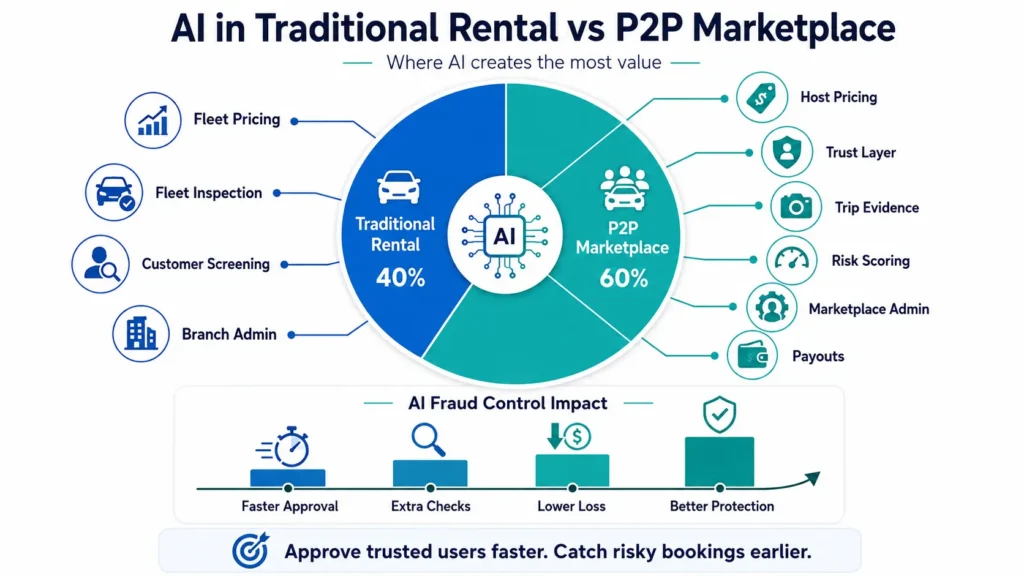
| Area | Traditional Car Rental Software | Turo-Like P2P Marketplace |
|---|---|---|
| Vehicle ownership | Company-owned or centrally managed fleet | Vehicles listed by individual owners, partners, or local suppliers |
| Pricing control | Mostly controlled by rental company | Hosts may need pricing guidance, admin rules, and marketplace-wide pricing logic |
| Trust challenge | Customer-to-company trust | Host-to-renter, renter-to-host, and user-to-platform trust |
| AI pricing value | Helps improve fleet revenue | Helps improve host earnings, renter conversion, and platform commission |
| Inspection workflow | Internal fleet inspection | Pre-trip and post-trip evidence for host-renter disputes |
| Risk control | Customer screening and payment checks | Renter scoring, host quality checks, payment risk, damage claims, and booking abuse |
| Admin dashboard | Fleet, branches, bookings, maintenance | Hosts, renters, commissions, disputes, listings, payouts, and marketplace liquidity |
This comparison helps differentiate the Miracuves blog from generic AI car rental articles and strengthens relevance for Turo clone buyers.
How Fraud Control Improves Car Rental Profitability
Fraud does not only create direct financial loss. It also increases admin workload, customer support issues, insurance pressure, legal complications, and brand risk. For a car rental startup, even one major fraud case can affect both profit and customer confidence.
AI risk scoring creates a safer and smoother booking process. Genuine users can move quickly, while suspicious bookings can be sent for manual review.
This creates a better balance:
- Genuine users get a faster booking experience.
- Risky users face extra verification checks.
- Admins focus only on high-risk cases.
- Fraud-related losses are reduced.
- Vehicles and payments stay better protected.
- Insurance and dispute risks become easier to manage.
The main value of AI fraud detection is protection. It helps rental businesses approve trusted customers faster while reducing financial loss, asset misuse, and operational damage.
EV Fleet Intelligence That Keeps Electric Rentals Ready for Every Trip
Electric vehicles are becoming a strong part of modern car rental and mobility businesses. But EV rentals need more planning than petrol or diesel vehicles. A rental company must know whether the vehicle is charged, healthy, available, and suitable for the customer’s trip before assigning it.
AI-powered EV fleet intelligence helps rental platforms manage battery health, charging schedules, route suitability, and vehicle readiness. This reduces low-battery issues, charging delays, poor vehicle allocation, and customer complaints.
What an EV Rental Platform Should Track
| EV Data Point | Why It Matters |
|---|---|
| Battery Health | Helps identify battery performance issues before they affect bookings. |
| Charging Status | Shows whether the vehicle is ready, charging, or unavailable. |
| Charging Cycle History | Helps monitor long-term battery usage and degradation. |
| Driving Range | Ensures the vehicle can complete the customer’s planned trip. |
| Charging Station Access | Helps match rentals with nearby or route-based charging options. |
| Charging Time | Helps estimate when the EV will be ready for the next booking. |
| Energy Cost | Supports better cost control for EV fleet operations. |
| Route Suitability | Checks whether the selected EV is suitable for short or long-distance trips. |
| Vehicle Readiness | Confirms whether the EV is fit for assignment before booking confirmation. |
For example, a short city rental may not need a fully charged premium EV. But a long-distance booking should only be assigned to a vehicle with enough range, battery health, and charging readiness.
IoT and Keyless Access That Make Pickup and Return Faster
Modern rental customers want speed and convenience. They do not want long paperwork, manual key handovers, or slow pickup counters. IoT and keyless access make the rental journey faster by allowing users to book, verify, pay, unlock, and start their rental through the mobile app.
This creates a smoother experience for customers and reduces manual dependency for the rental business.
What Connected Vehicle Systems Can Track
Connected car systems give rental operators better control over vehicle movement, usage, and safety.
They can track:
- Vehicle location
- Fuel or battery level
- Lock and unlock status
- Trip start and end time
- Vehicle movement
- Speed alerts
- Emergency events
- Return status
- Unauthorized movement
- Late return activity
Where Keyless Access Adds Business Value
| Use Case | Business Benefit |
|---|---|
| Airport Rentals | Customers can pick up cars faster without waiting at counters. |
| Self-Drive Rentals | Users can unlock and start vehicles directly through the app. |
| Corporate Rentals | Employees can access approved vehicles with less admin involvement. |
| Subscription Rentals | Long-term users get a smoother vehicle access experience. |
| Peer-to-Peer Car Sharing | Owners and renters do not need to meet physically for every handover. |
| Late-Night Bookings | Vehicles can be accessed outside normal office hours. |
| Early-Morning Returns | Customers can return cars without depending on staff availability. |
How Keyless Access Improves Utilization
Keyless access reduces the time required for pickup and return. Vehicles can move faster from one booking to the next, which improves fleet turnaround and utilization.
It helps rental businesses:
- Reduce counter dependency
- Speed up customer onboarding
- Improve vehicle turnaround time
- Support 24/7 rental operations
- Reduce staff workload
- Improve repeat bookings
- Offer a more modern rental experience
When customers can complete the rental journey without friction, they are more likely to book again.
Which AI Features Should a Founder Add First?
Not every AI feature needs to be launched on day one. A smarter approach is to start with AI features that affect revenue, trust, and operational control first, then add advanced modules as booking volume grows.
| AI Feature Priority | Feature | Best Stage | Why It Matters |
|---|---|---|---|
| Launch must-have | Dynamic pricing rules | First market version | Helps hosts and admins avoid underpricing or overpricing vehicles |
| Launch must-have | Renter verification and risk flags | First market version | Protects hosts, vehicles, payments, and platform trust |
| Launch must-have | Admin revenue and utilization dashboard | First market version | Helps operators monitor bookings, commissions, idle vehicles, and payout flow |
| Growth-stage | AI vehicle recommendations | After user behavior data grows | Improves renter experience and booking conversion |
| Growth-stage | Damage inspection support | After active booking volume increases | Reduces disputes and strengthens host confidence |
| Growth-stage | Demand forecasting by location | After multiple zones or cities are active | Helps identify where supply and pricing need adjustment |
| Advanced add-on | Predictive maintenance | When fleet or host inventory becomes larger | Helps reduce downtime and protect vehicle availability |
| Advanced add-on | EV range and charging intelligence | When EV listings become meaningful | Supports EV readiness, charging planning, and range confidence |
| Advanced add-on | Automated dispute intelligence | When dispute volume grows | Helps admins review evidence faster and resolve cases with better context |
For most founders, the goal should not be to build every AI module immediately. The stronger decision is to launch with a reliable car rental marketplace foundation, validate demand, and then layer AI around pricing,
AI Chatbots for Booking, Damage Reports, and Host Support
As a Turo-like car rental platform grows, many support questions become repetitive: cancellations, rental extensions, pickup instructions, refunds, payment issues, late returns, and damage reporting. AI chatbots can answer these questions instantly, helping renters and hosts get quick guidance without waiting for a support agent.
For car rental marketplaces, chatbots can assist with:
- Booking changes and rental extensions
- Pickup, drop-off, and document instructions
- Refund, payment, deposit, and invoice questions
- Late return, mileage, insurance, and fuel policy queries
- Vehicle damage reporting with required images and details
The business value is simple: faster support reduces booking drop-offs and lowers manual workload. Human agents can focus on complex disputes, payment issues, host complaints, and high-risk cases, while AI handles routine support at scale.
Personalized Search and Smart Upselling That Increase Booking Value
A generic vehicle listing can make users confused and slow down the booking journey. AI-powered personalization helps customers find the right vehicle faster by showing options that match their trip needs, budget, location, and past behavior.
Instead of showing the same vehicle list to every user, the platform can personalize search results based on customer intent.
What AI Uses to Recommend the Right Vehicle
The platform can personalize vehicle suggestions using:
- Trip type
- Past bookings
- Pickup location
- Budget range
- Group size
- Preferred vehicle type
- Rental duration
- Add-on history
- Search behavior
- Travel purpose
- Weekend or weekday pattern
For example, a business traveler may see premium sedans first. A family user may see SUVs or larger vehicles. A budget-focused customer may see compact cars with offers. A long-distance traveler may see vehicles with better mileage or EVs with stronger range.
Personalization Examples in a Car Rental Platform
| User Intent | AI Recommendation |
|---|---|
| Business Travel | Premium sedan, airport pickup, invoice support, quick checkout. |
| Family Trip | SUV, child seat add-on, extra luggage space, insurance package. |
| Budget Rental | Compact car, discount offer, limited-time deal, fuel-efficient option. |
| Long-Distance Trip | Comfortable sedan or SUV, extra mileage plan, roadside assistance. |
| EV Rental | EV with enough range, charging package, route-ready vehicle. |
| Weekend Travel | Popular weekend vehicles, early booking offer, flexible return option. |
How Smart Upselling Improves Revenue
Personalized search improves conversion because users see vehicles that match their needs faster. It can also increase average booking value through relevant add-ons.
The system can recommend:
- Insurance add-ons
- Child seats
- Extra mileage plans
- EV charging packages
- Premium vehicle upgrades
- Long-term rental offers
- Subscription plans
- Roadside assistance
- Additional driver option
- Flexible cancellation package
The benefit is simple: customers get a better-fit rental experience, and the platform gets more opportunities to increase revenue without making the upsell feel forced.
AI Fleet Dashboard for Better Business Decisions
A strong car rental platform should not only collect data. It should help the business understand what to do next.
An AI-powered fleet dashboard can show:
- Best-performing vehicles
- Underused vehicles
- Revenue per vehicle
- Idle time
- Maintenance cost
- Location-wise demand
- Booking cancellation rate
- Customer preference trends
- Peak booking hours
- Vehicle category performance
This helps business owners identify where profit is coming from and where money is being lost.
What a Smart Dashboard Should Recommend
A useful AI dashboard can suggest actions like:
- Move vehicles to better-performing locations
- Increase pricing for high-demand categories
- Offer discounts on idle cars
- Review vehicles with high repair costs
- Add more inventory in profitable zones
- Promote premium vehicles during high-demand periods
- Improve availability during weekend or airport demand
This gives rental companies better control over growth and operations.
AI Feature Impact Summary
| AI Capability | Business Problem It Solves | Profitability Impact |
|---|---|---|
| Dynamic Pricing | Fixed rates and missed peak revenue | Better revenue per booking |
| Fleet Utilization Intelligence | Idle vehicles and poor allocation | Higher vehicle usage |
| Predictive Maintenance | Unexpected downtime | Fewer lost bookings |
| Demand Forecasting | Poor location planning | Better availability and pricing |
| Vehicle Inspection | Damage disputes | Lower dispute and repair losses |
| Fraud Detection and KYC | Fake users and risky bookings | Safer rentals and fewer losses |
| EV Fleet Intelligence | Charging and range issues | Better EV readiness |
| IoT and Keyless Access | Slow pickup and return process | Faster vehicle turnaround |
| AI Chatbots | High support workload | Lower support cost |
| Personalization | Low conversion and weak upselling | Higher booking value |
How to Build AI Into a Car Rental Platform
Building AI into a car rental platform is not just about adding one smart feature. The platform needs a connected foundation where booking, pricing, fleet management, payments, KYC, maintenance, inspections, and reporting work together.
When these systems are connected properly, AI can support better decisions around vehicle availability, rental pricing, fraud control, maintenance planning, and customer experience.
Start with the Core Platform Modules
A complete AI-ready car rental platform should include a customer mobile app, admin dashboard, fleet management panel, and booking management system. These modules help users search vehicles, book rentals, pay online, manage trips, and allow admins to control vehicles, users, payments, and reports.
The platform should also include:
- Dynamic pricing engine
- KYC and document verification
- Damage inspection module
- GPS and IoT integration
- Analytics dashboard
- Security and access control
These modules create the base where AI can read data and support smarter business decisions.
Use a Practical Tech Stack
| Platform Layer | Suggested Technology |
|---|---|
| Web Panels | React.js or Next.js |
| Mobile Apps | Flutter or React Native |
| Backend System | Node.js or Laravel |
| AI/ML Layer | Pricing, forecasting, fraud scoring, and recommendations |
| Cloud Hosting | AWS, Google Cloud, or DigitalOcean |
| Third-Party APIs | KYC, maps, payments, notifications, and analytics |
| Vehicle Data Layer | GPS, IoT, telematics, and connected vehicle APIs |
The real value is not only in the technology stack. It comes from connecting each module properly. Booking data should support demand forecasting, vehicle data should support maintenance alerts, and location demand should support dynamic pricing.
That is what turns a basic car rental app into an AI-ready rental platform.
Implementation Roadmap for AI Car Rental Features
Start with the Core Rental Platform
The first stage should focus on the basic platform foundation.
Important modules include:
- User registration
- Vehicle listing
- Booking flow
- Payment system
- Admin dashboard
- Basic fleet management
- Reviews and support
This gives the business a working rental platform.
Add Smart Operations and Revenue Logic
The second stage should focus on better business control.
Useful modules include:
- Dynamic pricing
- Demand forecasting
- Fleet utilization dashboard
- Maintenance alerts
- Location-wise reporting
- Vehicle performance tracking
This helps improve utilization and pricing decisions.
Build the Trust and Risk Layer
The third stage should focus on security, verification, and dispute reduction.
Important modules include:
- KYC verification
- AI fraud scoring
- Document checks
- Damage inspection flow
- Dispute management
- Risk-based booking review
This protects the platform from fraud and operational loss.
Prepare for Advanced Mobility Growth
The final stage can include future-ready features.
Advanced modules include:
- EV intelligence
- IoT integration
- Keyless access
- Automated pickup and return
- Personalized recommendations
- AI chatbot support
This helps the platform scale with modern mobility trends.
AI features for car rental platforms for Turo-Like app
A Turo-like app succeeds when vehicle owners, renters, and platform admins all benefit from the system. AI should support each side of that marketplace.
1. AI Dynamic Pricing for Hosts and Admins
Dynamic pricing is one of the most direct revenue levers in a car rental marketplace. Instead of forcing hosts to guess daily rental prices, AI can analyze booking demand, location, vehicle type, rental duration, seasonality, events, and availability.
For hosts, this improves earning potential. For renters, it keeps pricing more aligned with demand. For the platform operator, it can improve commission revenue because better pricing often leads to better utilization.
Miracuves’ Turo Clone page already lists dynamic pricing and availability as a core feature, with pricing based on vehicle type, location, rental duration, and demand. The blog should connect this feature directly to AI-powered profitability.
2. AI Renter Risk Scoring and Fraud Detection
Trust is a bigger challenge in P2P car sharing because vehicles are owned by individuals or partners, not always by the platform itself. AI can support renter risk scoring by analyzing identity verification status, booking behavior, payment signals, cancellation patterns, location mismatches, and suspicious activity.
This does not replace manual checks or legal review, but it helps admins prioritize risk. A strong platform should support KYC workflows, secure payment gateway integration, activity logs, admin access controls, and dispute management.
3. AI Damage Inspection and Evidence Records
Damage disputes can damage host trust quickly. AI-supported inspection workflows can help users capture vehicle photos before and after trips, organize inspection records, and highlight visible changes for admin review.
The goal is not to make AI the final judge. The goal is to create better evidence. When hosts and renters know that inspection records are structured, timestamped, and reviewable, the platform becomes more trustworthy.
4. AI Vehicle Recommendations for Renters
A renter searching for a weekend SUV, airport pickup, EV, luxury car, or budget compact does not want to scroll through irrelevant listings. AI recommendations can help match renters with vehicles based on trip duration, location, previous bookings, budget, rating history, and availability.
This improves booking conversion because the platform feels easier to use. It also helps hosts because better matching can increase visibility for relevant listings.
5. AI Host Earnings and Listing Optimization
For vehicle owners, the biggest question is simple: “How can I earn more from my car?”
AI can support hosts by suggesting better listing titles, pricing ranges, availability windows, photo improvements, discount rules, and high-demand booking periods. It can also show which vehicles are underperforming and why.
This is an important section to add because most competitor blogs discuss “fleet owners,” but a Turo-like marketplace depends heavily on individual hosts and vehicle owners.
Step-by-Step Roadmap to Add AI Features in a Car Rental Platform
AI features should be added in phases, not all at once. This helps startups launch faster, control development cost, and add smarter features as the platform grows.
Step 1: Build the Core Rental Platform
Start with the basic rental foundation: user registration, vehicle listing, booking flow, payment system, admin dashboard, basic fleet management, reviews, and support.
This gives the business a working platform where users can search vehicles, book rentals, pay online, and manage their trips.
Step 2: Add Smart Operations
Once the platform is live, add AI features that improve pricing, utilization, and planning. This can include dynamic pricing, demand forecasting, fleet utilization dashboards, maintenance alerts, and location-wise reporting.
This helps the business reduce idle vehicles, improve pricing decisions, and plan fleet availability better.
Step 3: Add Trust and Risk Controls
Next, strengthen the platform with KYC verification, AI fraud scoring, document checks, damage inspection workflows, dispute management, and risk-based booking reviews.
This protects the business from fake users, risky bookings, payment fraud, and damage disputes.
Step 4: Add Advanced Mobility Features
Finally, add future-ready features such as EV intelligence, IoT integration, keyless access, automated pickup and return, personalized recommendations, and AI chatbot support.
This helps the platform deliver faster rentals, better customer experience, and stronger long-term scalability.
How Miracuves Builds AI-Ready Turo Clone Platforms
Miracuves helps founders launch ready-made and white-label car rental marketplace platforms that can be customized around their business model, branding, monetization strategy, and operating rules.
For a Turo-like platform, the foundation matters before advanced AI is added. The platform needs vehicle listings, renter profiles, owner dashboards, booking flows, payments, commissions, availability calendars, admin controls, verification workflows, reviews, notifications, and dispute support. Miracuves’ Turo Clone page positions the solution around peer-to-peer vehicle sharing, secure payment integration, driver verification, real-time booking, dynamic pricing, and admin control.
Once the foundation is in place, AI can be layered into the platform strategically:
| AI Layer | What It Can Improve |
|---|---|
| Pricing intelligence | Host pricing, platform commission, seasonal rates, demand-based adjustments |
| Trust intelligence | Renter risk flags, identity checks, suspicious booking behavior |
| Inspection intelligence | Damage records, photo-based evidence, dispute support |
| Utilization intelligence | Idle listings, high-demand areas, underperforming vehicles |
| Support intelligence | Booking questions, cancellation queries, refund guidance, host onboarding |
| Admin intelligence | Revenue reports, payout trends, disputes, host performance, marketplace health |
Miracuves’ Turo Clone page also lists white-label branding, a 6-day go-live message, 60 days of tech support, complete source codes, rebranding, and app publishing support on the live offer section. For founders, this means the practical path is not to wait months to build every AI feature from scratch. The better route is to launch the marketplace foundation faster, validate demand, and then add AI modules where they create the highest business impact.
Final Thoughts
AI in car rental platforms is not just about adding smart technology. It is about building a better scheduled rental system where every booking, vehicle, pickup, return, inspection, and maintenance task is planned more efficiently.
With AI-powered scheduling, rental businesses can assign the right vehicle to the right customer at the right time. Dynamic pricing helps adjust rates based on scheduled demand, while fleet utilization intelligence reduces idle time between bookings. Predictive maintenance ensures vehicles are serviced before they affect upcoming reservations, and AI vehicle inspection keeps pickup and return schedules smoother with fewer disputes.
For founders and rental operators, the goal is clear: build a car rental platform that does more than accept bookings. Build a system that manages scheduled rentals, vehicle availability, maintenance slots, customer verification, pickup timing, return flow, and revenue opportunities from one smart dashboard.
Miracuves helps startups and rental businesses build AI-powered car rental platforms with scheduled booking flows, fleet calendars, vehicle availability management, admin dashboards, automated reminders, pricing logic, maintenance planning, and advanced AI modules. If you are planning to launch or upgrade a car rental business, Miracuves can help you turn a basic rental app into a smarter, scheduled, and profit-focused mobility platform.
FAQs
What are the most important AI features for a Turo-like car rental platform?
The most important AI features are dynamic pricing, renter risk scoring, fraud detection, vehicle recommendations, damage inspection support, demand forecasting, and admin revenue dashboards. For a Turo-like platform, AI should improve host earnings, renter trust, booking conversion, and marketplace control.
How does AI dynamic pricing help car rental platforms?
AI dynamic pricing helps adjust rental rates based on demand, vehicle type, location, rental duration, seasonality, availability, and booking behavior. This can help hosts avoid underpricing during peak demand and reduce idle listings during slower periods.
Why is AI useful for peer-to-peer car rental marketplaces?
AI is useful because P2P car rental platforms need to manage hosts, renters, vehicles, payments, disputes, reviews, and risk signals at the same time. AI can help identify pricing gaps, risky bookings, low-performing listings, and inspection issues faster than manual review alone.
Can AI reduce damage disputes in car-sharing apps?
AI can support damage dispute handling by organizing pre-trip and post-trip inspection photos, highlighting possible visible changes, and giving admins better evidence for review. It should support human review rather than replace final dispute decisions.
Should founders add every AI feature at launch?
No. Founders should prioritize AI features that directly affect revenue, trust, and control first. Dynamic pricing, renter verification, fraud flags, and admin dashboards are more important at launch than advanced modules like EV intelligence or predictive maintenance.
How does AI help vehicle owners on a Turo-like platform?
AI can help vehicle owners improve pricing, availability, listing quality, booking potential, and earnings visibility. It can suggest better rates, highlight high-demand periods, and show why certain listings are performing better than others.
How can Miracuves help build an AI-ready car rental platform?
Miracuves helps founders build white-label, source-code-owned Turo clone platforms with booking flows, host and renter profiles, admin dashboards, dynamic pricing, verification workflows, and scalable customization options. AI modules can be added based on launch scope and business priorities.