


Key Takeaways
What You’ll Learn
- Car rental software is best for businesses that own or manage their own vehicles.
- A marketplace model is best for platforms connecting vehicle owners with renters.
- Both models need booking, payment, verification, and admin management features.
- The right model affects cost, operations, revenue flow, and platform complexity.
- Long-term success depends on choosing the model that fits your vehicles, users, and business goals.
Stats That Matter
- Fleet rental software focuses on vehicle inventory, pricing, bookings, maintenance, and branch operations.
- Marketplace platforms manage hosts, renters, listings, commissions, payouts, disputes, and approvals.
- Fleet models usually generate direct rental revenue, while marketplaces earn through commissions and service fees.
- Marketplace platforms need stronger verification because both hosts and renters must be checked.
- Development cost depends on user roles, payment flow, admin controls, automation, and scalability needs.
Real Insights
- Fleet software grows stronger when it improves utilization, pricing, and operational control.
- Marketplace platforms grow stronger when they build trust between hosts and renters.
- Hybrid models can work when a business owns vehicles and also allows third-party listings.
- Payment logic is one of the biggest differences between both models.
- The strongest car rental platforms combine smooth booking, secure payments, verification, analytics, and reliable support.
The car rental industry is no longer limited to local rental counters, phone bookings, and manual vehicle records. Today, customers expect to search cars online, compare prices, upload documents, make payments, track bookings, and manage everything from a mobile app.
For business owners and startup founders, this creates one important question:
Should you build car rental software for your own fleet, or should you build a car rental marketplace where multiple vehicle owners can list their cars?
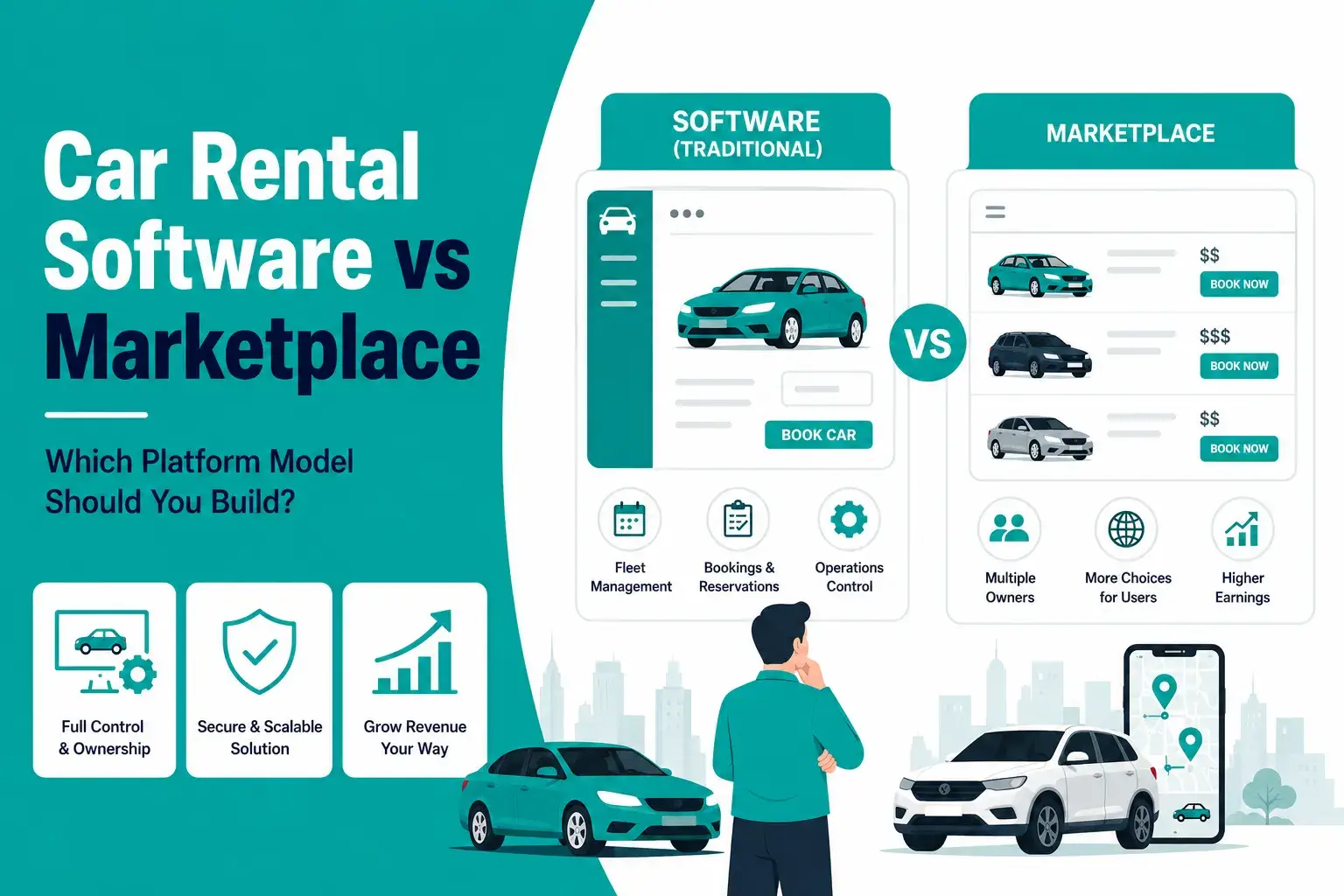
This decision matters because both models look similar from the outside, but they work very differently on the inside. A fleet-based car rental platform focuses on vehicle control, booking management, maintenance, and utilization. A marketplace model focuses on host onboarding, renter verification, commission management, trust, disputes, and scalable supply.
At Miracuves, we help founders and rental businesses choose the right platform model before development starts. The goal is not just to build an app. The goal is to build a rental system that matches your revenue model, operations, launch timeline, and long-term growth plan.
What Is Car Rental Software?
Car rental software is a digital platform built for businesses that own, manage, or operate their own vehicle fleet. It helps rental companies control bookings, vehicle availability, pricing, customer records, payments, documents, maintenance, and reporting from one centralized system.
This model is best for businesses that already have vehicles and want better control over how those vehicles are rented, tracked, priced, and maintained. Instead of handling bookings through phone calls, spreadsheets, or manual records, the business can manage the complete rental workflow through a website, mobile app, and admin dashboard.
A fleet-based car rental platform usually includes a customer app or booking website, admin dashboard, vehicle inventory system, real-time booking calendar, online payment gateway, customer verification, document upload, maintenance tracking, pricing management, revenue reports, and branch management.
The main goal of car rental software is simple: help the business rent more vehicles, reduce idle fleet time, improve booking control, and manage daily operations more efficiently.
This model works well for:
- Local car rental agencies
- Luxury car rental businesses
- Airport rental operators
- Self-drive and EV rental companies
- Corporate or chauffeur-based rental providers
- Multi-branch fleet owners
For example, if a rental business owns 50 cars across two cities, it does not need a full peer-to-peer marketplace from day one. It needs strong fleet control, booking automation, payment handling, customer records, vehicle availability tracking, and utilization reports.
In simple terms, car rental software is built for businesses that want to manage their own fleet under their own brand.
What Is a Car Rental Marketplace?
A car rental marketplace is a digital platform where multiple vehicle owners, hosts, or rental partners can list their cars, and customers can book those vehicles through the platform.
This model is similar to a Turo-style business. The marketplace owner does not need to own every vehicle. Instead, the platform connects vehicle supply with renter demand and earns revenue through commissions, service fees, subscriptions, or listing charges.
A car rental marketplace usually includes a renter app, host or vehicle owner panel, admin dashboard, vehicle listing system, host onboarding flow, renter verification, booking management, commission system, payment split logic, host payout management, ratings and reviews, dispute management, and insurance or damage claim workflows.
The main goal of a car rental marketplace is to scale vehicle supply without purchasing every car directly. This allows founders to grow faster by onboarding third-party vehicle owners, local fleet operators, or rental partners.
This model works well for:
- Startup founders
- Peer-to-peer car rental platforms
- Regional mobility marketplaces
- Vehicle aggregator businesses
- Entrepreneurs who do not own vehicles
- Businesses planning a Turo-like platform
- Rental companies adding third-party inventory
A marketplace can grow faster than a fleet-based rental business because expansion is not limited by owned vehicles. However, it also requires stronger trust systems, host verification, renter screening, payment protection, dispute management, and platform governance.
In simple terms, a car rental marketplace is built for founders who want to create a platform where others list vehicles and renters book them through one branded ecosystem.
Car Rental Software vs Marketplace — Core Difference
The biggest difference is ownership and control.
In car rental software, the business usually controls the vehicles directly. In a marketplace, the platform connects renters with third-party vehicle owners.
| Factor | Car Rental Software | Car Rental Marketplace |
|---|---|---|
| Business Model | Business owns or manages vehicles | Platform connects vehicle owners and renters |
| Inventory Control | Full control | Shared with hosts or partners |
| Revenue Model | Direct rental income | Commission, fees, subscriptions, add-ons |
| Main User Roles | Customer, admin, fleet manager | Renter, host, admin |
| Operational Focus | Fleet utilization and maintenance | Trust, supply, demand, payouts, disputes |
| Scaling Method | Add more vehicles and locations | Add more hosts and renters |
| Payment Flow | Business receives full rental amount | Platform deducts commission and pays host |
| Best For | Rental agencies and fleet owners | Startup founders and marketplace owners |
Both models can be profitable, but they require different planning.
A fleet rental platform needs strong operations. A marketplace rental platform needs strong ecosystem control.
Third-Party Marketplace vs Owning Your Own Rental Platform
Many rental businesses start by listing their vehicles on third-party marketplaces because it gives them quick visibility and access to existing renters. This can be useful in the early stage when the business wants to test demand, generate bookings, and understand customer behavior without building its own platform first.
However, marketplace visibility often comes with dependency. You may receive bookings, but you do not fully control the customer journey, brand experience, pricing strategy, or customer relationship.
Using a Third-Party Marketplace
A third-party marketplace can be helpful when a rental business wants to start quickly with lower setup effort. It may provide existing customer traffic, faster listing setup, built-in discovery, simple booking access, and lower initial technology cost.
But the limitations become clearer as the business grows. Marketplace commissions can reduce profit margins, while limited access to customer data makes repeat marketing harder. The business also depends on platform rules, ranking algorithms, pricing restrictions, and policy changes.
Common limitations include:
- Marketplace commission on bookings
- Limited customer ownership
- Less brand visibility
- Dependency on marketplace ranking
- Restricted pricing flexibility
- Limited access to customer data
- Risk of account suspension or policy changes
For small rental businesses, this model can work well in the beginning. But for long-term growth, relying only on a third-party marketplace can limit brand control, profitability, and customer retention.
Owning Your Own Car Rental Platform
When you own your own car rental platform, you control the complete rental experience. Customers book directly through your website or app, interact with your brand, and stay within your business ecosystem.
This gives you control over your brand identity, customer database, pricing rules, booking policies, payment flow, discounts, offers, customer communication, fleet reports, revenue analytics, and custom terms.
Owning your platform also helps you build long-term business value. Instead of depending on another marketplace for visibility, you can create your own booking channel, run direct marketing campaigns, build repeat customers, and improve margins over time.
For example, a fleet owner can use their own platform to offer loyalty discounts, corporate rental plans, airport pickup packages, monthly subscriptions, or location-based pricing without waiting for third-party marketplace approval.
Miracuves helps founders and fleet businesses move from marketplace dependency to their own branded rental platform with custom booking workflows, mobile apps, admin control, payment integration, fleet management, and scalable backend architecture.
Choosing the Right Car Rental Business Model Before Development
Before building a car rental platform, decide the business model first. Your choice between a fleet-based, marketplace, or hybrid model will affect features, user roles, payment flow, admin dashboard, revenue model, tech stack, and development cost.
Fleet-Based Car Rental Model
A fleet-based model is best for businesses that own, lease, or manage vehicles directly. It helps control bookings, availability, pricing, maintenance, payments, customer records, and branch operations from one system.
This model gives full control over vehicle quality, rental policies, pricing, discounts, and customer experience. However, growth depends on how many vehicles the business can manage and maintain.
It is ideal for rental agencies, luxury car rentals, EV rentals, airport rentals, self-drive businesses, and corporate rental providers.
Marketplace Car Rental Model
A marketplace model is best for founders who want to connect vehicle owners with renters. The platform manages host onboarding, vehicle listings, renter verification, bookings, commissions, payouts, reviews, disputes, and trust rules.
This model scales faster because third-party owners bring the vehicle supply. However, it needs stronger verification, payment protection, listing quality control, and dispute management.
It is ideal for Turo-like platforms, peer-to-peer rental startups, aggregators, and regional mobility marketplaces.
Hybrid Car Rental Model
A hybrid model combines owned fleet bookings with third-party vehicle listings. It gives the business both control and scalability.
This model works well for fleet owners who want to expand into new cities, add rental partners, or grow supply without buying every vehicle. However, it needs clear rules for payments, payouts, refunds, damage claims, and host responsibility.
Quick Decision Guide
Choose fleet-based if you own vehicles and want full operational control.
Choose marketplace if you want hosts to list vehicles and earn through commissions.
Choose hybrid if you want to combine owned vehicles with third-party supply.
For Miracuves, this model decision helps define the right features, tech stack, payment flow, admin dashboard, and launch roadmap.
Key Features of Car Rental Software for Fleet Owners
A fleet-based car rental system should help rental businesses manage vehicles, bookings, customers, payments, maintenance, and daily operations from one centralized dashboard.
For fleet owners, the goal is not only to accept online bookings. The platform should improve vehicle utilization, reduce manual work, prevent double bookings, track vehicle condition, and give the business better control over revenue and operations.
Vehicle Inventory Management to Control the Entire Fleet
Vehicle inventory management is the foundation of fleet rental software. Every car should have a complete digital profile so the admin can easily track availability, pricing, documents, and booking history.
Important inventory features include:
- Add and edit vehicle details
- Upload vehicle images and documents
- Manage fuel type, transmission, seats, mileage, and pricing
- Set vehicle status as available, booked, inactive, or under maintenance
- Track vehicle-wise booking history
A clean inventory system helps rental businesses avoid double bookings, manual confusion, and missed availability updates. It also gives the admin a clear view of which vehicles are ready for booking and which need attention.
Booking and Reservation System to Avoid Manual Errors
The booking system should make vehicle reservations simple for customers and easy to manage for the business. Customers should be able to book vehicles based on date, time, location, and vehicle type.
Important booking features include:
- Hourly, daily, weekly, and monthly bookings
- Real-time vehicle availability
- Pickup and return location selection
- Booking confirmation and invoice generation
- Cancellation, refund, and rescheduling options
For fleet businesses, booking accuracy is very important. One wrong availability update can create customer complaints, operational delays, or double-booking problems. A strong reservation system keeps the entire rental workflow organized.
Fleet Utilization Dashboard to Improve Profitability
Fleet owners need to know which vehicles are generating revenue and which vehicles are sitting idle. A utilization dashboard helps the business make better pricing, maintenance, and fleet expansion decisions.
A useful dashboard can show:
- Active and idle vehicles
- Most-booked vehicles
- Revenue per vehicle
- Revenue per location
- Booking frequency and average rental duration
- Maintenance downtime and cancellation trends
These insights help rental businesses reduce idle time, rotate vehicles better, adjust pricing, and plan future vehicle purchases based on real performance data.
Maintenance and Inspection Management to Protect Vehicle Quality
Vehicle condition directly affects customer experience, repair cost, and long-term profitability. Fleet rental software should help businesses track maintenance and inspections before and after every trip.
Important maintenance features include:
- Service reminders
- Inspection checklists
- Damage reports
- Vehicle condition logs
- Repair history and maintenance cost tracking
- Before-and-after trip photos
This is especially useful for luxury rentals, EV fleets, self-drive rentals, and high-value vehicles. A proper inspection system reduces disputes, protects vehicle quality, and helps the business control maintenance expenses.
Branch and Location Management for Multi-City Operations
If a rental business operates in multiple cities, airports, or service zones, the platform should support location-wise control. This helps owners manage vehicles, pricing, staff, and bookings across different branches.
Useful location features include:
- City-wise vehicle listings
- Branch management
- Airport pickup and return options
- Home delivery zones
- Location-based pricing
- Staff assignment and branch-wise reports
This helps multi-location rental businesses manage operations without depending on spreadsheets or disconnected branch-level records.
Customer Management to Increase Repeat Bookings
A strong customer management module helps rental businesses understand users, manage documents, track booking history, and improve repeat bookings.
Customer management can include:
- Customer profiles
- Booking history
- Uploaded documents
- Payment and refund records
- Support tickets
- Loyalty points
- Notes and risk flags
This gives the business better control over customer relationships. It also helps identify high-value repeat customers and high-risk renters before accepting future bookings.
Why These Features Matter for Fleet Owners
For fleet owners, car rental software should work as an operations control center. It should not only display vehicles and accept bookings. It should help the business manage availability, reduce idle time, protect vehicles, improve customer experience, and track revenue from every vehicle and location.
A well-built fleet rental platform gives owners better visibility, stronger control, and a more scalable way to run their rental business.
Key Features of a Car Rental Marketplace Platform
A car rental marketplace is more complex than fleet-based rental software because it manages vehicle owners, renters, vehicle listings, bookings, payments, reviews, disputes, and platform rules at the same time.
For a marketplace owner, the goal is not only to let users book cars. The platform must create a trusted ecosystem where hosts can list vehicles confidently, renters can book safely, and admins can control quality, payments, and user behavior.
Verified Host Onboarding to Build a Reliable Vehicle Supply
Host onboarding is the first trust layer of a car rental marketplace. The platform should not allow anyone to list vehicles without basic verification. Vehicle owners must be able to register, submit their details, upload documents, and wait for admin approval before their cars go live.
Important host onboarding features include:
- Host registration
- Identity verification
- Vehicle ownership document upload
- Bank or payout details
- Platform agreement acceptance
- Admin approval
This helps the marketplace avoid fake owners, incomplete listings, and trust issues at the early stage. A strong onboarding flow also gives genuine vehicle owners more confidence to list their cars on the platform.
Vehicle Listing Management to Maintain Marketplace Quality
Vehicle listings directly affect booking conversions. If listings have poor images, unclear pricing, missing documents, or incomplete details, renters may not trust the platform.
A good listing system should allow hosts to add complete vehicle details while giving admins control over listing approval and quality.
Important vehicle listing features include:
- Vehicle details and photos
- Rental pricing and availability
- Pickup and delivery options
- Rental rules and restrictions
- Insurance or registration documents
- Admin listing approval
- Listing status control
Clean and verified listings help renters compare vehicles faster, understand rental terms clearly, and make confident booking decisions. This also protects the marketplace from misleading or low-quality vehicle listings.
Renter Verification to Reduce Fraud and Vehicle Risk
Renter verification is essential because users are booking vehicles owned by other people. Without proper checks, the platform may face fraud, payment issues, vehicle misuse, fake profiles, or damage disputes.
A strong renter verification flow can include:
- User registration
- Phone and email verification
- Driving license upload
- Identity verification
- Payment verification
- Security deposit
- Booking history review
For high-value vehicles, luxury cars, EV rentals, or self-drive bookings, renter verification becomes even more important. It protects hosts, reduces risky bookings, and gives the admin better control over marketplace safety.
Smooth Marketplace Booking Flow to Improve Conversions
The booking journey should be simple for renters and manageable for hosts. Users should be able to search, compare, book, pay, and complete the rental process without confusion.
A good marketplace booking flow includes:
- Location-based vehicle search
- Date and time selection
- Vehicle filters
- Vehicle detail page
- Host rules and rental terms
- Instant booking or request-based booking
- Online payment
- Booking confirmation
- Pickup and return instructions
- Review after trip completion
A smooth booking flow reduces drop-offs and support requests. It also helps renters complete bookings faster while giving hosts clear visibility into upcoming trips.
Secure Payment and Payout System to Manage Marketplace Revenue
Payment logic is one of the most important parts of a car rental marketplace. Unlike fleet rental software, the platform must manage money between renters, hosts, and the marketplace owner.
The system should support:
- Renter payments
- Platform commission
- Host payouts
- Cancellation fees
- Refunds
- Promo codes
- Security deposits
- Tax handling
- Payment reports
For example, when a renter pays for a booking, the platform can deduct its commission and release the remaining amount to the host after the trip is completed.
This creates a clear revenue system for the marketplace owner while keeping financial records transparent for hosts and admins.
Ratings, Reviews and Dispute Management to Protect User Trust
Trust decides whether users return to a marketplace or leave after one bad experience. That is why reviews and dispute management should be built into the platform from the beginning.
Important trust and dispute features include:
- Renter reviews
- Host reviews
- Vehicle ratings
- Damage claims
- Late return disputes
- Refund disputes
- Support tickets
- Evidence uploads
- Admin mediation
Reviews help renters choose better vehicles and help hosts understand renter behavior. Dispute tools protect both sides when something goes wrong.
A strong trust layer improves platform credibility, reduces unresolved complaints, and helps the marketplace grow with confidence.
Admin Governance Tools to Control Marketplace Operations
A car rental marketplace needs a powerful admin dashboard because the platform owner must manage both supply and demand. As more hosts, renters, vehicles, and bookings join the platform, manual control becomes difficult.
Admin control should include:
- Host approval
- Vehicle listing review
- Renter verification
- Booking monitoring
- Commission management
- Refund and payout tracking
- Review moderation
- Dispute resolution
- Platform analytics
- Fraud or risk monitoring
Without strong admin control, the marketplace can become hard to manage at scale. For Miracuves, admin-first planning is important because marketplace success depends on operational control, not just app design.
A well-built admin panel helps platform owners scale safely while keeping users, bookings, payments, listings, and disputes under control.
Revenue Model Comparison: How Car Rental Platforms Make Money
The revenue model depends on whether you build fleet-based car rental software or a car rental marketplace. A fleet platform earns directly from owned or managed vehicles, while a marketplace earns by connecting renters with vehicle owners and charging fees around each booking.
Planning this early is important because it affects payment flow, admin reports, commission logic, refunds, deposits, and overall platform architecture.
Fleet-Based Car Rental Revenue Model
Fleet businesses earn directly from the vehicles they own, lease, or manage. Since the business controls the fleet, it also controls pricing, rental packages, discounts, deposits, add-ons, and customer policies.
Common revenue streams include:
- Hourly, daily, weekly, and monthly rental fees
- Long-term leasing and corporate rental plans
- Airport pickup and vehicle delivery fees
- Chauffeur add-ons
- Fuel, late return, and damage charges
- Insurance add-ons
- Premium vehicle upgrades
This model gives the business stronger revenue control because every booking comes directly to the company. It also allows custom packages for tourists, business travelers, airport customers, corporate clients, and long-term renters.
The main advantage is direct revenue control. The main challenge is that growth depends on fleet size, vehicle utilization, maintenance cost, and repeat bookings.
Marketplace Car Rental Revenue Model
A car rental marketplace earns by facilitating bookings between renters and vehicle owners. The platform does not need to own every car. Instead, it manages listings, bookings, payments, commissions, and host payouts.
Common revenue streams include:
- Commission per booking
- Renter service fees
- Host subscription plans
- Featured vehicle listings
- Promoted host profiles
- Insurance markup
- Cancellation fees
- Delivery fee sharing
- Verification fees
- Premium support plans
- Advertisement placements
This model can scale well because revenue grows as more hosts list vehicles and more renters complete bookings. For example, when a renter pays for a trip, the platform can deduct its commission and release the remaining amount to the host after booking completion.
The main advantage is scalable revenue without heavy vehicle ownership. The main challenge is managing host quality, renter trust, payment splits, refunds, disputes, and payout accuracy.
Miracuves Revenue Model Approach
Miracuves helps founders build custom revenue logic based on the platform model, business goals, and monetization strategy.
For a fleet owner, the platform may need direct booking revenue, rental package pricing, branch-wise reports, vehicle-wise earnings, discount rules, damage charges, and maintenance cost tracking.
For a marketplace founder, the platform may need commission settings, host payout logic, renter service fees, security deposits, cancellation rules, refund handling, tax calculation, and payout reports.
For a hybrid platform, the system may need both direct fleet revenue and third-party host payouts inside the same admin dashboard.
Miracuves can help structure revenue workflows for direct rentals, marketplace commissions, host payouts, security deposits, refunds, subscriptions, add-on services, and branch-wise or vehicle-wise reports.
A clear revenue model should be planned before development begins so the platform can manage bookings, commissions, payouts, reports, and customer payments smoothly as it grows.
Read More : AI in Car Rental Platforms: Features That Improve Utilization, Pricing, and Profitability
Feature Comparison: Fleet Rental Software vs Marketplace Platform
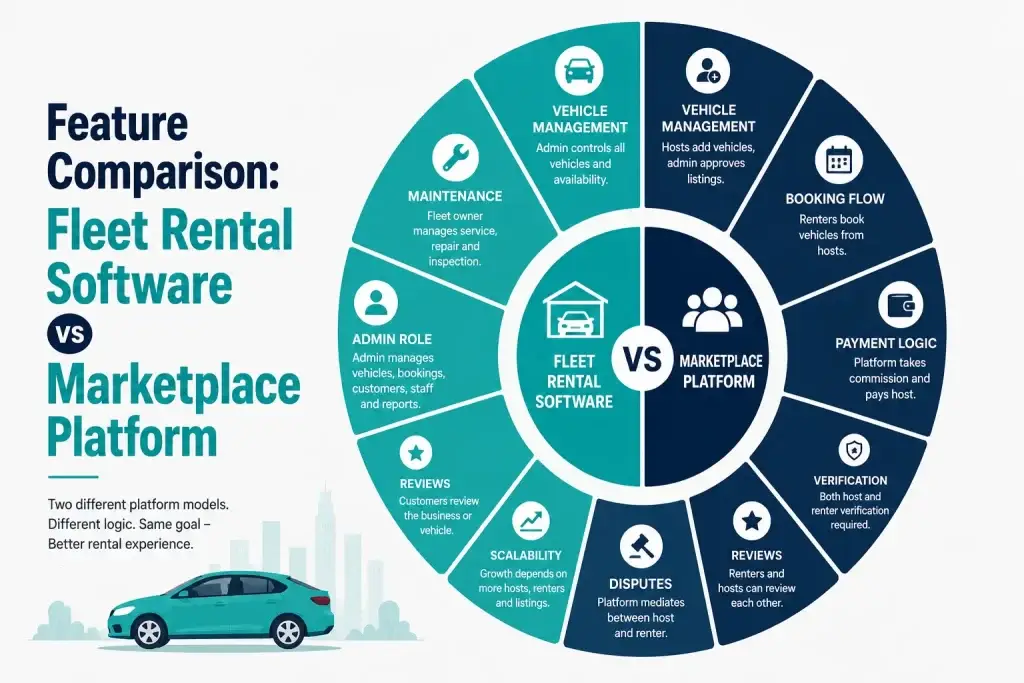
Fleet rental software is built for businesses that own or manage vehicles directly. A marketplace platform is built for businesses that connect vehicle owners with renters. Both need booking and payment features, but their backend logic is different.
| Comparison Factor | Fleet Rental Software | Marketplace Rental Platform |
|---|---|---|
| Vehicle Management | Admin controls all vehicles, pricing, availability, documents, and maintenance status. | Hosts add vehicles, and admin approves or rejects listings. |
| Booking Flow | Customers book directly from the rental business. | Renters book vehicles from hosts through the platform. |
| Payment Logic | Business receives the rental payment directly. | Platform takes commission and releases payout to the host. |
| Verification | Mainly customer verification, such as ID, license, and payment details. | Both host and renter verification are required. |
| Maintenance | Fleet owner manages vehicle service, repair, and inspection. | Host manages maintenance, while platform monitors quality. |
| Admin Role | Admin manages vehicles, bookings, customers, staff, and reports. | Admin manages hosts, renters, listings, commissions, payouts, and disputes. |
| Revenue Tracking | Revenue is tracked by vehicle, branch, location, and booking type. | Revenue is tracked by commission, service fee, host payout, and booking volume. |
| Reviews | Customers usually review the business or vehicle. | Renters and hosts can review each other. |
| Disputes | Business handles customer issues directly. | Platform mediates between host and renter. |
| Scalability | Growth depends on adding more vehicles and branches. | Growth depends on adding more hosts, renters, and listings. |
Cost to Build Car Rental Software vs Marketplace
The cost of building a car rental platform depends mainly on the model you choose. A fleet-based rental system is usually simpler because the business manages its own vehicles. A marketplace platform costs more because it needs renters, hosts, commissions, payouts, verification, reviews, and dispute workflows.
Instead of showing a fixed price, it is better to estimate cost based on platform scope, mobile apps, backend complexity, integrations, customization level, and launch timeline.
Main Cost Factors in Car Rental Platform Development
The final cost depends on how advanced the platform needs to be. A basic booking system costs less, while a full marketplace with apps, payouts, and verification costs more.
Key cost factors include:
- User roles: customer, host, admin, fleet manager, driver
- Platform type: website, mobile app, or both
- Booking logic: hourly, daily, weekly, monthly, or subscription rentals
- Payment setup: online payment, refunds, deposits, commission, and payouts
- Verification: KYC, driving license upload, ID checks, and risk scoring
- Location features: maps, GPS, pickup points, delivery zones, and branches
- Admin dashboard: reports, pricing, users, bookings, and analytics
- Advanced features: AI pricing, damage inspection, loyalty, and automation
- Integrations: payment gateway, maps, SMS, email, CRM, KYC, or insurance APIs
In simple terms, more user roles, payment rules, verification steps, and automation increase the development cost.
Fleet Rental Software Cost Factors
Fleet rental software is built for businesses that own or manage vehicles directly. It focuses on vehicle control, bookings, payments, maintenance, and reporting.
A basic fleet rental system may include:
- Vehicle management
- Booking calendar
- Customer registration
- Payment gateway
- Admin dashboard
- Basic reports
The cost increases when you add features like multi-branch management, advanced maintenance tracking, driver or chauffeur modules, corporate rental accounts, GPS tracking, fleet analytics, mobile apps, automated inspections, and loyalty programs.
Fleet software is usually more affordable than a marketplace because it does not need host onboarding, payout splitting, two-sided reviews, or marketplace dispute handling in the basic version.
Marketplace Platform Cost Factors
A car rental marketplace is more complex because it manages multiple parties: renters, hosts, admins, payments, commissions, and disputes.
A marketplace platform may include:
- Renter app or website
- Host or vehicle owner panel
- Admin dashboard
- Host onboarding
- Vehicle listing approval
- Renter verification
- Payment split and host payouts
- Reviews, ratings, and disputes
- Security deposit and insurance workflow
- Marketplace search and ranking
Marketplace development needs more planning because money, vehicle ownership, trust, and responsibility are shared between different users. That is why payment logic, verification, and dispute workflows must be built carefully from the start.
Fleet Software vs Marketplace Cost Difference
| Cost Area | Fleet Rental Software | Marketplace Platform |
|---|---|---|
| User Roles | Customer, admin, fleet manager | Renter, host, admin, support |
| Vehicle Control | Business manages vehicles | Hosts add vehicles, admin approves |
| Payment Flow | Business receives payment directly | Platform takes commission and pays hosts |
| Verification | Mainly customer verification | Host and renter verification |
| Admin Dashboard | Operations-focused | Marketplace governance-focused |
| Disputes | Business handles directly | Platform mediates between host and renter |
| Complexity | Lower to medium | Medium to high |
| Cost Impact | More affordable for MVP | Higher due to multi-user workflows |
Ready-Made vs Custom vs White-Label Development
Choosing the right development path can control cost and launch time. Each option fits a different business stage.
| Development Option | Best For | Main Benefit | Main Limitation |
|---|---|---|---|
| Ready-Made Solution | Fast MVP launch | Lower risk, faster setup, pre-built modules | Less flexible for unique workflows |
| Custom Development | Complex or large-scale platforms | Full flexibility and advanced features | Higher cost and longer timeline |
| White-Label Platform | Branded launch with faster delivery | Own branding with ready core modules | Deep changes may increase cost |
When to Choose a Ready-Made Car Rental Solution
A ready-made solution is best when speed matters more than deep customization. It helps founders test the market faster with pre-built booking, admin, and app modules.
Choose this when you need:
- Faster market entry
- Lower initial risk
- Pre-built booking flow
- Admin dashboard
- Mobile app base
- Custom branding
This option works well for startups and rental businesses that want to validate demand before investing in advanced custom features.
When to Choose Custom Car Rental Development
Custom development is better when your business needs unique workflows, advanced logic, or long-term scalability.
Choose this when you need:
- Custom booking rules
- Special payment or payout logic
- Advanced integrations
- AI pricing or recommendations
- Multi-country rollout
- Enterprise-level scalability
This option is best for businesses that want full control over platform design, architecture, and future growth.
When to Choose a White-Label Car Rental Platform
A white-label platform is a balanced option between ready-made and fully custom development. It gives you your own brand with faster development than starting from zero.
Choose this when you need:
- Your own brand identity
- Faster launch
- Custom design changes
- Existing core modules
- Admin control
- Mobile app support
This option is useful for rental businesses that want speed, branding, and flexibility together.
Miracuves Cost Approach
Miracuves can support ready-made, white-label, and custom car rental software development based on your budget, timeline, and business model.
For fleet owners, Miracuves can build booking, vehicle management, payments, maintenance, branch control, and reports.
For marketplace founders, Miracuves can build renter apps, host panels, listing approvals, commission logic, payment split, payouts, verification, reviews, disputes, and admin governance.
The goal is to build the right version first, avoid unnecessary features, and create a car rental platform that can scale with your business.
Read More : Business Model of Rentalcars : Complete Strategy Breakdown 2026
Best Tech Stack for Car Rental Software and Marketplace Platforms
The technology stack should match the platform model, expected traffic, feature complexity, and long-term growth plan. A local fleet rental system does not need the same architecture as a high-scale marketplace with hosts, renters, payouts, disputes, and real-time availability.
The right stack should support smooth booking, secure payments, fast search, admin control, mobile performance, and future scalability.
Frontend Technology for Web Platform and Dashboards
The frontend controls what users and admins see on the website, booking pages, dashboards, and marketplace screens.
Common frontend options include:
- React.js
- Next.js
- HTML, CSS, and JavaScript
- Tailwind CSS
- Material UI or custom UI libraries
React.js works well for booking dashboards, vehicle search pages, admin panels, and marketplace interfaces. Next.js is useful when the platform needs SEO-friendly pages, faster loading speed, and better web performance.
For a car rental business, the frontend should make vehicle search, booking, pricing, and payment steps simple for users.
Mobile App Technology for Customer and Host Apps
Mobile apps are important for car rental platforms because users often search, book, upload documents, and manage trips from their phones.
Common mobile app options include:
- Flutter
- React Native
- Native Android
- Native iOS
Flutter is often a practical choice because it supports Android and iOS from one codebase. This can reduce development time and keep the user experience consistent across both platforms.
For fleet rental software, a customer app may be enough in the first version. For a marketplace platform, separate renter and host app flows may be needed.
Backend Technology for Booking, Payments and Admin Control
The backend is the engine of the platform. It manages users, vehicles, bookings, availability, payments, documents, notifications, reports, and admin workflows.
Common backend options include:
- Node.js
- Laravel/PHP
- Go microservices
Node.js is useful for real-time booking, notifications, marketplace workflows, APIs, and scalable user activity.
Laravel/PHP can work well for cost-effective startup platforms with structured admin panels, booking logic, and standard rental workflows.
Go microservices can be considered for enterprise-level platforms that need high concurrency, fast processing, and large-scale operations.
The backend should be selected based on the platform’s complexity, not just popularity.
Database Technology for Vehicle, User and Booking Data
Car rental platforms need structured data for users, bookings, payments, vehicles, and reports. They may also need flexible data storage for listings, documents, images, and activity logs.
Common database options include:
- PostgreSQL
- MySQL
- MongoDB
- Redis
PostgreSQL or MySQL can manage structured records such as users, bookings, payments, invoices, and vehicle details.
MongoDB can support flexible listing data, document-heavy workflows, and marketplace content.
Redis can improve performance for caching, session handling, quick availability checks, and high-speed data access.
A good database setup helps the platform stay fast, reliable, and scalable as bookings increase.
Third-Party Integrations for a Complete Rental Workflow
A car rental platform usually needs integrations to support payments, maps, communication, verification, analytics, and document handling.
Useful integrations include:
- Google Maps or Mapbox for location and pickup/drop-off flows
- Stripe, Razorpay, PayPal, or local payment gateways for transactions
- Twilio for SMS and OTP verification
- WhatsApp notifications for booking updates
- SendGrid for email communication
- KYC verification APIs for identity and license checks
- Cloud storage for vehicle images and documents
- Analytics tools for performance tracking
- CRM tools for lead and customer management
- Insurance or damage claim APIs for risk workflows
These integrations make the platform more useful and reduce manual operational work.
Recommended Stack by Platform Type
| Platform Type | Suggested Stack Direction | Best For |
|---|---|---|
| Basic Fleet Rental Software | Laravel/PHP or Node.js with React.js | Local rental businesses, booking management, admin dashboard |
| Growth-Stage Rental Platform | Node.js, React.js or Next.js, Flutter | Multi-city fleet, mobile apps, real-time booking, analytics |
| Marketplace Rental Platform | Node.js, React.js/Next.js, Flutter, PostgreSQL/MongoDB | Host-renter workflows, commission logic, payouts, reviews, disputes |
| Enterprise Mobility Platform | Go microservices, React.js, Flutter, PostgreSQL, Redis | High traffic, multi-country rollout, advanced performance needs |
Miracuves Tech Stack Approach
Miracuves does not recommend a technology stack only because it sounds modern. The stack should match the business model, budget, performance needs, scalability goal, and development timeline.
For a fleet owner, Miracuves can build a stable platform focused on bookings, vehicle control, payments, maintenance, and reports.
For a marketplace founder, Miracuves can build a scalable system with renter apps, host panels, listing workflows, payment split, commission logic, reviews, disputes, and admin governance.
The right technology stack should help the platform launch efficiently today and scale smoothly as the business grows.
AI Features That Can Improve Car Rental Profitability
Modern car rental platforms can use AI to improve pricing, vehicle utilization, risk control, and customer experience. These features help rental businesses move from manual decisions to data-based operations.
AI Dynamic Pricing for Better Rental Margins
AI dynamic pricing helps adjust rental rates based on real demand signals. Instead of using fixed prices for every day, the platform can suggest better pricing based on season, location, vehicle type, booking duration, weekday or weekend demand, competitor pricing, and last-minute availability.
This helps businesses avoid two common problems:
- Underpricing vehicles during high-demand periods
- Overpricing vehicles during slow booking periods
For fleet owners, dynamic pricing can improve revenue per vehicle. For marketplace owners, it can help hosts set competitive prices and increase booking chances.
Demand Forecasting for Smarter Fleet Planning
Demand forecasting helps predict which vehicles, locations, and dates may receive higher bookings. This is useful for airport rentals, weekend demand, holiday seasons, city-wise supply planning, and promotional campaigns.
AI demand forecasting can help rental businesses:
- Move vehicles to high-demand locations
- Prepare for peak booking periods
- Plan offers during slow periods
- Improve fleet allocation
- Reduce idle vehicle time
For example, if SUVs receive more bookings during holiday weekends, the platform can highlight that trend early so the business can adjust pricing, availability, or promotions.
Fleet Utilization Prediction to Reduce Idle Vehicles
Fleet utilization prediction helps identify which vehicles are performing well and which vehicles are not generating enough bookings.
If one SUV is booked frequently while another similar SUV remains idle, the system can suggest a pricing change, promotional offer, better listing placement, or relocation to a higher-demand area.
This helps fleet owners increase vehicle usage without manually reviewing every vehicle report.
Fraud and Risk Scoring for Safer Rentals
Car rental platforms handle valuable vehicles, identity documents, driving licenses, payment records, and user behavior. AI can help detect risky patterns before they create bigger problems.
AI risk scoring can flag:
- Suspicious bookings
- Duplicate user profiles
- Unusual payment behavior
- Fake or mismatched documents
- Risky renters
- Repeated cancellation patterns
This is especially useful for marketplace platforms where vehicle owners and renters do not always know each other directly.
Smart Vehicle Recommendations for Higher Booking Conversions
AI can recommend vehicles based on user behavior, budget, location, trip type, and previous searches. This helps renters find suitable vehicles faster and improves the chance of booking completion.
For example:
- Family travelers may see SUVs
- Business users may see sedans
- Budget users may see compact cars
- Luxury users may see premium vehicles
- Long-trip users may see fuel-efficient vehicles
Smart recommendations improve customer experience because users do not need to browse too many irrelevant options.
AI Damage Support for Faster Claim Handling
AI can support damage inspection by comparing vehicle images before and after a trip. Admins can still make the final decision, but AI can help organize evidence and identify visible changes faster.
This can help rental platforms:
- Reduce damage disputes
- Support claim reviews
- Maintain vehicle condition history
- Improve transparency between renters and hosts
For luxury rentals, self-drive rentals, EV rentals, and marketplace vehicles, AI damage support can become a strong trust-building feature.
Why AI Matters for Car Rental Platforms
AI features are not only advanced add-ons. They can directly improve revenue, reduce risk, and make operations more efficient.
For fleet owners, AI can help improve pricing, reduce idle vehicles, and protect vehicle quality. For marketplace owners, AI can support fraud detection, host-renter trust, better recommendations, and smoother dispute handling.
A well-planned car rental platform should not only manage bookings today. It should also collect useful data that can support smarter automation as the business grows.
Step-by-Step Roadmap to Build a Car Rental Platform
Building a car rental platform becomes easier when the process is planned in stages. Start with the right model, launch with core features, and improve the platform based on real booking data.
Step 1 — Choose the Platform Model
First, decide whether you want to build fleet rental software, a marketplace platform, or a hybrid car rental platform.
This decision affects the features, user roles, payment flow, admin dashboard, cost, timeline, and tech stack. A fleet platform is built for owned vehicles, while a marketplace platform is built for hosts and renters.
Step 2 — Define User Roles
Next, decide who will use the platform. Keep the first version simple.
For a fleet platform, the main roles may be customer, admin, and fleet manager. For a marketplace, the main roles are usually renter, host, and admin.
Avoid adding too many roles early because every extra role increases development complexity.
Step 3 — Finalize MVP Features
The MVP should focus on the main rental journey: search, book, pay, and manage bookings.
Core features usually include user registration, vehicle listings, search filters, booking calendar, payment gateway, document upload, notifications, and admin dashboard.
For marketplace platforms, host onboarding, listing approval, commission logic, and payout flow should also be included.
Step 4 — Design the Booking Experience
The design should make booking simple and fast. Users should be able to search vehicles, check pricing, view photos, upload documents, pay online, and receive confirmation without confusion.
A clean mobile-first design helps improve conversions and reduces support requests.
Step 5 — Build Backend and Admin Control
The backend should manage vehicle availability, bookings, users, payments, documents, pricing, refunds, reports, and notifications.
The admin dashboard should give the business full control over operations. For marketplace platforms, it should also manage hosts, listings, payouts, reviews, and disputes.
Step 6 — Add Mobile Apps
Mobile apps are useful because many users book vehicles while traveling.
A fleet business may start with a customer app and admin dashboard. A marketplace platform usually needs both renter and host flows.
Step 7 — Set Up Revenue Logic
Payment logic should be planned early because it affects the whole platform.
Fleet platforms usually need direct rental payments, deposits, late fees, damage fees, and add-ons. Marketplace platforms also need commission deduction, host payouts, refunds, and transaction reports.
Step 8 — Launch and Improve
After launch, track bookings, cancellations, revenue per vehicle, idle vehicles, top locations, host quality, repeat customers, refunds, and disputes.
These insights help improve pricing, marketing, fleet planning, and platform performance over time.
Why Choose Miracuves for Car Rental Software Development?
A car rental platform should not be built like a generic booking app. It needs the right business logic, payment flow, admin control, vehicle management, and user experience based on whether you are building for a fleet, marketplace, or hybrid rental model.
Miracuves helps founders, startups, and rental businesses plan and build car rental software that fits their actual operations and growth goals.
What Makes Miracuves Different?
| Area | How Miracuves Helps |
|---|---|
| Business Model Planning | Helps you choose between fleet-based software, marketplace platform, or hybrid rental model. |
| Custom Platform Structure | Builds workflows around your users, vehicles, payments, bookings, and admin needs. |
| Fleet and Marketplace Logic | Supports both owned vehicle operations and host-based rental marketplace models. |
| Scalable Technology | Uses a tech stack that supports current launch needs and future growth. |
| Admin-First Control | Creates dashboards for bookings, users, payments, vehicles, reports, disputes, and operations. |
| Revenue Model Setup | Supports rental fees, commissions, deposits, payouts, add-ons, subscriptions, and promo logic. |
What Miracuves Can Build for You
Miracuves can build a car rental platform for fleet, marketplace, or hybrid rental models.
- White-label car rental software — Launch faster with your own branding and ready core modules.
- Custom car rental marketplace — Let vehicle owners list cars and renters book online.
- Fleet owner platform — Manage vehicles, bookings, payments, maintenance, and reports.
- Turo-like rental app — Build a peer-to-peer rental app with hosts, renters, payouts, and reviews.
- Customer mobile app — Help users search, book, pay, upload documents, and manage trips.
- Host panel — Allow vehicle owners to add cars, set pricing, manage bookings, and track earnings.
- Admin dashboard — Control users, vehicles, payments, refunds, commissions, reviews, and disputes.
- Booking and payment system — Manage availability, deposits, invoices, refunds, and add-on charges.
- KYC and document verification — Verify renters, hosts, licenses, IDs, and vehicle documents.
- Maps and location features — Add pickup points, delivery zones, airport rentals, and branch locations.
- Maintenance tracking — Track service reminders, inspections, damage logs, and vehicle status.
- Analytics and reporting — Monitor bookings, revenue, utilization, host performance, and growth.
Platform Options Based on Your Business Model
| Business Type | Miracuves Platform Focus |
|---|---|
| Fleet Owners | Vehicle inventory, booking control, payments, maintenance, branch management, customer records, and utilization reports. |
| Marketplace Founders | Renter app, host panel, listing approval, commission logic, payouts, verification, reviews, and dispute management. |
| Hybrid Rental Businesses | Owned fleet operations plus third-party vehicle listings, direct rental revenue, host payouts, and marketplace commission logic. |
Why This Matters
Many car rental platforms fail because they are built with features but without a clear operating model. A fleet owner does not need the same system as a marketplace founder. A hybrid rental business needs even more careful planning.
Miracuves focuses on building the platform around your model first, then adding the right features, admin controls, payment logic, and technology stack.
This helps you launch with a cleaner structure, avoid unnecessary complexity, and build a platform that can scale as your rental business grows.
Conclusion
Car rental software and car rental marketplace platforms are built for different business models. If you own or manage vehicles, fleet-based car rental software gives you better control over bookings, pricing, maintenance, customer records, and daily operations.
If you want to build a platform where vehicle owners list cars and renters book through your app, a marketplace model is more suitable. It can scale faster, but it also needs stronger verification, payment logic, reviews, dispute handling, and marketplace governance.
A hybrid model can combine both approaches, but it should be planned carefully because it adds more operational and technical complexity.
For founders and rental businesses looking for long-term control, customer ownership, and scalable growth, building your own branded car rental platform is usually stronger than depending only on third-party marketplaces.
Miracuves can help you choose the right model and build a car rental platform aligned with your business goals, revenue model, and launch strategy.
FAQs
What is the difference between car rental software and a car rental marketplace?
Car rental software is built for businesses that own or manage their own vehicles, while a car rental marketplace connects vehicle owners with renters through a platform. Fleet software focuses on booking control, maintenance, and vehicle utilization, while marketplace software focuses on host onboarding, renter verification, commissions, payouts, and trust management.
Which is better: car rental software or marketplace platform?
Car rental software is better for fleet owners who want full control over pricing, customers, bookings, and operations. A marketplace platform is better for founders who want to scale by allowing third-party vehicle owners to list their cars. The right choice depends on whether you own vehicles or want to build a platform business.
How does a car rental marketplace make money?
A car rental marketplace can make money through booking commissions, renter service fees, host subscription plans, featured vehicle listings, insurance markups, cancellation fees, delivery charges, verification fees, and premium support options.
What features should a car rental platform include?
A car rental platform should include vehicle listings, search filters, booking calendar, online payments, user profiles, document verification, admin dashboard, notifications, reviews, cancellation management, and analytics. Marketplace platforms also need host panels, commission settings, payout management, and dispute handling.
Can Miracuves build a white-label car rental software solution?
Yes, Miracuves can build white-label car rental software for fleet owners, marketplace founders, and hybrid rental businesses. The platform can include customer apps, host panels, admin dashboards, booking systems, payment integration, verification workflows, revenue logic, and custom branding.