Key Takeaways
What You’ll Learn
- Liquidity aggregation improves FX pricing by combining quotes from multiple providers.
- The engine selects the best available route based on price, depth, latency, and execution quality.
- Fast decisions matter because market prices can change within milliseconds.
- Smart order splitting reduces slippage by distributing volume across suitable liquidity sources.
- The main lesson is to benchmark the complete execution path, not only quote speed.
Stats That Matter
- Key metrics include median, p95, and p99 latency for more accurate performance testing.
- The benchmark should measure quote intake, normalization, routing, risk checks, and order submission.
- Useful quality metrics include fill rate, reject rate, slippage, spread improvement, and partial fills.
- Liquidity health must be monitored for stale quotes, disconnects, slow acknowledgements, and price gaps.
- Results depend on test conditions such as providers, order size, market activity, and infrastructure location.
Real Insights
- The best quote is not always the best execution because depth, rejects, and slippage also matter.
- Tail latency can hurt trading quality even when average response time looks fast.
- Routing logic needs constant updates as provider quality changes during different market conditions.
- Observability is essential for tracing each quote, route, risk check, and fill.
- For founders, build an FX liquidity aggregation engine around multi-provider pricing, smart routing, risk control, low latency, and execution analytics.
A Forex broker does not experience liquidity as one clean, synchronized market.
It receives competing price streams from banks, prime-of-prime providers, non-bank market makers, and electronic venues. Each source can publish at a different frequency, use different symbol conventions, expose different depth, and respond with different execution quality. A liquidity aggregation engine must convert that fragmented input into one coherent and executable view without allowing a slow, stale, or malformed feed to distort the broker’s pricing.
That is why the important question is not whether a white-label FX platform “supports multiple liquidity providers.”
The useful question is:
Can the engine ingest, normalize, validate, rank, and route against multiple institutional FIX feeds within a measurable latency envelope under realistic burst conditions?
Liquidity aggregation consolidates prices from multiple sources into a unified order book, potentially giving a broker access to deeper liquidity and more competitive pricing. In fintech app development, this requires a backend capable of managing multiple A-Book liquidity relationships while handling connectivity, aggregation, execution confirmation, and risk-management overhead without disrupting platform performance.
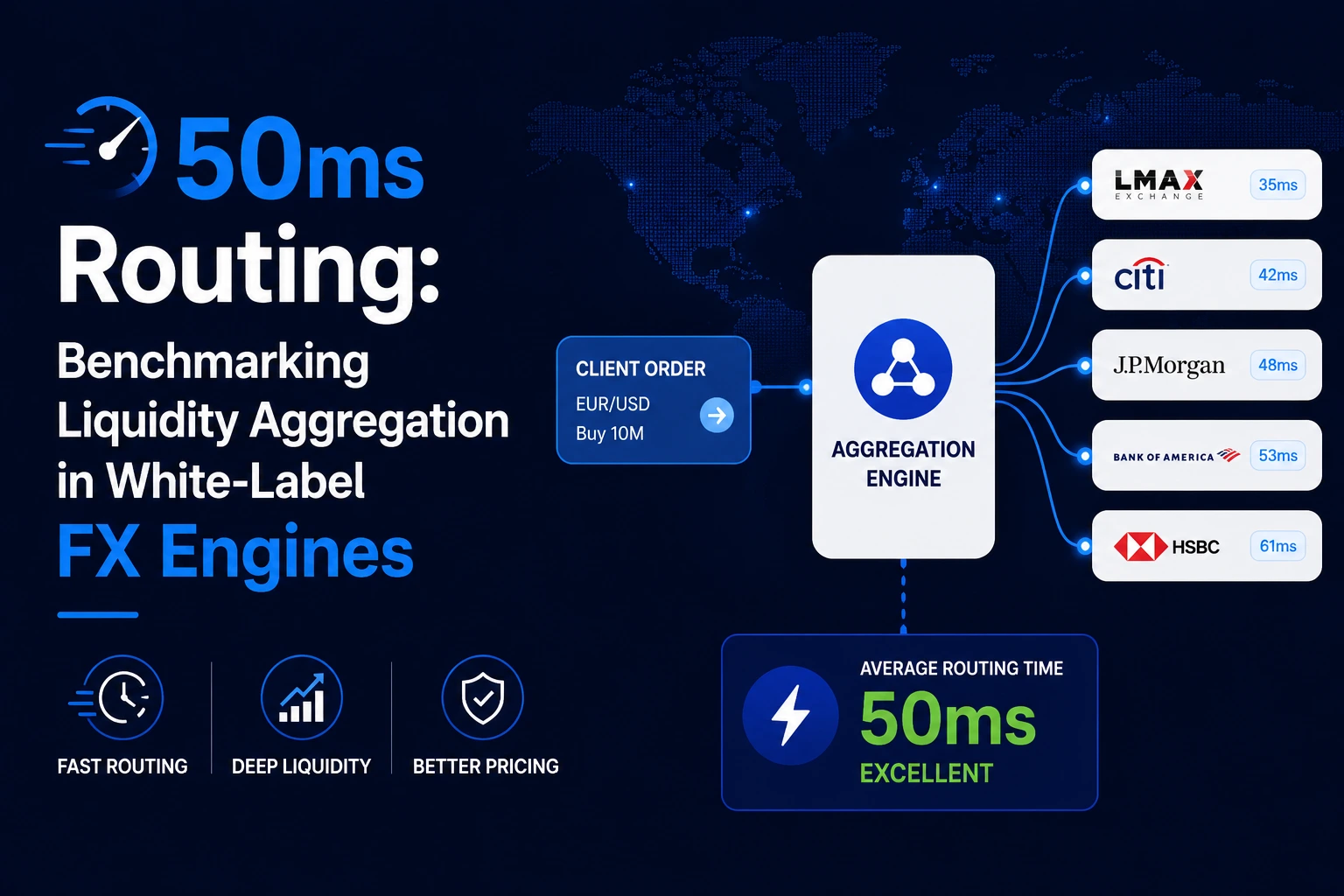
This report defines a benchmark for processing five concurrent FIX market-data feeds and making a dynamic A-Book or B-Book routing decision within a 50ms target envelope.
The 50ms figure should not be read as a universal execution guarantee. Live results depend on network distance, provider response time, hardware, virtualization, message rates, logging, risk rules, and the exact point at which measurement begins and ends.
The Fragmentation Problem: Why Single-Feed Brokers Fail
A single liquidity feed creates a simple architecture, but it also creates a concentrated dependency.
When that provider widens spreads, experiences latency, withdraws depth, rejects orders, or disconnects, the broker has no competing venue inside the routing layer. The issue is not merely price competitiveness. It affects continuity, slippage, fill ratios, and the dealing team’s ability to manage exposure.
A multi-provider environment can improve price discovery by comparing several bid and ask streams. It can also introduce four engineering problems.
1. Provider timestamps are not perfectly aligned
A quote that arrives last is not necessarily the newest quote. Network paths, buffering, session load, and provider-side processing can alter arrival order.
The engine therefore needs at least two notions of time:
- The source or exchange timestamp, where available
- The local high-resolution ingestion timestamp
Without both, the system may select an attractive but stale price.
2. Symbol and precision conventions differ
One provider may publish EUR/USD, another EURUSD, and another may use an internal instrument identifier. Pip precision, minimum quantities, lot increments, and contract metadata can also differ.
Normalization must occur before comparison. Otherwise, the aggregated book is not comparing equivalent instruments.
3. Quote quality differs from displayed price
The apparent best price is not always the best executable outcome.
A provider showing a narrow spread may:
- Offer insufficient depth
- Reject frequently
- Respond slowly
- Apply last look
- Produce excessive negative slippage
- Withdraw liquidity during volatility
A mature aggregator therefore scores more than price. It may consider depth, recency, historical fill quality, rejection behavior, and round-trip latency.
4. One blocked process can contaminate the whole pipeline
If every FIX adapter writes synchronously to the same relational database table, a burst in quote traffic can create lock contention, queue growth, or connection-pool exhaustion.
The safer pattern is to treat the current market state as a latency-sensitive, in-memory data problem and persistence as a separate audit and analytics responsibility.
Modern low-latency trading architectures commonly use event-driven services, in-memory state, distributed caching, message queues, and streaming interfaces to keep real-time processing separate from slower downstream work.
Read more: Don’t Let Bank Fees Kill Your Startup: Learn the Logic of Low-Fee Forex
What the 50ms Benchmark Actually Measures
A latency claim has little meaning unless the start and end points are defined.
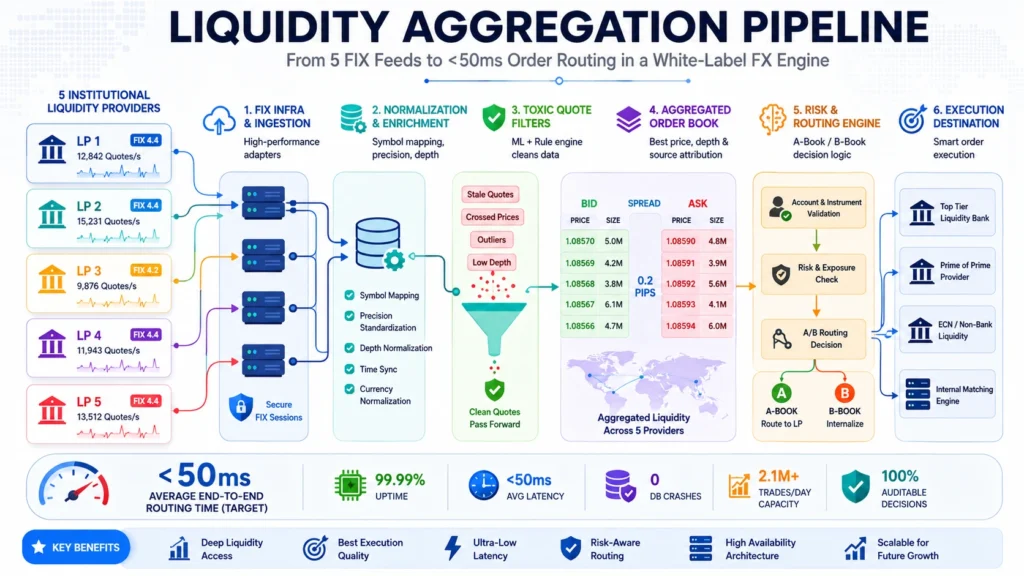
For this benchmark, the proposed measurement boundary is:
T0: Trader order accepted by the internal order gateway
T1: Instrument and account validation completed
T2: Latest normalized liquidity snapshot acquired
T3: Toxic-quote and market-quality filters completed
T4: A-Book/B-Book routing classification completed
T5: Destination or internalization path selected
T6: Order dispatched to the selected execution adapter
The measured routing latency is:
Routing latency = T6 - T0This number does not automatically include:
- Internet latency between the trader and broker
- External liquidity-provider acknowledgement time
- Venue-side matching time
- MetaTrader terminal rendering time
- Banking or settlement processes
- Post-trade regulatory reporting
These exclusions must appear beside any published benchmark. Otherwise, readers may interpret internal routing latency as complete end-to-end execution latency.
The benchmark should report percentiles, not one average
A single mean can conceal severe tail latency.
A credible result set should include:
| Metric | Why It Matters |
|---|---|
| Median or p50 | Typical internal routing performance |
| p95 | Experience during elevated but common load |
| p99 | Tail latency affecting a meaningful minority of orders |
| Maximum | Worst observed event in the test window |
| Jitter | Stability of routing time |
| Timeout rate | Orders exceeding the target envelope |
| Quote reject rate | Percentage removed by data-quality controls |
| Routing error rate | Orders sent to an invalid or unavailable path |
| Recovery time | Time required to isolate and recover a failed feed |
A broker serving algorithmic order flow may care more about p99 and jitter than about a highly attractive median.
Benchmarking the Aggregation Engine: Processing Five FIX Feeds Concurrently
The proposed benchmark uses five independent FIX sessions, each representing an institutional liquidity source.
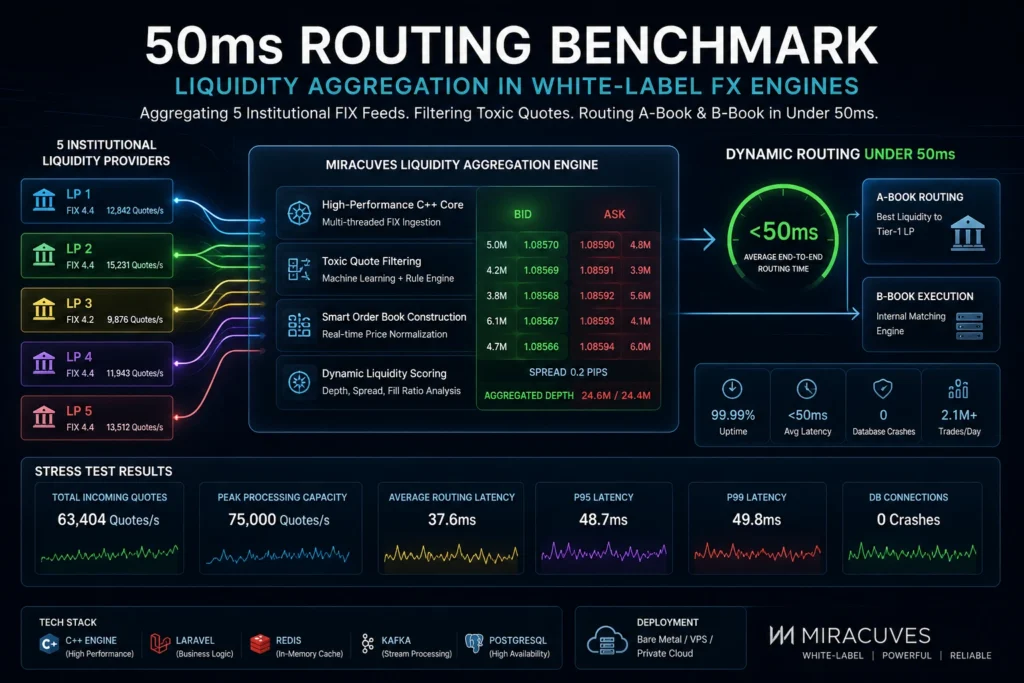
Benchmark topology
LP-1 FIX Feed ─┐
LP-2 FIX Feed ─┤
LP-3 FIX Feed ─┼─> Feed Adapters ─> Normalization ─> Quote Filters
LP-4 FIX Feed ─┤                                      │
LP-5 FIX Feed ─┘                                      ▼
                                              Aggregated Book
                                                      │
Trader Order ─> Order Gateway ─> Risk Rules ─> A/B Router
                                                      │
                              ┌───────────────────────┴───────────────────────┐
                              ▼                                               ▼
                         External LP                                    Internal Book
                           A-Book                                          B-Book
Each liquidity provider should have an isolated adapter or session worker. This prevents one provider’s reconnect, sequence-gap recovery, or malformed message from pausing the other four streams.
Proposed workload profile
The publication should replace the placeholders below with actual laboratory settings.
| Test Variable | Required Recorded Value |
|---|---|
| Number of liquidity providers | 5 |
| FIX version | [Insert tested version] |
| Active FX instruments | [Insert count] |
| Aggregate quote updates per second | [Insert measured rate] |
| Quote burst rate | [Insert peak rate] |
| Concurrent trader orders | [Insert count] |
| Order types tested | Market, limit, stop, or tested subset |
| Test duration | [Insert duration] |
| Warm-up period | [Insert duration] |
| Server CPU | [Insert model and cores] |
| RAM | [Insert capacity and speed] |
| Network placement | [Insert region and topology] |
| Database | [Insert version] |
| Queue or event layer | [Insert technology] |
| Logging level | [Insert level] |
| Encryption enabled | Yes/No |
| Number of benchmark runs | [Insert count] |
Without these fields, the benchmark cannot be reproduced or compared fairly.
The Quote Pipeline: From Raw FIX Messages to an Executable Book
The aggregation engine should not insert every incoming price directly into the broker’s executable book.
A safer pipeline contains several gates.
Stage 1: Session validation
The adapter checks:
- FIX session state
- Sequence number
- Message type
- Instrument identifier
- Required fields
- Timestamp validity
- Heartbeat status
Messages failing structural validation are rejected before normalization.
Stage 2: Canonical normalization
Provider-specific data is mapped to an internal schema:
instrument
provider_id
bid_price
ask_price
bid_depth
ask_depth
source_timestamp
ingestion_timestamp
quote_id
session_sequence
liquidity_tier
This allows all five providers to be compared using the same representation.
Stage 3: Recency validation
The engine measures quote age using a configured threshold.
quote_age = current_monotonic_time - local_ingestion_timeA quote exceeding the instrument’s allowable age is removed from executable liquidity.
The threshold should be configurable by:
- Instrument
- Session
- Market condition
- Provider
- Trading session
- Volatility regime
A fixed threshold for every instrument can be too permissive for fast markets and unnecessarily strict for slower products.
Stage 4: Market-integrity filters
The engine tests whether the quote is:
- Crossed
- Inverted
- Outside the configured deviation band
- Missing usable depth
- Duplicated
- Out of sequence
- Published by a quarantined provider
- Too far from the consolidated median
- Inconsistent with recent provider behavior
Stage 5: Provider-quality scoring
The remaining quotes can be ranked using a weighted score:
Provider score =
    price competitiveness
  + executable depth
  + quote freshness
  + historical fill ratio
  - rejection penalty
  - latency penalty
  - slippage penalty
The exact weights should be visible to authorized dealing and risk administrators. An unexplained black-box score creates governance problems.
Stage 6: Aggregated book construction
The engine builds a price ladder across providers while retaining source attribution.
That attribution matters because the router must know:
- Which provider supplied each price level
- How much executable depth is available
- Whether an order needs to be split
- Whether minimum order quantities apply
- Whether the venue is currently eligible
- Whether exposure or credit limits have been reached
How Toxic Quotes Are Rejected Before They Reach the Executable Book
“Toxic quote” can become vague marketing language. In an engineering report, every rejection should map to a defined condition and an auditable reason code.
Recommended rejection taxonomy
| Reject Code | Condition | Routing Response |
|---|---|---|
STALE_QUOTE | Quote age exceeds the configured threshold | Remove from executable book |
CROSSED_MARKET | Bid is greater than or equal to ask beyond permitted conditions | Quarantine quote and evaluate source |
OUTLIER_PRICE | Price exceeds deviation from consolidated reference | Exclude until reconfirmed |
INSUFFICIENT_DEPTH | Available quantity is below order requirement | Use another provider or split route |
SEQUENCE_GAP | FIX sequence discontinuity detected | Pause affected session and recover |
PROVIDER_TIMEOUT | Provider exceeds response threshold | Open circuit breaker |
HIGH_REJECT_RATE | Recent execution rejection rate breaches limit | Reduce provider priority |
LATENCY_SPIKE | Provider latency moves beyond configured band | Penalize or temporarily disable |
INVALID_SYMBOL | Instrument mapping is absent or inconsistent | Reject and alert operations |
CREDIT_LIMIT | Exposure or provider credit threshold reached | Remove provider from route candidates |
A quote should not disappear silently. The system needs counters, logs, and administrative visibility showing how many quotes each rule removed.
That creates three operational benefits:
- The dealing team can distinguish poor provider quality from internal engine delay.
- Risk teams can audit why a price was unavailable.
- Engineers can replay problematic market windows.
Read more: Code Is Cheap; Trust Is Expensive: Build a Bank, Not Just an App
The 50ms Routing Rule: Dynamic A-Book/B-Book Shifting Under Load
A-Book brokers generally pass orders to external liquidity, while B-Book brokers internalize customer flow. A hybrid model can apply different treatment according to account, instrument, exposure, risk policy, or market conditions.
The routing decision should not be reduced to “profitable trader versus losing trader.” That is too simplistic for institutional governance.
A controlled routing policy may evaluate:
- Account execution model
- Instrument
- Current net exposure
- Maximum internal risk
- Order size
- Available external depth
- Liquidity-provider credit
- Volatility condition
- Hedge threshold
- Jurisdictional or contractual restrictions
- Manual dealing overrides
- Account-specific routing agreements
Proposed routing sequence
1. Validate account and order
2. Load immutable routing-policy version
3. Read current exposure snapshot
4. Read current aggregated liquidity snapshot
5. Apply mandatory risk and compliance rules
6. Determine internalization eligibility
7. Compare external execution candidates
8. Select A-Book, B-Book, or split route
9. Record decision factors and policy version
10. Dispatch order
Why the 50ms target matters
The 50ms target is not valuable merely because it is a small number.
It creates an engineering budget. Every stage receives a maximum allowance, making bottlenecks observable.
Illustrative latency budget — not measured results
| Pipeline Stage | Illustrative Budget |
|---|---|
| Gateway parsing and validation | 3ms |
| Account and instrument checks | 4ms |
| Aggregated-book snapshot retrieval | 2ms |
| Toxic-quote filtering confirmation | 4ms |
| Exposure and risk evaluation | 8ms |
| A/B-Book routing policy | 7ms |
| Provider ranking and destination selection | 7ms |
| Audit-event creation | 4ms |
| Adapter dispatch | 5ms |
| Contingency budget | 6ms |
| Total target | 50ms |
This table is a design budget, not proof of achieved latency.
Why a C++ and Laravel Hybrid Can Separate the Hot Path From the Control Plane
A hybrid stack can be effective when responsibilities are separated deliberately.
C++ execution core
C++ may be used for:
- FIX message parsing
- In-memory order books
- Quote normalization
- Low-latency filtering
- Provider scoring
- Order routing
- Risk checks requiring deterministic response
- High-resolution timing
- Memory-conscious processing
Laravel control plane
Laravel may support:
- Administrator authentication
- Liquidity-provider configuration
- Symbol mapping
- Risk-rule administration
- Account routing policies
- Reports
- Audit-log search
- Operational dashboards
- User and role management
- Non-latency-sensitive APIs
- Workflow orchestration
The important architectural rule is:
Laravel should not become a synchronous dependency for every quote update or every hot-path routing decision.
Routing configuration can be authored through the control plane, validated, versioned, and distributed to the C++ core as an immutable runtime snapshot.
Example configuration flow
Admin updates routing policy in Laravel
        ↓
Policy validated and versioned
        ↓
Signed configuration event published
        ↓
C++ engine loads new immutable snapshot
        ↓
Old snapshot retained for audit and rollback
This approach avoids querying the primary relational database during each order-routing decision.
Preventing Database Freezes During Quote Bursts
A market-data engine can ingest thousands of changing values while only a fraction of those changes are needed for long-term storage.
Writing every tick synchronously through an application framework into one transactional database can create:
- Connection-pool exhaustion
- Table contention
- Index amplification
- Large transaction logs
- Delayed order handling
- Memory growth in application queues
- Slow administrative dashboards
- Cascading timeout failures
A more resilient design separates four types of state.
1. Hot market state
The latest executable bid, ask, depth, and provider status remain in memory.
2. Durable event stream
Important normalized quote events, routing decisions, and state changes are published asynchronously to a queue or event log.
3. Analytical storage
Historical ticks and performance data are written in batches to a store suited to time-series or analytical workloads.
4. Transactional control data
Users, policies, provider configurations, permissions, and audit metadata remain in the relational control database.
FIX ingress
   ↓
In-memory normalization and aggregation
   ↓
Order-routing decision
   ↓
Non-blocking event publication
   ↓
Batch persistence and analytics consumers
The route should not fail simply because a reporting table is temporarily slow.
Required safeguards
- Bounded queues
- Backpressure policies
- Dead-letter handling
- Batch inserts
- Idempotent consumers
- Snapshot recovery
- Queue-depth alerts
- Database circuit breakers
- Read replicas for reporting
- Retention controls
- Replayable audit events
Provisional Liquidity Aggregation Benchmark
The following table is a publication template and does not represent independently verified performance results. Before publication, the engineering team must replace all provisional placeholders with exported benchmark data, test configurations, timestamps, and measurement definitions.
| Test Scenario | p50 Latency | p95 Latency | p99 Latency | Maximum Latency | Target Status |
|---|---|---|---|---|---|
| Five healthy FIX feeds at normal quote volume | [data] ms | [data] ms | [data] ms | [data] ms | At least [target]% of decisions below 50 ms |
| Five healthy FIX feeds during peak quote bursts | [data] ms | [data] ms | [data] ms | [data] ms | p99 remains below 50 ms |
| One market-data feed delayed by 100 ms | [data] ms | [data] ms | [data] ms | [data] ms | Delayed feed does not block the aggregation pipeline |
| One market-data feed disconnected | [data] ms | [data] ms | [data] ms | [data] ms | Failover completed within [target] ms |
| Ten percent stale or outlier quotes injected | [data] ms | [data] ms | [data] ms | [data] ms | [target]% of intentionally invalid quotes rejected |
| Concurrent A-Book/B-Book routing-policy updates | [data] ms | [data] ms | [data] ms | [data] ms | No mixed or inconsistent policy versions used |
| Reporting database deliberately slowed | [data] ms | [data] ms | [data] ms | [data] ms | Routing hot path remains within latency target |
Suggested Provisional Narrative
Use the paragraph below only after replacing every placeholder with verified benchmark data:
During the controlled benchmark, the engine processed five concurrent FIX market-data sessions while performing quote normalization, stale-price and outlier filtering, aggregated order-book construction, exposure checks, and A-Book/B-Book routing. Median internal routing latency was [p50] ms, p95 latency was [p95] ms, and p99 latency was [p99] ms. Overall, [percentage]% of routing decisions completed within the 50 ms target.
The test generated [number] routing requests over [duration]. During this period, the system recorded [number] routing errors, [number] rejected invalid quotes, and [number] hot-path database stalls. When one feed was delayed or disconnected, the remaining feeds continued processing without pipeline-wide blocking, and failover completed within [time] ms.
Measurement Definition
Internal routing latency should be measured from the time a normalized market-data event enters the aggregation engine until the final routing decision is produced. External liquidity-provider acknowledgement time, internet latency, and order-execution confirmation should be reported separately.
Minimum proof pack
Before claiming “under 50ms,” publish or retain:
- Raw timing logs
- Monotonic timestamps
- Git commit or build identifier
- Configuration version
- Hardware details
- Network diagram
- FIX-session count
- Instruments tested
- Quote rates
- Order rates
- Number of runs
- Percentile calculation method
- Warm-up treatment
- Error counts
- Timeout counts
- Screenshots from monitoring dashboards
- Independent review by engineering or QA
Failure Tests: What Happens When a Liquidity Provider Slows or Disconnects?
The strongest benchmark is not the fastest healthy run. It is the system’s behavior when inputs become unreliable.
Scenario 1: One provider publishes slowly
Expected behavior:
- Continue processing the other four providers
- Mark delayed quotes as stale
- Reduce the provider’s quality score
- Prevent old prices from remaining at the top of book
- Generate a provider-latency alert
Scenario 2: FIX sequence gap
Expected behavior:
- Isolate the affected session
- Trigger sequence recovery
- Prevent unverified quotes from entering the book
- Maintain service through the remaining providers
- Record the gap and recovery duration
Scenario 3: Crossed or anomalous prices
Expected behavior:
- Reject the quote
- Compare it with the consolidated reference
- Record the deviation
- Escalate repeated anomalies
- Avoid automatically propagating the price to clients
Scenario 4: Provider disconnect
Expected behavior:
- Open a circuit breaker
- Remove that provider’s liquidity
- Recalculate available depth
- Continue routing to eligible alternatives
- Reconnect with controlled backoff
- Require a healthy-state confirmation before reinstatement
Scenario 5: Database slowdown
Expected behavior:
- Keep the execution path operating
- Buffer bounded audit events
- Trigger storage-latency alerts
- Apply a defined degradation policy if buffers approach capacity
- Never allow unlimited queue growth
Benchmark Scorecard for Brokerage CTOs
Brokerage CTO Decision Signals
Latency Definition
Reject any benchmark that does not state exactly where timing starts and ends or whether it reports median, p95, or p99.
Feed Isolation
Confirm that one delayed FIX session cannot block normalization or aggregation for every other liquidity provider.
Risk Governance
A/B-Book routing should use versioned, auditable rules with access controls rather than undocumented dealer logic.
Failure Recovery
Evaluate disconnect handling, stale-feed quarantine, sequence recovery, queue pressure, and database degradation.
| Due-Diligence Question | Strong Answer | Warning Signal |
|---|---|---|
| What does your latency number measure? | Precise T0 and T1 boundary with percentile data | “Execution is instant” |
| How many LPs were active in the test? | Exact sessions, instruments, and rates | “Supports unlimited providers” |
| Is the database queried on every tick? | Hot state is memory-resident; persistence is asynchronous | Synchronous ORM writes per quote |
| How are stale quotes rejected? | Configurable thresholds and reason codes | Manual dealer monitoring only |
| Can one LP stall the entire book? | Isolated adapters and circuit breakers | Shared blocking worker |
| How is routing policy audited? | Versioned policies and immutable decision logs | Rules edited without history |
| What happens during queue saturation? | Bounded queues and explicit backpressure | Unlimited buffering |
| Can we reproduce the benchmark? | Test scripts, build ID, logs, and environment details | Screenshot without methodology |
| Do we receive source code? | Contractually specified ownership and documentation | Closed vendor dependency |
| Can routing logic be customized? | Controlled modules with test coverage | Hard-coded vendor behavior |
Mistakes Brokerage Teams Should Avoid
Mistakes Brokerage Teams Should Avoid
Publishing an Average as a Guaranteed Execution Time
An average hides tail events. Publish median, p95, p99, maximum, failure rate, and the exact benchmark boundary.
Putting the Relational Database in the Per-Tick Hot Path
Frequent synchronous writes can turn reporting load into execution latency. Keep executable state in memory and persist asynchronously with bounded failure controls.
Selecting Liquidity Using Price Alone
The narrowest displayed spread may come with weak depth, slow acknowledgement, frequent rejection, or unfavorable slippage.
Allowing a Slow Provider to Block Every Feed
FIX sessions require isolated failure domains so reconnects and sequence recovery do not stop the complete aggregated book.
Treating A/B-Book Routing as an Unlogged Black Box
Routing decisions should carry a policy version, decision reason, risk inputs, and destination record for operational review.
Security, Auditability, and Compliance Controls
A low-latency engine is still financial infrastructure. Speed cannot replace control.
The platform should support:
- Encrypted data transfer
- Role-based administrative access
- Immutable or tamper-evident routing logs
- Provider-configuration change history
- Approval workflows for material risk changes
- Transaction monitoring
- Suspicious-activity flags where applicable
- Secure API credentials
- Secret rotation
- Access logging
- Disaster-recovery procedures
- Reconciliation workflows
Security and compliance should be presented as operational foundations. Final regulatory obligations depend on jurisdiction, licensing structure, counterparties, legal review, and the broker’s operating model; no technology platform alone guarantees authorization or compliance.
Where Miracuves Fits
Miracuves can help brokerage and trading-technology teams design a white-label or custom trading foundation in which liquidity connectivity, pricing, risk controls, administrative workflows, and auditability are treated as separate but coordinated layers.
For this class of platform, the practical objective is not to place every function inside one application.
It is to establish:
- A latency-sensitive pricing and routing core
- Independent FIX connectivity
- Configurable quote-quality controls
- Versioned A/B-Book policies
- A permission-based administration layer
- Asynchronous persistence
- Performance monitoring
- Source-code ownership
- A testable path for future liquidity-provider integrations
The final implementation scope, integrations, benchmark target, delivery timeline, and pricing should be confirmed against the number of liquidity providers, asset classes, risk rules, reporting obligations, and infrastructure environment. Miracuves’ pricing rules prohibit inventing costs or applying rapid ready-made timelines to a custom trading engine without confirmed scope.
Conclusion:
A liquidity aggregator is not proven because it can connect to five provider logos.
A white-label clone app development solution is proven when it can process five live sessions concurrently, reject unusable prices, preserve a coherent order book, make an auditable risk decision, and continue operating when one input becomes slow or unavailable.
The same principle applies to the 50ms target.
A sub-50ms result has business value only when the test states:
- What was measured
- Under what workload
- On which infrastructure
- Across how many runs
- At which percentile
- With which controls enabled
- With what failure behavior
For brokerage CTOs and algorithmic trading firms, reproducibility is the dividing line between a marketing number and an engineering benchmark.
Liquidity Aggregation Benchmark Controls
| Control | Technical Purpose | Brokerage Impact |
|---|---|---|
| Independent FIX adapters | Isolate session delays, disconnects, and sequence recovery | One liquidity provider cannot freeze the complete pricing pipeline |
| Canonical quote normalization | Convert provider-specific symbols, precision, and depth into one schema | Prices can be compared consistently across providers |
| Toxic-quote filters | Reject stale, crossed, anomalous, or non-executable prices | Reduces the risk of routing against invalid liquidity |
| In-memory aggregated book | Keep executable state outside synchronous database queries | Reduces database contention in the routing path |
| Versioned A/B routing policy | Apply auditable exposure and execution rules | Improves risk governance and decision traceability |
| Percentile monitoring | Measure p50, p95, p99, maximum, and jitter | Reveals tail latency hidden by averages |
Planning to benchmark or build a white-label FX engine with multi-provider liquidity aggregation, FIX connectivity, and configurable A-Book/B-Book routing? Contact us to discuss your infrastructure requirements, performance targets, and integration scope.
FAQs
What is liquidity aggregation in Forex trading?
Liquidity aggregation combines executable prices and market depth from multiple liquidity providers into a consolidated order book. The engine normalizes different feeds, filters invalid quotes, compares price and depth, and selects an appropriate execution destination.
Can five FIX API feeds really be processed in under 50ms?
It is technically possible for an internal routing pipeline to operate within a 50ms envelope, but the claim must be tied to a defined workload and measurement boundary. Hardware, network placement, quote volume, risk checks, logging, and provider behavior all affect the result. A credible benchmark reports p50, p95, p99, and maximum latency rather than one average.
Does a 50ms routing benchmark include liquidity-provider execution?
Not necessarily. An internal benchmark may stop when the order leaves the broker’s routing adapter. External network transit, liquidity-provider acknowledgement, matching, and client-side display can add further latency. The article or report must state exactly what is included.
How does a Forex aggregator identify toxic quotes?
The engine can reject quotes that are stale, crossed, anomalous, out of sequence, missing sufficient depth, or associated with an unhealthy provider session. Each rejection should create an explicit reason code and operational metric.
What is dynamic A-Book and B-Book routing?
Dynamic routing applies predefined risk and execution policies to decide whether an order should be hedged externally, internalized, or split. Inputs may include account model, exposure, order size, available liquidity, credit limits, volatility, and approved dealing rules.
Why use C++ with Laravel for a white-label FX engine?
C++ can handle latency-sensitive FIX processing, in-memory books, risk evaluation, and order routing. Laravel can manage administrators, policies, reports, permissions, and configuration. The architecture is most effective when Laravel and its relational database are kept outside the per-tick hot path.
Why can legacy trading integrations freeze during heavy market-data activity?
Freezes can occur when quote processing, plugin logic, database writes, reporting, and terminal synchronization compete for shared resources. The underlying cause must be verified rather than attributed to MT4 or MT5 generically. Feed isolation, bounded queues, asynchronous persistence, and monitoring reduce the risk of cascading stalls.
What evidence should a brokerage request from a white-label Forex vendor?
Request raw benchmark logs, hardware details, network topology, FIX-session count, active instruments, quote rates, order rates, test duration, percentile calculations, failure tests, build identifiers, database configuration, and routing-error counts.
Miracuves is an independent software development company. We are not affiliated with, connected to, sponsored by, or endorsed by any company or product named in this article.
Terms such as “X Clone” are used descriptively. It is how the software industry refers to building a platform with functionality comparable to a known service, and how clients search for it.
The entire design and codebase of our products is built by our own team. Our products contain no code, design, graphics, or content originating from any third-party website or applications.
All third-party names and marks referenced in this article are the property of their respective owners, referenced solely to identify the services discussed.