Key Takeaways
What You’ll Learn
- Industrial AI solves one costly workflow instead of answering every type of request.
- Multimodal agents combine many signals such as video, audio, thermal data, vibration, and telemetry.
- Enterprise buyers pay for outcomes like lower downtime, faster inspections, and safer decisions.
- Deployment creates pricing power through integrations, private infrastructure, support, and workflow design.
- The main lesson is to build specialised AI infrastructure, not another general assistant.
Stats That Matter
- The “10x margins” claim is not guaranteed and refers to stronger enterprise pricing power.
- Inputs can include cameras, thermal images, machine audio, sensors, manuals, and maintenance records.
- Revenue can come from setup fees, licences, monitored assets, usage, support, and integrations.
- Deployment options include private cloud, dedicated infrastructure, edge systems, and on-premise environments.
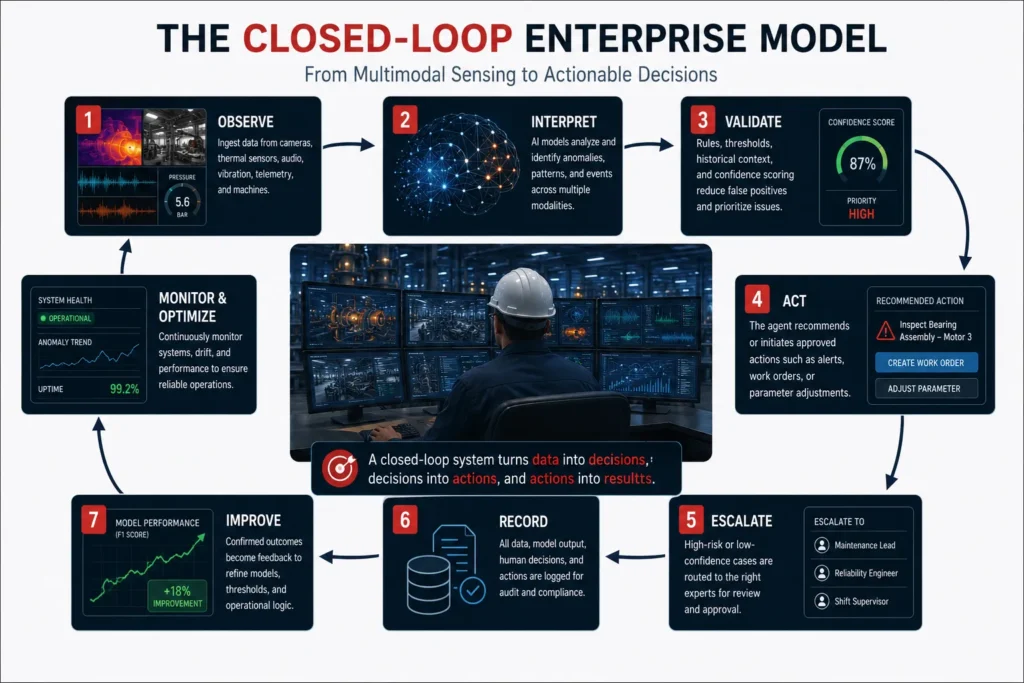
- Closed-loop workflows follow observe, interpret, validate, act, escalate, record, and improve.
Real Insights
- The model is only one part because enterprise value comes from the complete operational system.
- Private data creates defensibility through equipment history, sensor patterns, and site-specific workflows.
- Human review remains essential for high-risk, unusual, or low-confidence decisions.
- Reusable infrastructure protects margins while configurable workflows support different customers.
- For founders, build an industrial multimodal agent around specialised workflows, private data, system integrations, human review, and measurable business outcomes.
The consumer AI market has a seductive story.
Build an assistant that can see, hear, speak, search, reason, remember, and answer anything. Put it inside a polished mobile app. Offer a free plan, add a subscription, and wait for millions of users to arrive.
That is not a product strategy. For most founders, it is a capital-incineration strategy.
Building an AI and automation platform as a general-purpose consumer assistant forces a startup to compete on the same battlefield as Apple, Google, Microsoft, OpenAI, Amazon, Meta, and every device manufacturer capable of placing an assistant directly inside an operating system. These companies do not merely have larger models. They control distribution, hardware, cloud infrastructure, application ecosystems, identity systems, and existing consumer habits.
A startup entering that contest is not simply trying to build better AI. It is attempting to overcome an entire distribution and infrastructure stack.
The more defensible opportunity is almost the opposite.
Instead of developing an assistant that knows a little about everything, build an industrial multimodal agent that understands one expensive workflow better than any general-purpose platform.
Give it access to thermal images, machine audio, vibration patterns, equipment telemetry, operating procedures, service histories, and live camera streams. Deploy it inside a controlled enterprise environment. Connect it to human review and operational systems. Charge for the value of the failure it helps identify, the inspection it accelerates, or the downtime it helps the customer avoid.
That is where multimodal AI stops being a novelty and starts becoming infrastructure.
The B2C AI Graveyard: You Cannot Outspend Apple and Google
Founders often assume that model intelligence is the decisive competitive variable.
It is not.
In consumer AI, the decisive variables include distribution, inference cost, product habit, brand trust, ecosystem integration, and the ability to subsidise free usage for an extended period.
A technically impressive assistant can still fail because consumers already have an acceptable alternative embedded in their phone, browser, workplace suite, operating system, or messaging application.
The economics are equally unforgiving. A broad assistant must handle an unpredictable range of requests. That creates pressure to support multiple modalities, large context windows, real-time information, voice interaction, file processing, memory, safety controls, and continuous model upgrades. Many users will expect these capabilities for free or for the price of a low-cost monthly subscription.
The startup pays for breadth. The customer rarely pays a premium for it.
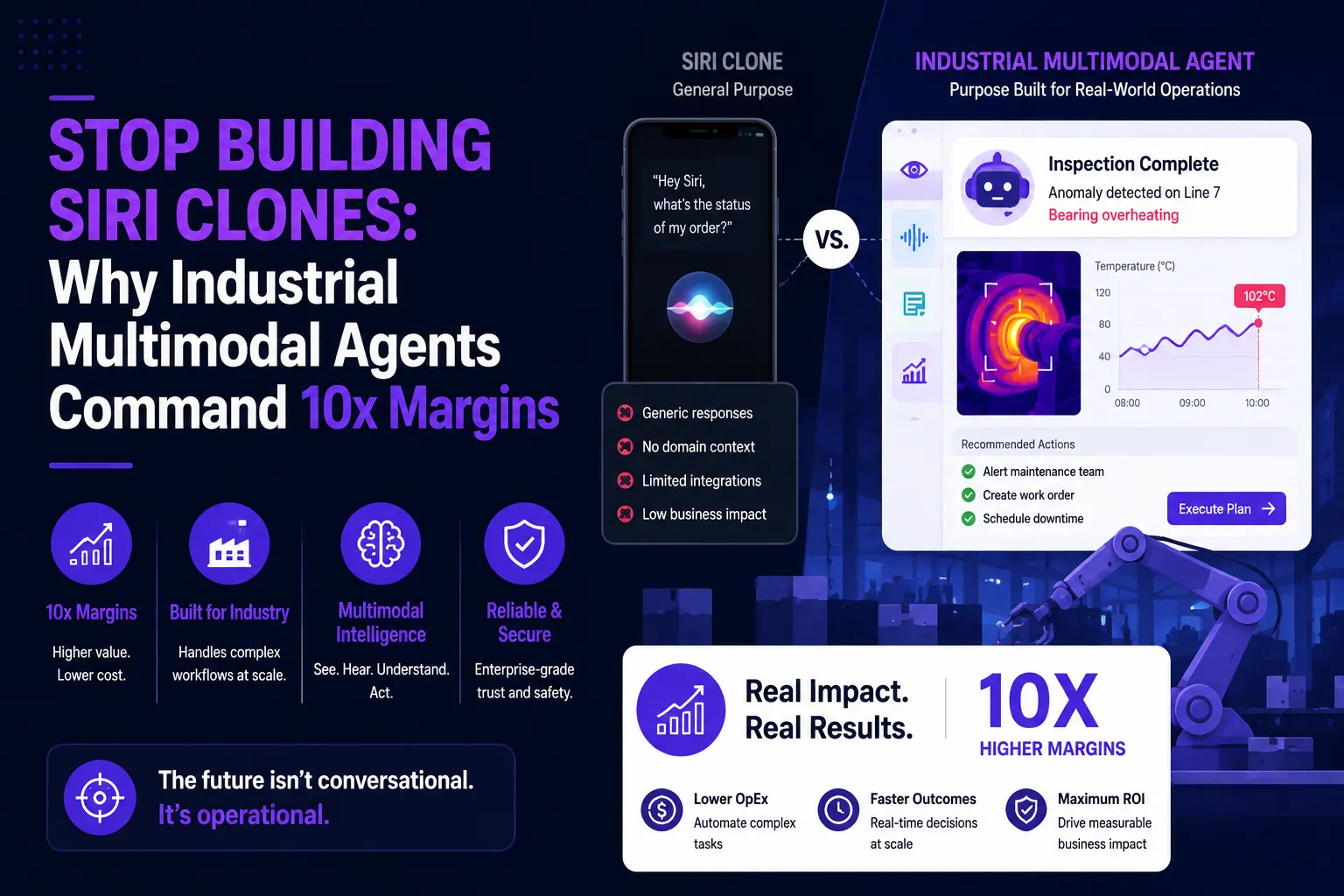
An industrial buyer behaves differently. The enterprise does not need the agent to write poetry, plan a holiday, answer trivia, and generate social posts. It needs the system to recognise a specific failure pattern, interpret an inspection feed, assist an engineer, or prioritise a maintenance response.
The consumer asks, “How many things can this assistant do?”
The industrial buyer asks, “Can this system reduce uncertainty in a workflow that costs us money?”
That is a much better commercial question.
Read more: Cracking the Code: How to Market Your Multimodal AI Platform Post-Launch
The Blind Spot Big Tech Does Not Automatically Own
Big technology companies own foundational models and mass-market interfaces. They do not automatically own the final operational layer inside every factory, warehouse, refinery, utility network, port, or processing facility.
That layer is difficult because it is messy.
Industrial environments contain:
- Legacy equipment
- Proprietary data formats
- Inconsistent sensor configurations
- Restricted networks
- Site-specific operating procedures
- Safety escalation rules
- Different machine baselines
- Specialised terminology
- Human approval requirements
- Long procurement and validation processes
These conditions look unattractive to consumer-software founders because they resist instant scale.
That resistance is precisely what makes them defensible.
A public assistant can analyse a photograph of a motor. An industrial agent can compare its thermal signature with its operating load, listen for an abnormal frequency, review the service history, inspect vibration changes, check the maintenance threshold, and route the finding to the appropriate engineer.
Industrial audio research already includes recordings of normal and anomalous operating conditions from valves, pumps, fans, and slide rails. Multimodal predictive-maintenance concepts extend that analysis by combining thermal anomalies, vibration signals, maintenance histories, and equipment specifications.
The value does not come from recognising an image or transcribing a sound in isolation. It comes from connecting multiple signals to a decision inside a controlled workflow.
What an Industrial Multimodal Agent Actually Does
A multimodal agent processes more than one kind of input and uses the combined context to produce an output or initiate an authorised workflow.
In an industrial setting, those inputs might include:
- Standard video from inspection cameras
- Thermal imagery
- Acoustic recordings
- Vibration measurements
- Pressure and temperature readings
- Machine-control data
- Maintenance records
- Technician notes
- Equipment manuals
- Shift and production context
A machine may sound unusual without showing an obvious temperature increase. Another may run hotter because the production load has changed rather than because a component is failing. A visual defect may be harmless in one operating state but dangerous in another.
A multimodal system can evaluate these signals together instead of treating each one as an isolated alert.
For example, an agent might:
- Detect an abnormal acoustic pattern from a pump.
- Compare the sound with its historical operating baseline.
- Check whether thermal readings are also increasing.
- Retrieve recent maintenance work and unresolved alerts.
- Determine whether the anomaly crosses an approved threshold.
- Recommend inspection rather than immediately stopping production.
- Create a maintenance ticket after human confirmation.
- Store the evidence and decision trail for later review.
This is not an all-knowing digital companion. It is a tightly governed operational system.
That narrower purpose is a strength.
Consumer Assistants vs Industrial Multimodal Agents
| Decision Area General Consumer Assistant Industrial Multimodal Agent | ||
|---|---|---|
| Primary value | Convenience across many everyday requests | Operational insight inside a specialised workflow |
| Data advantage | Broad public and user-provided context | Private sensor, equipment, and process data |
| Distribution | App stores, browsers, devices, and consumer subscriptions | Direct enterprise sales, integrators, consultants, and industrial partnerships |
| Deployment | Primarily public cloud | Private cloud, dedicated infrastructure, edge, or on-premise options |
| Buying trigger | Utility, novelty, or personal productivity | Risk, downtime, inspection capacity, quality, or safety |
| Pricing logic | Free, advertising, or low-cost subscription | Licence, deployment, integration, support, and usage contracts |
| Defensibility | Model quality, brand, and distribution | Workflow knowledge, integrations, private data, and operational trust |
The Margin Is Not in the Model—It Is in the Deployment
The phrase “10x margins” should not be interpreted as a universal financial benchmark.
It describes a strategic difference in pricing power.
A consumer assistant usually sells access to intelligence. An industrial agent can sell a complete operational capability.
That capability may include:
- Site assessment
- Sensor and camera integration
- Private deployment
- Model configuration
- Workflow design
- Dashboard access
- Role-based permissions
- Human-review queues
- Audit logs
- Enterprise support
- Service-level commitments
- Model monitoring and retraining
- Integration with ERP, SCADA, CMMS, or ticketing systems
The model is only one component of the contract.
A serious enterprise buyer is not paying merely for an answer generated by AI. It is paying for a system that fits its infrastructure, respects its access rules, produces reviewable evidence, and supports an agreed operational outcome.
This changes the revenue model.
Instead of relying only on a low-cost monthly subscription, a specialised provider can structure revenue around deployment fees, annual licences, monitored assets, facilities, sensor volume, support tiers, integration work, or private infrastructure.
Higher contract value does not automatically mean higher profit. Industrial deployments introduce longer sales cycles, technical integration, field validation, support obligations, and customer-specific requirements. The opportunity becomes attractive when the product foundation is reusable while the workflow layer remains configurable.
That is the balance founders should seek: repeatable infrastructure with valuable specialisation.
The Closed-Loop Enterprise Model
Many AI products stop at detection.
They produce a score, alert, or recommendation and leave the customer to determine what happens next.
A commercially stronger industrial agent closes the loop:
Observe → Interpret → Validate → Act → Escalate → Record → Improve
Observe
The system ingests authorised data from cameras, microphones, sensors, equipment systems, documents, or operator interfaces.
Interpret
Models identify objects, changes, anomalies, events, or combinations of signals that match a relevant pattern.
Validate
Rules, thresholds, historical context, confidence scoring, and human review reduce the risk of acting on an unreliable output.
Act
The agent recommends or performs an approved action, such as creating a ticket, requesting an inspection, adjusting a non-critical parameter, or notifying a responsible team.
Escalate
High-risk or low-confidence cases move to authorised personnel rather than being handled autonomously.
Record
The platform stores the source data, model output, human decision, action, and timestamp in an activity trail.
Improve
Confirmed outcomes become feedback for threshold refinement, workflow optimisation, or controlled model improvement.
This loop is where an AI demonstration becomes an enterprise product.
A multimodal model may be able to identify a potential fault. An enterprise agent must also know who is permitted to see it, how urgent it is, what evidence should be retained, who approves the response, and how the result enters the existing maintenance process.
Private, Edge, and Offline Deployment Are Product Features
Privacy is often discussed as a compliance item added near the end of a product plan.
For industrial AI, data control can be central to the buying decision.
Factories and critical facilities may produce sensitive data about:
- Production capacity
- Equipment performance
- Quality defects
- Proprietary processes
- Facility layouts
- Staff activity
- Operational vulnerabilities
- Maintenance schedules
- Unreleased products
Sending every image, sound, and telemetry stream to a shared public service may be unacceptable for the customer’s risk model.
An industrial agent can therefore be designed around different deployment patterns:
Private cloud: Dedicated infrastructure with controlled access and customer-specific data boundaries.
On-premise deployment: Processing within infrastructure controlled by the enterprise.
Edge inference: Selected analysis occurs near the machine, camera, or sensor to reduce latency and unnecessary data transfer.
Offline-capable operation: Essential workflows continue in facilities with restricted or unreliable connectivity.
The correct model depends on latency, hardware, security, maintenance, and operational requirements. “Offline” should not be used as a vague marketing claim. Founders must define which functions work locally, which require synchronisation, how model updates are delivered, and what happens when connectivity returns.
Security should include encrypted data transfer and storage, role-based access, permission-controlled dashboards, activity logs, secure API integration, and carefully limited administrative privileges. Final compliance depends on the jurisdiction, customer environment, selected integrations, and operating model.
Three Industrial Agent Opportunities Worth Building
1. Thermal and Acoustic Predictive-Maintenance Agent
This system combines thermal camera feeds, machine audio, vibration readings, equipment history, and operating conditions.
Its job is not to declare with certainty that a component will fail. Its job is to identify combinations of evidence that justify inspection, monitoring, or intervention.
Potential buyers include manufacturers, energy operators, logistics facilities, processing plants, and maintenance providers.
Recent industrial thermal-imaging work describes the move from periodic manual inspections toward continuous monitoring, while AI-based thermal analysis is used to identify abnormal temperature patterns and process deviations.
2. Visual Quality and Process-Deviation Agent
A quality agent monitors products or production steps through standard and specialised cameras. It can compare visual defects with process settings, batch data, machine states, and historical quality records.
The important distinction is that the product should not merely label an image “defective.” It should help answer:
- Which production condition correlates with the defect?
- Is the issue isolated or systematic?
- Which batch or machine is affected?
- Does the finding require stopping production?
- What evidence should be routed to a quality manager?
This creates a decision system rather than a computer-vision feature.
3. Industrial Technician Copilot
A technician copilot can combine live video, voice, equipment documents, service history, sensor information, and procedural guidance.
An engineer could point a device at an assembly, describe the symptom, and receive context-specific steps based on approved documentation. A human expert could review the session remotely when the agent’s confidence is low.
Research prototypes have already explored multimodal industrial assistance using video, speech, large language models, and simulated machinery to provide step-by-step task guidance.
The commercial product would need a much stronger control layer: approved knowledge sources, versioned procedures, access restrictions, evidence capture, escalation, and clear boundaries on autonomous recommendations.
Read more: Revenue Model for Multimodal AI Platform: How to Actually Make It Rain
The Architecture Founders Usually Underestimate
Founders attracted to multimodal AI often begin with model selection.
That is rarely the hardest part.
The larger architecture includes:
| Layer | Purpose | Founder Risk |
|---|---|---|
| Sensor ingestion | Collects authorised video, audio, thermal, and telemetry data | Unreliable or unsynchronised inputs |
| Data normalisation | Converts different formats into usable streams | Inconsistent timestamps and schemas |
| Model orchestration | Routes inputs to vision, audio, language, or anomaly models | High latency and unnecessary inference cost |
| Fusion layer | Combines evidence across modalities | Weak context or conflicting signals |
| Rules engine | Applies thresholds and operational policies | Acting outside approved boundaries |
| Knowledge layer | Retrieves manuals, records, and procedures | Outdated or unapproved information |
| Human review | Routes uncertain or sensitive cases to experts | Automation without accountability |
| Workflow integration | Connects with maintenance and enterprise systems | Alerts that never become action |
| Admin dashboard | Controls users, sites, assets, permissions, and models | Operational dependence on developers |
| Audit and monitoring | Records outputs, actions, errors, and performance | Limited explainability and weak governance |
A robust platform should also separate model output from operational authority.
The model may recommend that a machine be inspected. The workflow engine determines whether it creates a ticket. The permission layer determines who can approve it. The audit layer records what occurred.
That separation is essential for enterprise trust.
Founder Decision Signals
Expensive Problem
Choose a workflow where uncertainty, delay, inspection labour, quality failures, or downtime already carries measurable business cost.
Proprietary Data
Prioritise environments with valuable sensor, operational, or historical data that a general assistant cannot access by default.
Repeatable Foundation
Build reusable ingestion, permissions, orchestration, dashboards, and monitoring rather than creating an entirely new system for each customer.
Controlled Action
Define where the system may recommend, where it may act, and where a qualified human must approve the next step.
How to White-Label the Intelligence Without Commoditising It
White-labelling does not have to mean selling the same generic chatbot to every buyer.
A stronger model is to maintain a reusable multimodal product foundation while configuring the product around a vertical workflow.
The reusable foundation can include:
- User and organisation management
- Role-based access
- Sensor and media ingestion
- Model routing
- Knowledge retrieval
- Alert configuration
- Human-review queues
- Activity logs
- Reporting dashboards
- Integration APIs
- Branding controls
- Deployment management
The differentiated layer can include:
- Industry-specific models
- Customer-specific thresholds
- Approved documents
- Equipment taxonomies
- Escalation policies
- Custom connectors
- Private deployment requirements
- Specialist dashboards
- Commercial packaging
Miracuves’ existing AI and automation platform provides a relevant bridge for founders exploring configurable AI products, while its artificial intelligence development services and automation services can support more specialised workflow and integration requirements.
Founders researching the broader commercial model should also review Miracuves’ guides to building a multimodal AI platform and selecting a multimodal AI revenue model.
The strategic objective is not to resell generic intelligence. It is to package intelligence inside a high-value operational system.
Mistakes Founders Should Avoid
Building the Assistant Before Choosing the Failure
“Industrial AI” is still too broad. Start with one operational event, one buyer, one evidence set, and one controlled response workflow.
Assuming More Modalities Automatically Improve Accuracy
Additional inputs create value only when they are synchronised, relevant, reliable, and connected to a clear decision.
Promising Autonomous Decisions Too Early
High-risk workflows need thresholds, confidence handling, human review, permissions, and escalation—not unrestricted model autonomy.
Sending Everything to the Cloud
Unfiltered data transfer can increase latency, infrastructure cost, and customer resistance. Decide what should be processed locally and what needs central analysis.
Treating Integration as Custom Work Forever
If every deployment requires rebuilding the ingestion, dashboard, permissions, and workflow layers, services revenue may grow while product margins disappear.
Read more: How to Develop a Multimodal AI Chatbot Model Platform (2026 Guide)
Conclusion
The most visible AI opportunity is not always the most valuable one.
A broad consumer assistant offers an enormous theoretical market, but it also forces a founder to compete against companies with dominant distribution, infrastructure, models, and ecosystems.
An industrial multimodal agent operates in a narrower market. Yet inside that market, it can become much harder to replace.
It understands the customer’s equipment. It processes private operational data. It integrates with existing systems. It follows site-specific rules. It produces evidence. It supports human decisions. It becomes part of the workflow rather than another application competing for attention.
That is the contrarian opportunity.
Do not build an assistant that can answer anything.
Build an agent that can recognise one costly condition, assemble the right evidence, and move an enterprise safely toward the next decision.
Miracuves helps founders and enterprise teams develop white-label and custom AI systems with configurable workflows, administrative control, integrations, and deployment architecture aligned with the target business environment.
Ready to build a low-latency AI voice assistant that feels natural, responsive, and interruptible? Contact us to discuss the right native, streaming, or hybrid architecture for your product.
FAQs
What is an industrial multimodal agent?
An industrial multimodal agent is an AI system that analyses multiple kinds of operational data—such as video, thermal images, audio, vibration, telemetry, documents, and maintenance records—to support a specific industrial workflow.
Why are industrial AI agents more defensible than consumer assistants?
They can become defensible through proprietary data access, customer-specific integrations, workflow knowledge, private deployment, historical operating context, and deep integration with enterprise processes. A consumer assistant often competes more directly on model quality, price, and distribution.
Do industrial multimodal agents literally produce 10x margins?
Not automatically. The phrase expresses the potential for stronger pricing power than a low-cost consumer subscription. Actual margin depends on implementation cost, infrastructure, customer acquisition, support, integrations, hardware, and contract structure.
Can a multimodal AI agent run offline?
Selected functions can be designed to run locally or at the edge, but “offline-capable” must be precisely scoped. Founders should define which models and workflows run locally, how data is stored, and how updates or synchronisation occur.
How can multimodal AI support predictive maintenance?
It can combine evidence from machine audio, thermal patterns, vibration, telemetry, operating conditions, and maintenance history. The system can identify unusual combinations of signals and route them for inspection or human review.
What is the role of human review in industrial AI?
Human review helps validate low-confidence, high-risk, or unusual cases. It also creates accountability before actions that may affect safety, production, maintenance cost, or equipment availability.
Should an industrial agent use public-cloud AI models?
That depends on the customer’s risk profile, latency requirements, data policies, model needs, and infrastructure. Some workflows can use secure cloud APIs, while others may require private cloud, on-premise, or edge processing.
How should founders price a white-label industrial AI platform?
Possible pricing components include setup, integration, annual licensing, monitored assets, facilities, usage, private infrastructure, support tiers, and custom modules. Pricing should reflect the operational value and delivery obligations rather than model access alone.
Miracuves is an independent software development company. We are not affiliated with, connected to, sponsored by, or endorsed by any company or product named in this article.
Terms such as “X Clone” are used descriptively. It is how the software industry refers to building a platform with functionality comparable to a known service, and how clients search for it.
The entire design and codebase of our products is built by our own team. Our products contain no code, design, graphics, or content originating from any third-party website or applications.
All third-party names and marks referenced in this article are the property of their respective owners, referenced solely to identify the services discussed.