


Key Takeaways
- Food delivery app development is evolving beyond basic ordering into AI-driven logistics, real-time tracking, cloud kitchens, and personalized user experiences.
- Modern platforms now focus on faster delivery, smarter dispatch systems, predictive recommendations, digital payments, and customer retention features.
- Important trends include dark kitchens, subscription models, voice ordering, contactless delivery, loyalty systems, and hyperlocal delivery networks.
- Apps inspired by platforms like Uber Eats and Swiggy require scalable backend infrastructure, live GPS tracking, and strong operational automation.
- The future of food delivery depends on logistics intelligence, delivery optimization, personalization, and multi-service ecosystem expansion.
Industry Signals
- Real-time order tracking has become a standard expectation because users want complete visibility from restaurant preparation to delivery completion.
- AI recommendation systems improve retention by analyzing user behavior, cuisine preferences, reorder patterns, and delivery timing.
- Cloud kitchens and dark kitchens help businesses expand delivery operations without investing heavily in physical dining infrastructure.
- Subscription programs, free delivery plans, cashback offers, and loyalty rewards help increase repeat orders and customer lifetime value.
- Delivery platforms now rely heavily on automation for dispatching, route optimization, rider allocation, customer support, and operational analytics.
Real Insights
- A food delivery app is no longer just a restaurant marketplace; it is a real-time logistics and customer engagement platform.
- The strongest delivery apps succeed because ordering, payments, restaurant operations, and delivery coordination work together smoothly.
- Speed alone is not enough anymore because users also expect reliability, accurate ETAs, personalized offers, and frictionless payments.
- Founders should prioritize scalable backend systems because delivery platforms handle constant GPS updates, live orders, and high user concurrency.
- The future of food delivery platforms will depend on AI automation, predictive logistics, drone delivery experimentation, hyperlocal fulfillment, and integrated commerce ecosystems.
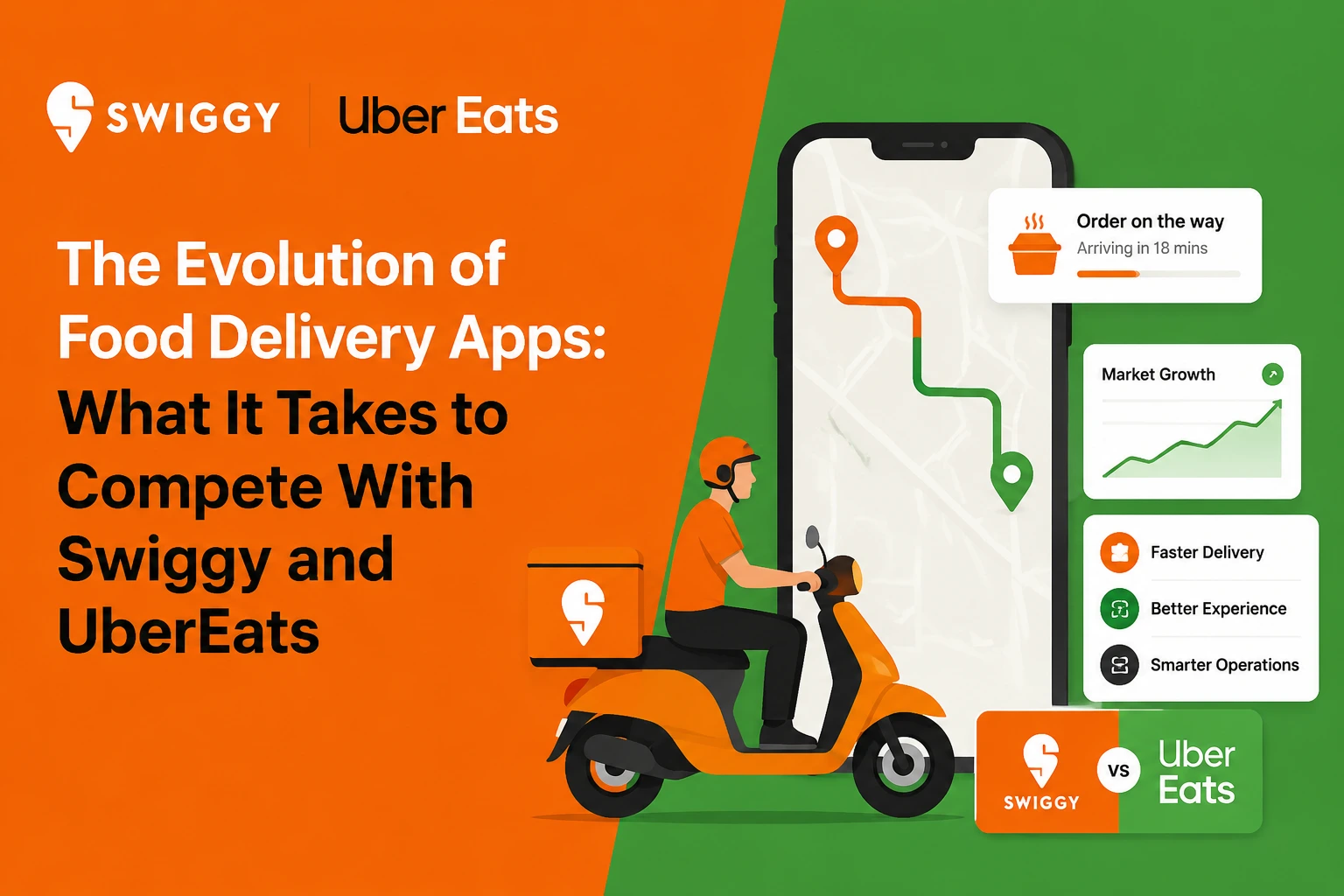
The global food delivery app industry has transformed from a simple restaurant-ordering convenience into a highly competitive technology-driven ecosystem. What once started as basic online ordering platforms has now evolved into intelligent logistics networks powered by AI, real-time tracking, cloud infrastructure, predictive analytics, and hyperlocal delivery systems.
Modern users expect instant order confirmations, live driver tracking, personalized recommendations, multiple payment methods, loyalty rewards, and ultra-fast deliveries — all within a seamless mobile experience. Businesses entering this space today are no longer just building an ordering application. They are building a complete digital commerce infrastructure capable of handling thousands of simultaneous users, restaurant operations, delivery logistics, customer engagement, and data-driven scaling.
As companies like Swiggy and Uber Eats continue dominating the market, startups and enterprises are increasingly investing in food delivery app development to launch scalable platforms faster using modern architectures and Swiggy clone solutions.
The Rise of Modern Food Delivery Platforms
The food delivery business has evolved through multiple stages over the last decade. Early platforms focused only on connecting restaurants with customers. Today’s delivery ecosystems operate more like real-time logistics and commerce engines.
Several factors accelerated this transformation:
- Smartphone penetration
- Digital payment adoption
- Cloud kitchens
- Hyperlocal commerce growth
- Real-time GPS infrastructure
- AI-driven recommendation systems
- Faster urban logistics
Consumers now prioritize convenience over traditional dining experiences. This shift has forced delivery platforms to innovate continuously in speed, delivery efficiency, personalization, and operational scalability.
The next generation of food delivery apps is heavily dependent on automation, predictive demand planning, and scalable backend infrastructure.
Why Food Delivery App Development Has Become a High-Growth Industry
Food delivery is no longer limited to restaurants. Modern platforms are expanding into:
| Industry Segment | Delivery Scope |
| Restaurants | Meals & beverages |
| Grocery delivery | Daily essentials |
| Cloud kitchens | Delivery-only brands |
| Quick commerce | 10–20 minute deliveries |
| Subscription meals | Scheduled food plans |
| Corporate food services | Bulk office deliveries |
This expansion creates major opportunities for startups building niche delivery ecosystems.
Businesses investing in food delivery app development are focusing on:
- Faster market entry
- Hyperlocal scaling
- Multi-vendor operations
- Real-time logistics
- Delivery optimization
- Customer retention systems
- Data-driven personalization
This is why Swiggy clone solutions and ready-made delivery platforms are becoming increasingly popular among startups seeking rapid deployment.
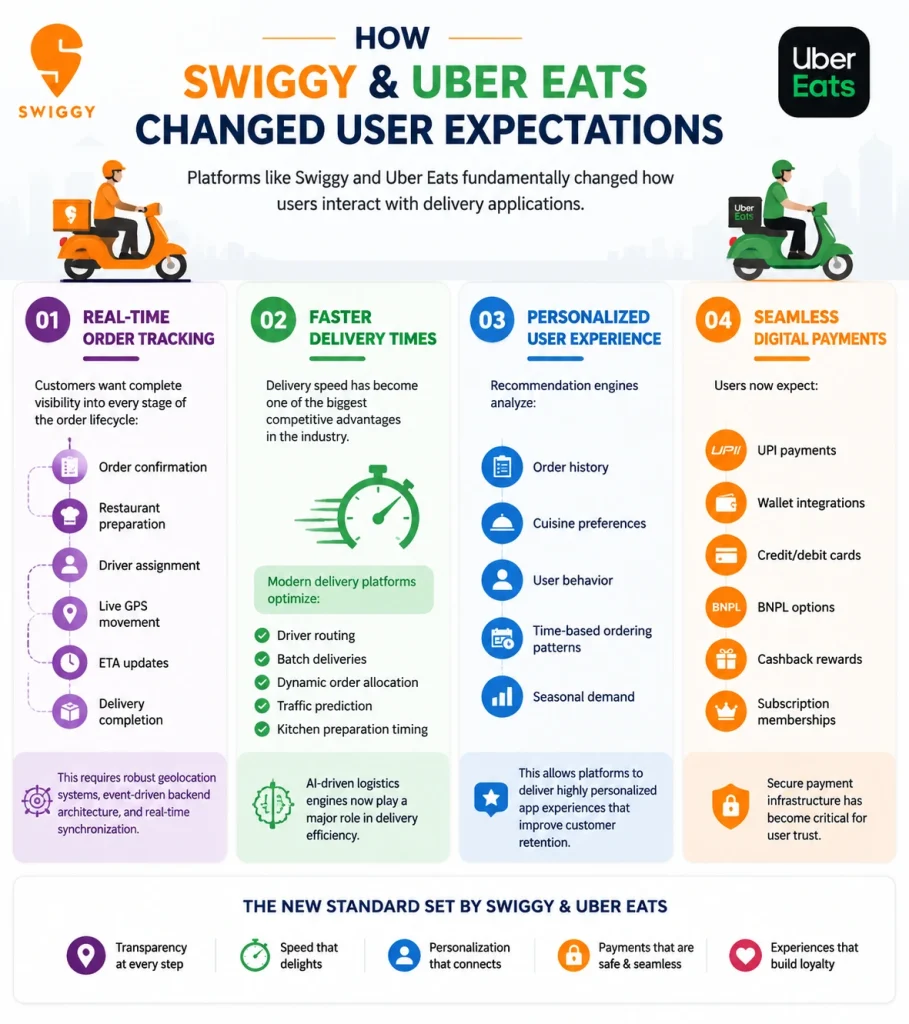
How Swiggy and UberEats Changed User Expectations
Platforms like Swiggy and Uber Eats fundamentally changed how users interact with delivery applications.
Modern consumers now expect:
Real-Time Order Tracking
Customers want complete visibility into every stage of the order lifecycle:
- Order confirmation
- Restaurant preparation
- Driver assignment
- Live GPS movement
- ETA updates
- Delivery completion
This requires robust geolocation systems, event-driven backend architecture, and real-time synchronization.
Faster Delivery Times
Delivery speed has become one of the biggest competitive advantages in the industry.
Modern delivery platforms optimize:
- Driver routing
- Batch deliveries
- Dynamic order allocation
- Traffic prediction
- Kitchen preparation timing
AI-driven logistics engines now play a major role in delivery efficiency.
Personalized User Experience
Recommendation engines analyze:
- Order history
- Cuisine preferences
- User behavior
- Time-based ordering patterns
- Seasonal demand
This allows platforms to deliver highly personalized app experiences that improve customer retention.
Seamless Digital Payments
Users now expect:
- UPI payments
- Wallet integrations
- Credit/debit cards
- BNPL options
- Cashback rewards
- Subscription memberships
Secure payment infrastructure has become critical for user trust.
Core Features Every Modern Food Delivery Platform Needs
A successful food delivery platform requires multiple interconnected systems working together in real time.
Customer Application Features
The customer application is the front-facing experience of the platform.
Essential features include:
| Feature | Purpose |
| Restaurant discovery | Browse nearby vendors |
| Smart search | Faster food discovery |
| Menu management | Dynamic food listings |
| Live tracking | Real-time order visibility |
| Ratings & reviews | Social proof |
| Personalized recommendations | Improve engagement |
| Multiple payment methods | Better checkout experience |
| Push notifications | Retention & updates |
| Loyalty rewards | Repeat orders |
The user interface must remain fast, lightweight, and responsive even during peak traffic periods.
Restaurant Panel Features
Restaurant management systems are equally important.
Restaurants require:
- Order management dashboards
- Inventory tracking
- Dynamic pricing
- Preparation time control
- Analytics dashboards
- Promotion management
- Delivery coordination
Without efficient restaurant operations, delivery ecosystems struggle to scale.
Delivery Partner Application Features
The delivery application acts as the logistics engine of the platform.
Key features include:
- Real-time order acceptance
- Navigation optimization
- Route mapping
- Earnings dashboards
- Delivery history
- Wallet systems
- Availability toggles
- AI-based order allocation
Efficient driver management directly impacts delivery speed and operational costs.
Read more: Migrating from SaaS to Owned Infrastructure: A Peak-Hour Performance Comparison
Challenges New Food Delivery Startups Face
Although the industry is growing rapidly, competition is extremely intense.
Startups entering this space face challenges such as:
| Challenge | Impact |
| Customer acquisition costs | Expensive scaling |
| Delivery logistics | Operational complexity |
| Restaurant onboarding | Supply-side growth |
| Retention issues | User churn |
| Peak-hour traffic | Infrastructure strain |
| Margin pressure | Profitability concerns |
Competing with established players requires a combination of technology, operational efficiency, and niche positioning.
Why Swiggy Clone Solutions Are Becoming Popular
Building a delivery platform completely from scratch requires:
- Large engineering teams
- Long development timelines
- Higher infrastructure costs
- Extensive testing cycles
This is why many startups now prefer Swiggy clone solutions.
A modern Swiggy clone can accelerate:
- MVP launches
- Market validation
- Feature deployment
- Delivery infrastructure setup
- Restaurant onboarding systems
Businesses can then focus on:
- Branding
- Customer acquisition
- Expansion strategies
- Operational optimization
Instead of spending years building foundational infrastructure.
Read more : Business Model of Swiggy :Complete Strategy Breakdown 2026
How Modern Food Delivery Apps Scale Efficiently
Scalable delivery platforms are built using modular architecture.
Key scaling strategies include:
Microservices Architecture
Different services operate independently:
- Payments
- Order management
- Notifications
- Tracking
- Analytics
- User management
This prevents platform-wide failures during traffic spikes.
CDN Optimization
CDNs improve:
- Image loading
- Menu performance
- App responsiveness
Caching Systems
Redis caching reduces:
- Database load
- API response times
- Server latency
Event-Driven Systems
Event queues handle:
- Notifications
- Order updates
- Driver assignments
- Payment processing
These systems allow platforms to scale millions of transactions efficiently.
Why Fast Time-to-Market Matters in Food Delivery
The food delivery industry moves extremely fast.
Delaying launch timelines often results in:
- Lost market opportunities
- Higher acquisition costs
- Competitive disadvantages
This is why many startups prefer rapid deployment strategies.
Modern food delivery app development frameworks allow businesses to:
- Launch faster
- Validate demand early
- Optimize using real user data
- Scale incrementally
Rapid deployment has become a major business advantage in highly competitive digital industries.
Conclusion
The evolution of food delivery apps has transformed the industry into a highly sophisticated technology ecosystem powered by AI, real-time logistics, cloud infrastructure, and scalable digital commerce systems.
Competing with platforms like Swiggy and Uber Eats requires far more than basic ordering functionality. Businesses now need intelligent logistics, scalable backend systems, personalized user experiences, real-time tracking, and operational automation to succeed in the modern delivery economy.
As consumer expectations continue evolving, startups investing in food delivery app development and scalable Swiggy clone solutions are focusing on faster launches, modular infrastructure, AI-driven optimization, and long-term scalability.
The future of food delivery belongs to platforms that can combine speed, operational efficiency, personalization, and scalable technology into one seamless ecosystem.
Launch your scalable food delivery platform faster with a powerful Swiggy clone solution designed for real-time logistics, smart order management, and rapid market growth — schedule a consultation with Miracuves
FAQs
What is food delivery app development?
Food delivery app development involves creating platforms that connect customers, restaurants, and delivery partners through real-time ordering and delivery systems. It includes mobile apps, payment integration, tracking, and admin management features.
What is a Swiggy clone app?
A Swiggy clone app is a ready-made food delivery solution with features similar to Swiggy. It helps startups launch faster with pre-built ordering, tracking, and logistics functionality.
How do food delivery apps make money?
Food delivery platforms earn revenue through restaurant commissions, delivery fees, advertisements, and subscription memberships. Some apps also generate income through surge pricing and featured listings.
Which features are important in a food delivery app?
Essential features include live order tracking, restaurant listings, payment gateways, push notifications, ratings, and delivery partner management. These features improve customer experience and operational efficiency.
Why are white-label food delivery solutions popular?
White-label solutions reduce development time and cost while allowing businesses to launch quickly with scalable infrastructure. They also make customization and faster market entry easier for startups.
Related Article :