


Key Takeaways
What You’ll Learn
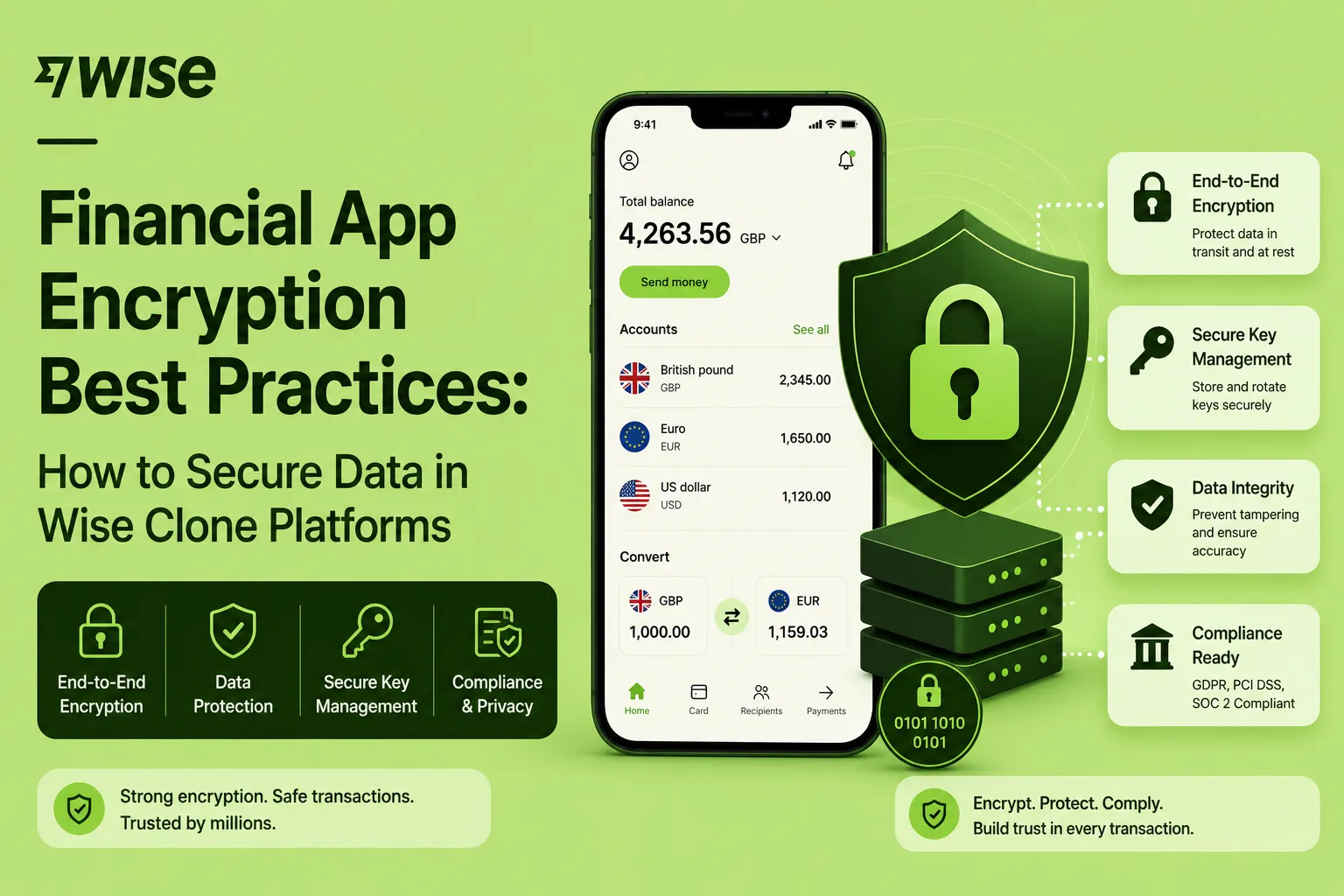
- Financial app encryption protects sensitive user data, transactions, credentials, and communication across fintech platforms.
- Modern fintech systems rely on encryption for databases, APIs, payment flows, authentication, and cloud storage security.
- Strong encryption strategies help reduce fraud risk, unauthorized access, and data exposure incidents.
- Compliance standards often require secure encryption practices for regulated financial applications.
- The goal is to build fintech platforms that balance strong security, scalability, compliance readiness, and user trust.
Stats That Matter
- Financial applications process highly sensitive personal, transactional, and banking information every second.
- Encryption is commonly applied to data at rest, data in transit, backups, authentication systems, and API communication.
- Cloud-based fintech infrastructure requires additional protection through secure key management and encrypted storage systems.
- Weak encryption practices can increase exposure to fraud, account compromise, compliance violations, and reputational damage.
- Security architecture becomes increasingly important as fintech platforms scale across users, regions, and payment ecosystems.
Real Insights
- Encryption should be treated as a core architectural requirement instead of an optional security feature.
- Strong fintech security depends on combining encryption with authentication, monitoring, access control, and fraud detection systems.
- API security, token management, and secure session handling are equally important in modern financial platforms.
- Scalable encryption strategies help fintech apps maintain performance while protecting growing volumes of sensitive data.
- Long-term financial platform success depends on balancing security strength, infrastructure scalability, compliance, and user confidence.
A Wise clone platform handles some of the most sensitive data in a fintech product: user identities, KYC documents, bank details, transaction records, transfer amounts, exchange rates, payout information, device sessions, API tokens, admin actions, and sometimes card or wallet-related data.
That makes encryption more than a technical checkbox.
For developers, financial app encryption best practices should answer three practical questions:
- What data should be encrypted?
- Where should encryption happen?
- Who controls the keys?
A remittance app or Wise-style money transfer app is only as secure as its weakest data path. If the mobile app uses strong TLS but stores tokens insecurely, attackers can still exploit the system. If the database is encrypted but logs expose KYC details, the risk remains. If encryption keys are stored in the same environment as encrypted data without controls, encryption becomes much weaker.
This guide explains how developers can secure data in Wise clone platforms using encryption at rest, encryption in transit, mobile secure storage, key management, API protection, tokenization, audit logs, and secure development workflows.
Miracuves helps founders and agencies build fintech and remittance app foundations with secure API integration, encrypted data handling, admin control, KYC/AML workflow support, audit logs, and source-code-owned flexibility. Final compliance depends on jurisdiction, legal review, integrations, infrastructure, payment partners, and security implementation.
Why Encryption Matters More in Wise Clone Platforms
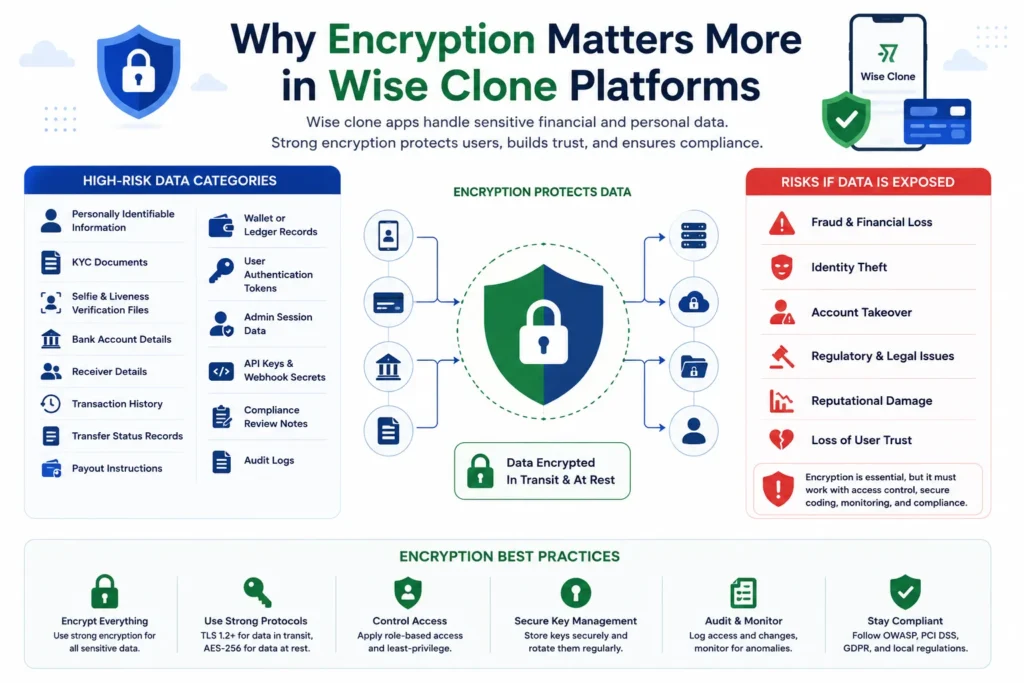
A Wise clone app is not a normal consumer app. It manages money movement, identity verification, sender and receiver profiles, FX workflows, payout details, transaction history, and admin risk controls.
That creates several high-risk data categories:
- personally identifiable information
- KYC documents
- selfie or liveness verification files
- bank account details
- receiver details
- transaction history
- transfer status records
- payout instructions
- wallet or ledger records
- user authentication tokens
- admin session data
- API keys and webhook secrets
- compliance review notes
- audit logs
If this data is exposed, the damage can include fraud, identity theft, account takeover, regulatory issues, reputational loss, and loss of user trust.
OWASP lists cryptographic failures among major application security risks and provides separate guidance for cryptographic storage, TLS, password storage, and mobile app security testing. For financial apps, developers should treat encryption as one layer in a broader security architecture, not as a replacement for access control, secure coding, monitoring, or compliance workflows.
Read More : Microservices Architecture for Wise Clone Apps: How to Scale a Fintech App for 10K+ Concurrent Users
The Core Encryption Model for Financial Apps
A secure Wise clone platform should protect data across four major states.
Financial App Encryption Layers
| Data State | Example in Wise Clone Platform | Security Control |
|---|---|---|
| Data in transit | Mobile app calling backend APIs, admin panel sending payout updates, webhook communication. | TLS 1.2+ or TLS 1.3, certificate validation, HSTS for web, optional certificate pinning for high-risk mobile flows. |
| Data at rest | Databases, object storage, backups, file storage, KYC documents, transaction records. | Database encryption, field-level encryption for sensitive fields, encrypted object storage, backup encryption. |
| Data in use | Application memory, backend processing, transaction monitoring, compliance review queues. | Least-privilege access, short-lived decrypted values, secure memory handling where supported, no unnecessary exposure. |
| Data in logs and analytics | Debug logs, API traces, crash reports, support tools, product analytics. | Redaction, tokenization, masking, log filtering, access control, retention limits. |
Encryption should be designed as part of the system architecture. It should not be added only at the database level after the app is complete.
Best Practice 1: Use Strong TLS for All Data in Transit
Every request between the mobile app, web app, admin dashboard, backend API, payment provider, KYC provider, AML tool, and payout partner should use strong transport encryption.
OWASP’s MASVS network category focuses on verifying that mobile apps establish secure encrypted channels for network communication, and its TLS Cheat Sheet provides implementation guidance for protecting web and application communication with TLS.
For Wise clone platforms, developers should implement:
- HTTPS everywhere
- TLS 1.2 minimum, TLS 1.3 preferred where supported
- strong cipher suites
- valid certificates from trusted authorities
- automatic certificate renewal monitoring
- HSTS for web dashboards
- strict certificate validation
- no fallback to plain HTTP
- no insecure testing certificates in production
- secure webhook endpoints
- mTLS for high-trust internal service communication where needed
Developers should also block mixed content in web panels and avoid sending tokens or sensitive transaction details through query strings, because URLs may end up in logs, browser history, analytics tools, and proxies.
Best Practice 2: Apply Field-Level Encryption for Highly Sensitive Data
Database-level encryption is useful, but it may not be enough for fintech-grade sensitive data. If an attacker gains application-level access or database query access, full-database encryption alone may not protect fields after the database is mounted and running.
For Wise clone platforms, use field-level encryption for sensitive values such as:
- identity document numbers
- bank account numbers
- tax identification numbers
- receiver bank details
- payout account details
- KYC metadata
- compliance notes
- high-risk transaction data
- personally identifiable information
This does not mean every database column should be encrypted. Over-encryption can make search, reporting, fraud detection, and support workflows difficult. A practical approach is to classify data by sensitivity and encrypt the highest-risk fields separately.
A common model:
| Data Type | Recommended Handling |
|---|---|
| Passwords | Never encrypt reversibly; use password hashing such as Argon2id, bcrypt, scrypt, or PBKDF2 based on current implementation requirements |
| Bank details | Field-level encryption or tokenization |
| KYC documents | Encrypted object storage with restricted access |
| Access tokens | Short-lived tokens, encrypted storage when stored, strong rotation |
| Transaction IDs | May be stored normally if not sensitive alone |
| Full transaction history | Database encryption plus strict access control and audit logs |
| Admin notes | Restrict by role; encrypt if notes contain sensitive compliance information |
OWASP’s cryptographic storage guidance states that passwords should not be stored using reversible encryption and should instead use secure password hashing methods.
Best Practice 3: Encrypt KYC Documents and Uploaded Files Separately
KYC files deserve special handling. A Wise clone platform may store passports, national IDs, proof of address, selfies, business registration documents, and verification files.
These files should not be placed in a public bucket, attached to unsecured emails, or stored with predictable URLs.
Use:
- private object storage
- server-side encryption
- customer-managed keys where required
- signed URLs with short expiry
- strict access control
- malware scanning for uploads
- document access audit logs
- retention policies
- deletion workflows
- separate storage paths by environment
- no KYC documents in debug logs or crash reports
Admin users should access KYC documents only through permission-based dashboards. Every view, download, approval, rejection, and note should create an audit event.
Best Practice 4: Secure Mobile Storage on iOS and Android
Mobile apps are a major risk point because devices can be lost, rooted, jailbroken, infected, backed up, or inspected.
OWASP MASVS storage guidance focuses on securely storing sensitive data and preventing leakage through APIs, platform behavior, backups, logs, or other unintended locations.
For Wise clone mobile apps:
- use iOS Keychain for secrets and tokens
- use Android Keystore-backed storage for cryptographic keys
- avoid storing raw access tokens in plain shared preferences
- avoid storing KYC documents locally unless absolutely necessary
- clear sensitive temporary files
- prevent sensitive values from appearing in screenshots where relevant
- disable clipboard use for high-risk fields where practical
- avoid exposing sensitive data in push notifications
- avoid logging API payloads on device
- use biometric access as a convenience layer, not the only security control
- consider certificate pinning for high-risk flows, with a safe certificate rotation strategy
Developers should also prevent sensitive data from leaking into mobile analytics, crash reports, deep links, and local caches.
Best Practice 5: Treat Key Management as a Separate Security System
Encryption strength depends heavily on key management. Poor key storage can make strong algorithms ineffective.
NIST SP 800-57 provides general best-practice guidance for managing cryptographic keying material. For fintech platforms, keys should be managed through a dedicated key management service or hardware-backed security controls where appropriate.
A strong key management model includes:
- centralized key management
- role-based access to keys
- separate keys by environment
- key rotation policies
- key versioning
- key usage logs
- emergency key revocation
- separation of duties
- no hardcoded keys
- no production keys in developer laptops
- no keys in Git repositories
- no keys in CI/CD logs
- no shared admin passwords for key access
Use envelope encryption where practical: encrypt data with a data encryption key, then protect that key with a master key managed in a secure key management system.
Best Practice 6: Use Tokenization for Payment and Bank Data Where Possible
Encryption protects data by making it unreadable without keys. Tokenization replaces sensitive data with a non-sensitive token that has no useful value outside the tokenization system.
For Wise clone platforms, tokenization can be useful for:
- payment card data
- bank account references
- payout account identifiers
- saved payment methods
- third-party provider references
If the platform processes payment card data, PCI DSS becomes relevant. PCI DSS is designed to provide baseline technical and operational requirements for protecting payment account data. In many fintech architectures, developers reduce card-data exposure by using compliant payment providers, hosted payment fields, tokenized payment methods, and provider-managed vaults.
The practical rule: do not store raw payment card details unless the business has a clear compliance, infrastructure, and audit reason to do so.
Best Practice 7: Protect API Secrets, Webhook Secrets, and Service Credentials
Wise clone platforms often integrate with KYC providers, AML tools, FX providers, payout APIs, banking APIs, notification services, analytics tools, and payment gateways.
Each integration introduces secrets.
Protect:
- API keys
- webhook signing secrets
- OAuth client secrets
- private keys
- database credentials
- queue credentials
- storage credentials
- admin panel secrets
- CI/CD deployment tokens
Implementation guidance:
- store secrets in a secrets manager
- rotate secrets regularly
- separate production and staging secrets
- restrict secret access by service identity
- monitor secret usage
- verify webhook signatures
- never expose API keys in mobile app binaries
- never commit
.envfiles - scan repositories for leaked secrets
- revoke secrets immediately after suspected exposure
Public mobile apps cannot safely protect long-term secrets. If a provider requires a secret, the mobile app should call your backend, and the backend should call the provider.
Best Practice 8: Use Password Hashing, Not Password Encryption
Passwords should not be encrypted and decrypted later. They should be hashed using a password hashing algorithm designed to resist brute-force attacks.
OWASP password storage guidance focuses on protecting passwords even if the application or database is compromised.
Use:
- Argon2id where available and appropriate
- bcrypt, scrypt, or PBKDF2 where required by platform constraints
- per-user salts
- strong work factors
- password reset tokens with short expiry
- MFA for admin and high-risk accounts
- breached-password checks where appropriate
- rate limiting
- account lockout or risk-based throttling
Never store plaintext passwords. Never use MD5 or SHA-1 for password storage.
Best Practice 9: Encrypt Backups, Snapshots, and Data Exports
Many breaches happen through backups, not production databases. A Wise clone platform may generate database backups, object storage backups, analytics exports, compliance exports, CSV reports, support exports, and finance reports.
Protect backups with:
- encryption at rest
- access controls
- separate backup keys
- retention policies
- immutable backups where appropriate
- backup access logs
- environment separation
- secure deletion workflows
- restricted export permissions
- watermarking for sensitive admin exports
If admins can export transaction data, KYC statuses, payout records, or compliance reports, exports should be logged and restricted by role.
Read More :- CBDC Integration for Remittance Apps: Preparing Wise-Like Platforms for Digital Currency Payments
Best Practice 10: Redact Sensitive Data From Logs and Monitoring Tools
Logs are often overlooked. Developers may log full API payloads during testing and accidentally keep that behavior in production.
For fintech apps, logs should never expose:
- passwords
- access tokens
- refresh tokens
- OTPs
- full bank account numbers
- full card numbers
- KYC document URLs
- private keys
- webhook secrets
- full identity numbers
- unmasked receiver payout details
- complete payment provider payloads
Use structured logging with redaction rules. Mask sensitive fields before they reach log pipelines. Ensure crash reports, APM tools, analytics tools, and customer support tools follow the same policy.
A practical masking approach:
| Sensitive Field | Display Format |
|---|---|
| Bank account number | XXXXXX1234 |
j***@domain.com | |
| Phone | +91******7890 |
| ID number | XXXX-XXXX-1234 |
| Token | Never display |
| KYC document URL | Never display |
Best Practice 11: Use Strong Access Control Around Encrypted Data
Encryption does not replace authorization.
Even encrypted data eventually needs to be decrypted for legitimate business workflows. That means role-based access control is critical.
A Wise clone platform should enforce:
- least privilege
- role-based admin dashboards
- separate compliance, support, finance, and super-admin roles
- MFA for admin users
- session timeout
- device and IP risk checks for admin accounts
- approval workflows for sensitive actions
- maker-checker patterns for high-risk changes
- audit logs for data access
- restricted production database access
- no shared admin accounts
For example, a customer support agent may need to see transfer status but not full KYC documents. A compliance analyst may need to review KYC documents but not change exchange-rate settings. A finance admin may need payout reconciliation but not identity verification files.
Best Practice 12: Encrypt Internal Service Communication
As fintech platforms grow, they often move from a monolithic backend to multiple services: user service, transaction service, FX service, payout service, notification service, KYC service, AML service, reporting service, and admin service.
Internal traffic can still be sensitive.
Use:
- TLS for internal APIs
- mTLS for high-risk service-to-service communication
- service identity
- API gateway controls
- private networking
- encrypted queues
- encrypted event streams
- restricted service permissions
- signed internal messages for critical workflows
Do not assume internal networks are automatically trusted.
Best Practice 13: Use Audit Logs for Encryption-Relevant Events
A secure financial app should record security-sensitive actions. Audit logs are not encryption, but they help prove control, detect misuse, and support investigations.
Log events such as:
- KYC document viewed
- bank detail updated
- payout account changed
- transaction manually approved
- admin role changed
- API key created
- API key rotated
- webhook secret changed
- encryption key rotated
- sensitive export generated
- failed admin login
- suspicious session detected
- compliance note edited
Audit logs should be tamper-resistant, access-controlled, and retained according to policy. Miracuves security language emphasizes audit logs, role-based access control, encrypted data transfer, encrypted storage, secure API integration, and admin access controls as important fintech security layers.
Best Practice 14: Build Encryption Into the SDLC
Encryption cannot be handled only by the backend developer at the end of the project. It should be part of the software development lifecycle.
Include:
- threat modeling before development
- data classification
- secure coding standards
- encryption architecture review
- secret scanning in CI/CD
- dependency scanning
- mobile security testing
- API security testing
- TLS configuration testing
- penetration testing
- code review for crypto usage
- key rotation drills
- incident response planning
- audit log review
OWASP MASVS can be used by mobile architects, developers, and testers to assess and improve mobile app security.
Common Encryption Mistakes Developers Should Avoid
Encryption Mistakes Developers Should Avoid
Hardcoding Secrets in the App
Mobile apps can be reverse engineered. Do not place long-term API secrets, private keys, or encryption keys inside mobile binaries.
Logging Sensitive Payloads
Debug logs can become production data leaks. Redact KYC, bank, token, identity, and payout information before logs reach monitoring tools.
Using Encryption Without Key Rotation
Encryption keys need lifecycle management. Plan for creation, storage, access, rotation, revocation, and retirement.
Encrypting Passwords Instead of Hashing Them
Passwords should be hashed with strong password hashing algorithms, not stored with reversible encryption.
Forgetting Backups and Exports
Database backups, CSV exports, support downloads, and compliance reports can expose sensitive data if they are not encrypted and access-controlled.
Founder and Developer Decision Signals
Founder and Developer Decision Signals
Data Sensitivity
If your Wise clone platform stores KYC documents, bank details, receiver data, or payout records, field-level encryption and strict access controls should be planned early.
Infrastructure Control
If you need stronger control over keys, logs, storage, and deployment, source-code ownership and cloud architecture visibility become important.
Integration Risk
If your app connects with KYC, AML, FX, payout, or payment providers, secure API secrets, webhook verification, and encrypted provider communication are mandatory.
Audit Readiness
If your platform may face partner review, compliance checks, or security audits, encryption decisions should be documented and backed by audit logs.
Read More :- White-Label Remittance Business Models: How Agencies Can Build Recurring Revenue With Wise Clone Apps
How Miracuves Helps Secure Wise Clone Platforms
Miracuves helps founders, agencies, and fintech teams build Wise clone and remittance app solutions with security-conscious product foundations.
For financial app security, Miracuves can support:
- secure API workflows
- encrypted data transfer
- encrypted data storage planning
- KYC workflow support
- AML workflow support
- role-based admin access
- audit logs
- payment gateway integration
- payout API integration support
- transaction history controls
- admin dashboard permissions
- source-code-owned app foundation
- post-launch customization support where applicable
For ready-made Miracuves solutions, a 6-day launch may be relevant depending on the selected solution, branding, modules, integrations, and customization scope. Pricing should be confirmed based on selected features, integrations, tech stack, and security requirements rather than assumed from generic estimates.
Final Thoughts: Encryption Is a Product Architecture Decision
Financial app encryption best practices are not limited to choosing AES, enabling HTTPS, or checking a security box before launch.
A Wise clone platform needs layered protection across mobile storage, APIs, backend services, databases, object storage, backups, logs, admin dashboards, secrets, and third-party integrations. Developers must also manage keys properly, avoid sensitive logging, tokenize data where practical, and document security decisions for future audits.
The real lesson is simple: encryption should be designed before sensitive financial data enters the system.
Miracuves helps founders and agencies build fintech and remittance app solutions with secure workflows, admin control, audit-ready foundations, source-code ownership, and scalable architecture for long-term product growth.
FAQs :-
What are financial app encryption best practices?
Financial app encryption best practices include TLS for data in transit, encryption at rest for databases and files, field-level encryption for sensitive data, secure mobile storage, key management, tokenization, encrypted backups, log redaction, secure API secrets, and audit logs.
What data should be encrypted in a Wise clone platform?
A Wise clone platform should protect KYC documents, identity numbers, bank details, receiver details, payout data, transaction records, access tokens, API secrets, compliance notes, and sensitive admin activity.
Is database encryption enough for fintech apps?
No. Database encryption is useful, but fintech apps also need field-level encryption, access control, secure key management, encrypted backups, log redaction, secure mobile storage, API security, and audit logs.
How should mobile apps store financial data securely?
Mobile apps should avoid storing sensitive data unless necessary. Tokens and secrets should use platform-backed secure storage such as iOS Keychain or Android Keystore-backed storage. Sensitive data should not appear in logs, screenshots, notifications, caches, or analytics tools.
Should passwords be encrypted in financial apps?
No. Passwords should not be stored with reversible encryption. They should be hashed with secure password hashing algorithms such as Argon2id, bcrypt, scrypt, or PBKDF2 depending on platform and security requirements.
How should encryption keys be managed?
Encryption keys should be stored in a secure key management system, separated by environment, rotated periodically, access-controlled, logged, and never hardcoded in source code, mobile apps, CI/CD logs, or repositories.
Do Wise clone platforms need PCI DSS compliance?
PCI DSS may apply if the platform stores, processes, or transmits payment card data. Many fintech apps reduce PCI scope by using compliant payment providers, hosted payment fields, and tokenized payment methods. Final compliance scope should be confirmed by qualified security and compliance experts.
Can Miracuves help build a secure Wise clone app?
Yes. Miracuves can help founders build Wise clone and remittance app solutions with secure API workflows, encrypted data handling considerations, admin dashboards, KYC/AML workflow support, audit logs, and source-code-owned product foundations.