


Key Takeaways
- Customs duty and VAT APIs help cross-border B2B platforms calculate landed costs before buyers place international orders.
- A strong API should return duty amount, VAT/GST, tax category, HS code logic, shipping impact, and total estimated landed cost.
- For B2B marketplaces, tax calculation depends on product type, buyer country, seller country, invoice value, quantity, and trade rules.
- Accurate landed cost visibility helps reduce buyer confusion, checkout drop-offs, pricing disputes, and post-order support issues.
- Founders building cross-border B2B platforms should connect tax logic with catalog, RFQ, checkout, invoice, shipping, and admin review workflows.
API Integration Signals
- Product data should include category, HS code, material, country of origin, product value, weight, and destination country.
- RFQ workflows should show estimated duties and VAT before suppliers send final quotes or buyers approve bulk orders.
- Checkout should display product price, shipping charges, customs duty, VAT/GST, handling fees, and final landed cost clearly.
- Admin panels should allow manual tax review, country-wise rules, API fallback handling, invoice checks, and landed cost adjustments.
- Reliable integration needs clean API requests, error handling, cached rates, audit logs, tax breakdowns, and compliance-ready order records.
Real Insights
- A customs duty API is not just a checkout feature; it affects pricing trust, supplier communication, buyer decisions, and repeat orders.
- Poor tax visibility can make a B2B marketplace look cheaper upfront but create serious issues after shipping, invoicing, or customs clearance.
- The best platforms treat landed cost calculation as part of the full buying journey, not as a last-minute payment screen calculation.
- For Alibaba-style marketplaces, customs and VAT logic becomes more important when buyers request bulk quotes from international suppliers.
- Miracuves helps founders build cross-border B2B platforms with API integrations, supplier workflows, admin controls, and scalable marketplace architecture.
Cross-border B2B platforms do not fail only because of logistics, supplier onboarding, or payment complexity. Many fail because buyers do not know the real cost of importing goods until it is too late.
A buyer may see a product price, accept an RFQ, pay for shipping, and then discover customs duties, VAT, GST, brokerage fees, handling charges, or import taxes at the delivery stage. That surprise creates disputes, abandoned orders, refund requests, and low trust in the platform.
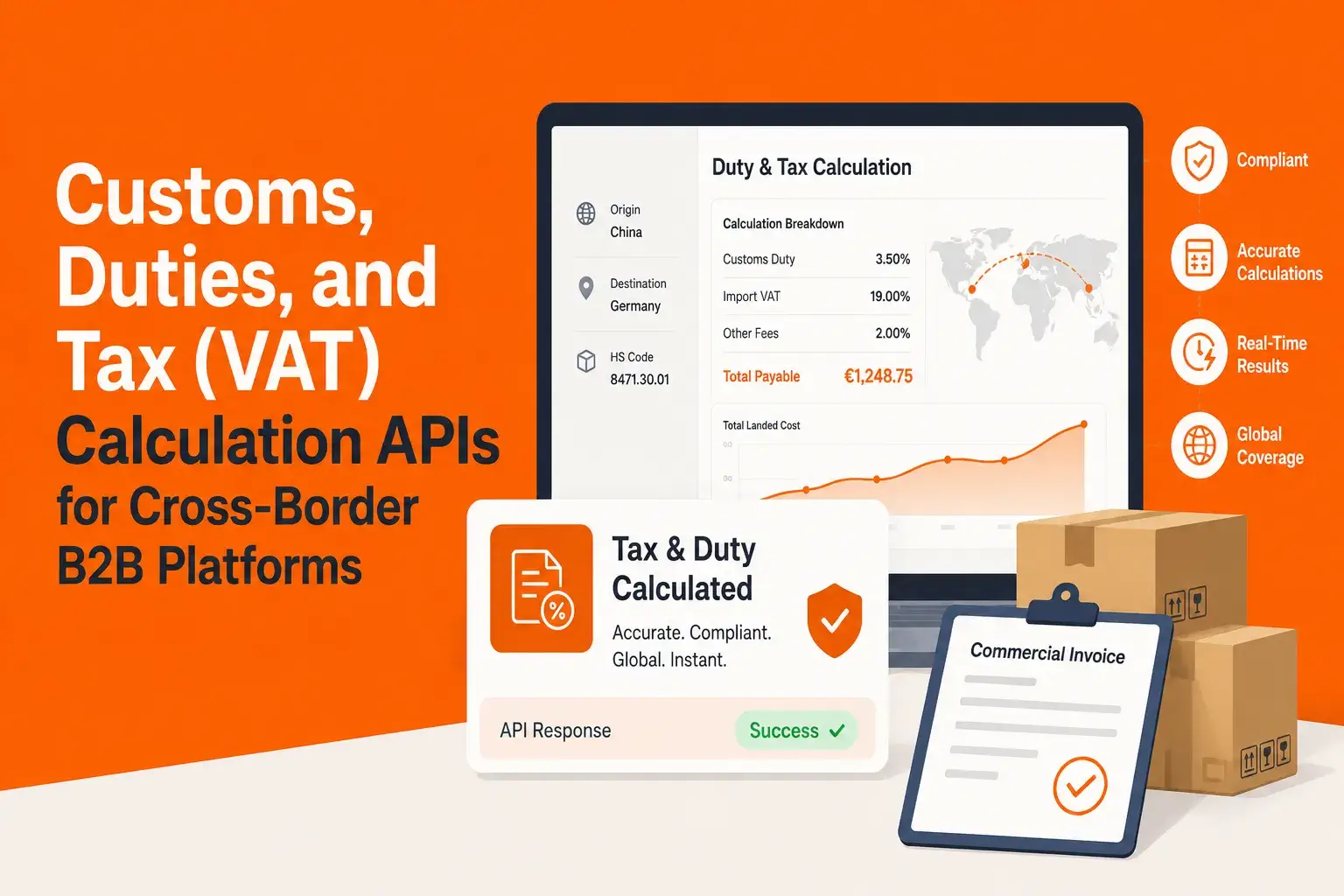
This is why customs duty, VAT, GST, import tax, and landed cost APIs are becoming important for cross-border B2B platforms, Alibaba clone marketplaces, and international ecommerce ecosystems. These APIs help platforms estimate or calculate duties, tariffs, taxes, and total landed cost before the buyer confirms the order.
For founders building a cross-border B2B marketplace, the real question is not only, “Which tax API should we use?” The stronger question is, “Where should duty and VAT calculation sit inside product catalog, supplier pricing, RFQ, checkout, invoice, shipping, and admin workflows?”
Miracuves helps founders build marketplace platforms with supplier panels, buyer dashboards, product catalogs, RFQ systems, checkout workflows, payment integrations, and third-party API connections. For cross-border platforms, this means designing tax and landed cost logic as part of the product foundation, not as a last-minute plugin.
Why Cross-Border B2B Platforms Need Duty and VAT Calculation APIs
A normal ecommerce checkout may involve one buyer, one product, one shipping address, and one payment. A cross-border B2B platform is more complex.
A buyer may request a quote from multiple suppliers. Products may ship from different countries. The order may include bulk quantities, mixed product categories, different HS codes, separate invoices, multiple currencies, and different import rules depending on the buyer’s destination country.
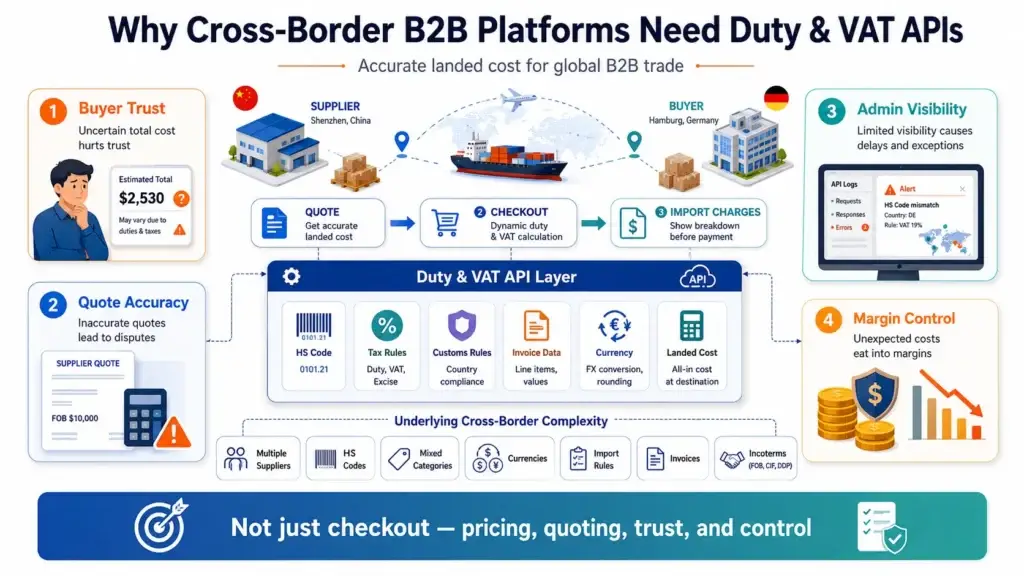
Without a customs duty and VAT calculation layer, the platform may show an incomplete price. That creates four major business risks.
First, the buyer may not trust the final cost. If the checkout shows only product value and shipping cost, the buyer still does not know the full landed cost. In B2B, that uncertainty can delay procurement approval.
Second, suppliers may quote incorrectly. If suppliers do not understand tax, duty, or Incoterm responsibilities, the quote may look competitive at first but become expensive after import charges are added.
Third, admins lose visibility. A marketplace operator needs to see failed tax calculations, missing HS codes, country-specific issues, API logs, and manual overrides.
Fourth, profit margins become unpredictable. If the platform collects duties upfront under a DDP model but calculates them incorrectly, the platform or seller may absorb the difference.
For an Alibaba clone or cross-border B2B marketplace, duty and VAT APIs are not just checkout tools. They are part of pricing, quoting, supplier data quality, buyer trust, and operational control.
Read More:Alibaba Features Explained: A Guide for Startup Founders
What Is a Customs, Duties, and VAT Calculation API?
A customs, duties, and VAT calculation API connects a marketplace platform with tax, tariff, customs, and landed cost data. The API receives shipment and product information, applies country-specific rules, and returns estimated or calculated duties, import taxes, VAT/GST, tariffs, fees, and landed cost.
In simple terms, the platform sends details such as:
- Origin country
- Destination country
- HS or HTS code
- Product value
- Shipping cost
- Insurance cost
- Currency
- Buyer type
- Incoterm
- Quantity
- Product category
The API then returns a tax and duty breakdown that the platform can show during RFQ, checkout, invoice generation, or admin review.
For example, Avalara positions its cross-border product around customs duties, import taxes, VAT, GST, and sales tax calculation from a centralized platform, while DHL’s Duty and Tax Calculator API calculates duties, taxes, and government fees while considering de minimis values and preferential tariff rates.
For a B2B marketplace, the value is not just the API response. The value is how that response is used inside the buyer journey, supplier quote flow, checkout logic, invoice system, and admin dashboard.
Customs Duty vs VAT vs GST vs Landed Cost
Cross-border tax terms can confuse buyers, suppliers, and even marketplace teams. A strong platform should present these charges clearly instead of grouping everything into one vague “fees” label.
| Term | Meaning | Example |
|---|---|---|
| Customs Duty | A tax charged on imported or exported goods based on product type, value, origin, and destination rules. | Duty on industrial machinery imported into Germany. |
| VAT | Value-added tax used in many countries, often applied to imported goods and domestic consumption. | Import VAT applied to goods entering the European Union. |
| GST | Goods and Services Tax used in countries such as India, Australia, Singapore, and others. | Import GST on goods shipped into Australia. |
| Tariff | A trade duty or rate applied based on product classification and country rules. | Product-specific tariff on electronics imported from another country. |
| Landed Cost | The total cost after product value, shipping, insurance, customs duty, taxes, and fees are included. | Final estimated cost a buyer pays before receiving imported goods. |
A platform owner should think of landed cost as the buyer’s real decision number. Product price alone does not help a B2B buyer make a procurement decision. The buyer needs to know the total cost of getting the goods delivered, cleared, and ready for business use.
How Duty and VAT Calculation APIs Work
A duty and VAT calculation API acts as the backend layer that connects product, supplier, buyer, shipping, and tax data. It takes structured order details from the platform and returns a clear estimate of customs duty, VAT/GST, tariffs, fees, and total landed cost.
Typical Flow
1. Buyer starts an order or RFQ
The buyer selects products, adds quantities, or requests a quote.
2. Platform checks origin and destination
The system identifies the supplier’s shipping country and the buyer’s delivery country.
3. Products are classified
Each item is mapped with an HS or HTS code for accurate duty and tariff calculation.
4. Order data is sent to the API
The platform sends product value, quantity, shipping cost, insurance, currency, Incoterm, origin, and destination.
5. API returns the cost breakdown
The API calculates customs duty, VAT/GST, tariffs, government fees, handling charges, and total landed cost.
6. Platform displays and stores the result
The estimate appears during RFQ, cart, checkout, or invoice generation, while the admin system stores the response for audit and support.
Why This Matters for B2B Platforms
Cross-border B2B orders are rarely simple. One order may include multiple suppliers, different origin countries, several HS codes, split shipments, bulk quantities, and buyer VAT/GST IDs.
That is why an Alibaba clone or cross-border B2B platform should not treat duty and VAT calculation as a basic checkout add-on. It should work as a backend service connected to supplier catalogs, RFQs, checkout, invoices, admin logs, and buyer support.
What Data Does a Customs, Duties, and VAT API Need?
A customs duty and VAT API is only as reliable as the data sent to it. If supplier product data is incomplete, the API response may be inaccurate or fail completely.
| Input | Why It Matters |
|---|---|
| Origin country | Determines export/import route, trade agreements, and applicable customs rules. |
| Destination country | Determines duty rate, VAT/GST rules, de minimis thresholds, and import conditions. |
| HS/HTS code | Maps the product to the correct tariff and duty classification. |
| Product value | Used as the base for duty, tax, and landed cost calculation. |
| Quantity | Important for bulk B2B orders and line-item calculations. |
| Shipping cost | Often included in the taxable landed cost base depending on country and Incoterm. |
| Insurance cost | May be included in CIF-based calculations. |
| Currency | Needed for conversion, checkout display, and invoice generation. |
| Buyer type | B2B buyers may require VAT ID validation, reverse-charge handling, or exemption logic. |
| Incoterm | DDP, DDU, DAP, FOB, and CIF affect who pays duties, taxes, freight, and insurance. |
| Product category | Helps classify products when HS codes are incomplete or need validation. |
| Shipment weight and dimensions | Useful for shipping-linked calculations and carrier fee logic. |
For B2B platforms, the API should support line-item calculations. Every product in a bulk order may carry a different HS code, tariff rate, duty rule, and tax treatment.
This matters especially for an Alibaba clone platform where suppliers upload large catalogs and buyers often place mixed-category orders.
Read More:How to Build a Multi-Vendor Inventory Management Database for B2B Apps
API Output: What Should the Platform Receive?
A duty and VAT API should not return only one final amount. For a cross-border B2B platform, the response should be detailed enough to support checkout clarity, RFQ pricing, invoice accuracy, admin review, and buyer communication.
Essential API Outputs
Duty amount
Shows the expected import duty for the product, shipment, or line item.
VAT/GST amount
Shows the destination-based tax applied at import or checkout.
Tariff rate
Explains the percentage or rule used to calculate the duty amount.
Total landed cost
Gives the buyer the estimated final cost before confirming the order.
De minimis result
Shows whether the shipment falls below a duty or tax threshold.
Currency conversion
Helps display accurate values for international buyers, suppliers, and invoices.
Tax breakdown
Separates product value, duty, VAT/GST, fees, shipping, and total payable amount.
Warnings or errors
Flags missing HS codes, unsupported countries, invalid product data, incomplete values, or failed calculations.
Calculation ID and timestamp
Helps admins trace when the estimate was generated and which API response was used.
For an Alibaba clone or cross-border B2B platform, these outputs should be stored against the RFQ, order, invoice, and admin logs. This creates a reliable record for buyer queries, invoice review, tax disputes, failed calculations, and future troubleshooting.
Best Customs, Duties, VAT, and Landed Cost API Providers
The right API depends on the platform’s geography, shipping model, buyer type, product categories, compliance needs, and integration depth.
| API / Platform | Best For | Key Strength |
|---|---|---|
| Avalara AvaTax Cross-Border | Enterprise tax automation and global commerce workflows | Customs duties, import taxes, VAT/GST, sales tax, and compliance workflows. |
| DHL Duty and Tax Calculator API | Shipment-linked duty and tax estimates | Duties, taxes, government fees, de minimis values, and preferential tariff rates. |
| Zonos Landed Cost API | Global landed cost calculation | Duty and tax calculations across 217 countries and territories, with HS-code support. |
| Easyship Import Tax & Duty API | Ecommerce and shipping checkout workflows | DDP/DDU tax, duty, tariff, brokerage, and handling fee calculations. |
| Dutify Landed Cost API | Ecommerce checkout duty and tax calculation | Live import duty and tax calculations for checkout, with API documentation covering VAT/GST, excise, and import taxes. |
| Vertex Marketplace | Enterprise marketplace VAT/GST compliance | Real-time VAT/GST calculation, B2B validation, invoicing, and audit reporting. |
| UPS Global Checkout API | Guaranteed landed cost at checkout | Duties, taxes, and fees shown upfront through UPS-connected checkout flows. |
| Trademo Landed Cost Calculator API | Trade compliance and landed cost estimation | Import duties, tariffs, VAT/GST, hidden charges, HS code, Incoterm, and transport inputs. |
Avalara, DHL, Zonos, Easyship, Dutify, Vertex, UPS, and Trademo each approach the problem differently. Zonos documentation mentions landed cost calculations for 217 countries and territories, Easyship describes DDP/DDU duty and tax calculations, Dutify focuses on live import duty and tax calculations for ecommerce checkout, and Vertex Marketplace supports real-time VAT/GST and B2B validation workflows.
For a cross-border B2B marketplace, the provider comparison should not stop at feature lists. The platform owner should ask:
- Does the API support target import and export countries?
- Can it calculate taxes per line item?
- Does it support HS-code-based duty logic?
- Does it support DDP and DDU workflows?
- Can it handle B2B buyer tax IDs?
- Can it provide audit-ready calculation logs?
- Does it integrate cleanly with RFQ, checkout, invoice, and admin workflows?
- What happens when the API is unavailable?
That last question is important. A tax API should not become a single point of checkout failure without fallback logic.
Where to Integrate Duty and VAT APIs in a B2B Marketplace
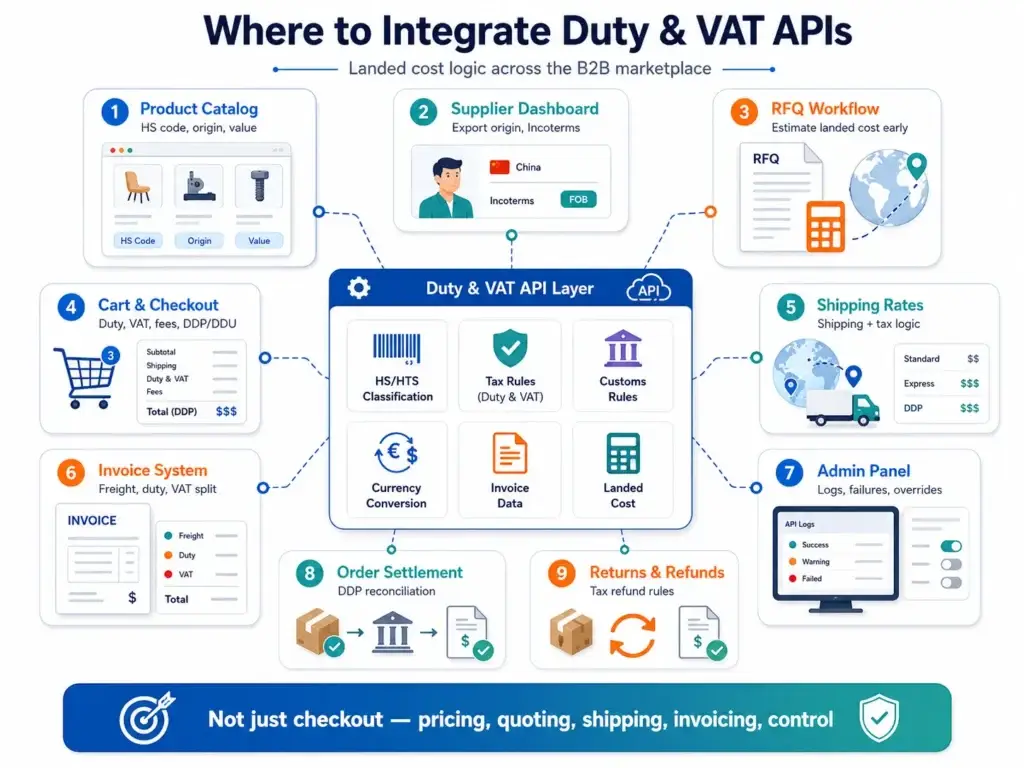
A customs duty and VAT API should not be isolated inside checkout. In a serious B2B marketplace, landed cost logic touches multiple product areas.
Product Catalog
The product catalog should store tax-relevant product data. This includes HS codes, HTS codes, product categories, country of origin, material, declared value, weight, dimensions, and restricted goods flags.
If the catalog is weak, every downstream calculation becomes weak.
For an Alibaba clone platform, supplier catalog quality is one of the biggest drivers of duty and tax accuracy. Suppliers should be guided to enter classification data during product upload instead of leaving the admin team to fix missing information later.
Supplier Dashboard
The supplier dashboard should allow suppliers to manage export origin, warehouse country, product classification, shipping documents, and Incoterm preferences.
A supplier selling from India to Germany may have very different duty logic from a supplier selling the same product from Turkey to Germany. Origin matters.
RFQ Workflow
Many B2B transactions do not go directly from product page to checkout. Buyers request quotes, negotiate price, agree on quantity, and then confirm.
Duty and VAT estimates should appear during RFQ evaluation, not only after the buyer has accepted the quote. This helps the buyer compare suppliers based on total landed cost instead of product price alone.
Cart and Checkout
At checkout, the platform should show a clear landed cost breakdown:
- Product subtotal
- Shipping cost
- Insurance
- Customs duty
- VAT/GST
- Brokerage or handling fees
- Total landed cost
- DDP or DDU responsibility
The buyer should know whether duties and taxes are collected upfront or payable at import.
Shipping Rate Calculation
Shipping and tax logic should work together. Some APIs calculate duty and tax separately, while others connect tax estimates with shipping options.
For example, Easyship’s documentation describes import duties and taxes in the context of DDP and DDU shipping workflows, while UPS describes Global Checkout as a way to offer guaranteed landed cost covering duties, taxes, and fees at checkout.
Invoice System
The invoice should separate product value, freight, insurance, duty, VAT/GST, service fees, and total payable. This matters for B2B buyers because finance teams need a clear cost breakdown for procurement, accounting, and tax records.
Admin Panel
The admin panel should show:
- API request logs
- API response logs
- Failed calculations
- Missing HS codes
- Unsupported countries
- Manual overrides
- Calculation timestamps
- Buyer disputes
- Supplier data issues
- Country-specific error patterns
An admin dashboard is where the marketplace operator controls risk. Without visibility, duty and VAT issues become support tickets instead of manageable operational signals.
Order Settlement
If the platform collects duties upfront, settlement logic must decide whether the seller, platform, carrier, or tax provider holds responsibility for payment and reconciliation.
This becomes especially important in DDP workflows.
Returns and Refunds
Returns can create tax complications. If a buyer returns goods after import duties and VAT were paid, the platform needs clear refund rules. Some taxes may be refundable, some may not, and some may require customs documentation.
The platform should not treat tax refunds exactly like product refunds.
Read More: Best Alibaba Clone Script in 2026: Features & Pricing Compared
DDP vs DDU: Why It Matters for B2B Platforms
DDP and DDU affect who pays duties and taxes, what the buyer sees at checkout, and how much operational responsibility the platform accepts.
| Model | Meaning | Buyer Experience | Platform Responsibility |
|---|---|---|---|
| DDP | Delivered Duty Paid | Buyer pays duties and taxes upfront, usually with a clearer landed cost. | Higher responsibility for accurate calculation, collection, invoice logic, and carrier coordination. |
| DDU / DAP | Delivered Duty Unpaid / Delivered at Place | Buyer may pay duties and taxes at import or delivery stage. | Lower upfront collection responsibility, but higher risk of surprise charges and buyer dissatisfaction. |
DDP creates a smoother buyer experience because the buyer sees the full cost before purchase. However, it requires stronger calculation accuracy, tax collection logic, invoice handling, and operational coordination.
DDU can be simpler for the platform, but it may create confusion if the buyer receives a separate duty or VAT bill after the order has shipped.
For B2B platforms, the right model depends on product category, destination countries, supplier maturity, carrier partners, and buyer expectations. A procurement team buying industrial goods usually wants predictable landed cost, not surprise delivery charges.
Founder Decision Signals Speed
If your marketplace needs cross-border checkout quickly, integrating a trusted tax and landed cost API is usually faster than building country-specific duty logic from scratch.
Cost
Wrong duty estimates can create margin loss, buyer disputes, refund pressure, and support overhead. The cost of poor calculation is often higher than the API cost.
Scalability
As suppliers, countries, product categories, and shipping routes grow, manual landed cost calculation becomes difficult to manage.
Market Fit
If buyers compare suppliers by total landed cost instead of unit price, duty and VAT transparency can directly improve trust and order confidence.
Speed
If your marketplace needs cross-border checkout quickly, integrating a trusted tax and landed cost API is usually faster than building country-specific duty logic from scratch.
Cost
Wrong duty estimates can create margin loss, buyer disputes, refund pressure, and support overhead. The cost of poor calculation is often higher than the API cost.
Scalability
As suppliers, countries, product categories, and shipping routes grow, manual landed cost calculation becomes difficult to manage.
Market Fit
If buyers compare suppliers by total landed cost instead of unit price, duty and VAT transparency can directly improve trust and order confidence.
Common Technical Challenges in Customs Duty and VAT API Integration
Duty and VAT APIs are powerful, but the integration can fail if the platform does not handle edge cases.
Missing HS Codes
HS codes are central to duty and tariff calculation. If suppliers upload products without HS codes, the platform may need auto-classification, admin review, or supplier correction workflows.
Some APIs can estimate based on product titles or categories, but the platform should still treat classification accuracy as an operational priority.
Wrong Product Classification
A wrong HS code can lead to wrong duty calculation. In B2B, this can affect large orders and create serious cost differences.
The platform should support admin review, supplier correction, and classification confidence flags.
Multi-Vendor Cart With Multiple Origin Countries
A buyer may add products from several suppliers in different countries. The platform should calculate duties separately per supplier origin, not as a single blended shipment.
Split Shipments
Bulk orders may ship in multiple batches. If the platform calculates duty on the full order but the shipment is split, tax and customs logic may change.
Currency Conversion Errors
A supplier may quote in USD, the buyer may pay in EUR, shipping may be billed in another currency, and tax may need to be shown in the destination country’s currency.
The platform needs a currency conversion layer that works consistently with tax calculation and invoice display.
De Minimis Threshold Changes
De minimis thresholds determine whether a shipment below a certain value may avoid some duties or taxes. These thresholds vary by country and can change.
DHL’s Duty and Tax Calculator API documentation specifically notes that it considers de minimis values and preferential tariff rates.
API Downtime
If the tax API fails, checkout should not simply break. The platform needs fallback logic, retry rules, admin alerts, and a clear message to the buyer.
Manual Admin Override Requirement
Some calculations need human review. Admins should be able to override HS codes, retry calculations, mark estimates as pending, or request supplier correction.
Refund and Return Tax Logic
If goods are returned, duties and taxes may not always be refunded automatically. The platform needs clear return rules and documentation handling.
Recommended Architecture for B2B Duty and Tax API Integration
A strong cross-border B2B platform should separate tax calculation into a structured backend architecture instead of scattering tax logic across checkout screens.
1. Product Classification Layer
This layer stores HS codes, product category, country of origin, material, weight, and classification confidence. It should connect to supplier product upload, admin review, and optional HS-code classification APIs.
2. Tax and Duty API Connector
This connector communicates with the selected provider, such as Avalara, DHL, Zonos, Easyship, Dutify, Vertex, UPS, or Trademo. It should normalize request and response formats so the platform is not locked into one provider forever.
3. Landed Cost Calculation Service
This service combines product value, quantity, shipping, insurance, duty, VAT/GST, tariffs, fees, and currency conversion into a total landed cost.
4. Checkout Pricing Engine
The checkout engine decides how to display duties and taxes based on DDP, DDU, buyer type, supplier policy, and destination rules.
5. RFQ Tax Estimation Module
The RFQ module allows buyers to compare quotes based on total landed cost, not just product price. This is especially important in Alibaba clone and B2B procurement platforms.
6. Invoice and Compliance Module
The invoice module separates product value, shipping, duty, VAT/GST, fees, and total payable. It should support tax breakdowns, calculation IDs, and downloadable records.
7. Admin Audit Logs
Every API request and response should be logged. Admins should be able to see what data was sent, what response came back, and whether the calculation was accepted, failed, retried, or overridden.
8. Fallback and Manual Override System
If the API is unavailable or product data is incomplete, the platform should support fallback messaging, manual review, and controlled checkout blocking where needed.
This architecture gives marketplace operators more control. It also helps reduce vendor lock-in because the platform owns the workflow even if the tax API provider changes later.
Example: Cross-Border B2B Order Calculation
Imagine a buyer in Germany purchases industrial tools from a supplier in India through a cross-border B2B platform.
The supplier has uploaded product details, including product category, declared value, country of origin, weight, and HS code. The buyer enters a German delivery address and provides a VAT ID. The platform checks the order quantity, shipping cost, insurance cost, currency, and Incoterm.
The duty and VAT API receives the data and calculates:
- Customs duty
- Import VAT
- Tariff rate
- Handling or brokerage estimate
- Total landed cost
- Warnings if the HS code or product value needs review
The platform then shows the buyer a clear breakdown before order confirmation.
Instead of seeing only “Product price: $5,000,” the buyer sees the estimated full cost of importing the goods. This supports faster procurement decisions and reduces invoice disputes later.
Build vs Integrate: Should You Create Your Own Tax Engine?
Most cross-border B2B platforms should not build customs duty and VAT calculation logic completely from scratch.
The reason is simple: duty rates, tax rules, product classifications, country regulations, trade agreements, de minimis thresholds, and e-invoicing requirements can change frequently. Maintaining this logic internally requires legal, tax, logistics, and engineering resources.
A better approach is to integrate a trusted customs duty, VAT, GST, or landed cost API and build a strong internal workflow around it.
The platform should own:
- Product classification workflows
- Supplier data validation
- Buyer tax ID collection
- RFQ display logic
- Checkout landed cost display
- Invoice breakdowns
- Admin controls
- Audit logs
- Manual overrides
- Provider fallback strategy
The API provider should handle the specialized calculation layer.
This gives the platform a better balance between accuracy, speed, scalability, and operational control.
How Miracuves Helps Build Cross-Border B2B Platforms With Tax API Integrations
Building a cross-border B2B platform is more complex than creating product listings and onboarding suppliers. The platform needs connected workflows for catalog management, supplier dashboards, buyer accounts, RFQs, checkout, shipping, payments, invoices, tax APIs, admin controls, and reporting.
This is where Miracuves helps founders create a practical marketplace foundation. For an Alibaba clone platform , Miracuves can support essential B2B marketplace workflows such as supplier product uploads, buyer dashboards, RFQ management, order tracking, payment gateway integration, shipping API connections, admin dashboards, and third-party API integrations.
For cross-border B2B platforms, these integrations can include customs duty APIs, VAT/GST calculation APIs, landed cost APIs, currency conversion tools, shipping APIs, payment systems, and compliance-ready workflows based on the selected business model.
The goal is not to copy Alibaba feature by feature. The goal is to build a scalable cross-border marketplace where buyers can compare suppliers, understand landed costs, approve quotes with confidence, complete orders smoothly, and receive transparent invoices. Miracuves helps businesses turn that marketplace logic into a launch-ready digital product with the right control layer for buyers, suppliers, and admins.
Final Checklist Before Integrating a Duty and VAT API
Before choosing a customs duty, VAT, GST, or landed cost API, make sure it supports the real workflows of your cross-border B2B platform, including RFQs, bulk orders, multiple suppliers, split shipments, buyer tax IDs, and DDP/DDU delivery terms.
| Checklist Area | What to Check | Why It Matters |
|---|---|---|
| Country coverage | Supports your import and export countries | Ensures calculations match your buyer-supplier trade routes |
| HS/HTS codes | Calculates duties using product classification codes | Improves tariff and landed cost accuracy |
| Duty and tax coverage | Covers customs duty, VAT, GST, tariffs, and fees | Gives buyers a clearer total cost before checkout |
| Line-item calculation | Supports product-level calculation | Useful for bulk orders with different product categories |
| B2B tax IDs | Handles VAT/GST IDs or business tax workflows | Supports B2B invoice and tax treatment needs |
| DDP/DDU logic | Supports prepaid or unpaid duty workflows | Clarifies who pays duties and taxes |
| RFQ estimates | Calculates landed cost before checkout | Helps buyers compare supplier quotes more accurately |
| Cost breakdown | Returns duty, tax, fees, currency, and total landed cost | Builds checkout and invoice transparency |
| Workflow integration | Connects with catalog, RFQ, checkout, shipping, invoice, and admin systems | Keeps tax logic consistent across the platform |
| Admin controls | Allows retry, override, flagging, and logs | Helps manage failed calculations and data issues |
| Split shipments | Supports multi-supplier and multi-origin orders | Fits real B2B marketplace operations |
| Fallback flow | Handles API downtime or incomplete data | Prevents checkout and RFQ workflows from breaking |
A duty and VAT API should not only return a tax number. It should support the full marketplace flow from supplier product data to RFQ pricing, checkout, invoices, admin review, and buyer support. For an Alibaba clone or cross-border B2B platform, review this checklist during product planning to avoid costly rework later.
Conclusion
Cross-border B2B platforms need more than product listings, supplier profiles, and payment gateways. They need accurate landed cost visibility, customs duty logic, VAT/GST workflows, tax-aware checkout architecture, and admin controls that help businesses manage international trade complexity.
The right customs duty and VAT API can reduce buyer confusion, protect margins, support better RFQ decisions, and make international ordering more predictable. But the real advantage comes from designing the platform so tax and landed cost logic works smoothly across catalog data, supplier inputs, RFQs, checkout, invoices, shipping, admin review, and post-order support.
For founders building an Alibaba clone or cross-border B2B marketplace, the next step is not only choosing an API provider. It is creating a scalable marketplace foundation where buyers can see costs clearly and admins can control complex cross-border workflows with confidence.
Miracuves helps businesses build marketplace platforms with the right product foundation, third-party API integrations, admin control, and scalable workflows for cross-border commerce. To plan your platform architecture and integration needs, schedule a consultation with Miracuves and discuss the right approach for your business model.
FAQs
What is a customs duty calculation API?
A customs duty calculation API is a software interface that calculates expected import duties based on product type, HS code, origin country, destination country, declared value, shipment details, and applicable customs rules. In a cross-border B2B platform, it helps buyers see duty estimates before confirming an RFQ or checkout order.
What is a landed cost API?
A landed cost API calculates the estimated total cost of importing goods. This usually includes product value, shipping, insurance, customs duty, VAT/GST, tariffs, brokerage fees, handling charges, and other import-related costs. For B2B platforms, landed cost is important because buyers need to compare suppliers based on total delivered cost, not just unit price.
How does a VAT calculation API work for B2B marketplaces?
A VAT calculation API uses destination country, buyer type, product category, buyer tax ID, invoice details, and transaction value to calculate applicable VAT or GST. In B2B marketplaces, VAT logic may also involve VAT ID validation, reverse-charge workflows, exemptions, and invoice-level tax reporting depending on the jurisdiction.
Which data is required to calculate customs duties and VAT?
Most APIs require origin country, destination country, HS/HTS code, product value, quantity, shipping cost, insurance cost, currency, buyer type, and Incoterm. B2B platforms may also need buyer VAT/GST ID, supplier warehouse country, product classification, and line-item-level values.
What is the difference between DDP and DDU?
DDP means Delivered Duty Paid. The seller or platform collects and handles duties and taxes upfront. DDU, often handled today through DAP-style workflows, means the buyer may pay duties and taxes at delivery or import stage. DDP gives buyers more cost clarity, while DDU can create surprise charges if not explained properly.
Can duty and tax APIs calculate HS-code-based tariffs?
Yes, many customs duty and landed cost APIs use HS or HTS codes to calculate product-specific tariffs and duties. However, the accuracy depends on the quality of product classification. A B2B platform should support supplier-entered HS codes, admin review, and correction workflows.
Do B2B platforms need VAT ID validation?
Many cross-border B2B platforms benefit from VAT ID validation because buyer tax status can affect VAT treatment, reverse-charge workflows, invoice requirements, and compliance processes. Final tax handling depends on the buyer’s country, seller location, transaction type, and legal review.
Which APIs are used for customs, duties, and VAT calculation?
Common providers include Avalara AvaTax Cross-Border, DHL Duty and Tax Calculator API, Zonos Landed Cost API, Easyship Import Tax & Duty API, Dutify, Vertex Marketplace, UPS Global Checkout API, and Trademo Landed Cost Calculator API. The right choice depends on countries, shipping model, B2B tax logic, API depth, and integration requirements.
Should a B2B marketplace build its own tax engine?
Most B2B marketplaces should not build customs duty and VAT calculation logic from scratch because rates, tariffs, country rules, trade agreements, and thresholds change frequently. A better approach is to integrate a trusted tax API and build strong internal workflows for catalog data, RFQs, checkout, invoices, admin logs, and manual overrides.
How can Miracuves help integrate duty and VAT APIs into a marketplace?
Miracuves can help build cross-border B2B marketplace platforms with supplier panels, buyer dashboards, RFQ systems, checkout workflows, payment gateways, shipping integrations, invoice systems, admin dashboards, and third-party API integrations for customs duty, VAT/GST, landed cost, currency conversion, and compliance-ready workflows.