
Key Takeaways
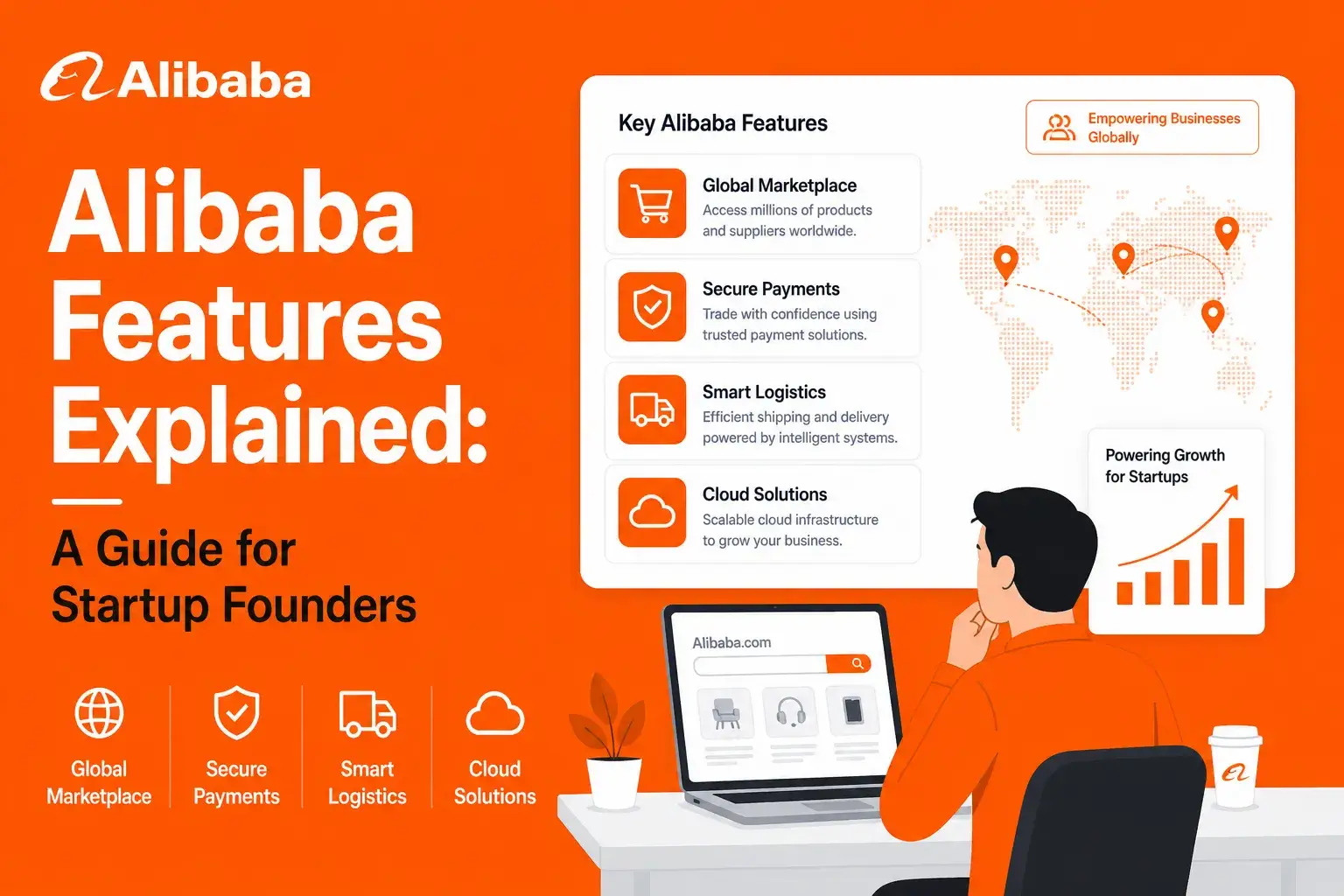
- An Alibaba-like app needs strong B2B marketplace features for buyers, suppliers, manufacturers, and admins.
- Product discovery, supplier verification, bulk ordering, RFQ, payments, and logistics are core platform drivers.
- Buyers need trusted suppliers, clear product details, quote comparison, and secure transaction workflows.
- Suppliers need catalog tools, inquiry management, pricing control, order tracking, and business analytics.
- A feature-rich Alibaba clone can help startups build a scalable B2B ecommerce marketplace.
Feature Signals
- Buyers need advanced search, filters, supplier profiles, RFQ forms, product comparison, and secure checkout.
- Suppliers need product listing tools, MOQ settings, quote handling, inventory updates, and lead tracking.
- Admins need control over users, suppliers, listings, commissions, payments, disputes, verification, and reports.
- Trust features like verified suppliers, ratings, trade assurance, and dispute handling improve buyer confidence.
- Notifications keep buyers, suppliers, and admins updated on inquiries, quotes, orders, payments, and shipment status.
Real Insights
- A B2B marketplace needs supplier trust and product data quality before it can scale.
- Weak RFQ and quote workflows can reduce buyer conversion and supplier engagement.
- Clear MOQ, pricing, shipping, certification, and product details help buyers make faster decisions.
- Verification, payment protection, and dispute handling reduce risk in high-value B2B transactions.
- Miracuves builds Alibaba Clone apps with B2B marketplace, supplier management, RFQ, bulk ordering, payments, and admin workflows.
Let’s rewind to a time when importing products from China was something only giant corporations could afford. Back then, if you were a small business owner trying to source custom socks or bamboo toothbrushes, you were either out of luck or needed serious connections. That all changed the moment Alibaba came into the picture.
From a scrappy startup in Jack Ma’s apartment to a juggernaut reshaping global commerce, Alibaba didn’t just build a marketplace—it built the blueprint for B2B eCommerce at scale. And here’s the twist: it’s not magic. It’s features—yes, cold, hard, well-thought-out features—that drive the entire operation. Want to build your own global trading empire? Better know what’s under the hood.
That’s exactly what we’ll dive into in this post: a detailed, value-packed breakdown of Alibaba’s top features, how they work in real-world scenarios, and what aspiring founders and startups can learn from them. And hey—if you’re already dreaming of your Alibaba-style platform, Miracuves just might be the team to call.
Read more: What is Alibaba App and How Does It Work?
What Makes Alibaba Tick: The Core Features You Can’t Ignore
1. Advanced Product Listings and Search Filters
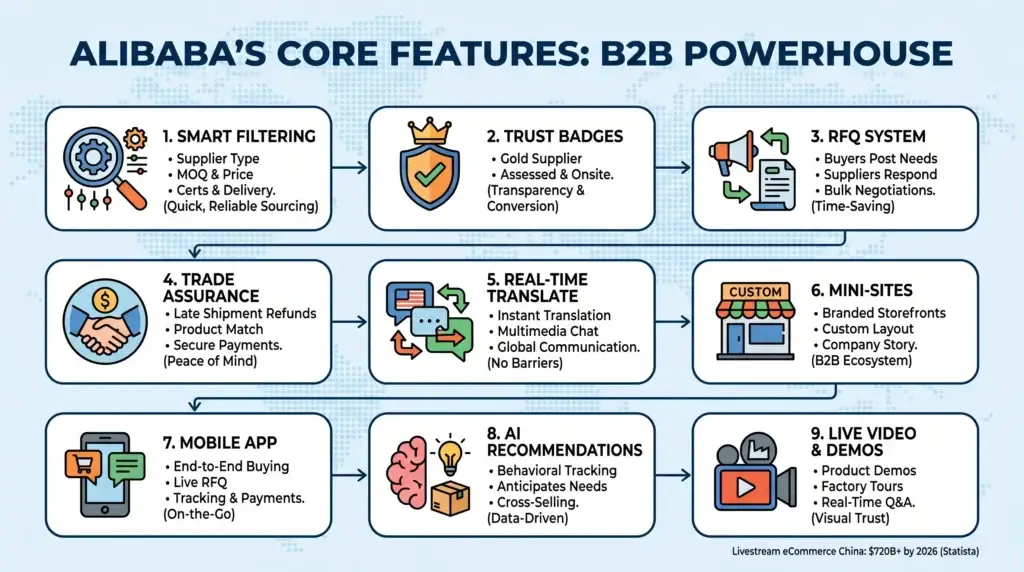
At the heart of Alibaba’s platform is its enormous product catalog. But without precision filtering, it’s just digital noise. Alibaba lets users filter products by:
- Supplier type (Manufacturer, Trader, Wholesaler)
- MOQ (Minimum Order Quantity)
- Price range
- Certification (e.g., CE, FDA)
- Delivery time
Why it matters: This isn’t just a filter frenzy. It’s a data-driven UX strategy that helps buyers zero in on reliable suppliers quickly—critical in the B2B world where bulk orders are the norm.
2. Supplier Verification & Trust Badges
Alibaba uses multiple verification tiers to build trust:
- Gold Supplier: Paid membership indicating the seller is verified
- Assessed Supplier: Includes audit reports from third-party agencies
- Onsite Check: Verifies the physical existence of the business
Trust is currency in online B2B. If you’re building a marketplace, offering transparency through certifications or on-site verifications isn’t optional—it’s conversion gold.
3. RFQ (Request for Quotation) System
This feature flips the script. Instead of hunting suppliers, buyers post what they need and let suppliers come to them.
- Time-saving for buyers
- Lead generation for sellers
- Supports bulk negotiations
A U.S.-based eco-brand posts an RFQ for biodegradable lunch boxes. Within hours, 12 verified Chinese manufacturers respond with offers.
4. Trade Assurance & Secure Payments
Alibaba’s Trade Assurance program gives buyers peace of mind with:
- Refunds for late shipments or non-matching products
- Escrow-style payment handling
- Logistics tracking
This is Alibaba’s answer to the age-old B2B trust problem. It’s PayPal meets import-export logistics.
5. Integrated Messaging & Real-Time Translation
Global commerce = language barriers. Alibaba handles this with:
- Real-time translation in messaging
- Multimedia chat support (images, videos)
- Document sharing
It’s WeChat for commerce. You can chat with a seller in Shenzhen while sipping your coffee in Brooklyn, and never worry about miscommunication.
6. Mini-Sites for Verified Sellers
Alibaba lets premium sellers build their own branded storefronts within the platform.
- Custom banner, logo, and layout
- Product categories
- Company video and story
This turns Alibaba into not just a marketplace, but a branded B2B ecosystem.
7. Mobile App with End-to-End Buying Power
Alibaba’s mobile app is far from just a product browser. It supports:
- Live RFQs
- In-app messaging
- Order tracking
- Payment integration
Smartphones aren’t just part of the experience—they are the experience, especially in emerging markets.
8. AI-Based Product Recommendations
Alibaba uses AI to track behavior, searches, and transaction history, suggesting products buyers didn’t even know they needed.
Example: You searched for stainless steel tumblers, and now you’re seeing cap manufacturers, laser engravers, and packaging solutions.
Why it works: Alibaba isn’t just selling products—it’s anticipating needs.
9. Live Video & Product Demos
With livestream commerce booming in Asia, Alibaba jumped in with:
- Live product demos
- Behind-the-scenes factory tours
- Real-time Q&A with suppliers
This builds emotional resonance and visual trust—especially valuable for big-ticket B2B orders.
According to Statista, livestream eCommerce in China is projected to reach over $720 billion by 2026.
Read more: Best Alibaba Clone Scripts in 2025: Features & Pricing Compared
Global Cost of Development for a Netflix-Like App
Netflix-Like Video Streaming App Development — Market Price by Tech Stack
The tech stack affects streaming quality, user data security, subscription flow, content access, and platform scalability in a Netflix-like video app. PHP/Laravel works well for cost-effective OTT app launches, Node.js/React.js supports real-time watch history, recommendations, and user activity, while Go microservices suit large streaming platforms with high traffic, secure video delivery, and multi-device support.
PHP/Laravel is often the most practical choice for launching an Alibaba-like marketplace quickly and affordably. Node.js/Python fits better when real-time supplier workflows and data-heavy B2B activity become more important, while Go microservices are better suited for enterprise-scale wholesale marketplaces with higher concurrency and more complex infrastructure needs.
These values reflect global development cost estimates. Final pricing varies based on video streaming setup, user profiles, subscription plans, payment gateways, content library, DRM/security layers, watch history, recommendations, admin controls, compliance needs, and platform complexity.
Miracuves Alibaba-Like Platform Solution Cost and Tech Stack
Miracuves Pricing for a Alibaba-Like B2B Marketplace Platform developed in PHP/Laravel with Flutter Apps for $3,099 USD (One-Time Price) in just 6 days
Get a fully developed, deployment-ready B2B marketplace platform modeled after Alibaba. Built on a stable PHP foundation, this complete package includes everything you need to launch and scale a wholesale marketplace for suppliers, manufacturers, distributors, exporters, and business buyers:
- Core Workflows: Supplier onboarding, buyer registration, product listing, category management, RFQ submission, bulk ordering, inquiry management, cart checkout, order tracking, shipment updates, and buyer-supplier communication.
- Built-in Revenue Logic: Supplier commissions, subscription plans, featured product listings, promoted supplier profiles, transaction fees, RFQ monetization, advertising placements, service charges, and premium seller tools.
- Management Hub: Centralized admin dashboard, supplier management, buyer management, product approval, RFQ monitoring, order tracking, payment records, refund handling, dispute management, verification controls, and marketplace analytics.
- Launch-Ready: Fully prepared for your custom branding, configuration, payment gateway setup, supplier onboarding, product category setup, RFQ workflow setup, and immediate market entry.
Why Is Alibaba-Like Marketplace Development More Affordable?
Most B2B marketplace platforms become expensive when businesses choose fully custom development from scratch. An Alibaba-style platform usually needs supplier panels, buyer workflows, product catalogs, bulk order logic, RFQ modules, payment systems, inquiry management, shipping workflows, dispute handling, and admin controls. Building all of this separately can increase both development cost and launch time.
We took a smarter, more practical approach:
- You Aren’t Paying for Ground-Up Development: Our B2B marketplace engine is already developed, tested, and ready to deploy. You skip the inflated cost and long waiting period usually required for building an Alibaba-style platform from scratch.
- The Power of PHP: We built this solution on a reliable and cost-effective PHP architecture. This keeps the upfront price affordable while supporting essential B2B marketplace workflows such as supplier management, buyer inquiries, RFQs, product listings, bulk orders, payments, and admin operations.
You get a launch-ready Alibaba-like B2B marketplace with practical wholesale commerce features, source code access, and faster deployment without the high custom development price tag.
Note: This cost is for the solution, re-branding, deployment, and source code only.
Bonus Features That Boost Alibaba’s Stickiness
Product Comparison Tool
Let’s users compare features, pricing, and ratings side by side.
Buyer Community Forum
Buyers can share experiences and rate suppliers—think Yelp, but for bulk trade.
Logistic Solutions
End-to-end freight, customs, and insurance services built into the purchase flow.
Why These Features Matter for Startup Founders
Each feature Alibaba offers is rooted in solving one big pain point: friction in global trade. Whether it’s trust, logistics, communication, or customization—Alibaba smooths it all out.
For founders building clone apps, the takeaway is simple: don’t just copy the interface—replicate the value. That’s what your users will pay for.
At Miracuves, we’ve helped entrepreneurs launch Alibaba-style platforms tailored for niche verticals, from industrial parts to local organic goods. With scalable tech and deep feature replication, we don’t just help you build—we help you compete.
Read more: Unlocking the Secrets of Alibaba App Marketing Success
Conclusion
Alibaba’s success didn’t come from luck or hype. It came from understanding real-world buyer and seller pain points and solving them at scale—with features that work.
If you’re dreaming of building the next big marketplace, keep your focus on functionality, trust-building, and UX detail.
At Miracuves, we help innovators launch high-performance app clones that are fast, scalable, and monetization-ready. Ready to turn your idea into reality? Let’s build together.
FAQs
What is Trade Assurance on Alibaba?
Trade Assurance is Alibaba’s free buyer protection service that refunds your payment if the order isn’t shipped on time or doesn’t match the contract terms.
Can I message suppliers directly on Alibaba?
Yes! You can chat in real time using built-in translation tools, send images, and even negotiate pricing.
How do I know if a seller is legit?
Look for badges like “Gold Supplier” or “Verified Supplier.” You can also read reviews and see audit reports.
What’s the difference between RFQ and regular search?
RFQ lets buyers post what they need and receive offers, while regular search means browsing and contacting suppliers directly.
Does Alibaba support small orders?
Some suppliers do. You can filter by MOQ (Minimum Order Quantity) to find low-volume sellers.
Can I launch my own Alibaba-style platform?
Absolutely. With the right tech team (like Miracuves), you can build a custom, scalable B2B marketplace clone.
Related Articles:
Miracuves is an independent software development company. We are not affiliated with, connected to, sponsored by, or endorsed by any company or product named in this article.
Terms such as “X Clone” are used descriptively. It is how the software industry refers to building a platform with functionality comparable to a known service, and how clients search for it.
The entire design and codebase of our products is built by our own team. Our products contain no code, design, graphics, or content originating from any third-party website or applications.
All third-party names and marks referenced in this article are the property of their respective owners, referenced solely to identify the services discussed.