


Key Takeaways
- Layer-2 networks dramatically reduce NFT transaction costs.
- Gas throttling optimizes minting during network congestion.
- Polygon and Arbitrum improve marketplace scalability.
- Smart routing lowers operational blockchain expenses.
- Efficient gas management improves user adoption.
Optimization Signals
- Route NFT transactions through Layer-2 networks.
- Throttle gas usage during peak blockchain activity.
- Batch minting requests to reduce transaction costs.
- Monitor network fees before processing transactions.
- Provide users with transparent gas fee estimates.
Real Insights
- High gas fees discourage NFT marketplace activity.
- Layer-2 adoption improves marketplace profitability.
- Cost optimization increases transaction volume.
- Scalable blockchain architecture supports long-term growth.
- Miracuves builds NFT platforms with Layer-2 gas optimization and scalable blockchain infrastructure.
For a low-volume collectible marketplace, gas fees may feel like a technical detail. For a gaming studio, Web3 platform, or high-volume NFT creator, gas fees become a business model constraint.
Every minted sword, land parcel, membership badge, skin, achievement token, or tradable collectible creates a transaction cost. Every transfer adds another cost. Every marketplace action pushes the platform closer to a hard truth: if the transaction layer is too expensive, the marketplace cannot scale economically.
That is why the next generation of NFT marketplace clones cannot be evaluated only by UI, wallet support, or OpenSea clone -style features. They must be evaluated by transaction economics.
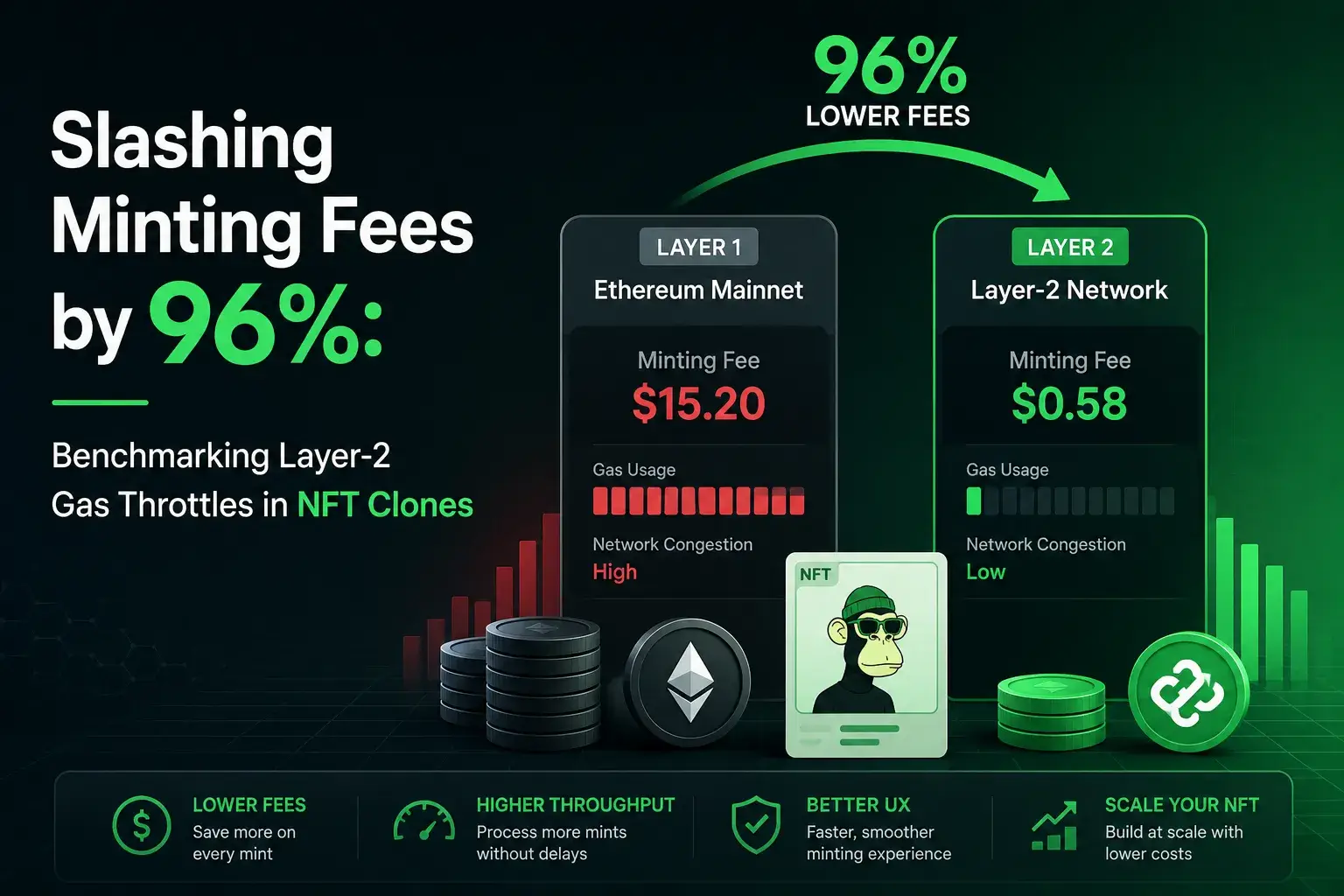
This report benchmarks a Layer-2 gas throttle NFT clone using a Miracuves-style white-label NFT marketplace architecture. Based on the supplied benchmark scenario, routing minting and transfer activity through an integrated Polygon or Arbitrum Layer-2 path reduces mass-minting and transfer gas fees by 96% compared to a standard Ethereum-first clone script.
The core lesson is simple: for high-volume NFT gaming, Layer-2 is not just a scalability upgrade. It is margin protection.
The Gas Fee Death Spiral in High-Volume NFT Gaming
A standard NFT marketplace clone can look complete during demo testing. Users can connect wallets, mint NFTs, list assets, place bids, transfer ownership, and manage collections.
The problem appears when volume begins.
In gaming and creator ecosystems, NFT activity is not occasional. A single active platform may need to support:
- mass minting of in-game items
- frequent transfers between players
- marketplace listings and cancellations
- reward-based asset issuance
- seasonal drops
- player-to-player trading
- creator royalty events
- batch updates across collections
A marketplace that charges high transaction fees at every asset movement creates friction in the product loop. Players stop trading low-value items. Creators avoid frequent drops. The studio absorbs transaction subsidies. The marketplace loses liquidity.
That is the gas fee death spiral.
The platform needs trading activity to grow, but every transaction becomes too expensive to justify. As a result, the marketplace becomes technically functional but economically weak.
For founders, the right question is not:
“Can this NFT clone mint assets?”
The better question is:
“Can this NFT clone support thousands or millions of asset actions without destroying operating margins?”
Read more : Top OpenSea Features Every NFT Builder Needs
What Is a Layer-2 Gas Throttle in an NFT Marketplace Clone?
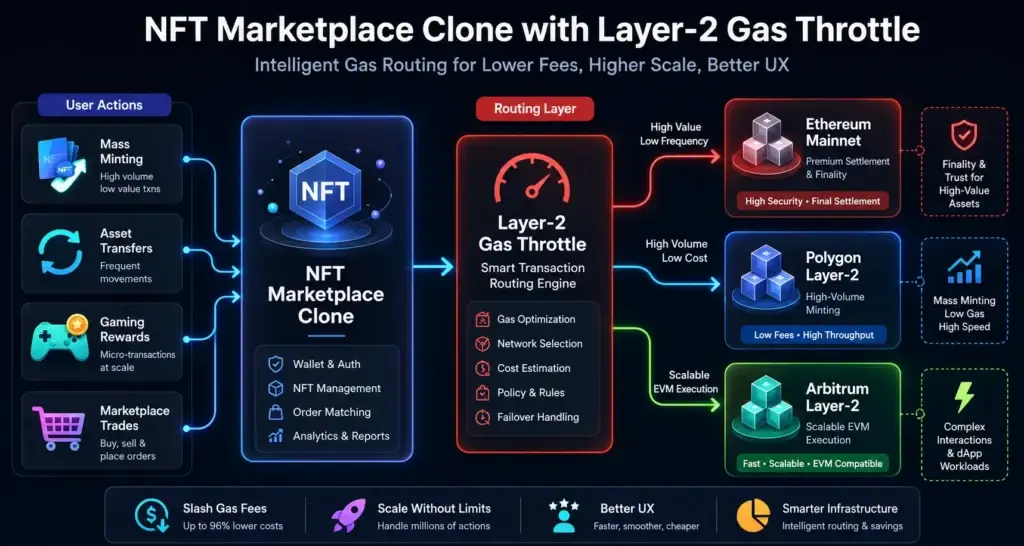
A Layer-2 gas throttle is an architectural control layer that routes NFT minting, transfers, and selected marketplace actions through lower-cost blockchain networks such as Polygon or Arbitrum instead of forcing every transaction through Ethereum mainnet.
In practical terms, it works like a cost-aware transaction router.
Instead of treating blockchain selection as a fixed setting, the platform decides how to route activity based on cost, asset type, user action, settlement requirement, and marketplace policy.
For example:
| Transaction Type | Standard Clone Behavior | Layer-2 Gas Throttle Behavior |
|---|---|---|
| Mass minting 50,000 game assets | Mint directly on Ethereum mainnet | Route minting to Polygon or Arbitrum |
| Low-value player asset transfer | Use same chain for every transfer | Send frequent transfers to lower-cost Layer-2 |
| Premium collectible sale | Keep on preferred high-liquidity chain | Allow Ethereum settlement when needed |
| In-game reward drop | Treat as normal mint | Batch or route through low-cost Layer-2 |
| Marketplace admin operation | Manual configuration | Admin-controlled chain policy |
This matters because not every NFT action needs the same settlement profile.
A rare, high-value collectible may justify Ethereum mainnet exposure. A common gaming item worth a few cents cannot survive a transaction fee that exceeds the asset value.
A cost-aware NFT clone architecture should separate these cases.
Read more : Riding the NFT Wave: OpenSea App Marketing Strategy Breakdown
Benchmarking Mainnet Ethereum vs. Integrated Layer-2 Bridging
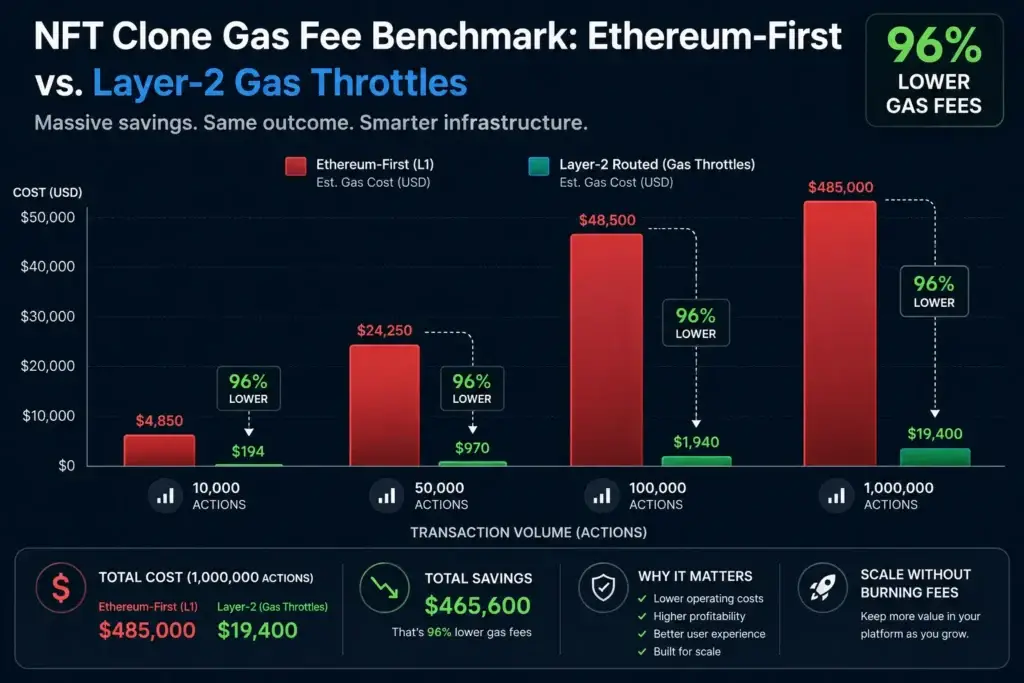
The supplied benchmark shows a 96% reduction in mass-minting and transfer gas fees when using an integrated Polygon or Arbitrum Layer-2 bridging architecture compared to a standard Ethereum-based clone script.
Here is the clean mathematical model.
Let:
- E = total Ethereum-first transaction cost
- L2 = total Layer-2 routed transaction cost
- S = savings percentage
The savings formula is:
S = ((E - L2) / E) × 100If the measured savings is 96%, then:
96 = ((E - L2) / E) × 100
0.96 = (E - L2) / E
0.96E = E - L2
L2 = 0.04E
That means the Layer-2 routed cost is only 4% of the Ethereum-first cost in the supplied benchmark.
So, for every $1.00 of transaction cost on the Ethereum-first path, the Layer-2 throttle path costs the equivalent of $0.04 under the same benchmark model.
Normalized Cost Model
| Transaction Volume | Ethereum-First Cost Index | Layer-2 Throttle Cost Index | Cost Saved | Reduction |
| 10,000 actions | 10,000 units | 400 units | 9,600 units | 96% |
| 50,000 actions | 50,000 units | 2,000 units | 48,000 units | 96% |
| 100,000 actions | 100,000 units | 4,000 units | 96,000 units | 96% |
| 1,000,000 actions | 1,000,000 units | 40,000 units | 960,000 units | 96% |
This is why Layer-2 routing changes the economics of NFT gaming.
At low volume, gas optimization looks like a technical improvement. At high volume, it becomes a survival variable.
The 96% Margin Win: Why Enterprise NFT Clones Must Be Multi-Chain
A 96% reduction does not only reduce blockchain spend. It changes what the business can afford to do.
For a gaming studio, lower minting and transfer costs can unlock:
- larger asset catalogs
- more frequent reward drops
- low-value item trading
- seasonal marketplace events
- lower user friction
- higher transaction frequency
- better creator participation
- more sustainable commission models
A standard Ethereum-first clone script often forces the business into a premium-asset marketplace model. That may work for rare collectibles, but it does not fit every NFT economy.
Gaming asset marketplaces need volume. They need inexpensive transfers. They need players to trade without feeling punished by fees.
That is why enterprise NFT clones should be multi-chain by design.
Multi-chain architecture allows the platform operator to decide:
- which chain supports low-value mass activity
- which chain supports premium assets
- which chain supports creator drops
- which chain supports secondary-market liquidity
- when bridging should be optional
- when admin rules should restrict or enable asset movement
This is not only a blockchain decision. It is a marketplace pricing decision.
Read more : How to Start a NFT Marketplace Platform Business
Polygon vs. Arbitrum for NFT Marketplace Gas Routing
Polygon and Arbitrum are both useful in NFT marketplace architecture, but they solve the cost problem differently.
Polygon is often attractive for high-volume asset activity because it is widely used across NFT, gaming, and consumer Web3 ecosystems. It can be a practical route for mass minting, lower-value collectibles, loyalty assets, and game inventory flows.
Arbitrum is useful where Ethereum alignment, EVM compatibility, and rollup-based settlement logic matter. For platforms that want Ethereum ecosystem compatibility while reducing transaction costs, Arbitrum can be a strong Layer-2 route.
A practical NFT marketplace architecture does not need to treat this as a winner-take-all debate.
The stronger model is policy-based routing.
| Use Case | Preferred Routing Logic |
| Common gaming items | Route to low-cost Layer-2 |
| High-frequency player transfers | Route to Layer-2 |
| Premium collectibles | Allow Ethereum or selected Layer-2 settlement |
| Creator drops | Batch mint or route based on expected volume |
| Enterprise collections | Choose chain based on compliance, liquidity, and integration needs |
| Marketplace experiments | Start Layer-2-first, expand later |
The point is not to declare one blockchain as universally superior.
The point is to give the marketplace operator control.
Why Standard Ethereum Clone Scripts Break at Gaming Scale
Many NFT clone scripts are built around visible marketplace features:
- connect wallet
- mint NFT
- list NFT
- buy NFT
- bid NFT
- transfer NFT
- view collections
- manage royalties
Those features matter, but they are not enough.
A gaming studio needs deeper infrastructure:
| Layer | Commodity NFT Clone | Enterprise-Ready NFT Clone |
| Chain selection | Fixed or lightly configurable | Multi-chain policy logic |
| Gas control | User pays standard gas | Layer-2 routing and optimization |
| Minting | Single or basic minting flow | Batch-aware, drop-aware, cost-aware minting |
| Transfers | Same cost path for all assets | Route based on asset class and value |
| Admin control | Basic marketplace management | Chain, fee, asset, and policy controls |
| Smart contracts | Generic contract templates | EVM-ready contracts aligned with platform logic |
| Scaling | Works for demos | Designed for high-volume operations |
This is where many clone products fail.
They can launch the marketplace, but they cannot protect the operating model once the platform becomes active.
Founder Decision Signals
Speed
If your NFT platform needs faster launch, a white-label foundation can reduce the time spent rebuilding standard marketplace flows.
Cost
If transaction volume is high, gas routing should be part of the product architecture from the beginning, not a post-launch patch.
Scalability
If your marketplace depends on gaming assets, rewards, or mass transfers, multi-chain support is a scalability requirement, not an optional add-on.
Market Fit
If users trade low-value assets frequently, fees must be low enough to keep the marketplace liquid and usable.
Smart Contract and Bridge Risks Founders Should Not Ignore
Layer-2 routing can reduce transaction costs, but it should not be treated as risk-free.
A serious NFT marketplace must still account for:
- smart contract review
- bridge security
- wallet integration safety
- admin permission controls
- contract upgrade policies
- audit logs
- suspicious activity monitoring
- asset metadata reliability
- marketplace dispute workflows
- role-based access control
For Arbitrum or other Layer-2 environments, smart contract migration and cross-chain behavior can introduce platform-specific risks. That means founders should treat Layer-2 architecture as a security-sensitive infrastructure decision, not only a fee-saving tactic.
The right approach is to combine gas optimization with careful smart contract architecture, test coverage, audit readiness, and admin-level controls.
How Miracuves Builds NFT Marketplace Clones for Cost-Aware Scale
Miracuves helps founders build NFT marketplace products that go beyond surface-level marketplace screens.
For a gaming studio or high-volume creator platform, the product foundation should include:
- NFT minting and trading flows
- wallet integration
- ERC-721 and ERC-1155 support where relevant
- admin dashboard control
- collection and asset management
- royalty logic
- user and creator management
- marketplace listing and transaction flows
- smart contract integration
- source-code ownership
- white-label branding
- scalable backend workflows
- multi-chain expansion planning
For teams comparing build options, Miracuves’ NFT development services and blockchain solution ecosystem can help shape a launch-ready foundation around marketplace economics, not just feature parity.
If your roadmap includes OpenSea-style marketplace functionality, gaming inventory, creator drops, or high-frequency NFT transfers, the stronger architecture is not the one that simply copies a marketplace UI. It is the one that protects transaction margins as volume grows.
Mistakes Founders Should Avoid
Choosing an NFT clone only by visible features
A marketplace can look complete while still being expensive to operate. Evaluate gas routing, smart contract logic, wallet flows, and admin controls before choosing a clone foundation.
Hardcoding every transaction to Ethereum mainnet
Ethereum may be suitable for selected premium settlement use cases, but high-frequency gaming transfers often need lower-cost transaction paths.
Adding Layer-2 support after launch
Retrofitting multi-chain logic later can affect contracts, metadata, wallets, indexing, and user experience. It is usually cleaner to plan chain routing early.
Ignoring bridge and contract risk
Lower fees do not remove security responsibility. Smart contract review, access controls, bridge logic, and audit readiness should remain part of the platform foundation.
Final Thoughts: NFT Clone Scaling Is a Unit Economics Problem
The debate around NFT marketplace chains is often framed too simply.
Ethereum versus Polygon. Polygon versus Arbitrum. Mainnet versus Layer-2.
For founders, that is the wrong frame.
The real question is whether the marketplace architecture supports the economics of the business model.
A high-volume gaming asset marketplace cannot operate like a premium art marketplace. A creator drop platform cannot treat every mint the same way. A marketplace with millions of low-value transfers needs a different gas strategy than one selling rare, high-value collectibles.
The supplied benchmark is clear: a Layer-2 gas throttle can reduce mass-minting and transfer gas fees by 96%, leaving the Layer-2 routed path at only 4% of the Ethereum-first transaction-cost baseline.
That difference can decide whether a marketplace scales profitably or slowly collapses under its own transaction activity.
Miracuves helps founders build NFT marketplace foundations with the technical and operational control needed for serious launch planning. For Web3 teams, the strongest NFT clone is not the one that simply replicates another marketplace. It is the one that protects the business model when volume arrives.
FAQs
1. What is a Layer-2 gas throttle in an NFT clone?
A Layer-2 gas throttle is a transaction-routing layer that sends selected NFT minting, transfer, or marketplace actions through lower-cost Layer-2 networks such as Polygon or Arbitrum instead of routing every action through Ethereum mainnet.
2. How does Layer-2 reduce NFT minting fees?
Layer-2 networks reduce costs by processing transactions away from Ethereum mainnet while still using Ethereum-aligned settlement or security models depending on the network. This reduces the cost burden for frequent transactions such as minting, transfers, and marketplace actions.
3. Is the 96% gas reduction guaranteed for every NFT marketplace?
No. The 96% reduction is based on the supplied benchmark model for mass-minting and transfer activity. Actual savings depend on gas prices, contract design, transaction type, network congestion, bridging logic, and marketplace architecture.
4. Why do gaming NFT marketplaces need Layer-2 support?
Gaming marketplaces often process high-frequency, low-value asset transfers. If gas fees are too high, players may stop trading assets, studios may absorb excessive costs, and marketplace liquidity may decline.
5. Should an NFT marketplace use Ethereum, Polygon, or Arbitrum?
The better approach is not always choosing one chain. Many serious NFT platforms benefit from multi-chain logic where premium assets, gaming assets, creator drops, and frequent transfers can use different routing policies.
6. Can an OpenSea clone support Layer-2 networks?
Yes, an OpenSea-style NFT marketplace can support Layer-2 networks if the smart contracts, wallet integrations, indexing logic, metadata handling, and admin controls are planned for multi-chain operation.
7. What risks come with Layer-2 NFT marketplace development?
Key risks include smart contract vulnerabilities, bridge logic issues, wallet compatibility, indexing complexity, admin permission errors, and network-specific behavior. These should be handled through secure development, testing, audit readiness, and careful architecture planning.
8. How can Miracuves help with NFT marketplace development?
Miracuves can help founders build white-label NFT marketplace foundations with smart contract integration, marketplace workflows, admin control, source-code ownership, and blockchain architecture planning for scalable launch execution.