
Key Takeaways
What You’ll Learn
- OpenSea grew through community-first marketing by showing up where NFT users already spent time.
- Creator-focused UX became organic marketing because easy listing and no-code collections helped creators promote themselves.
- Brand partnerships added credibility through limited NFT drops and cultural collaborations.
- Education reduced Web3 friction by helping new users understand wallets, NFTs, and buying flows.
- The main lesson for founders is to build trust, creator love, and culture into the product.
Stats That Matter
- The article highlights six growth pillars: community, creators, partnerships, UX, education, and real-time marketing.
- Early traction came from X, Discord, Reddit, and Clubhouse where NFT communities were already active.
- Creator advocacy grew through simple tools like easy listing flows, no-code collections, and lazy minting.
- Marketplace retention improved through discovery UX including trending NFTs, wallet flow, and floor price tools.
- Growth tactics include niche communities, shareable collections, frictionless onboarding, drops, rewards, and exclusivity.
Real Insights
- OpenSea did not market like a normal app because it became part of the NFT culture first.
- Creators became the growth engine when the product helped them launch, share, and sell faster.
- Trust came from visible adoption through creators, collectors, communities, and known brand drops.
- Education turned curiosity into confidence for first-time NFT buyers and mainstream creators.
- For founders, build an OpenSea-style NFT marketplace around community, creator tools, easy onboarding, strategic drops, and culture-led growth.
Remember when NFTs were the digital wild west? Apes in hoodies, pixel punks, and everyone claiming they were “early.” Fast forward to now, and while the hype isn’t 2021-level bonkers, platforms like OpenSea are quietly building a real user base, sustaining creators, and perfecting the business of trading JPEGs. The difference? Smart marketing. Less flash, more trust, and tons of community juice.
If you’re a startup thinking about launching a digital marketplace, especially one in the NFT, digital asset, or collectible space, OpenSea isn’t just a success story—it’s a blueprint. From Twitter AMAs to gas fee memes, they turned chaos into clicks and built real growth, not vanity metrics. That’s why studying OpenSea’s marketing strategy can help founders understand how to position, promote, and scale an OpenSea clone in a competitive Web3 marketplace.
Let’s crack the code of how they did it. And if you’re planning to launch your own NFT or marketplace app without re-inventing the wheel, Miracuves can help you launch faster, better, and smarter.
Why OpenSea’s Marketing Strategy Still Makes Waves
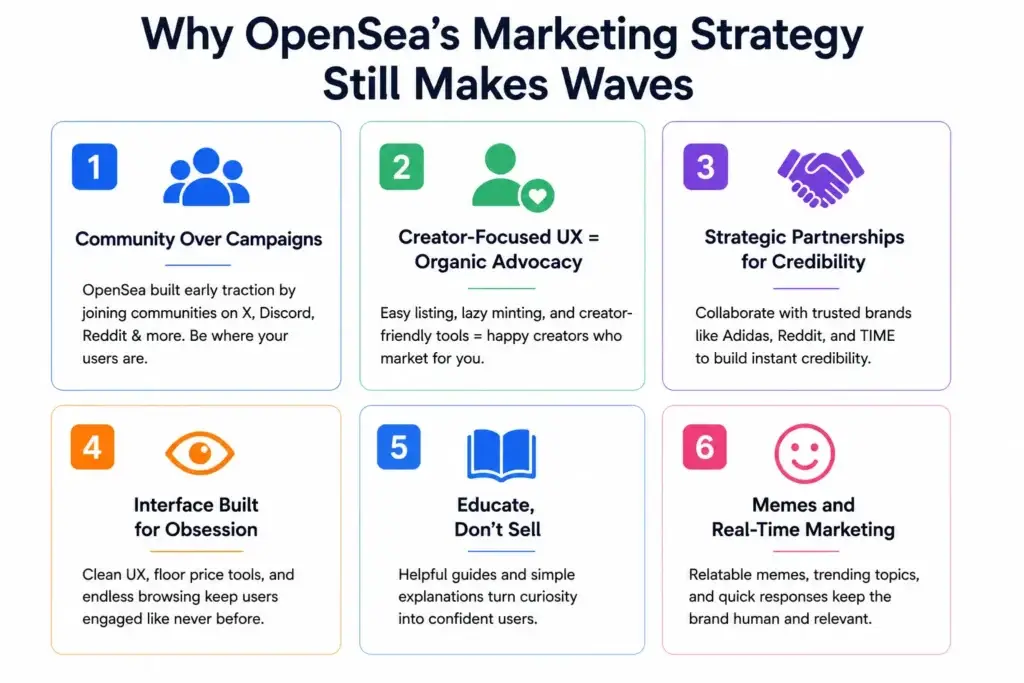
1. Community Over Campaigns
OpenSea didn’t spam users with ads—they invited them in. Their earliest traction came from X (Twitter), Discord, Reddit, and even Clubhouse rooms, where they positioned themselves not as a product—but as part of the NFT community. They hosted AMAs, joined heated debates, and celebrated creators like rockstars.
The takeaway? Don’t just market your app—be the user you want to attract. Be visible in the same places they hang out.
2. Creator-Focused UX = Organic Advocacy
You know what creators love? Control. And OpenSea delivered. Easy listing flows, no-code collections, and even “lazy minting” to save gas fees made the app wildly creator-friendly. And what do happy creators do? They tell everyone.
Rather than hard-sell promotions, OpenSea’s growth came from creator evangelism—tweet threads, YouTube tutorials, and even unsolicited TikTok walkthroughs.
3. Strategic Partnerships for Credibility
OpenSea teamed up with brands like Adidas, Reddit, and TIME Magazine to create limited edition drops. These weren’t random—they were cultural collaborations that gave OpenSea legitimacy beyond “crypto bros.”
It’s marketing by association: Don’t tell users your platform is credible—show them who trusts you already.
4. Interface Built for Obsession
OpenSea’s app isn’t flashy—it’s functional. The infinite scroll of trending NFTs, clean wallet connections, and “floor price” tools keep collectors glued. It’s like TikTok for traders.
They turned scrolling into a hobby. And made browsing feel like treasure hunting. That’s UX designed to retain.
5. Educate, Don’t Sell
OpenSea invested heavily in educational content—guides, FAQs, “how to buy your first NFT” posts. They simplified blockchain jargon for mainstream creators and first-time collectors.
This turned curiosity into confidence—something most platforms forget in the race to look “cool.”
TechCrunch on OpenSea’s NFT onboarding education initiatives
6. Memes and Real-Time Marketing
NFT Twitter is weird—and OpenSea leans in. They post relatable memes, trending topics, and subtle product shoutouts without sounding like a brand robot. Their tone is human, witty, and plugged in.
Their marketing team’s superpower? Timeliness. They react to community sentiment instantly, whether it’s positive hype or platform backlash.
Learn More: Best OpenSea Clone Scripts in 2025 | Build Your NFT Marketplace
How You Can Apply This to Your Own Marketplace App
1. Start with Your Niche Community
OpenSea didn’t market to “everyone.” They focused on crypto artists, Web3 collectors, and early adopters. Who’s your early tribe? Gamers? Artists? Digital creators?
Go deep, not wide. Get into their platforms—Telegram, Reddit, X—and become a trusted participant, not a billboard.
2. Build Marketing Into the Product
Your app should help users promote themselves. Just like OpenSea makes every collection easily shareable, your clone should empower creators to become your marketing engine.
3. Remove Friction at Every Turn
From wallet onboarding to pricing NFTs, OpenSea minimized headaches. Your app should do the same—think guest logins, easy asset creation, and real-time analytics for creators.
4. Use Drops and Exclusivity to Drive Hype
OpenSea’s timed drops created urgency and gave them calendar-worthy moments. Schedule limited-time launches, seasonal events, and unlockable rewards to keep users engaged.
How to Build Your Own OpenSea Clone with Miracuves
Conclusion
OpenSea didn’t just ride the NFT trend—they built the boat. Their app marketing isn’t loud, it’s strategic—rooted in trust, creator love, and digital culture.
At Miracuves, we help innovators launch high-performance app clones that are fast, scalable, and monetization-ready. Ready to turn your idea into reality? Let’s build together.
FAQs
How did OpenSea grow without traditional ads?
Through community involvement, creator partnerships, and social media engagement, especially on platforms like X and Discord.
What role do creators play in OpenSea’s marketing?
They’re the engine. Happy creators promote their own listings, which indirectly promotes OpenSea through every shared link or thread.
Is OpenSea’s success replicable?
Yes—if you focus on creator-first UX, strong onboarding, and community-led growth instead of traditional ads.
How important is UI in NFT apps?
Very. Traders and collectors spend hours browsing. An intuitive, visually engaging UI is key to retention and conversion.
Can I apply these tactics to a non-NFT app?
Absolutely. Whether it’s gaming assets, digital collectibles, or tokenized media, these strategies work across verticals.
Why choose Miracuves for OpenSea-style apps?
Because we don’t just build apps—we build experiences that convert. Our OpenSea clone app is packed with features and built for scale.
Related Articles:
Miracuves is an independent software development company. We are not affiliated with, connected to, sponsored by, or endorsed by any company or product named in this article.
Terms such as “X Clone” are used descriptively. It is how the software industry refers to building a platform with functionality comparable to a known service, and how clients search for it.
The entire design and codebase of our products is built by our own team. Our products contain no code, design, graphics, or content originating from any third-party website or applications.
All third-party names and marks referenced in this article are the property of their respective owners, referenced solely to identify the services discussed.