Key Takeaways
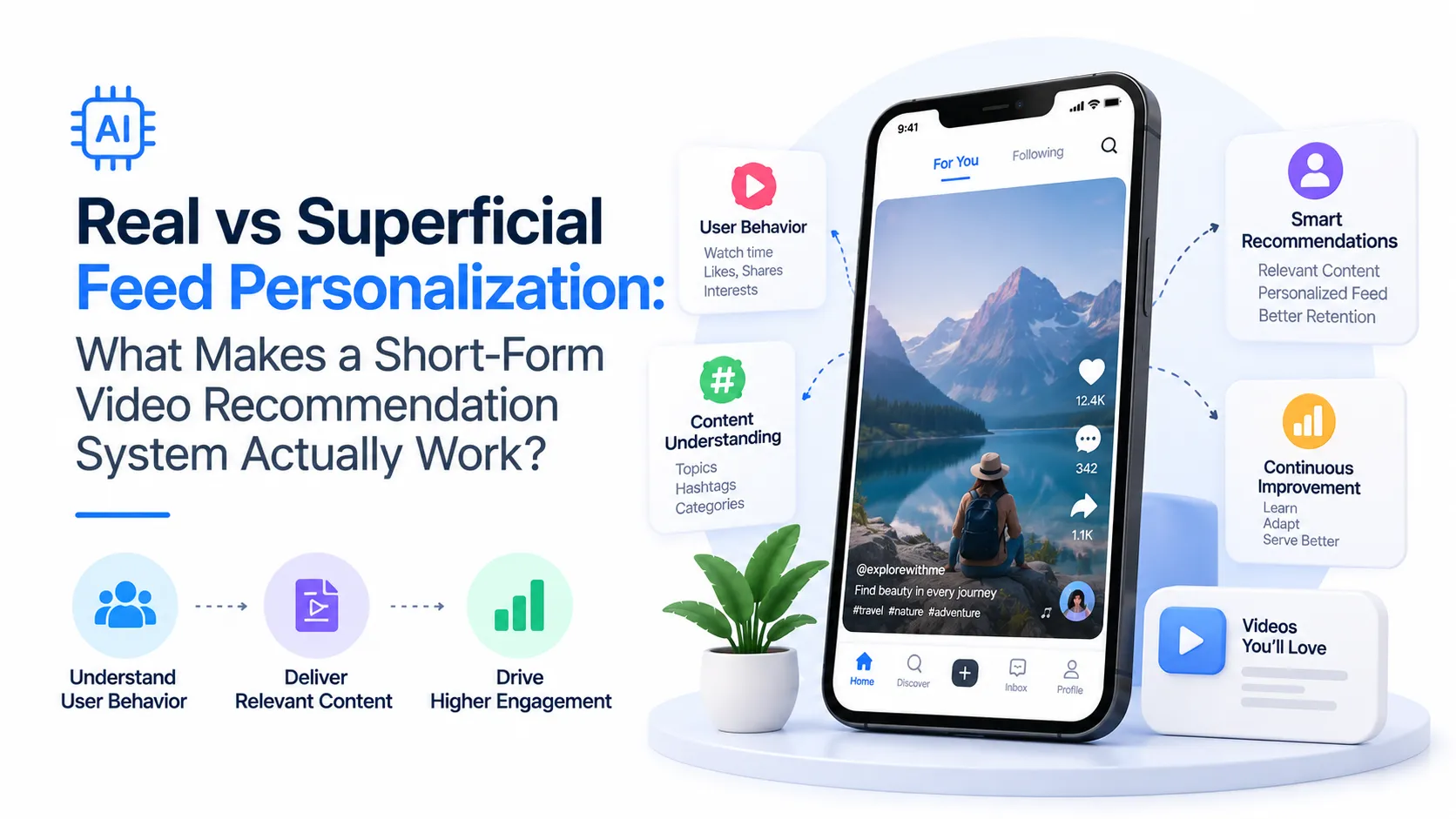
- A short-form video recommendation system becomes genuinely personalized when it adapts to watch time, completion, skips, rewatches, follows, shares, searches, and changing user interests.
- Superficial personalization often relies too heavily on broad categories, trending videos, or a few recent interactions, causing repetitive feeds and weak content discovery.
- Effective feed personalization requires relevance, freshness, diversity, exploration, negative feedback, creator variety, and continuous learning rather than simply repeating similar videos.
Personalization Quality Signals
- Real personalization can combine watch duration, completion rate, replays, likes, comments, saves, shares, follows, search behavior, topic interest, and session-level activity.
- Ranking logic should balance familiar interests with new creators, adjacent topics, trending content, exploration slots, freshness weighting, and duplicate suppression.
- Skips, hides, “not interested” actions, unfollows, repeated impressions, declining watch time, and session exits should act as negative signals that quickly influence future recommendations.
Recommendation System Insights
- A strong recommendation engine should continuously re-rank content as user intent changes instead of permanently assigning viewers to fixed interest categories.
- Operators should monitor recommendation clicks, completion rates, skips, creator diversity, repeat impressions, discovery rate, session depth, and return viewing to evaluate feed quality.
- Miracuves develops customizable short-form video platforms with personalized feeds, recommendation logic, content ranking, discovery controls, engagement analytics, moderation, and admin management.
A short-form video app can look polished at first glance. The feed scrolls smoothly, videos keep loading, creators can upload content, and users can like, comment, follow, and share. But a working interface does not always mean the platform has a real recommendation system.
The real test is whether the feed learns from user behavior.
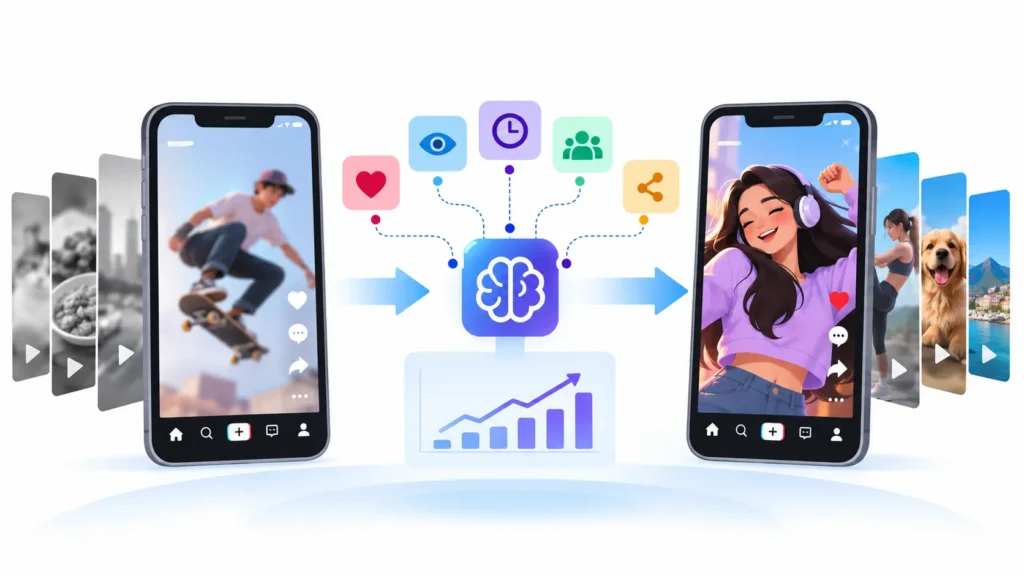
A strong personalized feed studies what users watch, skip, replay, complete, share, report, and engage with over time. A weak feed may simply rotate random videos, show the newest uploads, or push the same trending clips to everyone.
For founders building a creator platform, this difference matters because feed personalization directly affects retention, session time, creator discovery, content quality, and long-term growth. Before investing in any short-video app foundation, the smarter question is not just “Does the feed work?” but “Does the feed improve as users interact with it?”
A Good-Looking Video Feed Is Not the Same as Personalization
Many founders judge a short-video product by what they can see first.
The app opens smoothly. Videos scroll vertically. Users can like, comment, follow creators, upload content, and share videos. The feed keeps moving, so the product feels active. During a demo, that can look like a complete recommendation experience.
But a moving feed is not always a learning feed.
A superficial system may simply show videos based on upload date, basic popularity, broad categories, or random rotation. That can fill the screen, but it does not prove that the platform understands individual users.
A real personalized feed should answer more useful questions:
- Which videos does this user finish?
- Which clips does the user skip quickly?
- Which creators does the user repeatedly watch?
- Which topics create replays?
- Which content leads to follows, comments, saves, shares, or profile visits?
- Which videos should be reduced because the user keeps ignoring them?
- Which content should be reviewed because users report it or mark it as irrelevant?
For founders, this difference matters because short-form video retention is not created by the UI alone. It is created by the system’s ability to learn from behavior and improve what appears next.
What Superficial Feed Personalization Usually Looks Like
Superficial personalization often uses simple rules and presents them as advanced feed intelligence.
That does not mean simple rules are always bad. Early-stage platforms may begin with rule-based logic. The problem starts when the platform has no path to deeper personalization because the source code does not collect the right data.
Common examples of weak feed logic include:
- Showing the newest videos first
- Showing the most liked videos to everyone
- Rotating videos randomly
- Showing content only by selected category
- Showing the same trending feed to every user
- Ranking videos only by total views
- Ignoring skips, replays, and watch depth
- Not storing user-specific viewing sessions
- Having no negative feedback loop
- Offering admin controls without real performance signals
This creates what many founders experience after launch: the app looks complete, but the feed does not feel personal. Users scroll for a few minutes, see repetitive or irrelevant content, and leave without building a habit.
That is the hidden risk behind many low-cost short-video source code packages. They may show videos, but they do not actually learn.
What Real Feed Personalization Means in a Short-Form Video App
Real feed personalization is the process of matching the right video to the right user at the right moment based on behavior, content, creator relationships, and platform goals.
It does not require a massive machine learning setup on day one. Many early platforms can start with structured event tracking, weighted scoring, creator matching, category logic, and admin-controlled ranking rules.
The key is that the foundation should be built to improve.
A real short-form video recommendation system usually includes four layers:
| Layer | What It Does | Why It Matters |
|---|---|---|
| Behavior Tracking | Captures watch time, skips, replays, likes, comments, shares, follows, and reports | Helps the system understand user interest beyond visible engagement |
| Content Understanding | Uses categories, hashtags, captions, creator type, language, format, and topic signals | Helps videos reach users who are more likely to care |
| Ranking Logic | Scores videos based on relevance, freshness, quality, safety, and engagement depth | Decides what appears higher in the feed |
| Feedback Loop | Learns from user actions and admin moderation decisions | Makes the feed improve over time |
The founder does not need to own a perfect algorithm on day one. The founder does need a platform that collects the right signals from day one.
Without that, improving personalization later can require major backend changes.
The Difference Between Random Feed Logic and a Retention-Focused Feed
A random feed can make an app feel alive. A retention-focused feed makes the app feel relevant.
That difference becomes clear when real users enter the platform.
| Feed Layer | Superficial Personalization | Real Personalization |
|---|---|---|
| First Impression | Looks active in a demo | Feels relevant after repeated use |
| User Learning | Minimal or none | Builds a user interest profile over time |
| Ranking | Based on random, latest, or popular content | Based on behavior signals and content relevance |
| Watch-Time Logic | Often missing or basic | Tracks viewing duration and completion percentage |
| Skip Handling | Usually ignored | Treats fast skips as negative feedback |
| Creator Discovery | Broad creator visibility | Maps creator affinity and follow-after-view signals |
| Admin Analytics | Views, likes, and upload counts | Completion rate, skip rate, watch depth, reports, and engagement quality |
| Long-Term Value | Hard to improve without rebuilding | Can evolve into smarter recommendation workflows |
The real issue is not whether the first version uses artificial intelligence or manual rules. The issue is whether the system has a recommendation-ready architecture.
The User Signals That Actually Improve a Personalized Video Feed
Short-form video platforms generate many user actions. Some are obvious. Some are hidden but more valuable.
A like is useful, but it does not tell the full story. Some users like almost everything. Some rarely like anything. Some watch deeply without interacting. That is why a stronger recommendation system should look at both active and passive signals.
Important user signals include:
| Signal | What It Reveals | How It Helps the Feed |
|---|---|---|
| Watch Time | How long the user stayed on a video | Measures attention strength |
| Completion Rate | How much of the video was watched | Compares engagement across videos of different lengths |
| Skip Speed | How quickly the user swiped away | Detects weak content matches |
| Replay Count | Whether the user watched again | Shows curiosity, entertainment value, or strong interest |
| Likes and Comments | Direct engagement | Supports ranking but should not be the only signal |
| Shares | Social value | Helps identify content with viral potential |
| Follow After View | Creator-level interest | Improves future creator recommendations |
| Profile Visit | Deeper creator curiosity | Helps connect viewer behavior with creator discovery |
| Saves or Favorites | Intent to return | Signals durable interest |
| Not Interested | Explicit negative feedback | Helps reduce irrelevant content |
| Reports | Safety and quality feedback | Supports moderation and feed protection |
A strong feed does not treat all actions equally. Watching 95% of a video may be more meaningful than a casual like. A fast skip may be more useful than no action at all. A follow after watching three videos from the same creator may reveal a stronger preference than one comment.
This is where real personalization becomes a product strategy, not just a technical feature.
Why Completion Rate Matters More Than Basic View Counts
View count is one of the most misleading metrics in short-video platforms.
A video can have many views because it appears often, not because users enjoy it. If most users skip after one or two seconds, the content may be getting exposure without creating retention.
Completion rate gives founders a clearer signal.
A 12-second video watched for 11 seconds may be stronger than a 90-second video watched for 15 seconds. Raw watch time matters, but completion rate gives context. It helps the platform understand whether the video actually held attention relative to its length.
For a personalized feed, completion rate can help answer:
- Which content formats hold attention?
- Which creators produce videos users finish?
- Which categories create longer sessions?
- Which videos attract views but fail to retain?
- Which clips deserve more distribution?
When completion rate is missing from the backend, the feed is forced to make decisions with incomplete information.
Feed relevance also depends on performance. Even strong recommendation logic can lose impact if videos load slowly, first frames are delayed, or scrolling feels unstable. Founders should review video feed performance benchmarks when evaluating whether the platform can deliver a smooth viewing experience.
Cold Start: How a Short-Form Video Feed Should Handle New Users
Every recommendation system faces a cold-start problem.
When a new user joins, the platform does not yet know what they like. A weak system may show random content. A stronger system uses early signals to build a first interest profile quickly.
A practical cold-start flow may include:
- Asking users to select interests during onboarding
- Showing a balanced mix of popular, fresh, local, and category-based videos
- Tracking early skips and completions aggressively
- Giving new creators limited test distribution
- Adjusting the feed after the first few sessions
- Avoiding repetitive content too early
- Using language, location, age-appropriate settings, and user preferences where relevant
The goal is not to make perfect recommendations immediately. The goal is to reduce the time it takes for the feed to feel personal.
For founders, this is a major product decision. If the first session feels irrelevant, paid acquisition becomes harder because users may not return after the first install.
The Source Code Question Founders Should Ask Before Buying
A short-form video platform should not be judged only by the app demo. Founders should also ask how the feed logic works behind the scenes.
You do not need to be a developer to ask better questions.
Before choosing a video platform source code package, ask:
- Where are watch-time events stored?
- Does the database track video start, pause, skip, replay, and completion?
- How does the platform calculate completion rate?
- Does the feed change for each user based on behavior?
- Can the ranking logic be adjusted later?
- Does the admin panel show more than views and likes?
- Are negative signals such as reports, blocks, and “not interested” actions tracked?
- Can creators be ranked by engagement quality, not just follower count?
- Is the source code readable, extendable, and documented?
- Can the backend support higher event volume as users grow?
The goal is not to buy the most complex system. The goal is to avoid a dead-end system. This is why choosing a reliable short-form video development partner matters: founders need more than a visual demo; they need source-code clarity, scalable backend logic, admin control, and practical product guidance.
A dead-end system may look affordable at first, but it becomes expensive when the founder needs to rebuild the feed, database, event tracking, analytics, and admin controls after launch.
Why Admin Analytics Are Part of Recommendation Quality
Many founders think recommendation quality only belongs inside the user app. That is not true.
The admin dashboard also matters because platform operators need visibility into what the feed is doing.
A basic admin panel may show:
- Total users
- Total videos
- Total views
- Total likes
- Total reports
A stronger admin dashboard should help founders understand:
- Which videos have high completion rates
- Which videos are skipped quickly
- Which creators are growing organically
- Which categories retain users longer
- Which hashtags create repeat viewing
- Which content receives reports or moderation flags
- Which videos generate follows, shares, or comments
- Which content should be boosted, reviewed, restricted, or removed
This matters because early founders often need human judgment along with automated ranking. The admin panel should give them enough control to shape feed quality while the product collects more data.
Real Personalization Also Needs Content Safety
A recommendation system should not only maximize watch time. It should also protect platform quality.
If the feed only rewards engagement, it may push repetitive, low-quality, misleading, unsafe, or spam-heavy content. That can hurt user trust, creator trust, advertiser confidence, and long-term platform value.
A safer feed foundation should include:
- Content moderation workflows
- Abuse reporting
- Manual review queues
- Creator verification where needed
- Spam detection signals
- Comment moderation
- Category restrictions
- Age-sensitive content controls where relevant
- Admin approval controls
- Audit logs for important moderation actions
For a founder, this is not just a compliance issue. It is a retention issue. Users return to platforms where the feed feels relevant, safe, and worth their time.
Founder Decision Signals
Speed
A ready-made short-video platform can help founders launch faster, but the feed foundation should still support event tracking, ranking logic, and future personalization improvements.
Cost
The lowest upfront price may become expensive if the source code lacks watch-time tracking, completion-rate logic, admin analytics, or a flexible backend structure.
Scalability
As users grow, every view, skip, replay, and engagement action creates data. The backend must be prepared to handle this event volume without turning the feed into noise.
Market Fit
Personalization data helps founders understand what users actually watch, which creators deserve support, and which content categories should shape the product roadmap.
The Real Test: Can the Feed Learn From Every Session?
A short-video recommendation system should improve through repeated use.
That does not mean every action must instantly change the feed. It means the system should capture enough behavior to make smarter decisions over time.
A practical feed-learning cycle looks like this:
- The user watches, skips, replays, likes, shares, reports, or follows.
- The platform stores those actions as structured events.
- The system updates user interest, creator affinity, content quality, and negative signals.
- The feed ranking logic adjusts future recommendations.
- The admin panel shows performance patterns.
- Founders use the data to refine categories, creator strategy, monetization, and moderation.
When this loop is missing, the product cannot become smarter. It can only keep showing content.
That is the core difference between superficial personalization and real feed intelligence.
What a Strong Short-Form Video Recommendation Foundation Should Include
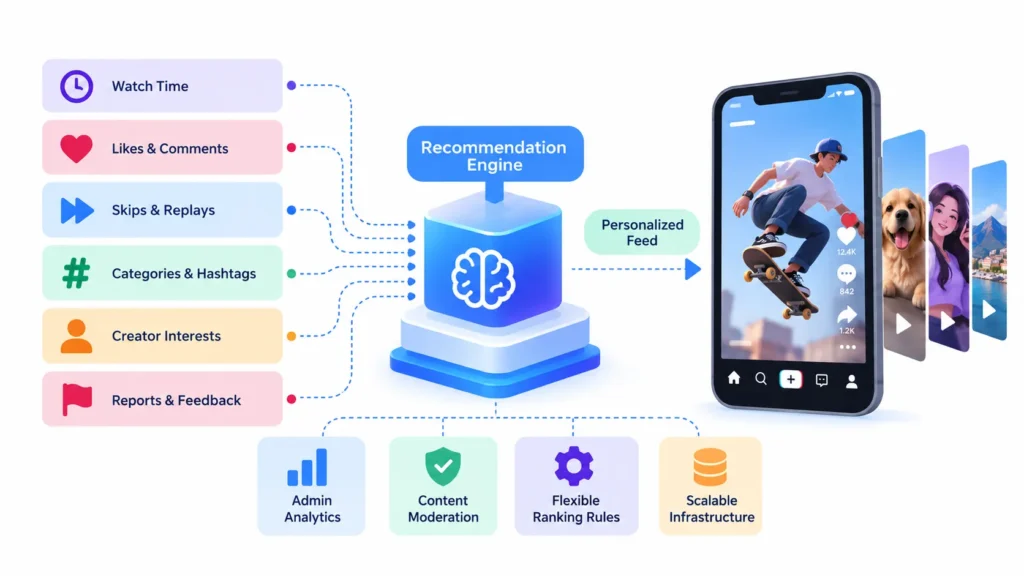
A founder does not need to replicate the recommendation systems of large global platforms. That would be unrealistic and unnecessary for a first market launch.
But the product should include a practical foundation that can grow.
At minimum, a serious short-video platform should support the right short-video app feature set, not just visible screens and upload flows. The deeper foundation should include:
- User behavior event tracking
- Watch-time measurement
- Completion-rate calculation
- Skip and replay detection
- Engagement weighting
- Creator-level interest mapping
- Category and hashtag preference mapping
- Negative feedback handling
- Admin analytics for content performance
- Content moderation workflows
- Flexible ranking rules
- Scalable backend workflows
- Source-code ownership for future customization
This foundation gives founders room to launch, learn, and improve without rebuilding the product from zero. As user activity grows, every view, skip, replay, like, share, and report becomes an event, which is why a scalable short-video backend is essential for long-term feed improvement.
Founders evaluating a launch-ready short-video app foundation</a> should look beyond the visible interface and ask whether the platform can collect, store, and use behavior data from the beginning.
Where Miracuves Fits Into This Decision
Miracuves approaches short-video app development as more than a visual interface. The goal is to help founders launch with the right product foundation: branded apps, source-code ownership, creator workflows, admin control, media handling, monetization planning, and room for personalization improvements.
For founders who want speed without losing control, a ready-made video sharing platform from Miracuves can support a faster 6-day delivery path where the selected modules and customization scope fit the launch plan.
This matters because a fast launch should not mean a shallow launch.
The stronger approach is to launch with a product foundation that can support real users, real creator activity, real analytics, and future recommendation improvements. That gives founders a better chance to validate the market before investing deeper into advanced personalization, AI models, or large-scale infrastructure.
You can also explore Miracuves’ <a href=”https://miracuves.com/solutions/entertainment/video-content-platform/”>video content platform solutions</a> if your roadmap includes short-form video, streaming, creator monetization, or other entertainment-led product models.
Mistakes Founders Should Avoid
Mistake 1: Judging the Platform Only by the Demo
A demo can show scrolling, uploading, likes, comments, and creator profiles. It cannot prove that the feed learns from users. Always ask how the backend tracks behavior and changes recommendations.
Mistake 2: Accepting “AI-Based Feed” Without Details
The phrase “AI-based” is not enough. Ask what data the system collects, how content is scored, how user interests are updated, and whether ranking rules can be modified later.
Mistake 3: Ignoring Negative Feedback
A feed should not only know what users like. It should also know what they skip, mute, report, block, or mark as irrelevant. Negative signals are essential for improving quality.
Mistake 4: Overbuilding Before Market Validation
Founders do not always need advanced machine learning from day one. A structured, recommendation-ready foundation is usually more practical for launch. The system can become more advanced after real user behavior is available.
Mistake 5: Buying Source Code That Cannot Be Extended
Source-code ownership is valuable only when the code can be understood, modified, and improved. If the recommendation logic is hard-coded, undocumented, or disconnected from analytics, long-term growth becomes harder.
Related reading: How to Build a Kundli and Horoscope Generation Algorithm in Python.
Final Thoughts: The Feed Should Learn, Not Just Scroll
A short-form video platform does not win because it has vertical scrolling. It wins when the feed becomes more relevant with every session.
Superficial personalization can create a good first impression, but real personalization needs behavior tracking, content scoring, admin visibility, moderation controls, and a backend foundation that can evolve.
For founders, the smartest question is simple:
Does this platform only show videos, or does it learn from users?
If it only shows videos, it is a content loop. If it learns from users, it becomes a retention engine. Once the feed foundation is strong, the next step is building a short-video platform growth strategy that brings creators, content supply, and user acquisition into the same launch plan.
Miracuves helps founders move toward that stronger foundation with white-label, source-code-owned short-video platforms designed for faster launch, practical control, and long-term product improvement.
FAQs
What is feed personalization in a short-form video app?
Feed personalization is the process of showing each user videos based on their behavior, interests, engagement, creator preferences, watch patterns, and feedback. A strong personalized feed should improve as the user watches, skips, replays, follows, or reports content.
What is the difference between real and superficial feed personalization?
Superficial personalization usually relies on random videos, latest uploads, category filters, or broad popularity. Real personalization uses user behavior signals such as watch time, completion rate, skip speed, replay count, shares, follows, and negative feedback to improve the feed.
Does every short-video platform need advanced AI recommendations from day one?
No. Many early-stage platforms can start with rule-based and weighted recommendation logic. What matters is that the source code collects the right behavior data from the beginning so the recommendation system can become smarter later.
Why is watch time important for video recommendations?
Watch time shows how long a user stays with a video. It helps the platform understand attention better than likes alone because some users watch deeply without taking visible actions.
Why does completion rate matter in a personalized video feed?
Completion rate shows how much of a video the user watched relative to its length. This helps compare short and long videos more fairly and identify content that truly holds attention.
What should founders check before buying short-video app source code?
Founders should check whether the source code tracks watch time, completion rate, skips, replays, shares, follows, reports, and negative signals. They should also review admin analytics, database structure, feed ranking logic, moderation controls, and customization flexibility.
Can a random video feed work for an early-stage platform?
A random feed may help populate the first version, but it should not be the long-term recommendation strategy. Without behavior tracking and ranking logic, the platform cannot become meaningfully personalized.
How does Miracuves help with short-video platform launch?
Miracuves helps founders launch white-label, source-code-owned short-video platforms with branded apps, admin control, creator workflows, monetization options, and faster delivery. Where the ready-made solution fits the scope, Miracuves can support a 6-day launch path.
Miracuves is an independent software development company. We are not affiliated with, connected to, sponsored by, or endorsed by any company or product named in this article.
Terms such as “X Clone” are used descriptively. It is how the software industry refers to building a platform with functionality comparable to a known service, and how clients search for it.
The entire design and codebase of our products is built by our own team. Our products contain no code, design, graphics, or content originating from any third-party website or applications.
All third-party names and marks referenced in this article are the property of their respective owners, referenced solely to identify the services discussed.