


Key Takeaways
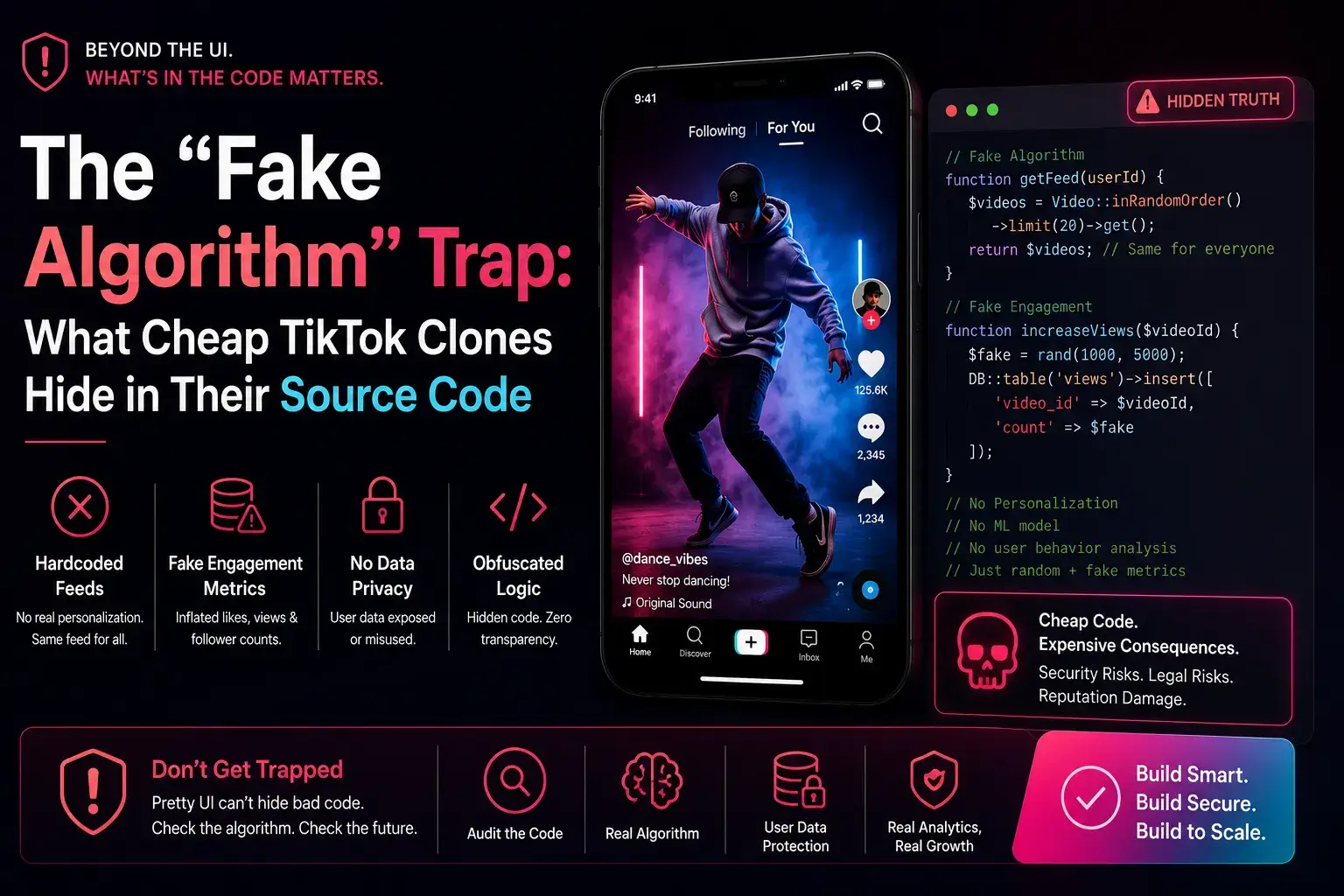
- Cheap TikTok clone source code often hides randomized feeds behind “AI algorithm” claims.
- A real short-video app needs retention logic based on watch time, completion rate, skips, and engagement signals.
- User feeds, creator uploads, video ranking, analytics, and admin controls must work together.
- Success depends on backend tracking, content scoring, fast playback, and personalized recommendations.
- A strong TikTok clone platform should build recommendation intelligence beyond simple random video rotation.
Algorithm Signals
- Users need personalized feeds, smooth video playback, likes, comments, shares, saves, and follow-based discovery.
- Creators need upload tools, profile analytics, engagement insights, content status, and monetization options.
- Admins need control over videos, users, reports, moderation, ranking rules, categories, and platform analytics.
- Watch-time tracking, completion-rate scoring, skip behavior, and replay signals help improve recommendation quality.
- Real-time notifications keep users and creators updated on likes, comments, follows, shares, and content performance.
Real Insights
- Randomized feeds can make a clone look functional, but they rarely create strong retention.
- Weak recommendation logic can show irrelevant videos, reduce session length, and lower creator engagement.
- True retention is built in the backend database, event tracking, scoring model, and content delivery pipeline.
- Founders should check whether the source code tracks real user behavior before buying a cheap TikTok clone script.
- Miracuves builds TikTok Clone apps with personalized feeds, video ranking, creator workflows, analytics, and admin control.
A cheap TikTok clone can look convincing in a five-minute demo.
The app opens. Videos scroll vertically. Users can like, comment, upload, follow creators, and share content. The vendor says the product includes a “TikTok algorithm.” For a non-technical founder, that sounds good enough.
But here is the trap: a scrolling video feed is not a recommendation engine.
Many low-cost TikTok clone scripts do not actually learn from user behavior. They simply show videos randomly, by upload date, by category, or by basic popularity. That may look active during a demo, but it does not create retention after real users enter the platform.
The difference matters because a TikTok-style business does not win through features alone. It wins when the feed gets smarter every time someone watches, skips, replays, likes, shares, comments, or follows. That intelligence is not built in the UI. It is built in the backend, database, analytics logic, and recommendation pipeline.
Miracuves approaches short video app development as a retention system, not just a visual clone. For founders buying source code, this distinction can protect you from wasting money on a product that looks like TikTok but behaves like a random video playlist.
Randomization Is Not Recommendation
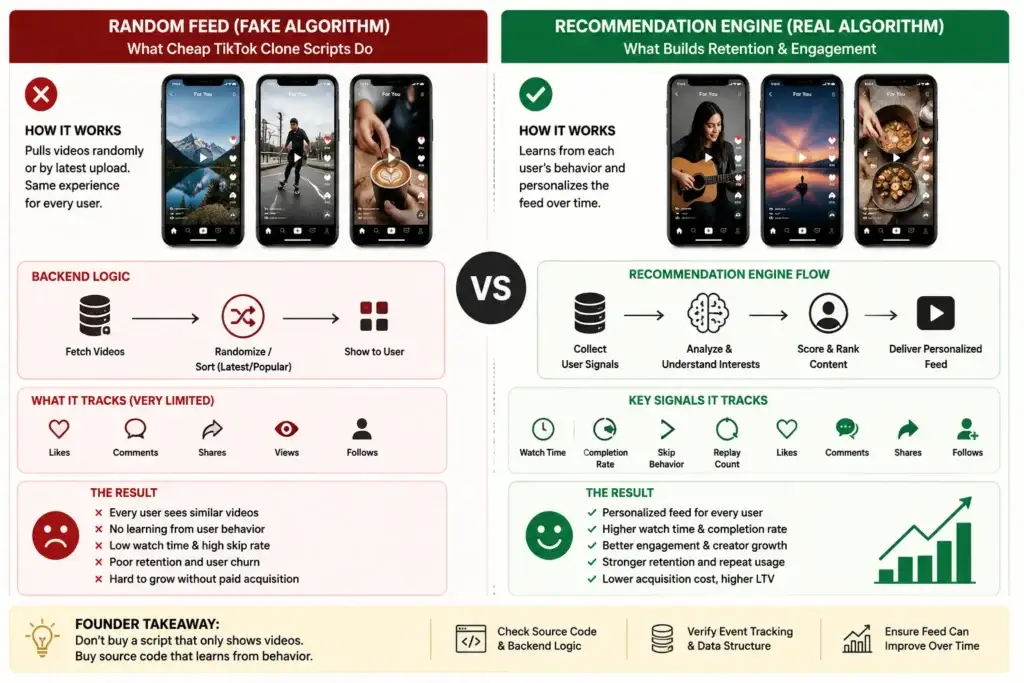
The biggest trick in cheap TikTok clone scripts is that the feed looks alive even when it is not intelligent.
A basic script can pull videos from the database and display them in a loop. It can shuffle uploads. It can show trending videos first. It can rotate content by category. It can even add a label in the admin panel called “AI Feed” or “Smart Recommendation.”
But none of that means the app understands the user.
A real recommendation system answers questions like:
- Which videos does this user finish watching?
- Which videos does this user skip in the first two seconds?
- Which creators does this user repeatedly watch?
- Which topics create replays?
- Which videos lead to comments, shares, follows, or profile visits?
- Which content should be reduced because the user keeps ignoring it?
A random feed cannot answer these questions. It treats every user almost the same. That is dangerous for a short video platform because users expect the feed to feel personal very quickly.
For a founder, the risk is simple. You may buy a TikTok clone script that has the visible parts of TikTok, but not the learning layer that makes people keep scrolling.
Read More: What is TikTok App and How Does It Work?
The “Fake Algorithm” Variable Founders Must Check
When a vendor says, “Our TikTok clone includes an algorithm,” ask what the algorithm actually measures.
If the answer sounds vague, you should be careful.
A weak answer usually sounds like this:
- “The app shows trending videos.”
- “The app recommends popular videos.”
- “The feed is AI-based.”
- “Users get videos based on category.”
- “The system automatically shows content.”
These answers are not enough.
A stronger answer should explain the signals being captured, stored, weighted, and used for future feed decisions. For example, the backend should be able to track watch duration, completion percentage, scroll speed, replay count, likes, comments, shares, follows, reports, muted videos, and skipped videos.
The issue is not whether every early-stage app needs a massive machine learning infrastructure on day one. Most founders do not. The issue is whether the source code has the right foundation to collect behavioral data from the beginning.
If your app does not track the right signals now, you cannot build a smarter feed later without rebuilding major backend parts.
Read More: Business Model of TikTok : Revenue Streams and Strategy
The Mechanics of True Watch-Time Metrics
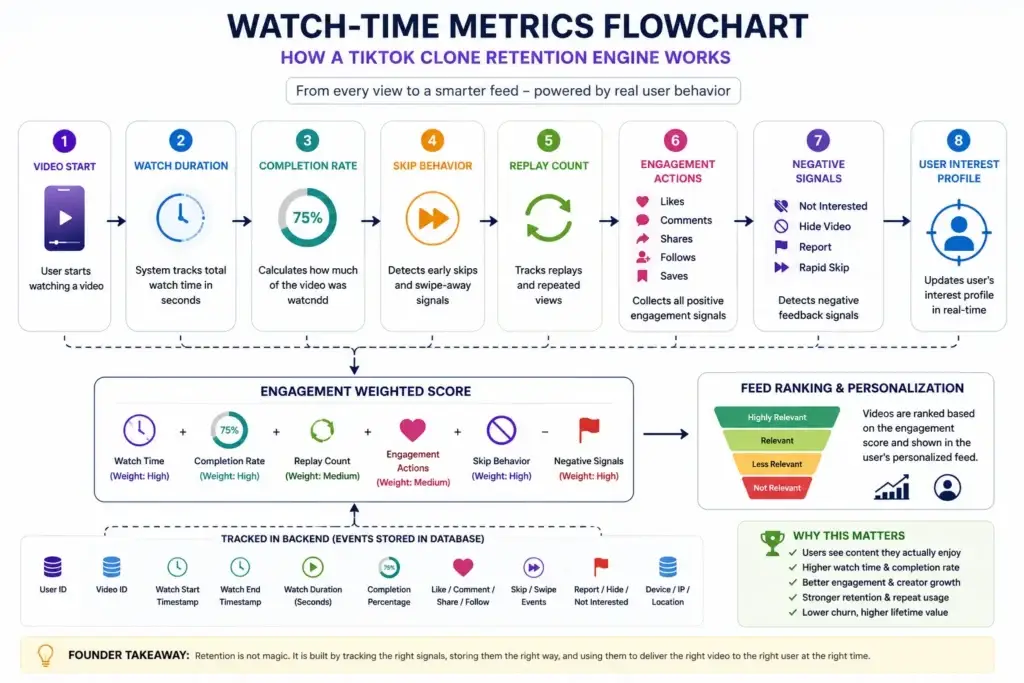
Watch time is one of the strongest signals in short video products because it tells you what users actually pay attention to.
A like is useful, but it is not always honest. Some users like casually. Some never like at all. Some watch content deeply without interacting. Watch time gives the system a quieter but more reliable signal: did the user stay?
But watch time alone is not enough. A 30-second watch on a 3-minute video means something different from a 30-second watch on a 35-second video. That is why completion rate matters.
Completion rate asks a better question:
How much of the video did the user finish?
For short video platforms, this matters because the app needs to understand whether a video held attention relative to its length. A 95% completion rate can be a stronger signal than a raw watch duration number.
A retention-focused TikTok clone should track signals such as:
| Signal | What It Means | Why It Matters |
|---|---|---|
| Watch time | How long the user watches | Shows attention strength |
| Completion rate | Percentage of video completed | Helps compare videos of different lengths |
| Skip speed | How fast the user swipes away | Identifies weak content matches |
| Replay count | Whether the user watches again | Shows high interest or curiosity |
| Like/comment/share | Active engagement | Helps rank stronger content |
| Follow after view | Creator-level interest | Improves creator recommendations |
| Report/not interested | Negative feedback | Protects feed quality and safety |
This is where many cheap scripts fail. They may store likes and comments, but they do not store detailed viewing behavior. Without viewing behavior, the app cannot understand attention.
Why App Retention Is Built in the Database, Not the UI
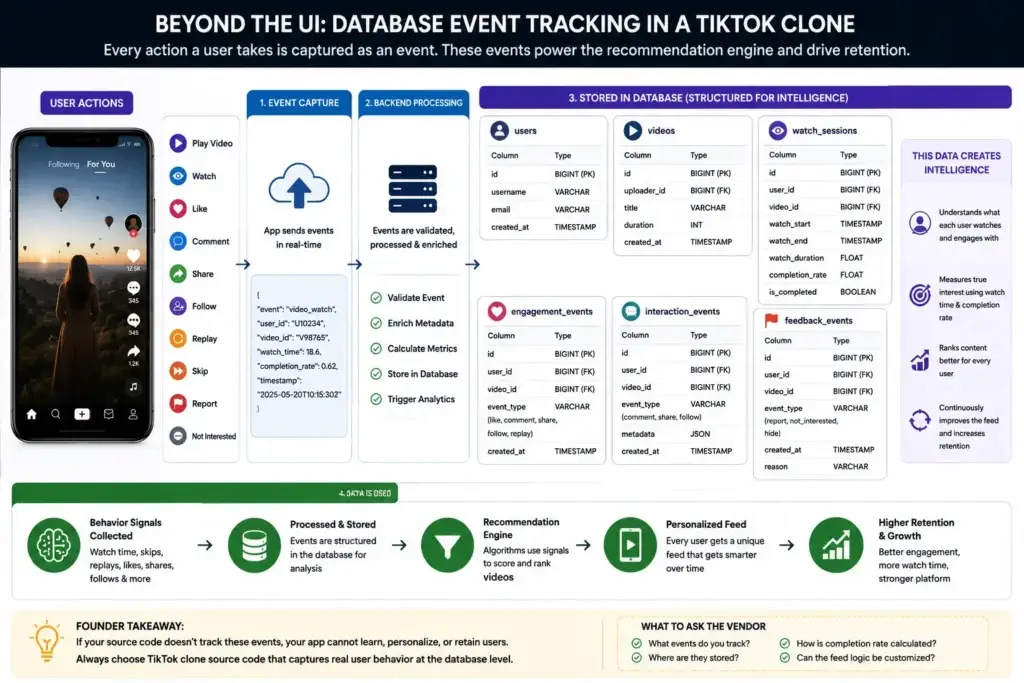
Non-technical founders often judge clone scripts by what they can see.
That is understandable. The UI is visible. The backend is not.
But retention is usually decided by the invisible layers.
A TikTok-style UI can be copied quickly. A real retention engine needs structured data. The database must know who watched what, when they watched it, how long they stayed, whether they skipped, whether they replayed, and what action happened next.
A weak database may only store:
- User ID
- Video ID
- Likes
- Comments
- Upload date
- Category
A stronger database foundation stores behavior events such as:
- User watched video
- Video started
- Video paused
- Video completed
- Video skipped
- User replayed video
- User shared video
- User followed creator after watching
- User reported content
- User muted creator or topic
- This difference changes the entire product.
With weak data, the app can only show videos. With strong data, the app can learn from behavior. That is why serious short video app development must treat the database as a product growth layer, not just a storage system.
Read More: TikTok Features Explained for Startups and Creators
How Cheap TikTok Clone Scripts Usually Hide Weak Feed Logic
A cheap script does not always look bad at first. In fact, many look polished because front-end templates are easy to package.
The weakness appears after launch.
The first sign is that every user sees similar videos. The second sign is that new users do not get a feed that adapts quickly. The third sign is that creators complain about uneven distribution. The fourth sign is that the admin panel gives you content control, but not intelligence.
Common warning signs include:
- The feed is sorted only by newest videos.
- The feed is randomized without user profiling.
- The app has likes and comments but no watch-time tracking.
- The admin panel shows total views but not completion rate.
- The vendor cannot explain how user events are stored.
- The source code has no event logging structure.
- The database has no table or collection for viewing sessions.
- The recommendation logic is hard-coded and difficult to modify.
- The problem is not just technical. It becomes a business problem.
If your platform cannot learn what users enjoy, your acquisition cost rises. You keep paying to bring users in, but the feed does not give them enough reason to return.
Read More: White-Label TikTok App Security: Is It Really Safe in 2026?
The Founder’s Source Code Audit Before Buying a TikTok Clone
Before buying a TikTok clone source code package, ask for a basic technical walkthrough. You do not need to be a developer to ask smart questions.
Start with these questions:
- Where does the app store watch-time events?
- How does the app calculate completion rate?
- Does the feed change based on individual user behavior?
- How are skips and replays handled?
- Can the admin see content performance beyond views and likes?
- Can the recommendation logic be modified later?
- Does the backend support event tracking at scale?
- Is the source code included, and can my team inspect it?
- Does the platform support content moderation and abuse reporting?
A serious vendor should be able to explain these clearly. If the answer is only “Yes, we have AI,” that is not enough.
The goal is not to buy the most complex system immediately. The goal is to avoid buying a dead-end codebase.
Read More: How to Build an App Like TikTok – Developer Guide
Founder Decision Signals
Founder Decision Signals
Speed
A ready-made TikTok clone can help you launch faster, but speed should not come at the cost of missing behavior tracking and feed intelligence.
Cost
A very low-cost script may look attractive, but weak backend logic can create higher rebuild costs after launch.
Scalability
If the database cannot track user events properly, scaling users will only increase noise, not recommendation quality.
Market Fit
Retention data helps founders understand what users actually want, which creators perform, and which content categories deserve investment.
What a Real TikTok Clone Recommendation Foundation Should Include
A strong TikTok clone does not need to copy TikTok’s exact proprietary system. That would be unrealistic and unnecessary.
But it should include a practical recommendation foundation that can improve over time.
At minimum, the system should support:
- Behavior event tracking
- Watch-time measurement
- Completion-rate calculation
- Skip and replay detection
- Engagement weighting
- Creator-level interest mapping
- Category and hashtag preference mapping
- Negative signal handling
- Admin analytics for content performance
- Scalable backend workflows for high-volume interactions
This gives founders room to grow. Early recommendations may start with rules and weighted signals. As the product matures, the platform can move toward deeper personalization, machine learning models, and more advanced content ranking.
That is the right way to think about a TikTok clone app: not as a finished imitation, but as a launch-ready foundation that can become smarter with real user data.
Read More: The Ultimate Developer’s Guide to Building a TikTok like app
Random Feed vs Retention Engine
| Layer | Randomized Cheap Script | Retention-Focused TikTok Clone |
|---|---|---|
| Feed logic | Shows random, latest, or popular videos | Adjusts feed based on user behavior |
| User learning | Minimal or none | Tracks watch time, skips, replays, engagement |
| Database | Stores basic content and user actions | Stores behavior events and viewing sessions |
| Analytics | Views, likes, comments | Completion rate, watch depth, engagement quality |
| Admin control | Basic content management | Content performance, moderation, ranking signals |
| Long-term value | Difficult to improve without rebuild | Can evolve into smarter personalization |
| Founder risk | Looks good in demo, weak after launch | Better foundation for retention and monetization |
Why Miracuves Builds Beyond the Surface-Level Clone
Miracuves helps founders launch white-label TikTok clone apps that are built around more than visual similarity.
For a short video platform, the visible product is only one part of the business. The real growth layer includes recommendation logic, creator workflows, scalable media handling, admin control, moderation, analytics, and monetization planning.
A Miracuves TikTok clone app can support a faster launch while still giving founders the product foundation needed to customize, control, and improve the platform after launch. That matters because source-code ownership is not only about having files. It is about having code that your team can understand, extend, and use to build long-term advantage.
Founders exploring this category can review the Miracuves TikTok clone app solution, the guide on TikTok-like app recommendation engines, and the blog on TikTok clone backend architecture to understand how feed intelligence, infrastructure, and retention connect.
Mistakes Founders Should Avoid
Mistakes Founders Should Avoid
Buying Source Code Based Only on the Demo
A demo shows the surface experience. It does not prove that the app tracks watch time, completion rate, skips, replays, or user-interest patterns.
Believing Every “AI Algorithm” Claim
Ask what signals the algorithm uses. If the vendor cannot explain the backend logic, the algorithm may be simple sorting or randomization.
Ignoring the Admin Analytics Layer
Founders need more than total views. Completion rate, skip behavior, creator performance, and engagement quality help guide growth decisions.
Choosing the Lowest Price Without Checking Rebuild Risk
A weak source code foundation can become expensive later if your team must rebuild the feed, database, analytics, or recommendation logic.
Final Thoughts: Do Not Buy a TikTok Clone That Cannot Learn
A TikTok clone is not valuable because it has vertical scrolling. It is valuable because the platform learns what each user wants to watch next.
That learning does not happen by magic. It requires event tracking, watch-time metrics, completion-rate logic, engagement weighting, database planning, backend workflows, and admin visibility.
For non-technical founders, the safest question is simple:
Does this source code only show videos, or does it learn from users?
If it only shows videos, you are buying a video loop. If it learns from users, you are building a foundation for retention.
Miracuves Solutions helps founders move beyond surface-level clone scripts with white-label, source-code-owned short video app solutions designed for faster launch, stronger control, and long-term product improvement.
FAQs
What is the fake algorithm trap in TikTok clone source code?
The fake algorithm trap happens when a vendor claims the app has a TikTok-style recommendation system, but the source code only uses random videos, latest uploads, basic categories, or simple popularity sorting. It may look acceptable in a demo, but it does not personalize the feed properly.
How can I check whether a TikTok clone script has a real recommendation engine?
Ask the vendor how the app tracks watch time, completion rate, skips, replays, likes, comments, shares, follows, and negative signals. Also ask where these events are stored in the database and whether the feed changes based on individual user behavior.
Is a randomized video feed enough for a TikTok clone app?
No. A randomized feed can help populate content, but it does not create true personalization. A TikTok-style platform needs behavioral tracking so the app can learn what each user prefers and improve recommendations over time.
Why is completion rate important in short video app development?
Completion rate shows how much of a video the user actually watched. It helps the platform compare engagement across videos of different lengths and identify which content holds attention.
Does every TikTok clone need advanced AI from day one?
Not always. Early-stage apps can begin with rule-based and weighted recommendation logic. However, the app should still collect the right behavior data from day one so the recommendation system can become smarter later.
Why does the database matter in a TikTok clone app?
The database stores user behavior signals. If it only stores likes, comments, and uploads, the app has limited learning ability. If it stores watch sessions, completion rates, skips, replays, and engagement events, the platform can build stronger personalization.
What should non-technical founders ask before buying TikTok clone source code?
Ask whether source code is included, how the recommendation engine works, whether watch-time events are tracked, what analytics the admin panel shows, how scalable the backend is, and whether the feed logic can be customized later.
How does Miracuves help founders avoid weak clone scripts?
Miracuves helps founders launch white-label TikTok clone apps with source-code ownership, admin control, scalable backend workflows, and recommendation-ready engagement tracking so the platform can grow beyond a basic video feed.