


Key Takeaways
- Solo-creator platforms give mega-creators more control than crowded multi-creator marketplaces.
- Top creators often need brand ownership, direct fan data, custom monetization, and lower platform dependency.
- Subscriptions, paid content, community access, private messaging, and creator-owned branding are core features.
- Success depends on existing audience strength, trust, content consistency, and smooth payment workflows.
- A standalone creator platform can create stronger revenue control than competing inside a broad marketplace.
Founder Signals
- Creators need branded profiles, subscription tiers, paid posts, fan messaging, analytics, and payout tracking.
- Fans need simple onboarding, secure checkout, exclusive content access, notifications, and account control.
- Admins need control over users, content, payments, subscriptions, reports, disputes, and platform settings.
- White-label ownership helps creators build their own digital real estate instead of renting attention from platforms.
- Notifications keep fans and creators updated on new content, renewals, messages, tips, and membership activity.
Real Insights
- Trying to build a new creator marketplace can burn budget before enough creators and fans join.
- A mega-creator already brings demand, which reduces the need for expensive marketplace-side acquisition.
- Direct fan ownership, custom pricing, and branded experiences can improve long-term creator monetization.
- Solo-platforms work best when the creator has a loyal audience and clear premium content strategy.
- Miracuves builds solo creator platforms with subscriptions, paid content, fan communities, payments, and admin control.
Most founders entering the creator economy are asking the wrong question.
They ask, “How do we build the next OnlyFans or Patreon?”
That question sounds ambitious. It also sounds expensive, slow, and strategically lazy.
The better question is sharper: Why build a marketplace for thousands of unknown creators when one mega-creator already brings the audience, trust, content, and demand?
That is the solo-platform thesis.
Instead of building a broad creator marketplace from zero, founders, talent managers, influencer agencies, and B2B entrepreneurs can launch dedicated white-label platforms for individual creators with massive existing followings. This approach takes the commercial logic often associated with an OnlyFans clone app and narrows it into something more defensible: one creator, one branded app, one direct fan economy, and no marketplace cold start.
The Marketplace Delusion: Why You Cannot Outspend the Giants
The creator marketplace model looks attractive from the outside.
You imagine thousands of creators joining your platform. Fans follow. Transactions grow. The platform takes a cut. The flywheel spins.
That is the fantasy.
The reality is colder.
A marketplace has two expensive problems at the same time: supply and demand. You need creators to attract fans. You need fans to attract creators. Until both sides show up, your platform is mostly empty infrastructure with a landing page and a pitch deck.
OnlyFans, Patreon, YouTube, TikTok, Twitch, Instagram, and Substack already own creator attention. They are not just software products. They are distribution machines. They have network effects, payment trust, creator habits, audience familiarity, and years of brand memory.
A new marketplace founder cannot simply “add better features” and expect creators to move.
The average small creator does not move because your platform has a nicer dashboard. They move when there is money, audience, safety, trust, and lower effort. That is hard to manufacture from zero.
This is why “build the next OnlyFans” is usually a budget trap. You are not only building software. You are trying to buy liquidity.
And liquidity is expensive.
Read More: What is OnlyFans and How Does It Work?
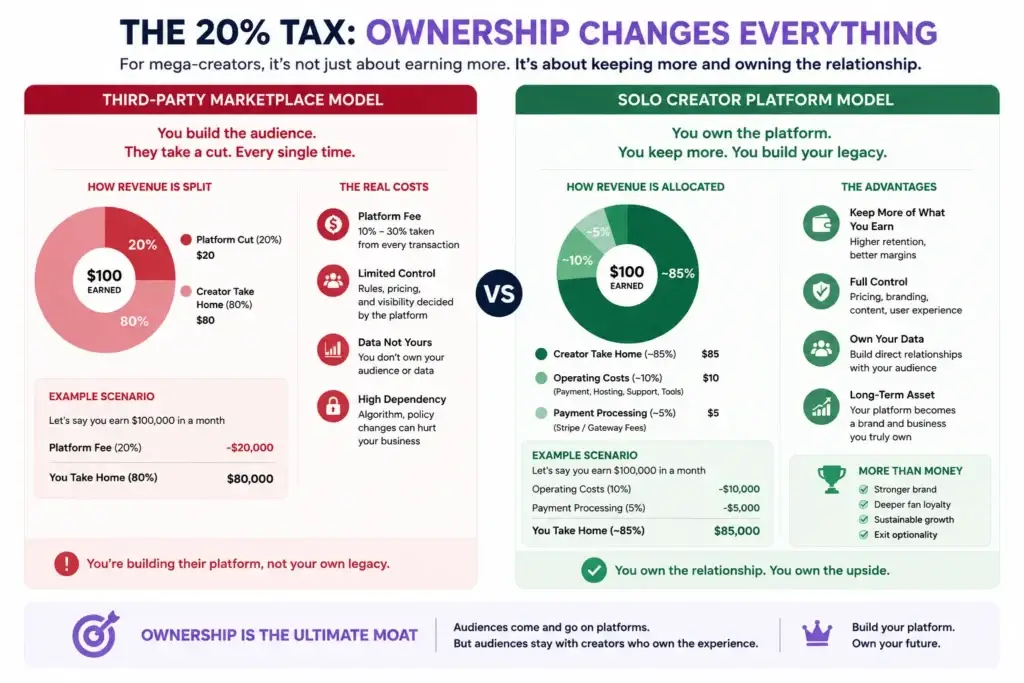
The 20% Tax: Why Top Creators Want to Own Their Real Estate
The marketplace is useful when a creator needs discovery.
But top creators are different.
A mega-creator already has distribution. They have followers on Instagram, YouTube, TikTok, X, Twitch, newsletters, podcasts, communities, events, or brand collaborations. Their problem is not awareness. Their problem is ownership.
When a top creator sends fans to a third-party platform, they are giving up several layers of control:
- They do not fully control the platform rules.
- They do not fully control the fan experience.
- They do not fully control monetization design.
- They do not fully control data access.
- They do not fully control long-term product direction.
- And they often pay a recurring platform fee on every transaction.
OnlyFans is widely reported to pay creators 80% while retaining 20% of creator earnings. Patreon’s current public pricing shows platform fees and additional payment-related costs depending on the plan and transaction type.
For a small creator, that tax may feel acceptable because the platform provides infrastructure and credibility.
For a mega-creator, the math changes.
If a creator already has millions of followers, the platform is no longer the source of demand. The creator is. The platform becomes a toll booth.
That is the opening.
A solo-platform lets the creator move from rented monetization to owned monetization. The business can still use payment processors, app stores, hosting, moderation workflows, and compliance tools, but the brand relationship belongs to the creator.
The creator is no longer one profile inside someone else’s marketplace. The creator becomes the platform.
Read More: How OnlyFans Makes Money in 2026
The Solo-Platform Model: Maximum ROI With Less Marketplace Waste
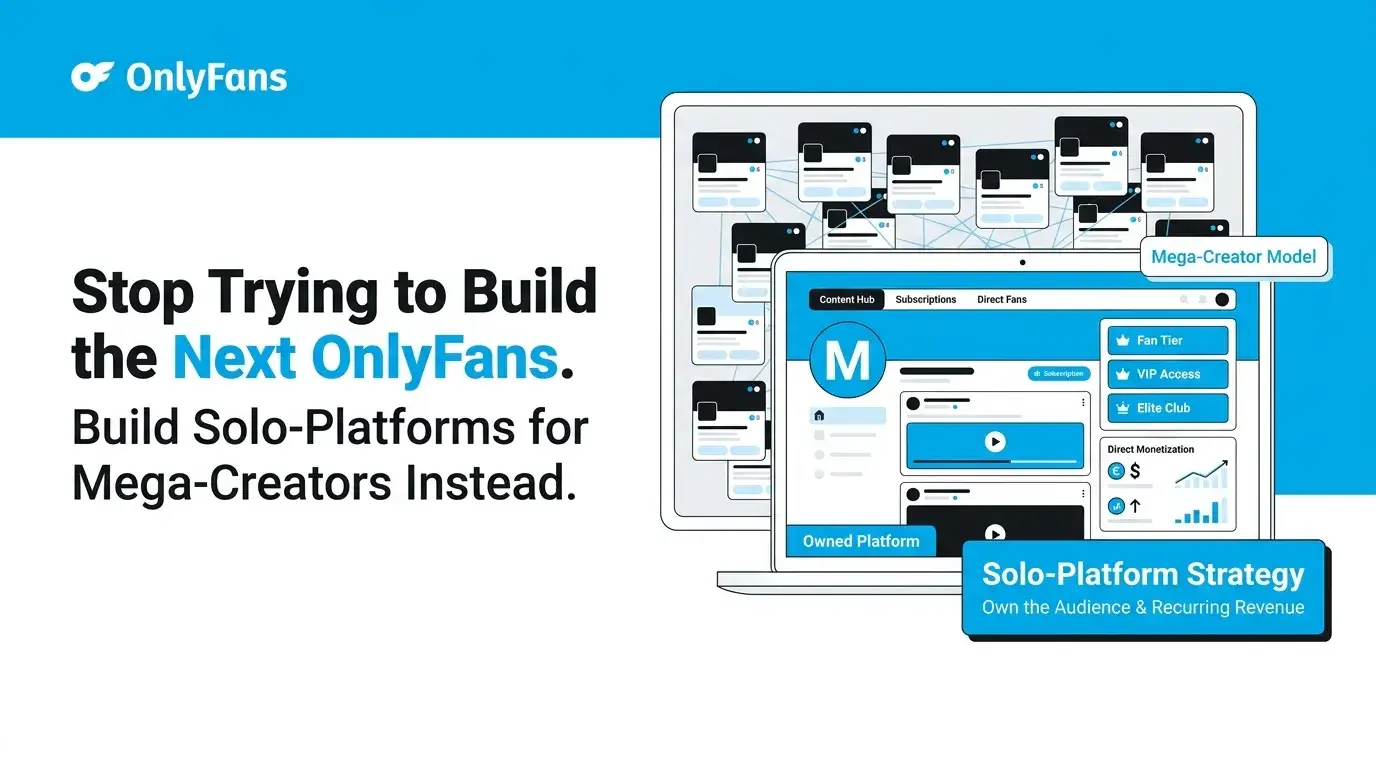
A solo-platform is a dedicated, white-label app or web platform built around one creator, influencer, athlete, educator, coach, performer, gamer, podcaster, or media personality.
It is not trying to attract every creator.
It is trying to maximize revenue from one creator’s existing audience.
That changes the entire business model.
Instead of spending heavily on creator acquisition, the platform launches with built-in distribution. Instead of designing for thousands of creator categories, it designs around one brand. Instead of competing against giant marketplaces, it gives a mega-creator their own digital real estate.
This is why the model works especially well for:
- Influencer agencies managing high-revenue creators.
- Talent managers who want to increase creator monetization.
- B2B entrepreneurs with access to celebrities, educators, coaches, athletes, musicians, or niche experts.
- Media brands with a strong personal brand attached.
- Creators who want more control over premium fan relationships.
The business logic is simple.
A marketplace needs thousands of creators to become interesting.
A solo-platform needs one creator with demand.
That is a completely different risk profile.
Read More: How Safe is a White-Label OnlyFans App?
Why “100% Creator Revenue Share” Is a Stronger Offer Than “Join Our Marketplace”
A cold marketplace asks creators to trust a new platform.
A solo-platform gives creators a stronger pitch:
“This is your app. Your brand. Your fan base. Your monetization engine.”
The most disruptive version of this model is a 100% creator revenue-share platform, where the creator keeps platform-side revenue after unavoidable third-party costs such as payment processing, hosting, tax handling, app store charges where applicable, and agreed operating expenses.
The business does not have to make money by taking 20% forever. It can monetize through:
- Setup fees.
- White-label licensing.
- Technical maintenance.
- Premium support.
- Growth services.
- Fan engagement strategy.
- Data and analytics services.
- Custom feature development.
- Agency partnerships.
For talent managers and B2B entrepreneurs, this is powerful because the offer is no longer “let us take a cut of your creator’s earnings.”
The offer becomes:
“Let us build the creator’s owned monetization infrastructure.”
That is much easier to sell to serious creators.
Read More: Building OnlyFans Clone Script in 2026
What a Solo Creator Platform Should Actually Include
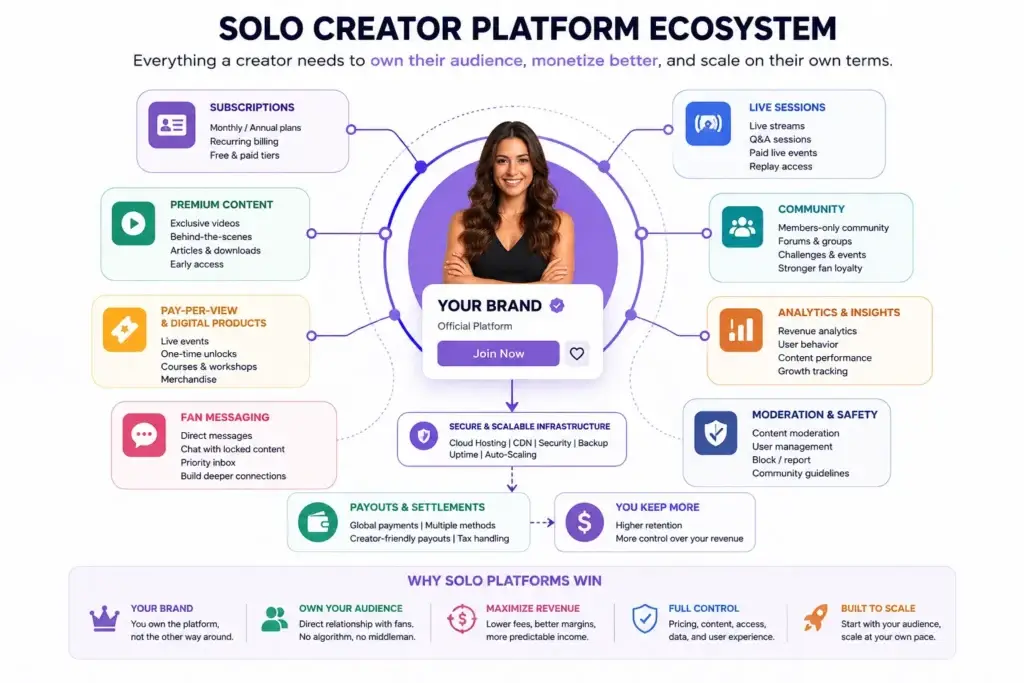
A solo-platform does not need bloated marketplace complexity. It needs the right control layers.
| Platform Layer | What It Does | Why It Matters |
|---|---|---|
| Branded creator app/web platform | Gives the creator their own digital home | Strengthens ownership and brand recall |
| Subscription access | Lets fans pay for recurring content | Creates predictable revenue |
| Premium content library | Supports locked posts, videos, audio, or downloads | Increases monetization depth |
| Pay-per-view content | Allows one-time paid access | Useful for high-value drops |
| Fan messaging | Enables direct fan relationships | Improves loyalty and upsell potential |
| Live sessions or events | Adds real-time engagement | Drives urgency and premium pricing |
| Admin dashboard | Controls users, payments, content, reports, and settings | Gives the operator business control |
| Analytics | Tracks revenue, retention, content performance, and fan behavior | Helps the creator make better decisions |
| Moderation and reporting | Manages abuse, content rules, and user safety | Protects the creator brand |
| Payout workflows | Tracks earnings and withdrawals | Reduces operational confusion |
Miracuves’ white-label creator platform approach can support this type of launch by giving founders a ready-made foundation that can be customized around the creator’s brand, monetization model, and audience strategy.
Founder Decision Signals
Founder Decision Signals
Speed
If the creator already has demand, the platform should launch fast. Spending months building generic marketplace features delays monetization.
Cost
The biggest cost in creator marketplaces is not software. It is creator and fan acquisition. A solo-platform reduces that burden by starting with built-in audience demand.
Scalability
The platform must support traffic spikes, premium content delivery, secure payments, and fan engagement without breaking during creator-led launches.
Market Fit
A solo-platform works best when the creator has a loyal audience willing to pay for access, exclusivity, education, entertainment, or community.
Marketplace vs Solo-Platform: The Strategic Difference
| Question | Multi-Creator Marketplace | Solo Creator Platform |
|---|---|---|
| Who brings the audience? | The platform must acquire both creators and fans | The mega-creator brings the audience |
| Main challenge | Liquidity and trust | Conversion and retention |
| Marketing spend | High | Lower if creator has strong distribution |
| Brand ownership | Platform-first | Creator-first |
| Monetization | Platform commission | Setup, licensing, services, support, or custom revenue model |
| Best for | Funded teams chasing network effects | Talent managers, agencies, influencer businesses, B2B entrepreneurs |
| Risk | Empty marketplace | Creator dependency |
| ROI path | Slow until network effects form | Faster if the creator has proven fan demand |
The solo-platform model is not for every creator. It is not designed for unknown creators with no audience. It is designed for the top 1% of creators who already have attention and need infrastructure.
That is why the model is contrarian but practical.
Read More: Top 10 Key Features of a Successful OnlyFans Clone That Drives Subscriptions
The Real Buyer Is Not Always the Creator
Many founders make another mistake: they assume the creator must be the buyer.
Not always.
The buyer can be:
- A talent manager.
- An influencer agency.
- A celebrity management firm.
- A media company.
- A venture studio.
- A brand working with a long-term ambassador.
- A B2B entrepreneur with creator partnerships.
- A coaching business built around one public figure.
This matters because mega-creators are often busy. They may not want to evaluate software, manage vendors, plan app architecture, or run product meetings.
But their management team does.
That creates a strong B2B opportunity. The entrepreneur does not need to become the next OnlyFans. They can become the infrastructure partner behind creator-owned platforms.
Mistakes Founders Should Avoid
Mistakes Founders Should Avoid
Trying to launch a broad creator marketplace with no creator leverage
If you do not already have access to creators or a strong niche, your marketplace may spend heavily before proving demand.
Pitching features instead of ownership
Top creators do not only care about features. They care about revenue control, audience ownership, brand independence, and long-term leverage.
Ignoring moderation and safety workflows
Creator platforms need reporting, content controls, admin access, user verification where relevant, and privacy-conscious data handling. Safety is part of the product foundation, not a cosmetic feature.
Copying OnlyFans too literally
The goal is not to recreate another marketplace. The goal is to build a creator-owned business layer around one high-value audience.
Where Miracuves Fits Into the Solo-Platform Opportunity
Miracuves helps founders, agencies, and creator businesses launch ready-made and white-label app solutions with source-code ownership, branded design, admin dashboards, and monetization-ready workflows.
For the solo-platform model, this matters because the founder does not need to build every subscription, content, payment, profile, messaging, admin, and moderation module from zero.
A Miracuves creator platform foundation can be customized around:
- Creator branding.
- Subscription tiers.
- Premium content flows.
- Fan engagement.
- Payment and payout workflows.
- Admin permissions.
- Content moderation.
- Analytics and reporting.
- Web and mobile app experience.
Final Thoughts: The Next Creator Economy Opportunity Is Smaller, Sharper, and More Profitable
The next big creator economy opportunity may not be another giant marketplace.
It may be a thousand solo-platforms.
One for the fitness creator with 5 million followers.
One for the finance educator with a loyal paid audience.
One for the musician with superfans.
One for the athlete with a global community.
One for the coach, podcaster, gamer, chef, entertainer, or niche expert who already owns attention but not infrastructure.
An OnlyFans-like platform does not always need to be built as a crowded multi-creator marketplace. For the right creator, the stronger model is a dedicated, branded platform where fans subscribe, pay for premium access, join exclusive communities, and engage directly under the creator’s own brand.
The marketplace model says, “Bring creators to our platform.”
The solo-platform model says, “Give the creator their own platform.”
That is the strategic shift.
For talent managers, influencer agencies, and B2B entrepreneurs, this is the cleaner opportunity: stop trying to compete with OnlyFans and Patreon for everyone. Start helping the top 1% own their revenue, audience, and digital real estate through standalone, creator-owned platforms.
FAQs
What is a solo creator platform?
A solo creator platform is a dedicated app or website built for one creator, influencer, educator, athlete, entertainer, or public figure. Instead of hosting many creators, it focuses on one brand and one existing audience.
Is a solo-platform better than building an OnlyFans-style marketplace?
For founders without large marketing budgets, a solo-platform can be more practical because it avoids the cold-start problem of attracting thousands of creators and fans. It works best when the creator already has a strong following.
Why would a mega-creator want their own platform?
A mega-creator may want more control over branding, fan relationships, data, monetization, content rules, and long-term business direction. Platform fees also make owned infrastructure more attractive at higher revenue levels.
Can a white-label creator platform support subscriptions and premium content?
Yes. A white-label creator platform can support subscription tiers, premium posts, locked videos, pay-per-view content, direct messaging, live sessions, fan communities, analytics, and admin controls depending on the selected scope.
Who should build solo creator platforms?
Talent managers, influencer agencies, B2B entrepreneurs, media companies, venture studios, and creator-led businesses can use this model when they have access to high-audience creators.
Does the creator keep 100% of revenue?
A platform can be structured with 100% creator-side revenue share after unavoidable costs such as payment processing, app store charges where applicable, taxes, infrastructure, and agreed operating expenses. The business can monetize through setup fees, licensing, maintenance, support, or custom services.
How does Miracuves help with creator platform development?
Miracuves helps founders launch white-label creator platforms with branded design, admin dashboards, monetization workflows, source-code ownership, and customization support.