

Key Takeaways
- Founders should avoid developing a subscription-based platform without first defining membership tiers, paid content access, recurring billing, creator payouts, user roles, and core monetization workflows.
- Common development mistakes include overloading the MVP, ignoring payment failures, weak access controls, poor mobile performance, limited analytics, and inflexible admin workflows.
- A reliable platform foundation should support secure payments, scalable content delivery, subscription management, moderation, analytics, and future feature expansion from the beginning.
Development Mistake Signals
- Building too many advanced features before validating onboarding, subscriptions, checkout, premium content access, messaging, and creator workflows can increase complexity without proving demand.
- Ignoring failed payments, renewals, cancellations, refunds, chargebacks, payout calculations, and access synchronization can create revenue leakage and poor subscriber experiences.
- Weak authentication, unclear permissions, insecure media delivery, missing moderation tools, limited audit logs, and poor data protection can create serious operational and trust risks.
Founder Launch Insights
- Founders should test signup, subscription purchase, content unlocking, renewal, cancellation, creator payout, notifications, moderation, and admin controls before bringing significant traffic to the platform.
- A modular architecture can reduce future rework by allowing teams to add PPV content, live sessions, new payment methods, loyalty features, analytics, and additional monetization tools as usage grows.
- Miracuves develops customizable subscription-based platforms with memberships, paid content, recurring billing, messaging, creator payouts, security, moderation, analytics, and admin controls.
Launching a subscription-based platform looks simple from the outside. Users sign up, creators publish exclusive content, subscribers pay monthly, and the platform earns a commission. But behind that clean user experience sits a much more complex system of recurring billing, access control, creator payouts, locked content, wallet flows, identity checks, content moderation, analytics, dispute handling, and admin operations.
This is where many founders make expensive mistakes.
They focus too early on screens and too late on platform logic. They assume subscriptions alone will create retention. They underestimate payout workflows. They launch without strong admin controls. Some overbuild a custom platform before validating their niche, while others choose a basic script that cannot support real creator activity, secure payments, or future monetization models.
A subscription-based platform is not just a content app. It is a recurring revenue business with creators, fans, payments, rules, trust, and operations working together. This guide breaks down the most important development mistakes founders should avoid before launch, especially if they are planning a creator monetization platform, premium content platform, paid membership app, or fan engagement business.
Why Subscription-Based Platform Mistakes Become Expensive Quickly
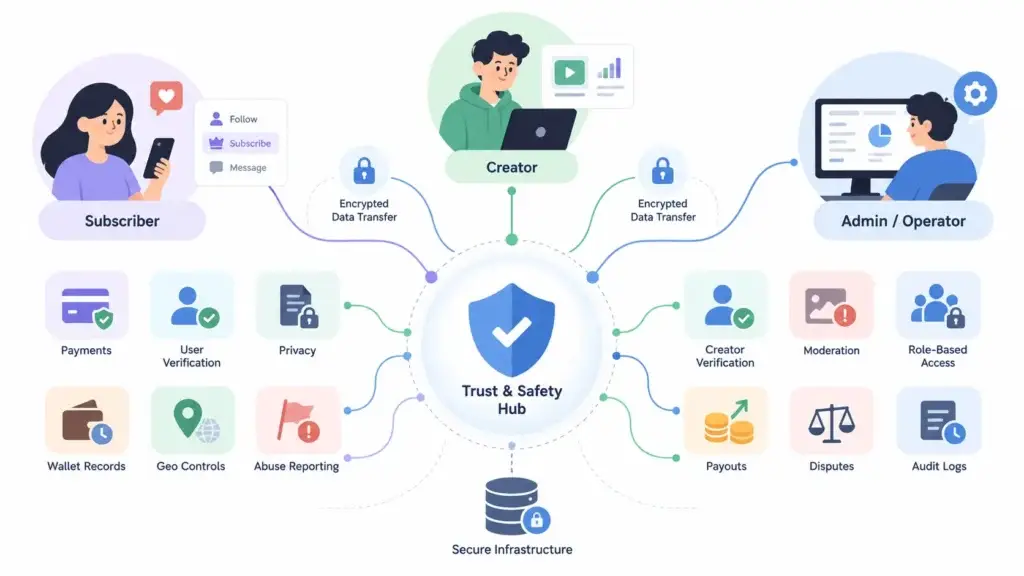
A subscription platform grows only when both sides of the ecosystem work well.
Creators need tools to publish, price, promote, message, analyze, and withdraw earnings. Fans need a smooth way to discover creators, subscribe, unlock content, manage renewals, make payments, and receive value consistently. The platform owner needs admin visibility over users, content, transactions, payouts, reports, disputes, policies, and revenue.
When one layer is weak, the whole business feels unstable.
For example, poor access control can let unpaid users view premium content. Weak payout logic can create creator frustration. Limited moderation can damage platform trust. No analytics can leave founders guessing why subscribers cancel. Poor onboarding can stop creators from publishing enough content to attract paying users.
That is why founders should treat the development phase as a business design phase, not just a coding phase.
Mistake 1: Building Features Before Defining the Platform’s Monetization Logic
Many founders begin with a feature checklist: profiles, posts, subscriptions, chat, payments, notifications, and admin panel. That sounds logical, but it misses the real question: how will the platform make money from user behavior?
A subscription-based platform needs monetization logic before development starts. Founders should define how creators earn, how fans pay, how the platform takes commission, how refunds work, how taxes or fees are handled where relevant, and how payouts are triggered.
A stronger monetization plan may include:
| Monetization Layer | How It Works | Founder Decision |
|---|---|---|
| Monthly subscriptions | Fans pay recurring fees for creator access | Define tiers, renewals, free trials, cancellations, and failed payment handling |
| Pay-per-view content | Fans unlock specific posts, files, or messages | Decide pricing flexibility and access duration |
| Paid messaging | Creators charge for private messages or media unlocks | Define message pricing, wallet deduction, and content rules |
| Tips and gifts | Fans support creators directly | Decide platform commission and transaction visibility |
| Live sessions | Fans pay for live access, calls, or private sessions | Plan scheduling, availability, payments, and moderation |
| Creator shop | Creators sell digital or physical products | Define catalog rules, fulfilment logic, and dispute workflows |
If monetization is added later, developers often need to rebuild database relationships, payment logic, wallet flows, creator earnings, reporting, and admin dashboards. That can slow launch and increase rework.
Founders who are still finalizing revenue logic should review the creator platform business model before development begins. It helps connect subscriptions, paid content, tips, creator commissions, wallet flows, and platform revenue into one clearer operating model instead of treating monetization as a later feature.
Mistake 2: Treating Subscriptions as the Only Revenue Model
Subscriptions are useful because they create recurring revenue, but they are not always enough.
Some fans may not want a monthly commitment. Some creators may earn more from one-time premium unlocks. Some niches work better with paid consultations, exclusive files, live access, creator stores, or private community benefits. A platform that supports only one revenue model may limit both creator earnings and platform commission potential.
Founders should think in revenue layers:
- Recurring memberships for predictable income
- PPV content for premium one-time unlocks
- Paid DMs for direct fan interaction
- Tips and gifts for creator support
- Live experiences for real-time engagement
- Featured placement for creator discovery
- Platform-level premium tools for creators or agencies
The goal is not to overload the first version with every feature. The goal is to choose a platform foundation that can support more than one monetization path as the business grows.
Mistake 3: Ignoring Access Control Until It Breaks
Access control is one of the most important technical layers in a premium content platform. It decides who can view what, when access starts, when access expires, and what happens after cancellation, failed payment, refund, chargeback, or account suspension.
Weak access control can create serious product issues. A fan may retain access after canceling. A creator may publish paid content that gets exposed incorrectly. A refund may not remove access. A blocked user may still view locked content through cached links. These are not small bugs; they directly affect trust and revenue.
A strong access system should consider:
| Access Rule | Why It Matters |
|---|---|
| Active subscription check | Ensures only paying users can access gated content |
| PPV unlock history | Keeps one-time purchases available only to valid buyers |
| Tier-based permissions | Allows creators to offer different benefits by plan |
| Expiry and renewal logic | Prevents access confusion after cancellation or failed billing |
| Account restrictions | Supports moderation, safety, and policy enforcement |
| Media protection rules | Reduces unauthorized access to premium files |
For founders, this is a high-priority development area because it protects the core promise of the platform: paid access to exclusive value.
This is also where founders should map the right premium content platform features before launch. Subscription tiers, gated posts, PPV unlocks, private messaging, creator dashboards, user wallets, notifications, and admin permissions should work together so the platform can protect paid content while keeping the user experience simple.
Mistake 4: Underestimating Payment Gateway and Payout Complexity
Payments are where many subscription platforms face friction. Recurring billing, card failures, wallet top-ups, refunds, creator withdrawals, commissions, payout schedules, and regional payment availability all need careful planning.
A founder may assume payment integration is just a checkout screen. In reality, the platform needs a transaction system that can answer practical questions:
Who paid?
Which creator earned?
What commission was deducted?
Was the payment successful, pending, refunded, disputed, or failed?
When can the creator withdraw?
Which payment provider supports the business category and geography?
How are transaction records shown inside the admin dashboard?
A subscription-based creator platform should ideally support clear payment and payout visibility for fans, creators, and platform operators. This reduces disputes and gives creators confidence that their earnings are tracked correctly.
Founders should also confirm payment gateway suitability early. Some payment providers have restrictions based on business type, region, content category, and risk profile. Final approval depends on the provider, business model, jurisdiction, and compliance requirements.
Mistake 5: Launching Without a Strong Creator Onboarding Flow
A subscription platform needs supply before demand converts. In a creator-led platform, supply means active creators publishing valuable content consistently.
If creator onboarding is confusing, the platform can look empty even after launch. Creators may not complete profiles, set subscription tiers, upload content, configure payout details, or understand how to promote their profile.
A strong creator onboarding flow should guide creators through:
- Profile setup
- Identity or account verification where required
- Subscription tier creation
- First content upload
- PPV pricing setup
- Wallet or payout configuration
- Community or messaging settings
- Analytics and earnings dashboard walkthrough
This is not just a user experience improvement. It directly affects marketplace liquidity. Without active creators, paid subscribers have little reason to join.
Creator onboarding should also connect with early go-to-market planning. A strong creator platform marketing strategy helps founders attract the first creators, build initial fan demand, test acquisition channels, and avoid launching a platform that is technically complete but commercially quiet.
Mistake 6: Leaving Moderation, Verification, and Safety for Later
Subscription-based platforms depend heavily on trust. The more a platform involves user-generated content, paid content, private messaging, and creator-fan interaction, the more important safety workflows become.
Founders should avoid treating moderation as something to add after traffic arrives. By then, content issues, user abuse, impersonation, spam, payment disputes, and policy violations may already be difficult to manage.
A safer platform foundation can include:
| Safety Layer | Founder Benefit |
|---|---|
| Creator verification | Reduces impersonation and improves trust |
| Content moderation queues | Helps review flagged or restricted content |
| Abuse reporting | Gives users a clear way to report issues |
| Admin approval controls | Lets operators manage creators, posts, and accounts |
| Activity logs | Creates visibility into platform actions |
| Geo or category controls | Helps configure access based on market and policy needs |
| Dispute management | Supports fair handling of complaints and refunds |
Final compliance depends on jurisdiction, operating model, legal review, payment provider rules, and platform policies. The right approach is to build compliance-ready workflows, not to assume every market has the same rules.
For a deeper safety checklist, founders can review this creator platform security guide before finalizing development scope. It can help teams think through account verification, content reporting, admin review queues, secure payments, activity logs, and privacy-conscious workflows from the beginning.
Mistake 7: Choosing a Basic Script That Cannot Support Real Operations
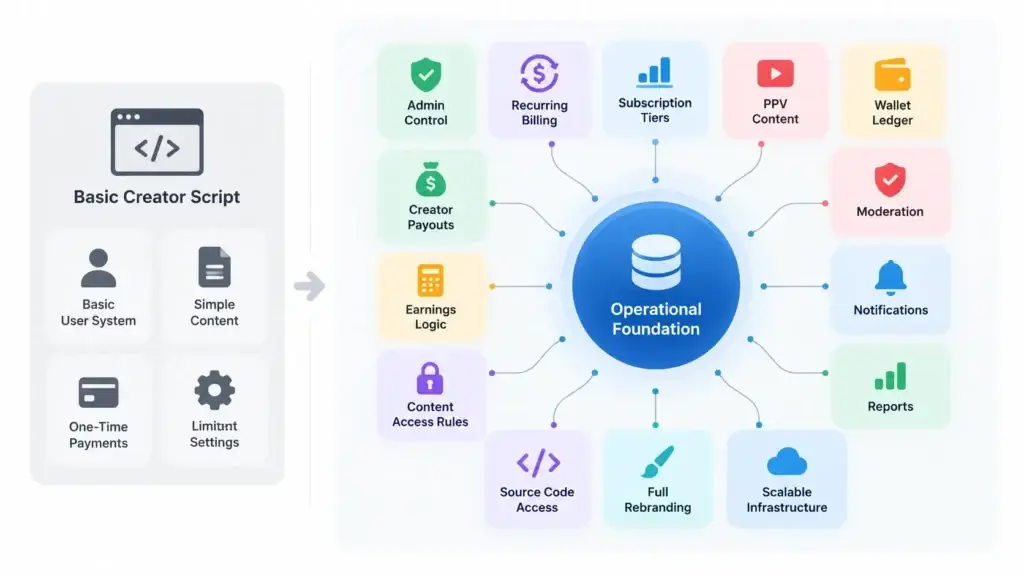
A basic subscription script may look attractive because it appears fast and cost-efficient. But founders should inspect what is actually included.
A serious platform needs more than login, profiles, uploads, and payment buttons. It needs admin control, source-code flexibility, creator earnings logic, payment history, subscription management, content access rules, moderation workflows, notifications, reporting, and scalable infrastructure.
Before choosing any development route, founders should ask:
- Can the platform support recurring billing and failed payment handling?
- Can creators offer multiple subscription tiers?
- Can users unlock one-time premium content?
- Is there a wallet or transaction ledger?
- Can the admin manage users, creators, content, commissions, and payouts?
- Is the source code accessible for future customization?
- Can the platform be rebranded fully?
- Can the architecture support media growth?
- Are moderation and reporting workflows included?
- What exactly ships at launch?
For founders planning a branded creator subscription business, Miracuves’ creator subscription platform foundation can be reviewed as a launch-ready option with monetization workflows, admin control, and faster deployment.
Mistake 8: Overbuilding From Scratch Before Market Validation
The opposite mistake is also common. Some founders spend months building every module from zero before validating creator demand, payment readiness, acquisition channels, and retention strategy.
Custom development can make sense when a business has unique workflows, deep funding, internal product leadership, or advanced technical requirements. But for many founders, the first priority is to launch a working product, test a niche, onboard creators, collect feedback, and improve based on real usage.
Building from scratch too early can create three problems:
| Risk | What Happens |
|---|---|
| Longer time to launch | The market may move before the platform is live |
| Higher upfront cost | Budget goes into infrastructure before demand is proven |
| Slower iteration | Product changes become harder if the first build is too rigid |
A ready-made, white-label foundation can reduce unnecessary rebuilding because core flows already exist. Miracuves helps founders use this approach where suitable, with branded deployment and 6-day solution delivery for ready-made scope.
Before choosing between custom development and a ready-made foundation, founders should understand the main creator platform development cost factors. Features, integrations, payment gateway requirements, media infrastructure, customization depth, security workflows, and launch scope all influence the final investment.
Mistake 9: Not Giving the Admin Dashboard Enough Power
The admin dashboard is the control center of a subscription-based platform. If it is weak, the founder becomes dependent on developers for routine operations.
A strong admin dashboard should help platform operators manage:
- Users and creator accounts
- Subscription plans
- Content visibility
- Payment transactions
- Platform commission
- Creator payouts
- Refunds and disputes
- Reports and analytics
- Verification status
- Moderation queues
- Notifications and announcements
- Featured creator placements
- Platform settings and policies
Admin control matters because subscription platforms change quickly. Founders may need to adjust commission percentages, approve creators, review content, pause accounts, manage payout delays, resolve disputes, or analyze churn. Without admin flexibility, every small change becomes an engineering request.
Mistake 10: Forgetting Retention During Development
Many founders plan acquisition before retention. They ask how to attract users, but not why users will stay after the first payment.
Retention in a subscription-based platform depends on ongoing value. Fans renew when creators post consistently, interaction feels personal, benefits are clear, and the platform experience is smooth. Creators stay when earnings are transparent, tools are easy to use, payouts are reliable, and audience engagement is visible.
Retention-focused features may include:
| Feature | Retention Impact |
|---|---|
| Renewal reminders | Reduces accidental churn |
| Creator analytics | Helps creators understand what fans value |
| Fan notifications | Brings users back to new content |
| Tiered benefits | Encourages upgrades and loyalty |
| Private messaging | Builds direct relationships |
| Live sessions | Creates urgency and interaction |
| Saved content libraries | Makes premium access feel organized |
| Promotions and discounts | Helps creators reactivate inactive fans |
A platform that is only built for content uploads may struggle. A platform built for recurring engagement has a stronger chance of retaining both creators and subscribers.
Retention should be planned as a product workflow, not only a marketing activity. Founders can explore practical ways to improve creator retention and subscriber loyalty through renewal reminders, creator analytics, private engagement, premium tiers, notifications, and reactivation campaigns.
Mistake 11: Ignoring Media Infrastructure and Performance
Subscription platforms often involve images, videos, livestreams, private media, thumbnails, previews, messages, and downloadable assets. That means media handling must be planned early.
Poor media infrastructure can lead to slow uploads, broken playback, high storage costs, poor mobile experience, and frustrated creators. Founders should think about content storage, CDN delivery, video processing, compression, access security, backup policies, and performance monitoring.
This does not mean every launch needs enterprise-grade infrastructure from day one. It means the architecture should be growth-ready, so the platform does not collapse when creators upload more content or fans start consuming videos at scale.
Founders who want to understand the technical build in more depth can review this creator platform developer guide. It gives more context on app architecture, user flows, backend planning, payment logic, media handling, and the development decisions behind a scalable subscription-based platform.
Mistake 12: Not Planning Legal, Policy, and Market Rules Early
A subscription-based platform may need clear policies around content categories, user eligibility, payments, refunds, creator verification, privacy, age restrictions where relevant, intellectual property, takedown requests, and dispute handling.
Founders should work with legal advisors before launch, especially when user-generated content, paid private content, or regulated payment flows are involved.
From a product perspective, the platform should support policy execution through features such as:
- Account verification
- Content reporting
- Admin review queues
- User blocking
- Activity logs
- Payment records
- Content removal workflows
- Region-based settings where required
- Terms acceptance flows
The platform cannot replace legal review, but it should give the business operational controls to apply its policies consistently.
Founder Decision Signals
Speed
If your main goal is to validate a niche quickly, avoid rebuilding standard subscription, payment, content, and admin workflows from zero.
Cost
Costs rise when monetization, access control, payouts, and moderation are not planned before development starts.
Scalability
Media storage, payment records, creator activity, and analytics should be built on an architecture that can grow beyond the first launch.
Market Fit
The strongest launch plan starts with a clear creator niche, defined fan value, flexible monetization, and measurable retention signals.
Ready-Made vs Custom Development: Which Route Reduces Launch Risk?
There is no single right answer for every founder. The better question is: what does your business need at this stage?
| Development Route | Best For | Main Advantage | Risk to Watch |
|---|---|---|---|
| Ready-made white-label platform | Founders who want faster launch and market validation | Core workflows are already available | Must confirm scope, customization, and integration fit |
| Custom development | Businesses with unique workflows or deep product requirements | Full flexibility from day one | Longer timeline and higher planning burden |
| Basic script | Small experiments with limited operational needs | Lower initial complexity | May lack scalability, admin control, and monetization depth |
| Hybrid approach | Founders who want speed plus customization | Faster foundation with tailored modules | Requires clear scope discipline |
A practical founder path is to start with a launch-ready foundation, customize the brand, configure monetization, test creator onboarding, and improve based on real platform behavior. This reduces the risk of spending months on assumptions.
The development partner also matters. Founders should evaluate whether the team understands recurring billing, gated content, creator payouts, moderation, admin dashboards, and source-code ownership. This guide on choosing a creator platform development company can help compare technical capability, launch support, customization flexibility, and long-term platform control.
Miracuves supports this path through ready-made and white-label creator monetization solutions that can include branded design, admin dashboards, subscription workflows, payment logic, creator tools, and source-code ownership.
Pre-Launch Checklist for Subscription-Based Platform Founders
Before launching, founders should confirm the platform can answer these questions clearly:
| Area | Questions to Confirm |
|---|---|
| Business model | What revenue streams will be active at launch? |
| Creator onboarding | How will creators set profiles, pricing, content, and payout details? |
| Subscriber journey | How will fans discover, subscribe, unlock, renew, and cancel? |
| Access control | What happens after failed payment, refund, cancellation, or account restriction? |
| Payments | Which gateways support the business model and target geography? |
| Payouts | How are creator earnings tracked, approved, and withdrawn? |
| Moderation | How are reports, restricted content, abuse, and disputes handled? |
| Admin control | Can operators manage users, content, payments, commissions, and analytics? |
| Retention | What brings subscribers back after the first payment? |
| Scalability | Can media, traffic, and transaction records grow without major rework? |
How Miracuves Helps Founders Avoid These Development Mistakes
The biggest advantage of working with a ready-made platform foundation is not just speed. It is avoiding avoidable mistakes.
Miracuves helps founders plan subscription-based creator platforms around the actual business layers that matter: creator onboarding, fan subscriptions, premium content access, PPV unlocks, wallet flows, payment integration paths, creator payouts, content moderation, verification, analytics, admin controls, and branded user experience.
For founders who want to move faster, Miracuves can support 6-day solution delivery where the selected ready-made scope fits. That gives businesses a faster path to launch, validate creator demand, test monetization, and refine the platform without waiting months for every foundational module to be built from scratch.
Final Thoughts: Build the Business Logic Before the Interface
The most successful subscription-based platforms are not built around screens alone. They are built around recurring value, creator trust, fan engagement, secure payments, transparent payouts, content safety, and operator control.
Founders should avoid rushing into development without defining monetization, access rules, onboarding, moderation, admin workflows, and retention logic. These decisions shape the platform’s long-term stability.
A launch-ready foundation can help reduce development risk, especially when the business model depends on proven workflows such as subscriptions, gated content, creator earnings, private engagement, and admin governance. The smarter decision is not always the longest build. It is the build that gets the right product into the market with enough control to improve after launch.
FAQs
What is the biggest mistake founders make when building a subscription-based platform?
The biggest mistake is starting with features before defining the business logic. Founders should first plan monetization, access control, payment flows, creator payouts, admin operations, and retention strategy. Without these foundations, the platform may look complete but fail under real user activity.
What features should a creator subscription platform include at launch?
A strong launch version should include user accounts, creator profiles, subscription tiers, gated content, PPV unlocks, secure payments, creator earnings, payout visibility, notifications, content reporting, moderation workflows, analytics, and admin controls. The exact scope depends on the target niche and launch strategy.
Why is access control important in a premium content platform?
Access control decides who can view paid content, how long access lasts, what happens after cancellation, and how refunds or failed payments affect content visibility. Weak access rules can cause revenue leakage and reduce creator trust.
Should founders build a subscription platform from scratch?
Custom development can work for businesses with unique workflows and enough time to plan every module. However, many founders prefer a ready-made white-label foundation because it can reduce development time, support faster validation, and avoid rebuilding standard subscription, payment, and admin workflows from zero.
How can a subscription-based platform make money beyond monthly plans?
A subscription-based platform can earn through PPV content, paid messages, tips, live sessions, creator commissions, featured placements, premium creator tools, creator shops, and transaction fees. Multiple revenue layers can make the business more flexible than relying only on monthly subscriptions.
Why do creator payouts need careful planning?
Creator payouts affect trust and retention. The platform should clearly track payments, commissions, wallet balances, withdrawal requests, pending earnings, refunds, and disputes. If creators do not understand how they earn or when they get paid, they may leave the platform.
How does moderation affect subscription platform growth?
Moderation protects users, creators, payment relationships, and brand reputation. Reporting tools, verification, review queues, admin controls, activity logs, and dispute workflows help platform operators manage risk as user-generated content grows.
How can Miracuves help launch a subscription-based creator platform?
Miracuves helps founders launch white-label creator monetization platforms with branded apps, subscription workflows, premium content access, payment logic, creator tools, moderation features, admin dashboards, and source-code ownership. For ready-made scope, Miracuves can support 6-day solution delivery.
Miracuves is an independent software development company. We are not affiliated with, connected to, sponsored by, or endorsed by any company or product named in this article.
Terms such as “X Clone” are used descriptively. It is how the software industry refers to building a platform with functionality comparable to a known service, and how clients search for it.
The entire design and codebase of our products is built by our own team. Our products contain no code, design, graphics, or content originating from any third-party website or applications.
All third-party names and marks referenced in this article are the property of their respective owners, referenced solely to identify the services discussed.