


Key Takeaways
- AI-generated code can look cheap until maintenance begins.
- Agencies charge more when the first task is code discovery.
- Missing docs, tests, and patterns create the Debug Premium.
- A working demo does not prove the app is safe to extend.
- A clean white-label engine can reduce long-term rebuild cost.
Debug Premium Signals
- Audit the codebase before asking for feature quotes.
- Check duplicate logic, unclear flows, and missing tests.
- Map payments, users, roles, data, and admin workflows.
- Review security gaps before launch or investor review.
- Compare repair cost against a cleaner product foundation.
Real Insights
- The cheapest code is the code your team can understand.
- AI saves time early but can create hidden prompt tax later.
- Agencies price uncertainty, not only development hours.
- Refactoring can cost more than starting from a clean engine.
- Miracuves builds white-label app foundations that reduce code rescue risk.
AI-generated apps have changed how founders build first versions of products. A founder can now prompt an interface, connect screens, generate backend logic, and produce something that looks like a working app faster than ever.
That speed feels like saved capital.
Until the first agency quote arrives.
Many founders are shocked when a development agency quotes far more to maintain, extend, or stabilize an AI-generated MVP than they expected. The founder sees an app that “already works.” The agency sees undocumented business logic, inconsistent architecture, missing tests, unclear data flows, duplicate functions, security blind spots, and code that may have been generated without a long-term product structure.
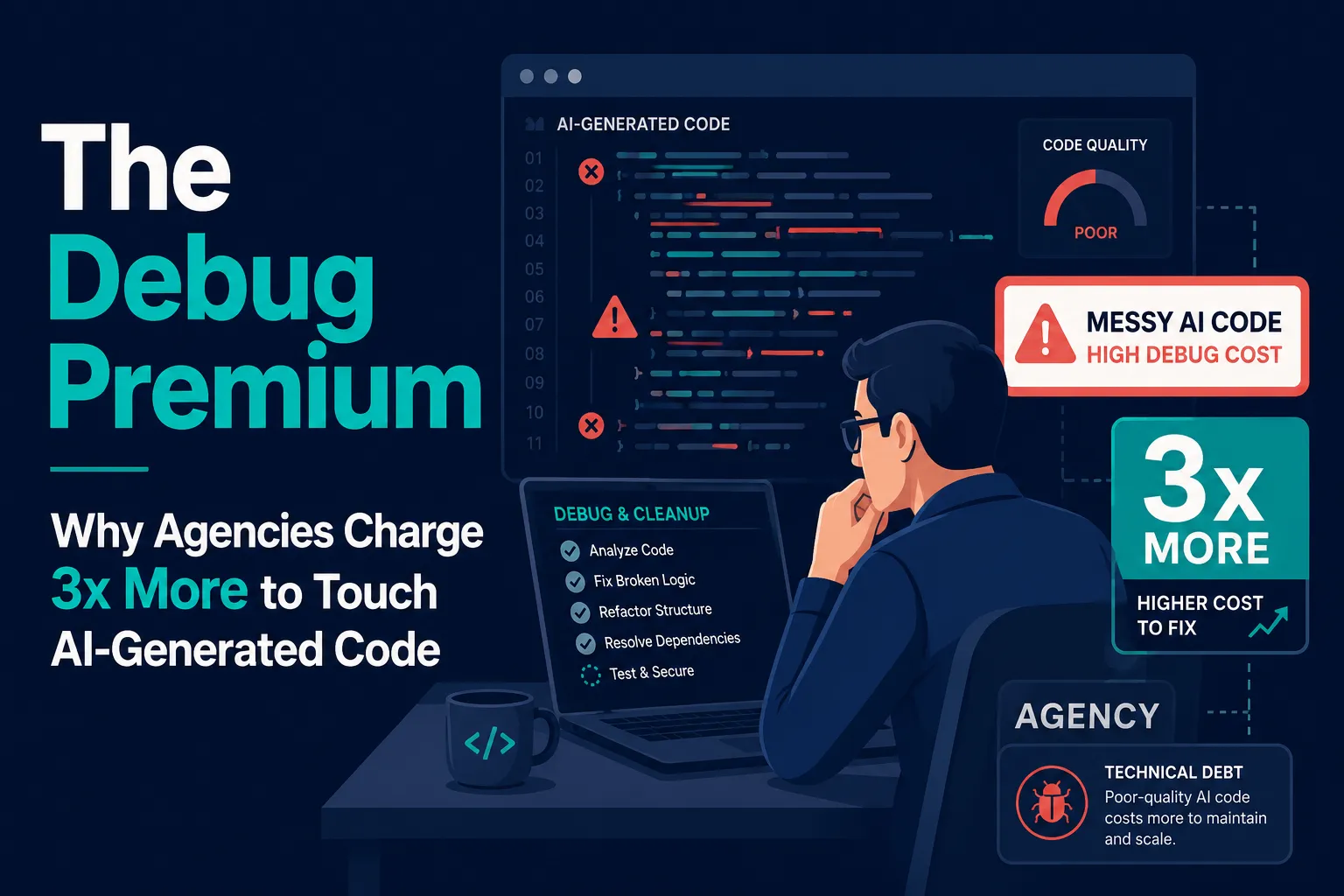
That difference creates what we call the Debug Premium.
The Debug Premium is the extra financial layer developers add when the first job is not building a feature. The first job is understanding what the AI actually created, why it works, where it breaks, and whether it can be safely changed.
Recent developer research supports the concern. Stack Overflow’s 2025 Developer Survey found that 66% of developers reported frustration with AI solutions that are “almost right, but not quite,” while 45% said debugging AI-generated code is more time-consuming. Sonar’s 2026 State of Code survey found that 96% of developers do not fully trust AI-generated code, and 38% said reviewing AI-generated code requires more effort than reviewing code written by human colleagues.
For founders, the issue is not whether AI code is always bad. It is not. The issue is whether the codebase is predictable enough for another team to own.
That is where the real cost begins.
The Illusion of Saved Capital: Paying for the Prompt Tax
AI makes the first visible version of software feel inexpensive. Screens appear quickly. APIs can be generated. Authentication, dashboards, forms, and payment flows can be stitched together in days instead of weeks.
But software cost is not only the cost of writing code.
It is also the cost of understanding, changing, testing, securing, deploying, and supporting that code over time.
This is where many AI-generated MVPs become financially misleading. The founder saves money during creation but pays later through what can be called the Prompt Tax: the hidden cost of decisions that were never documented because they happened inside prompts, model outputs, quick fixes, and repeated regeneration cycles.
A normal development team usually leaves behind some structure:
- Architecture decisions
- Naming conventions
- Database relationships
- API documentation
- Error handling standards
- Reusable components
- Test coverage
- Deployment logic
- Security assumptions
- Feature ownership boundaries
An AI-generated codebase may have pieces of this, but often not in a consistent way. The product can function on the surface while remaining difficult to reason about underneath.
That is why an agency quote can feel unreasonable to the founder and completely rational to the engineering team.
The agency is not only quoting for “one new feature.” It is quoting for the uncertainty around every hidden dependency that feature might break.
What Is the Debug Premium?
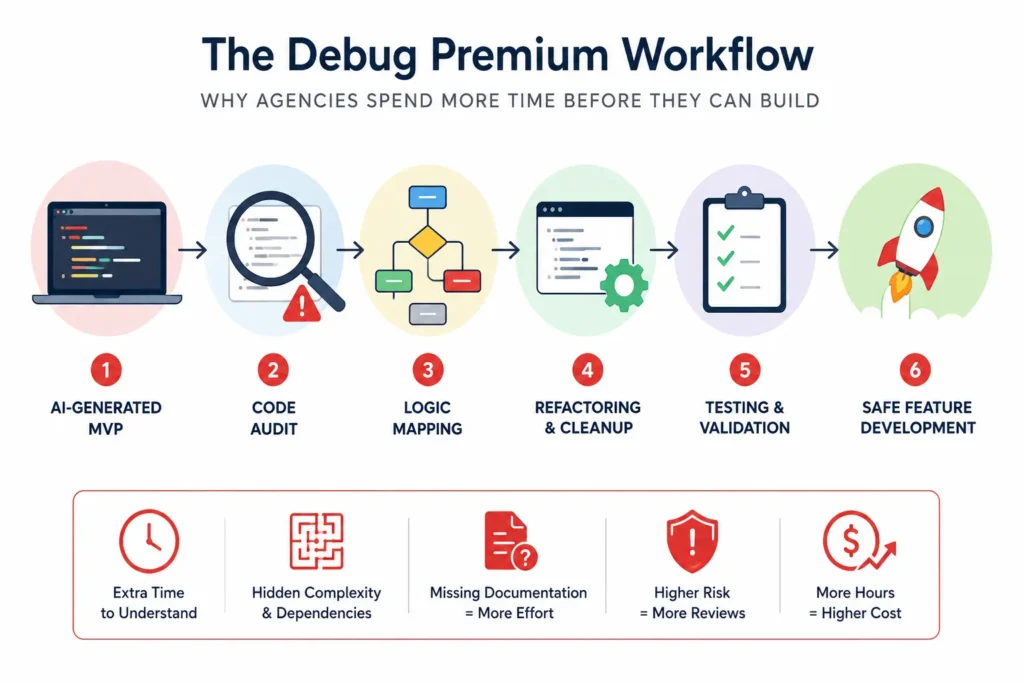
Image Source: AI-generated visual by Miracuves
The Debug Premium is the additional cost charged when developers must spend significant time diagnosing, mapping, and stabilizing a codebase before normal development can begin.
In a clean codebase, a developer might estimate a feature like this:
“Add subscription billing to the app dashboard. Estimated effort: 40 hours.”
In an undocumented AI-generated codebase, the same feature may become:
“Audit the existing payment logic, map user roles, check database relationships, identify duplicate billing functions, review security assumptions, document the flow, write missing tests, then add subscription billing. Estimated effort: 120 hours.”
That is the 3x premium model.
Not because the agency is charging triple for the same task, but because the task is no longer the same.
Read More: Stripe Payments Not Reconciling? Fix the Webhook Desync Breaking Your AI App Revenue
The job changes from feature development to forensic engineering.
Data Breakdown: The Time Sink of Undocumented Logic
The strongest public data does not say “all agencies charge exactly 3x.” What it does show is that AI-generated code creates measurable review, trust, and debugging friction.
A 2025 METR randomized controlled trial studied experienced open-source developers working on repositories they already knew well. Developers expected AI to make them faster, but the measured result showed tasks took 19% longer when AI tools were allowed in that setting. The study focused on experienced developers and mature codebases, so it should not be overgeneralized to every startup project, but it does challenge the assumption that AI automatically reduces engineering time.
A large-scale 2026 empirical study of AI-generated code in GitHub repositories analyzed 304,362 verified AI-authored commits across 6,275 repositories. It found 484,606 distinct issues introduced by AI-authored commits, with code smells making up 89.1% of the issues and 24.2% of tracked AI-introduced issues still surviving at the latest repository revision.
Stack Overflow’s 2025 survey adds the human side: developers are not simply rejecting AI; they are using it while reporting that “almost right” outputs and debugging overhead remain major frustrations.
For founders, these findings matter because agency quotes are built around risk. If developers expect higher review effort, unclear logic, and longer debugging cycles, the quote rises.
Why AI-Generated MVPs Become Expensive to Maintain
An AI-generated MVP becomes expensive when it has enough functionality to attract founder confidence but not enough structure to support team ownership.
The common risk pattern looks like this:
- The founder generates the first version quickly.
- Features are added through repeated prompts.
- The app starts working after several fixes.
- The founder demos it to users or investors.
- Real users ask for changes.
- A development agency is hired.
- The agency discovers the product works, but the code is hard to trust.
The cost is not created by AI alone. The cost is created by AI output without engineering governance.
Missing Design Patterns
A predictable app usually follows recognizable patterns: MVC, service layers, repository patterns, modular frontend structure, clean API boundaries, or domain-driven separation where needed.
AI-generated code may solve each prompt locally without maintaining a consistent design pattern across the product. That creates local success and global confusion.
Weak Documentation
A developer can work faster when the code explains itself through clean naming, comments where needed, README files, API documentation, environment setup guides, and deployment instructions.
Without documentation, every change starts with investigation.
Duplicate Logic
AI-generated products often contain repeated versions of similar functions because the model generated a solution for each prompt independently. One discount function may live in checkout, another in admin, another in subscriptions.
When a developer changes one version, the others may still behave differently.
Unclear Data Relationships
AI can generate database tables quickly, but long-term product health depends on clean relationships, migrations, indexing, validation, and data ownership boundaries.
If the database logic is unclear, even a small feature can risk breaking user accounts, orders, bookings, subscriptions, or payments.
Missing Tests
Without tests, developers cannot confidently know whether a change broke something else.
This is one of the biggest reasons agencies quote conservatively. The cost is not only writing code. It is protecting the business from regression.
Read More : Reconnecting Broken OAuth in Cursor Builds: A Step-by-Step Rescue
The 3x Debug Premium Model: How the Cost Math Works
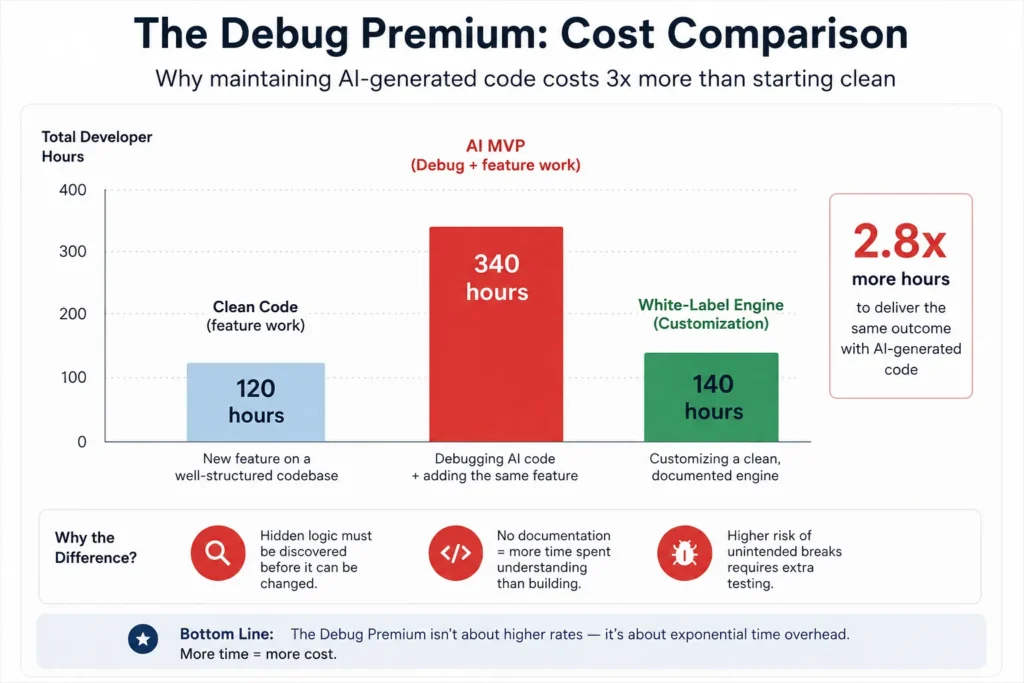
Image Source: AI-generated visual by Miracuves
Let’s model a practical founder scenario.
A founder asks an agency to maintain an AI-generated marketplace MVP. The requested scope looks simple:
- Fix login issues
- Add vendor approval
- Improve payment flow
- Add admin reporting
- Prepare the app for launch
In a clean, documented codebase, the agency may estimate:
| Workstream | Clean Codebase Estimate |
|---|---|
| Feature planning | 8 hours |
| Backend changes | 32 hours |
| Frontend changes | 28 hours |
| Payment/admin adjustments | 24 hours |
| QA and deployment | 28 hours |
| Total | 120 hours |
Now add the Debug Premium caused by undocumented AI-generated logic:
| Extra Workstream | Why It Exists | Added Hours |
| Codebase audit | Developers must understand structure before changing it | 30 hours |
| Logic mapping | Business flows are not clearly documented | 25 hours |
| Dependency tracing | Unknown relationships between modules | 20 hours |
| Refactoring duplicate code | Similar functions exist in multiple places | 35 hours |
| Test recovery | Missing tests must be created for safe changes | 45 hours |
| Security and payment review | Risk is higher around auth, payments, and access control | 35 hours |
| Deployment cleanup | Environment and build process may be unclear | 30 hours |
| Added effort | 220 hours |
The founder thought the job was 120 hours. The agency sees 340 hours.
That is a 2.8x increase.
Rounded commercially, this becomes the “3x Debug Premium.”
The agency is not necessarily inflating the quote. It is pricing the uncertainty that the AI-generated MVP created.
Patch, Refactor, or Replace: The Founder Decision Table
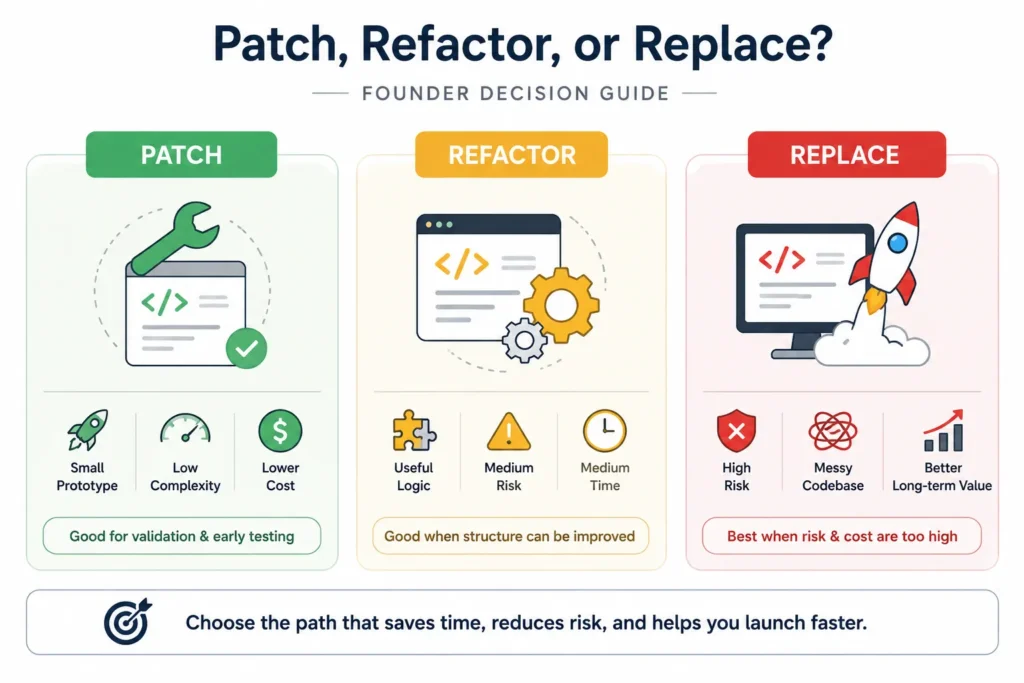
Image Source: AI-generated visual by Miracuves
Founders should not automatically scrap every AI MVP. Some AI-generated products are useful prototypes. Some are good enough for internal demos. Some can be cleaned up if the architecture is not deeply broken.
The decision depends on how much of the product is reusable.
| Option | Best When | Financial Risk | Founder Impact |
|---|---|---|---|
| Patch the AI MVP | The product is small, non-critical, and only needs minor fixes. | Low upfront cost but recurring instability if the structure is weak. | Useful for demos, internal tools, or validation without heavy users. |
| Refactor the AI MVP | The product has valuable logic but poor structure. | Medium to high cost because developers must clean before scaling. | Works when the business model is proven and the code is salvageable. |
| Replace with a clean engine | The MVP is hard to document, hard to test, or unsafe to maintain. | Often lower long-term cost because the foundation is predictable. | Best when the founder wants a launch-ready product with clearer ownership. |
The Clean Slate: Why Licensing a White-Label Engine Is Often Cheaper
A clean white-label engine is not cheaper because it has fewer features. It is often cheaper because the foundation is already organized, documented, tested, and built around known app workflows.
For founders, this matters more than the number of screens.
A launch-ready white-label engine can include:
- User app flow
- Provider, vendor, driver, merchant, or creator panels depending on the model
- Admin dashboard
- Authentication
- Payment gateway integration
- Booking, order, content, or transaction workflows
- Notification logic
- Role-based access control
- Basic reporting
- Source-code ownership
- Branding customization
- Deployment support
The financial advantage is not just speed. It is reduced uncertainty.
When a developer opens a predictable codebase, the work becomes clearer. They can see where the logic belongs, how modules communicate, where data lives, and how future customization should happen.
That reduces the Debug Premium.
For founders exploring ready-made app categories, the broader Miracuves solutions ecosystem offers a cleaner route than forcing developers to rescue a fragile AI-generated build. Miracuves also supports full stack app development and custom mobile app development when a business needs a tailored build instead of a ready-made foundation.
The Clean Engine Cost Model
Let’s compare three paths without inventing exact project pricing.
| Path | What the Founder Pays For | Cost Behavior |
| AI MVP maintenance | Audit, debugging, refactoring, documentation, then feature work | Unpredictable because the team must discover the architecture first |
| Custom rebuild | Product discovery, architecture, design, development, QA, deployment | Higher upfront cost but cleaner if built properly |
| White-label engine | Existing product foundation, branding, customization, deployment | Often more cost-efficient when the business model fits a known app category |
Miracuves’ ready-made approach can reduce development time because the foundation already includes core app flows, admin control, and essential modules. Final pricing depends on the selected features, integrations, branding, and customization scope.
The important financial point is simple:
You should not compare the cost of a white-label engine against the cost of generating an AI MVP. You should compare it against the cost of making that AI MVP maintainable.
That is where the math changes.
Read More: Ghost Charges & Failed Subscriptions: The Financial Cost of AI Billing Logic
Founder Decision Signals
Speed
If the AI MVP needs weeks of audit work before one safe feature can be added, it is no longer a fast product path.
Cost
If agency estimates are mostly discovery, debugging, and refactoring, the founder is paying to understand old code instead of launching new value.
Scalability
If the codebase lacks clear patterns, tests, and module boundaries, scaling users may increase operational risk.
Market Fit
If the business model is still unproven, a clean white-label engine can help validate faster without over-investing in code rescue.
When Keeping the AI MVP Still Makes Sense
The right decision is not always to throw the AI MVP away.
Keeping it may make sense when:
- The app is only a prototype.
- No payment, identity, or sensitive data workflows are involved.
- The codebase is small enough to audit quickly.
- The founder has clear documentation of prompts, decisions, and data flows.
- The agency confirms the architecture is salvageable after review.
- The product is not expected to scale immediately.
The danger begins when a founder treats a prototype as a production foundation.
A prototype proves that an idea can be shown. A production foundation must prove that the product can be owned, maintained, secured, and improved.
Those are different standards.
Mistakes Founders Should Avoid Before Hiring an Agency
Assuming working screens mean working architecture
An app can look complete while hiding fragile backend logic, duplicated functions, missing validations, and unclear data flows.
Asking for feature quotes before a code audit
Without an audit, an agency cannot know whether the requested feature is simple or whether it touches broken assumptions across the product.
Comparing AI generation cost with professional maintenance cost
The correct comparison is not “AI was cheap, agency is expensive.” The correct comparison is “What does it cost to make this product safe to own?”
Ignoring source-code ownership and documentation
If the founder cannot transfer, explain, and maintain the codebase, the business depends on fragile knowledge instead of a durable product foundation.
How Miracuves Helps Founders Avoid the Debug Premium
The fastest way to reduce the Debug Premium is to stop treating undocumented AI-generated code as the product foundation.
Miracuves helps founders move toward a cleaner starting point: a ready-made, white-label app engine with source-code ownership, admin control, and structured workflows that developers can understand, customize, and extend.
Instead of paying an agency to spend weeks decoding unpredictable logic, founders can begin with a foundation that already supports common digital business models such as delivery platforms, marketplace apps, ride-hailing apps, fintech products, ecommerce platforms, booking systems, creator platforms, and on-demand service apps.
The real value is not copying another app. The value is using a proven product structure to reduce engineering uncertainty.
For a founder, that means more budget can go toward:
- Branding and user experience
- Business model customization
- Monetization setup
- Admin dashboard configuration
- Payment and workflow adjustments
- Launch preparation
- User acquisition and market validation
A marketplace founder, for example, does not need to pay developers to untangle unclear vendor, listing, payment, review, and admin logic from an AI-generated backend. They can start from a cleaner marketplace app development foundation and customize the model around their niche.
A delivery founder can avoid rebuilding customer, merchant, delivery partner, dispatch, and admin workflows from scratch by starting with a structured delivery app development solution.
A creator-platform founder can move faster with a ready-made creator platform development engine that already supports key workflows such as content upload, creator profiles, moderation, feeds, and admin control.
This is where Miracuves’ white-label approach becomes financially practical. It helps founders avoid spending their launch budget on code archaeology and instead invest in a product foundation that is easier to brand, maintain, improve, and scale.
For broader strategic reading, founders can explore Miracuves’ guide on clone app development for faster market validation and white-label app business models before deciding whether to patch, refactor, or replace their AI-generated MVP.
Final Thoughts: The Cheapest Code Is the Code Your Team Can Understand
AI-generated code can be useful for exploration, prototyping, and early product thinking. But founders should not confuse a fast prototype with a maintainable business asset.
The real cost of software appears when another team must understand it, change it, secure it, document it, and support it under real business pressure.
That is why agency quotes for AI-generated MVPs can feel unusually high. Developers are not just building new features. They are pricing the risk of touching code that may not follow predictable design patterns.
The Debug Premium is the financial consequence of unclear ownership.
For founders, the smarter question is not, “How much did the AI MVP cost to generate?”
The better question is:
“How much will it cost to make this product safe to launch, own, and scale?”
If the answer is higher than starting from a clean white-label foundation, the cheapest decision may be to stop debugging the past and start building on a stronger engine.
FAQs
What is the Debug Premium in AI-generated code?
The Debug Premium is the extra cost developers or agencies charge when they must reverse-engineer, audit, document, refactor, and stabilize AI-generated code before normal feature development can begin.
Do agencies really charge 3x more to fix AI-generated code?
Not every agency charges exactly 3x. The 3x figure is best used as a financial model. If a clean feature takes 100 hours but AI-code audit, refactoring, testing, and debugging add another 200 hours, the total effort becomes roughly 3x.
Why is AI-generated code hard to maintain?
AI-generated code can be hard to maintain when it lacks consistent design patterns, documentation, tests, modular structure, secure workflows, and clear business logic. The code may work on the surface but become difficult to safely modify.
Should founders scrap their AI MVP?
Not always. If the AI MVP is small, well-documented, and only used for validation, it may be worth keeping. If it handles users, payments, identity, bookings, or transactions without a clean structure, a rebuild or white-label foundation may be safer.
Is a white-label app cheaper than fixing an AI MVP?
It can be cheaper when the AI MVP requires heavy audit, refactoring, documentation, and testing before launch. A white-label app foundation is often more cost-efficient because core workflows, admin controls, and app structure already exist.
What should founders ask before hiring an agency to fix AI code?
Founders should ask for a code audit, architecture review, security review, test coverage assessment, documentation check, and refactor estimate before requesting feature work.
How does Miracuves help founders avoid AI-code maintenance risk?
Miracuves helps founders launch with ready-made and white-label app foundations that include source code, branded design, admin control, and customizable app workflows. This reduces the uncertainty of maintaining undocumented AI-generated code.