


Key Takeaways
- An AI codebase audit helps founders understand whether their MVP is ready for real developers, users, and scale.
- AI-generated apps can work in demos while hiding poor structure, duplicated logic, and fragile dependencies.
- Modularity, documentation, database design, API safety, testing, and deployment setup are core audit areas.
- Technical risk depends on code quality, separation of concerns, security controls, and maintainability.
- A strong audit helps founders avoid costly rewrites before agency handoff, fundraising, or public launch.
Audit Signals
- Founders need visibility into frontend logic, backend services, database schemas, API routes, and third-party integrations.
- Developers need clean modules, readable code, environment setup notes, tests, documentation, and clear ownership boundaries.
- Admins need control over user roles, logs, prompts, model settings, payments, reports, and operational workflows.
- A modular codebase should separate UI, business logic, data access, authentication, payments, and AI workflows.
- Audit reports help identify rewrite risk, hidden bugs, security gaps, scaling limits, and missing documentation.
Real Insights
- A working AI-generated product can still be difficult to maintain when logic is scattered across files and prompts.
- Poor separation of concerns can make small feature changes break unrelated parts of the app.
- Missing documentation makes agency handoff slower, more expensive, and more likely to become a full rebuild.
- Founders should audit the codebase before scaling, hiring developers, pitching investors, or adding enterprise features.
- Miracuves builds AI MVPs and clone apps with modular architecture, documented codebases, secure workflows, deployment support, and admin control.
AI tools have changed how quickly founders can turn an idea into working screens, basic logic, and a clickable product. A non-technical founder can now create login flows, dashboards, booking forms, checkout pages, database tables, and even backend endpoints before speaking to a development agency.
That speed is useful.
But speed can also create a dangerous misunderstanding: a codebase that works in a demo is not always a codebase that a human development team can safely scale.
This is where the Modularity Audit becomes important.
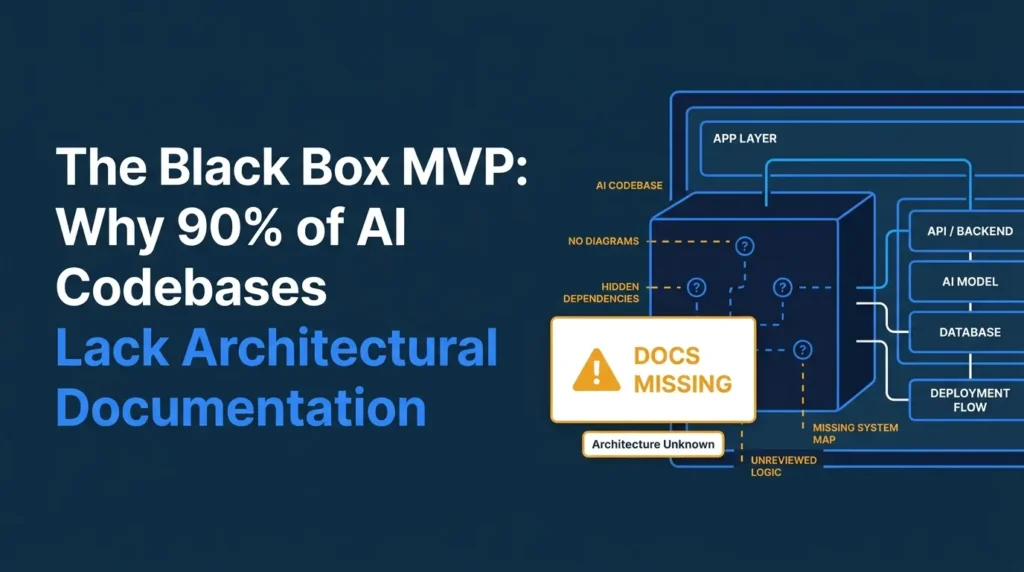
Before handing your AI-generated codebase to an agency, you need to check whether the code is separated into clear modules, whether business logic is easy to locate, whether APIs are predictable, whether components can be changed without breaking unrelated areas, and whether a developer can understand the product without reverse-engineering every file.
For founders seeking development quotes, this audit helps answer one practical question:
Is this AI-generated codebase worth improving, or will an agency need to rewrite it anyway?
Miracuves helps founders avoid that uncertainty by offering ready-made, white-label, source-code-owned app solutions and full-stack app development support that already includes structured app modules, admin control, branding flexibility, and launch-ready foundations for faster market validation.
Evaluating Technical Debt: The Pre-Handoff Reality Check
Founders often approach agencies with a simple assumption:
“I already built the first version with AI. Can you just clean it up and launch it?”
Sometimes the answer is yes. But often, the agency finds a deeper issue. The app may have working screens, but the underlying code may not have a clean product structure. The frontend may directly contain business rules. Payment logic may be mixed with UI code. Admin actions may be handled differently across different files. API endpoints may work, but without a clear pattern. Database tables may exist, but relationships may not support real-world operations.
This is not just a technical problem. It is a business problem.
When developers cannot understand how the app is organized, they cannot safely estimate the work. When they cannot safely estimate the work, they either quote higher, extend the timeline, or recommend a rewrite.
That is why founders should not ask only, “Does the app work?”
They should ask:
Can another developer understand, modify, test, secure, and scale this codebase without rebuilding it?
That is the real handoff test.
Read More: Stripe Payments Not Reconciling? Fix the Webhook Desync Breaking Your AI App Revenue
Why AI-Generated Code Often Breaks at the Architecture Layer
AI-generated code is strongest when the task is narrow: create a form, write a function, generate a component, build a basic endpoint, or scaffold a small feature.
The problem starts when the app grows through repeated prompts.
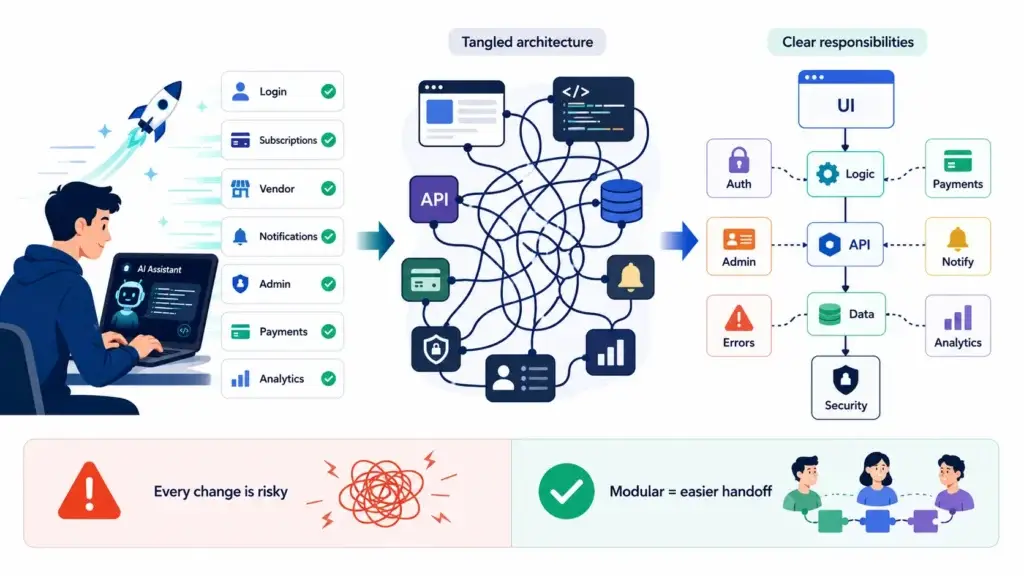
A founder may ask the AI to add login. Then subscriptions. Then vendor dashboards. Then notifications. Then admin approvals. Then payments. Then analytics. Each prompt may solve the immediate request, but the larger architecture may become inconsistent.
This can create what developers call poor separation of concerns.
In simple terms, separation of concerns means each part of the product has a clear responsibility.
A scalable app should separate:
- UI components
- Business logic
- API calls
- Database models
- Authentication rules
- Payment workflows
- Admin controls
- Notification services
- Error handling
- Analytics and reporting
- Security permissions
When these concerns are separated, developers can change one area without damaging another. When they are mixed together, every small change becomes risky.
For example, changing a subscription rule should not require editing multiple frontend components, database queries, checkout functions, and admin dashboard files. If it does, the codebase is not modular enough for efficient agency handoff.
Read More: What 70%+ of AI-Built Apps Get Wrong About Security — And Why Users Can See Each Other’s Data
The Modularity Checklist: Separation of Concerns in AI Code
Use this checklist before asking a development agency for a quote. The goal is not to become a senior engineer overnight. The goal is to identify whether your AI-generated codebase is structured enough for human developers to continue from it.
1. Can You Explain the Folder Structure in Five Minutes?
A handoff-ready codebase should have a folder structure that makes sense without a long explanation.
Look for clear areas such as:
- components
- pages or screens
- services
- API routes
- database models
- utilities
- config
- middleware
- tests
- admin modules
- user modules
- payment modules
Red flag: every feature has its own random structure.
If similar features are organized differently, human developers will need extra time to understand the logic before making changes.
2. Is Business Logic Separated From UI Code?
A common AI-code issue is business logic hiding inside buttons, forms, and page components.
For example, a checkout screen should not directly decide commission rules, tax calculations, refund eligibility, and wallet updates. Those rules should live in a dedicated service layer or backend module.
Ask this:
If we changed the pricing model tomorrow, where would the developer update it?
If the answer is “many places,” the codebase has a modularity problem.
3. Are API Calls Centralized or Scattered?
A clean app usually has predictable API handling. Developers should be able to find where the frontend communicates with the backend.
Red flags include:
- API calls written directly inside many UI files
- different naming styles for similar endpoints
- repeated fetch or axios logic everywhere
- no shared error handling
- no consistent response format
- no separation between user, admin, and partner workflows
Scattered API logic makes every new feature slower because developers must first understand all the inconsistent patterns already in the code.
4. Are Database Models Designed for Real Operations?
AI tools can generate database tables quickly, but founders must check whether those tables support real business workflows.
For example, a delivery app does not only need users and orders. It may need merchants, delivery partners, delivery zones, order statuses, commissions, refunds, payout records, cancellation reasons, ratings, and admin activity logs.
A marketplace app does not only need listings. It may need host profiles, bookings, availability rules, payments, disputes, reviews, verification status, and commission logic.
The question is:
Does the database reflect the business model, or only the demo screens?
If the database is shallow, the agency may recommend rebuilding the backend foundation.
5. Are User Roles and Permissions Clearly Defined?
Role-based access control is one of the clearest signs of a mature codebase.
A real app usually has different access levels:
- customer
- vendor
- provider
- driver
- creator
- admin
- sub-admin
- support team
- finance team
- platform operator
Depending on the app type, not every role is needed. But the logic should be clear.
Red flag: admin access is handled by simple frontend checks or hardcoded email addresses.
If permissions are not structured properly, the app may become difficult to secure, manage, and scale.
6. Is the Admin Dashboard a Real Control Layer?
Many AI-generated apps include a basic admin screen. But a screen is not the same as an admin control system.
A useful admin dashboard should help the platform operator manage users, listings, providers, payments, disputes, categories, content, commissions, reports, and platform settings.
Founders should ask:
- Can the admin approve or suspend users?
- Can the admin manage transactions or payouts?
- Can platform rules be changed without editing code?
- Can categories, prices, commissions, or service areas be controlled?
- Can the admin view activity logs and reports?
- Can disputes or support issues be handled?
If the admin dashboard is only cosmetic, the agency may need to rebuild the operational backend.
7. Is Repeated Code Creating Hidden Rewrite Risk?
AI-generated code often solves similar problems multiple times in slightly different ways.
Look for repeated logic such as:
- duplicate validation rules
- duplicate payment checks
- duplicate notification triggers
- duplicate database queries
- duplicate date formatting
- duplicate authentication checks
- duplicate status updates
Repeated code is not just untidy. It creates future inconsistency.
If the same business rule exists in five places, a developer must update all five places correctly. One missed update can create bugs, payment errors, reporting mismatches, or broken workflows.
8. Are Integrations Abstracted Properly?
Apps often depend on third-party services such as payment gateways, SMS providers, email tools, map APIs, analytics platforms, cloud storage, and authentication providers.
A modular codebase keeps integrations behind service layers so they can be replaced or modified later.
Red flag: third-party API keys, provider-specific logic, or payment rules are scattered across frontend and backend files.
If your payment gateway changes later, the app should not require a full rewrite.
9. Are Errors Logged and Handled Consistently?
A demo can ignore error handling. A production app cannot.
A handoff-ready codebase should have consistent patterns for:
- validation errors
- payment failures
- login failures
- permission errors
- API timeout issues
- failed notifications
- failed uploads
- failed booking or order updates
If errors are silently ignored or handled differently across the app, developers will struggle to debug real user issues after launch.
10. Are Tests, Documentation, and Environment Instructions Present?
AI-generated code is often missing the boring but essential parts of handoff.
A development agency will look for:
- setup instructions
- environment variable documentation
- database migration steps
- API documentation
- module notes
- test coverage
- deployment instructions
- known issues
- assumptions
- access credentials checklist
Without this documentation, the agency must spend extra discovery time before it can confidently modify the app.
That discovery time becomes part of your quote.
AI Codebase Modularity Audit Checklist
| Audit Area | Healthy Sign | Rewrite Risk Signal |
|---|---|---|
| Folder structure | Clear modules for screens, services, APIs, data, and admin logic | Random feature folders with inconsistent patterns |
| Business logic | Rules live in backend services or reusable modules | Pricing, commissions, permissions, and workflows hidden inside UI files |
| API layer | Centralized API calls with predictable response handling | Different API patterns across every page or component |
| Database design | Models reflect real users, roles, transactions, statuses, and admin operations | Tables only support demo screens, not real business workflows |
| Permissions | Role-based access control with clear admin and user rules | Hardcoded permissions or frontend-only access checks |
| Integrations | Payment, SMS, email, maps, and storage services are abstracted | Third-party logic scattered across files |
| Documentation | Setup, deployment, environment, and module notes are available | Developers must reverse-engineer the entire app before estimating |
How to Score Your AI Codebase Before Agency Handoff
A founder does not need to perform a deep engineering audit alone. But a simple scoring method can reveal whether the codebase is worth taking forward.
Use this practical score:
| Score | Meaning | Founder Decision |
|---|---|---|
| 0–3 | The app is mostly a demo with weak structure | Treat it as a prototype, not a handoff-ready codebase |
| 4–6 | Some modules are usable, but key areas need refactoring | Ask the agency for a cleanup estimate and a rebuild estimate |
| 7–8 | The foundation is reasonably structured | Continue with a focused technical review |
| 9–10 | The codebase is modular, documented, and handoff-ready | Proceed to feature expansion, testing, and launch planning |
Most AI-generated founder projects fall into the middle zone. They are not useless, but they are not clean enough to scale without review.
That is why the quote from an agency may feel higher than expected. The agency is not only pricing new features. It is pricing uncertainty.
Read More: How an AI-Built MVP Leaked PII and Why the White-Label Rescue Worked
The Rewrite Tax: Why Agencies Quote Higher for AI Code Cleanup
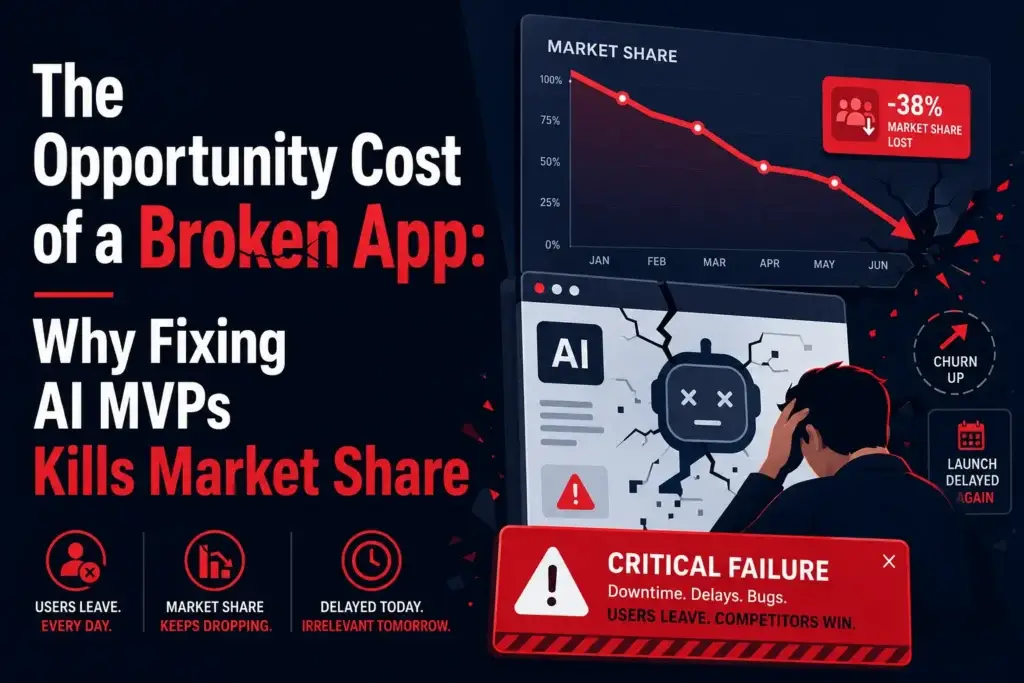
The rewrite tax is the hidden cost founders pay when a human development team must untangle a codebase before building on top of it.
This tax usually includes:
- understanding the existing architecture
- identifying duplicated logic
- mapping unclear data flows
- checking security gaps
- rebuilding fragile modules
- fixing inconsistent API behavior
- normalizing database models
- documenting missing assumptions
- replacing hardcoded logic
- testing workflows that AI generated but never validated properly
For a founder, this can feel frustrating because the app already appears to work.
But from the agency’s perspective, the risk is real. If they build new features on a fragile foundation, they inherit the bugs. If the code breaks after launch, the founder blames the agency, not the AI tool.
So agencies often protect both sides by recommending a partial or full rebuild.
The founder lesson is simple:
Do not measure your AI codebase by how much code exists. Measure it by how safely a human team can change it.
Bypassing the Rewrite Tax with Pre-Built White-Label Engines
There is another path.
Instead of paying an agency to convert an AI-generated prototype into a production-ready app, founders can use the prototype as a business brief and start from a modular, pre-built app foundation.
This is where a white-label engine becomes practical.
A ready-made app foundation can already include:
- structured user flows
- backend modules
- admin dashboard
- payment workflows
- notifications
- role-based control
- app panels based on the business model
- source-code ownership
- branding flexibility
- launch-ready deployment support
The value is not that it avoids customization. The value is that customization starts from a cleaner base.
Miracuves’ ready-made clone app solutions help founders avoid starting from zero when the business model already follows a proven pattern. For founders who have built an AI-generated prototype, that prototype can still be useful as a product brief, feature reference, or validation concept. But the production build does not always need to depend on the AI-generated code itself.
For deeper build support, Miracuves also offers full-stack app development and microservices app development services for founders who need structured architecture, source-code ownership, backend logic, and launch support.
Founder Decision Signals: Keep the AI Code or Start From a Better Base?
Speed
If your priority is to launch quickly, a fragile AI-generated codebase may slow the agency down. A modular white-label foundation can reduce handoff uncertainty.
Cost
If the agency quote is mostly for cleanup, not feature development, the founder should compare refactoring cost against starting from a ready-made app engine.
Scalability
If payments, admin controls, roles, reporting, and integrations are not separated cleanly, scaling the AI code may become more expensive than rebuilding modules.
Market Fit
If the AI prototype already validated the idea, use it as a product reference. The production foundation should be chosen for stability, not emotional attachment to generated code.
When AI Code Is Still Valuable
This article is not arguing that AI-generated code is useless.
AI code can be valuable for:
- testing product ideas
- creating early screens
- exploring user flows
- building internal prototypes
- explaining desired functionality to developers
- preparing a stronger development brief
- reducing ambiguity before the first agency call
The mistake is treating AI-generated prototype code as automatically production-ready.
A founder should separate the value of the idea from the quality of the codebase. Your AI-built app may prove that the product concept makes sense. But the production foundation still needs clean architecture, modular logic, secure workflows, admin control, deployment structure, and long-term maintainability.
That is the difference between a prototype and a business-ready app.
Mistakes Founders Should Avoid Before Developer Handoff
Assuming working screens mean production-ready code
A clickable product may still hide fragile backend logic, duplicated rules, weak permissions, and scattered API calls. Developers need a structure they can safely extend.
Asking agencies only for feature quotes
If the foundation is unclear, the quote will include discovery, cleanup, refactoring, and risk. Ask for a modularity review before asking for a final development estimate.
Keeping AI code because of sunk cost
The time spent generating code is already spent. The better decision is whether that code reduces future work or creates more work for the team that must launch it.
AI Prototype vs Modular White-Label Engine
| Decision Factor | AI-Generated Prototype | Modular White-Label Engine |
| Best use | Testing an idea quickly | Launching a structured app faster |
| Code structure | Depends on prompting quality and review process | Built around reusable product modules |
| Admin control | Often basic or incomplete | Usually included as part of platform operations |
| Developer handoff | May require reverse-engineering | Easier when modules, workflows, and source code are clear |
| Customization | Possible, but may become fragile if logic is scattered | Customization starts from an organized foundation |
| Launch confidence | Requires audit, refactor, and testing | Better suited for founder validation and deployment planning |
| Business value | Helps clarify the idea | Helps move from idea to market faster |
For founders comparing both paths, the question is not whether AI or white-label development is “better.” The better question is:
Which foundation reduces the most risk at your current stage?
If your AI-generated product already validates the workflow, keep the learning. But if the codebase fails the Modularity Audit, consider moving the production build to a structured engine instead of paying a team to repair every architectural decision made through prompts.
Read More: The Authentication Loop: Analyzing Session Failures in AI-Generated MVPs
How Miracuves Helps Founders Move From AI Prototype to Launch-Ready Product
Miracuves helps founders turn product ideas into launch-ready digital businesses using ready-made, white-label, and source-code-owned app solutions.
For a founder with an AI-generated prototype, Miracuves can help in three practical ways:
First, the prototype can be used as a product reference. The screens, flows, and feature ideas help clarify what the founder wants to launch.
Second, the Miracuves team can map the business model to a more structured app foundation. This matters when the product fits a proven category such as delivery, marketplace, fintech, ride-hailing, creator platform, ecommerce, booking, or service marketplace.
Third, the founder can avoid paying for unnecessary rewrite work when a pre-built modular engine already solves the common foundation. Customization can then focus on branding, workflows, monetization, user roles, and launch requirements.
If you want to understand why many founders use clone app development for faster validation, read Miracuves’ guide on clone app development and market validation.
Final Thoughts: Your AI Code Is a Prototype Until Modularity Proves Otherwise
AI-generated code can help founders move faster. It can turn vague ideas into visible workflows. It can help you explain your app to users, investors, and developers.
But the real test begins when a human team must maintain it.
A strong codebase is not measured by how many files exist or how quickly the first version was generated. It is measured by whether the product is modular, understandable, secure, testable, and ready for change.
That is why the Modularity Audit matters.
Before accepting an agency quote, check whether your AI-generated codebase has clean separation of concerns. If it does, you may have a foundation worth improving. If it does not, the smarter founder decision may be to preserve the product learning, leave the fragile code behind, and launch from a modular white-label engine instead.
Miracuves helps founders make that move with ready-made app solutions designed for faster launch, source-code ownership, admin control, and business model clarity.
FAQs
What is an AI codebase audit?
An AI codebase audit is a technical review that checks whether AI-generated code is clean, modular, secure, documented, and ready for human developers to maintain. For founders, it helps determine whether the codebase can be improved or should be replaced with a stronger foundation.
Why do agencies often rewrite AI-generated code?
Agencies may recommend a rewrite when the AI-generated code has poor structure, duplicated logic, unclear data models, weak permissions, missing documentation, or scattered business rules. The issue is not always whether the app works today, but whether it can be safely changed tomorrow.
What does modularity mean in app development?
Modularity means the app is divided into clear, reusable parts. UI, backend logic, API calls, database models, payment workflows, admin controls, and integrations should be separated so developers can update one part without breaking another.
Is AI-generated code good enough for production?
Sometimes, but it depends on review quality, architecture, testing, security, and documentation. AI-generated code can be useful for prototypes, but production apps need stronger control over scalability, permissions, integrations, deployment, and long-term maintenance.
How can a founder check if AI code is handoff-ready?
A founder can check the folder structure, API consistency, database design, business logic placement, user role controls, admin dashboard depth, integration structure, error handling, and documentation. If these areas are unclear, the code may need refactoring or rebuilding.
What is the rewrite tax in AI-generated app development?
The rewrite tax is the hidden cost of asking human developers to understand, clean, refactor, document, and stabilize AI-generated code before they can build new features. It often appears when the code works in a demo but lacks maintainable architecture.
When should founders use a white-label app instead of AI-generated code?
Founders should consider a white-label app when the AI-generated code fails the modularity audit, when speed matters, when the business model follows a proven app pattern, or when paying for cleanup costs more than starting from a structured app foundation.
Can Miracuves use my AI prototype as a reference?
Yes. An AI prototype can be valuable as a product brief, screen reference, and workflow explanation. Miracuves can use that clarity to help map the product to a ready-made or custom app foundation without depending on fragile prototype code.