


Key Takeaways
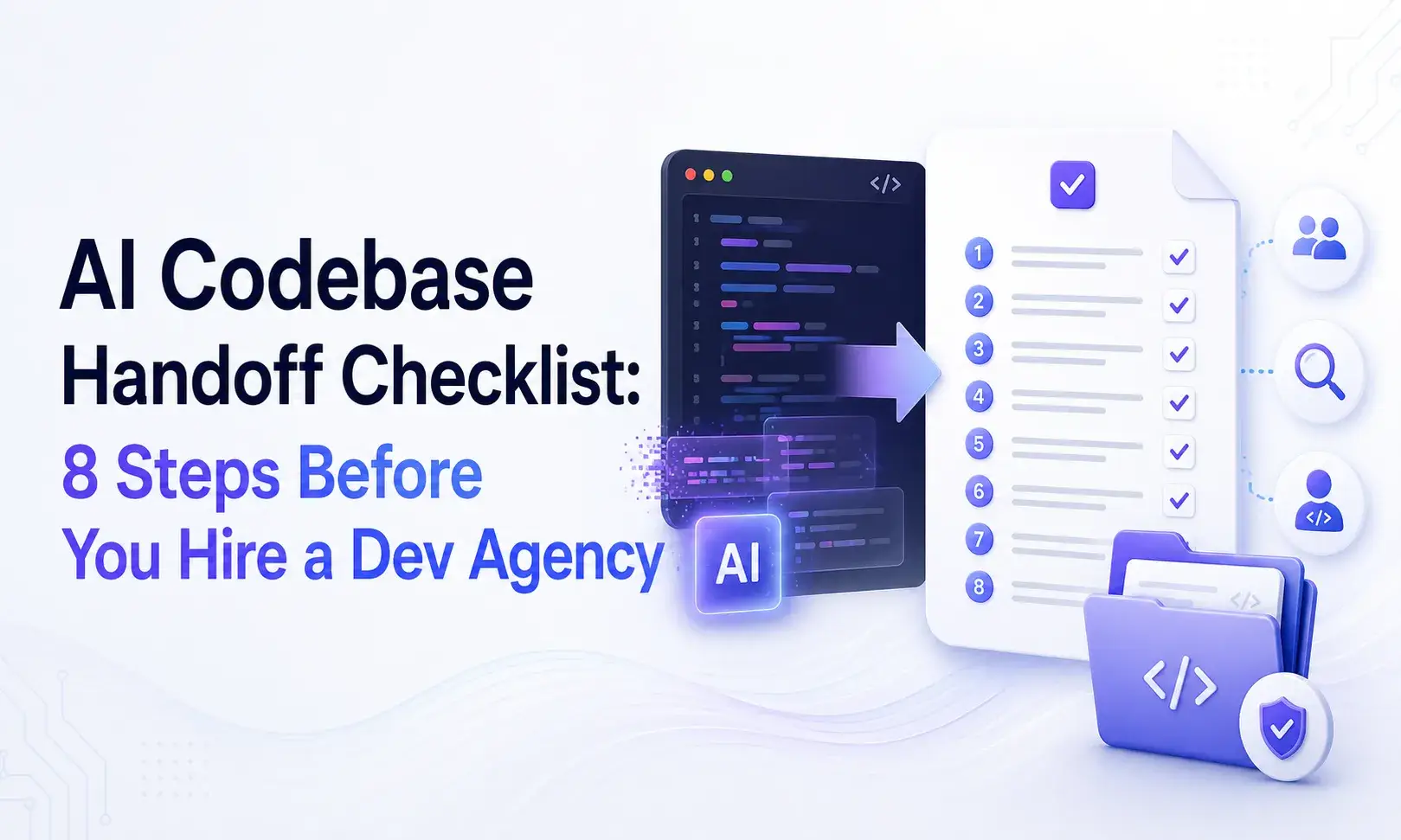
- An AI codebase handoff checklist helps founders prepare their app before bringing in a professional dev agency.
- AI-built MVPs can contain hidden issues in authentication, database logic, APIs, payments, and deployment setup.
- Documentation, environment variables, repository access, database schema, logs, and deployment details are core handoff items.
- A clean handoff reduces discovery time, prevents rework, and helps developers understand what is safe to keep or rebuild.
- A structured technical handoff can turn a fragile AI MVP into a production-ready development project faster.
Handoff Signals
- Founders need clear access to code repositories, hosting accounts, databases, API keys, payment tools, and admin panels.
- Developers need setup instructions, dependency lists, environment files, schema diagrams, test data, and known bug notes.
- Admins need visibility into users, roles, permissions, logs, payments, reports, and operational workflows.
- Security review should cover exposed secrets, weak permissions, unsafe APIs, broken sessions, and data access risks.
- Monitoring and error logs help teams identify crashes, slow endpoints, failed jobs, and unstable AI-generated logic.
Real Insights
- A working AI demo is not the same as a maintainable codebase that another team can safely improve.
- Missing documentation can force developers to reverse-engineer logic, increasing cost and delaying delivery.
- Exposed keys, unclear database relationships, and hardcoded workflows can create serious post-handoff risks.
- A proper handoff should identify which modules can be retained, refactored, replaced, or rebuilt from scratch.
- Miracuves helps founders audit and rebuild AI codebases with documentation, backend cleanup, security review, deployment support, and admin control.
You built an application with Cursor, tested the main screens, connected a database, and may even have shown the product to early users.
Then you hired a professional development agency to take it forward.
The agency opened the repository and gave you an answer you were not expecting:
“We cannot safely continue with this code. It needs to be rewritten.”
For a founder, that response can feel unreasonable. The application appears to work. Features are visible. Data moves through the system. Why would experienced developers refuse to continue from what is already there?
The problem is usually not that human developers dislike AI-assisted coding.
Founders who repeatedly ask Cursor to fix one issue only to see another workflow break are often trapped in a Cursor prompt loop. At that point, the repository keeps changing, but its overall stability does not improve.
The problem is that a working demonstration is not automatically a maintainable software product.
Cursor and other AI coding tools can help founders validate ideas, build interfaces, connect services, and create an initial product quickly. Difficulties begin when generated changes accumulate without a stable architecture, testing process, documentation, or one person who understands how the complete system works.
This AI codebase handoff checklist will help you determine whether your application can be retained, needs structured refactoring, requires a partial rewrite, or should be moved to a cleaner product foundation.
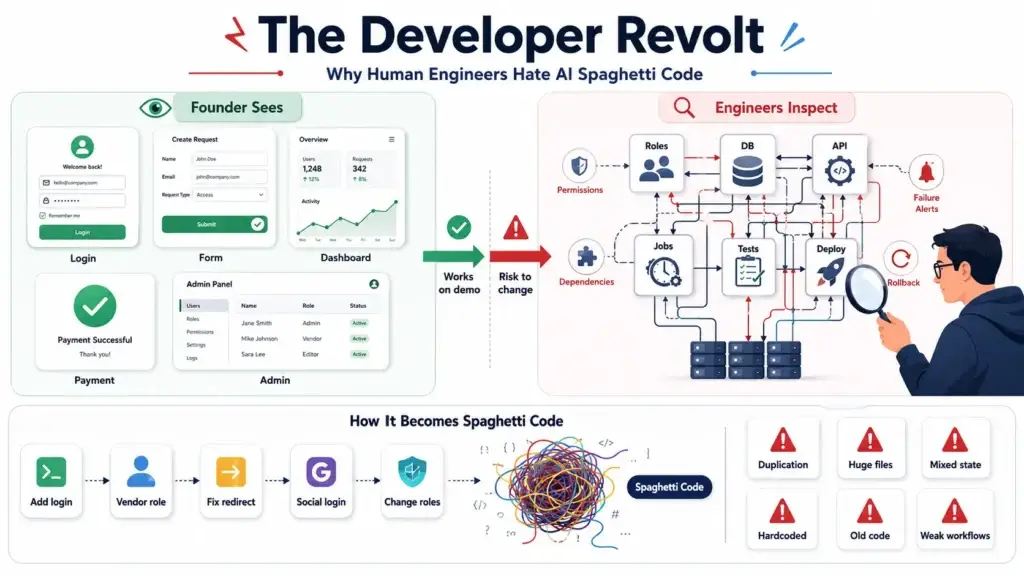
The Developer Revolt: Why Human Engineers Hate AI Spaghetti Code
“Hate” may be a strong word.
Most professional engineers do not object to AI-generated code simply because AI helped produce it. They object to inheriting software that cannot be understood, tested, or changed predictably.
A founder normally experiences an application through visible outcomes:
- The login screen loads.
- A user can submit a form.
- The dashboard displays information.
- A payment works during a test.
- An administrator can manage users.
An engineer experiences the same application as a connected system of permissions, database relationships, dependencies, background jobs, API contracts, failure conditions, and deployment processes.
A feature may work during a successful demonstration while remaining dangerous to modify.
What Founders See Versus What Engineers Investigate
| What the Founder Sees | What the Development Agency Investigates |
|---|---|
| The feature works | Does it work with invalid input, failed requests, duplicate submissions, and different user roles? |
| The database is connected | Are relationships, constraints, indexes, migrations, and backups properly controlled? |
| Authentication is complete | Are sessions, tokens, password recovery, and authorization implemented consistently? |
| The app deploys | Can a new engineer reproduce the deployment and safely roll it back? |
| Cursor understands the codebase | Are the product rules and architecture documented for humans? |
| There are only a few bugs | Are they isolated defects or signs of a deeper structural problem? |
How AI-Prompted Code Becomes Spaghetti Code
AI-generated code is not automatically poor-quality code.
The larger risk is uncontrolled accumulation.
A founder may prompt one feature at a time:
- Add customer login.
- Add administrator login.
- Add vendor login.
- Fix the dashboard redirect.
- Move authentication to a different provider.
- Restore the previous login behaviour.
- Add social login.
- Change the account roles.
Each request may create a locally reasonable change.
Across dozens or hundreds of prompts, however, the application may develop several competing patterns for the same responsibility.
Common warning signs include:
- Business logic duplicated across screens and API routes
- Large files responsible for unrelated operations
- Multiple approaches to managing application state
- Hardcoded settings instead of controlled configuration
- Old functions left behind after new versions are added
- Database queries written directly inside interface components
- Authentication checks implemented differently across routes
- Unnecessary or unexplained dependencies
- Missing records of why important technical decisions were made
- Tests that cover functions but not complete business workflows
The incoming agency is not only asking whether the application works today.
It is asking whether future developers can change it without creating unexpected failures.
Run the Spaghetti Code Audit Before Approving a Rewrite
Do not accept or reject a rewrite recommendation based only on emotion.
Ask the agency to show its reasoning through evidence.
Use the following founder-oriented scoring framework.
Award each area:
- 2 points: Clear, documented, and repeatable
- 1 point: Present but incomplete or inconsistent
- 0 points: Missing, unsafe, or dependent on one person
| Audit Area | Question to Test | Score |
| Build reproducibility | Can a new engineer run the product on a clean machine using written instructions? | 0–2 |
| Architecture | Can the team explain the responsibility of each major module? | 0–2 |
| Data model | Are database relationships, migrations, and constraints controlled? | 0–2 |
| Security | Are authentication, authorization, secrets, and sensitive data handled consistently? | 0–2 |
| Testing | Do automated tests protect critical user and business workflows? | 0–2 |
| Dependencies | Are package versions controlled and properly reviewed? | 0–2 |
| Deployment | Is there a repeatable deployment, backup, and rollback process? | 0–2 |
| Ownership | Does the founder control the source code, infrastructure, and critical accounts? | 0–2 |
How to Interpret the Score
13–16 points: Handoff-ready
The repository may still need improvements, but an experienced team should be able to continue development after a structured onboarding period.
8–12 points: Stabilisation required
The core application may be usable, but feature development should pause while the team documents, tests, and refactors high-risk areas.
0–7 points: Rewrite or replacement likely
The product may work as a demonstration, but understanding and controlling its hidden behaviour may cost more than replacing the implementation.
Founder Decision Signals
Speed
Continuing immediately is not always the fastest option. Uncontrolled changes can turn every future feature into a debugging exercise.
Cost
Compare the cost of stabilising the existing repository with the cost of replacing its standard modules. Do not compare only initial development estimates.
Scalability
Ask whether the data model, background processes, permissions and deployment design can support more users without repeated structural changes.
Control
The founder should own the repository, infrastructure accounts, app-store access, deployment process and technical documentation.
The 8-Step Pre-Handoff Audit to Assess Technical Debt
Step 1: Freeze the Current Product
Stop adding features while the handoff audit is being completed.
Create a protected branch or tagged release representing the exact version the agency will review.
Document:
- Features that currently work
- Known defects
- Incomplete workflows
- Available user roles
- Production and staging versions
- Recent changes that may be unstable
Without a freeze point, the agency may audit one version while Cursor or another contributor continues modifying another.
Evidence to request: A tagged repository version and a one-page product-status document.
Step 2: Confirm Ownership of Every Critical Asset
A project handoff is not complete because someone sent you a ZIP file.
Confirm that your business has administrative control over:
- Source repository
- Cloud hosting account
- Domain and DNS
- Database
- Backup storage
- Payment gateway
- Email and notification providers
- App Store and Play Console accounts
- Analytics tools
- Monitoring tools
- Third-party API accounts
- Design files
- Technical documentation
Credentials should be rotated after access is transferred.
Secrets, passwords, and API keys should not be stored directly in source-code files or shared through an unsecured document.
Evidence to request: An access matrix showing the asset, owner, administrator, billing contact, and recovery method.
Read more: Exposed API Keys in Your AI App? Here Is the 3-Step Emergency Rotation Protocol
Step 3: Reproduce the Application on a Clean Machine
This is one of the fastest ways to expose a fragile codebase.
Ask an engineer who did not create the application to clone the repository and run it using only the supplied documentation.
The documentation should explain:
- Required runtime versions
- Package manager
- Installation commands
- Environment-variable names
- Local database setup
- Database migrations
- Seed data
- Background workers
- Third-party service configuration
- Testing commands
- Build commands
- Deployment process
If the application only works on the founder’s laptop, it is not ready for handoff.
Evidence to request: A screen recording or live demonstration showing a clean installation from repository clone to working application.
Step 4: Create an Architecture and Data-Flow Map
The incoming agency should be able to answer four questions:
- Where does each major business capability live?
- How does data move between the interface, API, database, and external services?
- Which modules depend on one another?
- Where are permissions and business rules enforced?
The architecture map does not need to be unnecessarily complex.
It must be accurate enough for a new developer to trace an important workflow.
For example, a delivery order may follow this path:
Customer request → price calculation → payment authorization → database transaction → merchant notification → delivery allocation → status update → customer notification
When these steps are spread across unrelated components and server functions, developers cannot modify one stage confidently.
Evidence to request: A component diagram, data-flow diagram, and module ownership list.
Step 5: Audit Duplication, Complexity, and Dead Code
This is the central spaghetti code audit.
Ask the technical team to identify:
- Duplicate implementations of the same business rule
- Large files with several unrelated responsibilities
- Deeply nested conditions
- Unused components
- Unused dependencies
- Hardcoded settings
- Temporary debugging code
- Inconsistent naming
- Inconsistent folder structures
- Repeated API clients
- Suppressed errors
- Direct database access from inappropriate layers
Automated tools can identify code complexity and suspicious patterns.
They cannot determine whether the business logic is correct. Human review is still necessary, especially for permissions, payments, transactions, and other high-risk workflows.
Evidence to request: A prioritised report showing the affected files, business impact, and recommended treatment.
Step 6: Audit Security, Permissions, and Business Logic
An application can pass visual testing while still containing serious security and authorization problems.
Review:
- Authentication
- Session management
- Server-side authorization
- User-role boundaries
- Administrator permissions
- Input validation
- Payment logic
- Refund logic
- File-upload controls
- Database access rules
- Environment variables
- Exposed secrets
- Sensitive information in logs
- Dependency vulnerabilities
- Rate limits
- Abuse controls
Security should be treated as part of the product foundation, not as a feature that can be added later.
The audit should not claim that the product is automatically compliant with every regulation. Final compliance depends on the target jurisdiction, integrations, operating model, and legal requirements.
Evidence to request: A permission matrix, dependency report, secret scan, and list of critical remediation items.
Read more: AI MVP Security Audit: The 14-Point Checklist for Founder Survival
Step 7: Establish a Testing and Deployment Baseline
Before the agency adds new features, it needs a reliable way to determine whether existing behaviour has been broken.
Protect the highest-value workflows first:
- Registration
- Login
- Password recovery
- Role permissions
- Core booking or transaction flow
- Payment success
- Payment failure
- Administrator actions
- Notifications
- Data migrations
The repository should also include a repeatable delivery process:
- Pull-request review
- Automated checks
- Staging deployment
- Production approval
- Database backup
- Rollback procedure
Without this baseline, developers may fix one feature while silently breaking another.
Evidence to request: A passing test run and documented staging-to-production deployment.
Step 8: Classify Every Module
A credible technical recommendation should not treat the entire repository as equally good or equally bad.
Each major module should be classified as one of the following:
| Decision | When It Applies | Founder Action |
| Retain | The module is understandable, tested, and aligned with the intended architecture | Document it and place it under normal development controls |
| Refactor | The behaviour is useful, but the implementation is duplicated or tightly coupled | Preserve the behaviour while improving the internal structure |
| Rewrite | The module contains unsafe foundations or incorrect business logic | Define acceptance tests before replacing it |
| Replace | The module recreates a standard capability already available in a stronger foundation | Compare migration effort, ownership, flexibility, and long-term maintenance |
The final audit should explain the reason, effort, dependency, and risk associated with every decision.
How to Challenge a Rewrite Recommendation
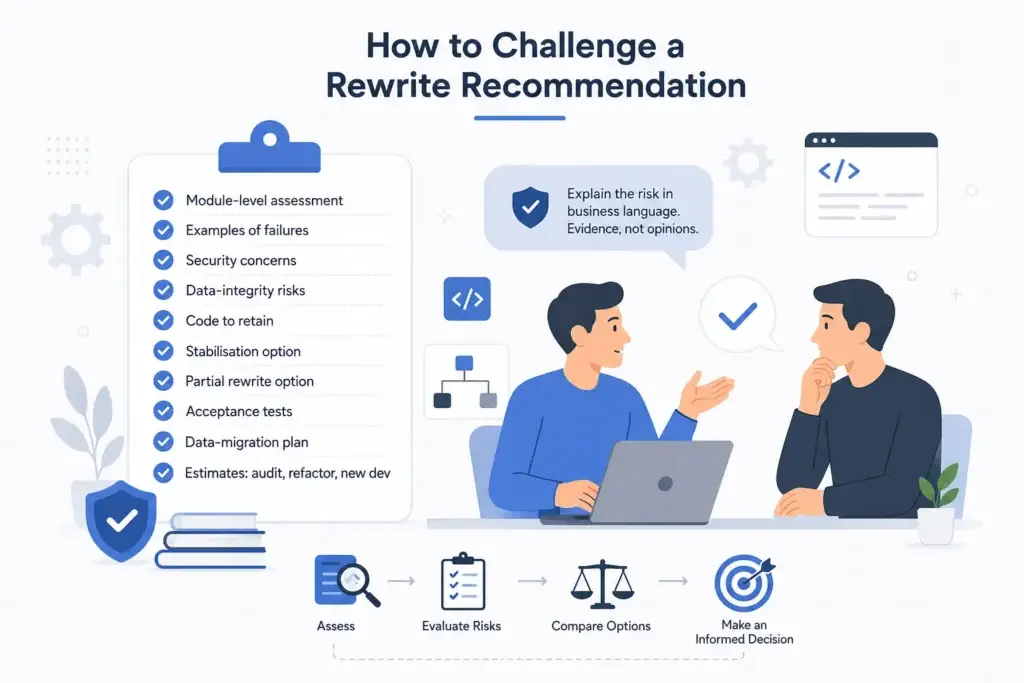
You do not need to accept “rewrite everything” as an unsupported conclusion.
Ask the agency for:
- A module-level assessment
- Examples of architectural failures
- A list of security concerns
- Data-integrity risks
- An estimate of how much code can be retained
- A stabilisation option
- A partial rewrite option
- Acceptance tests for existing behaviour
- A data-migration plan
- Separate estimates for auditing, refactoring, and new development
A professional team should explain the risk in business language.
For example:
The payment module should be rewritten because the current application creates an order before confirming the payment result. Retrying a failed request may therefore create duplicate transactions.
That is decision-grade evidence.
“The code is bad because AI wrote it” is not.
Bypassing the Rewrite With a Clean White-Label Foundation
Sometimes the existing application should not be rescued file by file.
This is especially relevant when a founder has used AI to recreate a familiar product model such as:
- Food delivery
- Grocery delivery
- Ride-hailing
- Service marketplace
- Rental marketplace
- Ecommerce marketplace
- Short-video platform
- Creator platform
- Social network
- Wallet or remittance application
These products require many standard operational layers:
- User management
- Provider or vendor management
- Administrator controls
- Payments
- Commissions
- Notifications
- Moderation
- Reporting
- Listings or catalogue management
- Transaction history
- Dispute management
- Role-based dashboards
When the existing repository implements these modules inconsistently, rebuilding each one individually may not be the strongest commercial decision.
A structured clone app development foundation can provide a cleaner starting point while the founder focuses custom development on the parts that genuinely differentiate the business.
Miracuves helps founders launch ready-made, white-label, and source-code-owned applications with admin control and custom branding.
Eligible ready-made solutions can be launched in six days. Custom development, complex integrations, and extensive changes require a separate timeline based on the final scope.
What Can Be Preserved From the AI-Built Product?
Replacing the implementation does not necessarily mean discarding everything you learned.
You may preserve:
- Validated user requirements
- Customer feedback
- Brand direction
- Interface references
- Workflow decisions
- Monetization logic
- Content
- Catalogue data
- Approved integrations
- Analytics events
- Acceptance criteria
The most valuable asset may be the product knowledge you validated, not every line of generated code.
When a White-Label Foundation Makes Sense
| Situation | Recommended Direction |
| The application follows a proven marketplace, delivery, mobility, or social-platform model | Evaluate a white-label foundation |
| The main differentiation is branding, operations, or market access | Use a ready-made foundation and customise the differentiating layer |
| The repository scores poorly on architecture, security, and deployment | Compare replacement cost with a full rewrite |
| The product depends on proprietary or novel technology | Custom development may still be required |
| The existing repository is well-tested and only a few modules are weak | Targeted refactoring may preserve more value |
Founders can also review white-label solutions versus custom development before choosing a new technical direction.
Mistakes Founders Should Avoid During the Handoff
Continuing to Add Features During the Audit
Every new prompt changes the system being evaluated and makes the agency’s findings less reliable.
Asking Only for a Rewrite Price
Request separate options for stabilisation, targeted refactoring, partial rewriting and replacement.
Transferring Credentials in Plain Text
Use controlled access, rotate credentials and review the repository history for exposed secrets.
Protecting Every Line Because It Already Cost Time
Sunk effort does not make an unsafe module valuable. Preserve validated requirements and behaviour when the implementation itself is not worth retaining.
Replacing the Repository Without a Data-Migration Plan
User accounts, transaction records, content and operational history may be more valuable than the current application code.
Final Thoughts: Your Prototype Was Not Wasted
The real decision is not AI development versus human development.
It is uncontrolled code versus understandable software.
An AI-built prototype may already have created meaningful value. It may have clarified the user journey, exposed weak assumptions, supported customer discussions, and demonstrated that the business problem is worth solving.
That does not automatically make the repository the correct foundation for production growth.
Use the eight-step handoff audit to turn the agency’s reaction into evidence.
Determine what can be retained, what should be refactored, what must be rewritten, and what can be replaced with a stronger foundation.
For founders whose product follows a proven application model, Miracuves can help compare the current repository with a structured, white-label, and source-code-owned alternative.
The goal is not to erase the validation work already completed.
The goal is to move that validated product knowledge onto a foundation future developers can understand, control, and extend.
FAQs
What is an AI codebase handoff?
An AI codebase handoff is the transfer of an application created partly or primarily with AI coding tools to a human development team.
It should include the source repository, architecture documentation, access details, dependency information, database structure, tests, deployment instructions, known defects, and product requirements.
Why would a development agency reject a Cursor codebase?
An agency may reject the repository when it cannot reproduce the build, understand the architecture, verify important business rules, or estimate the effect of future changes.
The concern is usually unpredictable maintenance risk rather than the use of Cursor itself.
Can AI-generated spaghetti code be refactored?
Yes, when the core architecture and data model are still usable.
Refactoring becomes less practical when authentication, permissions, database operations, and business workflows are inconsistent throughout the application.
How do I know whether my application needs a complete rewrite?
A rewrite becomes more likely when the application cannot be reproduced from documentation, lacks reliable tests, contains unsafe security foundations, or requires developers to change several unrelated areas for every feature.
Ask the agency for documented examples before approving the rewrite.
Does moving to a white-label app remove product uniqueness?
No.
A white-label foundation can provide standard operational modules while the founder customises branding, workflows, integrations, monetization, and market-specific features.
It may be less suitable when the product’s main value depends on proprietary technology.
How quickly can Miracuves launch a ready-made application?
Eligible ready-made Miracuves solutions can be deployed in six days.
Custom development, complex integrations, and extensive changes require a separate timeline based on the final feature scope.