



Key Takeaways
- AI app security risks can become legal liability when user data, payments, or private records are exposed.
- Founders, developers, admins, users, and legal teams need clear security controls before public launch.
- Authentication, authorization, API protection, audit logs, encryption, and secure data handling are core safety layers.
- Liability risk depends on data sensitivity, access rules, payment flows, compliance duties, and third-party integrations.
- A security-first app foundation helps reduce breach risk, user trust damage, compliance exposure, and post-launch legal problems.
Security Signals
- Founders need visibility into exposed API keys, weak permissions, unsafe database rules, and unsecured backend routes.
- Developers need secure authentication, role-based access, input validation, secrets management, and deployment safeguards.
- Admins need control over users, roles, logs, permission changes, suspicious activity, reports, and data access history.
- Compliance reviews should check payment security, privacy handling, user consent, data retention, and incident response readiness.
- Monitoring helps detect failed logins, abnormal API calls, unauthorized access, data leaks, and suspicious account behavior.
Real Insights
- A fast AI-generated MVP can look launch-ready while still missing the controls needed to protect real users.
- Security gaps are not only technical problems; they can create refund disputes, compliance issues, and legal exposure.
- Founders should test access control, payment flows, database permissions, and API routes before collecting customer data.
- A security audit helps identify whether the app is safe for public traffic, enterprise buyers, or regulated workflows.
- Miracuves builds AI MVPs and clone apps with secure backend architecture, protected APIs, role-based access, audit logs, monitoring, and admin control.
AI app platforms have changed how quickly founders can move from idea to interface. A founder can describe a marketplace, SaaS dashboard, booking app, or internal tool in plain English and get a working screen in minutes. That speed feels powerful, especially when investors, customers, or internal teams want to see progress quickly.
But speed creates a dangerous illusion.
A beautiful frontend does not prove that the backend is secure. A working login screen does not prove that session handling is safe. A connected database does not prove that row-level permissions, authorization rules, API validation, and access controls are correctly implemented.
That is why searches like “what 70% of Lovable-built apps get wrong about security” matter. The user is not really asking whether Lovable or any AI app builder can create a clean UI. They are asking whether an AI-generated product can safely handle users, payments, personal data, business logic, and intellectual property.
Lovable describes itself as a full-stack AI development platform that can generate frontend, backend, database, authentication, integrations, and editable code. That is useful for fast prototyping. But once real users, customer data, payments, or regulated workflows enter the picture, founders need to think like product owners, not just prompt writers.
The Danger of Fast UI: How AI Platforms Can Cut Corners on Security
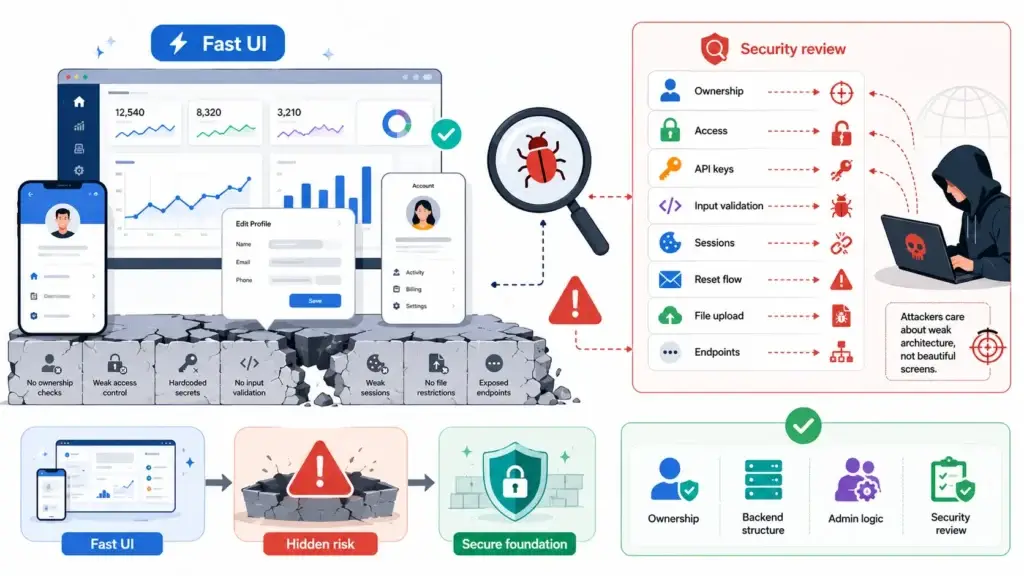
But speed should not come from skipping architecture. A controlled rapid app development process gives founders faster launch momentum while still keeping ownership, backend structure, admin logic, and security review in the build path
The problem is that attackers do not care how polished the UI looks.
They look for missing ownership checks. They test whether one user can access another user’s data. They inspect whether API keys are exposed. They try malformed inputs. They check whether authentication tokens are protected. They test password reset flows, session expiry, file upload handling, and hidden API endpoints.
A generated app can look finished while still missing security layers that experienced engineers normally design before public release. OWASP identifies web application security risks as a standard awareness baseline for developers and organizations. OWASP’s LLM application guidance also warns about insecure output handling, sensitive information disclosure, supply-chain vulnerabilities, and overreliance on LLM outputs.
For founders, the real issue is not whether AI platforms are useful. They are. The issue is whether a prototype generated for speed should become the foundation of a business that handles customer trust.
The Generated Code Vulnerability Index: A Practical Risk Score for Founders
The “Generated Code Vulnerability Index” is a simple founder-facing way to evaluate whether an AI-generated app is production-ready or still only a prototype.
This is not a public Lovable benchmark. It is a practical scoring model for founders reviewing any AI-generated app before launch.
| Risk Area | Weight | What to Check | Founder Risk |
|---|---|---|---|
| Access control | 25% | Can users access only their own data? Are admin routes protected? | Data leakage, privilege escalation, legal exposure |
| Input validation | 15% | Are forms, APIs, uploads, and queries sanitized? | Injection attacks, corrupted data, abuse |
| Session handling | 15% | Are tokens secure, expiring, and protected from misuse? | Account takeover, unauthorized access |
| Secrets management | 15% | Are API keys, service-role keys, and credentials kept out of frontend code? | Infrastructure compromise |
| Database rules | 15% | Are database permissions enforced at row, role, and API level? | Cross-user data exposure |
| Dependency and supply-chain safety | 10% | Are packages maintained, scanned, and necessary? | Vulnerable libraries, malicious packages |
| Monitoring and audit logs | 5% | Can suspicious actions be traced? | Weak incident response and compliance gaps |
A score below 70 should be treated as a warning sign. Not because “70% of Lovable apps are insecure,” but because a founder should not ship any customer-facing product when core security controls are missing or unverified.
Statistical Reality: What AI-Generated Code Research Shows
The security concern is not theoretical.
Veracode’s 2025 GenAI code security research reported that only 55% of AI-generated code was secure across its evaluated coding tasks, meaning 45% contained security flaws. A 2025 paper evaluating LLM-generated web application code found weaknesses across authentication mechanisms, session management, input validation, and HTTP security headers, and concluded that human expertise remains necessary before real-world deployment.
A 2026 study on vibe-coded applications also identified recurring vulnerability patterns such as placeholder logic, unfiltered input, and secret exposure, with root causes tied to limitations in AI-agent development workflows. VibeEval’s 2026 failure-mode catalog similarly tracks recurring authorization and credential failures in AI-built apps across Lovable, Bolt, Cursor, Replit, and V0.
This matters because startups often move faster than their security process. A founder may think, “The app works, so we can launch.” A security reviewer thinks, “The app works, but can users break isolation, access private records, or exploit a hidden endpoint?”
Those are two very different launch standards.
Where Lovable-Built and Vibe-Coded Apps Commonly Break
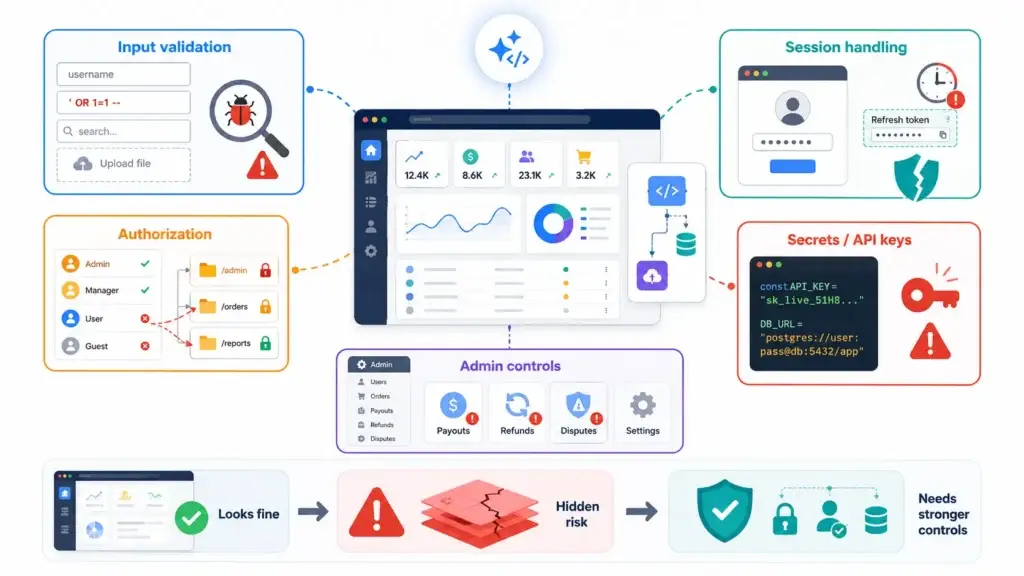
The security failures in AI-generated apps usually do not begin with exotic zero-day exploits. They often begin with basic product architecture gaps.
Missing Input Sanitization
Input sanitization is one of the most common places where generated code becomes risky. A form may accept names, email addresses, messages, files, search queries, locations, or payment-related fields. If those inputs are not validated and sanitized, attackers may test injection payloads, malformed requests, oversized uploads, or script-based attacks.
The dangerous part is that the app may still appear normal during a founder demo. Inputs save correctly. The interface updates. The database receives data. But without validation, every input box becomes part of the attack surface.
Fragile Session Handling
Session handling decides whether users stay authenticated safely. Generated apps may create login flows quickly, but session security requires more than a token and a redirect.
A serious app needs secure token storage, session expiry, refresh-token handling, device/session revocation, rate limiting, abuse detection, and protection against account takeover attempts. If those layers are missing, a login screen becomes a cosmetic feature rather than a security boundary.
Broken Authorization Logic
Authentication answers, “Who are you?” Authorization answers, “What are you allowed to access?”
Many early apps confuse the two. A user may be logged in, but that does not mean they should access every order, booking, file, project, vendor dashboard, or admin action. Broken authorization is especially dangerous in marketplace, fintech, healthcare, creator, and delivery apps where each role should see different data.
Exposed Secrets and API Keys
AI-generated apps can sometimes place configuration values where they do not belong. A public frontend bundle should never expose service-role keys, payment secrets, database credentials, private API tokens, or privileged backend credentials.
Once a secret is exposed, rotating it becomes urgent. If the leaked key has broad privileges, the breach risk can extend far beyond one feature.
Weak Admin Controls
Founders often focus on customer-facing screens first. But for real businesses, the admin panel is the control center. It manages users, disputes, payouts, providers, vendors, content, orders, bookings, reports, refunds, roles, and permissions.
If the admin layer is weak, the business has no reliable way to manage abuse, investigate incidents, or prove what happened during a dispute.
Read More: How Safe is a White-Label DeepSeek App? Security Guide 2026
Why Legal Liability Starts Before the First Breach
Legal risk does not begin after a breach becomes public. It begins when a startup collects user data without appropriate controls.
If an AI-generated app stores personal data, payments, private messages, uploaded documents, health-related information, financial records, or business-sensitive data, the founder becomes responsible for how that data is handled. Even if an AI tool generated the weak code, users and regulators will look at the business operating the app.
OWASP’s LLM guidance explicitly includes overreliance as a risk because failing to critically assess outputs can lead to security vulnerabilities and legal liabilities. The Register’s 2026 reporting on a Lovable-hosted app alleged that vulnerabilities exposed more than 18,000 users’ data, which shows how quickly a security gap can become a reputation and liability issue.
For founders, the question is simple: if users ask how their data is protected, can you explain the answer beyond “the AI generated it”?
Read More: White-Label Apple AI Realm App Security: Risks, Compliance & Best Practices (2026)
Protecting Your Intellectual Property with Source-Code-Owned Frameworks
Security is not only about user data. It is also about intellectual property.
When founders build inside AI and no-code ecosystems, they should understand what they own, what they can export, what depends on hosted infrastructure, what is locked into a platform workflow, and what happens if they need to migrate later.
A source-code-owned product foundation gives the founder more control over:
- Codebase review and independent audits
- Hosting and infrastructure decisions
- Security patching and dependency management
- Custom business logic
- Admin and role permissions
- Payment gateway changes
- Marketplace, delivery, creator, fintech, or booking workflows
- Long-term vendor flexibility
This is where a ready-made clone app foundation can be stronger than a prompt-generated product shell. The goal is not to copy another platform blindly. The goal is to start from a structured app foundation, customize it for the target market, and maintain control over code, branding, backend logic, and admin operations.
Miracuves helps founders launch ready-made clone app solutions with white-label branding, source-code ownership, admin dashboards, and faster deployment. For founders comparing AI-generated prototypes against a serious market launch, that control layer can be the difference between a demo and a business-ready platform.
Read More: White-label apps and source code ownership
AI Builder vs Pre-Built Clone Platform: Founder Decision Table
| Decision Area | AI App Builder Route | Pre-Built Clone Platform Route |
|---|---|---|
| Speed | Very fast for prototypes and UI demos | Fast for launch-ready foundations when scope matches an existing app model |
| Security | Depends heavily on generated code quality and review | More predictable if core modules are already structured and reviewed before customization |
| IP control | Depends on export rights, hosting model, and platform terms | Stronger when full source code is delivered |
| Backend logic | May be generated feature by feature | Built around known product workflows such as booking, delivery, marketplace, fintech, or creator platforms |
| Admin control | Often needs deeper customization | Usually part of the product foundation |
| Scalability | Requires architecture review before growth | Easier when backend, roles, and workflows are planned from the start |
| Best use case | Concept testing, demos, internal tools, low-risk experiments | Customer-facing platforms, monetization-ready apps, agency launches, market validation |
Founder Decision Signals
Speed
Use AI builders for quick validation, but do not confuse a fast prototype with a secure production foundation.
Control
If the product will handle users, payments, vendors, creators, or private records, source-code ownership becomes a strategic requirement.
Security
Before launch, verify input validation, access control, session handling, database permissions, and secrets management.
Liability
If the app collects sensitive data, the business remains responsible even if the risky code was generated by an AI platform.
What Founders Should Check Before Shipping an AI-Generated App
Before launching an AI-generated app, founders should review core app security requirements across both code and architecture.
At minimum, check:
- Are all user roles clearly separated?
- Can one user access another user’s records by changing an ID?
- Are API endpoints protected server-side?
- Are database permissions enforced beyond the UI?
- Are service keys and API secrets kept out of the frontend?
- Are inputs validated before reaching the database?
- Are sessions securely stored and expired?
- Are payment flows handled through secure integrations?
- Are admin actions logged?
- Are dependencies scanned?
- Is there a rollback plan if something breaks?
- Can the founder move the codebase away from the platform if needed?
If the answer is unclear, the app is not ready for serious users.
How Miracuves Helps Founders Launch With More Control
Miracuves’ ready-made clone app approach is built for founders who want speed without relying entirely on prompt-generated architecture. Instead of starting with a blank prompt and hoping the generated code handles every security-sensitive path correctly, founders can start from a structured app foundation aligned with an existing business model.
For example, a founder launching a marketplace, delivery platform, creator app, fintech workflow, service marketplace, or booking platform does not need to reinvent every core module from zero. They need the right foundation, branding, admin control, payment logic, user roles, and source-code ownership.
That is where Miracuves’ clone app development approach can help. Founders can also explore custom software development when the product requires unique workflows, unusual compliance requirements, or deeper architecture planning.
For AI-heavy products, Miracuves also supports generative AI app development with guardrails, observability, and source-code ownership.
Final Thoughts: Fast Interfaces Are Not the Same as Secure Products
AI app builders are not the enemy. They are useful tools for prototypes, internal demos, and early product exploration.
The risk begins when founders treat generated code as production architecture without security review, source-code clarity, access-control validation, and operational governance. A startup does not fail security because its interface looks bad. It fails when users, roles, data, sessions, payments, and admin controls are not protected properly.
The stronger founder decision is not “AI builder or no AI builder.” It is knowing when a generated prototype has reached its limit.
For serious business builders, a source-code-owned, white-label app foundation can offer a more controlled path to launch than relying on generated code alone. Miracuves helps founders move faster while keeping ownership, admin control, and product structure at the center of the launch decision.
FAQs
Are Lovable-built apps secure?
Lovable-built apps can be useful for rapid prototyping and product exploration, but every generated app should be reviewed before production use. Security depends on access control, database permissions, authentication, session handling, input validation, and how the app is deployed.
What do AI-generated apps usually get wrong about security?
Common issues include missing input sanitization, weak authorization, exposed API keys, fragile session handling, insecure database rules, weak admin permissions, and poor logging. These issues may not appear during a normal founder demo but can become serious once real users join.
What is the Generated Code Vulnerability Index?
The Generated Code Vulnerability Index is a practical scoring framework for reviewing AI-generated apps. It checks areas such as access control, input validation, session handling, secrets management, database permissions, dependency safety, and monitoring.
Is the “70% of Lovable apps” claim a verified statistic?
No public, universal statistic proves that 70% of all Lovable-built apps have the same security flaw. In this blog, 70% is used as a practical risk-threshold concept: if an app does not pass roughly 70% of core security checks, founders should treat it as a prototype, not a production-ready product.
Can AI app builders be used for real startups?
Yes, but founders should separate prototyping from production. AI builders can help test ideas quickly. Before launch, the app should go through code review, security testing, infrastructure review, role-permission checks, and source-code ownership evaluation.
Why is source-code ownership important for app security?
Source-code ownership gives founders more control over audits, hosting, security fixes, integrations, scaling, and future vendor decisions. Without clear ownership and portability, a startup may struggle to fix vulnerabilities or move away from a platform later.
How is a Miracuves clone app foundation different from an AI-generated app?
A Miracuves clone app foundation starts from a structured, ready-made app model with defined workflows, admin control, branding flexibility, and source-code ownership. AI-generated apps often begin as prompt-created prototypes and may require deeper review before becoming production-ready.
Should founders avoid AI app platforms completely?
No. Founders can use AI platforms for ideation, demos, and early validation. The mistake is shipping sensitive, customer-facing products without proper security review, ownership clarity, and backend control.