
Key Takeaways
- Cursor can help founders build faster, but it does not replace full product strategy, architecture, testing, and launch support.
- Hiring a dev agency gives founders access to developers, designers, QA teams, DevOps support, and delivery planning.
- The real comparison should include runway, time-to-market, rework risk, security, maintenance, and post-launch support.
- AI coding tools are useful for prototypes, while agencies are better for production-ready systems and scalable workflows.
- A smart founder should choose the option that leaves enough budget for launch, marketing, operations, and growth.
Decision Signals
- Founders need to compare development cost, launch speed, technical skill, feature scope, and long-term maintenance needs.
- Cursor users still need backend planning, database setup, payment integration, testing, deployment, and security reviews.
- Agency teams should provide project planning, architecture, UI/UX, QA, documentation, deployment, and ongoing support.
- Ready-made app solutions can reduce risk when founders need proven workflows instead of building every module from scratch.
- Budget planning should include development, branding, compliance, hosting, support, marketing, and founder runway after launch.
Real Insights
- The cheapest development path is not always the safest path if it creates bugs, delays, or rebuild costs later.
- A founder using Cursor may save upfront money but spend more time solving architecture, DevOps, security, and scaling problems.
- A dev agency can reduce execution risk when the product requires payments, admin panels, mobile apps, and production deployment.
- The best choice depends on whether the founder needs a quick prototype, a launch-ready product, or a scalable business platform.
- Miracuves builds ready-made clone apps and custom platforms with source-code ownership, deployment support, secure workflows, and admin control.
For early-stage founders, the real question is not, “Can I build this app?”
The sharper question is, “How much capital will I still have after the product is live?”
That distinction matters. A founder with pre-seed funding, personal savings, or a small angel cheque is not just buying code. They are buying time, market access, user feedback, investor confidence, and enough runway to survive the first version of the business.
This is why the Cursor vs hiring a dev agency debate has become so important. Cursor makes software building feel more accessible. A development agency promises a managed path to production. Both options can work in the right context.
But both also create financial blind spots.
Cursor looks inexpensive at the subscription level, but the hidden cost is founder time, technical judgment, QA, architecture, deployment, app store readiness, security, and product maintenance. A custom dev agency gives structure, but it can consume a large portion of startup capital before the founder has acquired a single customer.
There is a third option many founders ignore too late: licensing a ready-made, white-label clone app foundation and using the remaining capital for growth.
That is where Miracuves fits into the decision. Instead of forcing founders to choose between prompting everything themselves or funding a long custom build, Miracuves helps startups launch with ready-made clone app solutions, source-code ownership, white-label branding, admin control, and faster deployment.
The capital question becomes simple:
Should your first major spend go into building the same core workflows that already exist, or should more of your runway go into acquiring users, testing pricing, and proving demand?
The Capital Dilemma: Allocating Your Startup Runway Wisely
Most founders enter the product-build decision with the wrong spreadsheet. They compare development quotes, subscription prices, and hourly rates, but those numbers do not show the full financial picture.
Startup survival is not decided by the cheapest line item. It is decided by how much usable runway remains after the product reaches the market.
A founder with $100,000 in available capital does not truly have $100,000 to spend on development. That same capital must also cover branding, compliance review where relevant, hosting, operations, launch campaigns, paid acquisition, sales outreach, content, support, bug fixing, analytics, and future product iteration.
So when a founder spends $80,000 on a custom build, they are not simply spending $80,000 on software. They are choosing to enter the market with only $20,000 left for everything that happens after launch.
That is a risky position because software alone does not validate a startup. Customers do.
A product sitting in production without an acquisition budget is not a business. It is an expensive asset waiting for distribution.
This is the core mistake behind many early app launches. Founders treat development as the main event, when development is only the entry ticket. The real business begins when users interact with the product, reject it, pay for it, request changes, return to it, or reveal what the founder misunderstood about the market.
A smarter budget model does not begin with the question, “How much will the app cost?” It begins with the more important question, “How much capital will remain after the app is ready to acquire users?”
Read More: The Un-Indexed Trap: Why AI Schemas Cause Exponential App Latency
Cursor Looks Affordable, But Founder Time Has a Price
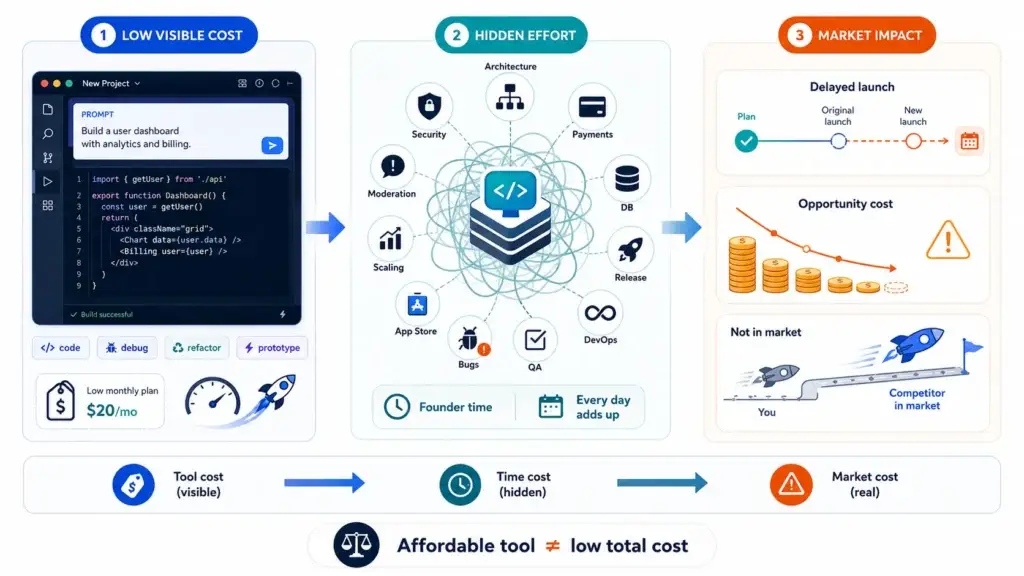
Cursor is attractive because it makes software creation feel more accessible. For technical founders, it can speed up code writing, debugging, refactoring, and experimentation. For non-technical founders, it creates the feeling that product development is finally within reach.
That is useful.
But Cursor is not a replacement for product architecture, engineering judgment, release management, security thinking, user experience design, database planning, payment logic, moderation workflows, admin control, testing, and scaling decisions.
A founder prompting an app into existence still has to answer questions like:
- What happens when payments fail?
- How are users verified?
- How will roles and permissions work?
- Where will admins manage disputes?
- How will refunds, cancellations, or blocked accounts be handled?
- What happens when app store submission fails?
- Who fixes production bugs after launch?
- How will the database behave when usage grows?
These are not minor technical details. They are business continuity decisions.
The apparent cost of Cursor may be low, but the true cost includes every month the founder spends trying to become a product manager, backend engineer, QA tester, DevOps engineer, security reviewer, and release manager at the same time.
If the founder spends four months prompting, testing, rebuilding, and debugging before launch, the business has paid four months of opportunity cost. During that time, competitors can launch campaigns, test audiences, collect feedback, and build market presence.
This is why AI-assisted building works best when the founder already knows what they are building, understands engineering tradeoffs, and can review the output with discipline.
Without that judgment, Cursor can create a dangerous illusion: the product appears to be moving fast, but the business is still not in the market.
Read More: AI MVP Security Audit: The 14-Point Checklist for Founder Survival
Hiring a Dev Agency Gives Structure, But Burns Capital Early
Hiring a custom development agency solves some of the problems founders face when trying to build with Cursor alone because an agency can bring structure, planning, and execution support to the product development process.
A good agency can provide discovery, UI/UX design, technical planning, backend development, mobile app development, QA, deployment, and project management. For complex products, regulated workflows, unusual technical models, or deep custom IP, that structure can be valuable.
However, agencies also come with a hard financial reality. Custom development is expensive because the team is building from zero. Every user flow, admin screen, database model, integration, notification, role, and deployment process must be scoped, estimated, built, reviewed, tested, and maintained.
That means founders are paying for product creation before they have proof of demand.
For a funded startup, the danger is not only the size of the invoice. The bigger danger is the timing of that invoice. A founder may spend months and a large share of capital before learning whether users care enough to install the app, complete transactions, subscribe, book services, place orders, or return after the first use.
This creates a capital trap. The app may be well-built, but the company may be underfunded for growth. The founder gets a product, but loses market momentum. The business has technology, but not enough budget left to create demand.
This is especially painful for products based on proven app models such as delivery, ride-hailing, marketplaces, booking platforms, creator apps, rental apps, social platforms, and ecommerce ecosystems. In these categories, many core workflows are already known. The strategic advantage is often not rebuilding basic functionality from zero. The real advantage is faster market entry, sharper positioning, local customization, better operations, and stronger customer acquisition.
That is where a custom agency may become too heavy for the first market version.
Financial Modeling: Custom Development Fees vs. The True Value of Time
To compare Cursor, a dev agency, and a white-label clone app, founders need to model total capital allocation.
Here is a simple example.
Assume a founder has $100,000 in available startup capital.
The goal is to launch an app-based business and preserve enough runway for acquisition, iteration, and early operations.
| Build Path | Upfront Build Logic | Hidden Cost | Capital Risk | Growth Capital Left |
|---|---|---|---|---|
| Cursor-led build | Low tool cost, founder-led execution | Months of founder time, technical review, QA, deployment, maintenance | Product may remain unfinished or fragile | Unclear because time burn is high |
| Custom dev agency | Managed custom build from zero | Large upfront invoice, longer build cycle, change requests | Growth budget may shrink before launch | Often limited if build absorbs most capital |
| Miracuves white-label clone app | Licensed ready-made foundation with branding and customization | Requires fit-checking, customization scope, launch planning | Lower build-time risk when model matches the app category | More capital can remain for marketing and growth |
The important number is not the first invoice. It is the post-launch operating budget.
A founder who spends $80,000 building and keeps $20,000 for growth is in a weaker position than a founder who spends $20,000 preparing the product foundation and keeps $80,000 for acquisition, partnerships, content, ads, onboarding, and iteration.
That is the “Total Capital Allocation” variable.
It asks:
- How much capital goes into software creation?
- How much goes into customer acquisition?
- How much remains for learning?
- How much remains for improving the product after real usage?
Founders often underestimate the last two. The first launch version is rarely the final business model. Pricing may change. User onboarding may need simplification. Admin tools may need improvement. A local market may require different payment options. A delivery business may need better dispatch rules. A marketplace may need stronger verification and dispute workflows.
If all available capital is spent before this learning starts, the founder has no room to respond.
Read More: Escrow Routing Failures: The Decision Framework for AI Marketplace Startups
The Real Cost of Prompting It Yourself
The appeal of Cursor is control. A founder can move without waiting for quotes, meetings, or sprint planning. That is powerful.
But founder-led AI development has a hidden financial problem: it converts capital cost into time cost.
For a bootstrapped founder, that may feel acceptable. For a funded founder, it can be expensive.
Every week spent building alone is a week not spent selling, recruiting partners, interviewing customers, building a waitlist, negotiating distribution, creating launch content, or speaking to investors.
The founder becomes the development bottleneck.
That may work for a prototype, internal tool, or simple web product. It becomes riskier for a multi-sided platform with payments, user roles, mobile apps, admin dashboards, notifications, booking flows, maps, delivery logic, creator tools, moderation, wallets, or marketplace operations.
AI can generate code. It cannot automatically decide which operational workflow will protect your unit economics.
For example, a food delivery app is not just menus and checkout. It needs merchant management, delivery partner assignment, order status logic, cancellation rules, commissions, refunds, customer support, real-time notifications, payment settlement, and admin oversight.
A creator platform is not just video uploads. It needs feed logic, content moderation, reporting, creator profiles, monetization flows, payouts, analytics, and abuse control.
A fintech-style wallet or remittance product is not just a dashboard. It needs user verification, transaction monitoring, audit logs, payment gateway integration, and compliance-ready workflows based on the target market.
This is where AI prompting alone can become expensive. Not because the tool costs too much, but because the founder may spend months discovering product complexity that experienced app teams already understand.
The Arbitrage Play: Licensing Pre-Built Assets to Fund Growth
The strongest founder move is often not “build everything myself” or “hire the biggest agency.”
It is asset arbitrage.
Use a pre-assembled product foundation for known workflows, then spend your capital where the startup actually differentiates: market entry, customer acquisition, positioning, pricing, partnerships, and local execution.
A white-label clone app works best when the founder is entering a category where the core product behavior is already familiar. Examples include:
- Food delivery platforms
- Grocery delivery apps
- Ride-hailing apps
- Rental marketplaces
- Service marketplaces
- Creator platforms
- Social apps
- Ecommerce marketplaces
- Booking platforms
- Fintech and wallet-style apps
In these categories, the founder usually does not need to invent every screen and workflow from zero. The founder needs a branded, customizable, launch-ready foundation that can be adapted for a specific audience, location, pricing model, and operational strategy.
That is the core advantage of licensing a Miracuves clone app.
The startup can begin with a ready-made product base, customize the brand and business logic, keep source-code ownership, and avoid spending the majority of its early capital rebuilding common modules.
That does not mean every startup should choose a clone app. If the product depends on a truly new technical invention, unusual IP, complex enterprise workflows, or regulated architecture that cannot map to an existing model, custom development may be the better decision.
But if the startup is trying to validate demand in a known app category, licensing a ready-made foundation can be a smarter capital decision.
Founder Decision Signals
Choose Cursor When
You are technical, building a small prototype, testing internal workflows, or exploring a concept before investing in production infrastructure.
Choose an Agency When
Your product requires deep custom architecture, unusual workflows, proprietary IP, or complex integrations that cannot fit a ready-made foundation.
Choose Miracuves When
Your business maps to a proven app model and you want a faster, branded, source-code-owned foundation without rebuilding standard modules.
Protect Runway When
Your main risk is not whether the app can be built, but whether you will have enough capital left to acquire users and validate demand.
Capital Allocation Example: The $100,000 Startup Budget
Let’s make the financial reality more direct.
A founder has $100,000.
The founder wants to launch a marketplace, delivery app, booking platform, or creator app.
The wrong budget model is:
- $100,000 available
- Spend as much as needed on development
- Use whatever remains for launch
- The smarter model is:
- Set a product foundation budget
- Protect a growth budget
- Protect an iteration budget
- Launch before the market window closes
- Here is a simple allocation model.
| Budget Category | Agency-Heavy Build | Cursor-Heavy Build | White-Label Clone App Route |
|---|---|---|---|
| Product build and setup | $60,000–$90,000 | Low tool spend, high founder time | Lower foundation cost, depending on selected solution and customization |
| Founder time cost | Medium | Very high | Lower because core modules already exist |
| Launch and acquisition | Often underfunded | Delayed until build stabilizes | Better protected |
| Post-launch iteration | Limited if build cost overruns | Delayed by technical cleanup | Easier to prioritize after market feedback |
| Risk profile | Stronger build process, high capital burn | Lower cash burn, higher execution risk | Balanced speed, ownership, and capital preservation |
The conclusion is not that one build option is always superior to the others. The real conclusion is that founders should stop asking, “Which build option is cheapest?” and start asking, “Which build option gives me the strongest chance to launch, learn from real users, acquire customers, and still have enough cash left to keep growing?”
That is why the white-label route becomes strategically attractive. It allows founders to preserve more capital for the work that actually creates traction, instead of spending most of their early runway on rebuilding core product foundations from zero.
Why Preserving Growth Capital Can Improve Startup Value
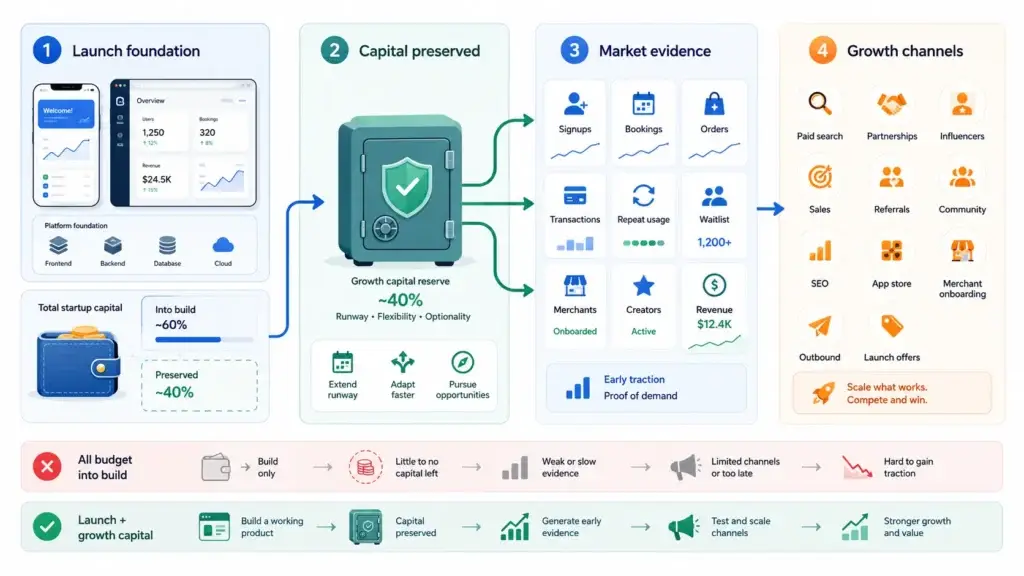
Startup valuation is rarely improved by telling investors, partners, or stakeholders that most of the company’s money was spent on building software. Serious stakeholders care about stronger business signals, such as whether users can be acquired, whether the product can be launched, whether the founder can learn quickly from the market, whether the business model can generate revenue, whether the platform can support operations, and whether the company can iterate without starting again.
A founder who launches with a working product and still has capital available for user acquisition is in a stronger position than a founder who has a polished custom build but no budget left to generate demand.
This is especially true for pre-seed startups. At this stage, the market does not reward perfection. It rewards evidence. That evidence may come from signups, bookings, orders, transactions, repeat usage, waitlists, merchant onboarding, creator activity, partner conversations, or early revenue.
A ready-made foundation helps founders reach that evidence stage faster by reducing the time and capital spent on building standard product workflows before the business has proven demand.
When more startup capital remains available for acquisition, the founder can test channels such as:
- Paid search
- Local partnerships
- Influencer campaigns
- Founder-led sales
- Referral programs
- Community building
- SEO content
- App store optimization
- Merchant onboarding
- Outbound campaigns
- Launch offers
These activities are not optional. They are how the market tells the founder whether the business deserves more investment.
Read More: What 70%+ of AI-Built Apps Get Wrong About Security — And Why Users Can See Each Other’s Data
Cursor vs Agency vs Miracuves: Which Option Fits Your Stage?
Here is the practical decision framework.
Use Cursor if you are still thinking
Cursor is useful when you are exploring workflows, testing technical concepts, building internal tools, or creating lightweight demos.
It is strongest when the founder or team can judge the code being produced.
If you are non-technical and trying to build a full marketplace, delivery ecosystem, booking app, fintech flow, or creator platform only through prompts, the risk increases quickly.
Hire a dev agency if your product is genuinely custom
A dev agency is the right path when your app requires unique architecture, custom workflows, specialized integrations, or defensible product IP.
If your product cannot map to an existing solution category, custom development may be worth the investment.
The key is to avoid using a custom agency to rebuild common app patterns that could have started from a ready-made foundation.
Choose Miracuves if speed, ownership, and runway matter together
Miracuves is strongest when the founder wants to launch in a proven app category without starting from zero.
With Miracuves’ ready-made and white-label app solutions, founders can explore categories through the broader Miracuves solutions hub, compare models, and choose a source-code-owned foundation that supports faster validation.
Relevant next reads:
- Explore ready-made clone app solutions at Miracuves
- Read more about clone app development for market validation
- Explore Miracuves ready-made apps:
- Learn about custom mobile app development when your product needs a ground-up build
Mistakes Founders Should Avoid
Comparing only invoice cost
A low software subscription or a lower agency quote does not reveal the true cost. Founders must include time, delays, QA, maintenance, launch budget, and post-launch iteration.
Spending the whole runway before launch
If development consumes most of the budget, the startup may reach launch without enough capital to acquire users, test pricing, or improve the product based on feedback.
Using custom development for standard workflows
When the core model is already proven, rebuilding every common module from zero can slow validation and increase avoidable cost.
Assuming AI output is production-ready
AI-generated code still needs architecture review, testing, security checks, deployment planning, and operational logic before it can support a real business.
The Honest Recommendation
If you are building a small prototype, use Cursor.
If you are building a complex, original product with unusual workflows, hire a strong custom development team.
If you are launching in a proven app category and need to protect startup runway, evaluate a white-label clone app before committing to a long custom build.
This is not a shortcut around strategy. It is a better way to spend capital.
The founder’s job is not to personally engineer every module. The founder’s job is to get the right product into the market, learn faster than competitors, and allocate capital toward the activities that create traction.
For many startup categories, the smarter move is to license the foundation, customize the experience, own the source code, and reserve more money for growth.
Final Thoughts: Build Less From Zero, Spend More on Proof
The Cursor vs. hiring a dev agency debate often misses the founder’s real problem, which is how much runway remains after the product is built.
Cursor can help founders move faster, but it does not remove the need for product judgment, technical decision-making, testing, deployment, and long-term maintenance. A dev agency can build a strong product, but it can also consume a significant portion of the capital founders need for launch, customer acquisition, and growth.
A ready-made white-label clone app gives founders a third path by allowing them to start from a proven app foundation, customize the product for their target market, own the source code, and keep more budget available for customer acquisition.
For many early-stage founders, this is the more capital-efficient decision.
The goal is not to avoid spending money on technology. The goal is to avoid spending too much of the first runway on rebuilding product foundations that already exist.
FAQs
Is Cursor cheaper than hiring a dev agency?
Cursor usually has a lower direct software cost than hiring a dev agency, but that does not mean the total startup cost is lower. Founders must include time spent prompting, testing, debugging, deploying, fixing issues, and maintaining the product.
Should a non-technical founder use Cursor to build an app?
A non-technical founder can use Cursor for exploration, prototypes, and simple workflows. For a production app with payments, admin control, mobile apps, user roles, security, and scaling needs, relying only on prompting can create operational risk.
When is hiring a dev agency better?
A dev agency is better when the product requires custom architecture, complex integrations, unusual workflows, or defensible technical IP. It is also useful when the founder needs a managed build process and has enough capital for both development and growth.
What is the third option besides Cursor and a dev agency?
The third option is licensing a ready-made white-label clone app. This gives founders a pre-built product foundation that can be branded, customized, deployed faster, and used to validate demand without building every common module from zero.
How does a Miracuves white-label clone app help preserve runway?
A Miracuves white-label clone app can reduce the need to fund a long ground-up build when the business model fits an existing app category. This helps founders keep more capital available for launch campaigns, customer acquisition, operations, and iteration.
Is a clone app the same as copying another business?
No. A strong clone app strategy does not mean copying another brand. It means using a proven product pattern as a foundation, then customizing branding, features, market positioning, monetization, and operations for a specific audience.
What should founders compare before choosing a build path?
Founders should compare total build cost, time-to-market, technical risk, source-code ownership, launch readiness, post-launch support, and the amount of capital left for growth after the product goes live.
When should I choose custom development instead of a clone app?
Choose custom development when your product does not fit a known app model, requires unusual workflows, has complex compliance needs, or depends on proprietary technical innovation that cannot be built from an existing foundation.
Miracuves is an independent software development company. We are not affiliated with, connected to, sponsored by, or endorsed by any company or product named in this article.
Terms such as “X Clone” are used descriptively. It is how the software industry refers to building a platform with functionality comparable to a known service, and how clients search for it.
The entire design and codebase of our products is built by our own team. Our products contain no code, design, graphics, or content originating from any third-party website or applications.
All third-party names and marks referenced in this article are the property of their respective owners, referenced solely to identify the services discussed.