


Key Takeaways
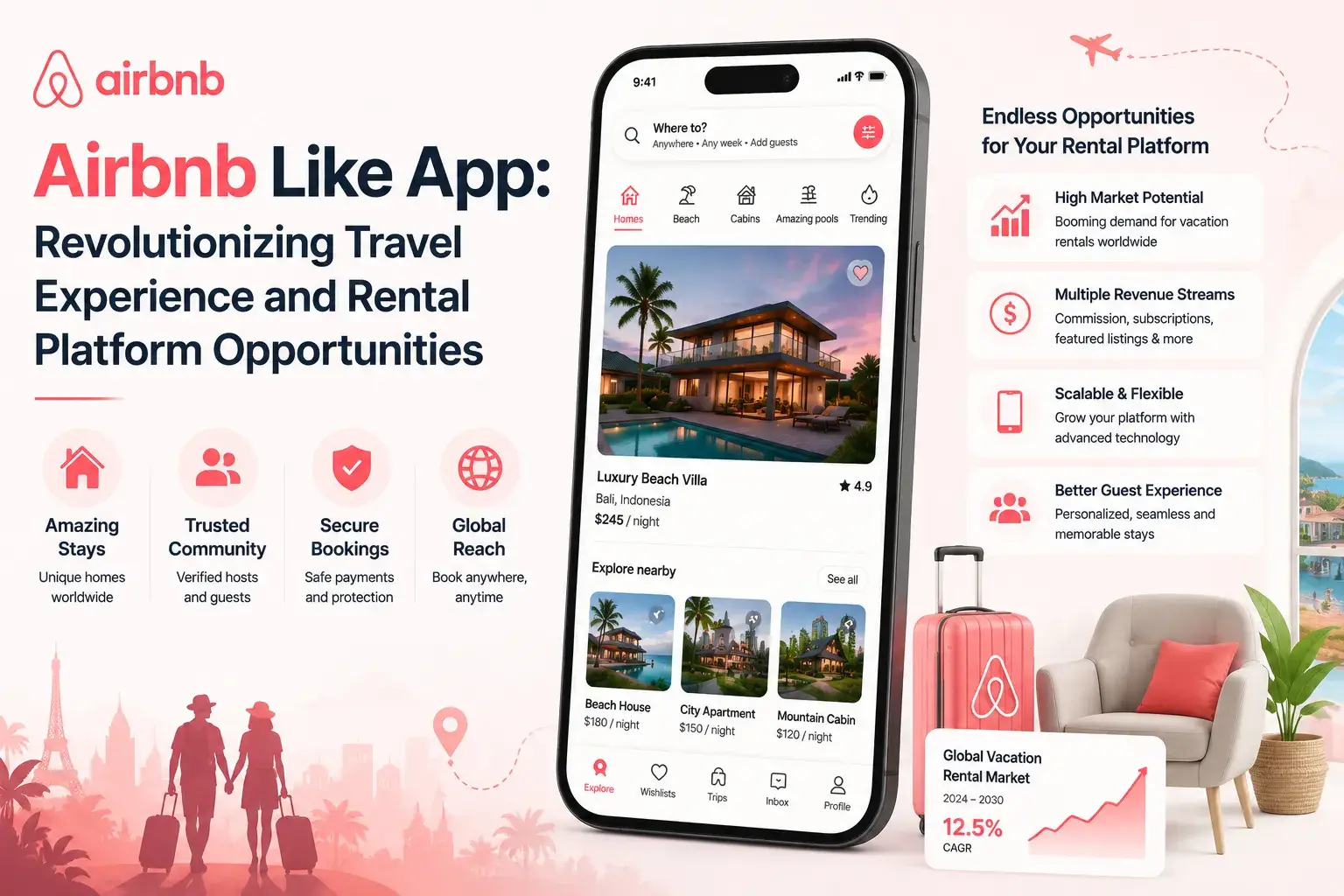
- An Airbnb-like app transforms travel by connecting guests with hosts offering apartments, villas, cottages, vacation homes, and other unique stays.
- Core features include advanced search filters, verified listings, secure payments, instant booking, real-time messaging, reviews, and ratings.
- Travelers benefit from greater accommodation choice, flexible booking options, local experiences, and more personalized stays.
- For founders, the business opportunity extends beyond accommodation into commissions, service fees, promoted listings, experiences, and value-added services.
- Long-term platform success depends on host supply, guest trust, booking convenience, secure transactions, reliable support, and strong marketplace operations.
Travel Marketplace Signals
- Comprehensive search filters help travelers narrow stays by location, price range, amenities, property type, and personal preferences.
- Verified listings and transparent reviews improve trust by helping guests evaluate properties and hosts before booking.
- Dynamic pricing can adjust rates according to demand, seasonality, local events, booking windows, and property availability.
- In-app messaging allows hosts and guests to clarify check-in details, property rules, special requests, and booking questions quickly.
- Development complexity changes based on mobile apps, map integration, payment flows, host dashboards, multi-currency support, admin controls, and customization depth.
Real Insights
- An Airbnb-like app is not just a property listing platform; it is a two-sided rental marketplace that must balance host supply, guest demand, trust, and booking operations.
- The strongest travel platforms make discovery easier while reducing friction across search, communication, payment, confirmation, and post-booking support.
- Founders can differentiate through niche inventory, regional focus, long-term rentals, luxury stays, local experiences, or specialized traveler communities.
- Admin automation becomes essential for managing listings, users, bookings, refunds, disputes, commissions, reviews, and marketplace performance.
- The best Airbnb-like app strategy combines personalized travel discovery, secure booking infrastructure, scalable marketplace technology, strong monetization, and continuous user experience improvement.
Travel has changed because users no longer want only hotel rooms and fixed booking choices. They want flexible stays, trusted hosts, local experiences, transparent pricing, and the ability to book from a mobile app in minutes. This is why an Airbnb clone like app has become one of the most recognizable models in modern travel technology.
For travelers, the value is simple. They can discover unique homes, apartments, villas, cabins, homestays, and local stays that feel more personal than traditional accommodation. For founders, the opportunity is bigger. The same model can be used to build a rental platform where hosts list properties, guests book stays, payments happen securely, and the platform owner earns through commissions, fees, or premium services.
If you are exploring this model as a business, Miracuves offers a launch-ready option to build a rental platform inspired by Airbnb with guest, host, booking, payment, and admin workflows designed for faster execution.
The goal is not to copy Airbnb blindly. The stronger opportunity is to understand why the Airbnb-style marketplace works, what features users expect, where startup monetization comes from, and how a focused rental platform can serve a specific travel or property niche.
What Is an Airbnb Like App?
An Airbnb like app is a travel and rental marketplace that allows property owners or hosts to list spaces and allows guests to search, compare, book, and pay for stays online. The platform acts as the bridge between both sides.
Guests use the app to find accommodation based on location, budget, dates, amenities, property type, ratings, and personal preferences. Hosts use the platform to list their spaces, manage pricing, accept bookings, communicate with guests, and receive payments.
The platform owner manages the marketplace through an admin dashboard. This includes user management, listing approvals, booking oversight, payment monitoring, dispute handling, content control, commissions, and analytics.
Why Airbnb Like Apps Changed the Travel Experience
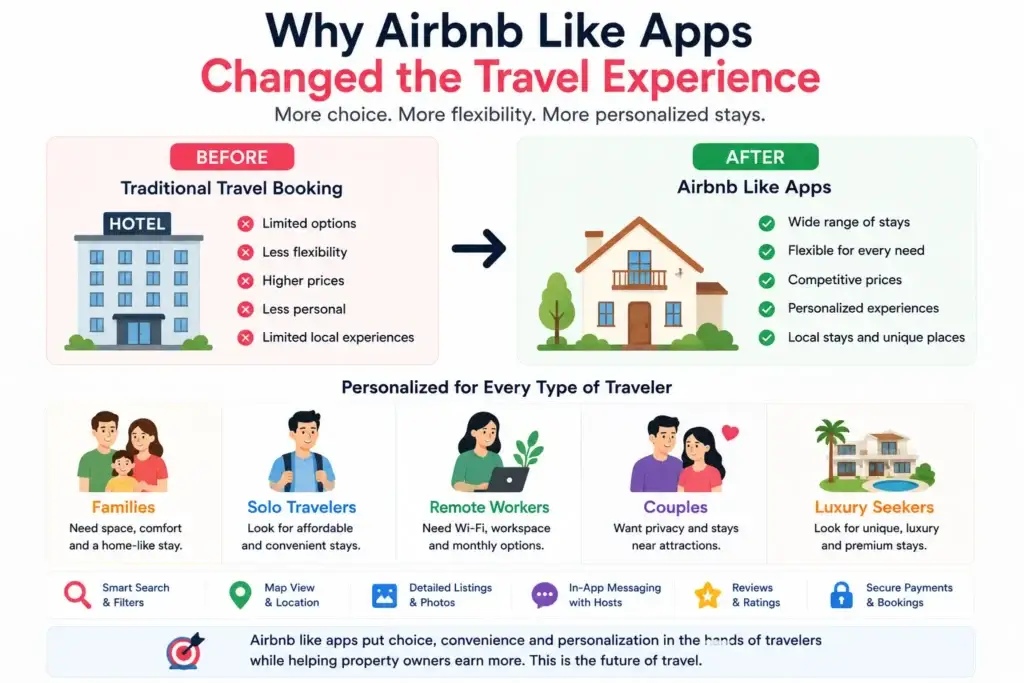
Traditional travel booking was often limited to hotels, travel agents, and standard accommodation options. Airbnb-style platforms changed this by giving travelers access to a wider range of stays and giving local property owners a way to monetize unused or underused spaces.
The biggest change is flexibility. Users are not forced into one type of accommodation. They can choose apartments, homes, villas, cabins, farm stays, boutique rooms, shared spaces, or luxury properties depending on their travel style.
Another important shift is personalization. A family may want a full home with a kitchen. A solo traveler may want a budget-friendly room near public transport. A remote worker may want Wi-Fi, workspace, and monthly pricing. A couple may want a private villa near local attractions.
An Airbnb like app makes this possible by combining search filters, maps, listing details, reviews, messaging, and secure payments in one place.
For founders, this change matters because user behavior has already moved toward digital-first booking. A rental platform can succeed when it focuses on a specific need that broad travel platforms do not serve deeply enough.
Read more : Reasons startups choose our Airbnb clone over custom development
Core Features Every Airbnb Like App Should Include
A rental platform succeeds when users can search easily, trust listings, book confidently, and get support when needed. Features should not be added only because competitors have them. Every feature should solve a real marketplace problem.
| Feature | What It Does | Business Value |
|---|---|---|
| User registration | Allows guests and hosts to create accounts and manage profiles. | Builds identity, trust, and repeat usage. |
| Host onboarding | Allows property owners to list spaces and manage details. | Helps grow supply on the platform. |
| Property listings | Displays property photos, pricing, amenities, location, availability, and rules. | Converts browsing users into booking-ready guests. |
| Advanced search filters | Helps users search by location, price, dates, amenities, and property type. | Reduces friction and improves booking conversion. |
| Map-based discovery | Allows users to browse stays by area or neighborhood. | Improves location-based decision-making. |
| Availability calendar | Shows open and booked dates. | Helps reduce booking conflicts. |
| Instant booking | Allows users to book without waiting for host approval. | Reduces drop-offs and improves booking speed. |
| Request-based booking | Lets hosts approve bookings manually. | Useful for premium, high-value, or selective properties. |
| Secure payments | Enables guests to pay through the platform. | Supports commission tracking, refunds, and transaction control. |
| In-app chat | Allows host and guest communication inside the app. | Keeps conversations trackable and reduces support issues. |
| Reviews and ratings | Allows users to rate stays and hosts. | Builds marketplace trust and improves future bookings. |
| Notifications | Sends booking updates, payment alerts, reminders, and host messages. | Improves engagement and reduces missed actions. |
| Admin dashboard | Gives the platform owner control over users, listings, bookings, payments, and disputes. | Makes the business manageable as activity grows. |
A good app like Airbnb does not succeed because of one feature. It succeeds when search, listing quality, booking flow, payment trust, communication, and admin control work together.
Read more : Best Airbnb Clone Script in 2026: Features, Pricing & Cost
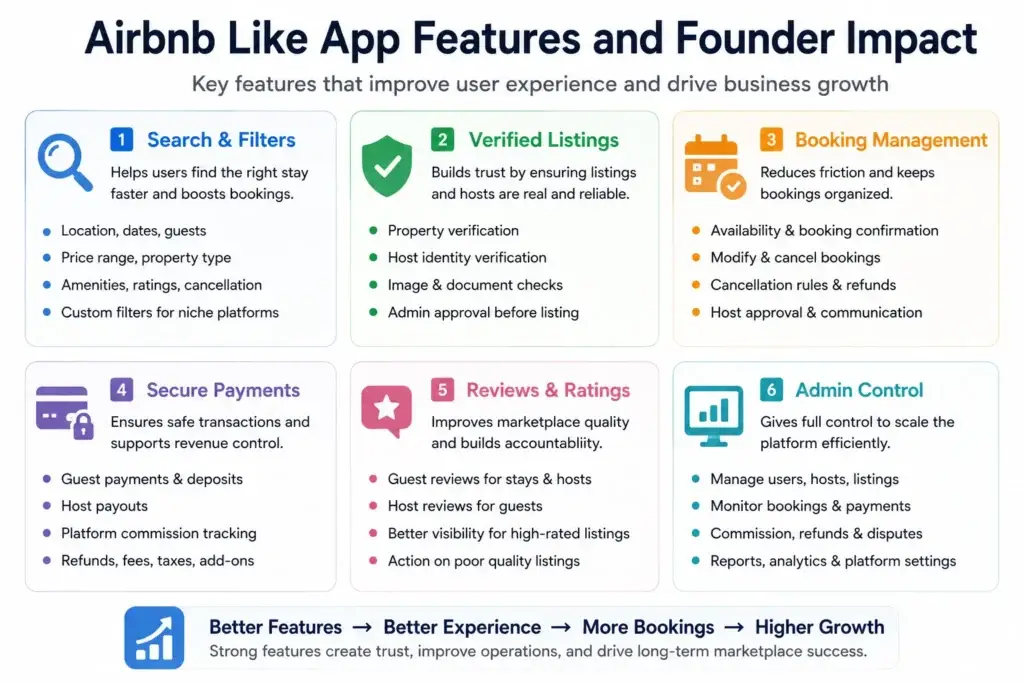
Airbnb Like App Features and Founder Impact
Many travel blogs explain features from the user side. For a startup founder, the more important question is how each feature affects business performance.
Search and Filters Improve Booking Conversion
Guests rarely book the first property they see. They compare based on location, price, photos, amenities, availability, ratings, and cancellation terms. If search is weak, users leave.
Advanced filters help users find the right stay faster. This can increase the chance of booking because the platform removes irrelevant results and shortens the decision process.
Useful filters may include:
- Destination or map location
- Check-in and check-out dates
- Number of guests
- Price range
- Property type
- Amenities
- Pet-friendly stays
- Free cancellation
- Instant booking
- Rating score
- Distance from landmarks
- Accessibility features
For niche rental platforms, custom filters can become a competitive advantage. A farm stay app may need filters for outdoor activities. A remote-work rental platform may need filters for workspace, Wi-Fi speed, and long-stay discounts. A luxury villa marketplace may need filters for private pools, staff, views, and concierge options.
Verified Listings Build Trust
Trust is one of the biggest challenges in any rental marketplace. Guests want to know whether the property is real, whether photos are accurate, whether the host is reliable, and whether payment is safe.
Verified listings help reduce uncertainty. A platform can use listing approval workflows, property document checks, identity verification, image moderation, and admin review before allowing properties to go live.
For founders, this is not only a safety feature. It is a growth feature. Users are more likely to book when they trust the marketplace.
Booking Management Reduces Operational Friction
Booking management includes availability checks, booking confirmation, booking modification, cancellation rules, refunds, host approval, and guest communication.
Poor booking management creates operational problems. Guests may book unavailable dates. Hosts may miss requests. Refunds may become unclear. Support tickets may increase.
A strong booking system protects both user experience and business operations.
Secure Payments Support Revenue Control
A rental platform needs payment flows that are safe, trackable, and easy to manage. Secure payment gateway integration allows guests to pay through the platform instead of moving transactions outside the marketplace.
This matters because the platform owner can track commissions, service fees, refunds, payouts, failed payments, and revenue reports.
Payment workflows may include:
- Guest booking payment
- Partial deposit
- Full payment
- Host payout
- Platform commission
- Refund processing
- Cancellation fees
- Add-on charges
- Taxes or local charges, where applicable
The final payment setup depends on the business model, geography, payment provider, and legal requirements.
Reviews and Ratings Improve Marketplace Quality
Reviews help guests make better decisions and help hosts improve service quality. They also create accountability.
A rental marketplace should allow guests to rate stays and hosts after completed bookings. Hosts may also rate guests depending on the platform model.
For the platform owner, reviews create long-term marketplace data. High-rated listings can receive more visibility, while poor listings can be reviewed, warned, or removed.
Admin Control Makes the Platform Scalable
Many founders focus heavily on the guest app and host app, but the admin dashboard is where the business is actually controlled.
The admin dashboard should help manage:
- Users
- Hosts
- Property listings
- Booking activity
- Payments
- Commission tracking
- Refunds
- Disputes
- Reviews
- Notifications
- Content pages
- Reports and analytics
- Platform settings
Without admin control, every operational issue becomes manual. As bookings increase, this can slow down the business and damage user trust.
Read more : How to Build an App Like Airbnb Clone Developer Guide
Monetization Models for an Airbnb Like App
An Airbnb like app can generate revenue in several ways. The best monetization model depends on the rental category, target users, host supply, transaction size, and market maturity.
| Revenue Model | How It Works | Best For |
| Booking commission | The platform earns a percentage from each confirmed booking. | Most vacation rental marketplaces. |
| Guest service fee | Guests pay an additional fee during booking. | Platforms with strong demand and trusted inventory. |
| Host service fee | Hosts pay a fee for each booking received. | Marketplaces with active host supply. |
| Subscription plans | Hosts pay monthly or yearly for listing access or extra tools. | Professional hosts, property managers, and long-term rental platforms. |
| Premium listings | Hosts pay to feature properties higher in search results. | Competitive markets with many listings. |
| Advertising | Local businesses or travel partners pay for visibility. | Mature platforms with steady traffic. |
| Add-on services | The platform earns from cleaning, pickup, experiences, insurance, or concierge services. | Platforms with high-value bookings or destination-specific services. |
| Cancellation fees | Fees apply based on platform and host policies. | Platforms with strict booking operations. |
Founders should avoid adding too many monetization layers too early. In the beginning, the priority is usually supply quality, user trust, and booking completion. Once the platform has traction, premium listings, subscriptions, and add-ons can increase revenue.
Startup Opportunity: Where New Rental Platforms Can Compete
A new rental marketplace should not try to become a broad global travel platform immediately. That approach requires massive inventory, brand trust, customer support, marketing spend, and technology investment.
A better startup opportunity is to choose a focused market where users need more specialized rental discovery.
Examples include:
Regional Vacation Rentals
Many local destinations have fragmented rental supply. Property owners may depend on social media, WhatsApp, agents, or offline networks. A local rental platform can organize this supply and make bookings easier.
Luxury Villa Rentals
High-value travelers often need better photos, trust signals, concierge support, and premium filters. A luxury rental marketplace can focus on quality instead of quantity.
Furnished Apartments
Corporate travelers, relocating professionals, students, and long-stay guests may need furnished rentals with monthly pricing, utilities, workspaces, and flexible lease terms.
Event Space Rentals
Farmhouses, villas, studios, rooftops, and private venues can be listed for events, shoots, retreats, and celebrations. This creates a different booking model from overnight stays.
Pet-Friendly Stays
Travelers with pets often face limited choices. A platform focused on pet-friendly stays can add filters for pet size, outdoor space, nearby parks, and host rules.
Remote-Work Stays
Remote workers need reliable internet, desk space, quiet surroundings, long-stay discounts, and flexible cancellation. A niche platform can serve this audience better than broad travel apps.
The business lesson is simple. Do not build a generic app like Airbnb. Build a rental platform with a clear reason to exist.
Ready-Made Airbnb Clone vs Custom Rental Platform Development
Founders often compare two routes: custom development and ready-made clone app development. Both can work, but they serve different business needs.
| Build Option | What It Means | Best For | Main Consideration |
| Custom development | Build the product from scratch based on unique requirements. | Founders with complex workflows, larger budgets, and a long product roadmap. | Takes more planning, development, testing, and budget. |
| Ready-made rental app | Start with an existing rental marketplace foundation and customize it. | Founders who want faster launch, market validation, and core app workflows ready. | Customization should match the niche and business model. |
| Hybrid approach | Start with ready-made modules and customize selected parts deeply. | Founders who need speed but also want market-specific differentiation. | Requires clear feature priorities. |
A ready-made Airbnb clone should not be treated as a copy-and-paste business. It should be used as a product foundation. The business still needs positioning, host acquisition, quality listings, pricing strategy, support workflows, and marketing.
Apps Similar to Airbnb and What Founders Can Learn
Several apps similar to Airbnb serve different types of travel and rental users. Studying them helps founders understand how rental platforms can position themselves.
| Platform Type | What It Focuses On | Founder Lesson |
| Vacation rental platforms | Homes, cabins, condos, villas, and family stays. | Good for destination-based rental supply. |
| Hotel and apartment platforms | Hotels, serviced apartments, and short stays. | Useful when combining professional inventory with marketplace listings. |
| Homestay platforms | Local hosts and cultural stays. | Strong for community-led travel experiences. |
| Luxury rental platforms | Premium homes and high-end service. | Focus on trust, quality, and concierge support. |
| Furnished apartment platforms | Long-stay and corporate rentals. | Better for professionals, relocation, and monthly rentals. |
| Niche rental platforms | Specialized categories or local destinations. | Easier to differentiate than broad marketplaces. |
The key takeaway is that the rental platform model is flexible. The strongest businesses usually choose a clear position rather than trying to serve every traveler at once.
How Miracuves Helps Founders Build Rental Marketplace Apps
Miracuves helps founders, startups, and businesses launch ready-made and white-label app solutions with source-code ownership, custom branding, admin control, and faster deployment.
For a rental marketplace, this means founders can start with an app foundation that includes important workflows such as guest registration, host listings, booking management, secure payments, reviews, notifications, and admin controls. The product can then be customized around the target rental category, business model, branding, and launch market.
A ready-made Airbnb clone solution can be useful when a founder wants to validate demand faster instead of building every module from zero. It can also help agencies or entrepreneurs who want a source-code-owned rental platform that can be adapted over time.
Miracuves can support rental marketplace ideas such as vacation rentals, furnished apartments, homestays, villa rentals, event spaces, local travel stays, and niche property booking platforms.
Final Thoughts: Build a Rental Platform With a Clear Market Advantage
An Airbnb like app is powerful because it combines travel discovery, host supply, booking convenience, secure payments, and trust. But the real business value comes from how founders adapt that model.
The strongest rental platforms are not generic copies. They are focused marketplaces built around a clear audience, property type, location, or booking need. A founder who understands the niche, controls the host experience, builds trust, and launches with the right app foundation has a better chance of creating a useful rental platform.
If your goal is to launch a vacation rental, furnished apartment, homestay, event space, or niche rental marketplace, Miracuves can help you start with a white-label, source-code-owned solution that supports faster validation and practical customization.
FAQs
What is an Airbnb like app?
An Airbnb like app is a rental marketplace that connects guests with hosts who list properties or spaces for booking. It usually includes property listings, search filters, booking management, secure payments, reviews, in-app chat, and admin control.
How does an app like Airbnb make money?
An app like Airbnb can make money through booking commissions, guest service fees, host service fees, subscription plans, premium listings, advertising, local experience add-ons, cancellation fees, and partner services.
Can I build an Airbnb like app for a niche rental market?
Yes. The Airbnb-style model can be adapted for vacation rentals, luxury villas, furnished apartments, homestays, student housing, event spaces, remote-work stays, pet-friendly stays, or regional rental marketplaces.
What features should a rental platform include?
A rental platform should include user registration, host onboarding, property listings, advanced search, map discovery, availability calendars, booking management, secure payments, in-app chat, reviews, notifications, and an admin dashboard.
How much does it cost to build an Airbnb like app?
The cost depends on features, design, mobile platforms, admin panel complexity, payment integrations, map features, customization, launch support, and development approach. Founders should confirm pricing based on their selected modules and business scope.
Is a ready-made Airbnb clone better than custom development?
A ready-made Airbnb clone can be useful when founders want faster launch, lower initial development effort, and a proven rental marketplace foundation. Custom development may be better when the business needs highly unique workflows or complex integrations from day one.
What security features are needed in a rental marketplace app?
Important security and trust features include host verification, guest verification, secure payment integration, listing approval, booking records, refund workflows, review moderation, abuse reporting, dispute management, admin access controls, and activity logs.
How can Miracuves help with Airbnb like app development?
Miracuves helps founders build ready-made and white-label rental marketplace apps with source-code ownership, branded design, host and guest workflows, booking management, payment integration, admin dashboard control, and customization support.
Should founders build a broad rental app or a niche rental platform?
Most early-stage founders should start with a niche rental platform. A focused category, location, or audience makes host acquisition, SEO, branding, and user trust easier than competing broadly from day one.