Key Takeaways
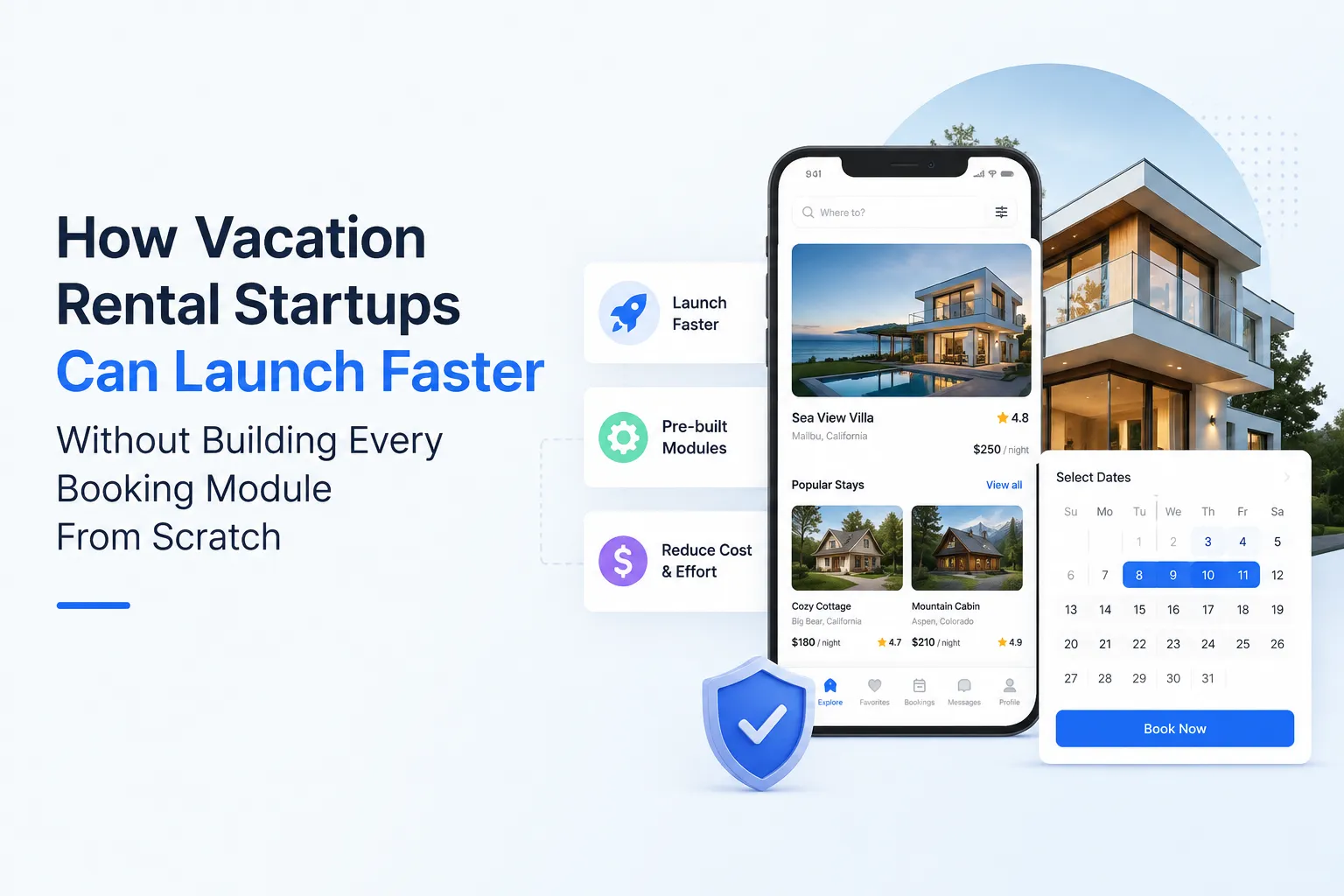
- Vacation rental platform development does not always need to begin from an empty codebase; startups can use a ready-made booking foundation and customize what creates real market differentiation.
- Standard modules such as property listings, availability calendars, booking flows, payments, reviews, messaging, host dashboards, and admin controls can significantly increase development time when rebuilt from zero.
- Early-stage founders should focus more resources on inventory quality, host acquisition, guest trust, positioning, pricing, and user acquisition.
- Ready-made foundations are useful for faster market validation, while custom development is better suited to highly unique booking rules, integrations, or enterprise workflows.
- The goal of launching faster is not to create a generic marketplace but to reach real hosts and guests sooner, learn from booking behavior, and customize the product using evidence.
Launch Signals
- Availability logic must prevent overlapping reservations while supporting blocked dates, booking windows, seasonal pricing, and host calendar controls.
- Payment workflows should handle guest payments, platform commissions, service fees, refunds, cancellations, and host payouts reliably.
- Host onboarding should make it easy to add properties, images, amenities, rules, pricing, availability, and payout information.
- Trust layers should include host verification, property approval, guest profiles, reviews, secure payments, cancellation rules, and dispute workflows.
- Founders should customize the inventory niche, commission model, local payments, languages, host experience, and guest journey instead of rebuilding every standard booking module.
Real Insights
- The real development complexity is not the listing interface; it is the booking logic behind availability, pricing, payments, cancellations, commissions, payouts, and disputes.
- A startup targeting villas, eco-stays, homestays, corporate housing, student accommodation, or another niche can differentiate through its market rather than reinventing standard backend workflows.
- Strong admin control lets founders change commissions, manage listings, handle refunds, resolve disputes, and adjust marketplace rules without depending on developers for routine decisions.
- A faster first release helps validate whether hosts will list, guests will book, which fees work, where users abandon the funnel, and which custom features deserve investment.
- The strongest path is: reliable booking foundation → market-specific customization → host acquisition → real bookings → behavioral learning → deeper product development.
Launching a vacation rental startup is not just about creating a website with property listings. A real booking marketplace needs listing management, availability calendars, host onboarding, guest booking flows, payment handling, commissions, reviews, messaging, dispute workflows, and admin control.
That is where many founders lose momentum.
They begin with a strong travel or rental business idea, but then spend months rebuilding standard booking modules before they can test demand. By the time the first version is ready, the market may have shifted, competitors may have captured supply, or the founding team may have already spent too much budget on infrastructure instead of growth.
This is why vacation rental platform development should not always begin from an empty codebase. For many startups, the smarter path is to begin with a ready-made booking foundation, customize it for the target market, and focus early effort on inventory, trust, branding, and user acquisition.
The goal is not to copy another platform. The goal is to launch a focused rental marketplace faster, validate real demand, and improve the product based on actual host and guest behavior.
Why Speed Matters in Vacation Rental Platform Development
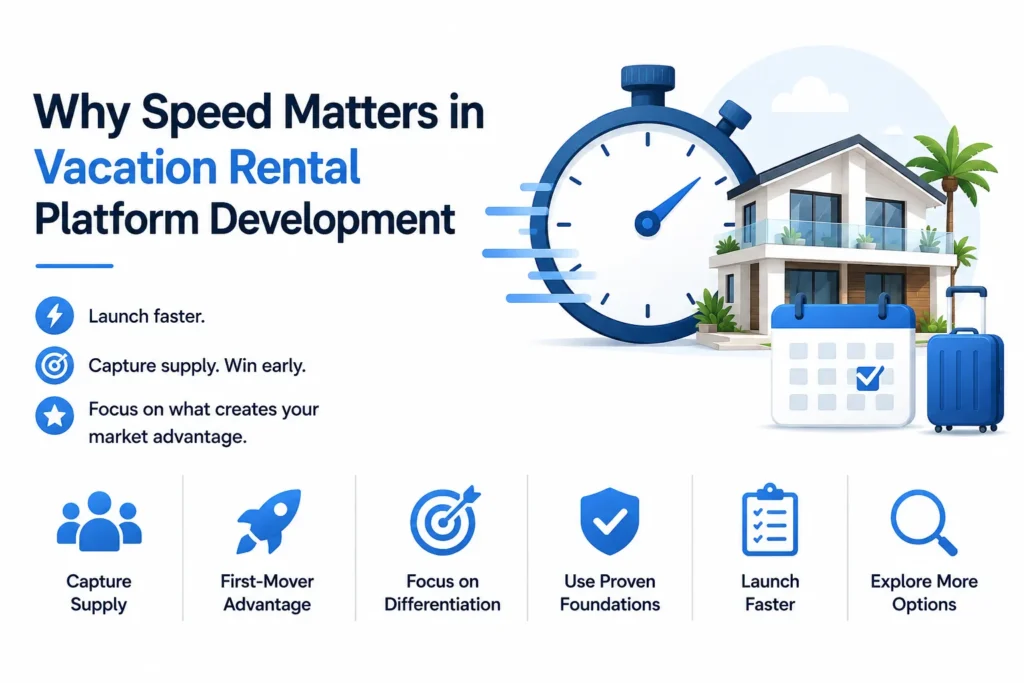
Speed matters because travel marketplaces depend on timing.
A founder may already have access to local property owners, villa operators, apartment managers, tourism partners, or niche accommodation providers. But if the product takes too long to launch, that supply advantage can fade. Hosts may join another marketplace, guests may form habits elsewhere, and the business may lose the first-mover benefit in its region or category.
In the early stage, the founder’s most important question is not:
“Can we build every module ourselves?”
The better question is:
“Which parts of the platform are standard, and which parts actually create our market advantage?”
For most vacation rental startups, login, property listings, booking calendars, review systems, payment flows, commission settings, and admin dashboards are not the unique advantage. These are expected marketplace foundations. The real differentiation comes from the target market, supply quality, local trust, pricing model, customer support, brand positioning, and the type of stays or experiences offered.
A startup targeting eco-stays, pet-friendly rentals, boutique villas, rural homestays, corporate housing, student stays, or destination-based travel packages does not need to reinvent every backend workflow before reaching customers. It needs a reliable foundation that can support bookings while the business validates what the market actually wants.
For founders still comparing different rental marketplace directions, it helps to understand the wider category before choosing one product path. Miracuves offers multiple rental and property platform options across short-stay booking, real estate listings, property management, car rentals, boat rentals, and related marketplace models.
The Real Delay Is Not the Interface. It Is the Booking Logic.
Many founders underestimate how complex a rental marketplace becomes once users start transacting.
A listing page may look simple from the outside. But behind it, the platform needs to manage availability, price calculations, booking requests, payments, cancellations, taxes, service fees, refunds, host payouts, notifications, and disputes.
If these workflows are built from scratch without a clear product structure, development can slow down quickly.
A vacation rental platform usually needs to answer questions such as:
- Can hosts set different prices for weekdays, weekends, seasons, or holidays?
- Can guests send booking requests, or should bookings be instant?
- What happens when two users try to book the same property for overlapping dates?
- How does the platform calculate cleaning fees, service fees, taxes, coupons, or deposits?
- When does the host receive payment?
- Can the admin pause a listing, approve a host, or resolve a dispute?
- What happens if a guest cancels close to the check-in date?
- Can the platform support multiple currencies, languages, or local payment methods later?
These questions are not small details. They are the operating system of the marketplace.
That is why building every booking module from zero can create unnecessary risk for startups that first need to launch, learn, and refine.
Core Booking Modules Founders Should Not Rebuild Blindly
| Module | Business Value | Risk If Built Poorly |
|---|---|---|
| Property Listing Management | Allows hosts to add stays, images, amenities, rules, location, pricing, and availability. | Incomplete listings reduce guest confidence and increase support questions. |
| Availability Calendar | Helps hosts control open dates, blocked dates, seasonal pricing, and booking windows. | Weak calendar logic can cause double-bookings and host dissatisfaction. |
| Guest Booking Flow | Lets guests search, compare, select dates, review pricing, and confirm reservations. | A confusing booking flow can reduce conversions before payment. |
| Payment and Payout Logic | Supports guest payments, platform commissions, refunds, and host earnings. | Poor payment handling creates trust, accounting, and dispute problems. |
| Host Dashboard | Gives hosts control over listings, enquiries, bookings, earnings, and availability. | Hosts may leave if they cannot manage inventory or understand earnings clearly. |
| Admin Dashboard | Allows the platform operator to manage users, listings, payments, disputes, content, and reporting. | Without admin control, every operational issue becomes manual and expensive. |
| Reviews and Ratings | Builds trust between guests and hosts through visible feedback. | A weak trust layer makes it harder for new users to book with confidence. |
| Messaging and Notifications | Keeps hosts and guests informed before, during, and after a booking. | Communication gaps lead to cancellations, confusion, and poor experience. |
If you want to review the product layer in more detail, explore this rental marketplace features, including booking flows, availability handling, host tools, payment logic, admin controls, and the technology behind the platform.
Ready-Made Foundation vs Custom Development: What Should Startups Choose?
Custom development gives full flexibility. For enterprise travel operators, hotel groups, or platforms with unusual booking rules, a custom build may be the right decision.
But for early-stage vacation rental startups, the first launch usually has a different priority: prove that hosts will list, guests will book, and the marketplace can generate transactions.
If you want to go deeper into the technical planning layer, this vacation rental platform architecture guide explains how booking workflows, host tools, guest journeys, payments, admin control, database planning, and backend decisions connect before choosing a final build path.
A ready-made rental marketplace foundation gives founders a faster path to that answer. Instead of spending the first phase building standard modules, the team can focus on market positioning, launch strategy, and operational execution.
| Decision Area | Ready-Made Booking Foundation | Full Custom Development |
|---|---|---|
| Launch speed | Faster because core modules already exist | Slower because architecture, flows, and modules start from zero |
| Early validation | Better for testing supply, demand, and pricing sooner | Better when the business model is too unique for standard flows |
| Budget control | More predictable for the first launch scope | Can expand as features, testing, and integrations increase |
| Customization | Strong when the foundation is modular and source-code-owned | Strongest when every workflow needs to be custom |
| Founder focus | More time for host acquisition, branding, partnerships, and marketing | More time spent managing development decisions |
| Risk profile | Lower early-stage product risk if the foundation is reliable | Higher early-stage timeline risk, but useful for complex products |
| Best fit | Startups, regional rental platforms, niche stay marketplaces, tourism brands | Enterprise platforms, complex operators, or highly differentiated booking models |
The right choice depends on how unique the startup’s operational model really is.
If the platform is mainly about connecting hosts and guests through listings, calendars, payments, reviews, and admin controls, rebuilding everything from scratch may not be necessary. If the platform involves unusual inventory rules, complex enterprise integrations, offline contracting, or region-specific compliance workflows, custom development may be needed from the beginning.
What Vacation Rental Startups Should Customize First
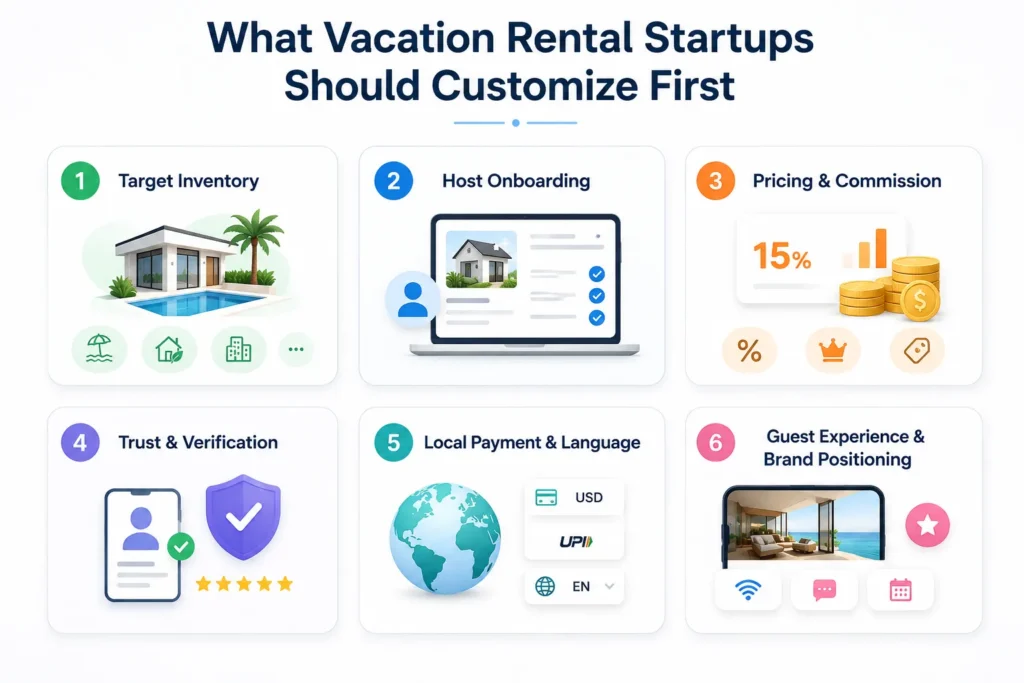
The mistake is not choosing a ready-made foundation. The mistake is launching a generic marketplace with no clear positioning.
A faster launch only helps if the business still feels specific, useful, and differentiated to its target users.
Instead of rebuilding every standard module, founders should customize the parts that shape the marketplace identity.
1. Target Inventory
A vacation rental platform should not try to serve everyone on day one. Stronger early positioning may come from a clear inventory niche, such as:
- Beach villas
- Long-stay apartments
- Pet-friendly homes
- Farm stays
- Luxury retreats
- Student accommodation
- Corporate housing
- Eco-stays
- Local homestays
- Destination-specific rentals
Before adding too many advanced features, founders should decide which inventory niche they want to own first. This niche vacation rental marketplace launch guide explains how focused categories such as villas, homestays, serviced apartments, pet-friendly stays, student housing, and regional rentals can create clearer positioning and stronger host acquisition.
A focused inventory strategy makes host acquisition easier because the value proposition is clearer. It also helps guests understand why they should use this platform instead of a larger generic marketplace.
2. Host Onboarding Workflow
Hosts are the supply side of the rental marketplace. If onboarding is confusing, supply growth slows.
A strong host workflow should make it easy to add property details, upload images, set availability, define pricing, add house rules, manage enquiries, and understand earnings.
Founders should customize host onboarding based on the type of suppliers they want to attract. A villa owner, apartment manager, tour operator, and corporate housing provider may all need different listing details and operational controls.
3. Pricing and Commission Model
Pricing is where the business model becomes real.
Founders should also decide how the platform will earn before adding too many features. A clear rental marketplace revenue model can include booking commissions, host subscriptions, guest service fees, host-configured fees, featured listings, and payout-related logic.
Vacation rental startups can experiment with:
- Commission per booking
- Host subscription plans
- Service fees
- Featured listings
- Promotion fees
- Cleaning or convenience fees
- Add-on services
- Local partner packages
The platform should give the operator enough control to test pricing without depending on developers for every small change. That is why admin-level commission and fee management matters from the beginning.
4. Trust and Verification Rules
Guests book faster when the platform feels safe. Hosts participate more confidently when guest identity and payment workflows are reliable.
Useful trust layers include host verification, property approval, guest profiles, booking history, reviews, cancellation rules, secure payments, dispute workflows, and admin monitoring.
Trust should not be treated as a later add-on. In rental marketplaces, trust is part of the product.
5. Local Payment and Language Preferences
A vacation rental startup often begins in one country, city, or travel region. That local focus should appear in the product.
Currency, language, payment methods, taxes, cancellation expectations, and support workflows can differ by market. A platform that reflects local behavior can feel more trustworthy than one that looks copied from a global template.
6. Guest Experience and Brand Positioning
The guest journey should match the startup’s brand promise.
If location-based discovery is important for your marketplace, review this map search performance guide to understand how spatial indexing, bounding-box queries, marker clustering, lightweight APIs, and search monitoring help rental platforms keep property discovery fast as inventory grows.
A luxury villa marketplace may need premium visuals, concierge messaging, and high-touch support. A budget homestay platform may need transparent pricing, map-based discovery, and strong reviews. A remote-work stay platform may need filters for Wi-Fi, desk space, long-stay discounts, and monthly billing.
The booking foundation can be ready-made. The experience should still feel intentional.
Founder Decision Signals
Speed
If the goal is to test supply and demand quickly, a ready-made booking foundation can reduce the time spent rebuilding standard marketplace workflows.
Cost
If early budget is limited, founders should prioritize modules that create booking readiness instead of spending heavily on features users may not need yet.
Scalability
If the startup plans to expand into multiple regions, the platform should support flexible pricing, payments, languages, categories, and admin controls from the beginning.
Market Fit
If the product direction is still being validated, launching faster helps founders learn from real host and guest behavior before committing to deeper custom development.
Why Admin Control Is the Real Startup Advantage
A rental marketplace can look polished on the guest side and still fail operationally if the admin layer is weak.
The admin dashboard is where the platform operator controls the business. It should help manage users, hosts, listings, bookings, payments, commissions, content, disputes, reports, and platform settings.
For founders, admin control matters because early-stage marketplaces change quickly.
You may need to adjust commission rates after speaking to hosts. You may need to pause risky listings. You may need to approve new property categories. You may need to refund a guest, resolve a dispute, update cancellation policies, or check which listings are converting best.
Without admin control, every small operational change becomes a development request. That slows the business down.
A strong vacation rental platform should give the founder control over the marketplace without requiring technical intervention for routine decisions.
How a Ready-Made Rental Platform Helps Startups Validate Faster
The biggest advantage of starting with a ready-made foundation is not only speed. It is learning.
A founder cannot validate a rental marketplace only through wireframes. The real test begins when hosts create listings, guests search for stays, payments are attempted, reviews are submitted, and support issues appear.
A faster launch helps founders answer practical questions:
- Are hosts willing to join the platform?
- Which property categories attract the most interest?
- Where do guests abandon the booking flow?
- Which fees feel acceptable?
- What filters do users actually use?
- Which locations generate demand first?
- Which trust signals improve booking confidence?
- What custom features are truly worth building next?
This is where a ready-made foundation becomes strategically useful. The first version does not have to be the final version. It becomes a controlled launch layer for learning what the next version should become.
Mistakes Founders Should Avoid
Rebuilding Standard Booking Modules Too Early
Many startups spend too much time building login, listings, bookings, payments, reviews, and dashboards from zero. These modules are important, but they are not always the source of differentiation.
Launching Without a Clear Inventory Niche
A generic rental marketplace is difficult to position. Start with a specific supply category, location, or user segment so hosts and guests understand why the platform exists.
Ignoring Host Experience
Guests cannot book what hosts do not list. The host dashboard, payout visibility, calendar control, and support experience are critical to supply growth.
Adding Trust Features Too Late
Verification, reviews, secure payments, cancellation rules, and dispute workflows should be part of the first serious platform version, not emergency fixes after problems appear.
Where Miracuves Fits Into Vacation Rental Platform Development
Miracuves helps founders launch rental marketplace platforms faster by starting with a ready-made, white-label, source-code-owned foundation instead of forcing every startup to begin from an empty build.
For founders who want to create a travel booking, homestay, villa rental, short-stay, or multi-category rental marketplace, Miracuves can provide the booking foundation, admin control, host and guest workflows, payment structure, and launch support needed to move faster.
The advantage is practical: founders can focus on the business layer while the platform foundation handles the standard rental marketplace workflows.
If you are exploring a faster route to market, you can review Miracuves’ launch-ready rental marketplace solution as the next step after understanding the development strategy.
Before choosing a build partner, founders should evaluate more than design screens. The right rental marketplace development partner should understand availability integrity, commission storage, payout workflows, source-code ownership, admin control, and post-launch support.
Final Thoughts: Build Faster, Validate Smarter, and Customize What Matters
Vacation rental startups do not win by rebuilding every booking module from scratch. They win by solving a clear market problem, onboarding the right hosts, creating guest trust, and launching a platform that can process real bookings reliably.
Custom development still has its place. But for many early-stage founders, the first priority is not maximum technical originality. It is getting a reliable product into the market, learning from real users, and improving based on evidence.
That is the strategic value of a ready-made rental marketplace foundation. It helps founders avoid unnecessary development delays while keeping room for branding, customization, monetization, and long-term growth.
The smarter path is not always the longest build. It is the build that helps the startup reach the market with enough speed, control, and clarity to make better decisions.
FAQs
What is vacation rental platform development?
Vacation rental platform development is the process of building a digital marketplace where hosts can list properties and guests can search, compare, book, pay, review, and communicate through the platform. It usually includes listing management, availability calendars, booking workflows, payments, host dashboards, guest accounts, and admin control.
Why should startups avoid building every booking module from scratch?
Startups should avoid rebuilding every standard module from scratch because it can delay launch and consume budget before the business validates demand. A ready-made foundation allows founders to focus on market positioning, host onboarding, guest acquisition, and monetization strategy.
What modules are most important in a vacation rental marketplace?
The most important modules include property listings, search filters, availability calendars, booking flow, payment gateway integration, host dashboard, guest dashboard, messaging, reviews, cancellation rules, payout management, and admin reporting.
Is a ready-made rental marketplace suitable for niche travel startups?
Yes. A ready-made rental marketplace can work well for niche travel startups when it allows customization. Founders can adapt the platform for villas, homestays, eco-stays, pet-friendly rentals, long-term stays, corporate housing, local tourism, or destination-based rental businesses.
When is custom development better for a rental marketplace?
Custom development is better when the platform requires highly unique workflows, complex integrations, unusual inventory rules, enterprise systems, or a business model that cannot fit a standard booking foundation. For early validation, however, many startups benefit from launching faster and customizing later.
How does admin control help a vacation rental startup?
Admin control helps the founder manage users, hosts, listings, payments, commissions, disputes, reports, content, and platform settings. Without a strong admin dashboard, routine marketplace decisions become dependent on developers, which slows operations.
Can a vacation rental platform support multiple revenue streams?
Yes. A rental marketplace can support commissions, service fees, host subscriptions, featured listings, promotional placements, cancellation fees, add-on services, and local partner packages. The exact model should match the platform’s market, supply type, and guest behavior.
How can Miracuves help with vacation rental platform development?
Miracuves helps founders launch faster with ready-made, white-label, source-code-owned rental marketplace solutions. Founders can customize branding, workflows, monetization, and market-specific features while avoiding the delay of building every standard booking module from zero.
Miracuves is an independent software development company. We are not affiliated with, connected to, sponsored by, or endorsed by any company or product named in this article.
Terms such as “X Clone” are used descriptively. It is how the software industry refers to building a platform with functionality comparable to a known service, and how clients search for it.
The entire design and codebase of our products is built by our own team. Our products contain no code, design, graphics, or content originating from any third-party website or applications.
All third-party names and marks referenced in this article are the property of their respective owners, referenced solely to identify the services discussed.