


Key Takeaways
- A Revolut clone script helps launch a digital wallet or neobank app faster.
- User, wallet, card, transaction, and admin flows must work together.
- KYC, payments, transfers, cards, and security are core fintech features.
- Pricing depends on features, APIs, compliance scope, and customization.
- A strong script needs secure wallet logic, audit logs, and scalable architecture.
Fintech Feature Signals
- Users need onboarding, KYC, wallet, cards, and transaction history.
- Admins need control over users, limits, fees, disputes, and reports.
- Transfers, currency exchange, and wallet refills need secure verification.
- Banking, payment, card, and KYC APIs must be integration-ready.
- Fraud alerts and audit logs help track sensitive financial actions.
Real Insights
- Fintech apps need trust before user growth.
- Weak wallet logic can create payment disputes quickly.
- Compliance workflows should be planned before launch.
- Source code control helps future fintech integrations.
- Miracuves builds Revolut Clone apps with secure digital wallet workflows.
Building a digital banking product no longer has to start with a blank screen, a large internal engineering team, and months of product discovery. For fintech founders, the bigger question is not whether users want faster money movement, multi-currency access, digital wallets, and card control. The bigger question is how quickly you can launch a reliable product foundation without creating technical, security, or compliance problems later.
That is why many startups compare a Revolut clone script before investing in full-scale digital wallet app development or neobank app development. A ready-made script gives you a faster starting point with core banking-style workflows such as wallets, transfers, cards, FX conversion, user onboarding, transaction history, and admin control.
If you are already comparing options and want to see a product-ready foundation, explore the Miracuves Revolut clone script to review the demo, pricing, app flows, admin dashboard, source code details, and launch support.
This guide keeps the original purpose simple: help you understand what a strong Revolut-style app script should include, what affects pricing, what security and admin layers matter, and when it makes sense to move from research to a product demo.
Why Founders Are Exploring Revolut-Style App Development
Digital banking users now expect finance apps to be fast, simple, mobile-first, and transparent. They want to check balances, move money, manage cards, exchange currency, track spending, and receive real-time updates without visiting a branch or waiting through slow manual processes.
For founders, this creates multiple opportunities:
- Launch a niche neobank for a specific region or customer segment.
- Build a multi-currency wallet for freelancers, remote workers, exporters, or international users.
- Create a business finance platform with accounts, expenses, payroll, vendor payments, and reporting.
- Add embedded finance workflows inside an existing marketplace, SaaS platform, or digital ecosystem.
- Start with a white-label fintech foundation instead of building every wallet, transaction, admin, and onboarding workflow from zero.
The real opportunity is not copying Revolut’s brand. It is using a proven product pattern to launch your own digital banking experience with the right features, controls, and monetization model.
What Is a Revolut Clone Script?
A Revolut clone script is a ready-made software foundation that helps founders launch a digital banking or fintech platform with features inspired by Revolut-style products.
It usually includes:
- User app
- Web app
- Admin dashboard
- Wallet and account workflows
- Payment and transfer flows
- Multi-currency support
- Card management
- KYC and verification workflows
- Transaction monitoring
- Security and admin controls
- Customization options
The script should not copy Revolut’s trademark, branding, design assets, or protected identity. A proper clone script gives you similar functional logic under your own brand, with your own customer experience, integrations, and operating model.
The strongest version is not just a front-end app. It should include backend control, admin workflows, transaction visibility, user management, and the flexibility to integrate banking, payment, KYC, or BaaS providers based on your market.
Must-Have Features in a Revolut Clone Script

A strong Revolut-style app should combine user experience, financial logic, backend control, and operational trust. Below are the core features founders should check before choosing a script.
| Feature | Why It Matters | Founder Impact |
|---|---|---|
| Multi-currency wallet | Allows users to hold, send, receive, and exchange multiple currencies | Supports cross-border users, freelancers, travelers, and global businesses |
| Real-time FX conversion | Enables currency exchange inside the app | Creates monetization potential through FX margin and improves user convenience |
| User onboarding and KYC | Helps verify users before allowing sensitive financial activity | Supports safer onboarding and compliance-ready workflows |
| P2P transfers and payments | Lets users send, receive, request, and manage money | Forms the core daily-use loop of a fintech app |
| Card management | Supports virtual or physical card controls such as freeze, unfreeze, and spending visibility | Improves user control and product stickiness |
| Transaction history | Gives users clear records of payments, transfers, and account activity | Builds trust and reduces support confusion |
| Budgeting and analytics | Helps users understand spending behavior | Adds retention value beyond basic payments |
| Admin dashboard | Gives the operator control over users, transactions, disputes, KYC reviews, and system activity | Converts the app from a simple interface into an operational fintech platform |
| Notifications and alerts | Keeps users updated about payments, transfers, card activity, and account changes | Improves engagement and transaction confidence |
| Security controls | Protects accounts, payments, data, and admin access | Reduces operational risk and supports long-term trust |
For a deeper feature breakdown, you can also review the Miracuves guide on Revolut app features list.
The Feature List Is Not Enough: What Founders Should Really Check
Many fintech scripts look impressive on the surface because they show wallet screens, card screens, profile screens, and an admin login. But a serious fintech product depends on what happens behind those screens.
Before choosing a Revolut clone script, ask these questions:
- Can the wallet ledger handle balance updates clearly?
- Can the admin team review suspicious transactions?
- Can users complete onboarding securely?
- Can KYC and AML workflows be configured for the target market?
- Can payment gateways, BaaS providers, or card providers be integrated?
- Can the system support future features without rebuilding the core product?
- Can the founder access and own the source code?
- Can the app be rebranded for a specific country, niche, or customer segment?
- Can user roles and admin permissions be controlled properly?
A script that only gives you screens may help you demo an idea. A stronger script helps you operate a fintech business.
How to Compare Revolut Clone Script Options
Instead of comparing random script names, founders should compare product foundations. The right choice depends on launch speed, customization depth, technical control, compliance preparation, and support.
| Comparison Factor | Weak Script | Strong Script |
| Source code | Limited access or locked system | Source-code ownership with customization flexibility |
| Branding | Basic logo and color change | Full white-label branding and workflow customization |
| Admin panel | Simple user list | User control, KYC review, transactions, disputes, reports, roles, and audit history |
| Integrations | Fixed payment gateway | Configurable payment, KYC, BaaS, and card provider integration |
| Security | Login and basic SSL only | Encrypted data transfer, role-based access, audit logs, transaction monitoring, and verification workflows |
| Scalability | Hardcoded flows and limited backend flexibility | Modular architecture that can support future product expansion |
| Support | Script handover only | Deployment guidance, technical support, and launch planning |
| Business fit | Generic wallet app | Customizable Revolut-style app aligned with market, monetization, and user segment |
The goal is not to buy the longest feature list. The goal is to choose a product foundation that supports your launch plan and does not become expensive to fix later.
Revolut Clone Script Pricing: What Affects the Cost?
The cost of a Revolut-style app depends on how much of the product is already built, how much customization is needed, and which integrations are required.
Key cost drivers include:
- Tech stack and backend architecture
- Mobile app and web app scope
- Admin dashboard depth
- Wallet and ledger complexity
- Multi-currency and FX workflows
- Card provider integration
- BaaS or banking partner integration
- KYC and AML workflow setup
- Payment gateway integration
- Security and audit log requirements
- Custom branding and UI changes
- App deployment and publishing support
- Source code ownership
- Post-launch support
A basic wallet app can cost less, but it may not support the operational depth needed for digital banking. A custom fintech build can offer high flexibility, but it usually requires more time, budget, and technical planning. A ready-made white-label platform sits between these two options by giving founders a faster launch foundation with room for customization.
Miracuves Revolut-Like App Solution Cost and Tech Stack
Miracuves Pricing for a Revolut-Like Super Fintech App developed in React/JS with Flutter Apps for $15,999 USD (One-Time Price) in just 6 days
Get a fully developed, deployment-ready platform modeled after Revolut. Built on a scalable JavaScript (Node.js) architecture, this complete package includes everything you need to launch and scale:
- Core Workflows: Multi-currency accounts, instant transfers, card management, expense tracking, and global payment flows.
- Built-in Finance: In-app wallet logic, real-time currency conversion, transaction processing, and secure payout systems.
- Management Hub: Comprehensive user management, KYC/AML controls, transaction monitoring, and a centralized admin backend.
- Launch-Ready: Fully prepped for your custom branding, compliance integrations, API setup, and app store deployment.
What Makes Revolut-Style App Development More Expensive Than a Basic Wallet?
Advanced fintech platforms like Revolut require high-performance architectures such as Node.js to handle real-time transactions, global scale, and strict financial compliance. Building from scratch with such frameworks demands highly specialized developers, security experts, and regulatory integrations, which significantly increases development costs.
We took a structured, enterprise-ready approach:
- Built for Fintech Complexity: This solution is designed to support high-volume transactions, multi-currency operations, and real-time processing. You’re investing in a system that meets modern fintech expectations from day one.
- The Power of JavaScript / Node.js: We built this on a high-performance, event-driven architecture ideal for fintech scalability. While the upfront cost is higher, it ensures long-term reliability, speed, and the ability to handle global user bases and financial operations efficiently. You get an enterprise-grade, future-ready foundation built for serious fintech growth.
Note: This cost is for the solution, re-branding, deployment, and source code only.
Ready to Validate Your Fintech Launch Plan?
Review the Revolut clone demo, confirm pricing, discuss integrations, and map the fastest practical launch path for your fintech platform.
- Ready-made Revolut-style app foundation
- White-label branding and customization
- Source code included
- Admin dashboard and fintech workflows
- 6-day launch path for aligned ready-made scope
Monetization Models for a Revolut-Style App
A Revolut-style app can support multiple revenue streams depending on your target market, regulatory setup, and partner integrations.
| Monetization Model | How It Works | Best For |
| FX margin | Earn a margin on currency exchange transactions | Multi-currency wallets and cross-border users |
| Transfer fees | Charge fixed or percentage-based fees on money movement | Remittance and wallet transfer apps |
| Subscription plans | Offer premium accounts with advanced limits, features, or support | Neobank and business finance platforms |
| Card-related revenue | Earn from card issuance, usage, or provider-linked models | Card-focused fintech products |
| Business accounts | Charge businesses for finance tools, payroll, expense management, or reporting | SME finance and business banking apps |
| Partner revenue | Earn through integrated financial services, offers, or third-party products | Embedded finance ecosystems |
| Featured services | Promote premium financial tools or add-ons | Multi-service fintech platforms |
For business model planning, you can also read the Miracuves comparison of Revolut vs Wise business model.
Security, KYC, AML, and Compliance-Ready Workflows
Security should not be treated as a marketing add-on in fintech. It should be part of the product foundation.
A serious Revolut clone script should support:
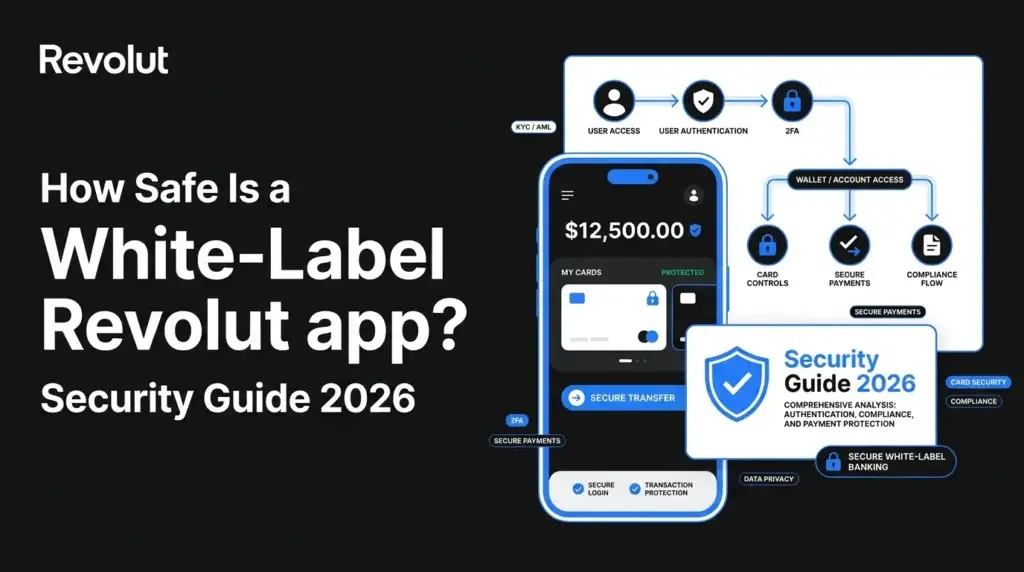
- Encrypted data transfer
- Secure login and session handling
- Role-based access control
- KYC workflow support
- AML workflow support
- Transaction monitoring
- Suspicious activity flags
- Audit logs
- Admin access controls
- Secure API integration
- Payment gateway security
- User verification
- Dispute management
- Activity history
- Compliance-ready workflows
Founders should be careful with any provider that claims a product is “fully compliant everywhere” out of the box. Compliance depends on jurisdiction, legal review, operating model, banking partners, payment providers, data policies, and regulatory requirements.
A stronger way to evaluate the product is to ask whether it provides the workflows your team, legal advisors, and financial partners will need to configure compliance properly.
For more technical depth, read the Miracuves guide on fintech clone security.
Why the Admin Panel Matters in a Revolut Clone App
Many founders focus only on the user app. That is understandable because users interact with the mobile experience first. But in fintech, the admin panel is where the business actually operates.
A strong admin dashboard should help you manage:
- Users and account status
- KYC submissions
- Transaction history
- Wallet activity
- Suspicious activity review
- Payment issues
- Disputes and refunds
- Card controls
- Currency settings
- Fees and limits
- Support requests
- Reports and analytics
- Role-based admin access
- Audit history
Without a strong admin panel, every operational issue becomes manual. That slows support, increases risk, and makes it harder to scale.
The right admin dashboard gives founders control over the platform without depending on developers for every small operational change.
Customization Options Founders Should Look For
A white-label Revolut clone should not force every business into the same product model. Your fintech app may target freelancers, travelers, SMEs, students, exporters, remote teams, or a specific regional market. Each audience may need a different onboarding flow, pricing model, currency setup, feature priority, or user experience.
Useful customization options include:
- Branding, logo, color, and interface changes
- Custom onboarding flow
- Local language support
- Country-specific workflows
- Payment gateway integration
- KYC provider integration
- BaaS provider integration
- Currency and FX configuration
- Custom fees and limits
- Business account modules
- Card workflows
- Reporting dashboards
- User roles and permissions
- Support and dispute workflows
A ready-made platform should give you speed, but it should also leave enough room to shape the product around your business model.
Launch Process for a White-Label Revolut Clone
A practical launch process should be clear before you commit to any script.
Typical stages include:
- Product scope discussion
- Feature selection
- Branding and UI customization
- Integration planning
- KYC, payment, card, or BaaS provider mapping
- Admin setup
- Testing and QA
- Deployment
- App publishing support
- Team training or handover
- Post-launch support
Miracuves’ ready-made approach is designed for faster deployment, with a 6-day launch path for the ready-made Revolut-style solution when the scope is aligned. Custom integrations, regulatory requirements, and advanced feature changes may affect the final rollout plan.
What to Watch Out For Before Buying a Revolut Clone Script
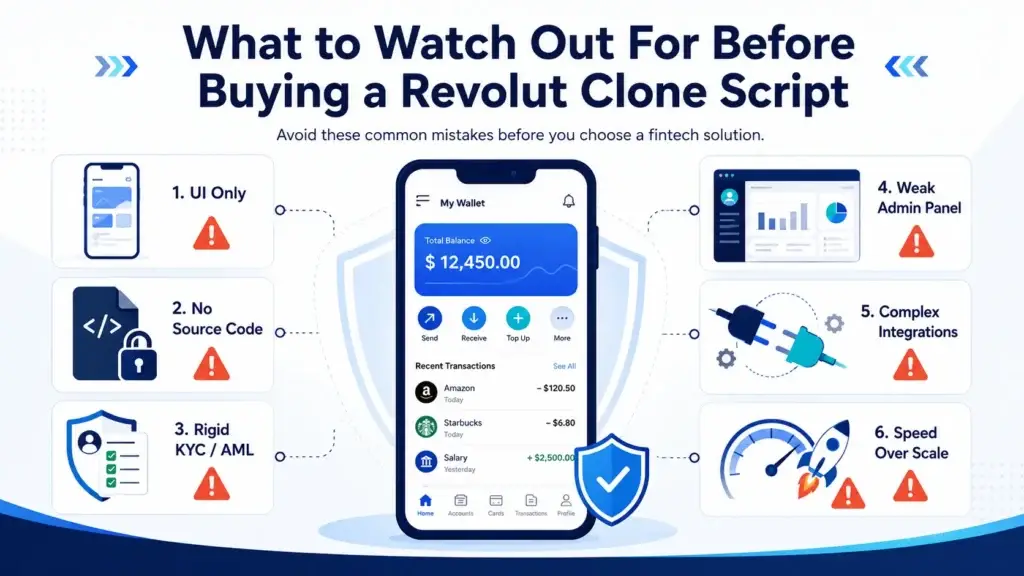
Image Source: AI-generated visual by Miracuves
Not every script that looks complete is ready for real fintech operations. Founders should avoid these mistakes.
Choosing a Script Only Because It Looks Good
A polished UI is useful, but fintech success depends on backend logic, transaction reliability, security workflows, and admin control. Screens alone are not enough.
Ignoring Source Code Ownership
If you do not control the source code, your long-term flexibility may be limited. Source-code ownership matters when you need custom features, new integrations, investor review, technical audits, or future scaling.
Overlooking Compliance Workflow Flexibility
KYC and AML needs vary by region and business model. Avoid rigid systems that cannot adapt to your operating requirements.
Accepting a Weak Admin Panel
A fintech app without a strong admin dashboard can become difficult to manage after launch. User issues, transaction reviews, verification checks, and disputes need backend visibility.
Underestimating Integration Complexity
Card providers, payment gateways, BaaS providers, KYC vendors, and banking partners may all have technical and compliance requirements. The script should be integration-ready, not hardcoded around one narrow setup.
Focusing Only on Launch Speed
Fast launch is valuable, but not if it creates rework later. The better goal is faster validation with a scalable, secure, and customizable foundation.
How to Choose the Right Revolut Clone Script
Use this checklist before choosing a provider:
- Does the product include user app, web app, and admin dashboard?
- Does it support multi-currency accounts and FX conversion?
- Can it support KYC and AML workflow configuration?
- Does it include source code?
- Can it be fully white-labeled?
- Are payment, BaaS, KYC, or card integrations possible?
- Is the admin panel strong enough for real operations?
- Does the provider offer deployment support?
- Is pricing clear?
- Can the product be customized for your market?
- Does the provider understand fintech platform development, not just app design?
- Can you view a demo before making a decision?
If your answers point toward faster launch, source-code ownership, admin control, and fintech-specific customization, a Miracuves white-label Revolut clone may be a practical fit.
Who Should Consider a Revolut-Style App?
A Revolut-style app is useful for founders and businesses that want to own the customer-facing finance experience rather than only depend on third-party tools.
It can fit:
- Fintech startups launching a neobank-style product
- Digital wallet founders
- Remittance and cross-border payment platforms
- Business banking startups
- SME finance platforms
- Embedded finance companies
- Agencies offering white-label fintech products
- Regional fintech brands
- Marketplaces adding financial workflows
- SaaS platforms adding wallet or payment experiences
If your core business involves money movement, multi-currency access, account workflows, business finance tools, or payment visibility, a Revolut-style app can become a long-term product asset.
For remittance-focused businesses, the Miracuves Wise clone solution may also be relevant.
Why Choose Miracuves for a Revolut Clone Script?
Choosing a Revolut clone script is not only about getting a ready-made app. It is about choosing a fintech product foundation that can support your launch, branding, admin control, integrations, and future growth.
Miracuves helps founders launch a white-label Revolut-style app with source code, custom branding, admin dashboard access, fintech workflows, and faster deployment support. This makes it useful for startups that want to validate a digital wallet, neobank, or multi-currency finance product without building every module from zero.
The Miracuves approach is especially relevant if you need:
- Source-code ownership for long-term flexibility
- White-label branding for your own fintech identity
- A ready-made app foundation for faster market entry
- Admin dashboard control for users, transactions, KYC reviews, and platform activity
- Multi-currency, wallet, transfer, and card-related workflows
- Customization support based on your target market and business model
- A practical 6-day launch path for aligned ready-made scope
Fintech founders should avoid choosing a script only because it looks affordable or feature-heavy. The better decision is to choose a platform that gives you control over the product, supports key fintech workflows, and leaves room for integrations, compliance preparation, and future expansion.
For founders who want to review the actual app flow before making a decision, Miracuves provides demo access, pricing clarity, and consultation support through the Revolut Clone App page.
Conclusion
The best Revolut clone script is not simply the one with the longest feature list. It is the one that gives founders a reliable foundation for digital wallet app development, neobank app development, multi-currency workflows, admin control, security, monetization, and future customization.
A blog like this should help you understand what to check before buying. The next step is to evaluate the actual product, demo, source code, pricing, and launch support.
For founders who want to move faster without building every module from zero, Miracuves offers a ready-made, white-label Revolut-style app foundation with source-code ownership, admin control, and a practical launch path.
Ready to Compare Demo, Pricing, and Launch Scope?
If you are still researching, use this guide to shortlist what matters: source code, admin control, multi-currency workflows, KYC/AML support, integrations, pricing, customization, and launch support.
If you are ready to review the actual product, visit the Miracuves Revolut Clone App page to view demo options, pricing, launch details, and product scope.
You can also talk to Miracuves experts to discuss your fintech idea, target market, required integrations, and the fastest practical launch path.
FAQs
What is a Revolut clone script?
A Revolut clone script is a ready-made software foundation that helps startups launch a digital banking or fintech app with features such as wallets, transfers, multi-currency accounts, cards, transaction history, KYC workflows, and admin control under their own brand.
Is it legal to launch a Revolut-style app?
Yes, it can be legal when you do not copy Revolut’s brand name, logo, design assets, trademarks, or protected intellectual property. A proper Revolut-style app uses similar financial functionality under your own branding, product strategy, legal setup, and operating model.
How much does a Revolut clone script cost?
Cost depends on features, technology stack, source code, integrations, customization, deployment, and support. Miracuves offers a ready-made Revolut-style fintech solution at $15,999 USD, subject to final scope, branding, integrations, and launch requirements.
Can I customize a white-label Revolut clone?
Yes. A strong white-label Revolut clone should allow customization for branding, user flows, local market needs, payment integrations, KYC providers, BaaS providers, admin roles, fees, currency setup, and additional product modules.
Does a Revolut clone app include KYC and AML?
A quality Revolut clone app should support KYC and AML workflows, but final compliance depends on your jurisdiction, legal review, integrations, operating model, and financial partners. Avoid any provider that guarantees universal compliance without proper review.
What features should a Revolut-style app include?
A Revolut-style app should include user onboarding, multi-currency wallets, FX conversion, transfers, cards, budgeting tools, transaction history, notifications, security controls, admin dashboard, KYC workflow support, AML workflow support, and transaction monitoring.
Do I need a custom fintech app or a ready-made clone script?
Choose custom development if your product requires highly unique architecture from day one. Choose a ready-made clone script if you want to validate faster with a proven foundation and customize the platform around your market, brand, and integrations.
Can I see a demo before buying the Revolut clone app?
Yes. Founders should review the app demo, admin dashboard, web app flow, pricing, source code scope, and launch process before making a decision. You can view the Miracuves Revolut clone demo from the money page or schedule a consultation with the team.
What is the difference between a Revolut clone app and a digital wallet app?
A digital wallet app usually focuses on storing, sending, and receiving money. A Revolut clone app is broader because it can include multi-currency accounts, FX conversion, cards, business finance tools, budgeting, admin controls, KYC workflows, and neobank-style experiences.
How fast can I launch a Revolut-style app with Miracuves?
Miracuves positions its ready-made Revolut-style app for a 6-day launch when the scope is aligned. Custom features, third-party integrations, compliance requirements, and market-specific changes may affect the final timeline.
Related Articles