


Key Takeaways
- Pre-launch marketing for a Wise clone focuses on awareness, waitlists, trust building, and early user validation.
- Post-launch marketing focuses on activation, retention, referrals, transaction volume, and customer feedback.
- Users, businesses, admins, compliance teams, and payment partners need clear fintech communication workflows.
- Success depends on transparent fees, secure transfers, strong onboarding, and credibility in target markets.
- A balanced launch strategy can help Wise clone startups acquire users faster and improve long-term growth.
Marketing Signals
- Pre-launch campaigns need landing pages, waitlists, educational content, early access offers, and credibility signals.
- Post-launch campaigns need referral programs, app store optimization, paid ads, email flows, and retention tracking.
- Users need clear messaging around exchange rates, transfer speed, fees, security, and transaction tracking.
- Admins need visibility into signups, user activation, transfer behavior, campaign ROI, and churn signals.
- Notifications and lifecycle campaigns keep users engaged with transfer updates, offers, reminders, and account activity.
Real Insights
- A Wise clone startup should build trust before asking users to move money across borders.
- Weak pre-launch positioning can attract the wrong audience and reduce early conversion quality.
- Post-launch growth depends on repeat transfers, referral loops, customer support, and transparent pricing.
- Marketing should connect directly with product features like KYC, payments, exchange rates, and transaction visibility.
- Miracuves builds Wise Clone apps with international money transfer workflows, wallets, compliance, payments, and admin control.
Launching a Wise-style app is not only a product decision. It is also a trust-building decision.
You may have a strong cross-border payment app idea, a clear audience, and a product plan around international transfers, currency exchange, multi-currency wallets, and transparent fees. But if users do not understand why they should trust your platform before they send money, growth becomes slow.
That is why pre-launch and post-launch marketing need to work together.
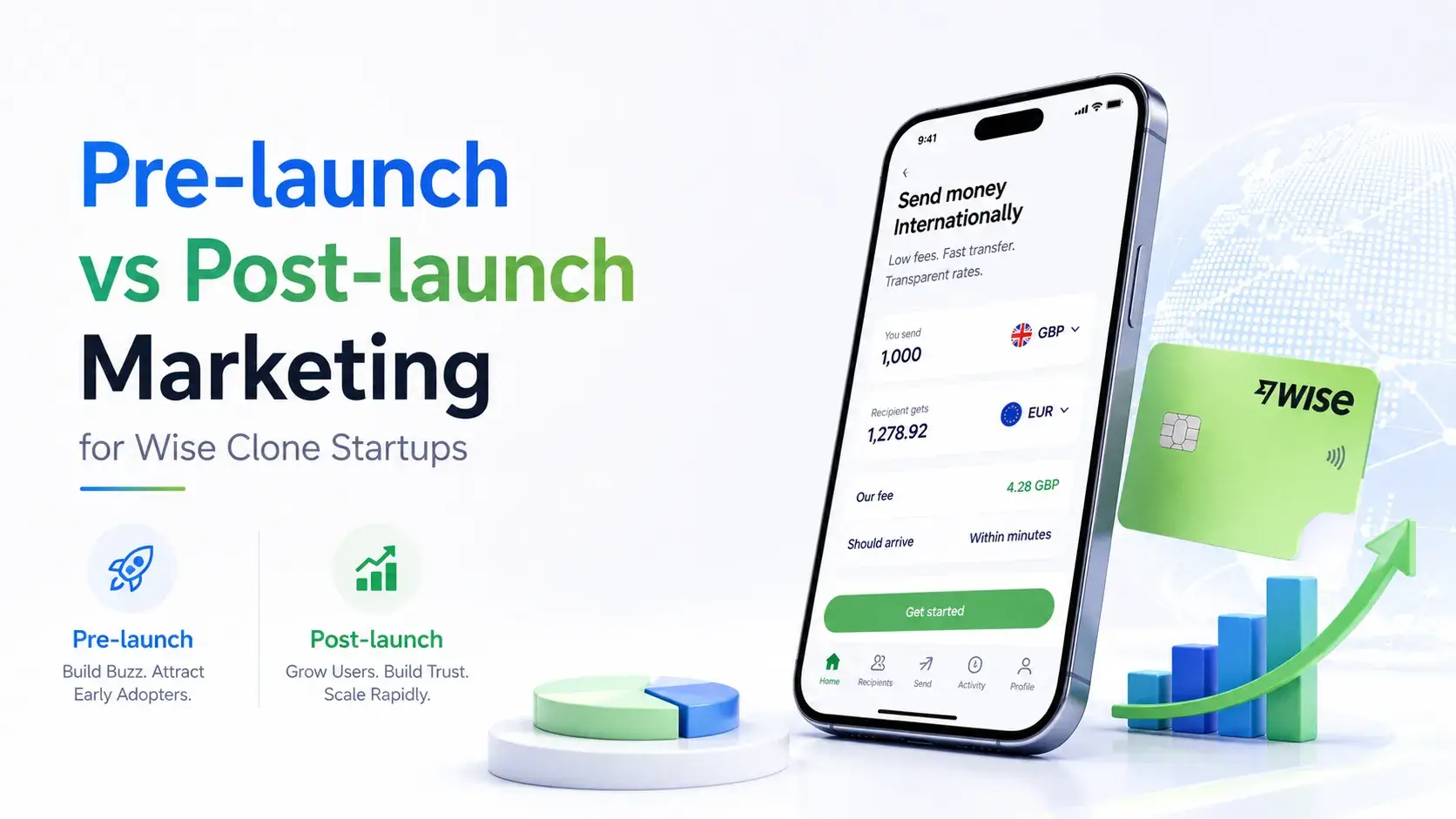
Pre-launch marketing helps you build awareness, educate users, collect early demand, and test your message before the app goes live. Post-launch marketing helps you convert users, increase transactions, improve retention, and turn early adopters into repeat customers.
For founders who are already planning the product foundation, the Miracuves Wise Clone App page is the right next step to explore demo flows, admin control, source-code ownership, and white-label platform readiness.
This guide keeps the original focus of pre-launch vs post-launch marketing, but adds the business, product, monetization, security, and conversion context founders need before launching a serious international money transfer app.
What Pre-launch Marketing Means for a Wise Clone Startup
Pre-launch marketing is everything you do before your app goes live to build awareness, credibility, and early demand.
For a fintech or remittance product, this matters more than usual because users are not downloading a casual app. They are trusting your platform with identity data, financial activity, exchange rates, transfers, and recipient information.
A strong pre-launch campaign should answer three questions:
- Who is this app for?
- Why should users trust it?
- What makes the transfer experience simpler, clearer, or more useful than their current option?
This is where many fintech founders make a mistake. They wait until the app is live before they start explaining the product. By then, they are already spending on ads without enough trust, educational content, waitlist data, or clear audience segmentation.
Pre-launch marketing helps you reduce that risk.
Read more: Business Model of Wise: Explained for Startup Founders
Why Fintech Apps Cannot Skip Pre-launch Trust Building
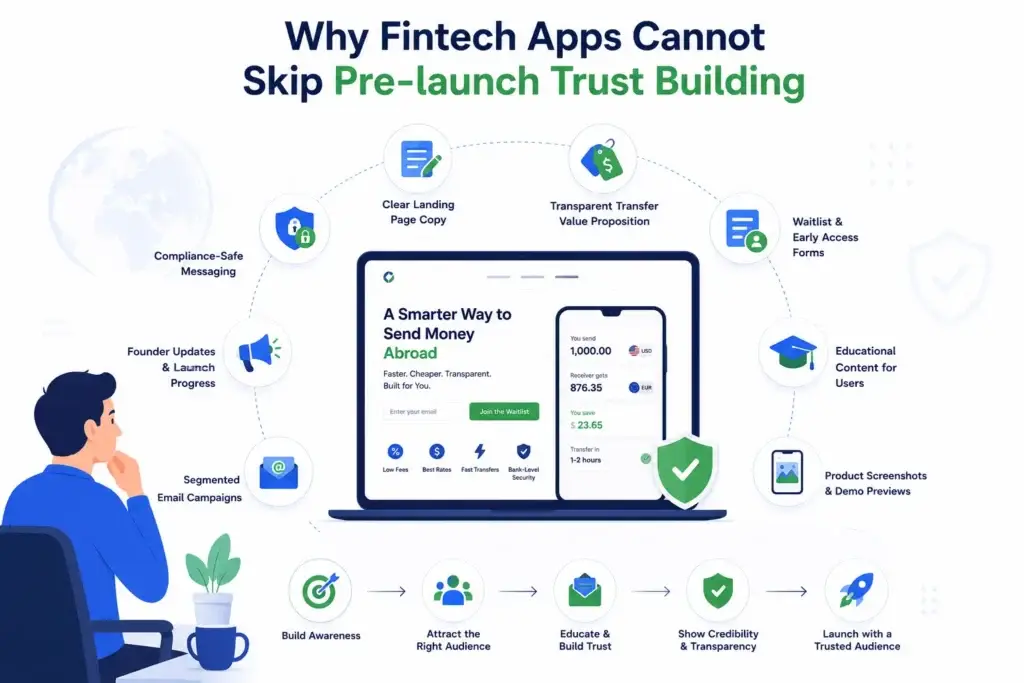
Trust is the real currency in money transfer apps.
Before users send money through a new platform, they want to understand fees, exchange rates, transfer speed, verification steps, security, support, and refund or dispute handling. If the messaging is unclear, users may visit once and leave.
A pre-launch campaign gives founders time to build trust through:
- Clear landing page copy
- Transparent transfer value proposition
- Waitlist and early access forms
- Educational content for target users
- Product screenshots or demo previews
- Compliance-safe messaging
- Founder updates and launch progress
- Segmented email campaigns
For a Wise clone startup, pre-launch marketing should not promise what the product cannot support. It should explain the problem, show the product direction, and invite the right audience to join early.
Pre-launch Marketing Checklist for Your Wise-Style App
1. Build a High-Intent Landing Page
Your landing page should not simply say “send money globally.” Many apps can say that.
It should explain the exact audience and value.
For example, your launch page can target:
- Freelancers receiving international payments
- SMEs paying overseas vendors
- Students sending or receiving money across countries
- Migrant communities supporting families abroad
- Agencies managing multi-currency client payments
- Remote teams handling payroll and reimbursements
A strong landing page should include:
- The core money transfer problem
- The audience you serve
- Expected product benefits
- Waitlist or demo CTA
- Trust and security language
- Early access form
- FAQs about launch, verification, and availability
Do not overpromise exchange rates, transfer speed, or regulatory coverage unless your operating model can support it.
2. Create an Early Access Waitlist
An early access waitlist helps you test demand before launch.
Instead of driving all traffic to a generic contact form, ask users what they need:
- Which country do they send money from?
- Which country do they send money to?
- Are they an individual, freelancer, business, or finance team?
- What problem are they facing today?
- Do they care more about fees, speed, transparency, or business workflows?
This gives you useful launch data.
A waitlist also helps you segment users before the app goes live. Freelancers may need payout messaging. SMEs may care about invoices, batch payments, business accounts, and dashboard access. Families may care about low-friction transfers, recipient saving, and status tracking.
3. Segment Email Campaigns Before Launch
A Wise-style app should not use one message for every user.
Different audiences care about different things.
| Audience Segment | Messaging Angle | Pre-launch Offer |
|---|---|---|
| Freelancers | Receive and convert international payments with more clarity | Early access to wallet and transfer updates |
| SMEs | Manage global payments, recipients, and business finance workflows | Demo invite or business waitlist |
| Students | Send or receive money across countries with simple tracking | Launch alert and transfer guide |
| Migrant users | Support family transfers with simple recipient flows | Country-corridor updates |
| Agencies | Manage multi-currency client payments and team finance needs | Consultation or product walkthrough |
Segmentation improves your conversion quality because users feel the product is built around their situation.
4. Use Build-in-Public Updates Carefully
Build-in-public can work well for fintech startups, but it should be handled professionally.
You can share:
- Product screens
- Founder notes
- Waitlist milestones
- Launch roadmap
- User research insights
- Educational posts about remittance problems
- Security and verification explainers
Avoid sharing sensitive architecture, compliance claims, user data, or unsupported financial promises.
The goal is to build credibility, not hype.
5. Prepare Product Proof Before Paid Ads
Paid ads can drive traffic, but fintech users need proof.
Before spending heavily on ads, prepare:
- Demo walkthrough
- Product screenshots
- Landing page
- FAQ section
- Pricing or consultation CTA
- Email nurturing sequence
- Trust and compliance explanation
- Support workflow explanation
This is where a ready-made Wise clone script or white-label Wise clone foundation can help founders move faster. If the core product flow is already available to demonstrate, the marketing team can show real user journeys instead of relying only on concept copy.
Post-launch Marketing: Turning Installs Into Trust and Transactions
Once your app is live, the goal changes.
You are no longer only building curiosity. You are trying to turn users into verified accounts, first transfers, repeat transactions, referrals, and long-term customers.
Post-launch marketing should focus on:
- Activation
- KYC completion
- First transfer completion
- Recipient saving
- Repeat transfers
- Referral adoption
- Support satisfaction
- Trust-building communication
- Retention campaigns
A fintech app does not win only because users install it. It wins when users complete key financial actions and return because the experience feels clear, safe, and useful.
Post-launch Tactics for Wise Clone Growth
1. Optimize App Store Listings for Fintech Search Intent
Your app store listing should target practical user intent.
Use keywords and phrases around:
- International money transfer app
- Send money globally
- Cross-border payment app
- Currency exchange app
- Multi-currency wallet
- Transfer money abroad
- Business international payments
Your screenshots should show the product benefit clearly. Avoid generic finance graphics. Show wallet views, transfer flows, recipient management, exchange preview, transaction status, and support access where relevant.
2. Improve KYC Completion With Lifecycle Messaging
Many fintech users drop off during verification.
Instead of treating KYC as only a compliance step, treat it as a customer experience moment.
Use email, push notifications, and in-app messages to explain:
- Why verification is required
- What documents are needed
- How long the process may take
- What happens after approval
- How user data is handled
- Where to get support
A smooth verification experience can improve activation and reduce support pressure.
3. Use Retargeting Based on User Intent
Post-launch retargeting should be smarter than “download now.”
Segment users based on behavior:
| User Behavior | Retargeting Message |
| Visited landing page but did not sign up | Join early access or view demo |
| Started signup but did not verify | Complete verification to activate transfers |
| Verified but did not transfer | Send your first international transfer |
| Completed first transfer | Save recipient for faster repeat transfers |
| Business user visited pricing page | Book a business payments walkthrough |
This approach keeps ads relevant and helps move users through the funnel.
4. Build Referral Loops Around Real User Value
Referral campaigns work best when users already trust the product.
For a money transfer app, referral messaging should focus on practical value:
- Invite a friend to simplify cross-border transfers
- Share the app with family members who send money often
- Help your team manage international payments
- Refer another freelancer or business owner
Rewards should be designed carefully based on your operating region, legal requirements, and business model.
5. Publish Educational Content After Launch
Your post-launch content should not only announce features.
It should educate users around:
- How international money transfers work
- How exchange rates affect transfer value
- How to avoid hidden transfer fees
- How businesses can manage global payouts
- How freelancers can receive money from overseas clients
- How to choose a secure remittance app
This content supports SEO, builds trust, and improves long-term user acquisition.
Pre-launch vs Post-launch Marketing: A Practical Breakdown
| Area | Pre-launch Marketing | Post-launch Marketing |
| Main Goal | Build awareness, trust, and waitlist demand | Convert, retain, and grow transaction volume |
| Primary Audience | Early adopters, investors, partners, niche communities | Verified users, active senders, businesses, referral audiences |
| Main CTA | Join waitlist, view demo, request early access | Complete signup, send first transfer, refer users, book consultation |
| Content Focus | Problem education, trust-building, product previews | Product usage, transfer clarity, customer support, retention |
| Product Dependency | Needs clear concept, screenshots, demo, audience promise | Needs stable user flows, admin control, support, analytics |
| Best Channels | SEO, LinkedIn, founder content, email, waitlist, communities | ASO, retargeting, lifecycle emails, referral campaigns, content SEO |
| Founder Decision | Validate demand before heavy launch spend | Improve activation and repeat usage after launch |
Read more: What is a Wise App and How Does It Work?
Common Marketing Mistakes Wise Clone Founders Should Avoid
Waiting Until Launch to Start SEO
SEO takes time. If your first blog, landing page, and fintech content go live after the app launch, you are already behind.
Start building content around international money transfer problems, audience use cases, and fintech trust topics before launch.
Promoting Features Without Explaining Business Value
Users do not care about “multi-currency wallet” as a feature alone.
They care that it helps them hold, send, receive, convert, and manage money across countries with better visibility.
Your content should always connect feature to user outcome.
Focusing Only on Installs
Installs are not enough.
Track what happens after install:
- Signup completion
- Verification completion
- First transfer
- Recipient saved
- Repeat transfer
- Referral sent
- Support ticket resolution
A fintech marketing strategy should be measured by trust and transaction behavior, not only downloads.
Ignoring KYC and Compliance Experience
A confusing verification flow can damage conversion.
Your marketing should prepare users for verification before they encounter it. Explain why it matters, what is needed, and how it protects the platform.
Not Connecting Campaigns to the Admin Panel
Founders often think marketing happens only on the front end. But growth also depends on backend visibility.
An admin panel helps operators review users, monitor transactions, manage fees, track flagged activity, respond to support issues, and understand what is happening inside the platform.
If marketing generates demand but operations cannot manage it, growth becomes risky.
How Product Readiness Improves Wise Clone Marketing
A strong marketing campaign needs a product foundation that can support the promises made in ads, landing pages, and sales calls.
For a Wise Clone App, product readiness should include:
- User onboarding
- KYC or business verification flow
- Multi-currency wallet experience
- Recipient management
- Currency conversion
- Transfer tracking
- Transaction history
- Push or email notifications
- Admin dashboard
- Fee and limit management
- Compliance review workflows
- Fraud and risk monitoring
- Reporting and analytics
- Support and dispute workflows
This section should support the money page, not replace it. Readers who want a deeper product walkthrough should visit the Wise clone script demo and review the user app, web platform, and admin dashboard.
For deeper product-level reading, you can also explore the Wise app features guide.
Monetization Planning Should Start Before Launch
Marketing brings users in. Monetization decides whether the platform can grow sustainably.
A Wise-style app can support different revenue streams depending on the business model, target market, and operating structure.
Common monetization options include:
| Monetization Model | How It Works | Founder Use Case |
| Transfer Fees | Charge a fee per international transfer | Useful for consumer remittance and high-volume corridors |
| FX Margin | Earn a margin on currency conversion | Works when transparent and compliant with market rules |
| Business Accounts | Offer premium features for SMEs and finance teams | Useful for B2B fintech positioning |
| Subscription Plans | Charge monthly access for advanced workflows | Suitable for business dashboards, payroll, or finance tools |
| API Access | Offer programmable payment or wallet access | Useful for embedded finance and partner models |
| Add-On Services | Charge for advanced reporting, support, or integrations | Works for scaling business users |
Your marketing should not wait until later to explain monetization value. If your target audience is businesses, talk about finance workflows. If your target audience is freelancers, focus on fees, payouts, speed, and clarity.
For a deeper strategy view, read the revenue model for international money transfer and the international money transfer business model guides.
Cost and Timeline: What Founders Should Plan Before Marketing
A marketing campaign should be aligned with the actual product timeline.
If you start promoting too early without a product demo, users may lose interest. If you wait too long, you miss the chance to build early demand.
For a Wise-style app, cost and timeline depend on:
- Mobile app and web platform scope
- Admin panel depth
- KYC and AML workflow requirements
- Currency exchange and transfer integrations
- Payment gateway or banking partner integrations
- Branding and UI customization
- Reporting and analytics needs
- Security and access control requirements
- Support and deployment expectations
Miracuves’ ready-made Wise clone approach can help founders start with a launch-ready foundation instead of building every module from zero. For the latest scope, pricing, demo access, and customization discussion, use the Get Pricing CTA on the product page.
Security, Compliance, and Admin Control Should Support Marketing Claims
Fintech marketing must be careful.
Do not claim that your app is fully compliant everywhere or approved for every market unless that has been legally verified. Financial compliance depends on jurisdiction, licensing, partnerships, payment rails, data handling, and operating model.
Use safer, more practical language such as:
- Supports KYC workflows
- Supports AML review workflows
- Includes transaction monitoring tools
- Supports role-based admin access
- Supports audit logs and activity visibility
- Can be configured for compliance workflows based on target market
- Legal and regulatory approvals should be reviewed separately
This does not weaken your marketing. It makes it more trustworthy.
A serious international money transfer app should give founders operational control over users, transactions, verification, fees, limits, flagged activity, and reporting. That control layer is what helps marketing, support, compliance, and operations work together after launch.
For broader fintech product planning, explore Miracuves’ fintech app development capabilities.
Customization: Why Your Wise-Style App Should Not Look Generic
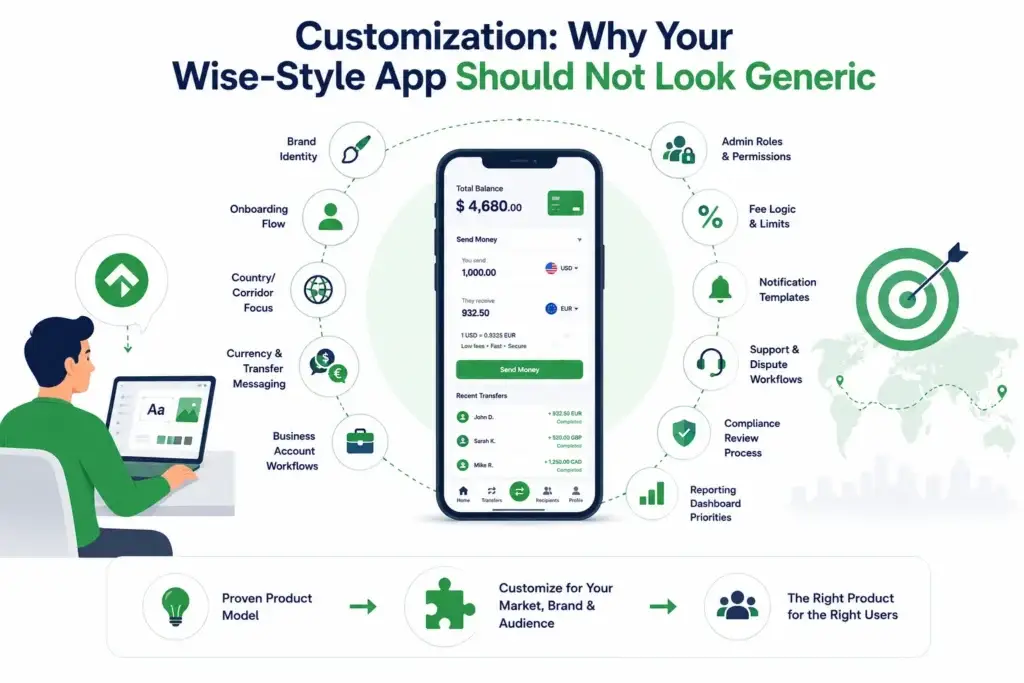
Image Source: AI-generated visual by Miracuves
A white-label Wise clone should not feel like a copied product.
The goal is to use a proven product model and adapt it for your market, brand, audience, corridors, and revenue strategy.
Useful customization areas include:
- Brand identity
- User onboarding flow
- Country or corridor focus
- Currency and transfer messaging
- Business account workflows
- Admin roles and permissions
- Fee logic and limits
- Notification templates
- Landing page positioning
- Support and dispute workflows
- Compliance review process
- Reporting dashboard priorities
A founder targeting freelancers will need a different message than a founder targeting SMEs or migrant communities. Product customization and marketing positioning should move together.
Simple Launch Process for Wise Clone Startups
A practical Wise clone launch plan can follow this flow:
| Stage | Focus | Marketing Output |
| Market Research | Identify users, corridors, pain points, and competitors | Audience segments and messaging map |
| Product Planning | Finalize core flows, admin needs, and compliance workflow expectations | Landing page promise and feature story |
| Pre-launch Campaign | Build waitlist, publish content, share demo previews | Early demand and qualified leads |
| Product Demo Review | Validate user app, web platform, and admin dashboard | Sales enablement and investor/product proof |
| Launch | Drive signups, verification, and first transfers | Paid, organic, email, and referral campaigns |
| Post-launch Optimization | Improve retention, support, and transaction confidence | Lifecycle messaging and user education |
| Scaling | Expand corridors, partnerships, integrations, and business workflows | Cluster content and partner campaigns |
This keeps marketing tied to product execution instead of running as a separate activity.
Read more: Wise App Features List: What Founders Can Learn from a Global Money Transfer App
Why Choose Miracuves for Wise Clone App Development?
A Wise-style app needs more than attractive screens and basic transfer flows. It needs a product foundation that supports user trust, admin control, secure workflows, monetization, and faster launch planning.
Miracuves helps founders build white-label fintech platforms with branded user experiences, source-code ownership, admin dashboards, and customizable modules for international money transfer use cases. This gives startups a stronger foundation to validate demand without building every core workflow from zero.
For a Wise Clone App, Miracuves can support important product layers such as:
- User onboarding and verification workflows
- Multi-currency wallet experience
- Recipient management
- Currency exchange and transfer flow
- Transaction history and status tracking
- Admin control for users, transfers, fees, and reports
- Security-focused workflows such as access control, activity visibility, and transaction monitoring
- Custom branding and business model alignment
- Monetization support through fees, FX margin, subscriptions, or business account models
The goal is not to copy Wise blindly. The stronger approach is to use a proven international money transfer product pattern and customize it for your target audience, region, pricing model, compliance needs, and growth strategy.
Founders planning a cross-border payment platform can explore the Miracuves Wise Clone App to review the demo, product flow, admin dashboard, pricing options, and consultation path before finalizing their launch strategy.
Conclusion
Pre-launch and post-launch marketing both matter, but they solve different problems.
Pre-launch marketing builds trust before the product reaches the market. Post-launch marketing turns that trust into verified users, first transfers, repeat transactions, referrals, and long-term retention.
For Wise clone startups, the stronger strategy is not only to run ads or publish generic fintech content. It is to connect marketing with product readiness, audience segmentation, transparent messaging, admin control, security workflows, monetization logic, and a clear demo-led conversion path.
A Wise-style app can create real business opportunity when the product foundation and go-to-market strategy work together.
FAQs
How early should I start pre-launch marketing for a Wise clone startup?
Start as soon as your audience, product direction, and landing page message are clear. Pre-launch marketing should begin before the app goes live so you can build a waitlist, test messaging, collect user intent, and prepare launch content.
What is the main difference between pre-launch and post-launch marketing for a Wise-style app?
Pre-launch marketing focuses on awareness, trust, waitlists, and product education. Post-launch marketing focuses on activation, verification, first transfers, repeat usage, referrals, and retention.
Should I link a marketing blog to the Wise Clone App money page?
Yes, but naturally. The blog should keep its marketing intent while linking to the money page where readers are ready to view the demo, check pricing, explore product features, or talk to experts.
What should a Wise clone landing page include before launch?
A pre-launch landing page should include audience-specific messaging, core transfer benefits, trust language, expected product features, waitlist form, demo CTA, FAQs, and a clear explanation of who the app is built for.
How can post-launch marketing improve user retention for an international money transfer app?
Post-launch marketing can improve retention through lifecycle emails, transfer reminders, recipient-saving prompts, referral campaigns, support education, app store optimization, and content that explains fees, security, and transfer workflows.
What features should marketing highlight in a Wise Clone App?
Marketing should highlight multi-currency wallets, recipient management, currency conversion, transfer tracking, transaction history, KYC workflows, admin control, reporting, security features, and business payment workflows where relevant.