


Key Takeaways
- A Turo clone script helps founders launch a peer-to-peer car rental marketplace faster with ready-made booking, host, renter, and admin workflows.
- Core features include vehicle listings, host dashboard, renter app, booking calendar, GPS tracking, secure payments, reviews, and admin control panel.
- Pricing depends on app complexity, tech stack, source-code access, mobile apps, payment flow, insurance logic, GPS integration, and customization level.
- A strong Turo-like platform must support both sides of the marketplace: car owners who want earnings and renters who want flexible vehicle access.
- Long-term success depends on trust, vehicle availability, smooth booking, secure payments, owner protection, renter verification, and scalable marketplace operations.
Marketplace Signals
- Peer-to-peer car rental demand is growing because users want flexible access to cars without ownership, long-term leases, or traditional rental friction.
- Important features include nearby vehicle search, real-time availability, booking requests, host approval, driver verification, deposits, and trip management.
- Revenue can improve through platform commissions, renter fees, host fees, insurance add-ons, delivery charges, late fees, subscriptions, and featured listings.
- These platforms can serve tourists, city renters, car owners, fleet operators, airport travelers, luxury car renters, and local mobility users.
- Development cost changes based on branding, app modules, admin dashboard depth, telematics, map APIs, payment gateways, support tools, and third-party integrations.
Real Insights
- A Turo-style marketplace is not just a car listing app; it must manage trust, bookings, payments, insurance, disputes, and vehicle protection together.
- Founders should check source-code ownership, scalability, customization flexibility, payment security, and post-launch support before choosing a clone script.
- Trust features like identity checks, vehicle verification, damage reporting, reviews, secure deposits, and cancellation rules are critical for marketplace growth.
- Launching faster can help founders validate demand, onboard hosts, test pricing, and improve the platform based on real renter behavior.
- The strongest Turo clone platforms combine booking automation, host control, renter safety, secure payments, GPS intelligence, admin visibility, and scalable rental marketplace infrastructure.
Car ownership is no longer the only way people access vehicles. Many users now prefer renting cars for specific needs: weekend trips, business travel, airport pickup, luxury experiences, family travel, or temporary local mobility. At the same time, car owners and fleet operators are looking for ways to monetize idle vehicles instead of letting them sit unused.
That shift has created strong demand for peer-to-peer car rental platforms. A Turo clone script gives founders a faster way to enter this market without building every renter, car owner, payment, booking, listing, and admin workflow from zero.
But choosing the right Turo clone app is not only about buying software. It is about choosing the right marketplace foundation. The platform needs to support renters, car owners, payments, GPS, verification, disputes, payouts, insurance logic, and admin control from day one.
Miracuves helps founders launch a white-label Turo clone app with source code, custom branding, admin dashboards, app publishing support, and a faster 6-day launch path for businesses that want to validate the car rental marketplace model quickly.
What Is a Turo Clone Script?
A Turo clone script is a ready-made software solution that helps businesses launch a car rental marketplace similar to Turo. It allows car owners or fleet operators to list vehicles, renters to search and book cars, and platform admins to manage users, bookings, payments, commissions, disputes, reviews, and reports.
A basic script only gives you listings and bookings. A strong Turo clone script gives you the operational foundation needed to run a real marketplace.
That means the platform should support:
- Car listing management
- Availability calendars
- Search and filters
- Booking requests or instant booking
- Secure online payments
- Owner and renter verification
- Ratings and reviews
- GPS and location-based discovery
- Damage reporting
- Admin commission control
- Cancellation and refund rules
- Payout management
- Support and dispute handling
For founders, the goal is not to copy Turo blindly. The smarter goal is to use a proven car-sharing model, customize it for a target region or niche, and launch with enough control to test demand.
How a Turo-Like Car Rental Marketplace Works
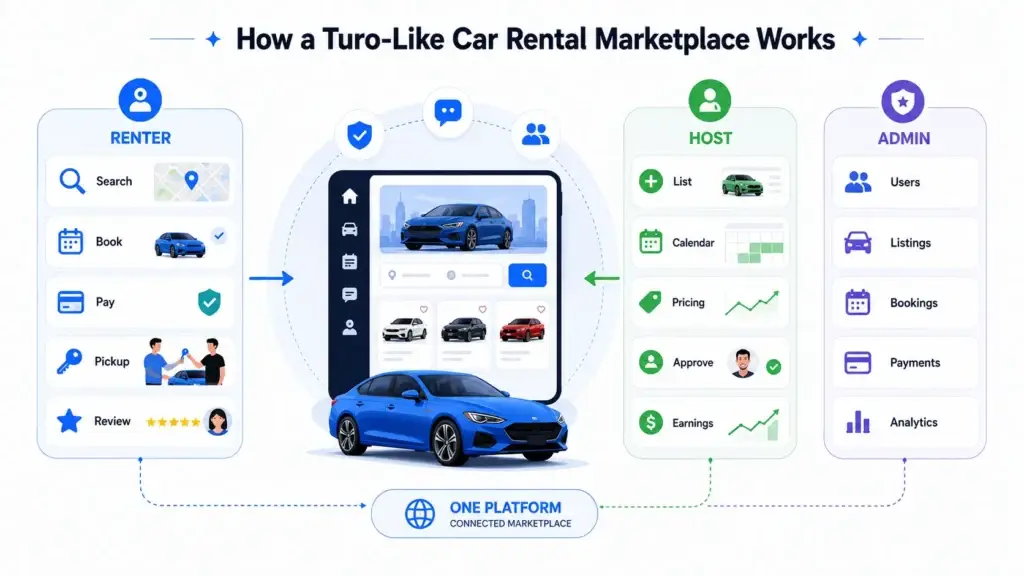
Image Source: AI-generated visual by Miracuves
A Turo-style platform connects three main roles: renters, car owners, and the admin team. Each role needs a different workflow.
Renter Flow
Renters use the app to search cars by location, date, price, vehicle type, seating capacity, transmission, fuel type, rating, or availability. After choosing a car, they can review pricing, rental rules, pickup details, add-ons, insurance options, and owner ratings before booking.
A strong renter flow should include:
- User registration and profile setup
- License or identity verification
- Location-based car search
- Advanced filters
- Booking calendar
- Secure payment
- Trip confirmation
- In-app messaging
- Pickup and return instructions
- Ratings and reviews
- Damage or issue reporting
Car Owner or Host Flow
Car owners need tools to list vehicles, manage calendars, set prices, approve bookings, track earnings, communicate with renters, and handle availability.
A scalable host flow should include:
- Vehicle listing creation
- Image and document uploads
- Availability calendar
- Price settings
- Booking approval or instant booking
- Earnings dashboard
- Payout history
- Trip rules
- Cancellation settings
- Review management
- Damage claim support
Admin Flow
The admin panel is where the platform operator controls the marketplace. This is one of the most important parts of a Turo clone app because founders need operational control after launch.
The admin should be able to manage:
- Users and car owners
- Vehicle listings
- Bookings
- Payments and commissions
- Refunds and cancellations
- Disputes and damage reports
- Verification workflows
- Featured listings
- Promo codes
- Reviews
- Reports and analytics
- Regional settings
- Payment gateways
- Support tickets
Without a strong admin layer, the founder becomes dependent on developers for every small operational decision.\
Read More: How to Integrate Telematics and GPS Tracking in Car Rental Applications
Must-Have Features in a Turo Clone App
A strong Turo clone app should support the full marketplace journey: renters search and book cars, hosts manage vehicles and earnings, and admins control bookings, payments, disputes, and platform quality.
1. Renter App Features
The renter app should make car discovery, booking, payment, and trip management simple.
Search & Discovery
Location-based car search, availability filters, vehicle type, pricing, ratings, fuel type, seats, and transmission filters.
Trust & Verification
Signup, login, license verification, identity checks, owner profile, reviews, and vehicle details to build booking confidence.
Booking & Payment
Instant booking or booking request, transparent pricing breakdown, secure online payment, cancellation request, and trip history.
Trip Communication
In-app chat, push notifications, pickup instructions, return updates, ratings, reviews, and damage report uploads.
2. Car Owner and Host Features
Hosts need tools to list vehicles, manage calendars, accept bookings, track earnings, and handle trip issues.
Vehicle Listing Tools
Host registration, vehicle listing creation, car images, documents, availability status, and listing approval workflows.
Pricing & Calendar Control
Daily, weekly, or custom pricing, availability calendar, booking approval settings, trip rules, and cancellation preferences.
Earnings & Payouts
Earnings dashboard, payout tracking, booking history, completed trip records, and commission visibility.
Host Protection Tools
Damage claim submission, renter reviews, host notifications, vehicle status updates, and trip-related alerts.
3. Admin Panel Features
The admin panel gives the platform operator control over users, cars, bookings, money, disputes, and marketplace performance.
User & Vehicle Management
User management, host management, vehicle approval, profile control, document review, and account status updates.
Booking & Payment Control
Booking management, payment tracking, payout management, commission settings, refunds, and cancellation control.
Trust & Dispute Management
Dispute management, damage report tracking, review moderation, fraud signals, and support workflow control.
Growth & Platform Settings
Promo codes, featured listings, analytics dashboard, notifications, regional settings, and payment gateway configuration.
Advanced Marketplace Features
Advanced features help the platform move beyond basic bookings and become a scalable car rental marketplace.
| Advanced Feature | Why It Matters |
|---|---|
| GPS tracking | Helps track vehicle location and improve trip visibility. |
| Telematics or OBD integration | Supports remote vehicle data, mileage, and lock/unlock workflows where configured. |
| Remote lock and unlock | Makes contactless pickup and return easier for selected vehicles. |
| AI-based recommendations | Helps renters discover relevant cars faster. |
| Dynamic pricing | Allows pricing changes based on demand, season, weekends, or availability. |
| iCalendar sync | Helps hosts avoid double bookings across platforms. |
| Multi-currency and multi-language support | Supports regional or international expansion. |
| Local payment gateways | Reduces payment friction in target markets. |
| SMS and email notifications | Keeps renters and hosts updated at every trip stage. |
| Fraud detection signals | Helps admins identify risky activity or suspicious bookings. |
| Host analytics | Helps car owners understand earnings, bookings, and listing performance. |
| Insurance or protection add-ons | Supports configurable protection workflows based on business and legal setup. |
| Fleet management tools | Helps professional operators manage multiple vehicles. |
Miracuves’ Turo Clone page lists web and admin technology using PHP/Laravel, Bootstrap, and MySQL, mobile apps using Flutter for Android and iOS, and third-party APIs such as Google Maps, Twilio, Pusher, payment API, Translate, and MTR.
Founder Feature Checklist
Before choosing a Turo clone script, confirm whether it includes:
- Renter, host, and admin workflows
- Vehicle listing, calendar, pricing, and booking tools
- Payment, payout, refund, and cancellation management
- Damage report and dispute handling
- Maps, notifications, and payment gateway integrations
- Source-code ownership
- White-label branding
- App publishing support
- Upgrade flexibility for GPS, OBD, dynamic pricing, and fleet tools
The best Turo clone script is not the one with the longest feature list. It is the one that supports real marketplace workflows: renter trust, host retention, admin control, monetization, and scalable operations.
Read More:Key Security Integrations for Peer-to-Peer Car Sharing Apps in 2026
Turo Clone Business Model: How the Platform Makes Money
A Turo-style marketplace is attractive because it can support multiple revenue streams. Founders should define the monetization model before launch, not after users start booking.
| Revenue Stream | How It Works | Founder Consideration |
|---|---|---|
| Commission per booking | Platform takes a percentage from each successful rental | Simple and scalable for marketplace revenue |
| Booking fee | Renter pays a platform fee during checkout | Useful when commission margins are tight |
| Host subscription | Car owners pay monthly or yearly for advanced tools | Works better when hosts earn consistently |
| Featured listings | Owners pay to promote cars in search results | Useful after the platform has enough inventory |
| Insurance or protection markup | Platform adds margin on protection packages where legally and operationally valid | Requires clear partner and legal setup |
| Delivery fee | Car delivery or pickup service carries an added charge | Useful for airport and premium rentals |
| Cancellation fee | Fee applied when users cancel outside policy | Requires transparent cancellation rules |
| Late return fee | Charged when renters exceed agreed return time | Needs evidence and clear terms |
| Fleet SaaS tools | Fleet owners pay for dashboard, analytics, or multi-car tools | Works well for B2B expansion |
The strongest monetization model depends on the city, car supply, renter demand, competition, insurance setup, and payment infrastructure.
Global Cost of Development for a Turo Clone App
Turo-Like Car Rental Marketplace Development — Market Price by Tech Stack
PHP/Laravel is often the most practical choice for launching a Turo clone quickly and affordably. Node.js/Python fits better when real-time booking flows and heavier marketplace activity become more important, while Go microservices are better suited for enterprise-scale car rental platforms with higher concurrency and more complex infrastructure needs.
The tech stack affects the speed, scalability, booking flow, GPS tracking, and host-renter experience of a Turo-like car rental platform. PHP/Laravel works well for cost-effective marketplace launches, Node.js/React.js supports real-time availability, trip tracking, and booking updates, while Go microservices suit large mobility platforms with high traffic, multi-city operations, and advanced fleet workflows.
These values reflect global development cost estimates. Final pricing varies based on vehicle listings, host and renter apps, booking calendar, GPS tracking, payments, insurance flow, reviews, damage reports, admin controls, and platform complexity.
Miracuves Turo-Like App Solution Cost and Tech Stack
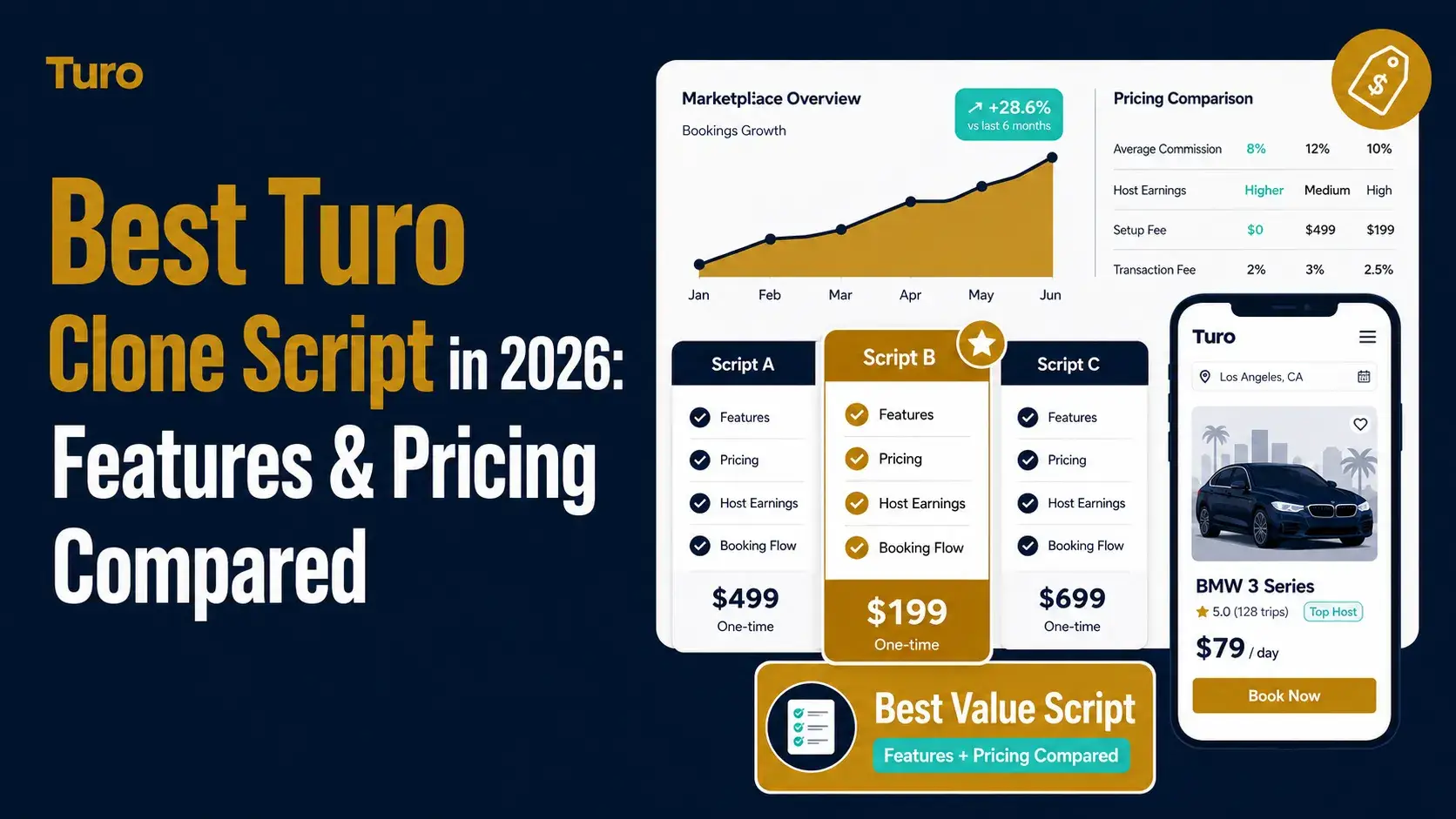
Miracuves Pricing for a Turo like car rental App developed in PHP/Laravel with Flutter Apps For $3,699 USD (One-Time Price) in just 6 days
Get a fully developed, deployment-ready car rental marketplace modeled after Turo. Built on a stable PHP foundation, this complete package includes everything you need to launch and scale:
- Core Workflows: Car listing, renter booking, host approval, availability calendar, pickup and drop-off scheduling, trip management, cancellation flow, and customer notifications.
- Built-in Revenue Logic: Booking commissions, rental fees, service charges, insurance add-ons, late return penalties, cancellation fees, promo codes, and host payout setup.
- Management Hub: Centralized admin dashboard, host management, renter management, vehicle approval, booking tracking, payment records, refund handling, dispute management, and rental analytics.
- Launch-Ready: Fully prepared for your custom branding, configuration, payment gateway setup, map integration, host onboarding, and immediate market entry.
Why Is Turo-Like App Development More Affordable?
Most car rental marketplace apps become expensive when businesses choose fully custom development from scratch. Building separate workflows for renters, vehicle hosts, admin teams, payments, booking calendars, trip tracking, verification, and dispute handling can increase cost, timeline, and technical complexity.
We took a smarter, more practical approach:
- You Aren’t Paying for Ground-Up Development: Our car rental marketplace engine is already developed, tested, and ready to deploy. You skip the inflated cost and long waiting period usually required for building a Turo-style platform from scratch.
- The Power of PHP: We built this solution on a reliable and cost-effective PHP architecture. This keeps the upfront price affordable while supporting essential car listings, rental bookings, host management, payments, availability logic, and admin operations.
You get a launch-ready Turo-like car rental platform with practical marketplace features, source code access, and faster deployment without the high custom development price tag.
Note: This cost is for the solution, re-branding, deployment, and source code only.
Why Miracuves Turo Clone Is Stronger for Fast Launch
For founders planning to launch a peer-to-peer car rental platform, Miracuves offers a practical ready-made foundation rather than forcing every module to be built from scratch.
The main advantage is speed with control. Miracuves positions its Turo Clone with a 6-day launch, source-code ownership, complete rebranding, white-labeling, app publishing support, 60 days tech support, and free 1-year updates.
This matters because a car rental marketplace is not only a front-end app. It needs a working ecosystem across renters, car owners, admins, listings, bookings, payments, disputes, and support.
A ready-made solution from Miracuves can help founders:
- Launch faster without starting from zero
- Own the source code for future customization
- Use white-label branding for their own business identity
- Manage operations through admin dashboards
- Publish apps with guided support
- Add region-specific integrations as needed
- Validate demand before investing in a fully custom platform
For a founder, this reduces one of the biggest early risks: spending months building before proving whether hosts and renters will actually use the platform.
Turo Clone vs Custom Car Rental App Development
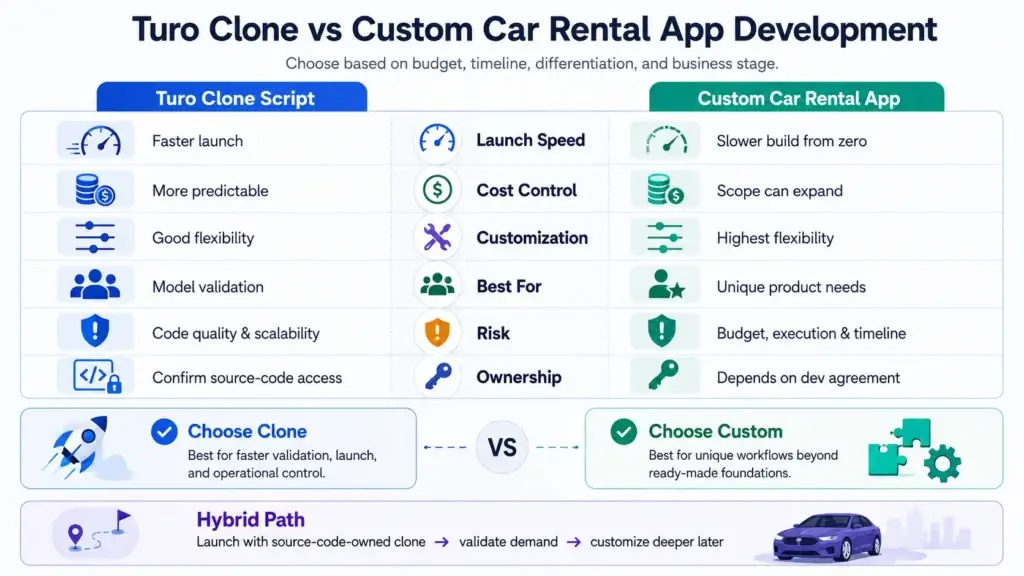
Image Source: AI-generated visual by Miracuves
Both approaches can work. The right decision depends on budget, timeline, differentiation, and business stage.
| Factor | Turo Clone Script | Custom Car Rental App |
|---|---|---|
| Launch speed | Faster because core modules already exist | Slower because workflows are built from zero |
| Cost control | More predictable if package is clear | Can expand as features and scope change |
| Customization | Good for branding, workflows, integrations, and add-ons | Highest flexibility |
| Best for | Founders validating a marketplace model | Funded teams with unique product requirements |
| Risk | Risk depends on code quality, support, and scalability | Risk depends on budget, execution, and timeline |
| Ownership | Must confirm source-code access | Depends on development agreement |
Choose a Turo clone script if your priority is faster validation, marketplace launch, and operational control. Choose custom development if your product has unique workflows that cannot be supported by a ready-made foundation.
Many founders choose a hybrid path: launch with a source-code-owned Turo clone app, validate demand, then customize deeper modules after real users reveal what the platform needs.
Launch Checklist for a Turo-Like Car Rental Marketplace
Before launch, founders should prepare the business rules, not just the software. A Turo clone app gives you the product foundation, but these decisions shape how the marketplace will actually operate.
| Launch Area | What to Decide |
|---|---|
| Target market | Choose the first city, region, or niche to launch. |
| Supply strategy | Decide whether to onboard individual car owners, fleet owners, or both. |
| Vehicle categories | Define car types such as economy, luxury, SUVs, EVs, vans, or sports cars. |
| Verification | Set renter license checks, identity rules, and host approval steps. |
| Insurance/protection | Confirm insurance partners, protection packages, and damage policies. |
| Pricing model | Decide daily, weekly, hourly, seasonal, or dynamic pricing rules. |
| Revenue model | Set commission, booking fees, host fees, or mixed monetization. |
| Payments | Choose local payment gateways, wallets, cards, Stripe, Razorpay, PayPal, or bank transfer. |
| Cancellation & damage | Define refund windows, penalties, pre-trip photos, damage reports, and claim process. |
| GPS & support | Decide tracking rules, support channels, dispute handling, and response process. |
| App publishing | Prepare Apple App Store and Google Play developer accounts. |
| Marketing plan | Plan host acquisition, renter acquisition, referrals, local SEO, and partnerships. |
A strong launch checklist turns the app from a ready-made product into a working car rental business.
Mistakes Founders Should Avoid
Mistakes Founders Should Avoid
Choosing only by the lowest starting price
A lower price may not include mobile apps, source code, publishing support, rebranding, support, or key integrations. Always compare the full launch package.
Ignoring the admin panel
The admin dashboard controls users, listings, bookings, payments, disputes, refunds, and reports. A weak admin panel creates operational bottlenecks after launch.
Launching without insurance and dispute rules
Car rental platforms involve vehicle damage, cancellations, identity checks, and renter-owner disputes. These rules should be defined before the first booking.
Copying Turo without localizing the model
Your market may need different payment gateways, vehicle categories, host incentives, language support, tax rules, or support workflows.
Final Thoughts
The best Turo clone script in 2026 is not the one with the longest feature list. It is the one that helps you launch a real car rental marketplace with the right balance of speed, control, ownership, support, and customization.
Founders should look beyond basic listings and bookings. A strong peer-to-peer car rental platform needs renter flows, car owner tools, admin control, secure payments, verification, GPS, damage reporting, payout logic, monetization options, and scalable support workflows.
Miracuves helps founders launch a white-label Turo clone app with source-code ownership, branded deployment, admin dashboards, app publishing support, and a faster path to market. If your goal is to test a Turo-like car rental marketplace without building every module from zero, a launch-ready foundation can help you move faster and make smarter product decisions.
FAQs
What is a Turo clone script?
A Turo clone script is a ready-made software solution that helps businesses launch a peer-to-peer car rental marketplace where car owners list vehicles and renters book them through web or mobile apps.
How much does a Turo clone app cost?
The cost depends on features, mobile apps, admin panel depth, source-code ownership, branding, integrations, support, and customization. Miracuves’ live Turo Clone page currently shows the ready-made solution at $3,699 with 6-day launch and listed deliverables including source code, white-labeling, support, app publishing support, and updates.
Can I launch a Turo-like app in 6 days?
With a ready-made solution, Miracuves lists a 6-day launch for its Turo Clone package. Custom development may take longer depending on design, integrations, custom workflows, and regional requirements.
What features should a Turo clone app include?
A Turo clone app should include renter registration, car search, filters, booking calendar, payments, car owner dashboard, vehicle listings, admin panel, GPS tracking, reviews, notifications, dispute handling, and payout management.
Does a Turo clone script include mobile apps?
A complete Turo clone solution should include renter apps, car owner apps, web panels, and admin control panels. Miracuves lists Flutter apps for Android and iOS along with web and admin technology details on its Turo Clone page.
Is source-code ownership important for a Turo clone app?
Yes. Source-code ownership gives founders more control over customization, future upgrades, integrations, and long-term product direction. Without source-code access, the business may depend heavily on the vendor.
How does a Turo-like platform make money?
Common revenue streams include booking commission, renter fees, host subscriptions, featured listings, insurance or protection markups, delivery fees, late return fees, cancellation fees, and fleet management tools.
What is better: Turo clone script or custom development?
A Turo clone script is better for faster launch and market validation. Custom development is better when the product needs highly unique workflows, custom architecture, or advanced differentiation from day one.
Why choose Miracuves for a Turo clone app?
Miracuves offers a ready-made white-label Turo clone solution with source code, rebranding, app publishing support, 60 days tech support, free 1-year updates, and a 6-day launch path according to the live solution page.
Related Articles