


Key Takeaways
- Netflix Clone platforms launch faster than custom OTT builds.
- Ready-made architecture reduces development complexity.
- Streaming and subscription features come pre-integrated.
- White-label customization preserves unique branding.
- Faster deployment helps startups validate demand sooner.
Platform Signals
- Support adaptive bitrate streaming and secure hosting.
- Enable SVOD, AVOD, and freemium monetization.
- Add recommendations based on viewing behavior.
- Integrate DRM, CDN, and payment services.
- Provide modular APIs for future expansion.
Real Insights
- Custom OTT development can delay market entry.
- Pre-tested architecture reduces early technical risk.
- Content strategy matters more than rebuilding common features.
- Scalable streaming infrastructure supports audience growth.
- Miracuves builds Netflix Clone platforms with customizable OTT workflows.
Launching a streaming business involves more than creating a familiar video interface. Founders must decide how content will be uploaded, discovered, protected, monetized, and managed across viewer applications and the backend.
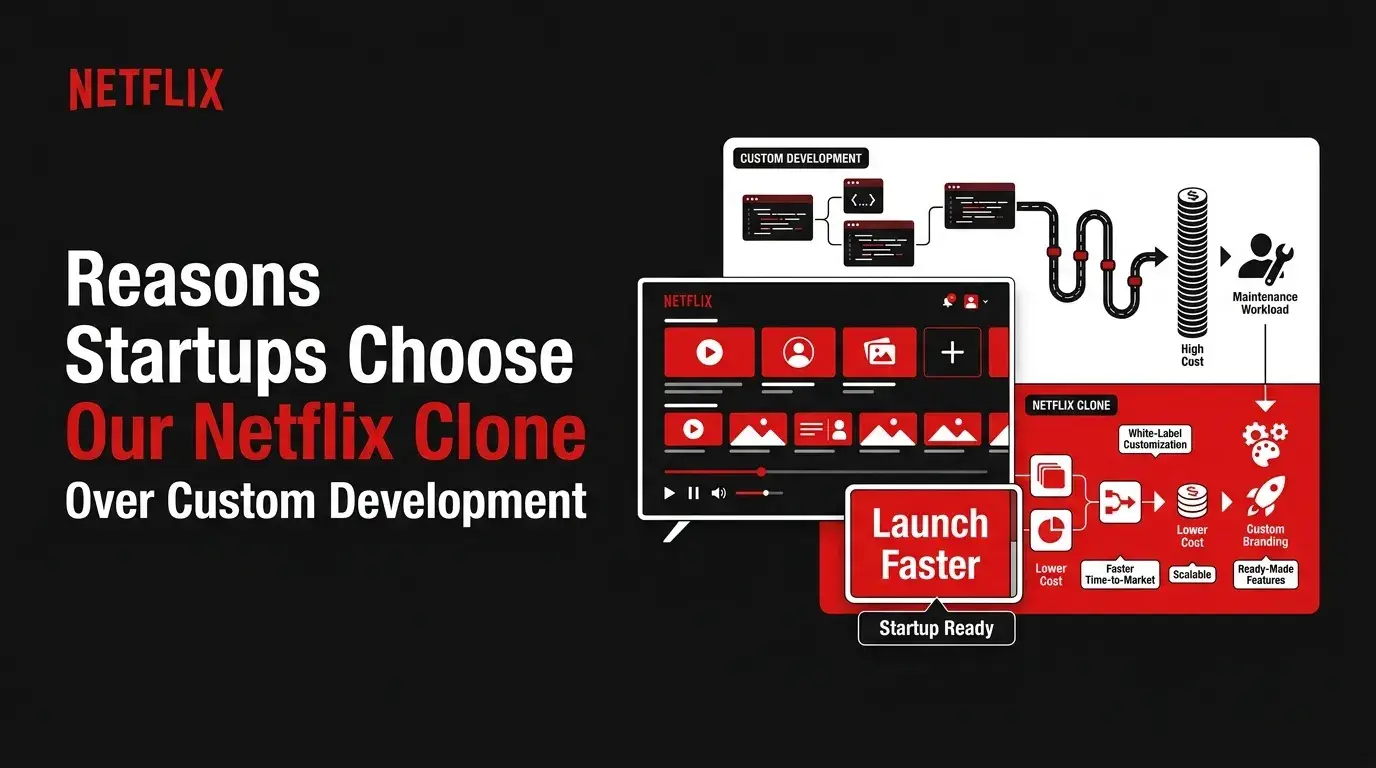
That is why the choice between a Netflix clone ready-made platform and custom development should be based on business requirements rather than assumptions about which option is universally better. A ready-made foundation can reduce the work required to launch common OTT workflows, while custom development can provide greater architectural freedom for highly specialized products.
Founders who want to examine an existing product foundation before choosing a development route can explore Miracuves’ white-label video streaming platform, including its viewer, producer, monetization, and admin workflows.
The right decision depends on your launch timeline, content strategy, monetization model, internal technical capacity, customization needs, and long-term product roadmap.
Why Custom OTT Development Requires More Than Building a Video Player
Custom development gives a streaming business control over product architecture, user experience, integrations, and infrastructure. It can be the right choice when the proposed platform depends on unusual workflows or proprietary functionality that cannot be supported by an existing foundation.
However, custom development also means planning and building each operational layer separately.
Core OTT Workflows Must Be Designed From Zero
A functioning streaming platform may require account management, viewer profiles, subscriptions, rentals, payment workflows, content access rules, content ingestion, search, recommendations, watch history, notifications, analytics, and administrative controls.
The challenge is not simply creating each feature. These workflows must operate consistently across web, mobile, television, payment, and video-delivery environments.
The Backend Determines Operational Complexity
Viewers primarily experience content discovery and playback, but the platform operator needs a reliable backend for managing users, content, plans, payments, promotions, producers, permissions, and reports.
When these controls are not planned early, routine operational changes can remain dependent on developers.
Infrastructure Decisions Affect Long-Term Cost
Video storage, transcoding, content delivery, playback quality, traffic patterns, analytics, and content protection all affect infrastructure requirements.
A custom build gives the business greater freedom to configure these components. It also places more responsibility on the business and development team to design, test, monitor, and maintain them.
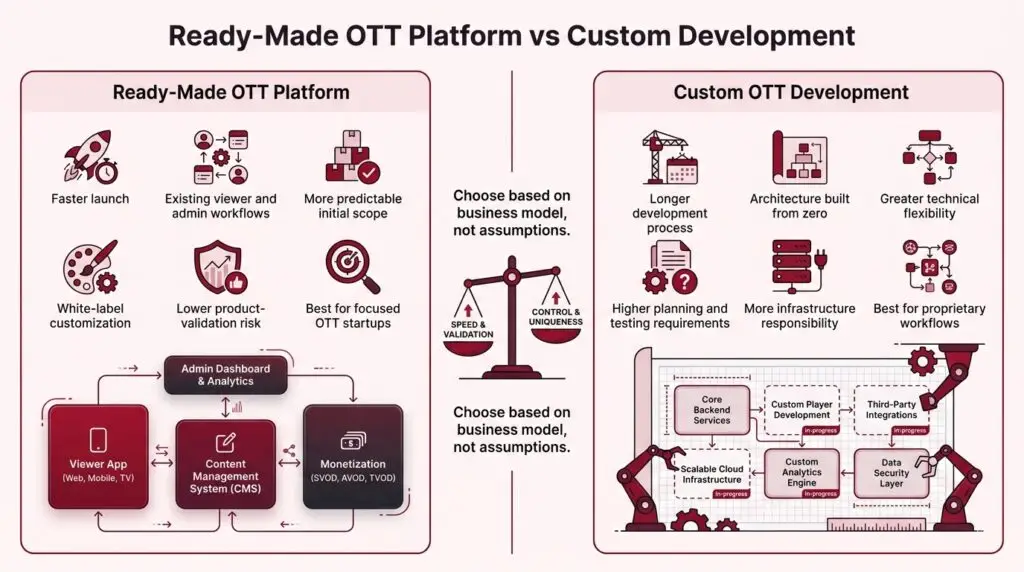
Ready-Made OTT Platform vs Custom Development
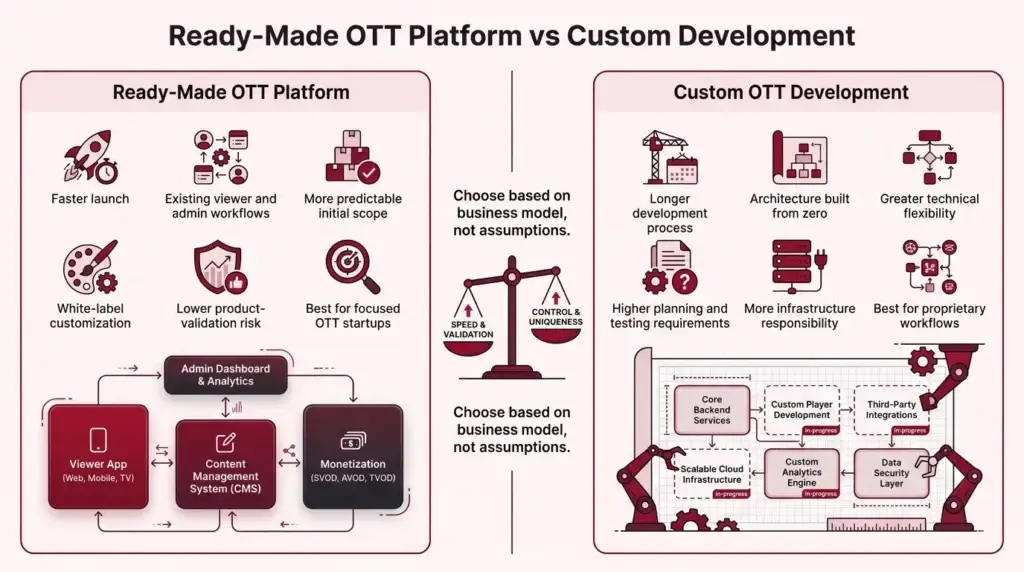
| Decision Area | Ready-Made OTT Foundation | Fully Custom Development |
|---|---|---|
| Launch speed | Core streaming and admin workflows already exist | Every workflow must be scoped, developed, and tested |
| Initial product risk | Existing workflows can be reviewed before customization | Product assumptions may remain untested until later development stages |
| Customization | Branding, modules, integrations, and workflows can be adjusted within the existing architecture | Product logic and architecture can be designed around highly specific requirements |
| Admin control | A functioning control layer may already be included | Admin requirements must be documented and developed separately |
| Cost structure | More predictable when the existing foundation fits the business model | Depends heavily on engineering scope, iterations, integrations, and infrastructure |
| Product ownership | Depends on source-code and licensing terms | Usually defined through the custom-development agreement |
| Best suited for | Founders validating a proven OTT model or launching a focused streaming service | Businesses with proprietary workflows or highly specialized technical requirements |
A ready-made platform is not automatically the right answer, and custom development is not automatically the more strategic answer. The stronger option is the one that supports the required business model without creating unnecessary development or operational risk.
Read More : How to Choose the Best Netflix Clone Developer
What to Review in a Ready-Made OTT Platform
A ready-made streaming platform should be evaluated through its working workflows, not only through a feature list or screenshots.
Viewer Experience
Review how users register, create profiles, discover content, search the catalogue, manage watchlists, continue watching, purchase access, and play content across the required devices.
The platform should provide a clear viewing experience without forcing the business to rebuild standard OTT interactions.
Monetization Control
Confirm whether the platform can support the revenue models required by the business. These may include:
- Monthly or annual subscriptions
- Rentals
- Pay-per-view access
- Premium content
- Coupons and promotional access
- Advertising-supported content
- Hybrid free and paid access
The monetization model affects payment flows, content access, reports, and the viewer journey. It should therefore be evaluated before customization begins.
Content Operations
The backend should make it practical to add, classify, schedule, approve, update, and remove content.
Businesses working with studios, instructors, creators, broadcasters, or independent producers may also require content-submission, approval, performance, and payout workflows.
Admin and Reporting
The platform operator should be able to manage users, content, subscriptions, rentals, payments, producers, promotions, permissions, and reports without requesting a code change for every routine update.
Technical Ownership
Before selecting a platform, clarify:
- Source-code ownership
- Hosting control
- Licensing terms
- Third-party dependencies
- Customization rights
- Update and support terms
- The process for adding future integrations
A live demonstration is more useful than evaluating screenshots alone. It allows founders to confirm whether the existing platform matches their intended business model before investing in customization.
Where Customization Creates Real Business Value
Customization should extend beyond changing the logo, colours, and application name.
The most important changes are those that align the platform with the audience, content strategy, revenue model, and operating process.
Brand and Audience Positioning
Apply the platform’s visual identity, language, onboarding, navigation, content categories, and discovery experience around the target audience.
Content Model
Configure the platform for the content being offered, whether that includes films, episodic shows, courses, sports, live events, creator libraries, fitness programs, or regional entertainment.
Monetization and Access Rules
Customize subscription plans, rentals, trials, coupons, premium collections, geographic restrictions, and entitlement rules around the intended revenue model.
Operational Workflows
Adapt producer onboarding, content approval, reporting, payouts, moderation, customer support, and internal permissions to match the business operation.
Integrations
Connect the required payment gateways, video services, analytics tools, notifications, customer-support systems, identity providers, or external content sources.
The first product release should focus on validating the audience, content, and monetization model. Additional complexity should be introduced when it supports a demonstrated business requirement.
Read More: White-Label Netflix Clone for iOS: Should You Build or Buy?
Where the Streaming Startup Opportunity Exists
A new streaming business does not need to compete with Netflix across every audience and content category.
The stronger opportunity often comes from serving a focused audience with content that is difficult to discover elsewhere. Examples may include regional entertainment, professional education, fitness programs, sports archives, independent films, faith-based content, children’s programming, specialist training, or creator-led libraries.
A focused platform can create business value through direct audience ownership, controlled access, recurring subscriptions, premium releases, and first-party viewing information.
The technology decision should therefore follow the audience and content strategy. Before selecting a build model, founders should define who will watch, why they will return, what they may pay for, how frequently content will be added, and which devices matter.
How a Video Streaming Platform Can Generate Revenue
A streaming platform does not need to depend on a single revenue source.
Subscription Video on Demand
Users pay a recurring monthly, quarterly, or annual fee for access. This model works best when the platform can release or acquire content frequently enough to support retention.
Advertising-Supported Access
Users watch some or all content without paying a subscription, while the platform generates revenue through advertisements or sponsorships.
Rentals and Pay-Per-View
Viewers pay for temporary access to a film, course, sports event, webinar, concert, or premium release.
Freemium or Hybrid Access
The platform combines free content with subscriptions, advertisements, rentals, or premium collections.
Producer Revenue Sharing
Studios, instructors, creators, and other partners contribute content under an agreed revenue-sharing model. The platform then requires submission, approval, reporting, earnings, and payout workflows.
The monetization model should be selected before customization begins because it affects content access, payment logic, reports, admin controls, and the viewer journey.
Why the Admin Dashboard Should Influence the Decision
A video streaming business is not managed from the viewer application.
The admin dashboard is where the platform operator controls the day-to-day business. Depending on the platform model, it should support:
- User and profile management
- Movies, series, episodes, videos, and live content
- Categories, banners, and content visibility
- Subscription plans and access rules
- Rentals and pay-per-view transactions
- Coupons and promotions
- Payment and invoice records
- Producer or content-partner approvals
- Revenue-sharing and payout workflows
- Reports and platform analytics
- Roles and permissions
- Platform settings
A weak admin dashboard can create hidden operational costs because routine changes remain dependent on developers.
Founders should request an admin demonstration and test common management tasks before choosing a ready-made platform.
What Determines OTT Platform Cost?
The cost of launching a streaming platform is not determined by the visible interface alone.
Important cost factors include:
- Web, Android, iOS, and television applications
- Viewer, producer, and admin workflows
- Subscription, rental, advertising, and pay-per-view requirements
- Payment-gateway integrations
- Video hosting, storage, transcoding, and CDN configuration
- Content security and DRM requirements
- Recommendation and analytics requirements
- Branding and user-experience customization
- Existing user or content migration
- Third-party integrations
- Testing, deployment, app-store submission, and post-launch support
A ready-made foundation can reduce the amount of software that must be created from zero. Final pricing still depends on how closely the existing platform matches the business and how much customization is required.
Current package pricing should remain on the product page so this comparison article does not compete for pricing and purchase-intent searches.
A Practical Ready-Made OTT Launch Process
Step 1: Define the Audience and Revenue Model
Clarify the target audience, content category, pricing model, territories, supported languages, and priority devices.
Step 2: Review the Existing Platform
Test the viewer application, web platform, admin dashboard, producer workflow, subscription logic, rentals, reports, and integrations.
Step 3: Document the Customization Gap
Separate essential launch requirements from later enhancements. Identify the branding, payment, content, language, workflow, and infrastructure changes required for the initial release.
Step 4: Configure Integrations and Infrastructure
Connect the selected payment services, video infrastructure, notifications, analytics, hosting, and content-security components.
Step 5: Test and Deploy
Test playback, access rules, subscriptions, payments, admin actions, device compatibility, and failure scenarios before publishing the applications.
Security Must Be Part of the Platform Foundation
A streaming platform may process user accounts, payment transactions, viewing history, content rights, partner information, and sensitive administrative actions.
Security planning should consider:
- Secure authentication and session handling
- Role-based access control
- Encrypted data transfer
- Appropriate storage protection
- Secure payment-gateway integration
- API authentication and rate limiting
- Administrative activity logs
- Content-entitlement checks
- DRM and protected playback where required
- Backup and recovery controls
- Abuse and account-monitoring workflows
Security and compliance requirements vary by region, payment setup, hosting architecture, content agreements, and operating model.
A platform can support compliance-ready workflows, but final compliance depends on configuration, integrations, business processes, and appropriate legal review.
Final Thoughts: Choose the Build Model That Reduces the Right Risk
The decision between a Netflix clone and custom development is not simply a choice between speed and flexibility.
A ready-made OTT foundation can reduce product-development risk when its existing workflows already support the planned audience, content, monetization, and operational model.
Custom development can be the stronger option when the business depends on proprietary functionality, unusual infrastructure, complex enterprise integrations, or workflows that cannot be adapted responsibly within an existing platform.
Before deciding, founders should review the working product, admin controls, ownership terms, integrations, security approach, infrastructure requirements, and customization boundaries.
The goal is not to recreate Netflix. It is to launch a differentiated streaming business with the right level of control, technical complexity, and operational readiness.
After selecting the product foundation, the next priority is audience acquisition and retention. Review Miracuves’ guide to marketing a video streaming platform after launch. Let’s build together.
FAQs
What is the difference between a Netflix clone and custom OTT development?
A Netflix clone is a ready-made streaming-platform foundation containing common viewer, content, monetization, and admin workflows. Custom OTT development starts with a new product specification and builds the required architecture and workflows around the business.
Does using a ready-made platform mean copying Netflix?
No. A responsible white-label platform uses familiar OTT product patterns while applying the business’s own branding, content, pricing, workflows, and audience strategy.
When should a startup choose custom development?
Custom development is more appropriate when the business depends on proprietary product logic, unusual content workflows, specialized infrastructure, complex enterprise integrations, or an experience that cannot be adapted within an existing platform architecture.
What should I test before choosing a ready-made video streaming platform?
Review the viewer application, web platform, playback, subscriptions, rentals, payment flows, content management, admin dashboard, producer workflows, reports, permissions, ownership terms, mobile experience, and available integrations.
Can a ready-made OTT platform be customized?
Yes, provided the architecture and provider agreement support customization.
Common changes include branding, languages, content categories, payment gateways, subscription plans, rentals, user flows, producer workflows, reports, integrations, and device support.
What should an OTT admin dashboard control?
The dashboard should help the operator manage users, profiles, content, categories, banners, plans, payments, rentals, coupons, producers, approvals, payouts, reports, roles, permissions, and platform settings.
How much does it cost to launch an app like Netflix?
Cost depends on supported platforms, viewer and admin modules, monetization models, video infrastructure, payment integrations, DRM, customization, content migration, Smart TV requirements, testing, and support.
How quickly can Miracuves launch a ready-made OTT platform?
Miracuves states that a standard ready-made rollout can go live in six days. Advanced customization, Smart TV applications, infrastructure changes, complex integrations, or specialized workflows may require a custom delivery timeline.
Related Articles :