


Key Takeaways
- A vacation rental app needs strong Airbnb-like features for guests, hosts, property managers, and admins.
- Property discovery, booking, secure payments, reviews, messaging, and host dashboards are core platform drivers.
- Guests need accurate listings, clear pricing, availability, cancellation rules, and smooth checkout.
- Hosts need listing control, calendar management, pricing tools, booking requests, and payout tracking.
- A feature-rich Airbnb clone can help startups build a scalable vacation rental marketplace faster.
Feature Signals
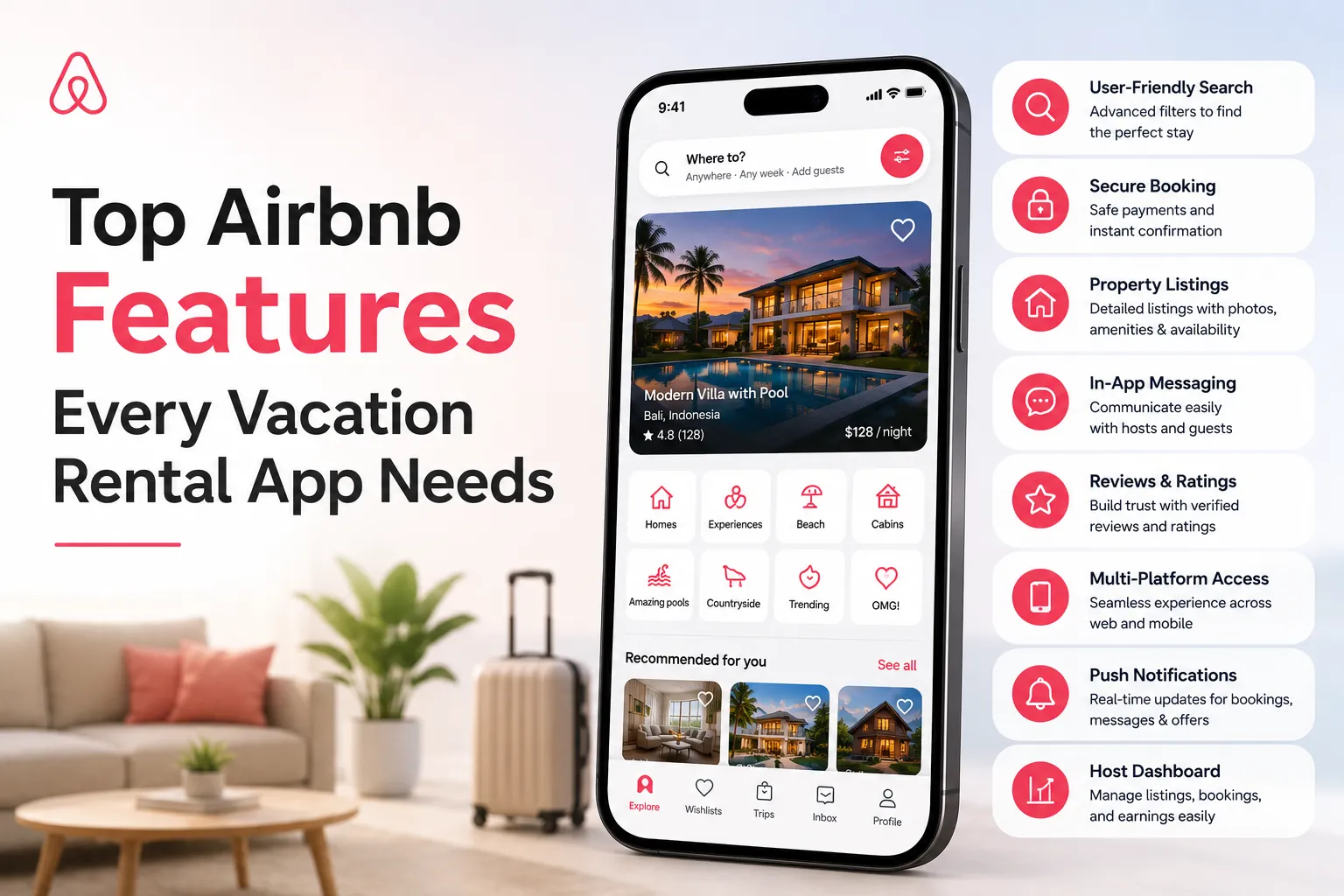
- Guests need location search, filters, map view, property photos, availability, wishlists, and secure booking.
- Hosts need property listing tools, calendar sync, pricing control, guest messages, reviews, and earnings visibility.
- Admins need control over users, hosts, listings, commissions, payments, disputes, refunds, and reports.
- Trust features like identity verification, property approval, reviews, and secure payments improve booking confidence.
- Notifications keep guests, hosts, and admins updated on bookings, cancellations, messages, payouts, and account activity.
Real Insights
- A vacation rental marketplace needs both strong property supply and smooth guest booking flows to scale.
- Weak search filters or poor listing details can reduce booking confidence and increase user drop-offs.
- Clear pricing, house rules, availability, reviews, and cancellation policies help guests book faster.
- Secure payments, host payouts, dispute handling, and moderation protect both guests and property owners.
- Miracuves builds Airbnb Clone apps with vacation rental features, property listings, booking workflows, payments, and admin control.
Thinking of building a vacation rental platform is exciting, but the real challenge is not copying a popular booking app. The real challenge is deciding which features will help guests trust the platform, hosts manage properties easily, and the business generate revenue without operational chaos.
A successful vacation rental app needs more than search, listings, and booking buttons. It needs a reliable marketplace system with guest onboarding, host dashboards, calendar availability, secure payments, reviews, dispute handling, admin controls, and monetization workflows. These are the features that turn a simple rental idea into a platform that can support real bookings.
For founders who want to launch faster, starting with an Airbnb clone app foundation can help validate the market without building every guest, host, and admin module from zero.
This guide keeps the focus on the top features every vacation rental app needs, but it also explains the business value behind each feature so you can decide what to build first, what to customize, and what to scale later.
Why Airbnb Features Matter for Vacation Rental Apps
A vacation rental platform is not just a property listing website. It is a trust-based marketplace where guests, hosts, payments, policies, location search, reviews, and admin controls must work together.
For a founder, vacation rental app features are not just interface elements. They decide whether guests complete bookings, whether hosts continue listing properties, and whether the platform operator can manage revenue, disputes, payouts, and quality control from one place.
The strongest rental marketplace features usually support three business goals.
Guest Trust
Guests need confidence before booking. They want verified profiles, transparent pricing, clear property details, secure payments, real reviews, and responsive support.
Key trust-building features include:
- Identity verification
- Verified property listings
- Secure payment flow
- Transparent cancellation policy
- Real guest reviews
- In-app messaging
- Refund and dispute support
Host Growth
Hosts need simple tools to list, manage, and monetize their properties. If the host experience is difficult, the platform may struggle to grow property supply.
Important host-side features include:
- Property listing dashboard
- Calendar availability management
- Pricing controls
- Booking request management
- Guest communication
- Payout tracking
- Review management
Operator Control
The business owner needs full visibility into marketplace operations. Without strong admin control, managing bookings, disputes, payments, hosts, and reports becomes difficult as the platform grows.
Platform operators need control over:
- User management
- Host verification
- Listing approvals
- Booking monitoring
- Payment and payout records
- Commission settings
- Refund and dispute workflows
- Revenue analytics
- Support tickets
- Policy and content pages
That is why feature planning should start with the business model, not only the screen design. A beautiful app may attract attention, but a well-structured rental marketplace keeps bookings, payments, support, and host operations under control.
Seamless User Onboarding and Identity Verification
User onboarding is the first trust layer of a vacation rental app. If registration feels confusing, slow, or unsafe, users may leave before searching for a property. If onboarding is too weak, the platform may attract low-quality users, fake profiles, or unverified hosts.
A strong onboarding flow should be simple for genuine users and strict enough to support marketplace trust.
Must-Have User Onboarding Features
- Social sign-ins through Google, Apple, or Facebook
- Email and phone OTP verification
- Guest profile creation
- Host profile creation
- ID document upload where required
- Selfie or profile photo verification
- Profile completion prompts
- Terms, privacy, and cancellation policy acceptance
- Role-based onboarding for guests and hosts
Business Value
For guests, onboarding should reduce doubt and make booking feel safe. For hosts, it should help them trust who is booking their property. For the platform owner, verification helps reduce fraud, fake accounts, spam listings, and support issues.
A vacation rental app does not need to make onboarding complicated from day one, but it should include enough verification logic to protect the marketplace as bookings increase.
Smart Search Filters and Personalized Discovery
Search is where guest intent becomes a booking opportunity. A guest may know the destination, budget, dates, property type, and amenities they want. If your app cannot help them find the right stay quickly, they may leave before reaching the booking page.
A strong app like Airbnb should make discovery fast, visual, and flexible.
Core Search and Discovery Features
- Location-based search
- Map-based property discovery
- Price range filters
- Date filters
- Guest count filters
- Property type filters
- Amenities filters
- Instant booking filter
- Pet-friendly filter
- Family-friendly filter
- Work-friendly stay filter
- Wishlist or save property option
- Recently viewed stays
- Recommended listings based on previous activity
Business Value
Search filters directly affect conversion. When guests can narrow down listings quickly, they are more likely to compare options, view property details, and complete bookings.
For niche rental marketplaces, search becomes even more important. A luxury villa app, student rental app, business stay app, religious travel rental app, eco-stay app, or local homestay app may need custom filters that match its audience. This is where customization matters because generic filters may not support every business model.
Host Dashboard: The Listing Control Center
The host dashboard is where property owners manage their side of the marketplace. Behind every good listing is a host who needs control over photos, pricing, availability, booking requests, guest communication, and payouts.
If the host dashboard is difficult to use, property owners may depend on manual support or leave the platform completely.
Must-Have Host Features
- Property listing creation
- Photo and video uploads
- Property description editor
- Amenities and house rules
- Calendar availability management
- iCal or Google Calendar sync
- Manual and dynamic pricing options
- Booking request management
- Instant booking settings
- Guest messaging
- Cancellation policy settings
- Payout history
- Listing performance insights
- Review management
Business Value
For a vacation rental startup, the host dashboard is one of the most important supply-side growth tools. If hosts cannot create listings quickly, adjust prices, block unavailable dates, respond to guests, and view booking performance, they will either stop using the platform or depend heavily on manual support.
A strong host dashboard should reduce friction for property owners while giving the platform operator enough visibility to maintain listing quality. This is especially important in niche rental markets such as luxury stays, local homestays, student rentals, business travel rentals, event spaces, or regional vacation homes.
Robust Booking Engine With Dynamic Pricing
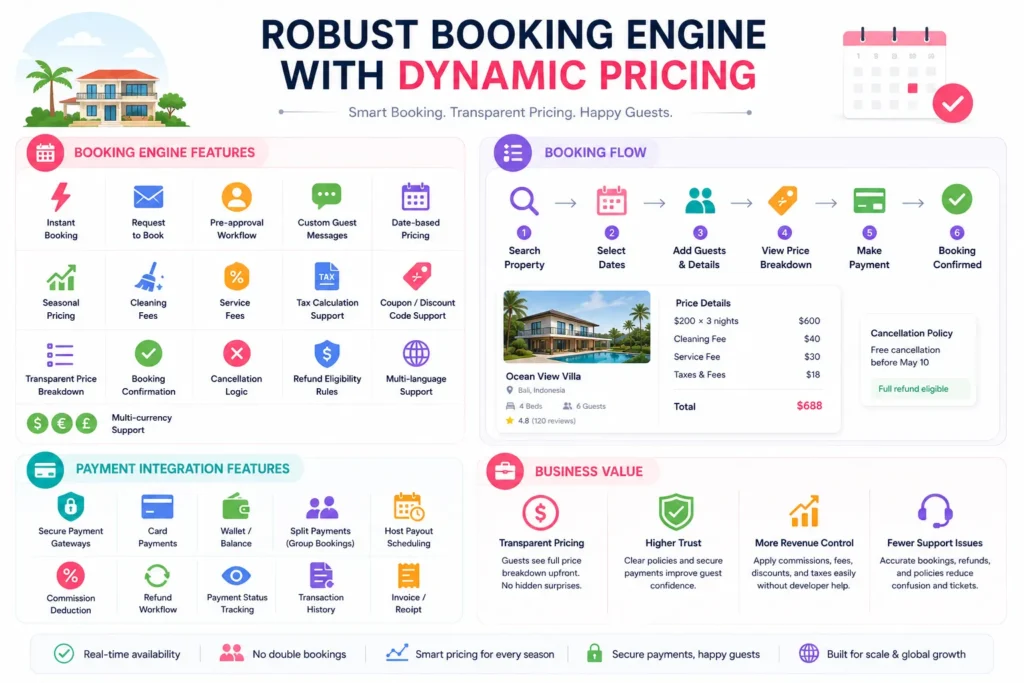
Image Source: AI-generated visual by Miracuves
The booking engine is where browsing turns into revenue. It connects availability, dates, guest count, pricing, fees, taxes, discounts, payment, cancellation policies, and booking confirmation.
A weak booking flow can create failed payments, double bookings, refund confusion, and poor guest experience. A strong booking engine creates clarity for guests and control for the platform owner.
Booking Engine Features
- Instant booking
- Request-to-book
- Pre-approval workflow
- Custom guest messages
- Date-based pricing
- Seasonal pricing
- Cleaning fees
- Service fees
- Tax calculation support
- Coupon or discount code support
- Transparent price breakdown
- Booking confirmation
- Cancellation logic
- Refund eligibility rules
- Multi-language support
- Multi-currency support
Payment Integration Features
- Secure payment gateway integration
- Card payments
- Wallet or payment balance support where relevant
- Split payments for group bookings
- Host payout scheduling
- Commission deduction
- Refund workflow
- Payment status tracking
- Transaction history
- Invoice or receipt generation
Business Value
The booking engine should make pricing transparent before the user reaches checkout. Hidden fees, unclear cancellation rules, or payment failures can reduce trust and increase support tickets.
For founders, this section of the app also affects monetization. The platform must be able to apply commissions, service charges, discounts, refunds, and payout rules without developer involvement for every small update.
How Vacation Rental App Features Support Monetization
The right features do not only improve user experience. They also create revenue opportunities for the platform owner. A vacation rental app can monetize through commissions, guest service fees, host subscriptions, featured listings, cancellation charges, add-on services, and local partnerships.
| Feature | Business Value | Monetization Opportunity |
|---|---|---|
| Booking engine | Handles reservations, pricing, taxes, and availability | Guest service fees, host commission |
| Host dashboard | Helps property owners manage listings and bookings | Premium host plans, subscription tools |
| Featured listings | Gives hosts more visibility in search results | Paid promotion fees |
| Secure payments | Builds trust and controls transaction flow | Platform commission, payment convenience fee |
| Reviews and ratings | Improves booking confidence | Higher conversion and repeat usage |
| Add-on services | Adds value beyond accommodation | Cleaning, insurance, concierge, local experience fees |
| Admin analytics | Shows revenue, bookings, cancellations, and demand | Better pricing, expansion, and marketing decisions |
Founders should avoid treating monetization as an afterthought. If commissions, payout timing, cancellation rules, refunds, taxes, discounts, and host plans are not planned early, the platform may need expensive changes later.
Read more: Complete Airbnb Clone Development Cost Guide
Messaging System With Real-Time Notifications
In-app messaging helps guests and hosts communicate before, during, and after a booking. It reduces confusion around arrival time, property rules, directions, special requests, cancellations, and support questions.
Messaging should be secure, simple, and connected to the booking record.
Core Messaging Features
- Guest-host chat
- Booking-specific chat threads
- Push notifications
- Email notifications
- SMS alerts where required
- Message templates
- Check-in instructions
- Attachment support for images or documents
- Translation support for multi-region platforms
- Admin visibility for dispute cases
Business Value
Messaging reduces dependency on external communication channels. When conversations happen inside the platform, the business owner has better records for disputes, support, cancellations, and safety issues.
For growing rental marketplaces, automated templates can also save support time. Hosts can send check-in rules, Wi-Fi details, parking instructions, or cancellation notes without typing the same messages repeatedly.
Review and Rating System
Reviews are a trust engine for a vacation rental marketplace. Guests want confidence before booking. Hosts want protection from low-quality guests. Platform owners need a feedback system to maintain listing standards.
A strong review system should support both sides of the marketplace.
Key Review Features
- Guest reviews for properties
- Host reviews for guests
- Star ratings
- Category-based ratings such as cleanliness, accuracy, location, and communication
- Private feedback
- Review moderation
- Verified booking reviews
- Review deadline rules
- Admin review control
- Report abuse option
Business Value
Reviews help new guests make decisions faster. They also help hosts improve service quality and help the admin team detect low-quality listings or repeated complaints.
The platform should avoid fake or unverified reviews because review quality directly affects trust. For serious marketplaces, review moderation and abuse reporting should be part of the admin workflow.
Safety, Support, and Refund Policies
Vacation rental apps handle people’s homes, travel plans, money, identity details, and private communication. That makes safety and support essential, not optional.
Guests need confidence that they can report issues. Hosts need rules that protect them from misuse. Platform owners need workflows that keep disputes manageable.
Must-Have Safety and Support Features
- Guest issue reporting
- Host issue reporting
- Photo upload for complaints
- Cancellation policy management
- Refund eligibility logic
- Emergency contact or support option
- Booking dispute workflow
- Admin dispute dashboard
- Host verification
- Guest verification
- Property approval workflow
- Abuse reporting
- Policy pages and help center
Business Value
Support workflows protect the marketplace from confusion and reputational damage. If guests cannot report issues or understand refund rules, they may stop trusting the platform. If hosts feel unsupported, they may stop listing properties.
The goal is not to promise that every issue can be avoided. The goal is to build clear processes that help the platform respond quickly, fairly, and consistently.
Loyalty, Referral, and Engagement Features
A vacation rental app should not only acquire users. It should bring them back. Loyalty, referral, and engagement features help increase repeat bookings and encourage users to share the platform with others.
These features are especially useful once the core booking flow is stable.
Useful Engagement Features
- Wishlist
- Saved searches
- Price drop alerts
- Referral credits
- Travel credits
- Host badges
- Guest loyalty rewards
- Featured destination campaigns
- Personalized recommendations
- Seasonal offers
- Abandoned booking reminders
Business Value
Retention is usually more cost-efficient than constantly acquiring new users. A wishlist can remind guests to return. Referral credits can help attract new users. Host badges can encourage better service quality. Personalized recommendations can improve booking discovery.
However, founders should not prioritize gamification before the core marketplace works. Booking, payments, listings, trust, and admin control should come first.
Admin Panel, Security, and Operator Control
The admin panel is where the vacation rental business is actually managed. Guests and hosts see the front-end experience, but the platform operator needs backend control to keep bookings, payouts, listings, disputes, and platform rules organized.
A strong admin panel should help the operator manage:
- User and host verification
- Property listing approvals
- Booking monitoring
- Payment and payout records
- Commission and service fee settings
- Cancellation and refund workflows
- Dispute and complaint handling
- Review moderation
- CMS pages, policies, and support content
- Revenue reports and booking analytics
- Security and compliance settings
Why Admin Control Matters
A rental marketplace becomes harder to manage as users, hosts, listings, payments, and support tickets increase. Without a strong admin panel, the operator may depend on developers or manual spreadsheets for basic business decisions.
The admin panel should help answer questions such as:
- Which listings are performing best?
- Which hosts have repeated cancellations?
- Which bookings are pending payment?
- Which disputes need action?
- Which properties need approval?
- Which regions are generating more demand?
- Which fees or commissions need adjustment?
Security Features Founders Should Plan
Security is especially important because a vacation rental marketplace handles personal data, property information, booking records, payment activity, and user communication.
Founders should plan for:
- Encrypted data transfer
- Secure payment gateway integration
- Role-based admin access
- Activity logs
- User verification
- Host verification
- Abuse reporting
- Review moderation
- Dispute management
- Privacy-conscious data handling
This does not mean one app is automatically compliant in every market. Short-term rental rules, tax requirements, data privacy expectations, and property regulations depend on the operating region. The stronger approach is to build a platform foundation that supports compliance workflows and then configure policies based on the target market.
Read more: Best Airbnb Clone Script in 2026: Features, Pricing & Cost
Mobile App-First Experience
A vacation rental app must feel smooth on mobile because users often search, compare, message hosts, and complete bookings while traveling or planning trips on the go.
The mobile experience should not feel like a smaller version of a desktop website. It should be designed around fast browsing, clear visuals, easy filtering, secure checkout, and quick communication.
Key Mobile Features
- iOS app
- Android app
- Mobile-first listing pages
- Map-based browsing
- Location services
- Push notifications
- One-tap booking actions
- Saved properties
- Quick guest-host chat
- Mobile payment flow
- Easy cancellation and support access
- Offline access to booking details where relevant
Business Value
A poor mobile experience can cause users to leave before they complete a booking. Slow property pages, confusing checkout, or hard-to-use filters can reduce conversion.
For founders, mobile UX should be tested across the full journey:
- Search
- Listing view
- Booking
- Payment
- Confirmation
- Messaging
- Cancellation
- Review
Customization Features for Niche Vacation Rental Apps
Not every vacation rental startup should copy the same feature set. A platform for luxury villas needs different filters than a student housing marketplace. A local homestay app needs different trust signals than a corporate stay platform.
Customization helps the product match the business model.
Customization Areas to Consider
- Property categories
- Booking rules
- Cancellation rules
- Host approval process
- Guest verification process
- Commission model
- Currency and language
- Local tax rules
- Listing approval workflow
- Homepage layout
- Search filters
- Featured destinations
- Subscription plans
- Add-on services
- Admin roles and permissions
Business Value
Customization helps founders differentiate without rebuilding the complete platform. A rental app can focus on eco-stays, local experiences, luxury retreats, workation homes, family rentals, religious travel stays, or event-friendly spaces.
This is where a ready-made foundation can be useful. The core marketplace flows already exist, while the business can customize branding, categories, policies, and monetization based on the target market.
Cost and Launch Planning for Vacation Rental App Features
Feature planning and cost planning should happen together. A vacation rental app with simple listings, booking requests, and basic admin control will cost less than a platform with dynamic pricing, AI recommendations, multi-language support, payment splitting, advanced analytics, and multiple mobile apps.
The final cost usually depends on:
- Number of platforms
- Guest app scope
- Host app scope
- Admin panel complexity
- Payment gateway requirements
- Calendar sync
- Messaging features
- Map and location services
- Security workflows
- UI/UX customization
- Third-party integrations
- Launch support
- Post-launch support
Ready-Made vs Custom Development
| Build Option | Best For | Cost Logic | Founder Impact |
| Custom development | Highly unique product logic and complex workflows | Higher planning, design, development, and testing effort | More flexibility but longer launch path |
| Ready-made rental marketplace foundation | Faster validation with proven guest, host, booking, and admin flows | More cost-efficient because core modules already exist | Faster launch and easier market testing |
| Hybrid customization | Founders who want a faster base with selected custom features | Balanced cost based on customization depth | Practical path for niche rental apps |
Founders should avoid choosing features only because competitors have them. The better approach is to decide what is required for the first launch, what supports revenue, and what can be added after market validation.
How to Move From Feature Planning to Launch
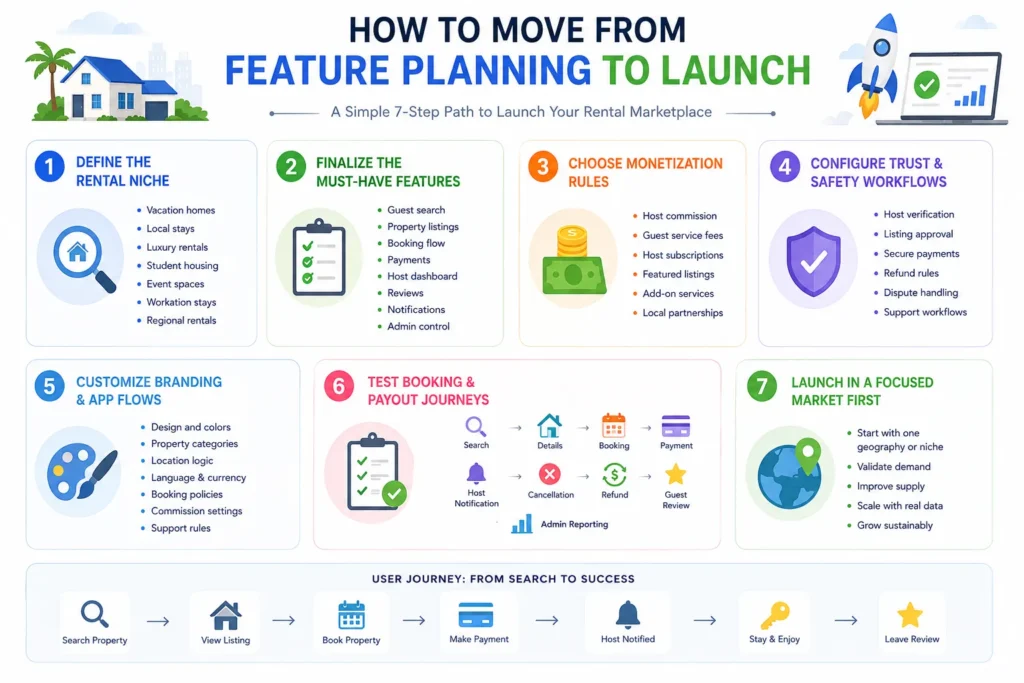
Image Source: AI-generated visual by Miracuves
Once the feature list is clear, the next decision is how to launch. Founders usually have two routes: custom development from scratch or a ready-made rental marketplace foundation that can be customized.
Custom development gives maximum flexibility but usually requires more time, planning, testing, and budget. A ready-made approach can be faster when the core flows already exist, including guest booking, host listings, calendar management, payments, messaging, reviews, and admin controls.
A practical launch process looks like this:
1. Define the Rental Niche
Decide whether the platform will focus on:
- Vacation homes
- Local stays
- Luxury rentals
- Student housing
- Event spaces
- Workation stays
- Regional short-term rentals
2. Finalize the Must-Have Features
Start with the core flows that make the marketplace usable:
- Guest search
- Property listings
- Booking flow
- Payments
- Host dashboard
- Reviews
- Notifications
- Admin control
3. Choose Monetization Rules
Decide how the platform will earn revenue:
- Host commission
- Guest service fees
- Host subscriptions
- Featured listings
- Add-on services
- Local business partnerships
4. Configure Trust and Safety Workflows
Add the controls that protect users and reduce operational risk:
- Host verification
- Listing approval
- Secure payments
- Refund rules
- Dispute handling
- Support workflows
5. Customize Branding and App Flows
Adjust the app based on the target market:
- Design and colors
- Property categories
- Location logic
- Language and currency
- Booking policies
- Commission settings
- Support rules
6. Test Booking and Payout Journeys
Before launch, test the full flow from guest search to booking confirmation.
Important flows to test include:
- Property search
- Listing details
- Booking request
- Payment
- Host notification
- Cancellation
- Refund
- Guest review
- Admin reporting
7. Launch in a Focused Market First
Start with one geography or niche so the platform can validate demand, improve supply quality, and scale based on real usage.
This approach keeps the blog informational while helping founders understand the business path from feature planning to launch.
Mistakes Founders Should Avoid While Planning Vacation Rental App Features
Adding Advanced Features Before the Core Booking Flow Works
AI recommendations, loyalty programs, virtual tours, and advanced pricing tools can be valuable, but they should not come before search, listing pages, booking, payment, host tools, and admin control.
Ignoring Host Experience
A vacation rental app cannot grow without quality hosts. If hosts struggle to list properties, manage availability, respond to guests, or track payouts, supply growth becomes difficult.
Weak Admin Panel Planning
A weak admin panel creates operational pressure. Founders need control over users, hosts, listings, payments, refunds, disputes, reviews, and commissions from the beginning.
No Clear Monetization Model
Commission, service fees, subscriptions, and featured listings must be planned early. If revenue logic is added later, the platform may need structural changes.
Overusing Generic Features
A rental app should match its target market. A platform for luxury homes, student stays, event spaces, or local homestays may need different search filters, host rules, and trust workflows.
Read more: Stop Hunting Broad Travelers: Why Niche Inventory Is the Only Way to Beat Airbnb
Final Thoughts: Features Should Support the Business, Not Just the App
The best vacation rental app features are the ones that create trust, reduce operational friction, and support revenue. Search filters, booking calendars, secure payments, host dashboards, reviews, notifications, and admin analytics all matter because they work together as a marketplace system.
For founders, the smarter decision is not to copy every Airbnb feature immediately. It is to identify the features that support the first launch, validate the market, and make the platform easier to manage. Once the core guest, host, payment, and admin workflows are stable, advanced features such as AI recommendations, dynamic pricing, loyalty programs, and experience bookings can be added strategically.
Miracuves helps founders build ready-made and customizable rental marketplace platforms with guest booking flows, host tools, admin control, secure payment workflows, and launch-focused execution. If you are planning a vacation rental app, start with the features that protect trust, simplify operations, and move the business closer to real bookings.
FAQs
What are the most important features every vacation rental app needs?
The most important features every vacation rental app needs are guest registration, property search, advanced filters, listing pages, booking calendars, secure payments, host dashboards, in-app messaging, reviews, notifications, cancellation rules, and admin controls. These features help guests book confidently, hosts manage listings, and platform owners control operations.
How do vacation rental app features help generate revenue?
Vacation rental app features support revenue through booking commissions, guest service fees, host subscriptions, featured listings, cancellation fees, add-on services, and local partnerships. The booking engine, payment system, host dashboard, and admin panel are especially important because they control transactions, payouts, pricing, and platform fees.
What features should an app like Airbnb include for hosts?
An app like Airbnb should include host registration, property listing creation, photo uploads, pricing tools, calendar availability, booking request management, guest messaging, payout tracking, review management, and performance analytics. These features help hosts manage properties without depending on manual support from the platform owner.
Why is the admin panel important in a vacation rental app?
The admin panel is important because it gives the platform owner control over users, hosts, listings, bookings, payments, commissions, refunds, disputes, content, reports, and platform settings. Without a strong admin panel, managing a rental marketplace becomes difficult as bookings, hosts, and customer support requests increase.
Should founders build a vacation rental app from scratch or use an Airbnb clone script?
The right choice depends on budget, timeline, customization needs, and long-term control. Building from scratch can offer deep flexibility but usually takes more time and planning. An Airbnb clone script can be useful when founders want a ready-made foundation with core rental marketplace features that can be customized for a specific niche or region.
What security features should a vacation rental app include?
A vacation rental app should include secure payment gateway integration, encrypted data transfer, user verification, host verification, role-based admin access, activity logs, abuse reporting, refund workflows, and dispute management. Security should be planned as part of the platform foundation, especially because rental apps handle personal data, property details, bookings, and payment activity.
How can founders decide which vacation rental app features to launch first?
Founders should start with the features needed to complete the main booking journey: guest onboarding, property search, listing pages, booking calendar, secure payments, host dashboard, messaging, reviews, notifications, and admin control. Advanced features such as AI recommendations, loyalty programs, virtual tours, and dynamic pricing can be added after the core platform is validated.
How does a vacation rental app support hosts and property owners?
A vacation rental app supports hosts with property listing tools, image uploads, availability calendars, pricing settings, booking management, guest messaging, payout tracking, and review management. These tools help hosts manage rentals more efficiently and keep the platform’s property supply active.