

Key Takeaways
- Vacation rental platform development becomes more effective when startups begin with focused inventory instead of trying to serve every traveler, property type, and destination from day one.
- A niche vacation rental marketplace competes on relevance by solving a specific traveler problem with more targeted listings, filters, trust signals, and booking experiences.
- Local supply density matters more than a large number of scattered listings because guests need enough relevant options for their location, dates, and stay requirements.
- Clear niche positioning also improves host acquisition by showing property owners exactly which travelers the marketplace is designed to attract.
- Founders should prove liquidity in one strong inventory category or region before expanding into additional property types, destinations, or traveler segments.
Marketplace Signals
- Strong niches can include pet-friendly stays, eco-retreats, luxury villas, remote-work rentals, student housing, corporate stays, and destination-specific properties.
- Niche-specific listing data should capture details that broad marketplaces may not emphasize, such as pet rules, Wi-Fi quality, workspace setup, concierge services, or lease terms.
- Focused inventory can improve search relevance, trust, guest conversion, and host value because users arrive with a clearer booking intent.
- Monetization should match the niche through booking commissions, subscriptions, service fees, featured listings, verification, add-ons, or partner services.
- Product workflows such as host onboarding, filters, pricing, booking rules, payments, reviews, and admin controls should reflect the specific inventory strategy.
Real Insights
- A broad marketplace can appear large while still feeling empty if its inventory is spread too thin across many cities and categories.
- A smaller marketplace with dense, relevant inventory in one region or category can create a stronger guest experience than thousands of scattered listings.
- Niche positioning strengthens trust because verification, listing standards, search filters, content, and support can all be designed around one category.
- The best niche should combine a specific traveler problem, reachable supply, differentiated data, viable monetization, and a logical path for future expansion.
- The strongest growth path is: choose a niche → build supply density → attract high-intent guests → prove bookings → strengthen trust → expand into adjacent markets.
Most vacation rental startups do not fail because the idea is weak. They fail because the marketplace is too broad too early.
Founders often want to build a platform that serves every traveler, every property type, every location, and every host category from day one. That sounds ambitious, but it usually creates a liquidity problem. Guests do not see enough relevant supply. Hosts do not see enough qualified demand. The platform becomes wide, but not useful enough for one specific audience.
That is why focused inventory matters.
In vacation rental platform development, niche positioning can be more powerful than broad competition. A startup that owns one clear category — such as pet-friendly stays, eco-retreats, luxury villas, student housing, corporate rentals, rural homestays, or destination-specific stays — can create stronger trust and better conversion than a generic marketplace with scattered listings.
The goal is not to become a broad travel platform immediately. The goal is to win a specific supply category, serve a specific traveler need, and build marketplace liquidity where both hosts and guests see real value.
Why Broad Rental Marketplaces Struggle in the Early Stage
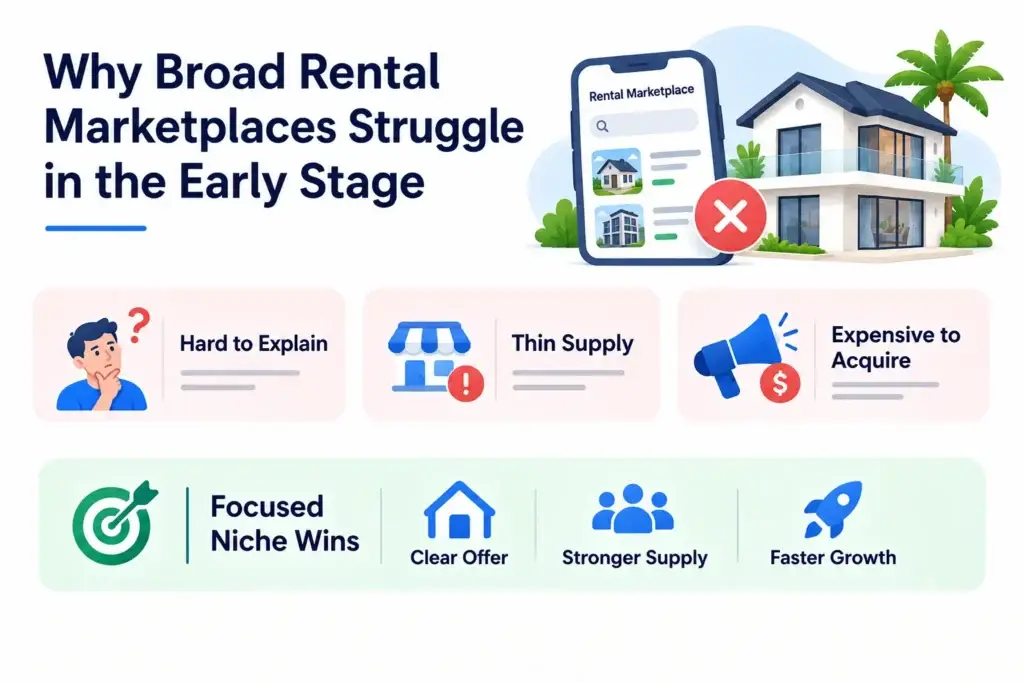
A broad rental marketplace sounds attractive because the total market looks bigger. But early-stage platforms do not win by serving the total market. They win by solving one painful problem better than existing options.
For founders who are still understanding the basic marketplace pattern, this host-guest rental marketplace model explains how guests search, hosts list properties, bookings are confirmed, payments are processed, and reviews help build trust across the platform.
When a new platform launches with too many categories, it creates three problems.
First, the marketplace becomes difficult to explain. Guests do not immediately understand why they should use it. Hosts do not know whether the platform is built for their type of inventory.
Second, supply becomes thin. A platform may have properties across many cities or categories, but not enough density in any one search result. This creates a poor guest experience because users search and find only a few relevant options.
Third, acquisition becomes expensive. A broad platform needs to reach many types of travelers and many types of hosts at the same time. That spreads the founder’s budget thin across too many messages.
A focused rental marketplace avoids this by starting with one strong promise.
Instead of saying, “Book any stay anywhere,” the platform can say:
- Book verified pet-friendly homes in coastal destinations.
- Find eco-stays and farm retreats within driving distance.
- Rent premium villas for family holidays.
- Discover long-stay apartments for remote workers.
- Book student-friendly housing near universities.
- Find corporate stays with monthly billing and workspace filters.
These are clearer, sharper, and easier to market.
The Real Advantage of Focused Inventory
Focused inventory gives a rental marketplace a reason to exist.
A generic listing platform competes on quantity. A niche vacation rental marketplace competes on relevance.
When users arrive on a niche platform, they should immediately feel that the marketplace understands their specific need. A family traveling with pets should not have to filter endlessly to find pet-friendly properties. A remote worker should not have to message every host to confirm Wi-Fi speed, desk space, or monthly pricing. A luxury traveler should not have to compare premium villas with low-quality listings that do not match the trip intent.
Focused inventory improves the marketplace in four ways:
- Search relevance: Users find better matches faster.
- Trust: Listings feel curated instead of random.
- Conversion: High-intent visitors are more likely to book.
- Host value: Hosts get leads from travelers who are already aligned with their property type.
For founders, this matters because marketplace growth depends on repeated trust loops. Guests return when the platform consistently gives them relevant options. Hosts stay when the platform sends better-qualified demand.
Focused Inventory Examples for Niche Rental Marketplaces
| Niche Inventory Type | Target Traveler | Marketplace Advantage |
|---|---|---|
| Pet-Friendly Stays | Families, couples, and solo travelers with pets | Clear filters for pet rules, outdoor space, deposits, and nearby pet services. |
| Eco-Stays and Farm Retreats | Nature travelers, wellness guests, and weekend escape seekers | Strong storytelling around sustainability, local food, nature access, and quiet stays. |
| Luxury Villas | Premium travelers, family groups, destination wedding guests | Higher booking values, concierge add-ons, verified hosts, and premium support. |
| Remote-Work Rentals | Digital workers, founders, consultants, and long-stay guests | Filters for Wi-Fi, work desk, monthly pricing, kitchen, quiet location, and workspace quality. |
| Student Housing | Students, interns, exchange programs, and young professionals | Location-based discovery near campuses, flexible stays, shared housing, and verified landlords. |
| Destination-Specific Rentals | Travelers visiting one region, island, city, or tourist belt | Local SEO, regional host relationships, curated recommendations, and stronger destination authority. |
Why Local Supply Density Beats Random Listing Volume
Many founders measure marketplace progress by listing count. But listing count alone can be misleading.
A platform with 3,000 listings scattered across 40 cities may feel empty when users search a specific destination. A platform with 300 high-quality listings in one focused region may feel much stronger because guests see enough relevant choices in one search flow.
This is the difference between volume and density.
Local supply density means having enough relevant inventory in a specific location or category so users believe the platform is worth using. It also gives hosts confidence that the platform understands their market.
For vacation rental platform development, this matters because the product experience depends on availability. Guests do not only ask, “How many listings exist?” They ask:
- Are there enough options for my dates?
- Are the listings relevant to my trip type?
- Can I trust the property details?
- Are prices clear?
- Are hosts responsive?
- Are reviews and verification signals strong enough?
- Does the platform understand this location better than broad marketplaces?
A niche marketplace should not chase every city. It should win one inventory cluster, then expand carefully.
Host Acquisition Becomes Easier With a Clear Niche
Hosts do not join new marketplaces just because the platform exists. They join when they believe the platform can bring them better bookings, better control, or better economics.
Once the niche is clear, founders also need a plan to attract both hosts and guests. This rental app marketing strategy explains how host outreach, guest acquisition, local SEO, trust signals, retargeting, and launch-stage campaigns work together for a rental marketplace.
A broad pitch is weak:
“List your property on our rental platform.”
A niche pitch is stronger:
“We help boutique villa owners in your region reach high-intent family travelers looking for premium stays.”
The second message tells the host who the platform is for, what type of demand it attracts, and why the host should care.
Focused inventory also makes onboarding more relevant. A platform for pet-friendly rentals can ask about pet rules, fenced spaces, cleaning policies, nearby parks, and pet fees. A platform for remote-work stays can ask about Wi-Fi speed, desk setup, quiet hours, backup power, and monthly discounts. A platform for luxury villas can collect staff availability, pool details, private chef options, airport transfers, and concierge services.
This improves the quality of listings because the platform captures details that matter to the niche.
How Niche Positioning Improves Guest Conversion
Guest conversion improves when users quickly see that the marketplace matches their trip intent.
A broad property booking platform often forces users to do the work. They must search, filter, message, compare, and verify whether a listing actually fits their needs. That creates friction.
A niche marketplace reduces that friction by building the user experience around a specific decision.
For example, a remote-work rental marketplace can make Wi-Fi speed, desk setup, monthly pricing, and quiet environment visible upfront. A family villa platform can highlight bedrooms, child-friendly amenities, private pool, kitchen, parking, and nearby attractions. A pet-friendly marketplace can show pet rules, allowed breeds, outdoor area, cleaning fee, and pet deposit before checkout.
The more specific the marketplace is, the more useful the product becomes.
This is where vacation rental platform development should connect strategy with product design. Filters, listing fields, booking rules, host dashboards, guest search flows, and admin controls should reflect the niche being served.
Founder Decision Signals
Inventory Focus
If your listings are spread too thin across many categories, narrow the platform around one high-intent stay type or destination before scaling.
Host Fit
If hosts cannot explain why your platform is better for their property type, your niche positioning needs to become sharper.
Guest Intent
If guests need too many filters or messages to find the right stay, the marketplace should capture more niche-specific listing details upfront.
Expansion Timing
If one niche or region is not yet liquid, expanding into more categories may increase complexity without improving bookings.
Product Features Should Match the Inventory Strategy
A niche rental marketplace should not use generic product logic for every category. The platform should be customizable enough to support the inventory strategy.
For example, a villa marketplace may need flexible guest capacity, room-level descriptions, private amenities, seasonal pricing, deposits, add-on services, and manual booking approval. A student housing platform may need monthly pricing, lease duration, roommate preferences, nearby campus filters, and document verification. A destination rental platform may need location guides, local recommendations, transport add-ons, and regional tax or fee settings.
The platform foundation should support standard marketplace workflows such as:
- Host onboarding
- Listing creation
- Image galleries
- Search and filters
- Availability calendars
- Booking requests or instant booking
- Payment gateway integration
- Host payouts
- Guest accounts
- Reviews and ratings
- Messaging
- Admin approvals
- Commission settings
- Dispute handling
- Reporting and analytics
But the niche layer should shape how those workflows appear.
Founders who want to review the deeper product layer can explore this rental marketplace features, including booking flows, host tools, payment handling, admin controls, availability logic, and marketplace modules.
Monetization Should Follow the Niche, Not the Other Way Around
A broad marketplace often defaults to commission because that is the most obvious model. But niche vacation rental marketplaces can use more flexible monetization depending on the inventory type and user behavior.
A luxury villa platform may earn from booking commissions, concierge services, airport transfers, premium support, and featured placements. A student housing marketplace may use landlord subscriptions, verification fees, or listing packages. A remote-work stay platform may monetize long-stay bookings, workspace add-ons, or partner services. A destination marketplace may earn from local experiences, tours, transport, and partner promotions.
The monetization model should match the value the platform creates.
Common revenue streams include:
- Booking commission
- Guest service fee
- Host subscription plans
- Featured listings
- Sponsored placement
- Verification fees
- Add-on services
- Local partner packages
- Cancellation or convenience fees
- Premium support or concierge fees
Once the niche is clear, founders should define how money moves through the marketplace. A clear rental marketplace revenue model helps align commissions, host plans, guest fees, featured placements, payout logic, and monetization controls before the platform scales.
Why Trust Signals Are Stronger in Niche Marketplaces
Trust is easier to build when the platform has a clear focus.
A generic marketplace has to prove everything at once. A niche marketplace can prove expertise in one category. That expertise becomes visible through listing quality, verification rules, search filters, content, host onboarding, reviews, policies, and support.
For example:
- A pet-friendly rental platform can verify pet policies and outdoor space.
- A luxury villa marketplace can verify property quality, amenities, and host service standards.
- A student housing platform can verify landlord identity and location accuracy.
- A remote-work stay platform can verify internet speed and workspace quality.
- A regional homestay platform can verify local hosts and community standards.
These trust signals improve guest confidence because they answer the questions that matter most for that niche.
In marketplace strategy, trust is not just a design element. It is part of the conversion system.
How to Choose the Right Niche for a Rental Marketplace
Not every niche is worth building around. A good niche should be specific enough to create differentiation, but large enough to support repeat demand.
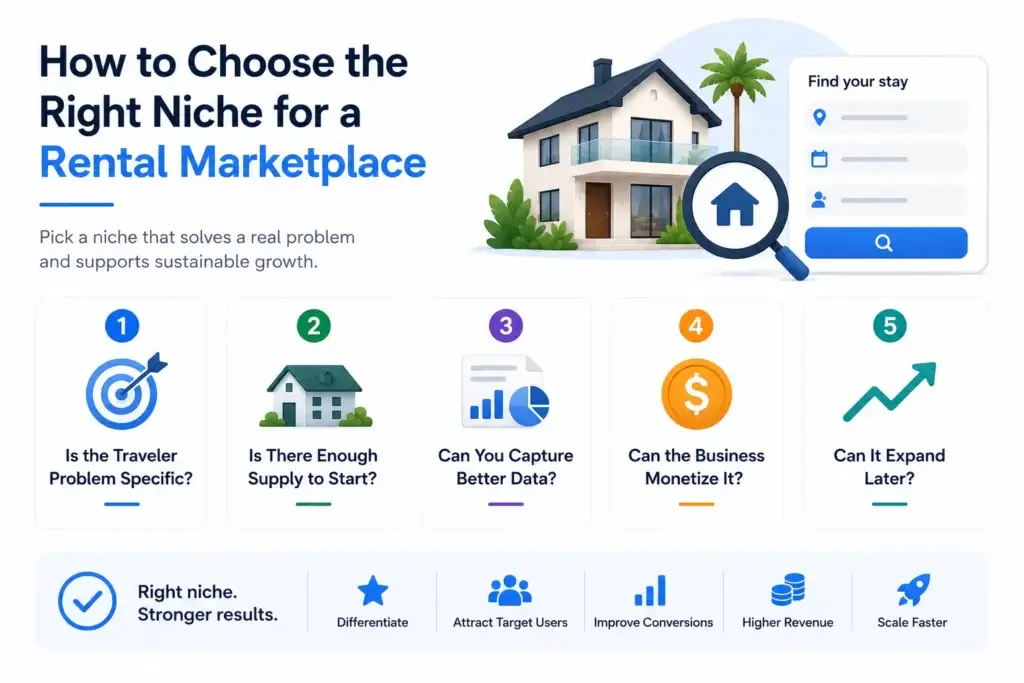
Before investing in vacation rental platform development, founders should evaluate the niche using five questions.
1. Is the Traveler Problem Specific?
A strong niche solves a clear problem. “Vacation rentals” is broad. “Verified pet-friendly beach homes for families” is specific. The more specific the problem, the easier it becomes to create search filters, landing pages, host onboarding flows, and marketing campaigns.
2. Is There Enough Supply to Start?
A niche must have enough hosts or properties to create useful search results. If inventory is too scarce, guests will not find enough options. Founders should validate supply before overbuilding the product.
3. Can the Platform Capture Better Data Than Broad Marketplaces?
A niche marketplace should collect details that broad platforms do not highlight well. That could include workspace quality, pet rules, eco-certifications, accessibility features, student lease terms, or destination-specific amenities.
4. Can the Business Monetize the Niche?
Some niches support higher commissions, subscriptions, add-ons, or partner revenue. Others may have lower booking values and require volume. Founders should understand revenue potential before choosing the category.
5. Can the Niche Expand Later?
A good niche can become a wedge into a larger market. A platform may begin with boutique villas in one region, then expand into premium apartments, serviced stays, or curated experiences. The first niche should create a foundation for logical expansion.
Niche Inventory Strategy vs Broad Marketplace Strategy
| Strategy Area | Niche Rental Marketplace | Broad Rental Marketplace |
|---|---|---|
| Positioning | Clear and specific | Often generic and harder to explain |
| Host acquisition | Easier to pitch to a defined supply group | Requires many host categories from day one |
| Guest intent | Higher because users arrive with a specific need | Mixed intent across many traveler types |
| Search experience | More relevant filters and listing details | Broad filters may not solve niche needs |
| Trust building | Stronger category expertise | Harder to prove expertise across all categories |
| Marketing | Easier to target with niche SEO and campaigns | Higher spend needed across many audiences |
| Expansion | Starts narrow, expands after liquidity | Starts wide, often struggles with thin supply |
| Best for | Early-stage startups and focused rental brands | Established operators with large inventory and budget |
A focused strategy does not mean the platform must stay small forever. It means the startup earns the right to expand after building liquidity in one strong category.
Mistakes Founders Should Avoid
Starting Too Broad
Trying to serve every traveler and every host category from day one makes positioning, acquisition, and product design harder. Start with one clear inventory wedge.
Measuring Supply by Listing Count Alone
A large number of scattered listings does not create marketplace liquidity. What matters is relevant supply density in the locations and categories users actually search.
Using Generic Listing Fields for a Specialized Market
Niche marketplaces need niche-specific data. Remote-work stays, pet-friendly homes, luxury villas, and student housing all require different listing details.
Expanding Before the First Niche Works
Adding more categories too early can create operational complexity without improving bookings. Build repeatable demand in one category before expanding.
Where Miracuves Fits Into Niche Vacation Rental Platform Development
Miracuves helps founders launch rental marketplace platforms with ready-made, white-label solution, source-code-owned foundations that can be customized for niche inventory strategies.
For a founder building a pet-friendly stay marketplace, villa rental platform, eco-stay network, student housing marketplace, long-stay rental portal, or destination-specific booking platform, the value is not only faster development. It is the ability to start with core marketplace workflows already in place and then customize the platform around the niche.
A focused rental marketplace still needs strong product fundamentals:
- Host dashboards
- Guest search and booking flows
- Availability calendars
- Payment handling
- Commission settings
- Reviews and ratings
- Admin approvals
- Listing moderation
- Payout workflows
- Reporting and operational controls
Miracuves can help founders move faster by giving the business a launch-ready foundation while keeping enough flexibility to shape the platform around supply, demand, branding, and monetization.
After choosing the niche and inventory direction, the next decision is how fast the platform should reach the market. This faster rental marketplace launch strategy explains how ready-made booking foundations compare with full custom development when founders want to validate hosts, guests, pricing, and bookings sooner.
If you are ready to move from niche strategy to platform planning, explore this launch-ready rental marketplace platform as the next step. This blog should remain focused on inventory strategy, while the solution page handles direct product, demo, pricing, and build-path details.
Before choosing a build partner, founders should also evaluate niche customization, booking workflows, source-code ownership, admin control, and post-launch support. This guide on choosing a rental marketplace development partner can help with that decision.
Final Thoughts: Focused Inventory Creates a Stronger Starting Point
A niche vacation rental marketplace does not win by being smaller. It wins by being clearer.
Focused inventory helps founders create sharper positioning, better host acquisition, more relevant search results, stronger trust signals, and higher guest intent. Instead of trying to compete across every travel category from day one, a startup can own one category deeply and expand only after liquidity is proven.
That is the practical lesson for vacation rental platform development.
Do not begin with the broadest possible marketplace. Begin with the most believable one. Choose a niche where the supply is reachable, the traveler problem is specific, the product experience can be tailored, and the revenue model makes sense.
The strongest rental marketplaces are not only built with technology. They are built with focus.
FAQs
What is a niche vacation rental marketplace?
A niche vacation rental marketplace is a property booking platform focused on a specific traveler need, property type, location, or stay category. Examples include pet-friendly homes, eco-stays, luxury villas, student housing, remote-work rentals, or destination-specific stays.
Why is focused inventory important in vacation rental platform development?
Focused inventory helps a new rental marketplace create stronger relevance, better search results, clearer host acquisition, and higher guest trust. Instead of spreading listings across too many categories, the platform builds liquidity in one specific market.
How does a niche rental marketplace attract better hosts?
A niche rental marketplace attracts better hosts by offering a clearer value proposition. Hosts are more likely to join when they understand the audience, booking intent, property standards, and revenue opportunity the platform is built around.
What are good niches for a vacation rental startup?
Good niches include pet-friendly stays, luxury villas, eco-retreats, rural homestays, remote-work rentals, student housing, corporate stays, long-term rentals, destination-specific stays, and local tourism marketplaces.
Should a rental marketplace start broad or narrow?
Most early-stage rental marketplaces should start narrow. A focused niche makes it easier to build supply density, improve guest conversion, control marketing spend, and prove marketplace demand before expanding into broader categories.
How can a niche rental marketplace make money?
A niche rental marketplace can earn through booking commissions, guest service fees, host subscription plans, featured listings, verification fees, add-on services, local partner packages, and premium support or concierge services.
What features should a niche rental marketplace include?
Core features should include host onboarding, listing management, search filters, availability calendars, booking workflows, secure payments, host payouts, reviews, messaging, admin approvals, reporting, and commission controls. The niche should shape the custom listing fields and search experience.
How does Miracuves support niche rental marketplace founders?
Miracuves helps founders launch ready-made, white-label rental marketplace platforms with source-code ownership, booking workflows, host and guest modules, payment handling, admin control, and customization support for niche inventory strategies.
Miracuves is an independent software development company. We are not affiliated with, connected to, sponsored by, or endorsed by any company or product named in this article.
Terms such as “X Clone” are used descriptively. It is how the software industry refers to building a platform with functionality comparable to a known service, and how clients search for it.
The entire design and codebase of our products is built by our own team. Our products contain no code, design, graphics, or content originating from any third-party website or applications.
All third-party names and marks referenced in this article are the property of their respective owners, referenced solely to identify the services discussed.