


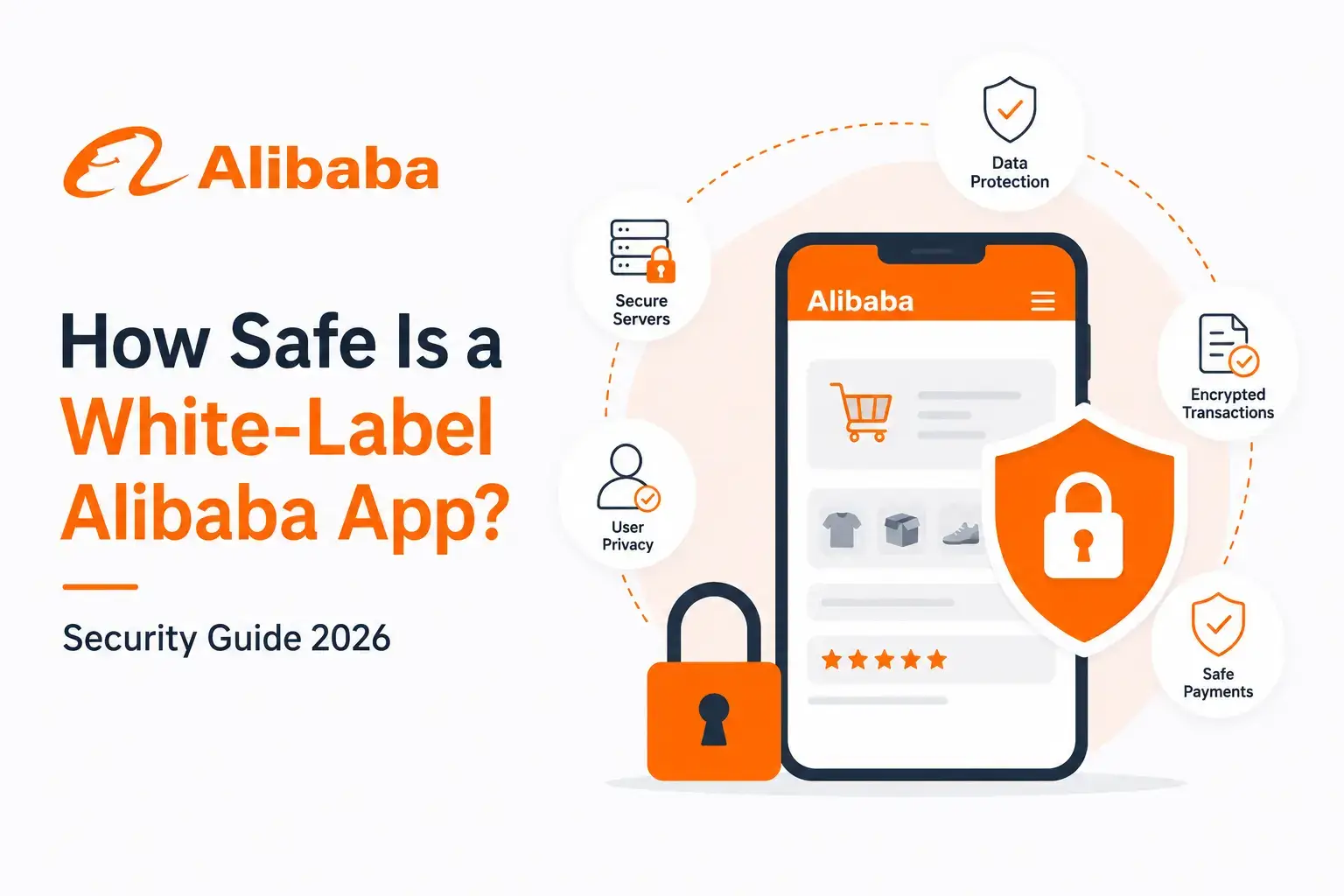
Key Takeaways
- White-label Alibaba app security protects buyers, suppliers, and transactions.
- B2B apps need secure login, roles, payments, and data control.
- Supplier data, RFQs, pricing, and orders must stay protected.
- Security depends on code, hosting, APIs, and admin access.
- A secure app reduces fraud, leaks, disputes, and business risk.
Security Signals
- Use role-based access for buyers, suppliers, and admins.
- Protect payment, escrow, refund, and order workflows.
- Encrypt sensitive data in transit and storage.
- Verify APIs, webhooks, uploads, and third-party integrations.
- Maintain audit logs for admin and supplier actions.
Real Insights
- Security is not complete after app installation.
- Weak admin access can expose the whole marketplace.
- Poor supplier verification can increase fraud risk.
- Regular testing helps find issues before attackers do.
- Miracuves builds Alibaba Clone apps with secure B2B marketplace foundations.
You have probably heard the horror stories.
Marketplace apps leaking supplier data. Payment systems getting compromised. Fake sellers entering platforms with stolen business identities. Buyers losing trust because disputes, refunds, and order records were poorly managed.
In 2026, security is no longer just a technical feature. It is a business survival requirement.
If you are planning to launch a white-label Alibaba app, the first question investors, suppliers, and enterprise buyers will ask is simple:
Is it safe?
The short answer is yes — a white-label Alibaba app can be safe, but only when the security architecture protects the real risk areas of a B2B marketplace: supplier verification, RFQ data, quotation history, payment workflows, admin access, APIs, product catalogs, logistics data, and document uploads.
An Alibaba-style B2B marketplace is not just another ecommerce app. It handles supplier identities, bulk pricing, trade documents, negotiation records, buyer intent, high-value orders, shipping updates, and payment states. That makes security a business requirement, not just a development feature.
This guide gives you an honest and practical security assessment of white-label Alibaba apps in 2026. No fear-mongering. No unsupported statistics. No generic “secure app” talk. Just real risks, practical controls, and founder-focused decision guidance.
Understanding White-Label Alibaba App Security Landscape
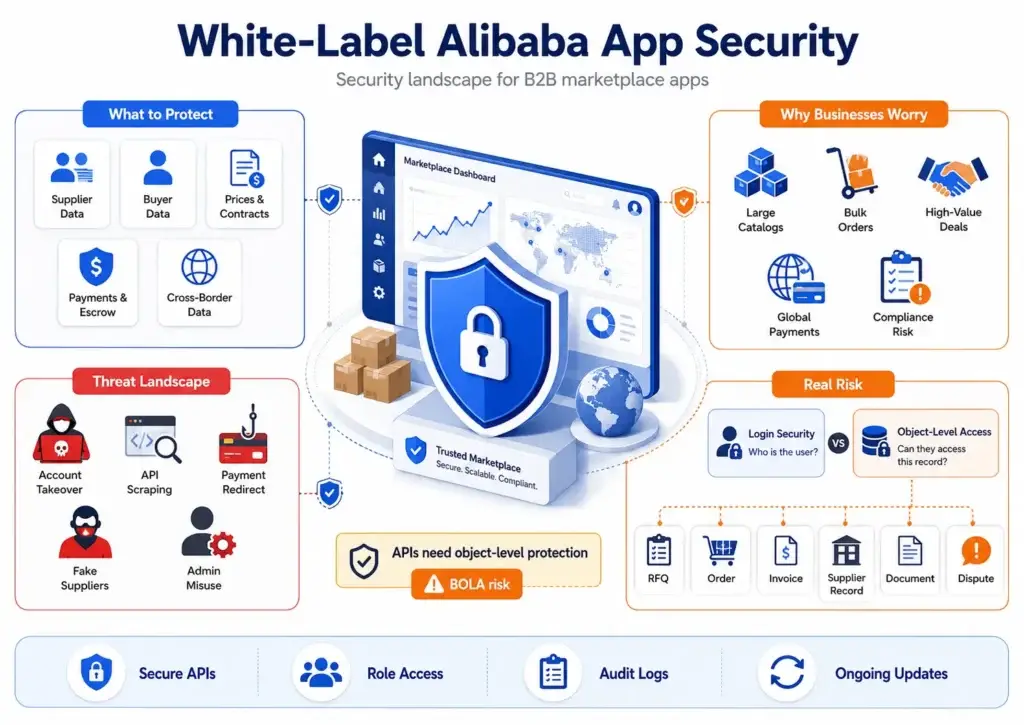
What White-Label Alibaba App Security Actually Means
White-label Alibaba app security refers to how safely a ready-made B2B marketplace app handles data, transactions, and business operations once it is branded and launched under your company name.
In 2026, security is not just about writing “secure code.” It includes how the app is architected, how data flows between buyers and suppliers, how payments are processed, and how compliance is maintained across multiple countries.
A secure white-label Alibaba app must protect:
- Supplier business data
- Buyer identities and transaction history
- Pricing, contracts, and negotiations
- Payment and escrow workflows
- Cross-border data transfers
Security responsibility does not disappear just because the app is white-label. Once you launch, you are legally and operationally responsible.
Why Businesses Worry About White-Label Alibaba Apps
The concern is valid. A white-label Alibaba app handles:
- Large supplier catalogs
- Bulk order negotiations
- High-value B2B transactions
- International payments
- Multi-country compliance
Any weakness can expose thousands of suppliers and buyers at once. In 2026, a single breach can permanently damage brand trust, especially in B2B environments where reputation matters more than marketing.
Current Threat Landscape for Alibaba-Type Marketplace Apps (2026)
Alibaba-style apps face targeted threats such as:
- Account takeover attacks on supplier dashboards
- API abuse to scrape pricing and supplier data
- Payment redirection and escrow manipulation
- Fake supplier onboarding using stolen identities
- Insider threats through admin access misuse
According to global app security reports in 2026, B2B marketplace apps rank among the top five most attacked platforms, mainly due to high transaction values and sensitive business data.
What the Real Security Risk Looks Like in Alibaba-Style Marketplaces
Instead of looking at security as a generic checklist, founders should look at how attackers usually find value inside a B2B marketplace.
In an Alibaba-style app, most sensitive actions are connected through APIs, dashboards, payment states, document uploads, supplier records, order IDs, and admin permissions.
This is why API authorization deserves special attention. OWASP lists Broken Object Level Authorization as the top API security risk in its 2023 API Security Top 10. In simple terms, this happens when a user can manipulate an object ID in an API request and access another user’s order, RFQ, invoice, profile, or supplier record.
For an Alibaba clone app, this means buyer RFQs, supplier quotes, product catalogs, invoice IDs, shipment records, dispute evidence, and admin actions must be protected at the object level — not only by login screens.
Login security answers one question: “Who is this user?”
Object-level authorization answers the more important marketplace question: “Is this user allowed to access this exact RFQ, order, supplier record, document, invoice, or dispute?”
That distinction is critical for B2B marketplace security.
Key Security Risks and How to Identify Them
High-Risk Area 1: Data Protection and Privacy
A white-label Alibaba app processes highly sensitive business data. In 2026, poor data protection can create serious legal, operational, and reputational risks.
User and Supplier Personal Information
This includes:
- Names.
- Business identities.
- Contact details.
- Tax information.
- Company registration documents.
- Bank or payout details.
- Trade certificates.
- Uploaded invoices or order documents.
Weak access controls or poor encryption can expose entire supplier and buyer networks.
RFQ and Quotation Data
RFQ data is especially sensitive because it reveals buyer demand, expected quantities, price expectations, supplier responses, and negotiation history.
For a B2B marketplace, RFQ leakage can create serious business harm. Competitors may understand buyer behavior. Suppliers may manipulate pricing. Buyers may lose trust if their requirements are exposed.
A secure Alibaba clone app should protect RFQ workflows with:
- Role-based access.
- Object-level authorization.
- Encrypted storage.
- Activity logs.
- Quote visibility controls.
- Admin review permissions.
Product and Catalog Data
Product catalogs are not just listings. They include pricing, MOQ, supplier availability, inventory logic, category mapping, images, specifications, and sometimes private wholesale rates.
Risks include:
- Unauthorized catalog edits.
- Product data scraping.
- Fake listings.
- Duplicate supplier listings.
- Spam uploads.
- Counterfeit product claims.
A strong marketplace backend should include moderation, seller controls, rate limits, and admin approval workflows.
High-Risk Area 2: Payment and Transaction Security
B2B transactions are often larger and more complex than normal ecommerce transactions. A buyer may request custom pricing, partial payment, milestone release, shipment-linked settlement, refund approval, or supplier payout.
Weak payment workflows can cause:
- Payment redirection.
- Refund fraud.
- Unauthorized payout changes.
- Transaction status manipulation.
- Poor dispute handling.
- Buyer trust loss.
A secure Alibaba-style app should include:
- Secure payment gateway integration.
- Transaction logs.
- Payment state protection.
- Refund approval workflows.
- Admin review controls.
- Payout monitoring.
- Escrow-style workflow support where required.
Miracuves’ Alibaba Clone page highlights secure payment gateways, RFQ workflows, supplier verification, bulk listings, logistics integration, real-time order tracking, source code, white-labeling, and 6-day launch positioning as part of the solution offering.
High-Risk Area 3: Business-Level Risks
Security is not only a technical concern. In B2B marketplaces, security directly affects business performance.
Business-level risks include:
- Fake suppliers damaging buyer confidence.
- Poor dispute workflows increasing refund abuse.
- Weak admin controls creating internal misuse.
- Poor document handling exposing private trade data.
- No audit logs making investigations difficult.
- Poor compliance planning creating legal exposure.
- Weak supplier approval leading to low-quality marketplace inventory.
Founders should not ask only, “Is the app encrypted?”
They should ask, “Can this platform protect the business model as it scales?”
Read more : –Alibaba Features Explained: A Guide for Startup Founders
Supplier Verification and Fraud Prevention in Alibaba Clone Apps
Supplier trust is one of the most important security layers in an Alibaba-style marketplace.
In a B2B marketplace, buyers are not only browsing products. They are evaluating whether a supplier is real, whether product information is accurate, whether bulk orders can be fulfilled, and whether payment is safe.
A weak supplier onboarding process can lead to:
- Fake suppliers.
- Duplicate supplier accounts.
- Stolen business identities.
- Misleading product claims.
- Payment fraud.
- Counterfeit product listings.
- Buyer disputes.
- Platform reputation damage.
That is why supplier verification should be treated as a core marketplace security layer.
Supplier Verification Features to Include
A secure Alibaba clone app should support:
- Business document upload and verification.
- Company registration or local business proof.
- Tax ID or GST verification where applicable.
- Supplier bank or payout detail review.
- Manual admin approval before high-risk suppliers go live.
- Supplier status labels such as pending, verified, restricted, or suspended.
- Product listing review for sensitive or high-risk categories.
- Fraud signals for duplicate accounts, unusual pricing, or suspicious activity.
- Buyer reporting tools for misleading listings or non-fulfillment.
For founders, supplier verification improves marketplace trust before heavy marketing spend begins. It also gives the admin team stronger control over marketplace quality as the platform scales.
White-Label Alibaba App Risk Assessment Checklist
Before selecting a white-label Alibaba app provider, founders should ask practical security questions.
Data Protection Checklist
- Does the app encrypt sensitive user, supplier, and order data?
- Are supplier documents stored securely?
- Are RFQs and quotations protected from unauthorized access?
- Are buyer and supplier records separated properly?
- Is sensitive data available only to authorized roles?
- Are backups encrypted and access-controlled?
Payment Security Checklist
- Does the platform use secure payment gateway integration?
- Does it avoid storing sensitive card data directly?
- Are refunds and payouts controlled through role-based permissions?
- Are payment status changes logged?
- Are webhook events verified before changing order or payment status?
- Is there a clear dispute or refund approval workflow?
Supplier Verification Checklist
- Can suppliers upload business documents?
- Can admins approve or reject suppliers?
- Can suspicious suppliers be restricted or suspended?
- Is there a process for reviewing duplicate or fake supplier accounts?
- Can buyers report misleading supplier behavior?
- Are supplier profile changes logged?
Admin Control Checklist
- Does the admin panel support role-based access control?
- Can different staff members have different permissions?
- Are high-risk actions logged?
- Is 2FA supported for admin access?
- Can the platform track who approved suppliers, refunds, disputes, and product changes?
- Can admin permissions be changed as the business grows?
API Security Checklist
- Are APIs protected with authentication?
- Does every API verify object-level access?
- Are admin-only functions blocked from normal users?
- Is rate limiting used to reduce scraping and brute-force attempts?
- Are API logs monitored for unusual behavior?
- Are third-party integrations validated securely?
Maintenance Checklist
- Does the provider offer security updates?
- Are patches applied after vulnerabilities are found?
- Is there a maintenance plan after launch?
- Are penetration tests or security reviews supported?
- Is hosting configured securely?
- Is there a response plan for incidents?
Alibaba Clone Security Risks by Marketplace Module
A secure Alibaba clone app should be reviewed module by module. Marketplace risk does not come from one place. It comes from how buyers, suppliers, catalogs, RFQs, payments, logistics, and admin workflows interact with each other.
| Marketplace Area | Security Risk | What the Platform Should Include |
|---|---|---|
| Supplier onboarding | Fake suppliers, stolen business identity, duplicate accounts | KYC/KYB workflows, document verification, admin approval, supplier status tracking |
| RFQ system | Quote leakage, pricing manipulation, unauthorized access to buyer demand | Role-based access, encrypted RFQ data, object-level authorization, audit logs |
| Product catalog | Scraping, fake listings, spam uploads, unauthorized catalog edits | Rate limits, moderation tools, seller controls, catalog approval workflows |
| Payments | Payment redirection, refund fraud, transaction state manipulation | Secure payment gateway integration, transaction logs, escrow-style flow, admin review |
| Admin panel | Internal misuse, excessive permissions, accidental data exposure | 2FA, role-based access control, activity logs, approval workflows |
| APIs | Data exposure, privilege bypass, unauthorized access to records | API authentication, object-level authorization, throttling, request validation, API logging |
| Logistics integrations | Shipment data exposure, webhook abuse, leaked API keys | Secure API keys, webhook validation, limited access, event logging |
| Disputes and refunds | Fraud claims, evidence tampering, unauthorized refund changes | Evidence logs, status tracking, role-based review, admin approval |
| Document uploads | Malicious files, exposed trade documents, privacy leaks | File type validation, malware scanning, access control, encrypted storage |
Security Standards Expected in 2026
A white-label Alibaba app should not depend on basic login security alone. Founders should expect security standards that cover data, users, payments, APIs, hosting, and operations.
Important Security Standards and Practices
| Security Standard or Practice | Purpose | Importance for Alibaba-Type Apps |
|---|---|---|
| SSL/TLS | Protects data transfer between users and the platform | Essential |
| Role-Based Access Control | Limits what buyers, suppliers, staff, and admins can do | Essential |
| Data Encryption | Protects sensitive stored information | Essential |
| Secure Payment Gateway Integration | Reduces payment data exposure | Essential |
| API Authentication | Protects backend communication | Essential |
| Object-Level Authorization | Prevents users from accessing records they do not own | Critical |
| Audit Logs | Tracks admin actions, disputes, refunds, and approvals | Critical |
| Penetration Testing | Finds real-world attack paths before launch | Strongly recommended |
| Secure File Upload Handling | Protects trade documents and prevents malicious uploads | Critical |
| Compliance-Ready Workflows | Helps prepare for data and business regulations | Important |
For an Alibaba clone app, these standards should be mapped to actual marketplace workflows.
Encryption should protect supplier documents, RFQ history, buyer records, and payment references.
Role-based access should separate buyer, supplier, staff, finance, support, and super-admin actions.
Vulnerability scanning should include APIs, dashboards, file uploads, payment callbacks, and third-party logistics integrations.
Compliance planning should support the target market, but final compliance depends on jurisdiction, legal review, integrations, data handling, and operating model.
API Security for Alibaba-Style B2B Marketplace Apps
APIs power almost every important workflow in an Alibaba-style marketplace.
Buyers submit RFQs through APIs. Suppliers send quotes through APIs. Admins approve sellers, update disputes, review payments, and manage listings through APIs. Logistics providers may also push shipment updates through APIs.
This creates a simple rule: login security is not enough.
Each API must check whether the user has permission to access the specific buyer record, supplier account, RFQ, order, invoice, shipment, or dispute file being requested.
Core API Security Layers to Include
- Authentication: Confirm that the user, supplier, admin, or integration is valid before allowing access.
- Object-level authorization: Confirm that the logged-in user can access the exact RFQ, order, quote, invoice, product, or supplier record requested.
- Function-level authorization: Prevent normal buyers or suppliers from accessing admin-only actions.
- Rate limiting: Reduce scraping, brute-force attempts, catalog abuse, and automated API misuse.
- Request validation: Block malformed, unexpected, or manipulated API requests before they reach business logic.
- API logging: Record suspicious access attempts, repeated failed requests, unusual admin actions, and integration errors.
- Webhook validation: Verify logistics, payment, and third-party callbacks before updating order or payment status.
For founders, API security is not only a technical issue. It protects pricing confidentiality, supplier trust, buyer negotiations, platform reputation, and long-term marketplace value.
Payment and Escrow Security for Alibaba Clone Apps
Payment security in a B2B marketplace is more complex than a standard ecommerce checkout.
Alibaba-style orders may involve:
- Bulk quantities.
- Negotiated pricing.
- Milestone payments.
- Partial payments.
- Supplier payouts.
- Refund requests.
- Shipment-linked releases.
- Dispute-based settlements.
A secure Alibaba clone app should protect the full payment journey, not only the payment gateway screen.
This includes buyer payment initiation, supplier payout eligibility, refund approval, escrow-style holding logic, transaction status updates, and admin override permissions.
Payment Security Controls to Review
- Secure payment gateway integration: Payment data should be handled through trusted payment providers rather than stored directly inside the marketplace app.
- Transaction state protection: Order status, refund status, and payout status should not be editable through weak or exposed APIs.
- Escrow-style workflow control: Funds should only move based on clearly defined order, delivery, approval, or dispute conditions.
- Refund approval rules: Refunds should require proper role permissions, evidence review, and activity logging.
- Payout monitoring: Supplier payouts should include fraud checks, bank account verification, and suspicious activity review where relevant.
- Audit logs: Every payment-related admin action should be recorded for accountability.
- Dispute connection: Payment releases and refunds should connect with dispute workflows so the platform can review buyer evidence, supplier response, delivery records, and admin decisions.
Document Upload Security in Alibaba Clone Apps
Document upload security is often ignored, but it matters in B2B marketplaces.
Suppliers may upload:
- Business registration documents.
- Tax certificates.
- Trade licenses.
- Product certificates.
- Invoices.
- Shipping documents.
- Compliance documents.
- Product images and catalogs.
Buyers may also upload RFQ attachments, specifications, or order-related documents.
Weak upload handling can create several risks:
- Malware hidden in files.
- Exposed business documents.
- Unauthorized access to trade records.
- Fake certificates.
- Oversized file abuse.
- Publicly accessible storage links.
- Privacy violations.
A secure Alibaba clone app should include:
- File type validation.
- File size limits.
- Malware scanning where applicable.
- Private file storage.
- Role-based file access.
- Expiring file links where required.
- Admin review for supplier verification documents.
- Logs showing who uploaded, viewed, approved, or rejected documents.
For founders, document security protects both trust and compliance readiness.
Admin Panel Security and Permission Control
The admin panel is one of the most powerful and risky parts of an Alibaba-style marketplace.
Admins may control:
- Supplier approvals.
- Buyer records.
- Product listings.
- Categories.
- RFQs.
- Orders.
- Refunds.
- Disputes.
- Payouts.
- Promotions.
- Reports.
- Platform settings.
If every staff member has full admin access, the business is exposed to misuse, mistakes, and unnecessary risk.
A secure admin panel should include:
- Role-based access control.
- 2FA for high-risk admin accounts.
- Separate permissions for support, finance, operations, catalog, and super-admin users.
- Activity logs for supplier approvals, refunds, payouts, and dispute decisions.
- Approval workflows for sensitive changes.
- Restricted access to payment and document data.
- Alerts for unusual admin behavior.
Founder insight: Admin control is not only about security. It also decides whether the business can scale operations without chaos.
Product Catalog and Scraping Protection
Alibaba-style marketplaces depend heavily on product discovery. That makes catalog security important.
Catalog risks include:
- Competitor scraping.
- Fake products.
- Duplicate listings.
- Spam uploads.
- Unauthorized pricing changes.
- Supplier impersonation.
- Category manipulation.
- Misleading product descriptions.
A secure catalog system should include:
- Supplier-level product controls.
- Admin review for high-risk categories.
- Rate limiting to reduce scraping.
- Moderation tools.
- Duplicate listing detection.
- Image and content review.
- Pricing change logs.
- Report abuse options for buyers.
For B2B marketplaces, catalog trust directly affects conversion. Buyers are more likely to send RFQs and place bulk orders when supplier listings feel credible.
Logistics and Shipping API Security
Many Alibaba-style marketplaces connect with third-party shipping, tracking, or logistics tools.
These integrations can improve the buyer experience, but they also introduce risk.
Common logistics security risks include:
- Exposed API keys.
- Fake webhook events.
- Unauthorized shipment status updates.
- Leaked buyer addresses.
- Manipulated delivery confirmations.
- Poor tracking data validation.
Secure logistics integrations should include:
- API key protection.
- Webhook signature validation.
- Limited access permissions.
- Encrypted communication.
- Event logs.
- Shipment status verification.
- Admin visibility into delivery changes.
A logistics integration should never be allowed to change sensitive order or payment status without validation.
Compliance and Privacy Considerations
Compliance for an Alibaba clone app depends on target countries, user data, payment methods, document handling, and the business model.
A white-label Alibaba app can support compliance-ready workflows, but no provider should claim universal compliance in every country without proper legal review.
Founders should think about:
- Data privacy requirements.
- User consent.
- Data retention.
- Payment regulations.
- Tax and invoice requirements.
- Supplier verification requirements.
- Document storage rules.
- Cross-border data handling.
- Dispute recordkeeping.
- User data deletion requests.
Use careful language here: the platform can support compliance workflows, but final compliance depends on jurisdiction, legal review, integrations, and operating model.
White-Label Alibaba App vs Custom Build: Which Is More Secure?
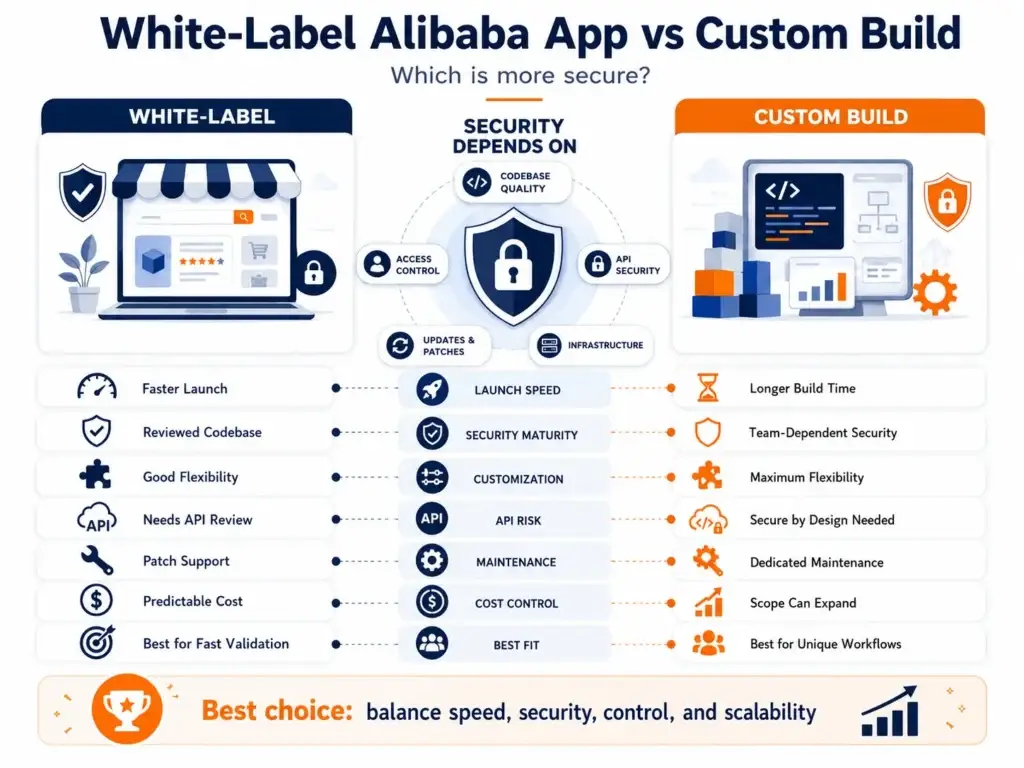
Security depends less on whether the platform is white-label or custom and more on how the codebase, infrastructure, access control, APIs, and maintenance process are handled.
A poorly built custom app can be unsafe.
A well-reviewed white-label Alibaba app can be a secure foundation if it includes strong controls, source-code ownership, and ongoing updates.
| Security Factor | White-Label Alibaba App | Custom Alibaba-Style Build | Founder Decision |
|---|---|---|---|
| Launch speed | Faster if core modules are already built | Usually longer because every module is built from scratch | Choose white-label when speed and validation matter |
| Security maturity | Can be stronger if the codebase has been reviewed and improved over time | Depends on the quality of the development team and review process | Ask for security documentation before choosing either route |
| Customization | Good for branding, workflows, panels, and business rules | Highest flexibility for unusual marketplace logic | Use custom only when the model needs heavy uniqueness |
| API risk | Needs proper review of existing API authorization and integration security | Needs secure design from the first sprint | Object-level authorization is critical in both models |
| Maintenance | Can be easier if updates and patches are included | Requires dedicated technical maintenance | Clarify update ownership before launch |
| Cost control | More predictable when core marketplace modules are already available | Can expand as scope increases | Choose based on launch scope and long-term roadmap |
| Best fit | Founders who want a faster B2B marketplace launch | Businesses with complex, highly unique workflows | Match the build type to risk, budget, and launch urgency |
The smarter decision is not simply “white-label or custom.” The smarter decision is choosing the model that gives you the right balance of launch speed, security depth, admin control, source-code flexibility, and marketplace scalability.
Red Flags – How to Spot Unsafe White-Label Providers
Warning Signs You Should Not Ignore
In 2026, unsafe white-label Alibaba app providers often reveal themselves long before any contract is signed. The warning signs are usually visible if you know where to look.
No Security Documentation
If a provider cannot share security architecture details, audit reports, or compliance policies, it usually means security was never a priority.
Unrealistically Cheap Pricing
Security costs money. Extremely low pricing without a clear explanation often indicates shortcuts in infrastructure, audits, or skilled security resources.
No Compliance Certifications
Providers who say “we follow GDPR” but cannot show certification, processes, or legal documentation are exposing you to regulatory risk.
Outdated Technology Stack
Legacy frameworks, unsupported libraries, and old server configurations are common entry points for attackers in 2026.
Poor Code Quality
Messy, undocumented code increases vulnerability risks and makes future security updates difficult.
No Defined Security Update Policy
If there is no commitment to regular patches and upgrades, your app will fall behind evolving threats.
Lack of Data Backup & Recovery Systems
Without secure backups, a ransomware attack or system failure can permanently destroy marketplace data.
No Cyber Insurance Coverage
In 2026, responsible providers carry cyber liability insurance. Absence of coverage puts the entire risk on your business.
White-Label Provider Evaluation Checklist
Critical Questions to Ask
- How is user and supplier data encrypted?
- What security certifications do you currently hold?
- How often are security audits performed?
- Who is responsible for incident response?
- How are third-party integrations vetted?
Documents You Should Request
- ISO or SOC compliance reports
- Data protection and privacy policies
- Incident response and breach notification plans
- Penetration testing summaries
- Backup and disaster recovery documentation
Testing & Due Diligence Steps
- Request a demo of admin access controls
- Review API authentication methods
- Conduct a third-party security assessment
- Verify compliance claims with auditors
- Check past security incident history
If a provider hesitates or avoids these questions, consider it a serious risk indicator.
Read more : – Business Model of Alibaba : Revenue Streams & Strategy
Founder Decision Signals Before Choosing an Alibaba Clone App
Before choosing a white-label Alibaba clone solution, founders should evaluate four business signals.
Speed
Do you need to validate the B2B marketplace quickly?
A ready-made white-label solution can help reduce the time spent building basic marketplace modules from zero. Miracuves’ Alibaba Clone page highlights 6-day launch positioning for its ready-made solution.
Security
Does the platform already support the core security layers your marketplace needs?
You should check authentication, authorization, supplier verification, secure payment workflows, admin logs, API protection, and file handling.
Control
Will you get enough control over branding, source code, admin workflows, supplier rules, and future customization?
Source-code ownership matters because B2B marketplace businesses often need to evolve around new supplier policies, integrations, pricing models, and compliance requirements. Miracuves states that its Alibaba Clone offering includes complete source code usage ownership.
Market Fit
Are you launching a generic marketplace or a focused B2B trade platform?
A focused marketplace may need category-specific supplier verification, payment rules, RFQ logic, logistics workflows, and admin controls.
How Miracuves Builds a Safer Alibaba Clone Foundation
Miracuves approaches Alibaba clone development as a B2B marketplace system, not just an ecommerce storefront.
That means the product foundation should support:
- Buyer journeys.
- Supplier management.
- RFQ workflows.
- Bulk product listings.
- Secure payment logic.
- Order tracking.
- Logistics integration.
- Admin control.
- Marketplace governance.
- White-label branding.
- Source-code ownership.
Miracuves’ Alibaba Clone solution includes business-facing modules such as bulk product listings, supplier verification, secure payment gateways, RFQ workflows, multilingual support, logistics integration, real-time order tracking, complete source code, rebranding, white-labeling, and faster launch positioning.
Security-Focused Marketplace Controls Miracuves Can Support
Miracuves can help founders build a safer Alibaba-style foundation with:
- Buyer, supplier, and admin role separation.
- Supplier verification and approval workflows.
- RFQ and quotation access control.
- Secure payment gateway integration.
- Admin activity visibility.
- Permission-based dashboards.
- Catalog moderation and seller controls.
- Order, refund, and dispute tracking workflows.
- Logistics and shipment tracking integration.
- Scalable white-label marketplace foundation.
- Source-code ownership for long-term flexibility.
This is the right way to position white-label marketplace development: not as a shortcut that ignores security, but as a launch-ready foundation that can be reviewed, configured, branded, and strengthened around the founder’s business model.
Final Thoughts: Launch a Secure Alibaba-Style Marketplace Faster
A white-label Alibaba app can be safe, but only when it protects the real business risks of a B2B marketplace.
A secure Alibaba clone app should protect supplier onboarding, buyer records, RFQs, quotations, payments, refunds, admin actions, documents, APIs, logistics integrations, and catalog data. It should also give founders enough control to manage fraud, review suppliers, monitor disputes, update workflows, and scale operations confidently.
Security should not slow your marketplace idea, but it should shape how the platform is built. The value of a white-label Alibaba app is not just faster launch. It is faster launch with a structured, secure, and scalable product foundation.
Miracuves helps founders launch white-label Alibaba clone apps with supplier workflows, buyer journeys, RFQ logic, secure payment gateway integration, admin control, source-code ownership, and faster deployment.
Explore the Miracuves Alibaba Clone solution or talk to Miracuves experts to plan your secure B2B marketplace launch.
FAQs
Is a white-label Alibaba app safe?
Yes, a white-label Alibaba app can be safe if it includes secure authentication, role-based access control, supplier verification, encrypted data handling, secure payment gateway integration, API authorization, admin activity logs, and regular security updates.
What is the biggest security risk in an Alibaba clone app?
The biggest risks usually come from weak supplier verification, insecure APIs, poor admin permissions, unprotected RFQ data, payment workflow gaps, unsafe document uploads, and poor post-launch maintenance.
Why is API security important for Alibaba-style marketplaces?
API security is important because buyer RFQs, supplier quotes, order records, invoices, payment states, logistics updates, and admin actions are usually API-driven. Each endpoint should verify that the user has permission to access the exact record being requested.
How can supplier fraud be reduced in an Alibaba clone app?
Supplier fraud can be reduced through business document verification, admin approval, supplier status controls, duplicate account checks, suspicious activity monitoring, product listing review, and buyer reporting tools.
Should an Alibaba clone app include escrow-style payment workflows?
For many B2B marketplace models, escrow-style workflows can improve buyer trust because funds can be held or released based on order, delivery, approval, or dispute conditions. The exact payment workflow depends on the business model, payment gateway, and legal requirements.
Is white-label development less secure than custom development?
Not necessarily. Security depends on the quality of the codebase, access control, API protection, hosting, updates, and maintenance. A well-reviewed white-label app can be secure, while a poorly built custom app can still be risky.
What should founders check before buying a white-label Alibaba app?
Founders should check supplier verification, RFQ protection, secure payments, admin permissions, API security, document upload safety, source-code ownership, hosting setup, update policy, and post-launch support.
Does Miracuves provide source code with the Alibaba Clone solution?
Miracuves states that its Alibaba Clone offering includes complete source code usage ownership, along with white-labeling and rebranding support. Founders should confirm the latest deliverables directly with Miracuves before purchase.
Related Articles :