

A fashion ecommerce marketplace depends on more than attractive product listings, competitive prices, and a convenient shopping experience. Customers must feel confident that their payments are protected, their personal information is handled responsibly, and their orders will be delivered as promised. Sellers need assurance that their business information, inventory, and earnings are protected from unauthorized access.
For founders operating a multi-brand fashion marketplace, security is therefore both a technical responsibility and a business requirement. A compromised customer account can result in fraudulent purchases. Weak seller permissions can expose private business information, while poorly managed returns and refunds can create financial losses and customer disputes.
These risks are particularly important in fashion ecommerce, where customers frequently compare product variants, use promotional offers, place orders with multiple sellers, and request exchanges or returns. Each additional interaction introduces information that must be protected and transactions that must remain accurate.
Fashion ecommerce marketplace security involves protecting this entire ecosystem through secure payment processing, customer data protection, seller verification, permission-based access, fraud monitoring, and reliable order management.
This guide explains the security challenges fashion marketplace operators should understand, the safeguards that help reduce operational risks, and the practical measures founders should evaluate before launching or expanding a shopping platform.
Key Takeaways
- Fashion marketplace security must protect customers, sellers, administrators, payments, and order information throughout the shopping journey.
- Secure payment gateways, tokenization, transaction verification, and refund controls help reduce financial exposure.
- Customer information should be protected through encryption, restricted access, appropriate retention policies, and responsible data collection.
- Seller verification and role-based permissions help prevent unauthorized access to inventory, customer information, and financial records.
- Order histories, audit logs, fraud monitoring, and structured dispute workflows help protect both buyers and sellers.
- Security requires continuous monitoring, testing, maintenance, and clearly assigned operational responsibilities.
Why Trust and Security Matter in Fashion Ecommerce Marketplaces
Unlike a single-brand online store, a multi-vendor fashion marketplace brings multiple independent businesses into one digital environment. Customers browse products from different sellers, make payments through a shared checkout, and expect the marketplace operator to maintain a consistent level of service.
This operating model introduces additional security responsibilities because customers, sellers, delivery partners, payment providers, and platform administrators may interact with different parts of the same order.
Security failures can therefore affect more than one individual transaction. An unauthorized seller account could expose multiple orders, a compromised administrator account could affect several businesses, and a payment-processing error could create discrepancies across customer refunds and seller settlements.
Customer Trust Influences Purchasing Decisions
Customers share personal information when creating accounts, saving delivery addresses, tracking orders, and making purchases. They expect that information to be used only for legitimate shopping-related purposes and other processing they have been properly informed about.
When a platform provides trustworthy checkout flows, clear payment confirmations, transparent order tracking, and accessible customer support, shoppers have fewer reasons to question the reliability of the transaction.
Conversely, suspicious payment redirects, unexplained account activity, or inconsistent refund information can undermine confidence even when no confirmed security breach has occurred.
Seller Confidence Supports Marketplace Growth
Fashion brands and independent sellers entrust a marketplace with their inventory records, product information, customer orders, and settlement details. They need clear boundaries around who can access this information and who has permission to make changes.
A seller should not be able to view another seller’s financial records, change an unrelated product listing, or approve a payout outside their authorized account. Establishing these restrictions supports predictable business operations and reduces disputes between marketplace participants.
Security Protects Business Continuity
Security incidents can interrupt checkout, delay order fulfilment, affect vendor settlements, and require considerable operational effort to investigate. The resulting disruption may be especially damaging during seasonal shopping campaigns, when order volumes and customer expectations are high.
For founders, the objective is not simply to prevent unauthorized access. It is to establish systems that can detect unusual activity, preserve accurate records, contain incidents, and restore operations when something goes wrong.
Payment Security: Protecting Checkout, Transactions, and Refunds
Payment security is one of the most important components of a fashion ecommerce marketplace. Customers may pay through cards, supported digital wallets, local payment methods, or cash on delivery, depending on the region and the platform’s operating model.
Every payment method introduces different risks. Online transactions require safeguards against unauthorized payments and transaction manipulation, while cash-on-delivery operations need reliable collection, reconciliation, and settlement procedures.
A secure payment workflow must protect sensitive information while ensuring that the amount charged, the order recorded, and the payment status remain consistent.
Secure Payment Gateway Integration
Using an established payment gateway can reduce the amount of sensitive financial information that a marketplace needs to handle directly. Hosted payment fields or secure gateway interfaces allow payment credentials to be collected and processed within the payment provider’s controlled environment.
However, gateway integration does not remove every security responsibility from the marketplace. The platform must still protect its payment credentials, verify transaction responses, restrict administrative access, and ensure that an order cannot be marked as paid merely because a customer-facing screen reports success.
For example, when a shopper completes a payment, the marketplace should validate the payment status through an authenticated gateway response or a verified server-side notification. It should not rely exclusively on information supplied by the shopper’s browser or mobile application.
Payment Tokenization and Sensitive Data Protection
Payment tokenization replaces sensitive payment information with a reference token that can be used within an authorized payment workflow. This helps reduce unnecessary exposure of financial credentials within the marketplace application.
Where supported by the payment provider, tokenized transactions can also make repeat purchases more convenient without requiring the marketplace to store raw card details.
Tokens must still be protected because they may enable transactions or expose payment relationships when misused. The marketplace should restrict access, protect relevant credentials, and follow the payment provider’s security requirements.
Payment Verification and Transaction Integrity
Payment verification ensures that a transaction actually occurred and corresponds to the correct order. This involves confirming the transaction identifier, expected amount, currency, payment status, and relevant merchant information.
Duplicate gateway notifications also need careful handling. If the same successful payment notification is delivered more than once, the system should recognize that the transaction has already been processed rather than creating a second order payment or duplicate financial entry.
This is commonly addressed through idempotent processing, where repeated requests associated with the same transaction do not produce repeated financial effects.
Refund Security and Payment Reconciliation
Refund protection is particularly important in fashion marketplaces because customers may return individual items from orders containing several products or multiple sellers.
Consider a customer who purchases three garments and returns only one. The platform must identify the exact order item, determine the eligible refund, update its return status, and adjust the appropriate seller settlement without affecting the remaining products.
Refunds should follow an authorized sequence rather than relying on an editable payment-status field. The system should record who initiated the refund, why it was approved, which amount was processed, and the external payment reference.
Once a refund has been settled, repeated requests should not cause the same amount to be refunded again. Reconciliation between the gateway records, order records, and seller financial records helps identify missing transactions or inconsistent balances.
Founder insight: A payment gateway can protect payment credentials, but the marketplace operator remains responsible for ensuring that orders, refunds, and settlements are accurately connected.
Customer Data Protection: Keeping Personal Information Private
Fashion marketplaces collect information at several points in the customer journey. Some information is necessary to complete a purchase, while other information may support personalization, marketing, customer service, and business analytics.
Typical customer information includes names, email addresses, telephone numbers, delivery locations, saved addresses, purchase histories, product preferences, and support interactions.
Each additional category of information increases the need for responsible collection, secure storage, restricted access, and a clear retention policy.
Collect Only the Information the Business Needs
Data minimization is a practical starting point for customer privacy. A marketplace should collect information for a defined purpose rather than requesting unnecessary details simply because the application can store them.
For example, a delivery address is normally required to fulfil a physical product order, while additional personal preferences may not be necessary to complete the purchase.
Marketing and personalization should be supported by appropriate privacy notices and any consent or other lawful basis required in the relevant jurisdiction.
Encrypt Information During Transfer and Storage
Encryption helps protect information against unauthorized disclosure. Secure transport protocols, including properly configured HTTPS using modern TLS, protect data transmitted between customers, applications, and servers.
Encryption at rest provides an additional protective layer for stored information. Particularly sensitive records may also need application-level encryption or other safeguards based on their risk and use.
Encryption is not a replacement for access control. A compromised account with legitimate decryption privileges may still expose information. For this reason, encryption, permissions, credential management, and monitoring should work together.
Protect Customer Accounts Against Unauthorized Access
Account takeover occurs when an unauthorized person gains access to a legitimate customer account. Attackers may attempt to reuse stolen passwords, exploit weak recovery procedures, or manipulate authentication workflows.
Account security should include appropriate password hashing, secure session management, login rate limiting, suspicious activity detection, and additional verification for sensitive account changes.
Changes to saved payment methods, email addresses, phone numbers, or delivery details may warrant stronger verification because they can affect account ownership or an active transaction.
Customer-facing security must also remain usable. Excessive verification during ordinary browsing can create unnecessary friction, while insufficient verification around high-risk activities can increase fraud exposure.
Limit Access to Customer Information
Not every marketplace participant needs access to the same information. Customer support agents may need to view order status, sellers may need fulfilment details, and delivery partners may require a delivery address and a way to contact the recipient.
These operational requirements do not justify unrestricted access to a customer’s complete profile, browsing history, financial information, or previous orders.
Role-specific data access and selective display of sensitive information help reduce unnecessary exposure. Access to particularly sensitive records should be recorded and reviewed where appropriate.
Establish Data Retention and Deletion Procedures
Customer information should not be retained indefinitely without a legitimate purpose. Marketplace operators need retention policies that account for order fulfilment, tax records, dispute resolution, fraud prevention, and applicable legal obligations.
Customers should also receive appropriate information about privacy rights, account deletion, access requests, and the handling of their personal data.
Privacy requirements vary according to the markets served. The GDPR, India’s Digital Personal Data Protection framework, and other applicable laws may impose different obligations depending on the organization, processing activity, jurisdiction, and relevant implementation rules.
A privacy-conscious technical foundation can support these workflows, but it does not automatically establish legal compliance. Operators should obtain jurisdiction-specific advice and maintain appropriate documentation.
Seller Verification and Access Control in a Multi-Vendor Marketplace
Seller security creates a different challenge from customer security. A seller account may have permission to upload products, manage inventory, review customer orders, respond to returns, and access settlement information.
If these permissions are not carefully controlled, an account compromise or application vulnerability could affect customers, financial records, or other businesses using the marketplace.
Marketplace operators should therefore treat seller onboarding, authentication, authorization, and account monitoring as connected components of one security process.
Verify Sellers Before Granting Commercial Access
Seller verification helps establish that a business is authorized to operate through the marketplace. Depending on the business model and applicable requirements, the process may involve checking business-registration details, contact information, tax information, banking details, or relevant identity documentation.
Verification reduces opportunities for fraudulent storefronts, misleading business identities, and unauthorized financial activity. It also creates an accountability framework when product authenticity, delivery failures, or settlement disputes occur.
Verification should be proportionate to the risk. Collecting more documentation than necessary introduces its own privacy and information-security responsibilities.
Use Role-Based Access Control
Role-based access control, commonly called RBAC, assigns permissions according to a user’s authorized responsibilities.
For example, a product manager working for a fashion seller may need permission to update product descriptions and stock quantities. That does not necessarily mean the same employee should be allowed to change payout credentials or approve financial adjustments.
A well-designed seller dashboard separates responsibilities and restricts sensitive operations to appropriately authorized accounts.
The principle of least privilege should guide these decisions: each account receives the minimum permissions required to perform its legitimate tasks.
Keep Seller Records Properly Separated
Multi-vendor marketplaces must ensure that sellers cannot access records belonging to unrelated sellers. This restriction should apply to product management, inventory updates, order details, settlement records, reports, and other commercially sensitive information.
Separating information visually in the dashboard is not sufficient. The application must also enforce authorization within its backend services and APIs.
For example, changing an order identifier in an API request should not allow one seller to retrieve or modify another seller’s order. Every relevant request must validate the user’s authority to access the specific record.
This is particularly important because broken object-level authorization and other permission failures are recognized API security risks.
Protect High-Risk Seller Account Changes
Some seller actions introduce greater financial or operational risk than routine product management.
- Changing payout bank-account information.
- Adding or removing users with financial permissions.
- Requesting unusually large settlements.
- Changing product prices across an entire catalogue.
- Approving exceptional refunds or order adjustments.
These actions may justify additional verification, approval requirements, notifications, or enhanced audit logging.
For example, a newly added payout account could be subject to additional checks before it becomes eligible to receive seller funds. The appropriate control depends on the platform’s payment provider, fraud profile, and settlement process.
Maintain Seller Activity Logs
Activity logs help operators investigate unexpected changes and establish accountability. Useful records can include account logins, permission changes, product updates, payout modifications, and significant order actions.
Logs should contain sufficient context to support investigation without unnecessarily exposing sensitive credentials or personal information. Their integrity and access permissions also require protection.
As a marketplace grows, reliable activity histories become increasingly important for resolving disagreements between sellers, support teams, and platform administrators.
Order Protection: Preventing Fraud, Manipulation, and Fulfilment Disputes
Order protection is the process of preserving the accuracy and integrity of an order from checkout through fulfilment, delivery, return, and settlement.
It is especially important in fashion ecommerce because a single product may have several sizes, colours, and price variations. Customers can also purchase multiple items from different sellers in one transaction.
Without consistent order records and controlled status changes, a marketplace can encounter incorrect shipments, inventory discrepancies, duplicate refunds, and seller-payment disputes.
Protect Order Information After Checkout
Once a customer places an order, the marketplace should preserve the transaction’s relevant commercial details. These include the purchased product variant, agreed price, applied discount, quantity, taxes, and associated seller.
The order should not depend exclusively on the current product listing because catalogue information may change after the purchase.
For example, a seller may change a garment’s price or remove a colour variation after a customer has paid. These later catalogue changes should not alter the historical purchase record.
Maintaining accurate order-item information helps resolve disputes and ensures that refunds are calculated using the original transaction rather than updated catalogue values.
Control Order Status Transitions
Order management involves a sequence of states, such as placed, payment confirmed, accepted, packed, shipped, delivered, returned, and refunded.
Not every participant should be allowed to move an order into every state. A seller may confirm packing, a delivery partner may report a delivery event, and an authorized administrator may resolve an exceptional dispute.
Server-side rules should validate each transition and prevent invalid changes. For instance, an unpaid order should not ordinarily become eligible for a seller settlement merely because a client application submits a delivered status.
These controls help prevent both deliberate manipulation and accidental operational errors.
Protect Inventory at the Product-Variant Level
Fashion inventory is more complicated than a single quantity attached to a product. A shirt may have several sizes and colours, with different stock levels for each combination.
Order-processing rules must ensure that the correct variant is purchased, reserved, shipped, and potentially returned. Otherwise, simultaneous orders may lead to overselling, incorrect fulfilment, or inaccurate inventory records.
Appropriate inventory reservations, transactional updates, and reconciliation procedures help reduce these risks. Returned items should only be added back to sellable inventory when their condition and the business’s restocking rules permit it.
Prevent Duplicate Refunds and Return Abuse
Return abuse can involve repeated refund requests, inaccurate return claims, substitution of returned products, or attempts to obtain a refund after a transaction has already been settled.
A reliable return workflow should associate each request with an identifiable order item, record its approval status, and preserve the evidence needed for dispute resolution.
Refund execution should be linked to the approved return and protected against duplicate processing. For higher-risk situations, operators may also require inspection, delivery confirmation, or additional authorization before releasing funds.
Controls must balance fraud prevention with a fair customer experience. Excessive restrictions on legitimate returns can damage customer confidence just as much as weak controls can increase financial losses.
Maintain Reliable Delivery Evidence
Delivery confirmation helps establish whether an order reached the intended recipient. Depending on the fulfilment model, evidence may include carrier updates, delivery timestamps, recipient confirmation, or an appropriately controlled one-time verification code.
However, delivery evidence should not be treated as an absolute guarantee. Missing-package complaints, incorrect deliveries, and disputed confirmations still require a structured investigation process.
Customers and sellers should have access to accurate order histories and a clear mechanism for reporting discrepancies.
Fraud Prevention Across the Fashion Marketplace
Marketplace fraud can originate from compromised customer accounts, dishonest sellers, abusive buyers, unauthorized employees, or external attackers. The risk is not limited to stolen payment information.
Promotional offers, return policies, seller settlements, account recovery, and delivery procedures can all become targets when the underlying business rules are insufficiently protected.
A useful fraud-prevention strategy combines technical safeguards with operational review rather than relying on a single automated detection mechanism.
Account Takeover and Credential Abuse
Attackers may attempt to access customer or seller accounts using previously compromised passwords, automated login attempts, or social engineering.
Risk-based authentication, rate limiting, suspicious-login monitoring, and secure account-recovery processes can help reduce exposure. Additional verification is especially valuable when an account attempts sensitive actions following unusual login activity.
Promotional and Coupon Abuse
Fashion marketplaces often use first-order discounts, referral rewards, loyalty points, and seasonal campaigns to encourage customer acquisition.
Fraudsters may attempt to exploit these programmes through repeated account creation, manipulated referral relationships, unauthorized coupon combinations, or refund workflows that fail to reverse earned rewards.
Campaign eligibility should be enforced through server-side business rules. The marketplace should also define what happens to discounts and rewards when an eligible transaction is cancelled or refunded.
Seller and Payout Fraud
Seller-related fraud may involve misleading listings, unauthorized changes to payment details, fabricated fulfilment events, or attempts to obtain settlements for transactions that have not been completed.
Verified seller onboarding, approval controls for financial changes, settlement reconciliation, and suspicious activity alerts can help operators identify and investigate these situations.
Where commercially appropriate, payout release rules can also account for order completion, unresolved disputes, and relevant return conditions.
Refund and Return Fraud
Return fraud is a particularly relevant risk for apparel businesses because size-related exchanges, fit concerns, and product returns are normal parts of the customer journey.
Marketplace operators should distinguish ordinary customer behaviour from genuinely suspicious patterns. Multiple returns do not automatically establish fraudulent intent, but repeated discrepancies, inconsistent claims, or unusual refund activity may justify further review.
Transaction histories, return reasons, inspection results, and documented decisions help support fair and consistent resolution.
Founders evaluating the economics of these operations can separately explore how the fashion marketplace business model connects seller participation, transactions, and platform operations.
API Security and Administrator Controls
Modern fashion marketplaces commonly connect customer applications, seller dashboards, administrative systems, payment services, and delivery integrations through APIs.
These interfaces allow different systems to exchange information, but they can also expose sensitive operations if requests are not properly authenticated, authorized, and validated.
Enforce Authorization on Every Sensitive Request
Authentication establishes who is making a request. Authorization determines whether that person is allowed to perform the requested action.
Both are necessary. A legitimate seller who is signed in should not automatically gain access to every order or product record in the marketplace.
Object-level and function-level authorization checks should be enforced by the backend rather than relying on the visibility of buttons or navigation options in the user interface.
Validate Inputs and Protect Business Rules
Applications should validate incoming information before it is processed. This includes product identifiers, prices, quantities, refund requests, addresses, file uploads, and account-management actions.
Secure database access, appropriate output encoding, validated file handling, and controlled object updates help reduce exposure to common application vulnerabilities.
Financial and order-related values must also be verified against trusted server-side records. A customer or seller should not be able to manipulate a transaction simply by changing the values sent from their application.
Strengthen Administrator Authentication
Administrator accounts often have access to sensitive functions, including seller approvals, refunds, user management, transaction reports, and platform configuration.
These accounts require stronger protection than ordinary browsing sessions. Multi-factor authentication, individual staff accounts, restricted permissions, secure session handling, and additional approval controls for critical financial actions should be considered.
Shared administrator credentials should be avoided because they weaken accountability and make investigations more difficult.
Secure Third-Party Integrations
Payment providers, email services, analytics tools, logistics partners, and notification platforms may require access to selected marketplace functions or information.
Each integration should receive only the credentials and permissions it requires. API keys and other secrets should be stored securely, monitored where appropriate, and rotated when necessary.
Inbound notifications should be authenticated using the integration provider’s supported verification mechanism. Operators should also assess the implications of sending customer information to external services.
The ecommerce application development process should account for these security requirements when integrating checkout, fulfilment, customer support, and administrative workflows.
Security Controls That Protect Customers, Sellers, and Marketplace Operators
Different marketplace participants face different risks. A customer is primarily concerned about personal information, payment safety, and receiving the correct order. A seller needs protection for product records, commercial information, and earnings. Platform administrators must maintain the integrity of the entire operating environment.
The following table summarizes the main risks and the controls marketplace operators should consider.
| Security area | Main risk | Recommended control | Business outcome |
|---|---|---|---|
| Payment processing | Unauthorized or manipulated transactions | Secure gateway, verified notifications, transaction reconciliation | Reduced payment exposure |
| Customer accounts | Account takeover | Secure authentication, rate limits, additional verification | Improved account protection |
| Personal information | Unauthorized disclosure | Encryption, data minimization, restricted access | Stronger privacy protection |
| Seller dashboards | Unauthorized access to business information | Role-based permissions and record-level authorization | Better seller confidentiality |
| Administrator accounts | Misuse of privileged functions | Multi-factor authentication, activity logs, approval controls | Greater operational accountability |
| Order management | Incorrect or manipulated order states | Validated state transitions and immutable transaction evidence | More reliable fulfilment |
| Refunds | Duplicate payments and return abuse | Authorized refund workflows and idempotent processing | Lower financial leakage |
| Third-party services | Compromised integrations | Restricted credentials, authenticated requests, provider reviews | Reduced integration risk |
| Infrastructure | Service interruption or data loss | Monitoring, patching, protected backups, recovery testing | Improved business continuity |
No individual control makes a marketplace completely secure. The objective is to establish several complementary safeguards so that one compromised account, failed integration, or operational mistake does not automatically result in a wider incident.
Security and Privacy Standards Marketplace Founders Should Understand
Security standards and privacy regulations help organizations establish expectations for protecting information and managing operational risks.
However, different standards address different responsibilities. A payment-security standard is not interchangeable with a privacy law, and a technical security assessment is not the same as an organizational certification.
PCI DSS and Payment Card Security
The Payment Card Industry Data Security Standard, or PCI DSS, establishes security requirements for environments that store, process, or transmit payment-card account data.
A marketplace that uses hosted payment fields may reduce the amount of card data passing through its own systems. Nevertheless, the exact responsibilities depend on the payment architecture, provider arrangements, and applicable validation requirements.
Founders should confirm their responsibilities with their payment provider and qualified compliance advisers rather than assuming that using a payment gateway automatically removes every PCI DSS obligation.
GDPR and Customer Privacy
The General Data Protection Regulation, or GDPR, establishes requirements for personal-data processing within its territorial scope.
Depending on the marketplace’s activities and applicability of the regulation, relevant obligations may include transparency, lawful processing, appropriate security, retention controls, and procedures for handling individuals’ rights.
Other jurisdictions have their own privacy and data-protection requirements. A marketplace operating internationally should evaluate where its customers are located, what information it collects, and how its service providers process that information.
OWASP and Application Security
The Open Worldwide Application Security Project, or OWASP, provides widely used guidance on application and API security risks.
Its guidance is particularly relevant to marketplaces because customer applications, seller dashboards, and administrative systems frequently interact with shared APIs and databases.
Security teams can use OWASP resources to guide threat modelling, code reviews, authorization testing, and the assessment of common application vulnerabilities.
ISO 27001 and SOC 2
ISO 27001 concerns information-security management systems, while SOC 2 reports address controls relevant to defined trust-services criteria and the scope of the examination.
These frameworks may be relevant to organizational governance, procurement, and customer assurance. However, neither should be described as a universal prerequisite for launching every fashion marketplace.
Certification or an assurance report must be independently established within its defined scope. Security features alone do not demonstrate that an organization holds either credential.
How to Evaluate the Security of a Ready-Made Fashion Marketplace
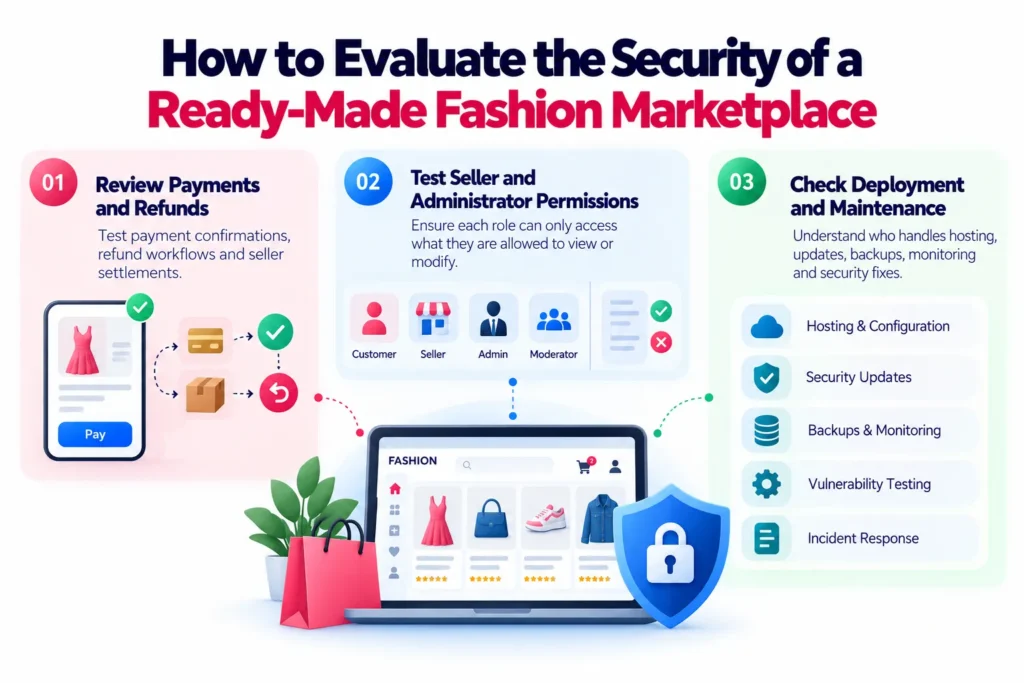
A ready-made or white-label application is not automatically secure or insecure because of its delivery model. Its security depends on the quality of the underlying implementation, the deployment configuration, the integrations used, and the way the platform is maintained after launch.
Founders should therefore evaluate the actual application and its operational requirements rather than relying on broad security claims.
Review How Payments and Refunds Are Handled
Test whether payment confirmations are validated, duplicate notifications are handled safely, and refund requests are restricted to authorized workflows.
A useful test is to place an order containing several products, return one item, and examine whether the customer refund and relevant seller settlement are updated accurately.
Test Seller and Administrator Permissions
Create accounts with different roles and attempt to access records outside their authorized scope. The application should prevent both unauthorized viewing and unauthorized modification.
Pay particular attention to payout details, customer information, refund approvals, and administrative actions that could affect multiple sellers.
Check the Deployment and Maintenance Responsibilities
Security responsibilities do not end when the application is delivered. Founders should establish who manages hosting, security updates, secrets, monitoring, backups, vulnerability testing, and incident response.
Ask what security controls are included in the software, which controls must be configured during deployment, and which remain the ongoing responsibility of the marketplace operator.
Miracuves offers a ready-made fashion marketplace solution for founders seeking a source-code-owned platform with customer, seller, delivery, and administrator workflows. Its six-working-day deployment offering can accelerate the initial platform setup, while the required integrations, security verification, operating procedures, and ongoing maintenance still need appropriate attention.
Founders who want to understand the product’s exact modules and functional scope can explore the fashion marketplace platform features separately. The important security decision is to verify that the selected configuration and operational procedures satisfy the business’s actual risk requirements.
Pre-Launch Security Checklist for Fashion Marketplace Operators
Before accepting real orders, marketplace operators should validate the controls that protect payments, customer information, seller operations, and fulfilment.
The checklist below provides a practical starting point. It should be adapted to the platform’s operating model, payment integrations, target market, and risk assessment.
Marketplace Security Readiness Checklist
Payment and Transaction Protection
- Payment-gateway credentials are securely configured.
- Payment notifications are authenticated and verified.
- Duplicate payment events cannot create duplicate financial entries.
- Refund approvals and settlement rules have been tested.
- Payment records can be reconciled with order records.
Customer Data Protection
- HTTPS and appropriate encryption controls are configured.
- Customer information is restricted to authorized roles.
- Account recovery and sensitive profile changes are protected.
- Privacy notices and retention procedures are reviewed.
- Data access and deletion workflows are established where required.
Seller and Administrator Security
- Seller identities and business details are appropriately verified.
- Seller records are protected by backend authorization.
- Administrative access follows the least-privilege principle.
- High-risk financial changes require appropriate controls.
- Important account and transaction activities are logged.
Orders and Operational Security
- Order-status transitions are validated.
- Product-variant inventory is handled consistently.
- Return requests are associated with individual order items.
- Duplicate refunds and inconsistent settlements are prevented.
- Security testing, monitoring, backups, and recovery procedures are in place.
The checklist should be supported by documented evidence rather than simple confirmation that a feature exists. A functioning login page, for example, does not prove that account recovery, authorization, and session management have been adequately tested.
Common Security Mistakes Fashion Marketplace Founders Should Avoid
Several recurring mistakes can create avoidable exposure even when a marketplace includes basic security mechanisms.
Assuming a Secure Payment Gateway Protects the Entire Marketplace
A payment provider may protect the collection and processing of payment credentials, but it does not automatically secure seller permissions, order records, refund logic, or administrative access.
Founders must evaluate the entire transaction lifecycle, including what happens before the payment is initiated and after the payment provider confirms it.
Giving Staff Unnecessary Administrative Access
Granting every employee unrestricted access may appear convenient during early operations, but it increases the damage that a compromised account or internal mistake can cause.
Defined roles, individual accounts, periodic permission reviews, and appropriate approval procedures provide greater accountability as the team expands.
Ignoring Return and Settlement Logic
A marketplace can have strong authentication while still losing money through duplicate refunds, incorrectly calculated settlements, or unauthorized changes to order records.
Transaction integrity and operational fraud prevention deserve the same attention as conventional cybersecurity controls.
Treating Security as a One-Time Launch Task
New integrations, employee changes, software updates, and evolving fraud methods can introduce risks after the initial deployment.
Operators need recurring vulnerability assessments, dependency updates, access reviews, incident-response exercises, and security monitoring appropriate to their risk profile.
Collecting More Customer Information Than Necessary
Unnecessary information increases storage requirements and creates additional privacy obligations. It can also increase the impact of a security incident.
Data collection should serve clearly defined business purposes, with appropriate controls governing retention, access, and deletion.
Maintaining Marketplace Security After Launch
Marketplace security is an ongoing process. As customer activity increases, sellers join the platform, and new integrations are introduced, the original risk assessment needs to be revisited.
Founders should establish ownership of the most important operational controls and define how security issues will be identified, prioritized, and resolved.
Monitor Unusual Account and Transaction Activity
Security monitoring should provide visibility into repeated authentication failures, suspicious account changes, unusual payment activity, exceptional refund patterns, and unauthorized access attempts.
Alerts should be relevant enough to support timely investigation without overwhelming operators with routine events.
Keep Software and Dependencies Updated
Applications depend on frameworks, libraries, services, and infrastructure components that require ongoing maintenance.
A documented patch-management process helps teams identify relevant security updates, evaluate their impact, test changes, and deploy fixes according to the severity of the risk.
Perform Security Testing
Automated vulnerability scanning, dependency analysis, code reviews, and risk-based penetration testing can reveal weaknesses that routine functional testing may not detect.
Testing should cover the platform’s important business workflows, including customer authentication, seller authorization, payments, refunds, and administrative operations.
The appropriate testing schedule depends on the marketplace’s risk exposure, operational changes, and any contractual or regulatory obligations.
Maintain Backups and an Incident Response Plan
Backups help protect business continuity, but they must be appropriately secured and periodically tested to confirm that important data can actually be restored.
An incident-response plan should identify who investigates suspicious activity, how affected systems can be isolated, who makes operational decisions, and how customers, sellers, payment providers, or authorities will be notified when required.
Documenting these responsibilities before an incident helps reduce confusion when an urgent decision is required.
Building a Security-Conscious Fashion Marketplace With Miracuves
For founders, building a trusted marketplace requires a combination of suitable technology, clearly defined responsibilities, and operational processes that support secure transactions and reliable fulfilment.
A ready-made platform can reduce the amount of foundational development needed, but it should still be evaluated against the business’s requirements for customer privacy, seller permissions, payment processing, refunds, and ongoing maintenance.
Miracuves helps businesses establish a customizable, source-code-owned fashion marketplace foundation through its ready-made solution approach. The six-working-day deployment offering provides an accelerated starting point for eligible deployments, while additional integrations, security assessments, and business-specific changes must be planned according to their actual scope.
The most useful approach is to define the marketplace’s security and operational requirements before deployment, validate the relevant workflows, and assign ownership of ongoing security activities.
Final Thoughts: Marketplace Trust Depends on More Than Secure Checkout
Fashion ecommerce marketplace security extends across the entire shopping and fulfilment experience. Secure payments protect transactions, privacy controls safeguard customer information, seller permissions protect business records, and reliable order workflows reduce opportunities for fraud and operational errors.
These safeguards are most effective when they operate together. Strong authentication cannot compensate for flawed refund logic, and secure payment processing cannot prevent a seller from accessing unauthorized records if backend permissions are poorly implemented.
For marketplace founders, the practical objective is to create an operating environment where sensitive actions are controlled, important transactions are traceable, and security responsibilities remain clear as the business grows.
Trust is not established through a security claim alone. It develops when the marketplace consistently protects information, processes transactions accurately, resolves disputes fairly, and maintains reliable operations over time.
FAQs
How secure is a white-label fashion ecommerce marketplace?
A white-label fashion ecommerce marketplace can provide strong security when it uses properly implemented payment processing, encryption, secure authentication, backend authorization, and operational monitoring. Its actual security depends on the application, deployment configuration, integrations, testing, and ongoing maintenance rather than its white-label delivery model alone.
How can fashion marketplaces protect customer payment information?
Fashion marketplaces can reduce payment-data exposure by using secure payment gateways, hosted payment fields, tokenization where appropriate, authenticated payment notifications, and restricted access to financial systems. The platform must also maintain accurate payment records and follow applicable payment-security requirements.
What is role-based access control in a multi-vendor marketplace?
Role-based access control assigns permissions according to a user’s responsibilities. It allows sellers, employees, delivery partners, and administrators to access only the information and functions required for their authorized tasks. Backend authorization must also prevent users from accessing records belonging to other businesses or customers.
How can an ecommerce marketplace prevent refund fraud?
A marketplace can reduce refund fraud by linking return requests to individual order items, recording approval decisions, verifying relevant return conditions, and preventing duplicate refund processing. Transaction reconciliation, activity logs, and risk-based manual reviews help identify inconsistencies while preserving a fair experience for legitimate customers.
What customer data should a fashion shopping application protect?
A fashion shopping application should protect customer names, contact information, delivery addresses, order histories, account credentials, and other personal information it processes. Protection should include appropriate encryption, secure authentication, limited access, defined retention periods, and procedures for exercising applicable privacy rights.
Does using a payment gateway make an ecommerce marketplace PCI DSS compliant?
No. A payment gateway can reduce the amount of cardholder data handled directly by the marketplace, but the platform’s remaining PCI DSS responsibilities depend on its payment architecture, integrations, service-provider arrangements, and applicable validation requirements. Operators should confirm their obligations with qualified advisers and payment providers.
Why is order security especially important in fashion ecommerce?
Fashion orders frequently involve different sizes, colours, sellers, discounts, and return requests. Secure order management preserves the original purchase details, validates changes to order status, protects inventory records, and links refunds to the correct items. These controls reduce fulfilment errors, financial discrepancies, and opportunities for fraud.
What security checks should founders complete before launching a fashion marketplace?
Founders should test payment verification, customer authentication, seller permissions, administrator access, order-state controls, refund processing, API authorization, and backup restoration. They should also review privacy requirements, conduct appropriate vulnerability testing, document incident-response procedures, and assign responsibility for post-launch maintenance.
Miracuves is an independent software development company. We are not affiliated with, connected to, sponsored by, or endorsed by any company or product named in this article.
Terms such as “X Clone” are used descriptively. It is how the software industry refers to building a platform with functionality comparable to a known service, and how clients search for it.
The entire design and codebase of our products is built by our own team. Our products contain no code, design, graphics, or content originating from any third-party website or applications.
All third-party names and marks referenced in this article are the property of their respective owners, referenced solely to identify the services discussed.