Key Takeaways
- A Walmart-like app must protect customer data, seller records, payments, orders, and delivery information.
- Customers, sellers, delivery partners, warehouse teams, and admins need secure role-based access.
- Secure checkout, encrypted data, fraud detection, API protection, and compliance controls are essential.
- Security risk depends on code quality, hosting setup, payment gateways, integrations, and vendor reliability.
- A secure Walmart clone app helps build customer trust and reduce marketplace risk after launch.
Security Signals
- Customers need safe login, protected addresses, secure payments, order history, and refund protection.
- Sellers need secure product management, inventory control, pricing tools, payouts, and account protection.
- Admins need permission control, fraud monitoring, seller verification, audit logs, and report access.
- Delivery and warehouse workflows need verified actions, protected user details, and secure status updates.
- Real-time alerts help detect fake orders, suspicious logins, payment abuse, and seller-side risks.
Real Insights
- A large ecommerce marketplace handles sensitive customer and transaction data, so security must be planned from day one.
- Weak APIs can expose customer accounts, product data, orders, payments, and seller dashboards.
- Fraud checks help reduce fake orders, refund misuse, coupon abuse, and payment disputes.
- Regular updates, penetration testing, and compliance reviews keep the platform safer as traffic grows.
- Miracuves builds Walmart Clone apps with secure ecommerce marketplace workflows, payments, seller panels, and admin control.
You’ve probably heard the horror stories.
E-commerce apps leaking customer data, payment details getting compromised, or platforms getting penalized for GDPR violations. When someone considers launching a white-label Walmart app, the first question is not features or pricing anymore. It is safety.
In 2025, app security is no longer optional. A single vulnerability can destroy customer trust, invite legal trouble, and shut down operations overnight. This is especially true for marketplace-style apps like Walmart, where user data, payments, vendors, and logistics all intersect.
This guide gives you an honest, practical security assessment of white-label Walmart app safety. No fear-mongering, no exaggeration—just real risks, real standards, and real solutions used by serious businesses today. If you first want to understand how the Walmart app works from a business and feature perspective, that foundation will also help you evaluate its security needs more clearly.
Understanding White-Label Walmart App Security Landscape
What “White-Label Walmart App Security” Really Means
White-label security does not mean “shared” or “weaker” security. It refers to a pre-built app architecture that is customized and deployed under your brand, while security controls are implemented at the platform, infrastructure, and data layers.
The real difference lies in how seriously the provider treats security, not in the white-label model itself.
A secure white-label Walmart app should offer the same core protections as a custom-built enterprise e-commerce platform when built correctly.
Common Security Myths vs Reality
Many safety concerns around white-label apps are driven by outdated assumptions.
Why Businesses Worry About White-Label Walmart Apps
Marketplace apps like Walmart handle high-risk data flows. Businesses worry because:
- Customer personal and address data is stored centrally
- Payments and refunds involve sensitive financial information
- Vendors and logistics partners access shared systems
- Large transaction volumes attract cyberattacks
These concerns are valid, but they point to implementation quality, not the white-label model itself.
Current Threat Landscape for Walmart-Style Apps
In 2025, Walmart-style e-commerce apps face targeted risks such as:
- Credential stuffing attacks on buyer and seller accounts
- API abuse exposing product, pricing, or order data
- Payment gateway manipulation
- Vendor panel privilege escalation
- Bot-driven fake orders and refund fraud
According to global breach reports, e-commerce platforms account for over 32% of application-layer attacks, with marketplaces being the primary target due to multi-party access.
Security Standards in 2025
Modern white-label Walmart apps are expected to follow:
- Zero-trust access principles
- Encryption-first data handling
- Continuous vulnerability scanning
- Region-based data residency compliance
- Automated incident detection and response
Security is no longer a one-time setup. It is an ongoing operational discipline.
Real-World App Security Statistics
- Over 60% of e-commerce breaches originate from API vulnerabilities
- 45% of breaches involve misconfigured cloud infrastructure
- Apps without regular security audits are 3× more likely to face data leaks
- Compliance-ready platforms reduce breach impact costs by up to 40%
These numbers show that security maturity, not app type, determines safety.
Read more : – Reasons startup choose our Walmart clone over custom development
Key Security Risks & How to Identify Them
High-Risk Area 1: Data Protection & Privacy
A white-label Walmart app processes massive volumes of sensitive data. This makes data protection the highest risk zone.
User Personal Information
Names, phone numbers, addresses, and order history must be protected with strict access controls. Poor role management often leads to internal data exposure.
Payment Data Security
Although payments usually pass through gateways, insecure token handling, weak callbacks, or poor session control can expose transaction data.
Location & Order Tracking
Real-time delivery tracking introduces risk if APIs are not rate-limited and encrypted, allowing attackers to map user behavior.
GDPR and CCPA Compliance
Failure to implement consent tracking, data deletion rights, and audit logs can lead to heavy penalties and forced shutdowns in regulated markets.
High-Risk Area 2: Technical Vulnerabilities
Technical weaknesses often come from rushed deployments or outdated infrastructure.
Code Quality Issues
Unvalidated inputs, hardcoded credentials, and lack of secure coding practices increase exploitability.
Server & Cloud Security Gaps
Improper firewall rules, open ports, or unsecured storage buckets are common breach entry points.
API Vulnerabilities
Marketplace apps rely heavily on APIs. Weak authentication, missing rate limits, and exposed endpoints are major risks.
Third-Party Integrations
Shipping, analytics, CRM, and payment services can introduce vulnerabilities if not vetted and monitored.
High-Risk Area 3: Business & Operational Risks
Security failures impact more than technology.
Legal Liability
Data breaches can trigger lawsuits, regulatory investigations, and forced compensation.
Reputation Damage
Trust loss spreads faster than recovery. One incident can permanently damage brand credibility.
Financial Losses
Chargebacks, fraud refunds, downtime, and compliance fines quickly add up.
Regulatory Penalties
Non-compliance with data laws can result in fines reaching millions, especially in EU and US markets.
White-Label Walmart App Risk Assessment Checklist
- Is all sensitive data encrypted at rest and in transit?
- Are role-based access controls enforced for buyers, sellers, and admins?
- Are APIs protected with authentication, rate limits, and monitoring?
- Is compliance documentation available and up to date?
- Are third-party integrations security-reviewed?
- Is there an incident response and recovery plan?
If any of these answers are unclear, the app is not production-safe.
Security Standards Your White-Label Walmart App Must Meet
Essential Security Certifications
A serious white-label Walmart app must align with internationally recognized security and compliance frameworks. These certifications are not marketing labels; they are operational requirements.
ISO 27001 Compliance
Ensures a structured Information Security Management System covering risk assessment, access control, incident handling, and continuous improvement.
SOC 2 Type II
Validates long-term operational security across data security, availability, confidentiality, and processing integrity.
GDPR Compliance
Mandatory for apps handling EU user data, covering consent management, data minimization, breach reporting, and user rights.
HIPAA (If Applicable)
Required only if the app handles healthcare-related products or medical data, ensuring strict data confidentiality.
PCI DSS for Payments
Essential for any app processing card payments, enforcing encryption, secure storage, and transaction monitoring.
Technical Security Requirements
Certifications alone are not enough. A secure white-label Walmart app must implement strong technical controls.
End-to-End Encryption
All sensitive data must be encrypted during transmission and storage using industry-approved standards.
Secure Authentication
Multi-factor authentication, OAuth-based logins, and session protection reduce account takeover risks.
Regular Security Audits
Independent audits identify vulnerabilities before attackers do.
Penetration Testing
Simulated attacks help validate real-world resistance against breaches.
SSL Certificates
Mandatory HTTPS enforcement prevents data interception.
Secure API Design
Token-based access, strict permissions, and throttling protect backend services.
Security Standards Comparison Overview
- ISO 27001 focuses on organizational security management
- SOC 2 validates ongoing operational security controls
- GDPR governs user data rights and privacy obligations
- PCI DSS secures financial transaction handling
- Technical controls ensure day-to-day protection
A white-label Walmart app lacking any of these layers is exposed by design.
Red Flags: How to Spot Unsafe White-Label Providers
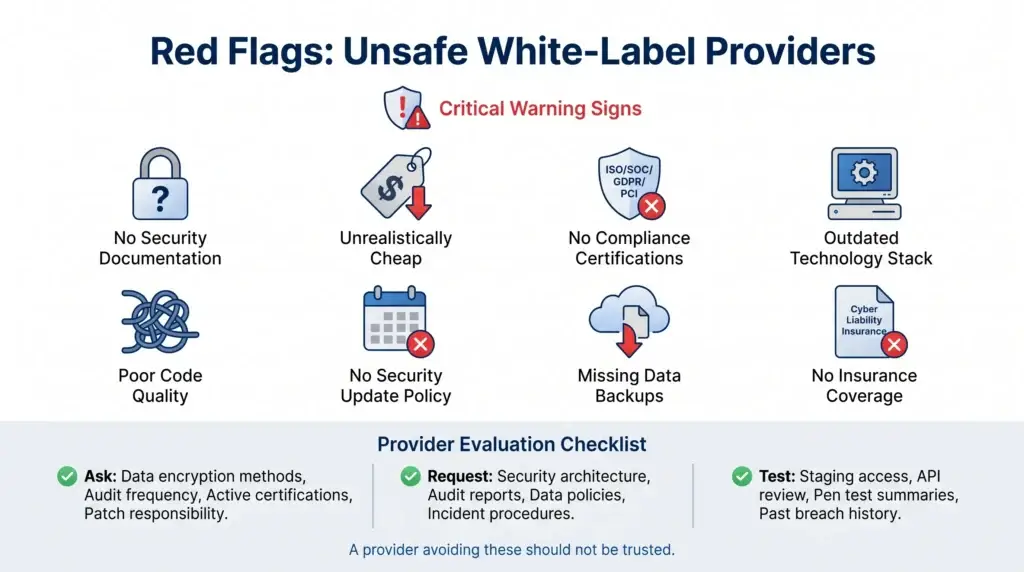
Critical Warning Signs
Not all white-label providers operate at enterprise security standards. Many risks become visible if you know what to look for.
No Security Documentation
If a provider cannot clearly explain how data is protected, it usually means security was never properly designed.
Unrealistically Cheap Pricing
Security infrastructure, audits, and compliance cost money. Extremely low pricing often indicates shortcuts in encryption, testing, or monitoring.
No Compliance Certifications
Lack of ISO, SOC, GDPR, or PCI alignment is a major risk, especially for transaction-heavy apps.
Outdated Technology Stack
Old frameworks and unsupported libraries introduce known vulnerabilities that attackers actively exploit.
Poor Code Quality
Messy architecture, lack of documentation, and monolithic codebases are harder to secure and audit.
No Security Update Policy
Apps without regular patch cycles quickly become vulnerable as new threats emerge.
Missing Data Backup Systems
Without encrypted backups, recovery after incidents becomes slow or impossible.
No Insurance Coverage
Providers unwilling to carry cyber liability insurance expose clients to full financial risk.
White-Label Walmart App Provider Evaluation Checklist
Questions to Ask
- How is user and payment data encrypted?
- How often are security audits conducted?
- What certifications does the platform currently maintain?
- Who is responsible for applying security patches?
Documents to Request
- Security architecture overview
- Compliance and audit reports
- Data protection policies
- Incident response procedures
Testing & Verification
- Staging environment access for security testing
- API documentation review
- Penetration test summaries
Due Diligence Steps
- Verify past breach history
- Review update and support SLAs
- Confirm data residency options
A provider that avoids these discussions should not be trusted with a Walmart-style marketplace app.
Read more : – Walmart App Features Explained
Best Practices for Secure White-Label Walmart App Implementation
Pre-Launch Security Practices
Security must be built before the app goes live, not patched later.
Security Audit Process
Conduct a full code and infrastructure audit to identify vulnerabilities before real users access the platform.
Code Review Requirements
Ensure secure coding standards are followed, including input validation, authentication checks, and error handling.
Infrastructure Hardening
Cloud servers should be protected with firewalls, intrusion detection systems, and restricted access policies.
Compliance Verification
Confirm that GDPR, PCI DSS, and other applicable regulations are fully implemented and documented.
Staff Security Training
Admin users and support teams must understand access control, data handling, and breach prevention practices.
Post-Launch Security Monitoring
Security does not end at launch. Continuous oversight is critical.
Continuous Monitoring
Real-time monitoring helps detect suspicious activity before it escalates into breaches.
Regular Updates and Patches
Security vulnerabilities evolve constantly. Timely updates prevent exploitation of known issues.
Incident Response Planning
A defined response plan ensures fast containment, communication, and recovery during incidents.
User Data Management
Clear retention, deletion, and anonymization policies reduce long-term data exposure.
Backup and Recovery Systems
Encrypted, automated backups ensure business continuity after failures or attacks.
Secure Implementation Timeline Overview
- Pre-launch audit and testing
- Compliance validation
- Controlled production rollout
- Ongoing monitoring and updates
- Quarterly security reviews
A structured security timeline significantly reduces long-term risk for white-label Walmart apps.
Global Cost of Development for a Walmart-Like App
Walmart-Like Marketplace App Development — Market Price by Tech Stack
The tech stack affects product browsing, checkout speed, vendor management, payment security, and order tracking in a Walmart-like marketplace app. PHP/Laravel works well for cost-effective e-commerce launches, Node.js/React.js supports faster cart updates, inventory sync, and real-time notifications, while Go microservices suit large retail platforms with high traffic, secure transactions, and multi-vendor operations.
PHP/Laravel is often the most practical choice for launching a Walmart-like marketplace quickly and affordably. Node.js/Python fits better when real-time inventory, seller activity, and data-heavy shopping workflows become more important, while Go microservices are better suited for enterprise-scale retail platforms with higher concurrency and more complex infrastructure needs.
These values reflect global development cost estimates. Final pricing varies based on product catalogs, seller panels, checkout flow, payment gateways, order tracking, security layers, compliance needs, admin controls, and platform complexity.
Miracuves Walmart-Like App Solution Cost and Tech Stack
Miracuves Pricing for a Walmart-Like Multi-Vendor Retail and Grocery App developed in PHP/Laravel with Flutter Apps for $2,499 USD (One-Time Price) in just 6 days
Get a fully developed, deployment-ready retail marketplace platform modeled after Walmart. Built on a stable PHP foundation, this complete package includes everything you need to launch and scale an online shopping app for groceries, retail products, household items, electronics, fashion, and multi-category commerce:
- Core Workflows: Customer registration, product browsing, seller onboarding, category management, cart checkout, order placement, inventory management, order tracking, returns, refunds, and customer notifications.
- Built-in Revenue Logic: Seller commissions, product listing fees, featured product placements, delivery charges, promotional campaigns, subscription-based seller plans, marketplace service fees, and advertising options.
- Management Hub: Centralized admin dashboard, customer management, seller management, product approval, inventory control, order monitoring, payment records, refund handling, return requests, dispute management, and marketplace analytics.
- Launch-Ready: Fully prepared for your custom branding, configuration, payment gateway setup, product category setup, seller onboarding, delivery settings, and immediate market entry.
Why Is Walmart-Like App Development More Affordable?
Most large retail marketplace apps become expensive when businesses choose fully custom development from scratch. A Walmart-style platform usually needs customer apps, seller panels, product catalogs, inventory logic, order management, payments, shipping workflows, returns, refunds, coupons, reviews, and admin controls. Building all of this separately can increase both development cost and launch time.
We took a smarter, more practical approach:
You Aren’t Paying for Ground-Up Development: Our retail marketplace engine is already developed, tested, and ready to deploy. You skip the inflated cost and long waiting period usually required for building a Walmart-style platform from scratch.
The Power of PHP: We built this solution on a reliable and cost-effective PHP architecture. This keeps the upfront price affordable while supporting essential commerce workflows such as product listings, seller management, checkout, payments, inventory control, order tracking, returns, refunds, and admin operations.
You get a launch-ready Walmart-like retail marketplace with practical multi-vendor commerce features, source code access, and faster deployment without the high custom development price tag.
Note: This cost is for the solution, re-branding, deployment, and source code only.
Legal & Compliance Considerations
Regulatory Requirements by Region
Operating a white-label Walmart app across regions introduces multiple legal obligations.
Data Protection Laws
- GDPR for European users
- CCPA and CPRA for US residents
- DPDP Act for India
Each law governs how user data is collected, stored, processed, and deleted.
Industry-Specific Regulations
Marketplace apps must also comply with consumer protection, digital payments, and e-commerce laws specific to each country.
User Consent Management
Apps must record explicit consent for data collection, cookies, and marketing communications.
Privacy Policy Requirements
Policies should clearly explain data usage, retention, third-party sharing, and user rights.
Terms of Service Essentials
These define acceptable use, liabilities, dispute resolution, and jurisdiction.
Liability Protection Strategies
Legal exposure increases when handling transactions and third-party sellers.
Insurance Requirements
Cyber liability insurance helps cover breach-related costs, legal claims, and recovery expenses.
Legal Disclaimers
Clear disclaimers reduce risk by defining platform responsibilities and limitations.
User Agreements
Seller and buyer agreements must outline data usage, security responsibilities, and penalties.
Incident Reporting Protocols
Regulations require timely breach notifications to authorities and affected users.
Compliance Monitoring
Ongoing compliance reviews ensure the app adapts to legal changes.
Regional Compliance Checklist Summary
- GDPR-compliant data handling for EU
- CCPA and CPRA alignment for US users
- Local data protection law adherence in Asia and Middle East
- Payment regulations compliance in operating regions
Ignoring legal compliance is one of the fastest ways to shut down a marketplace app.
Read more : – How to Hire the Best Walmart Clone Developer
Why Miracuves White-Label Walmart App Is Your Safest Choice
Miracuves Security-First Architecture
Miracuves approaches white-label Walmart app development with security as a foundation, not an add-on. Every app is built using enterprise-grade architecture designed to protect data, transactions, and platform integrity from day one.
Enterprise-Grade Security Controls
Miracuves white-label Walmart apps are designed with:
Hardened Infrastructure
Secure cloud environments with restricted access, firewalls, and continuous threat monitoring reduce exposure to attacks.
Encrypted Data Handling
All sensitive data is protected using encryption during transmission and storage, minimizing breach impact.
Secure Payment Processing
PCI DSS–aligned payment flows ensure financial data is never exposed or mishandled.
Regular Security Audits
Ongoing internal and third-party audits help identify and fix vulnerabilities before they become risks.
Compliance by Default
Apps are designed to meet GDPR and CCPA requirements from the start, reducing legal and operational stress.
Continuous Security Updates
Regular patches and updates ensure protection against evolving threats.
24/7 Monitoring
Active monitoring helps detect suspicious behavior early and enables faster incident response.
Insurance Coverage
Miracuves-backed platforms include liability considerations that protect businesses from unexpected security incidents.
Why Businesses Trust Miracuves
Miracuves has successfully delivered 9k+ secure platforms across industries without any major reported security breaches. This track record reflects disciplined security practices, not luck.
Final Thought
Do not compromise on security. Miracuves white-label Walmart app solutions come with enterprise-grade protection built in. Talk to Our Security Experts Now and understand why businesses trust Miracuves for safe, compliant marketplace platforms.
Choosing a security-first provider like Miracuves reduces risk, protects user trust, and creates a foundation for long-term growth. Safety is not a feature. It is the backbone of a successful marketplace app.
FAQs
1. How secure is a white-label Walmart app compared to custom development?
A well-built white-label Walmart app can be as secure as custom development when it follows certified security standards, regular audits, and secure infrastructure practices.
2. What happens if there is a security breach?
A secure platform should have an incident response plan, immediate containment steps, regulatory reporting procedures, and recovery mechanisms in place.
3. Who is responsible for security updates?
The white-label app provider is responsible for core security updates, while the business ensures operational security practices are followed.
4. How is user data protected in a white-label Walmart app?
User data is protected through encryption, role-based access control, secure servers, and strict compliance with data protection laws.
5. What compliance certifications should I look for?
ISO 27001, SOC 2 Type II, GDPR, CCPA, and PCI DSS are essential for a secure Walmart-style marketplace app.
6. Can white-label apps meet enterprise security standards?
Yes. With proper architecture, audits, and monitoring, white-label apps can meet and maintain enterprise-grade security levels.
7. How often should security audits be conducted?
Security audits should be performed at least annually, with continuous monitoring and periodic vulnerability assessments.
8. What is included in the Miracuves security package?
Miracuves provides encrypted data handling, compliance-ready architecture, regular audits, monitoring, and secure payment processing.
9. How is security handled across different countries?
Security is managed through region-specific compliance, data residency controls, and adaptable privacy policies.
10. What insurance is needed for app security?
Cyber liability insurance is recommended to cover data breaches, legal claims, and recovery costs.
Related Articles:
Miracuves is an independent software development company. We are not affiliated with, connected to, sponsored by, or endorsed by any company or product named in this article.
Terms such as “X Clone” are used descriptively. It is how the software industry refers to building a platform with functionality comparable to a known service, and how clients search for it.
The entire design and codebase of our products is built by our own team. Our products contain no code, design, graphics, or content originating from any third-party website or applications.
All third-party names and marks referenced in this article are the property of their respective owners, referenced solely to identify the services discussed.