


Key Takeaways
What You’ll Learn
- Leonardo AI is an AI-powered generative content platform designed for creating images, concept art, game assets, illustrations, and visual designs using text prompts and machine learning models.
- The platform simplifies professional asset generation workflows by helping creators produce high-quality visuals faster without advanced manual design processes.
- AI-generated asset creation is the platform’s biggest advantage because users can rapidly generate game art, marketing visuals, creative concepts, and production-ready content.
- Leonardo AI supports creators, designers, marketers, and game developers across concept design, storytelling, branding, digital media, and creative production workflows.
- The biggest takeaway for founders is that AI creative platforms scale successfully when visual quality, automation, creator productivity, and workflow flexibility work together.
Stats That Matter
- The article positions Leonardo AI as a next-generation AI image generation platform focused on creative asset production, AI-assisted design, and generative visual workflows.
- Core features include text-to-image generation, AI art creation, custom model training, image upscaling, asset generation, and creative editing tools.
- The platform focuses heavily on gaming and creative industries by helping users generate concept art, character designs, environments, and production assets faster.
- AI automation significantly reduces production time because creators can generate multiple design variations and visual concepts without building everything manually.
- The broader opportunity is AI-assisted visual production where businesses and creators increasingly rely on generative AI for scalable design, branding, and digital content creation.
Real Insights
- Leonardo AI succeeds because it accelerates professional asset creation allowing creators to move from ideas to polished visual concepts much faster than traditional workflows.
- The strongest value comes from creative scalability because AI-generated visuals allow teams to experiment rapidly while reducing production bottlenecks.
- Custom AI models improve creator flexibility by enabling businesses and artists to generate visuals aligned with specific styles, branding, or project requirements.
- User-friendly workflows directly affect adoption since creators increasingly prefer AI tools that combine high-quality output with simple interfaces and faster iteration.
- For entrepreneurs, the biggest lesson is to build a Leonardo AI-style creative platform around generative image automation, scalable rendering infrastructure, creator-focused workflows, and AI-assisted asset production systems.
Imagine designing game assets, concept art, or product visuals with consistent style and fine control—without spending hours in complex design software. You describe what you want, adjust a few creative controls, and generate polished visuals that feel production-ready. That’s exactly where Leonardo AI fits in.
Leonardo AI is an AI-powered image generation platform built for creators, designers, and game developers who need more control and consistency than basic text-to-image tools. It goes beyond simple prompting by offering fine-tuning options, style control, and asset-focused workflows.
What sets Leonardo AI apart is its focus on professional-grade creative output. Instead of just generating one-off images, it helps users build repeatable visual styles, making it especially useful for games, branding, and long-term creative projects.
By the end of this guide, you’ll understand what Leonardo AI is, how it works step by step, its business model, key features, the technology behind it, and why many founders aim to build Leonardo-AI-like creative platforms—and how Miracuves can help bring that vision to life.
What Is Leonardo AI? The Simple Explanation
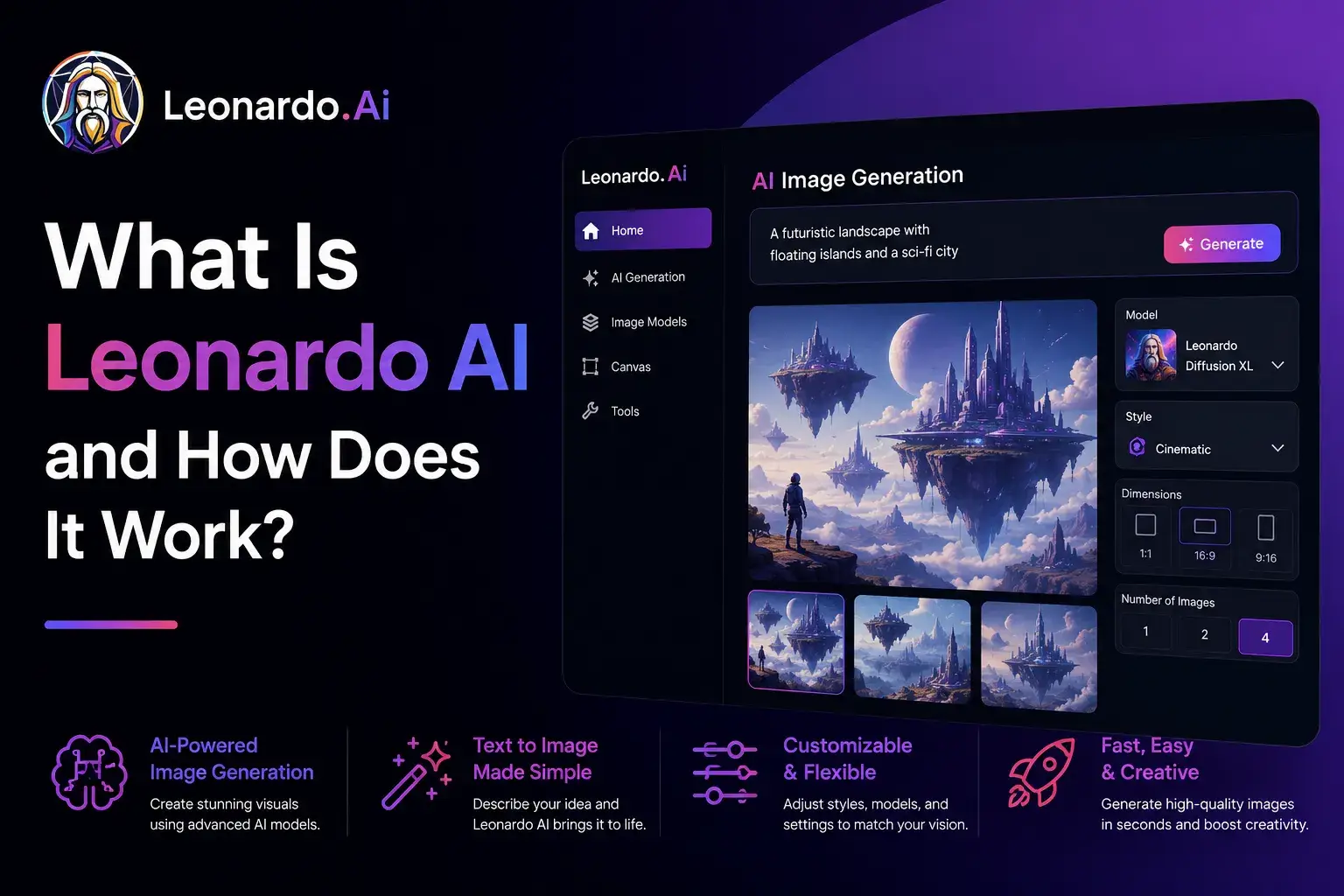
Leonardo AI is an AI image generation platform built for creators who need control, consistency, and production-ready visuals. In simple terms, it helps users generate high-quality images from text prompts while giving them more creative knobs to adjust style, detail, and output behavior than basic AI art tools.
The Core Problem Leonardo AI Solves
Many AI image generators are great for experimentation but fall short when users need consistent results for real projects. Leonardo AI solves this by:
- Offering fine-grained control over image generation
- Supporting repeatable styles across multiple images
- Producing visuals suitable for games, branding, and assets
- Reducing manual design time while maintaining quality
It bridges the gap between quick AI art and professional creative workflows.
Target Users and Use Cases
Leonardo AI is commonly used by:
• Game developers creating characters and environments
• Designers building concept art and mood boards
• Creators producing consistent visual themes
• Product teams prototyping visuals
• Artists experimenting with controlled AI styles
Current Market Position
Leonardo AI is positioned as a creator-focused AI art platform. It appeals to users who want more than casual AI images and need outputs that can actually be reused in production pipelines.
Why It Became Successful
Leonardo AI gained traction because it respected how creators work. By prioritizing control, consistency, and asset generation, it attracted professionals who found simpler tools limiting
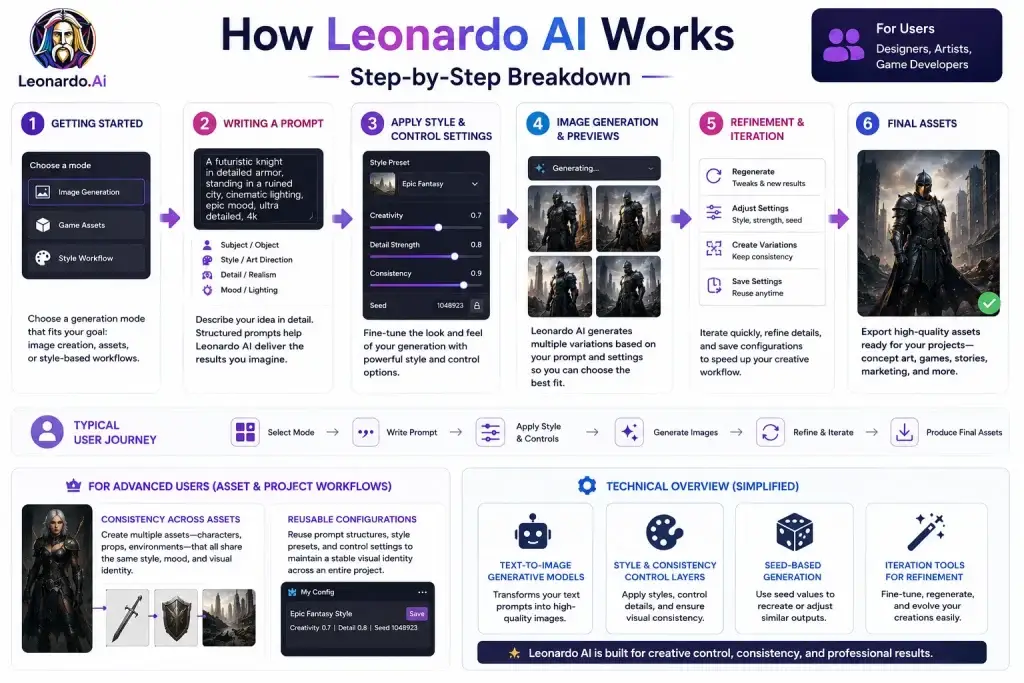
How Leonardo AI Works — Step-by-Step Breakdown
For Users (Designers, Artists, Game Developers)
Getting started
Users begin by choosing a generation mode inside the Leonardo AI interface. This can be standard image generation, asset-focused creation, or style-based workflows depending on the project goal.
Writing a prompt
Users describe what they want to create using text, similar to other AI image tools. Prompts often include:
- Subject or object (character, environment, item)
- Visual style or art direction
- Level of detail and realism
- Mood, lighting, or color tone
Leonardo AI is designed to respond well to structured, intentional prompts, making it suitable for professional use.
Applying style and control settings
This is where Leonardo AI stands out. Users can control:
- Style presets or custom styles
- Image consistency across generations
- Detail strength and creativity level
- Seed values to reproduce similar outputs
These controls help generate images that look like part of the same visual universe.
Image generation and previews
Once settings are applied, the AI generates images that align closely with the prompt and style configuration. Users typically receive multiple outputs to compare and choose from.
Refinement and iteration
After generation, users can:
- Regenerate with small prompt tweaks
- Adjust style or control parameters
- Create variations while maintaining consistency
- Save settings for future reuse
This makes Leonardo AI ideal for iterative design workflows.
Typical user journey
User selects generation mode → writes prompt → applies style controls → generates images → refines settings → produces final assets.
For Advanced Users (Asset & Project Workflows)
Consistency across assets
Leonardo AI supports workflows where multiple assets—characters, props, environments—need to look cohesive. This is especially useful in games and branded creative projects.
Reusable configurations
Users can reuse prompt structures and control settings to maintain a stable visual identity across an entire project.
Technical Overview (Simplified)
Leonardo AI works by combining:
- Text-to-image generative models
- Style and consistency control layers
- Seed-based generation for repeatability
- Iteration tools for refinement
The system is optimized for creative control, not just novelty.
Leonardo AI’s Business Model Explained
How Leonardo AI Makes Money
Leonardo AI operates on a freemium, creator-focused SaaS model. The platform is designed to attract users with free access while monetizing advanced creative needs through paid plans.
Its main revenue streams include:
- Subscription plans: Monthly plans that unlock higher generation limits, faster processing, and advanced features
- Credit-based usage: Image generations consume credits, with paid users receiving larger credit pools
- Pro creator plans: Designed for professionals who need consistent, high-volume asset creation
- Team and commercial use tiers: Supporting studio-style workflows and business usage
This model aligns pricing with creative output and usage intensity.
Pricing Structure
Leonardo AI pricing typically depends on:
- Monthly subscription tier
- Number of image generation credits
- Speed and priority of generation
- Access to advanced tools like style consistency and fine control
Free users can experiment, while serious creators upgrade as their needs grow.
Fee Breakdown
- Monthly or annual subscription fees
- Credit consumption per generation
- No advertising-based monetization
- No commissions on created assets
This keeps pricing predictable and creator-friendly.
Market Size and Demand
Demand for Leonardo AI-style platforms is driven by:
- Growth in game development and digital art
- Rising need for rapid asset creation
- Indie creators and small studios scaling production
- Brands needing consistent visual identity
- Designers seeking AI tools that fit real workflows
Leonardo AI sits between casual AI art tools and full design suites.
Profitability Insights
Leonardo AI improves profitability by:
- Encouraging recurring subscriptions
- Scaling one core system across many creators
- Focusing on high-retention professional users
- Offering premium control features that justify upgrades
Revenue Model Breakdown
| Revenue Stream | Description | Who Pays | Nature |
|---|---|---|---|
| Subscriptions | Monthly creator plans | Users | Recurring |
| Credit Usage | Image generation limits | Creators | Usage-based |
| Pro Plans | Advanced workflows | Professionals | Tiered |
| Team Use | Studio-level access | Businesses | Contract |
Read More :- How to Develop an AI Chatbot Platform
Key Features That Make Leonardo AI Successful
Advanced style control
Leonardo AI gives creators more control over visual style than most basic AI image tools. Users can guide the look and feel of outputs so images stay consistent across multiple generations.
Consistency across assets
One of Leonardo AI’s biggest strengths is maintaining visual consistency. This is critical for projects like games, branding, and product design where multiple assets must look like they belong together.
Asset-focused workflows
Leonardo AI is designed for asset creation, not just one-off images. Characters, props, environments, and visual elements can all be generated with repeatable quality.
Seed-based reproducibility
By using seed values, creators can reproduce similar images or continue evolving a design without starting from scratch each time.
Fine-tuning creative intensity
Users can adjust how creative or strict the AI should be, balancing originality with adherence to the prompt and style.
High-quality outputs
The platform emphasizes polished, production-ready visuals that can move quickly into downstream workflows like game engines or design tools.
Iterative refinement tools
Leonardo AI supports fast iteration—users can tweak prompts, settings, and styles until the output matches their vision.
Creator-friendly interface
The UI is built around creative workflows, making it easier to manage projects, revisit past generations, and reuse settings.
Community-driven inspiration
Users often share prompts, styles, and workflows, helping others learn how to get better results faster.
Professional appeal
Leonardo AI attracts serious creators who need reliability, repeatability, and control rather than purely experimental outputs.
The Technology Behind Leonardo AI
Tech stack overview (simplified)
Leonardo AI is built on text-to-image generative models enhanced with additional control layers for style, consistency, and reproducibility. Instead of focusing only on novelty, the technology is optimized for repeatable, production-quality output.
At a high level, the stack includes:
- Core image generation models
- Prompt interpretation and weighting logic
- Style and consistency control layers
- Seed-based generation for repeatability
- Upscaling and refinement pipelines
- Cloud infrastructure for scalable generation
How prompts are interpreted
When a user enters a prompt, Leonardo AI:
- Identifies the main subject and intent
- Applies style presets or custom style rules
- Balances creativity vs precision based on user settings
- Uses stored parameters to guide output consistency
This ensures the image aligns with both the idea and the chosen visual direction.
Style and consistency layers
Leonardo AI adds extra logic on top of base models to maintain visual coherence. These layers help:
- Keep character features consistent across images
- Maintain similar lighting, color, and composition
- Reduce randomness when consistency is required
- Support asset sets that feel unified
This is especially important for games, branding, and multi-image projects.
Seed-based reproducibility
Seed values act like a creative anchor. By reusing or adjusting seeds, users can:
- Recreate similar images
- Make controlled variations
- Evolve a design gradually
- Avoid starting from zero every time
This is a major advantage over purely random generation.
Iteration and refinement pipeline
Leonardo AI is designed for iteration. Each generation feeds into the next by allowing:
- Parameter adjustments without prompt rewrites
- Small refinements instead of full regeneration
- Progressive improvement toward a final asset
This mirrors how designers work in real production environments.
Performance and scalability
Because image generation is compute-heavy, Leonardo AI relies on scalable cloud infrastructure to:
- Handle many simultaneous generations
- Keep wait times predictable
- Offer priority processing for paid users
- Balance cost with output quality
Data handling and safeguards
The platform applies content and usage controls to reduce harmful or disallowed outputs while still allowing creative freedom—important for a creator-driven environment.
Why this technology matters for business
Leonardo AI’s technology shows how adding control layers on top of generative models can turn experimental AI into a reliable creative tool. For businesses, this means faster asset creation, consistent branding, and lower production costs without sacrificing quality.
Leonardo AI’s Impact & Market Opportunity
Industry impact
Leonardo AI has had a strong impact by pushing AI image generation beyond experimentation into production-ready creative workflows. It showed that creators don’t just want beautiful images—they want control, consistency, and the ability to reuse outputs across real projects.
This has been especially influential in areas like game development, concept art, and branding, where visual coherence matters as much as creativity.
Market demand and growth drivers
Demand for Leonardo AI–style platforms is driven by:
- Growth of indie game studios and digital creators
- Rising demand for fast, scalable asset production
- Businesses needing consistent visual identities
- Cost and time pressures on creative teams
- Increased acceptance of AI-assisted design workflows
As content demands increase, tools that blend speed with control become essential.
User segments and behavior
Leonardo AI attracts:
- Game developers building characters and environments
- Designers creating reusable visual assets
- Artists producing themed collections
- Startups prototyping visuals quickly
- Creative professionals seeking efficiency
A common behavior pattern is project-based usage. Users return repeatedly to build asset sets rather than generating one-off images.
Community and creator ecosystem
The platform benefits from creators sharing techniques, styles, and workflows. This community-driven learning improves output quality and encourages long-term engagement.
Future direction
Leonardo AI-style platforms are evolving toward:
- Stronger consistency tools for long projects
- Better asset management and organization
- Team collaboration features
- Integration into game engines and design tools
- Expansion into animation and 3D workflows
Opportunities for entrepreneurs
There are strong opportunities to build Leonardo-AI-inspired platforms for:
- Game asset generation
- Brand and marketing visual systems
- Design tools for SMBs
- Industry-specific creative platforms
- AI-assisted production pipelines
This growing demand explains why control-focused AI creativity tools are becoming a major category in the generative AI market.
Building Your Own Leonardo-AI-Like Platform
Why businesses want Leonardo-style creative AI platforms
Leonardo AI proves that creators value control and consistency just as much as creativity. Businesses are drawn to this model because:
- Production teams need repeatable visual styles
- Games, brands, and products require consistent assets
- AI can dramatically reduce design time and cost
- Creators are willing to pay for professional-grade control
- Subscription models scale well with creative demand
This makes Leonardo-style platforms ideal for long-term creative workflows, not just experimentation.
Key considerations before development
If you plan to build a Leonardo-AI-like platform, focus on:
- Target audience (game studios, designers, brands, creators)
- Asset types (characters, environments, props, branding visuals)
- Style control and consistency mechanisms
- Seed-based reproducibility
- Credit or usage-based pricing
- Content moderation and licensing clarity
- Project and asset management features
Clear positioning around production readiness is critical.
Read Also :- How to Market an AI Chatbot Platform Successfully After Launch
Miracuves Leonardo AI-Like Creative AI Platform Solution Cost and Tech Stack
Miracuves Pricing for a Leonardo AI-Like Creative AI Platform developed using JavaScript architecture is available on request. Final pricing depends on AI image generation workflows, rendering infrastructure, generative AI integrations, media processing systems, scalability requirements, storage infrastructure, and deployment scope. Estimated delivery timeline: 30 to 90 days. For custom architecture planning, enterprise AI workflows, and feature-specific pricing — Contact us.
Get a fully developed, custom AI-powered creative platform modeled around Leonardo AI-style generative design and image creation capabilities. Built on a modern JavaScript foundation, this solution can be customized for AI startups, game studios, content creators, design agencies, SaaS businesses, marketing teams, educational platforms, and enterprise media solutions.
- Core Workflows: AI image generation, text-to-image creation, concept art generation, AI-powered editing, asset generation, prompt-based creative workflows, media management, workspace collaboration, export systems, and AI-assisted design automation.
- Built-in Revenue Logic: Subscription plans, AI generation credits, premium rendering access, enterprise licensing, API monetization, creator memberships, team collaboration plans, and white-label SaaS monetization.
- Management Hub: Admin dashboard, user management, rendering analytics, AI usage tracking, project monitoring, subscription management, moderation controls, API monitoring, storage management, and reporting systems.
- AI-Ready Architecture: Prepared for generative AI models, scalable rendering systems, cloud-based media processing, AI workflow orchestration, secure content management, real-time generation pipelines, and enterprise-grade scalability.
Why Does a Leonardo AI-Like Platform Require JavaScript Architecture?
A modern AI creative platform requires more than a standard design tool. It handles AI prompts, rendering systems, media processing, generative workflows, user workspaces, collaboration systems, subscription management, AI request handling, and scalable creative operations. A modern JavaScript architecture helps manage these highly interactive AI and media workflows smoothly across creators, teams, admins, and AI systems.
We recommend JavaScript architecture for this type of platform because:
- Built for Interactive AI Creative Workflows: JavaScript supports live rendering updates, dynamic media previews, AI-powered generation systems, project collaboration, and smooth user interactions.
- Advanced Frontend Experience: React.js or similar JavaScript frameworks can power modern AI creative dashboards, asset libraries, prompt interfaces, editing panels, rendering systems, and admin controls.
- Scalable Backend Logic: JavaScript-based backend systems can efficiently manage AI rendering queues, media storage, user sessions, subscription limits, project history, API requests, and high-volume AI processing.
- Flexible Integration Layer: The platform can connect with generative AI APIs, cloud rendering providers, storage systems, analytics tools, payment gateways, authentication systems, editing frameworks, and third-party creative services.
You get a scalable AI-powered creative platform designed for intelligent content production, creative automation, recurring revenue generation, and long-term AI product growth.
Tech Stack
We preferably will be using JavaScript for building the entire solution (Node.js/Nest.js/Next.js for the web backend + frontend) and Flutter / React Native for mobile apps, considering rendering performance, scalability, AI workflow efficiency, and the benefit of one codebase serving multiple platforms.
Note: Final pricing depends on selected AI models, rendering infrastructure, media storage requirements, scalability goals, usage limits, security layers, and custom feature development.
Essential features to include
A strong Leonardo-style MVP should include:
- Text-to-image generation with prompt control
- Style presets and custom style saving
- Seed-based reproducibility
- Asset-level consistency tools
- Image variation and refinement options
- Credit-based usage system
- Creator-friendly dashboard
High-impact extensions to add later:
- Team collaboration and shared projects
- Brand or game-specific style libraries
- Asset tagging and organization
- Commercial licensing management
- Expansion into animation or 3D assets
Read More :- AI Chat Assistant Development Costs: What Startups Need to Know
Conclusion
Leonardo AI highlights a crucial shift in AI creativity—from novelty to production reliability. By giving creators control over style, consistency, and iteration, it transforms AI image generation into a practical tool for real projects rather than just experimentation.
For founders and product builders, Leonardo AI shows that the future of creative AI lies in workflow-aware platforms. When AI understands how professionals actually create—step by step—it becomes an indispensable part of the creative process, not just an optional add-on.
FAQs :-
What is Leonardo AI used for?
Leonardo AI is used to generate consistent, high-quality images and assets for games, branding, design, and creative projects where visual control matters.
How does Leonardo AI make money?
Leonardo AI earns revenue through subscription plans and credit-based usage, offering higher limits and advanced features to paid users.
Is Leonardo AI free to use?
Leonardo AI typically offers a free tier for experimentation, with paid plans unlocking more credits, faster generation, and professional tools.
What makes Leonardo AI different from other AI image generators?
Leonardo AI focuses on style control, consistency, and asset workflows, making it more suitable for production use than casual AI art tools.
Can Leonardo AI create game assets?
Yes. Leonardo AI is widely used for characters, environments, props, and concept art in game development and related creative fields.
Does Leonardo AI support consistent styles across images?
Yes. Style presets, seed values, and control settings help maintain a cohesive visual identity across multiple images.
Is Leonardo AI suitable for professional designers?
Yes. Many professional designers and studios use Leonardo AI to speed up ideation and asset creation while maintaining creative control.
Can Leonardo AI outputs be used commercially?
Commercial usage depends on the subscription plan and licensing terms, but many creators use Leonardo AI for professional and commercial projects.
Can I build a platform like Leonardo AI?
Yes. Leonardo-AI-style platforms can be built by combining image generation models with style-control layers, reproducibility tools, and creator-focused workflows.
How can Miracuves help build a Leonardo-AI-like platform?
Miracuves helps founders build creator-focused AI image platforms with style consistency engines, asset workflows, subscription billing, and scalable infrastructure—allowing rapid launch and long-term growth.