


Key Takeaways
What You’ll Learn
- A DHgate-style app must protect buyers, sellers, payments, orders, and marketplace data.
- Main risks include fake sellers, payment fraud, account takeover, and data leaks.
- Secure login, seller checks, encrypted payments, and API protection reduce major risks.
- Regular audits, updates, backups, and monitoring help keep the platform safe.
- Strong security builds trust across buyers, vendors, and marketplace operations.
Stats That Matter
- DHgate-style marketplace apps handle customer data, vendor profiles, product listings, payments, and shipment details.
- Common threats include fake listings, refund abuse, bot activity, unsafe APIs, and checkout fraud.
- Secure payments, role-based access, fraud checks, and cloud protection help reduce security gaps.
- PCI DSS, GDPR, ISO 27001, and SOC 2 support safer ecommerce marketplace operations.
- Security testing, monitoring, and patch updates protect the app after launch.
Real Insights
- Marketplace security should be built from the start, not added after launch.
- Seller verification helps reduce fake vendors and product fraud.
- Secure APIs and payment gateways protect key buying and selling workflows.
- Monitoring helps detect suspicious accounts, orders, refunds, and transactions early.
- The strongest DHgate-style apps combine secure code, verified sellers, safe payments, compliance, and maintenance.
You’ve heard the horror stories about data breaches, fake marketplaces, and stolen customer data.
When it comes to launching a white-label DHgate app, security is often the biggest concern. And rightly so.
In 2026, eCommerce platforms handle massive volumes of sensitive data—user identities, payment details, and supplier transactions. One weak link can lead to serious financial and reputational damage. White-label apps are not inherently unsafe. With a trusted provider like Miracuves, their security is strengthened through expert development, regular updates, and reliable management practices.
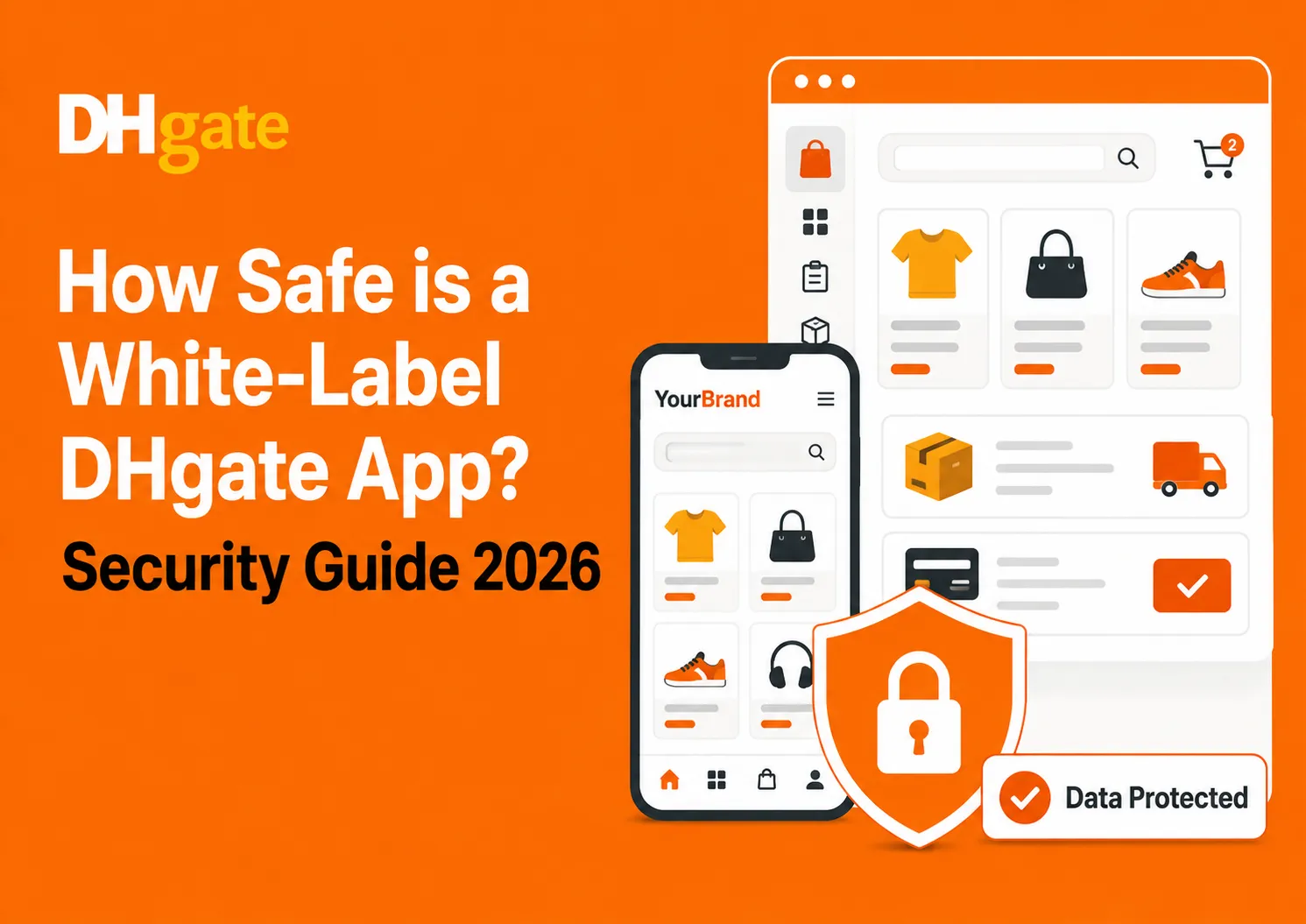
In this guide, you’ll get an honest assessment of white-label DHgate app security—along with practical steps to ensure your platform is safe, compliant, and trustworthy.
Understanding White-Label DHgate App Security Landscape
What White-Label Security Actually Means
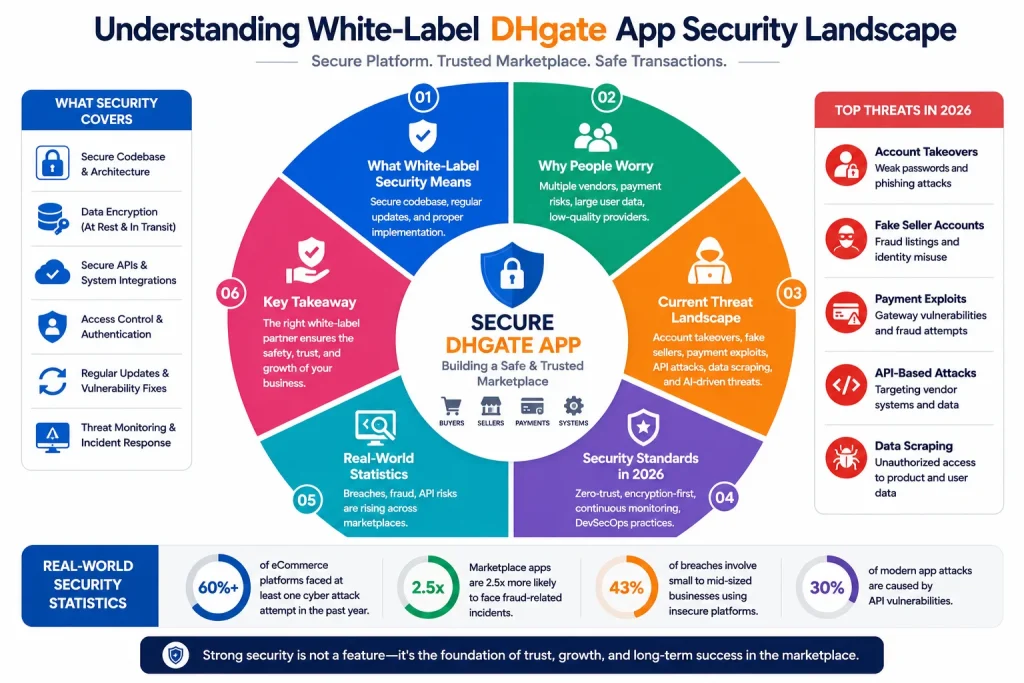
White-label security refers to how securely a pre-built app solution is developed, customized, and deployed for your business.
Unlike custom-built apps, the core structure is already created. So, security depends on:
- The original codebase quality
- How well the provider maintains updates
- Your implementation practices
A secure white-label DHgate app is not just about features—it’s about how data flows, how systems communicate, and how threats are handled.
Why People Worry About White-Label Apps
There are valid concerns, especially in marketplace apps like DHgate models:
- Multiple vendors increase attack surfaces
- Payment systems attract cybercriminals
- Large user databases are high-value targets
Also, low-cost providers often skip proper security practices, which fuels distrust.
Current Threat Landscape for DHgate-Type Platforms
Marketplace apps face more complex threats compared to standard apps. Common risks include:
- Account takeovers through weak authentication
- Fake seller accounts and fraud listings
- Payment gateway exploits
- API-based attacks targeting vendor systems
- Data scraping and unauthorized access
In 2026, attackers increasingly use automated bots and AI-driven attacks, making basic security measures insufficient.
Security Standards in 2026
Modern white-label apps are expected to follow strict global standards:
- Zero-trust architecture
- Encryption-first design
- Continuous security monitoring
- Secure DevOps (DevSecOps) practices
Security is no longer optional—it’s a baseline expectation.
Real-World Statistics on App Security Incidents
- Over 60% of eCommerce platforms reported at least one cyber attack attempt in the past year
- Marketplace apps are 2.5x more likely to face fraud-related incidents
- 43% of breaches involve small to mid-sized businesses using insecure platforms
- API vulnerabilities account for nearly 30% of modern app attacks
These numbers highlight one thing clearly: choosing the right white-label provider directly impacts your app’s safety.
Read more : – Business Model of DHgate : Complete Strategy Breakdown 2026
Key Security Risks & How to Identify Them
High-Risk Areas
Data Protection & Privacy
Marketplace apps like a white-label DHgate app handle highly sensitive user data. This makes them a prime target.
Key concerns include:
- User Personal Information
Names, addresses, phone numbers, and order history must be securely stored and encrypted. - Payment Data Security
If payment handling is not PCI DSS compliant, it can lead to financial fraud and chargebacks. - Location Tracking Risks
Delivery tracking and logistics features expose real-time user location data. - GDPR/CCPA Compliance
Failure to comply can result in heavy penalties and legal action, especially if you operate globally.
Small mistake here can cost millions in fines and lost trust.
Technical Vulnerabilities
Even a well-designed app can fail if the technical foundation is weak.
- Code Quality Issues
Poorly written code leads to exploitable bugs and backdoors. - Server Security Gaps
Misconfigured servers can expose entire databases. - API Vulnerabilities
APIs connect vendors, users, and payment systems. Weak APIs are one of the biggest entry points for attackers. - Third-Party Integrations
Payment gateways, shipping APIs, and analytics tools can introduce external risks.
In 2026, API attacks are among the fastest-growing threats.
Business Risks
Security is not just technical. It directly affects your business survival.
- Legal Liability
Data breaches can lead to lawsuits and compliance violations. - Reputation Damage
One incident can destroy user trust permanently. - Financial Losses
Fraud, refunds, and downtime directly impact revenue. - Regulatory Penalties
Non-compliance with laws like GDPR can result in fines up to 4% of annual revenue.
Risk Assessment Checklist
Use this checklist before choosing or launching your white-label DHgate app:
- Is user data encrypted at rest and in transit?
- Does the app follow GDPR/CCPA guidelines?
- Are payment systems PCI DSS compliant?
- Is the backend protected against unauthorized access?
- Are APIs secured with authentication and rate limiting?
- Are third-party services vetted for security?
- Is there a regular vulnerability testing process?
- Does the provider offer security documentation?
If you cannot confidently answer these, the app may not be safe.
Read more : – How to Start an International Retail Platform Business
Security Standards Your White-Label DHgate App Must Meet
Essential Certifications
To ensure your white-label DHgate app is secure, it must align with globally recognized certifications. These are not optional anymore in 2026.
- ISO 27001 Compliance
Ensures a structured information security management system is in place. - SOC 2 Type II
Validates how well your app handles customer data over time, not just at a single point. - GDPR Compliance
Mandatory if you handle data of European users. Focuses on data privacy and user rights. - HIPAA (if applicable)
Required only if your platform handles health-related data. - PCI DSS for Payments
Critical for any app processing online payments. Protects cardholder data.
Without these certifications, your app is exposed to both security and legal risks.
Technical Requirements
Certifications alone are not enough. Your app must meet strict technical standards.
- End-to-End Encryption
All data, especially user and payment data, must be encrypted during transmission and storage. - Secure Authentication (2FA / OAuth)
Users and vendors should have strong login protection. - Regular Security Audits
Frequent checks to identify vulnerabilities before attackers do. - Penetration Testing
Simulated attacks to test real-world security strength. - SSL Certificates
Ensures secure communication between users and servers. - Secure API Design
APIs must use authentication tokens, rate limiting, and encryption.
Security Standards Comparison Table
| Security Element | Basic App (Low Cost Providers) | Secure White-Label DHgate App |
|---|---|---|
| Data Encryption | Partial or missing | End-to-end encryption |
| Authentication | Password only | 2FA / OAuth enabled |
| Compliance Certifications | None | ISO, SOC 2, GDPR, PCI DSS |
| Security Testing | Rare or none | नियमित audits + pen testing |
| API Security | Weak or open endpoints | Token-based secure APIs |
| Payment Security | Third-party only | Fully PCI DSS compliant |
| Monitoring | Manual or none | 24/7 automated monitoring |
This comparison clearly shows that not all white-label apps are equal. Security depends on the provider’s standards and your implementation choices.
Red Flags: How to Spot Unsafe White-Label Providers
Warning Signs
Choosing the wrong provider is the biggest security mistake businesses make. Many risks can be identified early if you know what to look for.
- No Security Documentation
If a provider cannot explain their security architecture, it’s a major red flag. - Unusually Cheap Pricing Without Clarity
Low pricing often means compromised security, outdated tech, or no compliance investment. - No Compliance Certifications
Absence of ISO, SOC 2, or PCI DSS indicates weak security practices. - Outdated Technology Stack
Old frameworks and libraries are easier to exploit. - Poor Code Quality
Messy or unstructured code increases vulnerability risks. - No Security Updates Policy
Apps without regular updates become unsafe very quickly. - Lack of Data Backup Systems
Without backups, data loss can be permanent after an attack. - No Insurance Coverage
Serious providers always have cyber liability coverage.
Ignoring even one of these signs can lead to long-term problems.
Evaluation Checklist
Before finalizing a white-label DHgate app provider, follow this due diligence process.
Questions to Ask Providers
- How do you handle data encryption and storage?
- What security certifications do you currently hold?
- How often do you perform security audits?
- Do you offer 2FA and secure authentication methods?
- How do you handle API security?
- What is your incident response plan?
Documents to Request
- Security architecture documentation
- Compliance certificates (ISO, SOC 2, PCI DSS)
- Recent audit reports
- Data protection and privacy policies
- Penetration testing reports
Testing Procedures
- Conduct a third-party security audit
- Test login and authentication flows
- Validate API security endpoints
- Simulate basic attack scenarios
Due Diligence Steps
- Verify client case studies
- Check past security incidents
- Review update and maintenance history
- Confirm legal and compliance readiness
Taking time at this stage can prevent major losses later.
Best Practices for Secure White-Label DHgate App Implementation
Pre-Launch Security
Security should start before your app goes live. Fixing issues early is always cheaper and safer.
- Security Audit Process
Conduct a full audit of the app’s code, infrastructure, and integrations before launch. - Code Review Requirements
Ensure clean, well-documented, and vulnerability-free code. Avoid shortcuts. - Infrastructure Hardening
Secure servers with firewalls, access controls, and proper configurations. - Compliance Verification
Confirm that your app meets GDPR, PCI DSS, and other required standards. - Staff Training Programs
Your internal team should understand basic security practices and data handling rules.
A secure launch builds trust from day one.
Post-Launch Monitoring
Security is not a one-time task. Continuous monitoring is critical in 2026.
- Continuous Security Monitoring
Use automated tools to detect suspicious activity in real time. - Regular Updates and Patches
Keep frameworks, plugins, and systems updated to avoid known vulnerabilities. - Incident Response Planning
Have a clear plan for handling breaches, including communication and recovery steps. - User Data Management
Limit access to sensitive data and follow strict data handling policies. - Backup and Recovery Systems
Maintain regular backups to recover quickly in case of data loss or attacks.
Ignoring post-launch security is one of the biggest reasons apps get compromised.
Security Implementation Timeline
| Phase | Key Actions |
|---|---|
| Planning Stage | Define security requirements, choose compliant provider |
| Development Stage | Secure coding, API protection, encryption implementation |
| Pre-Launch | Security audit, penetration testing, compliance validation |
| Launch | Enable monitoring tools, secure deployment |
| Post-Launch | Continuous monitoring, updates, incident response, regular audits |
Following a structured approach ensures your white-label DHgate app remains secure at every stage.
Legal & Compliance Considerations
Regulatory Requirements
Running a white-label DHgate app means handling user data across multiple regions. Each region has its own legal framework, and ignoring them can lead to serious penalties.
- Data Protection Laws by Region
- Europe: GDPR requires strict data handling and user consent
- USA: CCPA focuses on consumer data rights
- India: DPDP Act (Digital Personal Data Protection) is now critical in 2026
- Other regions: Local privacy laws must be followed based on user base
- Industry-Specific Regulations
Marketplace apps must comply with eCommerce and financial transaction regulations. - User Consent Management
Users must clearly agree to how their data is collected, stored, and used. - Privacy Policy Requirements
A transparent privacy policy is legally mandatory. It should clearly explain:- Data collection practices
- Data usage
- Third-party sharing
- Terms of Service Essentials
Define rules for buyers, sellers, and platform responsibilities. This protects your business legally.
Non-compliance can result in fines, bans, or even shutdown of your app.
Liability Protection
Security incidents are not just technical failures—they are legal events.
- Insurance Requirements
Cyber liability insurance protects against financial loss due to breaches. - Legal Disclaimers
Clearly define platform limitations and responsibilities. - User Agreements
Strong agreements help reduce disputes and fraud risks. - Incident Reporting Protocols
You must report breaches within a defined time (e.g., 72 hours under GDPR). - Regulatory Compliance Monitoring
Laws change frequently. Your app must stay updated continuously.
Compliance Checklist by Region
| Region | Key Law / Regulation | What You Must Do |
|---|---|---|
| Europe | GDPR | User consent, data protection, breach reporting |
| USA | CCPA | Data access, opt-out options |
| India | DPDP Act | Data security, consent management |
| Global | PCI DSS | Secure payment processing |
| Global | ISO 27001 / SOC 2 | Information security management |
Legal compliance is not just about avoiding penalties. It directly impacts user trust and business credibility.
Why Miracuves White-Label DHgate App is Your Safest Choice
Miracuves Security Advantages
When it comes to launching a secure marketplace app, not all providers are built the same. Miracuves focuses on security from the ground up, not as an afterthought.
- Enterprise-Grade Security Architecture
Built with scalable and secure infrastructure designed to handle high-volume marketplace operations safely. - Regular Security Audits and Certifications
Continuous audits ensure that vulnerabilities are identified and fixed before they become threats. - GDPR/CCPA Compliant by Default
Data privacy is built into the system, helping you stay compliant across regions without extra effort. - 24/7 Security Monitoring
Real-time monitoring detects suspicious activities instantly, reducing response time. - Encrypted Data Transmission
All user and transaction data is protected using strong encryption protocols. - Secure Payment Processing
Fully aligned with PCI DSS standards to protect financial transactions. - Regular Security Updates
Frequent updates ensure protection against the latest threats in 2026. - Insurance Coverage Included
Additional layer of protection with cyber liability coverage.
Miracuves doesn’t just provide a white-label DHgate app. It delivers a secure ecosystem designed for long-term business growth.
Final Thought
Our 9k+ successful projects have maintained zero major security breaches. talk to our security expert and see why businesses trust Miracuves for safe, compliant platforms.
In 2026, users expect safe, transparent, and compliant platforms. One mistake can break trust instantly. Choosing the right provider, following best practices, and staying compliant are the keys to long-term success. A secure app doesn’t just protect your business—it builds credibility and growth.
FAQs
1. How secure is a white-label DHgate app vs custom development?
A well-built white-label app can be equally or more secure than custom apps if it follows proper standards and regular updates.
2. What happens if there’s a security breach?
You must activate your incident response plan, inform users, and report to authorities as per legal requirements.
3. Who is responsible for security updates?
Both provider and business owner share responsibility. The provider handles core updates, while you manage usage and configurations.
4. How is user data protected in white-label apps?
Through encryption, secure servers, access controls, and compliance with laws like GDPR and CCPA.
5. What compliance certifications should I look for?
ISO 27001, SOC 2 Type II, GDPR, and PCI DSS are essential.
6. Can white-label apps meet enterprise security standards?
Yes, if developed by a security-focused provider like Miracuves.
7. How often should security audits be conducted?
At least quarterly, with continuous monitoring in place.
8. What’s included in Miracuves security package?
Encryption, compliance readiness, 24/7 monitoring, secure payments, and regular updates.
9. How to handle security in different countries?
Follow regional laws like GDPR, CCPA, and DPDP, and implement global compliance practices.
10. What insurance is needed for app security?
Cyber liability insurance is recommended to cover financial and legal risks.
Related Articles