Key Takeaways
What You’ll Learn
- DHgate’s business model is built around cross-border B2B and B2C marketplace commerce connecting global buyers with manufacturers, wholesalers, and suppliers through digital trade infrastructure.
- The platform monetizes through marketplace-driven revenue streams including seller commissions, transaction fees, advertising, logistics support, and payment processing services.
- Supplier scalability is DHgate’s biggest competitive advantage because thousands of merchants and manufacturers continuously expand product variety and global trade activity.
- Cross-border logistics and payments improve marketplace retention through international shipping support, buyer protection systems, and secure transaction workflows.
- The biggest takeaway for founders is that global marketplace platforms scale successfully when supplier ecosystems, logistics infrastructure, secure payments, and digital commerce operations work together.
Stats That Matter
- The article positions DHgate as a large-scale cross-border commerce marketplace focused on wholesale trade, supplier ecosystems, and global digital retail operations.
- Core revenue comes from marketplace transaction activity including seller commissions, listing promotions, payment services, logistics coordination, and merchant subscriptions.
- Additional monetization comes from advertising and value-added seller services supporting supplier visibility, marketplace optimization, and operational commerce tools.
- The platform benefits from growing global eCommerce adoption as businesses and consumers increasingly rely on international sourcing and digital trade platforms.
- DHgate’s supplier ecosystem improves marketplace scalability because more sellers increase inventory diversity, trade activity, and customer acquisition opportunities.
Real Insights
- DHgate succeeds because it simplifies global supplier access allowing buyers and businesses to source products directly from manufacturers and wholesalers.
- The strongest growth driver is marketplace expansion because increasing supplier participation continuously improves inventory scale and trade opportunities.
- Cross-border logistics directly affect customer trust since shipping reliability, customs handling, and delivery visibility strongly influence international commerce experiences.
- Secure payment systems improve platform credibility because international buyers require trusted transactions, dispute resolution, and marketplace protection mechanisms.
- For entrepreneurs, the biggest lesson is to build a DHgate-style marketplace platform around supplier ecosystems, cross-border logistics, secure payment infrastructure, scalable commerce operations, and international digital trade enablement.
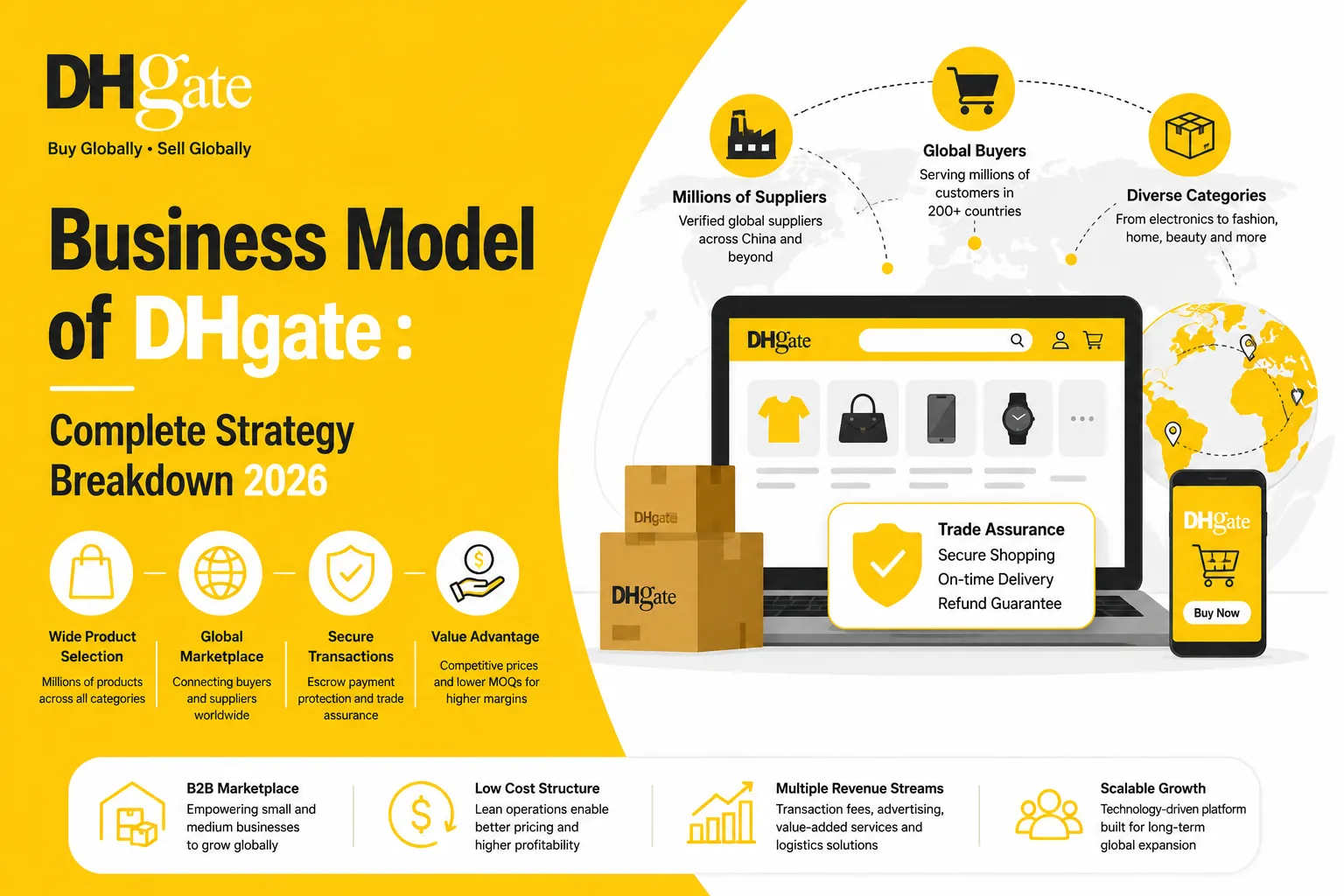
In global ecommerce, few platforms have reshaped cross-border trade as quietly and effectively as DHgate. Instead of competing with Amazon or Alibaba in consumer retail, business model of DHgate focused on a transaction-driven B2B wholesale marketplace, directly connecting small and mid-sized international buyers with Chinese manufacturers and exporters. This strategic positioning allowed it to dominate a niche that large platforms often overlook—SME sourcing.
By 2026, DHgate serves millions of buyers across more than 200 countries, facilitating billions of dollars in annual cross-border trade for resellers, dropshippers, and small businesses. A key strength of the business model of DHgate is its ability to operate with thin margins, complex logistics, and global trust challenges while remaining completely asset-light, owning neither inventory nor warehouses.
For entrepreneurs building marketplaces, cross-border ecommerce platforms, or B2B transaction-driven systems, DHgate offers a powerful blueprint. At Miracuves, we reference DHgate-style architectures because they prove success depends not on branding dominance, but on liquidity, trust infrastructure, and disciplined monetization.
How the DHgate Business Model Works
DHgate operates as a cross-border B2B online marketplace designed to simplify global trade between Chinese manufacturers/suppliers and international small-to-medium buyers. Unlike traditional wholesale platforms that rely on large bulk orders, DHgate’s model supports low minimum order quantities (MOQs)—which dramatically expands its buyer base.
At its core, DHgate does not sell products. It orchestrates transactions, manages trust, and monetizes the flow of commerce.
Type of Business Model
DHgate uses a hybrid marketplace model, combining:
- B2B Marketplace – Connecting suppliers and buyers globally
- Transaction-based Platform – Monetizing successful trades
- Service-driven Model – Payments, logistics, dispute handling, and compliance
This hybrid approach allows DHgate to stay asset-light while controlling critical parts of the transaction lifecycle.
Value Proposition by User Segment
For Global Buyers (SMEs, Resellers, Dropshippers)
- Access to factory-direct pricing
- Low MOQs compared to traditional wholesalers
- Escrow-based payments reducing fraud risk
- Global shipping options with tracking
For Suppliers (Manufacturers & Exporters)
- Immediate access to international demand
- Built-in traffic and buyer discovery
- Payment protection and dispute resolution
- Optional promotion tools to boost visibility
For DHgate (Platform Owner)
- No inventory risk
- Revenue scales with transaction volume
- Strong data control over pricing, demand, and behavior
Key Stakeholders & Their Roles
- Suppliers: List products, fulfill orders, maintain quality ratings
- Buyers: Place orders, make payments, leave reviews
- Logistics Partners: Enable cross-border delivery
- Payment Providers: Support multi-currency transactions
- DHgate Platform: Ensures trust, liquidity, and dispute management
The system stays balanced because no single party can bypass the platform without losing trust, protection, or reach.
Evolution of the Model
DHgate’s model has evolved significantly:
- Early years: Focus on listing scale and global reach
- Growth phase: Introduction of escrow payments and buyer protection
- Recent years (2024–2026):
- Improved seller vetting
- Smarter dispute resolution
- Logistics integration
- Mobile-first experience for international buyers
- Improved seller vetting
Each evolution strengthened trust—critical in cross-border B2B commerce.
Why DHgate’s Model Works in 2026
In today’s market:
- SMEs want direct sourcing to protect margins
- Buyers prefer smaller test orders before scaling
- Trust and payment security matter more than brand awareness
- Cross-border trade is fragmented but growing
DHgate fits perfectly into this environment by acting as a trade infrastructure layer, not just a marketplace.
This is why Miracuves often models similar B2B marketplace architectures for clients targeting wholesale, sourcing, or international trade platforms—because DHgate proves that control of transactions beats ownership of products.
Read more : What is DHgate and How Does It Work?
Target Market & Customer Segmentation Strategy
DHgate’s success is deeply tied to precision targeting. Instead of chasing mass consumers, the platform deliberately focused on underserved global buyers who were priced out or ignored by traditional wholesale systems.
Primary & Secondary Customer Segments
Primary Buyer Segment (Demand Side)
- Small and medium businesses (SMEs)
- Online resellers and dropshippers
- Amazon, eBay, Etsy, and Shopify sellers
- Retail store owners sourcing inventory
- Entrepreneurs testing new product categories
Behavioral Traits
- Price-sensitive but margin-focused
- Willing to trade brand certainty for cost advantage
- Repeat buyers once trust is established
- Prefer low MOQs and flexible logistics
Secondary Buyer Segment
- Large-volume importers testing suppliers
- Regional distributors in emerging markets
- Promotional merchandise buyers
Primary Supplier Segment (Supply Side)
- Chinese manufacturers
- Export-focused trading companies
- OEM and private-label producers
- Factory clusters specializing in electronics, apparel, accessories, and home goods
Supplier Motivation
- Access to global buyers without overseas sales teams
- Faster cash flow compared to traditional export channels
- Ability to scale orders gradually
Customer Journey: Discovery → Conversion → Retention
1. Discovery
- Google search for wholesale products
- Marketplace browsing by category
- Supplier recommendations and internal search
- External seller referrals
2. Conversion
- Product comparison and MOQ evaluation
- Supplier credibility signals (ratings, transaction history)
- Escrow-based payment assurance
- Transparent logistics options
3. Retention
- Repeat supplier relationships
- Better pricing for returning buyers
- Platform dispute protection
- Loyalty built through reduced risk, not branding
DHgate’s retention strategy relies more on operational trust than emotional loyalty.
Acquisition Channels & Lifetime Value Optimization
Buyer Acquisition
- SEO-driven product pages
- Long-tail wholesale keyword capture
- Country-specific landing pages
- App-based reordering convenience
Supplier Acquisition
- Regional factory onboarding programs
- Export incentives and platform education
- Tiered seller benefits based on performance
LTV Optimization
- Higher buyer LTV through repeat sourcing
- Higher supplier LTV through promotion tools and data access
- Switching costs created by transaction history and ratings
Market Positioning & Competitive Edge
DHgate positions itself as:
- Accessible global trade for SMEs
- A mid-layer between Alibaba (large B2B) and AliExpress (B2C)
- A practical sourcing engine, not a brand marketplace
Differentiation Strategies
- Lower MOQs than traditional B2B platforms
- Simpler onboarding for international buyers
- Strong escrow and dispute framework
- Focus on functionality over consumer branding
This clear positioning helps DHgate protect its niche despite competition from Alibaba, Made-in-China, and emerging vertical marketplaces.
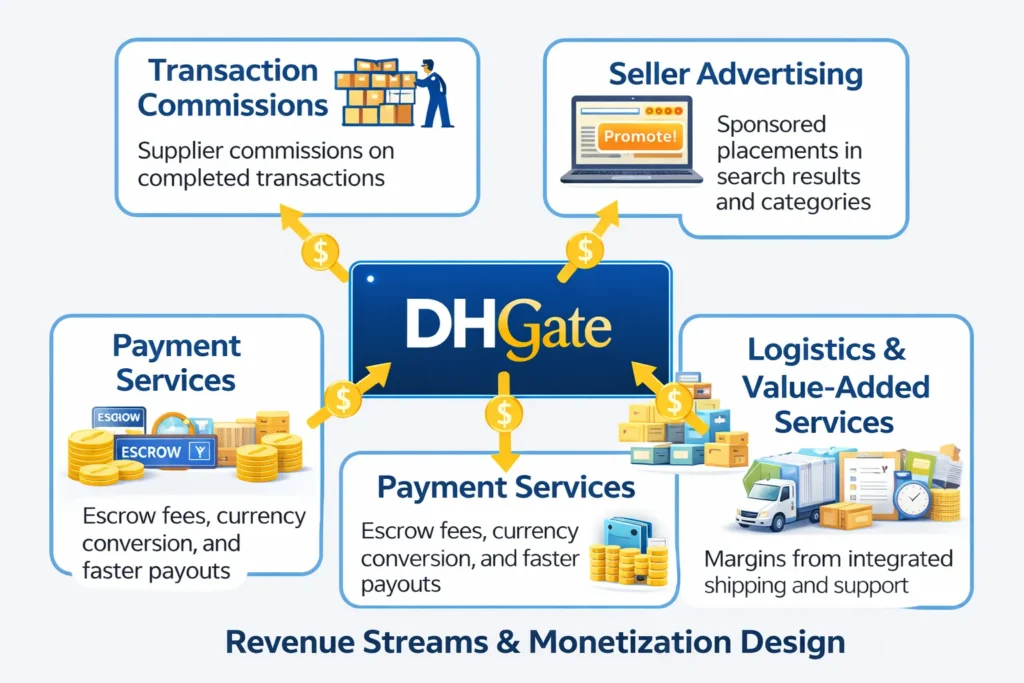
Revenue Streams and Monetization Design
Once DHgate established liquidity and trust between buyers and suppliers, monetization became a transaction-first, service-supported system. Unlike consumer ecommerce platforms that push subscriptions or ads early, DHgate’s revenue model is designed to extract value only when trade happens.
This keeps adoption friction low while ensuring revenue scales directly with platform usage.
Primary Revenue Stream 1: Transaction Commission (Core Engine)
Mechanism
DHgate charges suppliers a commission on every successfully completed transaction. The fee is deducted after the buyer confirms receipt or the escrow period ends.
Pricing Model (2026)
- Percentage-based commission per order
- Varies by product category and supplier tier
- Performance-linked incentives for high-rated sellers
Revenue Contribution
- Largest and most stable revenue source
- Directly tied to Gross Merchandise Volume (GMV)
- Predictable because it scales with repeat trade
Growth Trajectory
- Rising cross-border SME trade volumes
- Increased repeat buying from trusted suppliers
- Higher average order values as buyers scale sourcing
This stream works because DHgate controls the payment flow—suppliers cannot access funds without platform completion.
Secondary Revenue Stream 2: Seller Promotion & Advertising Tools
Mechanism
Suppliers pay to improve product visibility within search results and category listings.
Examples
- Sponsored product placements
- Category-level promotions
- Seasonal exposure campaigns
Why It Works
- Seller competition increases as categories mature
- Visibility directly impacts sales volume
- Ads feel like growth tools, not platform taxes
Secondary Revenue Stream 3: Payment & Financial Services
Mechanism
DHgate earns margins through:
- Escrow-based payment handling
- Currency conversion services
- Faster payout options for suppliers
Value Creation
- Reduces fraud and trust barriers
- Improves supplier cash flow
- Locks users into the platform ecosystem
Secondary Revenue Stream 4: Logistics & Value-Added Services
Mechanism
DHgate partners with logistics providers and earns margins or referral fees through:
- Integrated shipping options
- Tracking and customs support
- Optimized delivery routes
While DHgate doesn’t own logistics infrastructure, it monetizes coordination.
Overall Monetization Strategy
DHgate’s monetization design is layered but intentional:
- Commissions power the core engine
- Ads monetize competition, not users
- Payments & logistics monetize trust and convenience
Each stream reinforces the others:
- More transactions → more data
- More data → better targeting
- Better targeting → higher seller spend
The psychology is simple:
DHgate charges businesses when they make money, not before.
This is a monetization philosophy Miracuves often recommends when building B2B marketplaces and trade platforms—because it aligns platform success with customer success.
Read more : DHgate Revenue Model: How DHgate Makes Money in 2026
Operational Model & Key Activities
Behind DHgate’s marketplace sits a highly structured operations-first organization. Because cross-border B2B trade involves trust, compliance, and logistics complexity, DHgate’s operational model is designed to reduce friction without owning physical assets.
Instead of warehouses or inventory, DHgate invests in systems, automation, and governance.
Core Operational Functions
1. Platform & Technology Management
- Marketplace infrastructure (web + mobile)
- Search, ranking, and recommendation algorithms
- Secure payment and escrow systems
- Seller dashboards and analytics tools
2. Supplier Quality Control
- Supplier verification and onboarding
- Rating and review systems
- Performance monitoring (delivery, refunds, disputes)
- Tier-based seller classification
3. Trust & Dispute Resolution
- Escrow-based transaction monitoring
- Buyer–seller dispute handling
- Refund and arbitration workflows
- Fraud detection and risk scoring
4. Customer Support Operations
- Multilingual buyer support
- Seller training and compliance support
- Region-specific resolution teams
5. Marketing & Demand Generation
- SEO-driven category traffic
- Country-level localization
- Campaign coordination for peak seasons
Resource Allocation Strategy (2026)
DHgate’s spending priorities reveal how platform businesses should think:
- Technology & Infrastructure: ~35–40%
(Platform stability, security, automation, AI-driven moderation) - Operations & Trust Systems: ~25–30%
(Dispute teams, compliance, quality control) - Marketing & Growth: ~20%
(SEO, performance marketing, supplier acquisition) - People, R&D & Expansion: ~10–15%
(New markets, partnerships, product innovation)
This allocation reflects a key insight:
In B2B marketplaces, trust costs more than traffic.
Operational Advantage in 2026
What gives DHgate resilience today:
- Automation reduces manual intervention at scale
- Data-driven supplier enforcement improves quality
- Escrow protects both sides without legal overhead
- Regional ops teams adapt to local trade rules
For Miracuves clients building marketplace platforms, this operational blueprint is critical. Many startups fail not due to lack of demand—but because operations are under-designed.
DHgate proves that scalable marketplaces are systems businesses, not product businesses.
Read more : Best DHgate Clone Scripts 2025: Build a Global B2B Wholesale Marketplace Faster
Strategic Partnerships & Ecosystem Development
DHgate understood early that no marketplace can scale cross-border trade alone. Instead of building everything in-house, it focused on ecosystem orchestration—partnering with specialized players to strengthen speed, trust, and reach.
Its partnership strategy is not about branding—it is about removing friction from global commerce.
DHgate’s Partnership Philosophy
DHgate partners where:
- Control is expensive or inefficient
- Speed-to-market matters more than ownership
- Specialization improves trust and compliance
By doing this, DHgate remains asset-light while still delivering a full-stack trade experience.
Key Partnership Categories
1. Technology & API Partners
- Cloud infrastructure providers
- Data security and fraud detection vendors
- API integrations for seller tools and analytics
Impact:
Improves platform stability, scalability, and risk prevention.
2. Payment & Financial Service Partners
- Global payment gateways
- Escrow and settlement providers
- Currency conversion and compliance partners
Impact:
Enables multi-currency transactions, reduces fraud, and accelerates supplier payouts.
3. Logistics & Fulfillment Alliances
- International courier services
- Cross-border shipping networks
- Customs and documentation partners
Impact:
Expands delivery coverage without capital-heavy logistics ownership.
4. Marketing & Distribution Partners
- Affiliate networks
- Regional ecommerce communities
- Influencer and reseller ecosystems
Impact:
Drives buyer acquisition in cost-sensitive markets.
5. Regulatory & Market Entry Partners
- Trade compliance advisors
- Country-specific regulatory consultants
- Local market representatives
Impact:
Reduces legal risk during geographic expansion.
Ecosystem Strategy & Competitive Moat
DHgate’s ecosystem creates compounding advantages:
- More partners → better service coverage
- Better coverage → higher transaction success
- Higher success → more buyers and suppliers
This produces network effects not just from users, but from partners embedded into workflows.
Monetization within the ecosystem happens indirectly:
- Higher GMV increases commissions
- Better logistics improve repeat orders
- Financial tools increase seller lifetime value
This is a model Miracuves actively applies when building scalable B2B and cross-border platforms—designing ecosystems where partners grow with the platform, not outside it.
Growth Strategy & Scaling Mechanisms
DHgate’s growth has never been driven by hype or heavy consumer branding. Instead, it scales through trade volume compounding—where every successful transaction increases the likelihood of the next.
Its growth strategy is built around liquidity, efficiency, and geographic reach.
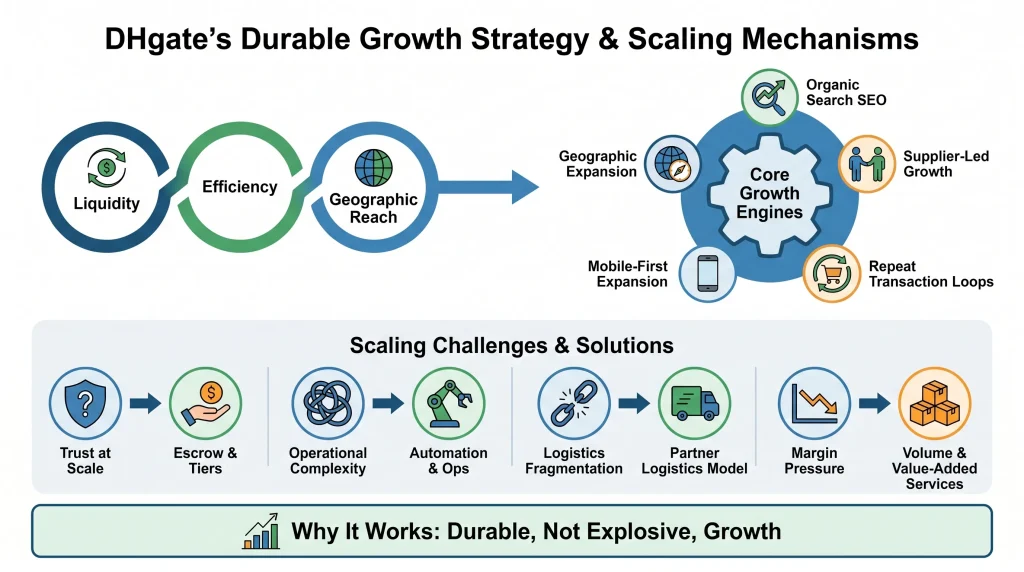
Core Growth Engines
1. Organic Demand Through Global Search
- Strong SEO for wholesale and sourcing keywords
- Category-level dominance in long-tail queries
- Country-specific language and currency localization
This brings in high-intent buyers, not casual browsers.
2. Supplier-Led Growth
- As suppliers succeed, they reinvest in promotions
- High-performing sellers attract more buyers
- Supplier competition increases marketplace depth
Growth is partially self-funded by sellers.
3. Repeat Transaction Loops
- Buyers reorder from trusted suppliers
- Platform data improves matching quality
- Reduced friction increases order frequency
Retention drives scale more than acquisition.
4. Mobile-First Expansion
- App-based reordering
- Push notifications for price drops and restocks
- Simplified dispute and tracking flows
5. Geographic Expansion
- Focus on emerging markets with strong SME growth
- Localization over aggressive advertising
- Gradual rollout of logistics and payment options
Scaling Challenges & How DHgate Solved Them
Challenge 1: Trust at Scale
Solution:
- Escrow-based payments
- Supplier performance tiers
- Automated dispute workflows
Challenge 2: Operational Complexity
Solution:
- Heavy automation
- Regional ops teams
- Standardized processes
Challenge 3: Logistics Fragmentation
Solution:
- Partner-based logistics model
- Multi-carrier integrations
- Transparent delivery expectations
Challenge 4: Margin Pressure
Solution:
- Volume-based economics
- Value-added services
- Promotion monetization
Why DHgate’s Scaling Model Works
DHgate grows by:
- Increasing transaction success rate
- Improving repeat usage
- Expanding supplier competition
- Lowering per-transaction cost
This is not explosive growth—it is durable growth.
For Miracuves, this mirrors how we advise founders to scale marketplaces:
Fix trust first, optimize operations second, and accelerate growth last.
Competitive Strategy & Market Defense
DHgate operates in one of the most competitive environments in global ecommerce. It faces pressure from Alibaba, Made-in-China, AliExpress, emerging vertical B2B platforms, and even direct supplier websites. Yet DHgate continues to defend its position by focusing on structural advantages, not short-term pricing wars.
Core Competitive Advantages
1. Deep Network Effects
- More suppliers → better pricing and variety
- More buyers → higher supplier competition
- Higher competition → better value for buyers
Once liquidity is achieved, competitors struggle to replicate it quickly.
2. High Switching Costs
- Supplier ratings and transaction history
- Buyer–seller trust relationships
- Platform dispute protection
- Payment and logistics integration
Leaving the platform means starting from zero.
3. Brand Trust Over Brand Fame
DHgate is not a consumer brand—but it is a trusted trade brand.
- Buyers trust the escrow system
- Suppliers trust predictable payouts
- Both sides trust platform enforcement
4. Data-Driven Marketplace Control
- Pricing intelligence
- Demand forecasting
- Fraud detection
- Algorithmic search and ranking
Data gives DHgate control without owning inventory.
5. Compliance & Risk Management
- Trade regulations
- Payment compliance
- Buyer protection frameworks
In 2026, compliance is a competitive moat, not a cost.
Market Defense Tactics
Against New Entrants
- Rapid category saturation
- Supplier exclusivity via performance incentives
- Platform lock-in through tools and analytics
Against Pricing Wars
- Focus on total cost of sourcing, not unit price
- Emphasis on reliability and dispute protection
- Long-term supplier relationships
Against Platform Disintermediation
- Escrow and buyer protection enforcement
- Dispute resolution that favors platform usage
- Incentives for on-platform communication
Strategic Moves
- Feature rollouts timed with seasonal demand
- Geographic expansion into less contested markets
- Partner alliances instead of acquisitions
Why DHgate’s Defense Strategy Is Effective
DHgate does not try to be everything. It defends its core SME sourcing niche with:
- Trust
- Efficiency
- Infrastructure
This defensive clarity is something Miracuves emphasizes when helping entrepreneurs design marketplace platforms—dominate one ecosystem before expanding outward.
Lessons for Entrepreneurs & Implementation
DHgate’s journey offers one of the most practical playbooks for founders building marketplaces, sourcing platforms, or cross-border ecosystems. Its success was not driven by viral growth or aggressive branding—but by disciplined execution and trust-led design.
This section bridges insight to action.
Key Factors Behind DHgate’s Success
- Transaction Control Over Inventory Ownership
DHgate never owned products. It owned the flow of money, trust, and data. - Low-MOQ Strategy to Unlock Liquidity
By enabling small orders, DHgate massively expanded its buyer base. - Escrow as a Growth Lever
Trust infrastructure increased conversions and repeat transactions. - Operations Before Marketing
Strong dispute resolution and supplier enforcement reduced churn. - Aligned Monetization
The platform earns only when users earn—creating long-term loyalty.
Replicable Principles for Startups
Entrepreneurs can adapt DHgate’s model by:
- Starting with one narrow trade niche
- Solving trust before scale
- Designing marketplace rules early
- Monetizing transactions, not listings
- Building partner ecosystems instead of assets
Common Mistakes to Avoid
- Launching without escrow or buyer protection
- Over-investing in ads before liquidity
- Ignoring supplier quality enforcement
- Underestimating operational costs
- Expanding markets too early
Adapting DHgate’s Model to Local or Niche Markets
This model works especially well for:
- Regional wholesale marketplaces
- Vertical B2B platforms (fashion, electronics, construction)
- Import–export sourcing apps
- Dropshipping and reseller ecosystems
Localization is key—especially for:
- Payment methods
- Delivery expectations
- Dispute handling norms
Implementation Timeline & Investment Priorities
Phase 1 :
- Core marketplace MVP
- Escrow and payments
- Supplier onboarding
Phase 2 :
- Trust systems and ratings
- Dispute workflows
- SEO-driven demand
Phase 3 :
- Promotion tools
- Logistics partnerships
- Geographic expansion
This phased approach mirrors how Miracuves helps founders launch scalable, revenue-ready marketplace platforms—reducing risk while accelerating traction.
Ready to implement DHgate’s proven business model for your market?
Miracuves builds scalable marketplace platforms with tested business models, trust systems, and growth mechanisms. We’ve helped entrepreneurs launch profitable apps.
Get your free business model consultation today.
To put this into practice, our ready-made B2B wholesale marketplace starts at $3,099 and is delivered in 6 days. It offers bulk product listings, supplier verification and request-for-quote flows. It is not a copy of DHgate.
Conclusion
DHgate’s business model proves that true scale does not come from flashy branding or aggressive discounting, but from engineering trust, efficiency, and discipline into every transaction. By focusing on SME buyers, lowering entry barriers, and controlling trade flows through the platform, DHgate built a marketplace that compounds value steadily while remaining asset-light. Its journey highlights a critical lesson for founders: in platform businesses, execution outperforms ideas, and systems matter more than features.
As we move deeper into 2026, the future of platform economies will favor businesses that control trust instead of inventory, monetize outcomes rather than access, and build ecosystems—not just apps. DHgate stands as a clear blueprint for the next generation of cross-border marketplaces and digital trade platforms, especially for entrepreneurs willing to build patiently, strategically, and at scale.
FAQs :
What type of business model does DHgate use?
DHgate uses a B2B cross-border marketplace model. It connects global buyers with manufacturers and earns primarily through transaction-based commissions and services.
How does DHgate’s business model create value?
It simplifies global trade by offering low MOQs, escrow payments, and supplier verification. This reduces risk and cost for small and medium businesses.
How scalable is DHgate’s business model?
The model is highly scalable because DHgate does not own inventory or logistics. Growth happens by adding users, suppliers, and partners with minimal capital.
What are the biggest challenges in DHgate’s model?
Maintaining trust at scale, managing disputes, and coordinating cross-border logistics are key challenges. DHgate addresses these through automation and partnerships.
How can entrepreneurs adapt DHgate’s model to their region?
Founders can localize payments, logistics, and dispute rules while focusing on one niche market first. Trust systems should be built before scaling.
What are alternatives to the DHgate business model?
Alternatives include vertical B2B marketplaces, inventory-led wholesale platforms, or subscription-based supplier directories, each with different risk profiles.
How has DHgate’s business model evolved over time?
DHgate evolved from a simple listing platform into a full trade infrastructure with escrow, logistics integration, and data-driven supplier enforcement.
Related Article :
Miracuves is an independent software development company. We are not affiliated with, connected to, sponsored by, or endorsed by any company or product named in this article.
Terms such as “X Clone” are used descriptively. It is how the software industry refers to building a platform with functionality comparable to a known service, and how clients search for it.
The entire design and codebase of our products is built by our own team. Our products contain no code, design, graphics, or content originating from any third-party website or applications.
All third-party names and marks referenced in this article are the property of their respective owners, referenced solely to identify the services discussed.