




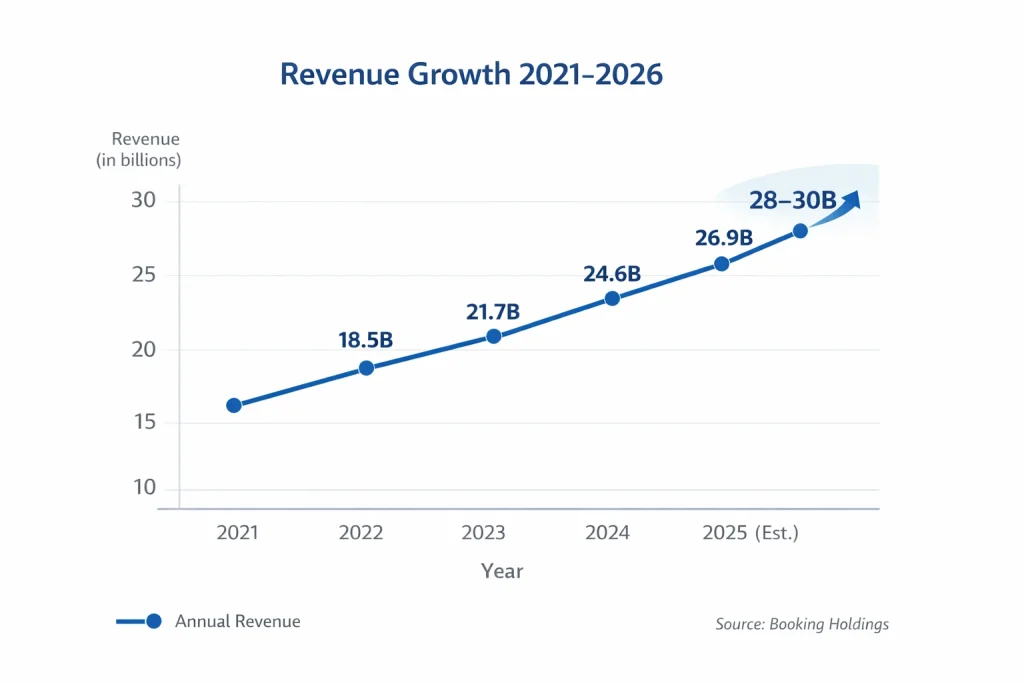
Kayak operates inside one of the most powerful travel ecosystems in the world—Booking Holdings, which generated nearly $26.9 billion in revenue in 2025 with double-digit growth. This makes Kayak less of a standalone startup and more of a strategic monetization layer within a massive global travel infrastructure.
For founders, Kayak is a masterclass in building a traffic-first, asset-light marketplace. It doesn’t own inventory like airlines or hotels—it owns intent. And in travel, intent is one of the most valuable currencies.
Understanding Kayak’s model is essential because it shows how you can monetize search behavior, comparisons, and decision-making moments—without owning the underlying product.
Kayak Revenue Overview – The Big Picture
Kayak itself doesn’t publicly disclose standalone revenue today, but as part of Booking Holdings, it contributes to a $26.9B+ travel empire growing ~13–16% YoY.
Key snapshot (2026 estimates based on parent ecosystem):
• Parent company revenue: ~$26.9B (2025)
• Estimated Kayak contribution: Low-single-digit % of total revenue (industry estimate)
• Growth driver: Performance marketing + travel demand rebound
• Profitability: Indirectly profitable via high-margin advertising model
• Valuation context: Booking Holdings ~$140B+ market cap (2026 market estimate)
Regional distribution (Booking ecosystem proxy):
• Europe: Largest contributor
• North America: High-margin market
• Asia-Pacific: Fastest growth
Benchmark comparison:
• Competes with Skyscanner, Google Travel, Wego
• Differentiation: Strong brand + deep integration into Booking ecosystem
Read More: What Is KAYAK? A Simple Guide to the Travel Search Platform
Primary Revenue Streams Deep Dive
Revenue Stream #1: Cost-Per-Click (CPC) Advertising
This is Kayak’s core engine. Airlines, OTAs, and hotels bid to appear in search results.
• Works like Google Ads for travel
• Advertisers pay per user click
• High-intent traffic = premium pricing
Estimated contribution: 50–60%
Pricing model:
• Auction-based CPC
• Varies by route, geography, and demand
Performance insight:
Travel CPC rates are among the highest in digital advertising due to strong conversion intent.
Revenue Stream #2: Affiliate Commissions
When users click through and complete bookings on partner sites, Kayak earns a commission.
• Revenue triggered only after conversion
• Lower volume but higher value per user
Estimated contribution: 15–25%
Pricing model:
• % of booking value
• Fixed payout per conversion
Revenue Stream #3: Sponsored Listings & Display Ads
Travel brands pay for premium placement and visibility.
• Top-of-page placements
• Native ads within search results
Estimated contribution: 10–15%
Pricing model:
• Fixed + performance hybrid
• CPM + CPC combinations
Revenue Stream #4: Kayak Direct / Booking Integration
Kayak increasingly pushes users toward direct booking flows within its ecosystem.
• Reduces friction
• Improves conversion rates
• Keeps more value in-house
Estimated contribution: 5–10% (growing)
Pricing model:
• Commission + internal revenue sharing within Booking
Revenue Stream #5: Data & Insights Monetization
Aggregated travel data is valuable for airlines, hotels, and tourism boards.
• Pricing trends
• Demand forecasting
• Route intelligence
Estimated contribution: <5% but strategic
Pricing model:
• B2B analytics contracts
Revenue Streams Breakdown (Latest Available Data)
| Revenue Stream | Description | Estimated Revenue Share | Pricing Model |
|---|---|---|---|
| CPC Advertising | Paid clicks from partners | 50–60% | Auction-based CPC |
| Affiliate Commissions | Booking-based payouts | 15–25% | % per transaction |
| Sponsored Listings | Paid visibility | 10–15% | CPC + CPM hybrid |
| Direct Booking | In-app booking flows | 5–10% | Commission-based |
| Data Monetization | Travel insights & analytics | <5% | B2B contracts |
The Fee Structure Explained
Kayak’s monetization is asymmetric—it charges providers, not users.
Platform Fee Structure (Latest Available Data)
| User Type | Fee Type | Typical Fee Range | Notes |
|---|---|---|---|
| Travelers | Free usage | $0 | Core value proposition |
| Airlines / OTAs | CPC (Cost per Click) | $0.50 – $5+ per click | Depends on route competition |
| Hotels | Commission / CPC | ~5% – 20% equivalent | Earned via partner platforms |
| Advertisers | Sponsored listings | Variable | Premium placement pricing |
| Enterprise clients | Data fees | Contract-based | Analytics & insights offerings |
Hidden revenue layers:
• Retargeting ads
• Cross-platform attribution
• Data-driven bidding optimization
Regional variations:
• Higher CPC in US & Europe
• Lower CPC but growing in Asia
How Kayak Maximizes Revenue Per User
Kayak doesn’t just monetize traffic—it optimizes intent value.
Customer segmentation:
• Budget travelers vs premium travelers
• Business vs leisure users
Upselling mechanics:
• Flight → hotel → car rental bundling
• “Complete your trip” nudges
Cross-selling systems:
• Email remarketing
• App notifications
• Price alerts
Dynamic pricing:
• Real-time bid adjustments
• Demand-based CPC inflation
Retention monetization:
• Price alerts keep users returning
• App installs increase LTV
LTV optimization:
A single user may generate multiple clicks across sessions before converting—each click is monetized.
Psychological tactics:
• “Only 2 seats left” urgency
• Price drop alerts
• Comparison framing
Cost Structure & Profit Margins
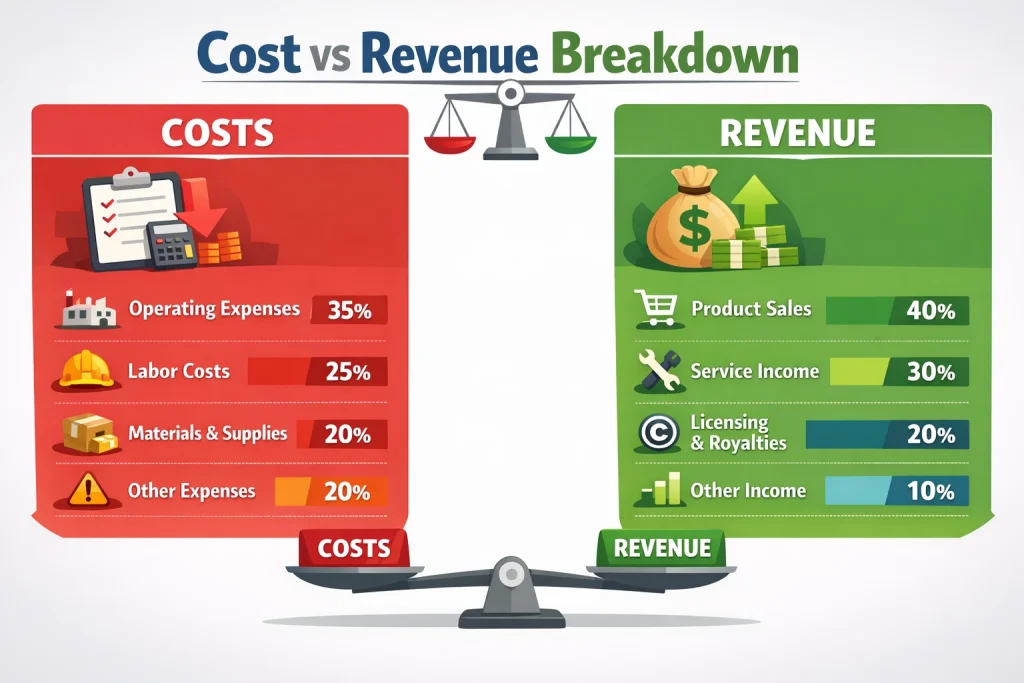
Kayak is a high-margin, asset-light business.
Major cost buckets:
Infrastructure:
• Cloud hosting
• Search indexing systems
Customer acquisition (largest cost):
• Google Ads dependency
• SEO + brand marketing
Marketing spend:
Booking Holdings spends billions annually on performance marketing.
Operations:
• Engineering teams
• Product development
R&D:
• AI-based travel recommendations
• Personalization engines
Unit economics:
• High gross margins (typical for ad platforms)
• CAC heavy but scalable
Margin strategy:
• Increase direct traffic (reduce Google dependency)
• Improve conversion rates
• Push app adoption
Future Revenue Opportunities (2026–2028 Outlook)
AI-driven travel planning:
• Conversational trip planning
• Predictive pricing engines
Super app integration:
• Seamless booking across flights, hotels, cars
Market expansion:
• Asia-Pacific growth
• Emerging markets with rising travel demand
New monetization layers:
• Subscription-based premium features
• Personalized deal engines
Risks:
• Google Travel dominance
• Rising CAC costs
• Supplier disintermediation
Startup opportunities:
• Niche travel verticals (luxury, remote work travel)
• AI-native travel assistants
• Community-driven booking platforms
Lessons for Entrepreneurs
What works:
• Monetizing intent instead of inventory
• Aggregation as a moat
• Performance-based revenue
What to replicate:
• CPC marketplace model
• Multi-layer monetization
• Data-driven optimization
Market gaps:
• Hyper-personalized travel planning
• Local experience aggregation
• Creator-led travel discovery
What to improve:
• Reduce reliance on Google
• Build stronger direct user relationships
• Increase retention loops
Final Thought
Kayak proves that you don’t need to own supply to build a powerful business—you just need to own the decision layer. That’s where margins are highest and competition is weakest.
For founders, the real insight is this: the closer you get to the moment of decision, the more valuable your product becomes. Kayak sits exactly there.
In a world moving toward AI-driven discovery, whoever controls intent will control revenue—and Kayak is already positioned at that intersection.
FAQs
1. How much does Kayak make per transaction?
Kayak doesn’t charge users directly; it earns via CPC and commissions, typically a few dollars per click or a % of booking value.
2. What is the most profitable revenue stream for Kayak?
CPC advertising is the most profitable due to high margins and scalability.
3. How does Kayak’s pricing compare to competitors?
Similar to Skyscanner and Google Travel, but Kayak benefits from deeper Booking ecosystem integration.
4. What percentage does Kayak take from providers?
Indirectly 5–20% equivalent through commissions or CPC economics.
5. How has Kayak’s revenue model evolved?
From pure metasearch to integrated booking and data-driven monetization.
6. Can small startups use a similar model?
Yes, especially in niche verticals with high-intent traffic.
7. What scale is needed for profitability?
Significant traffic scale is required due to reliance on CPC economics.
8. How can founders implement a similar model?
Focus on aggregation, SEO, and building a demand-side marketplace first.
9. What alternatives exist to this revenue model today?
Subscription travel apps, direct booking platforms, and AI travel assistants.