


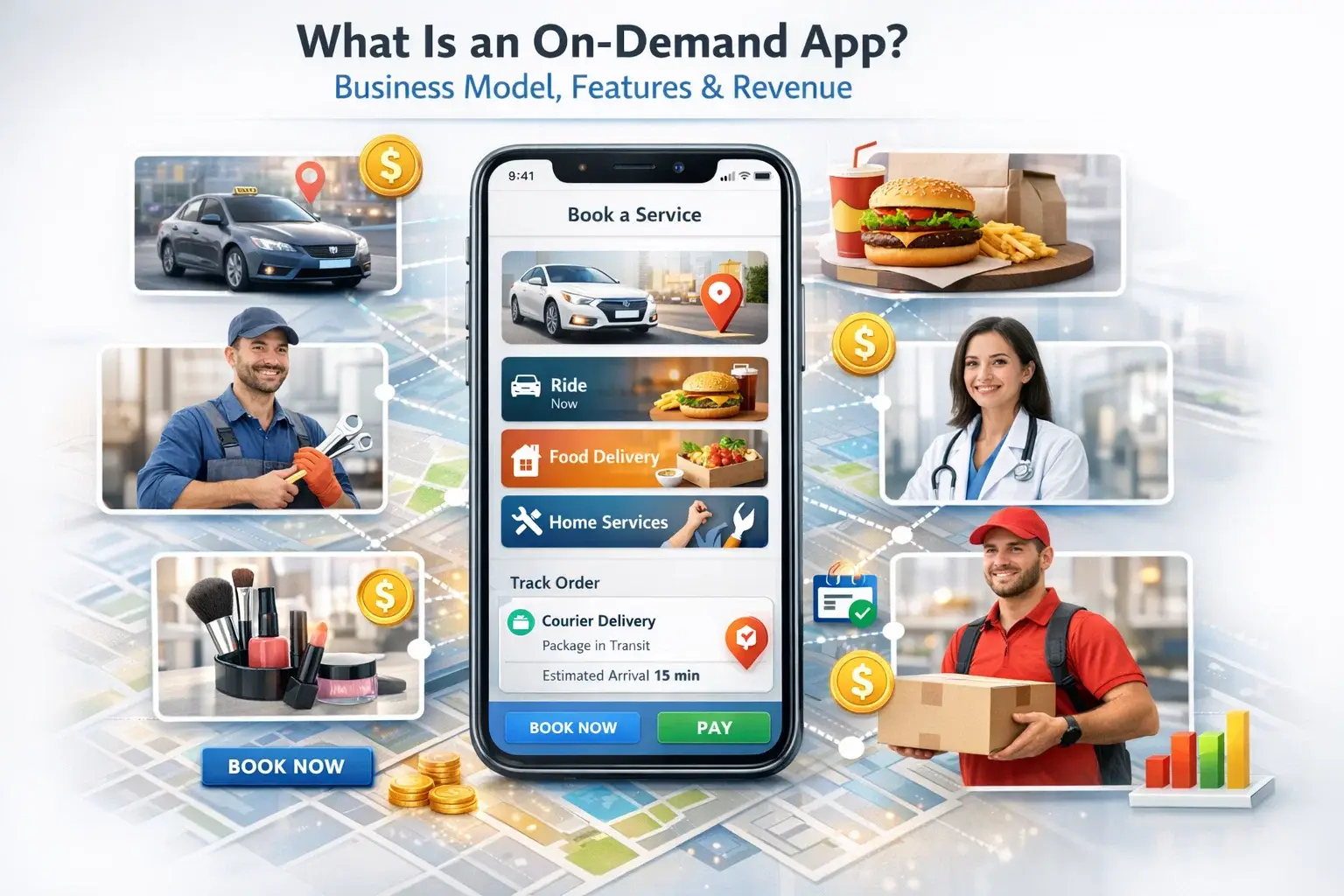
An on-demand app is a digital platform that connects users with services or products whenever they need them. Instead of following a fixed schedule or traditional service process, users can request a ride, order food, book a home service, schedule a delivery, or access professional help directly through an app in real time. These platforms are built to offer speed, convenience, and a smoother customer experience.
The popularity of on-demand apps has grown because people now expect services to be available faster and with less effort. Rather than searching manually, calling providers, or waiting for offline coordination, users prefer a system where they can browse, book, pay, and track everything in one place. That convenience is what makes the on-demand model attractive for both users and businesses.
For startups and established companies, on-demand apps create a strong digital business opportunity. They can serve daily needs, increase customer engagement, and open multiple revenue streams through commissions, subscriptions, delivery charges, convenience fees, or featured listings. But to build a successful platform, it is important to understand how the on-demand model works, what features matter most, and how revenue is generated over time.
What an On-Demand App Really Means
An on-demand app is designed to fulfill an immediate or scheduled customer need through a digital interface. The app acts as a bridge between the user and the service provider, making the process faster and more organized.
How an On-Demand App Works
In most cases, the flow is simple. A user opens the app, selects a service or product, places a request, makes payment if needed, and tracks the request until completion. Behind the scenes, the app manages communication between customers, service providers, delivery agents, vendors, or admins.
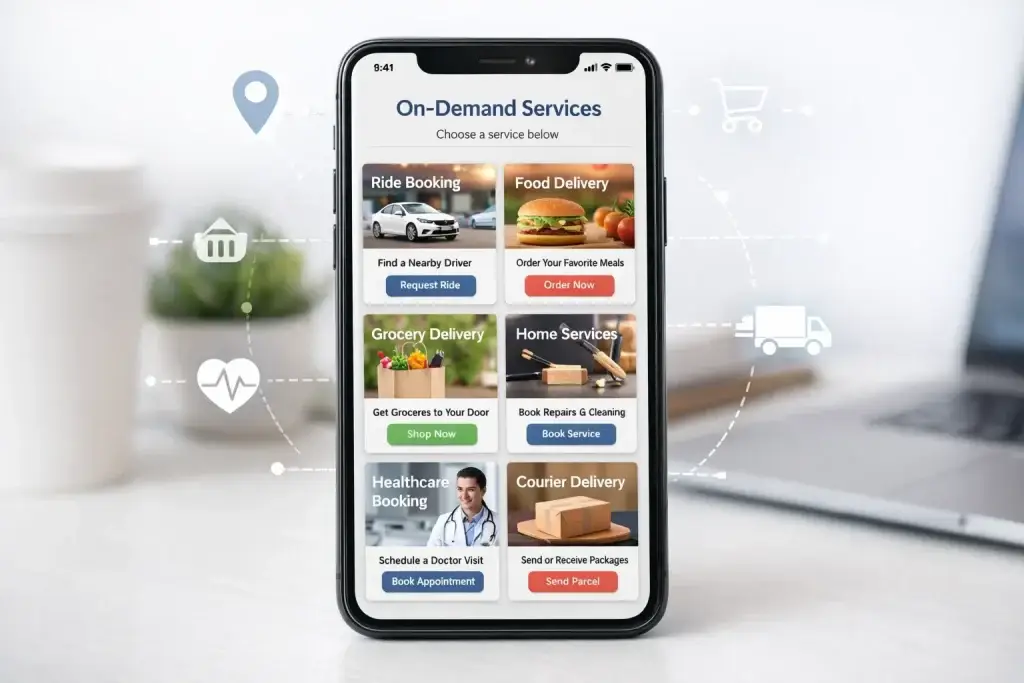
This model is used in many industries such as:
- Ride-hailing
- Food delivery
- Grocery delivery
- Home services
- Healthcare bookings
- Courier and logistics
- Beauty and wellness
- Professional consulting
Why On-Demand Apps Are So Popular
The main reason on-demand apps are popular is convenience. They save time, reduce friction, and give users more control. For businesses, they also provide a better way to manage bookings, orders, payments, and customer interactions digitally.
Common Types of On-Demand Apps
| App Type | Example Use |
|---|---|
| Service-based on-demand app | Booking a plumber, electrician, or cleaner |
| Delivery-based on-demand app | Ordering food, groceries, or medicine |
| Mobility-based on-demand app | Booking a taxi or local transport |
| Professional on-demand app | Hiring a tutor, consultant, or expert |
| Multi-service on-demand app | Accessing several services in one app |
This is why on-demand apps are now seen as one of the most practical digital business models for modern service-driven markets.
Understanding the Business Model of an On-Demand App
The business model of an on-demand app explains how the platform creates value, how different users interact inside the system, and how the business earns revenue. This is one of the most important parts of building an on-demand app because even a well-designed platform can struggle if the model behind it is not sustainable.
An on-demand app usually works by connecting demand with supply in the fastest and most organized way possible. On one side, there are customers looking for a service or product. On the other side, there are providers, vendors, delivery partners, or professionals ready to fulfill that request. The platform manages the interaction between both sides through a mobile app or web system.
The Basic Structure of the On-Demand Model
Most on-demand apps operate with three main sides:
- Customers who place requests
- Service providers, vendors, or delivery partners who fulfill them
- Admins who manage the platform, payments, operations, and support
This structure allows the business to act as a digital connector instead of a traditional offline operator. In many cases, the platform does not directly provide every service itself. Instead, it creates the system that makes the service accessible, trackable, and easier to manage.
How the Business Model Works in Practice
The typical flow of an on-demand app looks like this:
- A customer opens the app and selects a service or product
- The request is sent to a provider, vendor, or delivery partner
- The provider accepts and fulfills the request
- The customer pays through the app or another supported method
- The platform tracks the order or booking
- The business earns revenue from the transaction
This model works across many industries because it turns time-sensitive needs into digital transactions that can be repeated and scaled.
Common Types of On-Demand Business Models
Different on-demand apps can use slightly different business structures depending on what they offer.
Aggregator Model
In this model, the platform connects users with service providers or vendors and earns revenue from each transaction. This is common in food delivery, home services, and ride-booking apps.
Marketplace Model
A marketplace-style on-demand app allows multiple providers or businesses to list services or products on one platform. The app owner earns through commissions, subscriptions, or promotions.
Subscription-Based Model
Some on-demand businesses combine convenience with membership plans. Users may pay monthly or yearly for priority access, free delivery, lower service charges, or premium features.
Full-Service Model
In this model, the business may control both the platform and the service execution itself. This offers more control but usually requires more operational effort and investment.
Why the On-Demand Business Model Works
The reason this model works so well is because it benefits all sides of the system.
Customers benefit from:
- Speed
- Convenience
- Easy payments
- Real-time updates
- Better service access
Service providers or vendors benefit from:
- More visibility
- More customer access
- Easier booking or order management
- Digital payment support
Businesses benefit from:
- Scalable digital operations
- Recurring transactions
- Multiple revenue streams
- Better user data and insights
| Business Model Element | Role in the Platform |
|---|---|
| Customer demand | Drives bookings or orders |
| Service provider or vendor | Fulfills the request |
| Platform | Connects, manages, and tracks the process |
| Admin control | Handles operations, support, and platform rules |
| Payment flow | Enables monetization and transaction management |
Why Choosing the Right Model Matters
Not every on-demand app should use the same business model. A food delivery platform may need a stronger logistics structure, while a home services app may depend more on provider availability and scheduling. A multi-service app may need a combination of commission, subscription, and featured listing models.
That is why the business model should be selected based on:
- The type of service
- User behavior
- Provider structure
- Market demand
- Revenue goals
- Operational complexity
A strong on-demand app is not just built around features. It is built around a model that makes the service practical for users and profitable for the business.
Key Features Every On-Demand App Should Have
The success of an on-demand app depends heavily on the features it offers. A good app is not only about attractive design. It must make the service easy to discover, simple to request, smooth to track, and reliable to manage. The right feature set helps users trust the platform, helps providers complete tasks efficiently, and gives admins the control needed to run the business properly.
An on-demand platform usually serves more than one user group, so the features should be planned for each side of the system. Most apps need customer features, provider or vendor features, and admin features working together in one connected ecosystem.
Customer App Features
Customer features shape the main user experience. If the app feels confusing, slow, or incomplete, users are less likely to return.
Important customer-side features include:
- User registration and login
- Profile management
- Service or product browsing
- Search and filters
- Booking or ordering flow
- Real-time tracking
- In-app payments
- Saved addresses or preferences
- Push notifications
- Ratings and reviews
- Order or booking history
- Customer support access
These features help customers move from discovery to final service completion with less friction.
Service Provider or Vendor Features
An on-demand app also needs a reliable provider-side system. This may be used by drivers, delivery agents, service professionals, or merchants depending on the platform type.
Important provider-side features include:
- Registration and verification
- Availability management
- Request alerts
- Accept or reject request options
- Live location access if needed
- Earnings dashboard
- Task or order history
- Status updates
- In-app communication
- Performance ratings
If providers or vendors struggle with the system, service quality can quickly decline.
Admin Panel Features
The admin panel is the operational core of the on-demand app. It gives the business control over users, requests, payments, service quality, and platform settings.
Important admin features include:
- User management
- Provider or vendor management
- Booking and order monitoring
- Payment and commission tracking
- Service category control
- Reports and analytics
- Promotions and offers
- Notification controls
- Complaint and dispute handling
- Content and banner management
A strong admin panel helps the platform stay organized and scalable.
Shared Features That Improve the Whole System
Some features are important across the entire app ecosystem because they support consistency, trust, and better performance.
These often include:
- Secure payment integration
- Real-time tracking
- Notifications and alerts
- Review and rating system
- Search and recommendation support
- Analytics and reporting
- Security and authentication
These shared features make the platform feel complete and dependable.
| Feature Group | Purpose |
|---|---|
| Customer features | Improve usability and service access |
| Provider features | Help fulfill bookings or orders efficiently |
| Admin features | Control and manage business operations |
| Shared system features | Connect all parts of the platform smoothly |
Why Feature Planning Matters
Not every on-demand app needs the same features in the first version. A simpler home services platform may need booking and scheduling tools, while a food delivery app may need live tracking, merchant dashboards, and delivery coordination. That is why features should be selected based on the service model and business priorities.
The best approach is to build essential features first, test how users behave, and then add advanced functionality as the platform grows. That makes development more practical and reduces unnecessary cost in the early stage.
Revenue Model of an On-Demand App
The revenue model of an on-demand app is what turns convenience into a real business. While the app may focus on bookings, delivery, or service access from the user’s perspective, the business behind it needs a clear system for earning from each transaction, provider relationship, or premium platform feature. Without the right revenue structure, even a well-designed app can struggle to become sustainable.
One of the biggest advantages of the on-demand model is that it does not depend on only one earning method. Many on-demand businesses use a combination of revenue streams to improve profitability and reduce risk over time.
Commission on Each Transaction
This is one of the most common revenue models for on-demand apps. The platform takes a commission whenever a booking, order, or service request is completed.
This model works well because:
- Revenue grows with platform usage
- The business earns from every successful transaction
- It is simple to understand and scale
This is commonly used in apps for food delivery, ride booking, beauty services, home services, and local delivery.
Delivery or Convenience Fees
Many on-demand apps also charge users a service fee, delivery fee, booking fee, or convenience fee. This creates a direct revenue stream from the customer side and helps cover logistics or operational costs.
This approach is often useful when the platform handles time-sensitive service coordination or delivery support.
Subscription Plans
Some on-demand apps offer subscription plans for customers, providers, or merchants.
For customers, subscriptions may include:
- Free delivery
- Lower service charges
- Faster service access
- Exclusive offers
For providers or merchants, subscriptions may include:
- Better visibility
- More lead access
- Advanced dashboard features
- Premium placement
This model helps create recurring revenue beyond one-time transactions.
Featured Listings and Promotions
Providers, vendors, or merchants may pay to appear in highlighted positions inside the app. This can include promoted listings, featured service cards, priority recommendations, or homepage banner visibility.
This model works especially well when the platform already has strong traffic and providers want more exposure.
Advertising Revenue
Some larger on-demand platforms also earn through advertising. Related brands, merchants, or service partners may pay to promote products or services inside the app.
This model usually becomes more valuable after the platform has built a strong user base and regular app activity.
Surge Pricing or Dynamic Pricing Benefits
In some on-demand models, the business may also benefit from dynamic pricing structures. This is more common in ride-hailing, delivery, or urgent service categories where pricing may rise during peak demand periods.
While this should be used carefully for user trust, it can improve margins when demand spikes and supply is limited.
Multi-Revenue Models Are Often Stronger
The strongest on-demand apps usually combine more than one revenue source instead of depending on a single stream.
A common combination may include:
- Transaction commission
- Delivery or service fee
- Subscription revenue
- Featured listing charges
- Promotional or advertising revenue
This helps the business remain more stable as user behavior and market conditions change.
| Revenue Stream | How It Works |
|---|---|
| Commission | Platform earns a percentage from each transaction |
| Delivery or service fee | User pays an added fee for convenience or fulfillment |
| Subscription | Recurring payment for premium access or benefits |
| Featured listing | Providers pay for better visibility in the app |
| Advertising | Brands or partners pay for promotional placement |
| Dynamic pricing benefit | Higher earnings during peak demand periods |
Why Revenue Planning Matters Early
The revenue model should not be treated as an afterthought. It affects platform design, pricing strategy, user behavior, provider incentives, and long-term sustainability. A business that plans monetization early can build the app in a way that supports both growth and profitability.
The right revenue structure depends on:
- Type of service
- User expectations
- Provider relationship
- Market pricing
- Competition
- Operational cost structure
An on-demand app becomes much stronger when convenience, usability, and monetization are designed together from the beginning.
Benefits of an On-Demand App for Businesses
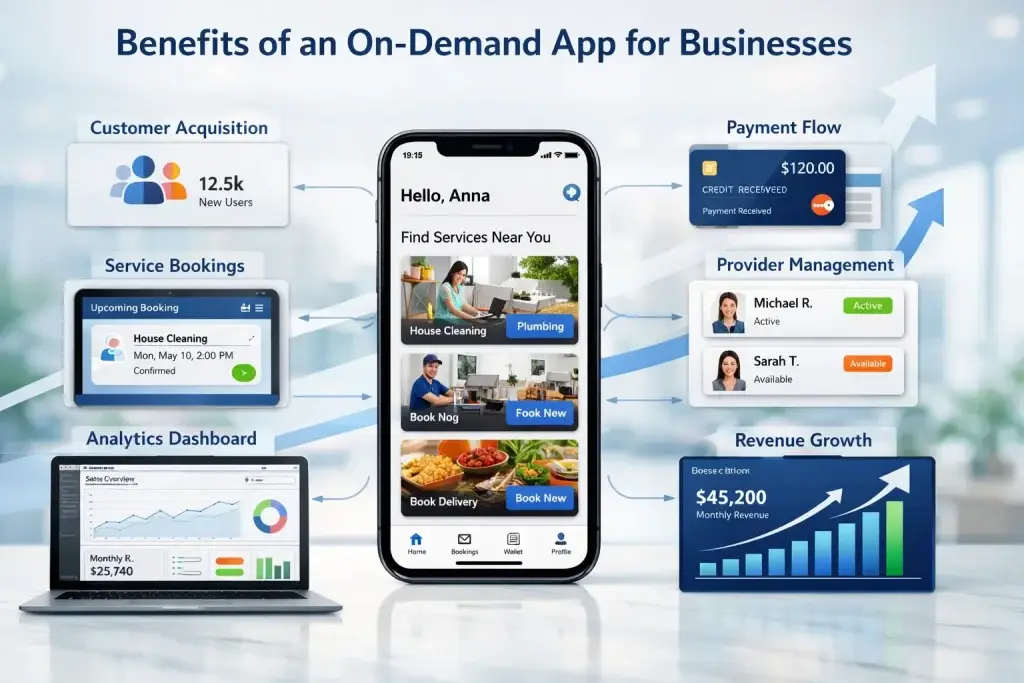
On-demand apps are not only useful for customers. They also give businesses a more scalable and structured way to deliver services, manage operations, and build recurring revenue. This is one of the main reasons why startups and established companies continue to invest in the on-demand model across industries such as delivery, mobility, healthcare, home services, and professional bookings.
A well-built on-demand app does more than digitize a service. It creates a system where requests, payments, communication, and service fulfillment can all be managed through one platform.
Faster Access to Customers
An on-demand app gives businesses direct access to customers through mobile-first convenience. Instead of depending only on offline channels, calls, or manual bookings, the business can receive requests instantly through the app.
This helps businesses:
- Reach more users
- Reduce response time
- Improve service visibility
- Increase booking opportunities
The easier it is for users to place a request, the easier it becomes for the business to generate transactions.
Better Operational Control
One of the biggest advantages of an on-demand app is that it brings operational activity into one manageable system. Orders, bookings, provider availability, tracking, payments, and customer communication can all be monitored digitally.
This improves:
- Request management
- Task assignment
- Payment tracking
- Service coordination
- Customer support handling
That level of control is difficult to achieve with traditional manual systems.
Improved Customer Experience
Customer experience plays a major role in whether an on-demand business grows or struggles. A good app makes the process simpler for users by giving them a clear path from service discovery to final completion.
An improved customer experience often includes:
- Easy booking or ordering
- Real-time status updates
- Secure payments
- Faster communication
- Transparent pricing
- Better support access
A better experience can lead to stronger retention and more repeat usage over time.
Scalable Business Growth
An on-demand app can help a business grow without depending fully on offline expansion methods. Once the platform is running well, it becomes easier to add more users, providers, services, or cities in a more structured way.
This creates opportunities for:
- Multi-city expansion
- More service categories
- More customer transactions
- Better provider network growth
- Stronger digital brand presence
That is why on-demand apps are often seen as long-term digital assets rather than simple software tools.
Better Revenue Opportunities
An on-demand app can support multiple revenue streams at the same time. Instead of depending on only one income source, businesses can earn through transaction fees, subscriptions, premium visibility, service charges, or other monetization methods.
This makes the model more flexible and more suitable for long-term business planning.
Data and Business Insights
Digital platforms also help businesses collect useful data. Over time, this can improve decision-making and platform growth.
Important insights may include:
- Most requested services
- Peak usage times
- Customer preferences
- Provider performance
- Revenue trends
- Retention behavior
This kind of data can help a business improve pricing, service quality, promotions, and expansion strategy.
| Business Benefit | Why It Matters |
|---|---|
| Faster customer access | Increases booking and order opportunities |
| Better operational control | Helps manage the service more efficiently |
| Improved customer experience | Supports retention and repeat use |
| Scalable growth | Makes it easier to expand services and markets |
| Multiple revenue options | Improves long-term profitability |
| Better business insights | Helps make smarter decisions over time |
Also Read :- How to Develop an On-Demand Delivery App
Why Businesses Continue to Invest in On-Demand Apps
Businesses invest in on-demand apps because they match how users now prefer to access services. People want convenience, speed, and transparency. An app-based model helps businesses meet those expectations while also improving internal control and revenue potential.
That is why on-demand apps are now used not only by startups but also by traditional businesses that want to modernize their service delivery and stay competitive in digital markets.
Challenges in Building and Scaling an On-Demand App
While on-demand apps offer strong business potential, they also come with operational and technical challenges. Many businesses focus only on the customer-facing side of the app, but the real success of the platform depends on how smoothly the entire ecosystem works behind the scenes. If the model is not planned properly, the business may struggle with service quality, retention, and profitability.
Understanding these challenges early helps businesses build a stronger product and avoid costly mistakes later.
Balancing Demand and Supply
One of the biggest challenges in an on-demand app is maintaining the right balance between customer demand and service provider availability. If customer demand rises but providers are not available, the app experience becomes frustrating. If too many providers are active but customer demand is low, partner satisfaction may decline.
This balance is especially important in categories such as:
- Ride-hailing
- Food delivery
- Home services
- Courier delivery
- Beauty and wellness bookings
A strong platform needs systems that help manage availability, assignment, and response time efficiently.
Maintaining Service Quality
An on-demand app often depends on third-party providers, merchants, drivers, or service professionals. That means the platform must work harder to maintain consistency.
Common service quality challenges include:
- Delayed fulfillment
- Poor provider behavior
- Inconsistent service standards
- Customer complaints
- Missed bookings or cancellations
Without strong verification, ratings, and monitoring systems, user trust can drop quickly.
Managing Real-Time Operations
Many on-demand apps depend on real-time processes such as live tracking, instant booking updates, provider assignment, and in-app communication. These features improve the customer experience, but they also increase technical complexity.
Real-time challenges may include:
- Tracking accuracy issues
- Notification delays
- Booking conflicts
- Slow order updates
- Server performance problems
This is why technical stability becomes a major part of long-term success.
Handling Retention and Repeat Usage
Getting users to download the app is only the beginning. The bigger challenge is making them return. If the experience is not smooth, pricing feels unclear, or service reliability is weak, users may stop using the platform.
Retention depends on factors such as:
- Easy app experience
- Reliable service completion
- Transparent pricing
- Good support
- Useful offers and incentives
- Consistent quality
An on-demand app becomes stronger when it creates habits, not just one-time transactions.
Controlling Operational Costs
Many on-demand businesses face pressure around commissions, discounts, logistics costs, support costs, and platform maintenance. If the business spends too much to attract users without a clear long-term revenue plan, profitability becomes difficult.
This is why on-demand businesses need to balance:
- Customer acquisition cost
- Service fulfillment cost
- Provider incentives
- Platform maintenance
- Marketing expenses
- Revenue per transaction
Growth without cost control can create serious pressure later.
Scaling Without Losing Performance
As the app grows, the platform must handle more users, more service providers, more bookings, and more transactions. If the system is not scalable, the app may become slower, less reliable, and harder to manage.
Scaling challenges often appear in:
- Server performance
- Database handling
- Order volume management
- User support load
- Provider network expansion
- Multi-city service control
That is why the app should be built with long-term expansion in mind, even if the first version is simple.
| Challenge | Why It Matters |
|---|---|
| Demand and supply balance | Keeps the service usable and efficient |
| Service quality control | Protects customer trust and retention |
| Real-time operations | Supports tracking, booking, and delivery flow |
| User retention | Helps build long-term revenue |
| Cost control | Improves sustainability and profitability |
| Scalability | Supports future growth without major disruption |
Why These Challenges Can Be Managed
These challenges are real, but they are manageable when the app is built with the right business model, feature planning, provider control, and technical foundation. Most problems happen when businesses launch too quickly without thinking through operations, monetization, and user experience.
A strong on-demand app is not built only for launch. It is built for consistent service delivery, user trust, and gradual growth over time.
Read More :- How to Market an On-Demand Delivery App Successfully After Launch
Conclusion
An on-demand app is more than a digital convenience tool. It is a business model built around speed, accessibility, and easier service delivery. By connecting users with service providers, vendors, or delivery partners through one platform, on-demand apps make everyday services simpler to access and easier to manage. That is why they continue to play such an important role across industries like transportation, food delivery, home services, healthcare, beauty, logistics, and professional bookings.
The strength of an on-demand app comes from the combination of the right business model, the right feature set, and a revenue strategy that supports long-term growth. When these elements work together, the platform can improve customer experience, create recurring revenue opportunities, and help businesses scale in a structured way. At the same time, success depends on how well the business handles operations, provider quality, real-time coordination, and user retention.
For startups and businesses planning to enter this market, the smartest approach is to build an on-demand app around a real customer need, launch with essential features, and grow step by step based on user behavior and market demand. A well-planned on-demand platform can become a strong digital asset that supports both service efficiency and business growth over time. Miracuves helps businesses build scalable on-demand app solutions with the right structure, features, and monetization approach for long-term success.
FAQs :-
What is an on-demand app in simple words?
An on-demand app is a mobile or web platform that lets users request a product or service whenever they need it. It connects customers with providers, vendors, or delivery partners in real time or through scheduled bookings.
How does an on-demand app make money?
An on-demand app can earn money through commissions on each transaction, delivery or service fees, subscriptions, featured listings, advertising, or a combination of multiple revenue models.
What industries use on-demand apps the most?
On-demand apps are widely used in industries such as ride-hailing, food delivery, grocery delivery, home services, healthcare, courier logistics, beauty and wellness, and professional service bookings.
What are the most important features of an on-demand app?
The most important features usually include user registration, service browsing, booking or ordering flow, real-time tracking, in-app payments, notifications, ratings and reviews, provider management, and an admin dashboard.
What is the business model of an on-demand app?
The business model of an on-demand app is based on connecting customer demand with service supply through a digital platform. The app manages bookings, payments, communication, and fulfillment while earning revenue from the transaction or platform usage.
Are on-demand apps profitable?
Yes, on-demand apps can be profitable when they are built around repeat-use services, efficient operations, good retention, and a clear monetization model. Profitability depends on both revenue structure and cost control.
What is the difference between an on-demand app and a marketplace app?
An on-demand app focuses more on instant or scheduled service fulfillment, while a marketplace app may focus more broadly on connecting buyers and sellers across products or services. Some platforms can function as both depending on the model.
Can an on-demand app support multiple services?
Yes, an on-demand app can support multiple services inside one platform. This is common in super apps and multi-service platforms that combine ride booking, delivery, home services, payments, and other categories.
Why do businesses invest in on-demand apps?
Businesses invest in on-demand apps because they improve customer convenience, create digital revenue opportunities, simplify operations, and help services become more scalable and easier to manage.
What are the biggest challenges in building an on-demand app?
The biggest challenges usually include balancing supply and demand, maintaining provider quality, managing real-time operations, controlling costs, improving user retention, and scaling the platform without losing performance.