

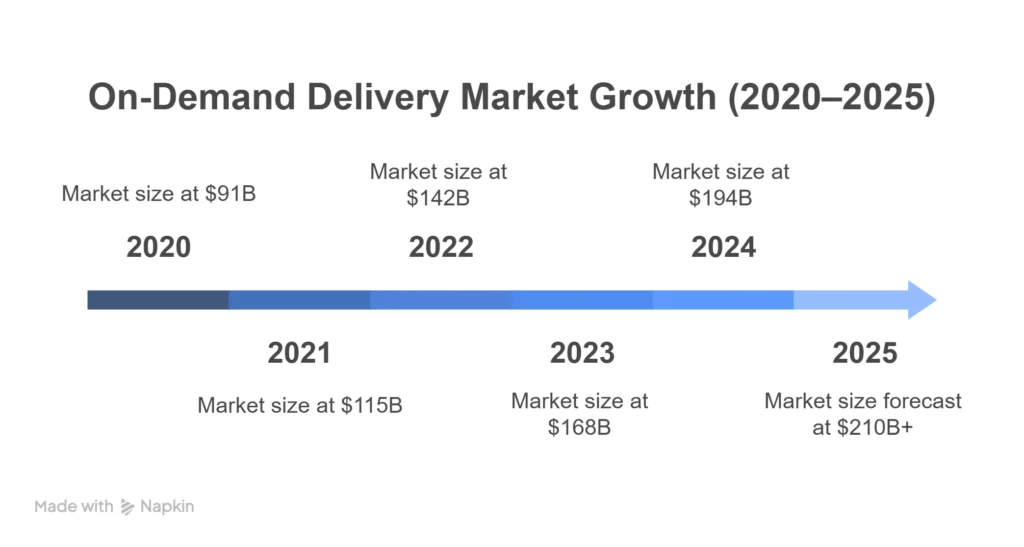
If you’ve ever waited hungrily for your dinner to arrive or scrambled to send a last-minute gift across town, congrats—you’re already knee-deep in the on-demand economy. And guess what? You’re not alone. Millions of users now expect instant gratification, whether it’s food, medicine, or a forgotten charger. This “I-want-it-now” culture is more than a phase—it’s a booming market.
Let’s be honest: starting an on-demand delivery business sounds sexy, but is it actually profitable? Spoiler: Yes. With the right app, model, and market fit, you can absolutely build a delivery empire—minus the headaches of old-school logistics. Add a sprinkle of tech, a dash of real-time tracking, and you’ve got yourself a money-making machine.
we’ve helped launch countless delivery clones across industries. Whether you’re dreaming of becoming the next DoorDash or carving out a hyperlocal niche, we’re here to unpack exactly how to get started—profitably.
What Is an On-Demand Delivery Business?
An on-demand delivery business connects customers to goods or services through a digital platform—often a mobile app—that facilitates real-time ordering, matching, and delivery. Think Uber Eats, but not just for food—groceries, meds, laundry, even fuel.
Key Verticals:
- Food & Restaurant Delivery (Swiggy, DoorDash)
- Grocery & Essentials (Instacart, FreshDirect)
- Medicine (1mg, PharmEasy)
- Multi-category Hyperlocal (Dunzo, Gojek)
Why the On-Demand Model Is So Profitable
The secret sauce? Convenience + scalability + low asset ownership. Most on-demand businesses don’t own inventory. They simply connect users and service providers. It’s a pure-play middleman model, supercharged by tech. According to a SensorTower – On-Demand App Revenue Trends 2024, top delivery apps are raking in millions via commissions, delivery fees, and in-app promotions.
Revenue Streams to Bank On:
- Delivery Charges: Fixed or distance-based
- Surge Pricing: Peak time profits
- Vendor Commissions: Cut from restaurants or stores
- Subscription Plans: Prime-style loyalty programs
- Ads & Promotions: In-app monetization via sponsored listings
How to Build Your On-Demand Delivery Business in 7 Steps
1. Pick Your Niche (Don’t Go Generic)
Find your lane. Is it vegan food in Tier 2 cities? Emergency pet meds? Artisanal groceries? Niching down increases customer loyalty and reduces CAC.
2. Choose the Right Business Model
- Single Store: One vendor, one location
- Aggregator: Multiple vendors, like Zomato
- Marketplace + Logistics: You manage the fleet (like Gojek)
- White-Label Franchise: Custom branded apps for vendors
3. Build or Buy the App?
Unless you’re a dev ninja, skip reinventing the wheel. Opt for ready-made delivery app clones with full customization. They’re faster, cheaper, and tested.
4. Get the Features Right
- Real-time GPS tracking
- ETA & route optimization
- Order scheduling
- Payment integrations
- Ratings & reviews
5. Logistics & Fleet Strategy
Outsource deliveries (like Uber Eats) or build an in-house fleet? Outsourcing scales faster but may affect customer experience. Hybrid is a smart compromise.
6. Launch Smart—Not Big
Pilot your app in one city. Partner with 10–15 vendors. Tweak your UX and pricing. Once your NPS is solid, expand.
7. Market Like a Maverick
Use hyperlocal ads, referral bonuses, and influencer shoutouts. User-generated content (UGC) goes a long way. Everyone loves showing off their food, trust us.
Common Pitfalls to Avoid
- No real-time tracking = frustrated users
- Too many SKUs = poor performance
- Ignoring customer service = churn city
- Falling for vanity metrics = focus on retention & LTV
Future of On-Demand Delivery
AI route optimization, drone deliveries, and even robot waiters aren’t just sci-fi—they’re next-gen logistics. As smartphones and 5G networks evolve, the speed and personalization of on-demand delivery will only intensify.
Now’s the time to ride the wave before the market saturates. Remember: being early isn’t luck, it’s strategy.
Conclusion
Starting an on-demand delivery business today isn’t just doable—it’s smart, scalable, and brimming with opportunity. Niche down, launch lean, and let your app do the heavy lifting.At Miracuves, we help innovators launch high-performance app clones that are fast, scalable, and monetization-ready. Ready to turn your idea into reality? Let’s build together.
FAQs
Q1. How much does it cost to build a delivery app?
A complete, ready-to-launch delivery app from Miracuves starts at around $2K–$5K, including setup, deployment, and full branding — all delivered within 6 days.
Q2. Can I start with a single city?
Absolutely. In fact, we recommend piloting in one city, fixing UX gaps, and scaling with real insights.
Q3. What’s better—owning the fleet or outsourcing?
Both have pros. Outsourcing scales faster, but owning offers control. A hybrid model gives you the best of both worlds.
Q4. Do I need a developer team?
Not if you choose Miracuves. Our app clones are plug-and-play and fully customizable—zero tech stress needed.
Q5. Is food delivery still profitable?
Yes, especially with niche targeting. Profits come from optimized delivery zones, efficient UX, and multiple revenue streams.
Q6. How do I attract vendors or restaurants?
Offer zero commissions for the first 3 months, promise app visibility, and provide customer insights as a value-add.
Related reading: on-demand delivery app business model.
Miracuves is an independent software development company. We are not affiliated with, connected to, sponsored by, or endorsed by any company or product named in this article.
Terms such as “X Clone” are used descriptively. It is how the software industry refers to building a platform with functionality comparable to a known service, and how clients search for it.
The entire design and codebase of our products is built by our own team. Our products contain no code, design, graphics, or content originating from any third-party website or applications.
All third-party names and marks referenced in this article are the property of their respective owners, referenced solely to identify the services discussed.