
Key Takeaways
- A vacation rental booking app connects guests, hosts, properties, availability, reservations, payments, and payouts within one digital marketplace.
- Core features include property search, filters, listings, availability calendars, booking requests, secure payments, messaging, reviews, and host dashboards.
- The complete booking experience depends on accurate inventory, real-time availability, transparent pricing, reliable payment processing, and clear host payout workflows.
Booking Workflow Signals
- Search, location filters, maps, property categories, amenities, pricing, reviews, and listing details help guests discover suitable vacation rentals.
- Availability calendars, blocked dates, minimum stays, instant booking, reservation requests, cancellations, and booking confirmations manage property availability.
- Checkout connects pricing breakdowns, service fees, taxes, payment gateways, booking status, refunds, and confirmation notifications into one transaction flow.
Platform Operations Insights
- Host dashboards help property owners manage listings, calendars, reservations, pricing, guest messages, earnings, and payout preferences.
- Payout workflows track completed stays, commissions, deductions, refunds, settlement status, and host earnings before funds are released.
- Miracuves develops customizable vacation rental booking platforms with search, property listings, calendars, reservations, payments, payouts, reviews, analytics, and admin controls.
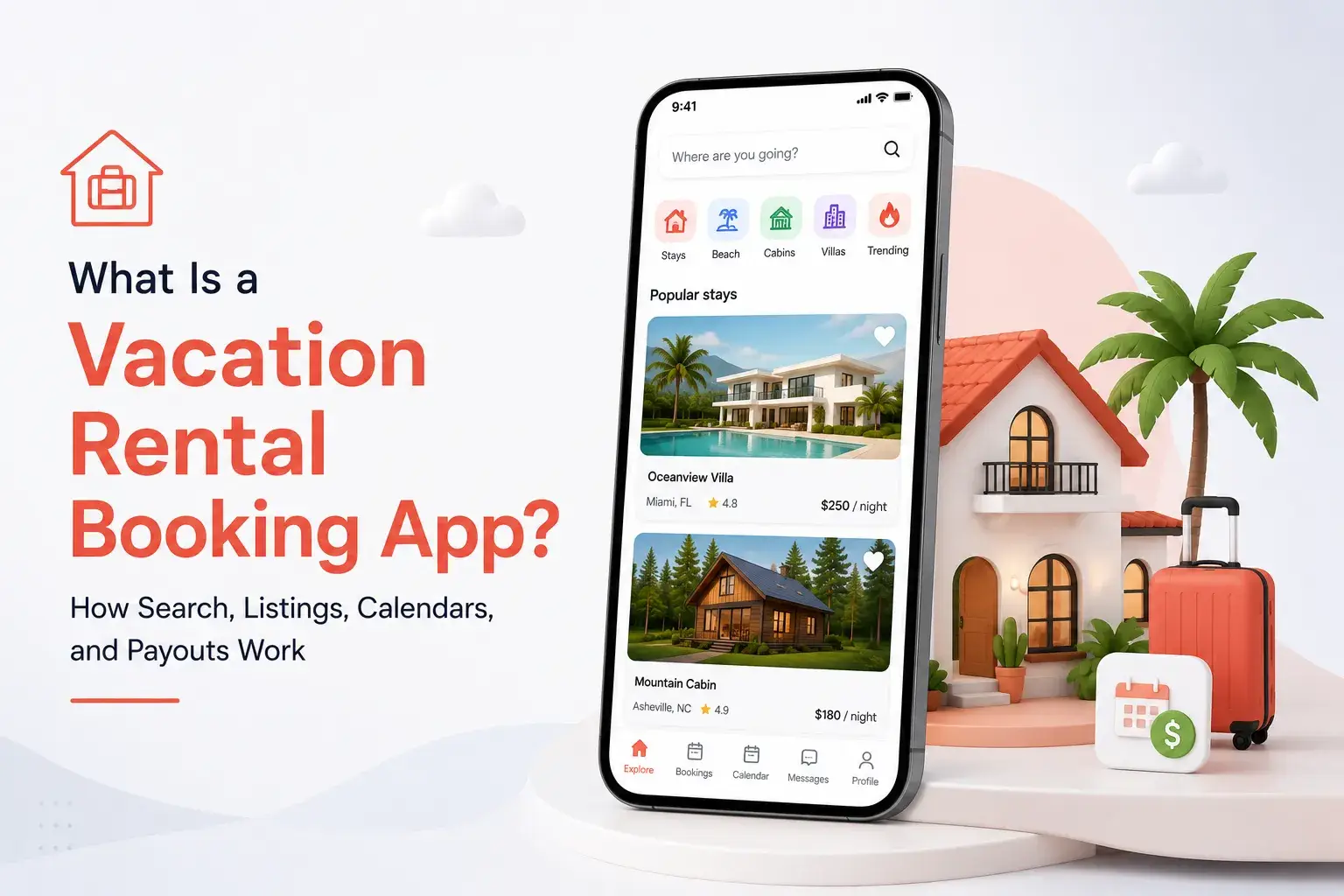
A vacation rental booking app is a digital marketplace where guests search for short-term stays and property owners list spaces for rent. The app connects both sides through property discovery, availability calendars, booking flows, secure payments, reviews, messaging, and host payouts.
For users, the experience feels simple. They choose a location, enter dates, compare properties, make a payment, and receive booking confirmation. For hosts, the app becomes a control panel for managing listings, prices, availability, guest communication, and earnings.
For founders, the real value is deeper than the booking screen. A strong vacation rental booking app is not just a travel interface. It is a marketplace system that balances guest demand, host supply, payment trust, platform rules, and admin control. For businesses exploring broader listing and rental marketplace solutions, this model is useful because it shows how property discovery, booking rules, payments, host supply, and admin workflows work together.
That is why understanding how these apps work is useful before building or launching one. The success of a rental marketplace depends on how well the platform manages search, listings, calendars, payments, payouts, disputes, and trust.
What Is a Vacation Rental Booking App?
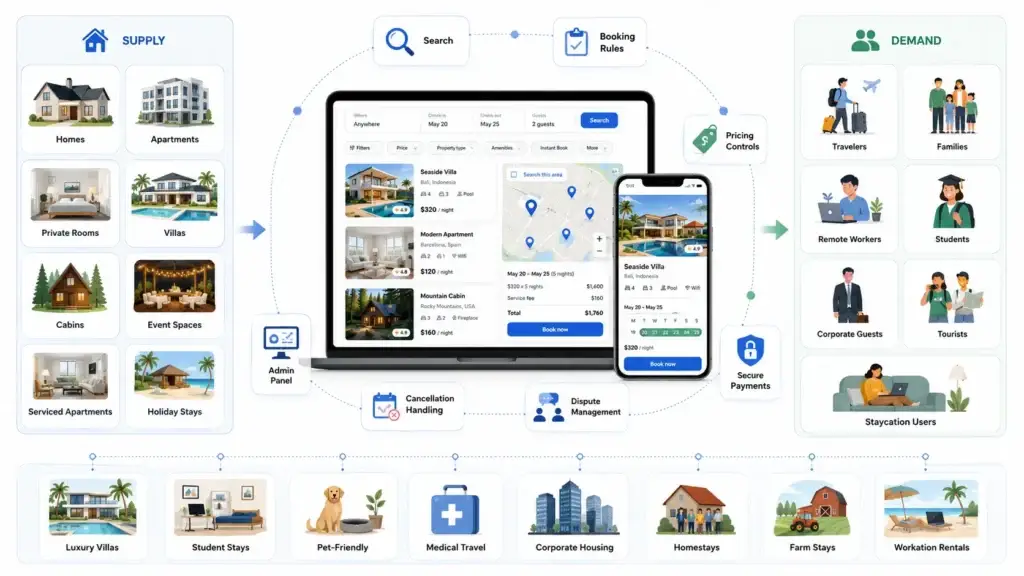
A vacation rental booking app is an online platform that allows guests to find and reserve short-term accommodation from individual hosts, property managers, hotels, resorts, local operators, or niche rental businesses.
Instead of operating like a traditional hotel website, this model usually works as a two-sided marketplace. One side brings the supply, which includes homes, apartments, private rooms, villas, cabins, event spaces, serviced apartments, or holiday stays. The other side brings demand, which includes travelers, families, remote workers, students, corporate guests, tourists, or local staycation users.
The platform sits between both groups and manages the transaction.
A guest wants a reliable place to stay. A host wants visibility, bookings, and income. The platform owner wants to create a trusted system where both sides can interact safely and where each booking generates business value.
This is why a vacation rental booking app needs more than a listing page. It needs search logic, booking rules, pricing controls, secure payments, user verification, cancellation handling, dispute management, and a backend admin panel.
For founders, this model is attractive because it can be adapted to focused markets such as luxury villas, student stays, religious tourism, pet-friendly rentals, medical travel stays, corporate housing, local homestays, farm stays, workation rentals, or event-space bookings.
How a Vacation Rental Booking App Works
A rental booking platform works by connecting guest intent with available property inventory. The app collects guest preferences, matches them with suitable listings, verifies availability, processes payment, confirms the booking, and later supports review and payout workflows.
The process usually includes three major sides: guest, host, and platform admin.
The guest side focuses on search, comparison, booking, payment, communication, and review. The host side focuses on listing creation, calendar control, pricing, booking management, guest messaging, and payout tracking. The admin side controls users, listings, commissions, payments, refunds, disputes, content, reports, and platform rules.
When all three sides work together, the platform becomes a complete booking marketplace instead of a simple property directory.
Guest Workflow: From Search to Booking Confirmation
The guest journey begins with intent. A user enters a destination, check-in date, check-out date, number of guests, budget, and preferences. The app then displays matching properties based on availability and filters.
A good search experience allows guests to refine results by property type, price range, bedrooms, amenities, location, ratings, cancellation policy, instant booking, parking, kitchen, workspace, pool, pet-friendliness, or family-friendly options.
Once the guest opens a listing, they usually review photos, pricing, amenities, house rules, host details, map location, reviews, availability, cancellation terms, and total payable amount.
This matters because guests do not book only based on price. They book when the listing creates enough confidence. Clear photos, transparent pricing, accurate location details, visible reviews, and reliable availability all reduce hesitation.
After selecting the property, the guest moves to booking. Depending on the platform model, booking can be instant or request-based. Instant booking confirms automatically if the dates are available. Request-based booking gives the host the option to accept or reject the reservation.
The final step is payment and confirmation. The guest receives booking details, check-in instructions, host communication access, invoice or receipt, and platform notifications.
Host Workflow: From Listing Creation to Earnings
For hosts, the app works as a business dashboard. A host creates an account, adds property details, uploads photos, sets location, adds amenities, defines house rules, chooses pricing, manages availability, and responds to guest requests.
The listing creation process should be structured enough to make the property searchable and trustworthy. A weak listing form can lead to incomplete data, poor search results, and guest confusion.
Important host-side fields usually include:
- Property title and description
- Property type and room type
- Address or location zone
- Photos and gallery
- Amenities and facilities
- Guest capacity
- Pricing rules
- Cleaning fees or service charges
- Availability calendar
- Cancellation policy
- Check-in and check-out rules
- Host profile and verification details
After the listing is live, the host needs tools to manage bookings. This includes accepting requests, blocking unavailable dates, changing prices, messaging guests, reviewing upcoming reservations, tracking earnings, and requesting payouts.
Founders who want to compare guest, host, booking, payment, calendar, and admin modules can review the core rental marketplace features before finalizing their product scope.
For founders, the host experience is critical because supply quality decides marketplace strength. If hosts find the dashboard confusing, they may not update calendars, respond to guests, or maintain listing quality. That directly affects conversion and trust.
Search and Filters: The Discovery Engine of a Rental Marketplace
Search is one of the most important parts of a vacation rental booking app. Guests usually come with specific needs. They may want a beach villa for five people, a city apartment near public transport, a pet-friendly homestay, or a quiet workspace for remote work.
The search system should help users move from broad intent to confident selection.
A strong search experience usually includes keyword search, location-based results, map discovery, date availability, budget filters, amenities, property types, guest capacity, ratings, and sorting options.
Map-based discovery is especially useful for travel and rental marketplaces because location affects booking decisions. Guests often compare distance from attractions, airports, hospitals, business centers, beaches, universities, or event venues. If map performance is important for the product, founders can also study map search optimization for rental marketplaces before planning location-based discovery.
For founders, search is not only a user experience feature. It affects revenue. If good listings are buried, hosts lose bookings. If irrelevant listings appear first, guests abandon the platform. Search logic should balance relevance, availability, quality, pricing, location, and platform monetization.
Listing Pages: Where Guest Trust Is Built
A listing page is where the guest decides whether to book. It should answer every practical question before the user contacts the host.
A strong listing page usually includes property photos, description, amenities, sleeping arrangements, pricing, taxes or fees, cancellation policy, map preview, host profile, availability calendar, reviews, ratings, house rules, check-in details, and support options.
The best listing pages reduce uncertainty. Guests want to know what they are paying for, where they are staying, what is included, what rules apply, and what happens if something goes wrong.
For hosts, listing pages are also conversion assets. Better images, complete descriptions, competitive pricing, verified details, and positive reviews can increase booking confidence.
For platform owners, listing quality needs admin control. The admin should be able to approve listings, reject incomplete submissions, moderate photos, remove misleading content, review complaints, and manage reported listings.
Availability Calendars: Why They Matter More Than Founders Think
The availability calendar is one of the most sensitive parts of a rental booking app. If the calendar is wrong, the platform can accept bookings for unavailable dates. This leads to cancellations, refunds, complaints, and loss of trust. For a deeper technical view, founders can review calendar sync and double-booking prevention before building multi-channel availability workflows.
A reliable booking calendar should show available dates, blocked dates, booked dates, seasonal pricing, minimum stay rules, check-in restrictions, and special date-based conditions.
For hosts, the calendar helps manage inventory. For guests, it prevents disappointment. For admins, it reduces operational disputes.
Calendar logic becomes more complex when hosts list the same property on multiple channels. If the founder plans to support multi-channel inventory later, the platform should be designed with synchronization possibilities in mind.
The key point is simple: a rental marketplace does not scale well if availability is managed casually. Calendar accuracy protects the guest experience, host trust, and platform reputation.
Payments: How Booking Transactions Are Processed
Payments are the trust layer of a vacation rental booking app. The guest needs confidence that their money is handled securely. The host needs confidence that they will receive earnings. The platform owner needs control over commissions, refunds, fees, and payout timing.
A typical payment flow includes booking amount calculation, service fees, taxes where applicable, coupons or discounts, wallet or gateway payment, transaction confirmation, booking record creation, and payment status updates.
The platform may support card payments, wallets, bank transfer, regional gateways, or other local payment methods depending on the target market.
For founders, payment design should be planned carefully. It affects user trust, conversion, accounting, refund handling, and host satisfaction.
The admin panel should help the platform owner view transactions, track failed payments, process refunds, manage commissions, and monitor suspicious activity. This is also where secure payment gateway integration, encrypted data transfer, and role-based access control become important.
Host Payouts: How Earnings Move From Platform to Host
A vacation rental booking app does not end at guest payment. The platform also needs a payout system for hosts.
Host payouts are usually calculated after deducting platform commission, service fees, cancellation penalties, taxes where applicable, or other agreed charges. The host should be able to see completed bookings, pending earnings, available balance, payout requests, payout history, and payment status.
The platform owner may release payouts after check-in, after check-out, after a holding period, or after admin approval. The right model depends on business rules, local regulations, refund policies, and trust requirements.
A good host payout system helps prevent confusion. Hosts should understand when they will be paid, how much they will receive, and why any deductions were applied.
For founders, payout transparency is important because hosts are the supply side of the marketplace. If hosts do not trust the platform’s payment process, they may stop listing or move to competing channels.
Reviews and Ratings: The Marketplace Trust Loop
Reviews help guests choose better stays and help hosts build reputation. They also help the platform maintain quality.
A rental marketplace can include guest reviews, host reviews, star ratings, written feedback, review moderation, abuse reporting, and admin review controls.
The review system should be protected from spam and manipulation. Fake reviews, abusive feedback, and unfair ratings can damage both user trust and host confidence.
A healthy review loop improves marketplace quality over time. Good hosts get more visibility. Poor listings receive signals for improvement. Guests make more informed decisions. Admins get useful quality data.
For founders, reviews are not just social proof. They are an operational signal.
Messaging and Notifications: Keeping Guests and Hosts Aligned
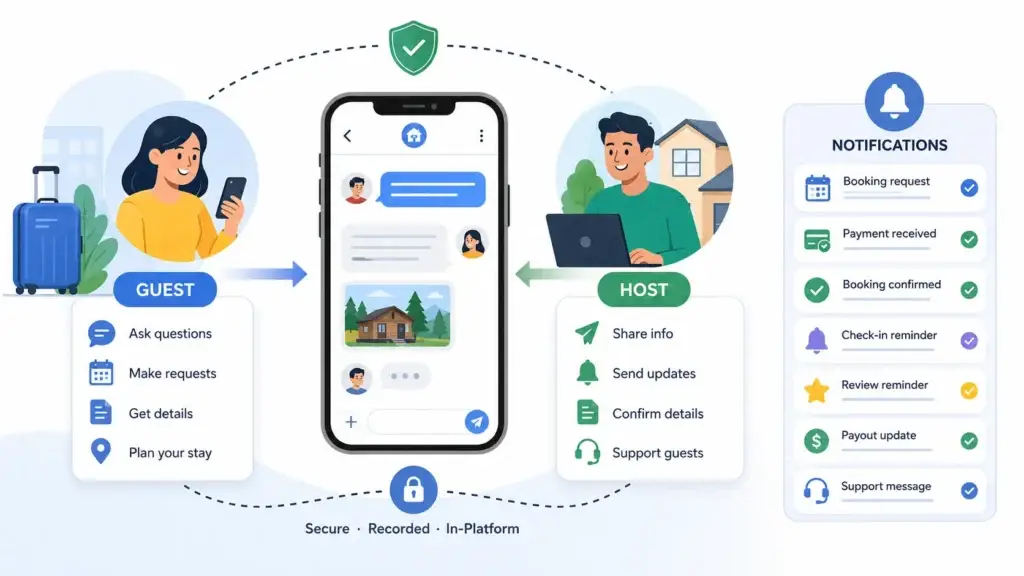
Guest-host communication is another important workflow. Guests may ask about check-in, parking, pet rules, local directions, amenities, or special requests. Hosts may need to send arrival instructions, payment reminders, policy details, or emergency updates.
In-app messaging keeps communication recorded inside the platform. This helps with trust, dispute resolution, and support visibility.
Notifications also keep the booking journey moving. Guests and hosts may need alerts for booking requests, payment status, confirmation, cancellation, check-in reminders, review prompts, payout updates, and support messages.
For platform owners, keeping communication inside the system creates better control. It also reduces dependency on scattered emails, phone calls, or external messaging apps.
Admin Panel: The Control Layer Behind the Platform
The admin panel is where the platform operator manages the marketplace. Without a strong admin panel, the business becomes difficult to control as bookings, users, hosts, and disputes increase.
A useful admin panel usually includes user management, host approval, listing moderation, booking management, payment tracking, commission settings, payout approvals, refund handling, dispute management, coupon management, content control, reports, and role-based access.
The admin should also be able to monitor platform health. This includes booking volume, revenue, active listings, top locations, host performance, cancellation trends, guest complaints, and payment issues.
For founders, admin control decides whether the platform can grow without becoming chaotic. A beautiful app can attract users, but the admin system determines whether the business can operate reliably.
Founder Decision Signals
Speed
If your target market is already clear, a ready-made foundation can reduce the time spent building common booking, listing, calendar, and payment workflows from zero.
Cost
Costs usually depend on feature scope, integrations, branding, payment gateways, mobile apps, admin controls, and custom business rules.
Scalability
The platform should be planned for more listings, more hosts, more locations, stronger search, accurate calendars, and reliable payout operations.
Market Fit
Founders should validate whether their niche has enough guest demand and host supply before expanding into too many property categories.
Common Revenue Models for Vacation Rental Booking Apps
A vacation rental booking app can make money in several ways. The most common model is commission, where the platform earns a percentage from each successful booking. Founders comparing commissions, guest fees, host subscriptions, featured listings, and add-on revenue can explore the full rental marketplace business model in more detail.
Other models include guest service fees, host subscription plans, featured listings, advertising, cancellation charges, cleaning service partnerships, insurance add-ons, local experience bookings, and premium tools for property managers.
The best revenue model depends on the platform’s audience. A luxury villa marketplace may use higher commissions and concierge services. A student housing platform may use subscription or listing fees. A corporate housing platform may use negotiated contracts and long-stay pricing.
| Revenue Model | How It Works | Best For |
|---|---|---|
| Booking Commission | Platform takes a percentage from each booking | Most rental marketplaces |
| Guest Service Fee | Guest pays an additional platform fee | Consumer travel platforms |
| Host Subscription | Hosts pay monthly or yearly for listing tools | Property managers and professional hosts |
| Featured Listings | Hosts pay for better visibility | Competitive locations |
| Add-on Services | Cleaning, insurance, concierge, local experiences | Premium or niche marketplaces |
| Advertising | Travel brands or local partners promote services | Platforms with strong traffic |
For founders, monetization should not be added as an afterthought. Commission rules, payout rules, refunds, coupons, taxes, and service fees should be planned early because they affect the booking engine and admin reporting.
Security and Trust Features Every Rental Marketplace Needs
Trust is the foundation of a rental booking platform. Guests are paying before they arrive. Hosts are sharing property access with people they may not know. The platform owner is responsible for reducing risk on both sides.
Important trust and security features include user verification, host verification, secure payment gateway integration, encrypted data transfer, review moderation, abuse reporting, dispute management, refund workflows, admin approval controls, role-based access, and activity logs. For a deeper checklist, review these rental marketplace security guidelines before finalizing verification, payment, moderation, and access-control workflows.
For sensitive workflows, the platform should also support clear cancellation policies, booking records, payout history, identity checks where required, and transparent communication records.
Final legal and compliance requirements depend on the target region, operating model, payment method, data handling rules, local rental regulations, and legal review. The platform should provide a compliance-ready foundation, but the founder still needs to validate local business requirements before launch.
Vacation Rental Booking App vs Simple Property Listing Website
A property listing website mostly displays information. A vacation rental booking app manages transactions.
That difference matters.
A listing website may show properties, photos, contact numbers, and enquiry forms. A booking app goes further by handling search, availability, booking confirmation, online payment, cancellation, refunds, host dashboards, reviews, payout tracking, and admin controls.
| Area | Simple Listing Website | Vacation Rental Booking App |
| Property Discovery | Basic listing pages | Search, filters, map, categories |
| Booking | Usually manual enquiry | Instant or request-based booking |
| Availability | Often not real-time | Calendar-based availability |
| Payments | Usually offline | Integrated payment workflow |
| Host Tools | Limited | Listing, calendar, pricing, payout dashboard |
| Admin Control | Basic CMS | User, listing, booking, payment, refund, and dispute control |
| Revenue Model | Leads or ads | Commission, fees, subscriptions, featured listings |
For founders planning a scalable marketplace, a booking app provides stronger control than a simple directory. The platform can manage the full transaction instead of only passing users to property owners.
Mistakes Founders Should Avoid
The first mistake is launching with too many categories too early. A focused platform is often easier to validate than a broad marketplace. For example, a founder may start with villas in one region, workation stays, student housing, or pet-friendly rentals before expanding.
The second mistake is treating calendar management as a small feature. Calendar errors can cause double bookings, refund pressure, and poor reviews.
The third mistake is ignoring host onboarding. If hosts do not understand how to create strong listings, set prices, upload good photos, and manage availability, the marketplace quality suffers.
The fourth mistake is not planning payouts properly. Hosts need clear visibility into earnings, deductions, payout requests, and payment timelines.
The fifth mistake is depending only on a good-looking guest app. Marketplace success also depends on backend operations, admin control, support workflows, trust systems, and monetization logic.
When Should Founders Consider a Ready-Made Rental Marketplace Foundation?
A ready-made rental marketplace foundation can be useful when the founder already understands the niche, audience, and business model but does not want to spend months building common marketplace workflows from zero.
If the project requires deeper customization, technical guidance, or launch planning, founders can also compare what a vacation rental app development company should provide before choosing a build partner.
This approach can be especially useful for founders planning to launch a focused rental platform for villas, serviced apartments, homestays, event spaces, corporate housing, vacation homes, or local travel stays.
The main advantage is not copying another business. The value is starting with proven marketplace workflows and then customizing the platform for your own brand, audience, locations, pricing rules, and growth strategy.
For founders who want to move faster, Miracuves offers a ready-made rental marketplace solution that can support guest booking, host listing, calendar management, payments, payouts, admin control, and white-label branding.
How Miracuves Helps Founders Launch Rental Booking Platforms Faster
Miracuves helps founders build ready-made and white-label app solutions with source code, branded design, admin control, and faster deployment. For rental marketplaces, this means founders can start from a launch-ready product foundation instead of building every listing, booking, payment, and dashboard workflow from the ground up.
The right launch path depends on your business model. Some founders need a niche vacation rental platform. Others need a property manager marketplace, stay booking app, local travel platform, serviced apartment booking system, or multi-category rental marketplace.
Miracuves can help map the right modules, user flows, admin controls, monetization logic, and customization scope before development begins.
Final Thoughts
A vacation rental booking app works because it brings guests, hosts, payments, calendars, trust, and admin operations into one connected system.
The guest sees search, listings, booking, and payment. The host sees property management, calendars, guest communication, and earnings. The platform owner sees users, listings, transactions, commissions, disputes, refunds, and growth data.
For founders, the real decision is not only whether the app should look good. The stronger question is whether the platform can manage real bookings, real hosts, real payments, real disputes, and real growth.
A focused rental marketplace can become a strong business when the product foundation, niche positioning, trust layer, and monetization model are planned properly.
FAQs
What is a vacation rental booking app?
A vacation rental booking app is a platform where guests search and book short-term stays while hosts list and manage properties. It usually includes search, listings, calendars, payments, messaging, reviews, host dashboards, and admin controls.
How does a vacation rental booking app work?
It works by matching guest search intent with available property listings. Guests enter location, dates, and preferences, compare listings, pay online, and receive booking confirmation. Hosts manage listings, prices, calendars, booking requests, and payouts from their dashboard.
What features should a vacation rental booking app include?
Important features include guest registration, property search, map view, filters, listing pages, availability calendars, booking management, secure payments, host dashboards, reviews, messaging, notifications, payout tracking, and an admin panel.
Why is the availability calendar important in rental booking apps?
The availability calendar prevents double bookings and helps guests see which dates are open. It also helps hosts manage blocked dates, seasonal pricing, minimum stays, and booking rules.
How do hosts get paid on a rental booking platform?
Hosts usually receive payouts after the platform deducts commission, service fees, refunds, or other charges. The payout may be released after booking confirmation, check-in, check-out, or admin approval depending on the business model.
How does a vacation rental marketplace make money?
A vacation rental marketplace can earn through booking commissions, guest service fees, host subscriptions, featured listings, advertising, cancellation charges, local service partnerships, and premium tools for hosts.
Is a rental booking app different from a property listing website?
Yes. A listing website mainly displays property information, while a rental booking app manages the full transaction. This includes availability, payments, booking confirmation, host dashboards, reviews, payouts, refunds, and admin control.
Can founders launch a niche rental booking platform?
Yes. Founders can launch niche platforms for villas, local homestays, student housing, workation rentals, corporate housing, serviced apartments, event spaces, farm stays, or pet-friendly stays. The key is to define the target audience, supply model, trust rules, and monetization strategy clearly.
Miracuves is an independent software development company. We are not affiliated with, connected to, sponsored by, or endorsed by any company or product named in this article.
Terms such as “X Clone” are used descriptively. It is how the software industry refers to building a platform with functionality comparable to a known service, and how clients search for it.
The entire design and codebase of our products is built by our own team. Our products contain no code, design, graphics, or content originating from any third-party website or applications.
All third-party names and marks referenced in this article are the property of their respective owners, referenced solely to identify the services discussed.