
Key Takeaways
What You’ll Learn
- inDrive’s revenue model is built around bid-based ride pricing, where users and drivers negotiate fares directly.
- Ride commissions remain the biggest income source, but the platform also earns from delivery, subscriptions, advertising, and partnerships.
- Lower commission rates help inDrive attract and retain more drivers compared to many traditional ride-hailing apps.
- Multiple monetization layers make the business model stronger than depending on rides alone.
- Scalable revenue growth depends on market fit, driver supply, repeat usage, and efficient multi-service expansion.
Stats That Matter
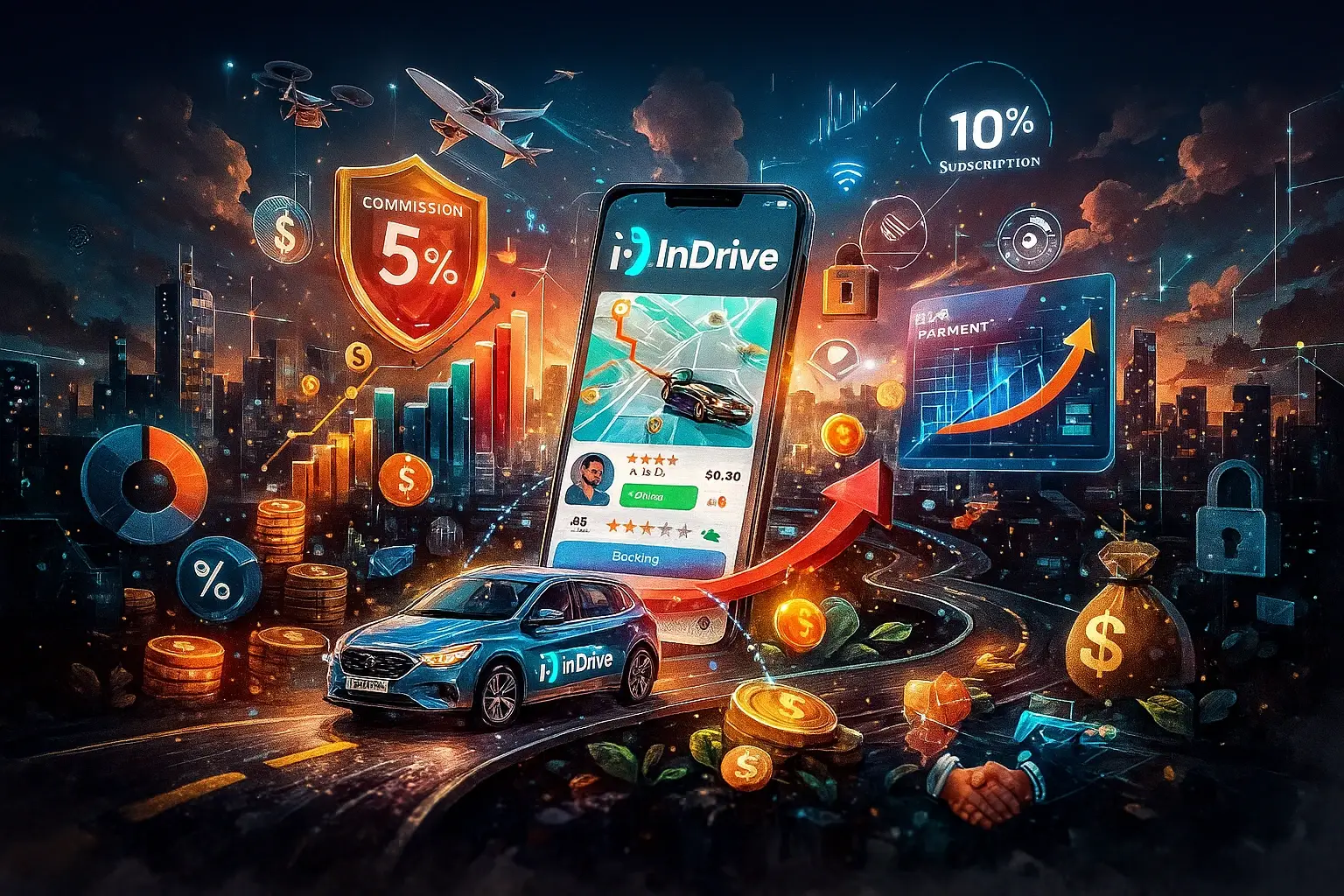
- Ride commissions contribute around 58% of total revenue, making them the platform’s biggest monetization source.
- Delivery and courier services add about 14%, showing how multi-service expansion improves overall revenue strength.
- Subscriptions contribute 10%, with premium driver plans offering better visibility and ride-request priority.
- Advertising and promotions add another revenue layer, while data and B2B partnerships contribute about 10%.
- In the fee structure, riders may pay 2–3% in service fees, while drivers usually pay 6–12% commission depending on region and plan.
Real Insights
- The core strength of inDrive’s model is pricing flexibility, which makes the platform attractive in cost-sensitive markets.
- Driver-focused monetization works well because subscriptions and lower commissions can improve loyalty and participation.
- Cross-selling services like courier and delivery inside the same app helps increase user lifetime value.
- Hidden revenue layers such as peak-time surcharges, geo-based pricing, and instant withdrawal fees can significantly improve margins.
- For long-term success, the real advantage is combining ride commissions, recurring subscriptions, service expansion, and market-specific pricing into one flexible business model.
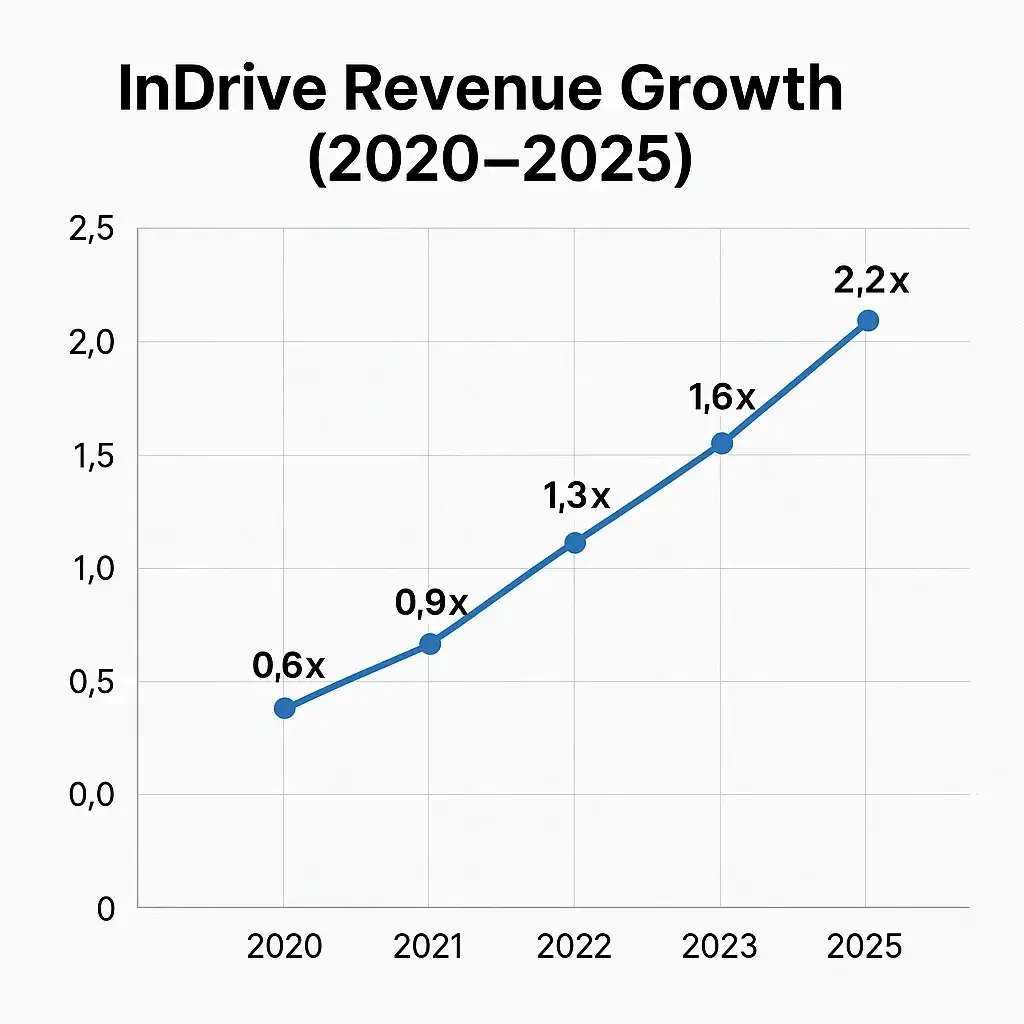
In 2026, InDrive surpassed $2.2 billion in annual gross revenue, marking over 35% year-over-year growth, driven by its unique “bid-based” pricing model that empowers users to negotiate fares directly. Unlike traditional ride-hailing apps, InDrive thrives on flexibility, fair pricing, and reduced commissions — making it one of the fastest-growing mobility platforms globally.
For entrepreneurs, understanding this revenue structure is key. The InDrive model showcases how transparent commissions, negotiated pricing, and multi-service diversification can build a profitable, user-trusted mobility app.
Planning to build in this space? Miracuves offers a ready-made fare bidding taxi platform that you can launch under your own brand.
InDrive Revenue Overview – The Big Picture
As of 2025, InDrive’s valuation crossed $4.8 billion, driven by strong adoption across Asia, Latin America, and Eastern Europe. The company now operates in 47+ countries, boasting over 175 million downloads.
- Annual revenue (2026): $2.2 billion
- YoY growth (2024–2026): 35%
- Revenue by region:
- LATAM: 34%
- Asia-Pacific: 28%
- Eastern Europe: 22%
- MENA & Africa: 16%
- Net profit margin (2026): ~18%
- Market position: Third globally after Uber and Bolt in active city count
Read More: Build an App Like Indrive | Best Developer Guide for JS & PHP
Primary Revenue Streams Deep Dive
Revenue Stream #1: Commission from Rides
How it works: InDrive takes a small service commission from each completed trip, usually 6–12%, depending on location.
Share of total revenue: ~58%
Pricing structure: Dynamic; negotiated between driver and passenger. InDrive’s flexibility increases user retention.
Example: If a $10 ride is completed, InDrive may take $0.80 (8%), leaving $9.20 with the driver.
Trend: Lower commissions drive higher driver loyalty compared to Uber’s 25–30%.
Revenue Stream #2: Delivery & Courier Services
InDrive expanded to parcel and grocery delivery, charging commissions on deliveries similar to rides.
Share: 14%
Growth rate: +52% YoY due to cross-service adoption.
Revenue Stream #3: Subscription & Priority Access
Premium users (especially drivers) pay a monthly subscription ($5–$15) for higher visibility and priority bookings.
Share: 10%
Trend: Rising demand from professional drivers seeking more leads.
Revenue Stream #4: Advertising & Promotions
InDrive partners with brands to display in-app ads and sponsored listings (restaurants, fuel stations, etc.).
Share: 8%
Revenue Stream #5: Data & B2B Partnerships
InDrive monetizes mobility data for city planners and corporate ride solutions.
Share: 10%
Detailed Breakdown of Revenue Streams by Percentage
| Revenue Stream | Share of Total Revenue |
|---|---|
| Rides Commission | 58% |
| Delivery & Courier | 14% |
| Subscriptions | 10% |
| Advertising & Promotions | 8% |
| Data Partnerships | 10% |
The Fee Structure Explained
User-side Fees:
- Riders negotiate directly but pay a service fee (2–3%).
- Subscription plans for frequent riders reduce booking delays.
Provider-side Fees:
- Drivers pay 6–12% commission.
- Subscription tiers: Gold/Pro users gain algorithmic boost in ride requests.
Hidden Revenue Tactics:
InDrive occasionally charges peak-time surcharges, geo-based rates, and transaction fees for instant withdrawals.
Regional Variations:
InDrive uses market-specific pricing, with lower commissions in emerging markets (Africa: 6%) and higher in mature markets (Europe: 12%).
Detailed Fee Structure Breakdown by User Type
| User Type | Fee Type | Range |
|---|---|---|
| Rider | Service Fee | 2–3% |
| Driver | Commission | 6–12% |
| Driver (Pro) | Subscription | $5–$15/month |
| Instant Pay | Transaction Fee | 1% |
How InDrive Maximizes Revenue Per User
- Segmentation: Targets city tiers (Tier 2–3 cities) where Uber penetration is low.
- Upselling: Promotes delivery and intercity travel to existing users.
- Cross-selling: Offers “Courier” services within ride app interface.
- Dynamic pricing: AI matches rider offers and driver bids for optimal acceptance.
- Retention: Loyalty programs for high-frequency users.
- LTV optimization: Encourages multi-service usage (ride + courier + delivery).
- Psychological pricing: Transparent negotiation increases perceived fairness, improving repeat usage.
Example: Cities with fare negotiation see 25% higher retention compared to fixed-fare markets.
Cost Structure & Profit Margins
Major Costs:
- Technology Infrastructure: 25%
- Marketing & CAC: 20%
- Operations & Support: 18%
- R&D (AI Matching, Fraud Detection): 12%
- Compliance & Legal: 5%
Unit Economics:
- Average Revenue per Ride: $0.85
- Average Cost per Ride: $0.55
- Gross Margin per Ride: $0.30
Profitability Path:
InDrive turned operationally profitable in select markets in 2024; full-scale profitability projected by 2026.
Future Revenue Opportunities & Innovations
- AI Negotiation Engine: Testing auto-bidding for optimal pricing.
- Micro-Insurance: Partnered with insurtechs to sell trip insurance.
- Freight & B2B Logistics: Expanding into small truck delivery verticals.
- Autonomous Integration: Exploring driverless routes in 2027 markets.
- Threats: Regulatory hurdles and competition from local apps.
Entrepreneurial Opportunity: New entrants can localize the model in untapped Tier-3 markets using white-label InDrive clone solutions.
Lessons for Entrepreneurs & Your Opportunity
Key Takeaways:
- Lower commissions = higher driver adoption
- Negotiation builds user trust
- Regional pricing adaptability boosts growth
- Multi-service integration improves revenue per user
Market Gaps:
- Limited adoption in rural & suburban markets
- Opportunity to integrate EV-based fleets or carbon credits
Entrepreneur Insight:
Replicate InDrive’s user-empowered model, but add AI-driven fare suggestions, gamified loyalty, and EV tie-ins for differentiation.
Read More: InDrive App Features: What Sets It Apart
Get a free consultation to map out your revenue strategy.
Final Thought
InDrive proves that innovation in pricing can disrupt even saturated markets. Its hybrid of negotiation economics and low-fee inclusivity makes it a sustainable blueprint for the next generation of ride-hailing startups.
FAQs
How much does InDrive make per transaction?
Around 6–12% of the total trip value depending on region.
What’s InDrive’s most profitable revenue stream?
Ride commissions account for nearly 58% of total revenue.
How does InDrive’s pricing compare to competitors?
It’s 20–40% cheaper on average than Uber or Bolt thanks to bid-based fares — and with Miracuves, you can build a similar platform starting at just $3099.
What percentage does InDrive take from drivers?
Between 6% and 12%, depending on market and subscription tier.
How has InDrive’s revenue model evolved?
Started as pure ride-hailing; now includes delivery, subscriptions, ads, and B2B logistics.
Can small platforms use similar models?
Yes. Negotiation-based pricing scales well in emerging markets.
What’s the minimum scale for profitability?
Approx. 50K monthly active rides in a single region.
How to implement similar revenue models?
Use Miracuves’ InDrive clone with modular commission control.
What are alternatives to InDrive’s model?
Fixed-fare (Uber style) or hybrid tier-based pricing.
Related Articles:
Miracuves is an independent software development company. We are not affiliated with, connected to, sponsored by, or endorsed by any company or product named in this article.
Terms such as “X Clone” are used descriptively. It is how the software industry refers to building a platform with functionality comparable to a known service, and how clients search for it.
The entire design and codebase of our products is built by our own team. Our products contain no code, design, graphics, or content originating from any third-party website or applications.
All third-party names and marks referenced in this article are the property of their respective owners, referenced solely to identify the services discussed.