

Key Takeaways
What You’ll Learn
- inDrive stands out because of fare negotiation, giving riders and drivers more control over trip pricing instead of relying only on algorithm-based fares.
- Transparent driver profiles and ratings help users make better ride decisions before accepting a trip.
- Cash and card payment flexibility makes the platform more accessible across different markets and user groups.
- Multi-service integration expands the app beyond city rides into intercity trips, freight, and courier services.
- The real value of an inDrive-style app comes from combining pricing freedom, trust, flexibility, and a more people-first ride experience.
Stats That Matter
- The blog highlights fare negotiation as inDrive’s biggest feature, where riders suggest a fare and drivers can accept or counter it.
- Driver ratings, trip history, and profile visibility improve trust by making driver selection more transparent.
- Cash plus digital payment support makes the app more practical in underbanked and mixed-payment markets.
- Safety tools include ride-detail sharing, emergency contact support, SOS options, and two-way reviews.
- inDrive is also positioned as more than a taxi app, with city rides, intercity trips, freight deliveries, and courier services included in its wider mobility ecosystem.
Real Insights
- Pricing control changes user perception because people feel more involved when they can negotiate instead of passively accepting a system-generated fare.
- Trust is built through visibility, not just automation, which is why ratings, profiles, and two-way reviews matter so much.
- Payment flexibility is a growth advantage for markets where users still rely on cash as much as cards or digital wallets.
- Multi-service expansion improves platform value because users can depend on one app for several transport and delivery needs.
- For founders, the strongest takeaway is that an inDrive-like product wins by balancing fair pricing, user trust, service flexibility, and scalable mobility use cases.
Ever felt like ride-hailing apps are all starting to look the same? You tap, you wait, you get charged a price you never agreed to, and boom—wallet dented. As someone who once pitched an Uber-for-dog-grooming startup at a hackathon (true story), I’ve had a soft spot for innovation that challenges the status quo. That’s exactly what inDrive does. It flips the script by letting passengers and drivers negotiate their fare. Yes, negotiate—like at a flea market, but for taxis.
Now, imagine you’re a startup founder or digital creator looking to launch something different—something with personality, a pricing twist, and grassroots appeal. This is where inDrive’s unique DNA shines and becomes more than just a transport app—it becomes a product blueprint for anyone considering an inDrive clone to disrupt the market.
Whether you’re in Lagos, Lima, or Lucknow, Indrive is proof that localization, fairness, and people-first tech can scale fast. And if you’re thinking of launching a similar app that empowers users over algorithms, you’re in the right place. At Miracuves, we help entrepreneurs bring such bold ideas to life with powerful, customizable clone solutions.
What Is InDrive & Why Are People Loving It?
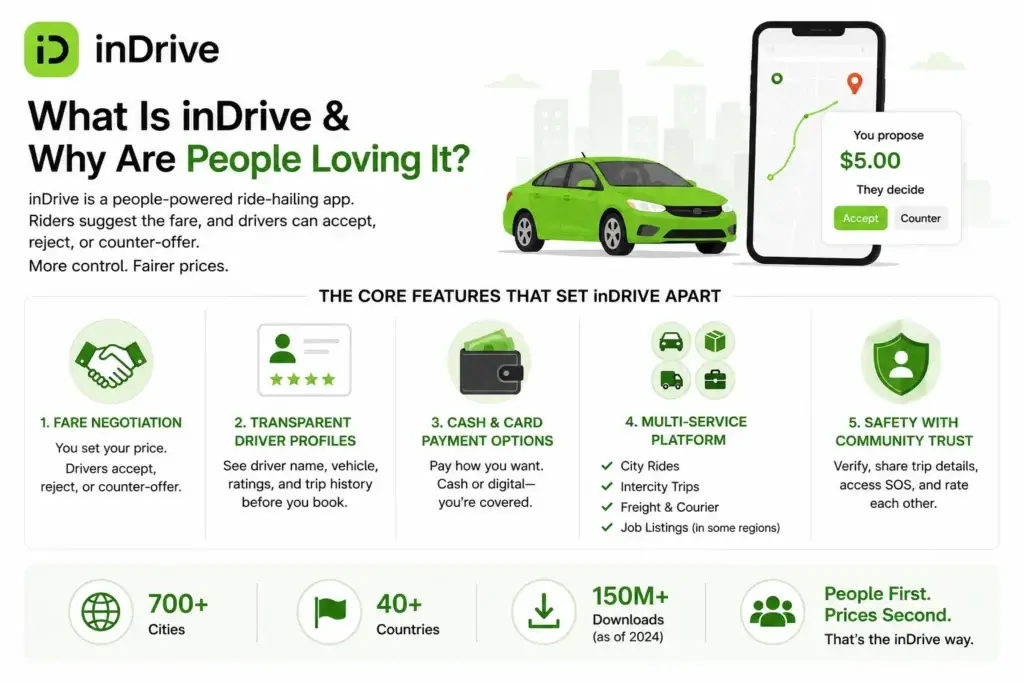
InDrive (formerly inDriver) isn’t just another ride-hailing app like Uber or Bolt. It’s a people-powered marketplace where riders propose the fare, and drivers can accept, reject, or counter-offer. This back-and-forth model gives users more control, especially in emerging markets where fixed fares often feel exploitative or out of sync with real-world conditions.
Launched in Russia and now active in over 700 cities across 40+ countries, inDrive boasts more than 150 million downloads as of 2024. The app doesn’t stop at just rides—courier services, freight, and intercity travel are part of its expanding feature mix.
Read more: What is InDrive App and How Does It Work?
The Core Features That Set inDrive Apart
1. Fare Negotiation System
The crown jewel of inDrive’s success. Riders input their pickup and drop-off points and suggest a fare. Drivers nearby see this and respond with acceptance or a counter-offer. No algorithmic pricing. No peak-hour surprises.
2. Transparent Driver Ratings & Profiles
Riders can view detailed driver profiles—name, vehicle info, user ratings, and trip history—before accepting a ride. Trust is built not through automation, but via transparency.
3. Cash and Card Payment Flexibility
inDrive supports both cash and digital payments, allowing users in underbanked regions to participate without needing credit cards.
4. Multi-Service Integration
It’s not just about urban mobility:
- City Rides
- Intercity Trips
- Freight Deliveries
- Courier Services
- Job Listings (experimental in some regions)
This creates an ecosystem around the transportation needs of users—sort of a “one-stop urban mobility shop.”
Read more : White-Label inDrive App Security: Risks, Standards & Best Practices 2026
Safety, But with a Community Twist
Safety in inDrive isn’t reliant solely on GPS tracking. The app encourages both drivers and passengers to verify each other, share ride details with emergency contacts, and access SOS support options. There’s also two-way rating and review enforcement, meaning bad behavior on either side doesn’t go unchecked.
Think of it like a trust-based rideshare community rather than a faceless network of drivers. That feeling of “I see you, I know who you are” is what builds loyalty.
User-Centric Design: The Little Things That Matter
Here’s where inDrive really walks the talk:
- Minimal App Size: Lightweight APK perfect for low-end smartphones
- No Compulsory Surge Pricing: Freedom over fares
- Map + Manual Location Options: Useful in areas with poor GPS accuracy
- Contact Driver via App: No need to swap personal numbers
- 24/7 Support: Chat and phone options even in smaller cities
Read more : How to Build Indrive Clone App: A Complete Guide for Developers
Monetization: How inDrive Makes Money
While inDrive starts with zero commission in many cities to attract users, it eventually charges a low, fixed commission per ride—much lower than Uber or Ola. This helps onboard drivers quickly and build community momentum.
- Commission-based model (as low as 5–8%)
- Ads and Promotions inside the app
- Freemium service tiers (being tested)
This user-first monetization strategy builds trust first, profits second—a rare play in today’s growth-obsessed climate.
Who Should Launch an App Like inDrive?
You, if you:
- Operate in underserved or tier-2/3 markets
- Want to empower users with pricing control
- Are building a regional logistics or delivery network
- Need an MVP that’s fast, flexible, and battle-tested
- Want to go beyond “just another Uber clone”
And guess what? Miracuves has already helped dozens of entrepreneurs deploy Indrive clone app that are fast, scalable, and completely white-labeled. Whether you’re going hyperlocal or global, we’ve got the blueprint—and the tech chops—to get you live in record time.
Conclusion
InDrive isn’t just disrupting the ride-hailing space—it’s redefining how digital products can feel more human, more fair, and more community-driven. If you’re building the next big thing in mobility, think beyond static pricing and soulless UIs.
The future? It belongs to apps that listen to users, not dictate to them.
At Miracuves, we help innovators launch high-performance app clones that are fast, scalable, and monetization-ready. Ready to turn your idea into reality? Let’s build together.
FAQs
Q:1 What is inDrive’s biggest feature?
The fare negotiation model. Riders suggest a price and drivers accept or counter—giving both parties control over the cost.
Q:2 Is inDrive safe to use in smaller cities?
Yes, inDrive includes safety features like driver ratings, emergency contacts, and two-way reviews. It’s especially community-driven.
Q:3 Can inDrive work without GPS?
Partially. Users can manually enter pickup locations, which is handy in areas with poor GPS accuracy.
Q:4 How does inDrive make money?
It uses a low commission model after a promotional free period, along with in-app promotions and freemium features.
Q:5 Can I build an inDrive-style app for deliveries?
Absolutely. inDrive supports freight and courier services—features Miracuves can include in your clone build.
Q:6 Why should I choose Miracuves for an inDrive clone?
Because we’ve got ready-to-deploy solutions, deep product knowledge, and customization support to bring your unique vision to life fast.
Related Articles:
Miracuves is an independent software development company. We are not affiliated with, connected to, sponsored by, or endorsed by any company or product named in this article.
Terms such as “X Clone” are used descriptively. It is how the software industry refers to building a platform with functionality comparable to a known service, and how clients search for it.
The entire design and codebase of our products is built by our own team. Our products contain no code, design, graphics, or content originating from any third-party website or applications.
All third-party names and marks referenced in this article are the property of their respective owners, referenced solely to identify the services discussed.