

Key Takeaways
- Building an app yourself may look cheaper at first, but hidden costs can increase quickly.
- Founders must account for design, backend, mobile apps, testing, hosting, security, and maintenance.
- DIY development often costs more when delays, bugs, weak architecture, and missed market timing are included.
- Ready-made app solutions can reduce launch time by starting from proven workflows and existing modules.
- The cheaper option depends on technical skill, project complexity, launch urgency, and long-term business goals.
Cost Signals
- Founders need to compare development time, opportunity cost, feature scope, integrations, and post-launch support.
- DIY builds require UI design, database planning, API setup, payment integration, testing, and deployment knowledge.
- Admins need dashboards, user control, reports, permissions, payments, notifications, and operational settings.
- Security, scalability, and maintenance costs should be planned before choosing the cheapest development route.
- Launch delays can become expensive when competitors move faster or customer acquisition costs increase.
Real Insights
- The real cost of app development is not only coding hours but also mistakes, rework, testing, and lost launch time.
- A founder with no technical background may spend months learning basics instead of validating the business.
- Custom development makes sense when the product needs unique architecture or highly specialized workflows.
- Ready-made clone apps can be more practical when speed, proven features, and controlled launch risk matter most.
- Miracuves builds ready-made app solutions with source-code ownership, custom workflows, deployment support, and admin control.
For many founders, the idea sounds financially responsible at first: instead of paying an app development company, learn to code and build the app yourself.
On the surface, this feels cheaper. You avoid developer invoices. You control every decision. You do not need to explain your idea to anyone. With AI coding tools, tutorials, no-code platforms, and open-source templates everywhere, building an app yourself can look like the most cost-efficient path.
But the real question is not whether you can build something. The real question is whether building it yourself is the best use of your time, capital, and market window.
For non-technical business owners, regional brand managers, and bootstrapped founders, the hidden cost of “free” app development is often not money. It is delayed launch, missed customer feedback, weak architecture, no admin control, poor scalability, and months spent learning full-stack development instead of acquiring users.
This comparative case study breaks down the difference between a founder who spends 18 months trying to self-teach app development and an operator who uses a ready-to-deploy white-label framework to launch a commercial system in 14 days.
The 18-Month Learn-to-Code Trap: Missing Your Market Window
The biggest mistake founders make is treating app development as a technical challenge only.
A delivery app, booking app, marketplace app, fintech app, or service platform is not just a collection of screens. It needs user registration, role-based dashboards, payment flows, notifications, admin control, order management, vendor or provider workflows, database structure, security logic, deployment, testing, and post-launch maintenance.
A non-technical founder can absolutely learn programming. But learning enough to ship a reliable commercial app is different from completing tutorials.
The 18-month trap usually looks like this:
Month 1 to 3: The founder learns frontend basics and builds static screens.
Month 4 to 6: The founder realizes the app needs backend logic, databases, authentication, hosting, and APIs.
Month 7 to 10: The founder starts rebuilding because the first structure cannot support real users, payments, or admin workflows.
Month 11 to 14: The founder discovers testing, performance, app store rules, push notifications, server errors, and device compatibility issues.
Month 15 to 18: The app finally works in a limited way, but the market has moved, competitors have launched, customer expectations have changed, and the founder has still not validated real demand.
This is the hidden cost of DIY development. The code may be “free,” but the market delay is not.
Read More: Why Time to Market Matters More Than Ever in App Development
Calculating Opportunity Cost: Self-Teaching vs. Production Architecture
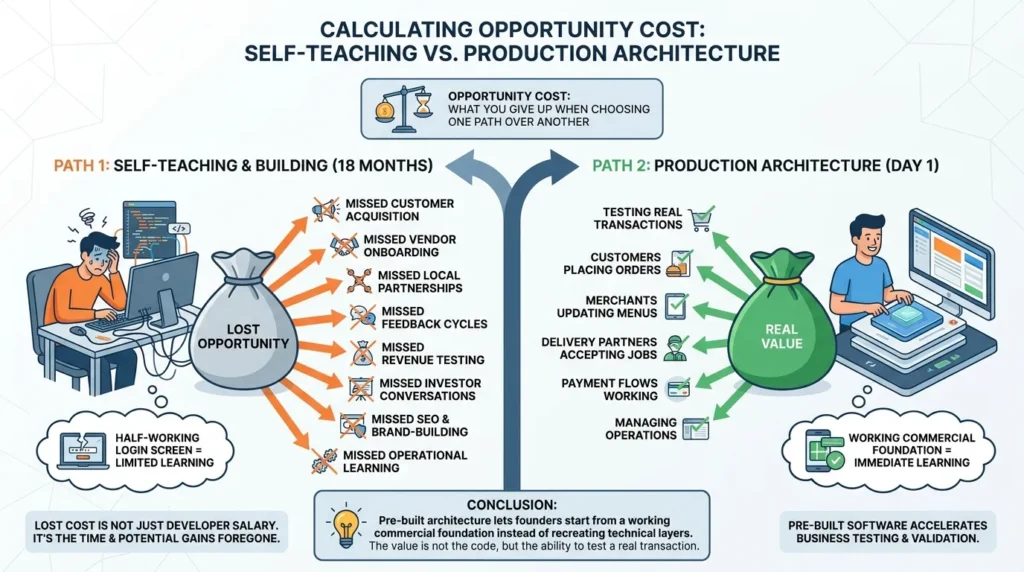
Opportunity cost is what you give up when you choose one path over another.
When a founder spends 18 months trying to build a basic delivery tool, the lost cost is not only the salary they did not pay to a developer. It also includes:
- Missed customer acquisition
- Missed vendor onboarding
- Missed local partnerships
- Missed feedback cycles
- Missed revenue testing
- Missed investor conversations
- Missed SEO and brand-building time
- Missed operational learning
A production app is not valuable because it has code. It is valuable because it lets the business test a real transaction.
For example, a local delivery founder does not learn much from having a half-working login screen. They learn from seeing whether customers place orders, whether merchants update menus, whether delivery partners accept jobs, whether payment flows work, whether refunds happen smoothly, and whether the admin dashboard gives enough control to manage operations.
That is why pre-built software architecture can be powerful. It lets the founder start from a working commercial foundation instead of spending months recreating the same technical layers that many businesses already need.
Read More: Clone App Development: The Fastest Way to Validate a Market Without Starting From Zero
Why “Free” DIY App Development Still Has a Cost
DIY app development can look cheaper because there is no large upfront invoice. But a founder still pays in other ways.
The first cost is time. If it takes 18 months to build something usable, the founder has delayed learning from the market. In fast-moving categories like delivery, rentals, local services, social platforms, and ecommerce, timing can decide whether a business enters early enough to win attention.
The second cost is technical debt. A self-built app may work for a demo but fail when real users arrive. Weak database design, poor API structure, missing error handling, slow dashboards, and untested payment flows can create expensive rebuilds later.
The third cost is operational blindness. Many DIY founders focus on the customer app but forget the admin layer. Without admin control, the business owner cannot manage users, orders, vendors, payments, commissions, complaints, disputes, offers, or reports properly.
The fourth cost is emotional fatigue. After months of technical problem-solving, many founders lose the energy needed for sales, marketing, partnerships, and customer support.
A “free” build becomes expensive when it delays the actual business.
Read More: The True Cost of Waiting : Why Fast App Development Beats Long Timelines
The 14-Day Blueprint: Leveraging White-Label Arbitrage to Launch Fast
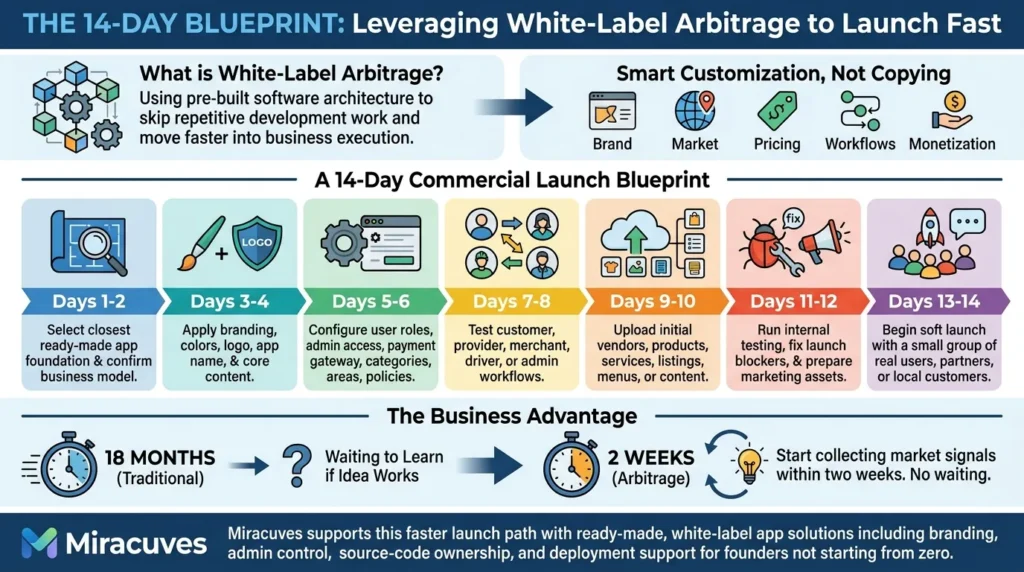
White-label arbitrage means using pre-built software architecture to skip repetitive development work and move faster into business execution.
This does not mean blindly copying another app. A good white-label approach starts with a proven product structure and customizes it for your brand, market, pricing, workflows, and monetization model.
A 14-day commercial launch blueprint may look like this:
Day 1 to 2: Select the closest ready-made app foundation and confirm the business model.
Day 3 to 4: Apply branding, colors, logo, app name, and core content.
Day 5 to 6: Configure user roles, admin access, payment gateway, categories, service areas, and basic policies.
Day 7 to 8: Test customer, provider, merchant, driver, or admin workflows depending on the app type.
Day 9 to 10: Upload initial vendors, products, services, listings, menus, or content.
Day 11 to 12: Run internal testing, fix launch blockers, and prepare marketing assets.
Day 13 to 14: Begin soft launch with a small group of real users, partners, or local customers.
This is where the business advantage appears. Instead of waiting 18 months to learn whether the idea works, the founder can start collecting market signals within two weeks.
Miracuves supports this kind of faster launch path through ready-made and white-label app solutions that include branding, admin control, source-code ownership, and deployment support for founders who do not want to start from zero.
Self-Built App vs. White-Label App: A Founder-Level Comparison
| Decision Area | Building It Yourself | White-Label App Foundation |
|---|---|---|
| Launch speed | Slow if the founder is learning while building | Faster because core workflows already exist |
| Upfront cash cost | Lower at first | Higher than DIY, but usually lower than full custom development |
| Hidden cost | Time, mistakes, rebuilds, delayed validation | Vendor selection, customization scope, ownership review |
| Technical quality | Depends on founder’s learning curve | Depends on provider’s architecture and delivery process |
| Admin dashboard | Often forgotten or underbuilt | Usually included as a core business control layer |
| Scalability | May require rebuild if early architecture is weak | Stronger if the framework is production-ready and modular |
| Founder focus | Technical learning | Sales, operations, onboarding, marketing, and validation |
| Best for | Technical founders building proprietary technology | Non-technical founders launching proven app models faster |
The key is not to assume every white-label solution is equal. Founders should check source-code ownership, demo quality, customization depth, admin features, support terms, security practices, and whether the app can be extended after launch.
A ready-made app foundation is strongest when it gives the founder control, not dependency.
Read More: Dating App Development: A Comprehensive Guide to Building Your Own Platform
Where AI Helps and Where It Still Does Not Replace Architecture
AI has changed how quickly people can generate code, prototypes, landing pages, scripts, and internal tools. For founders, this is useful. AI can help with product planning, wireframes, content, simple automations, test ideas, and even early coding assistance.
But AI does not automatically replace production architecture.
A commercial app still needs reliable user flows, secure authentication, payment logic, database planning, admin permissions, activity logs, testing, deployment, store submission, and long-term maintenance. AI can accelerate parts of the work, but it does not remove the need for responsible system design.
This is especially important for marketplace, delivery, fintech, healthcare, rental, ecommerce, and user-generated content apps. These platforms involve trust, payments, data, roles, disputes, and operational rules.
The founder’s mistake is not using AI. The mistake is believing AI removes every technical and operational risk.
A stronger approach is to combine AI-enabled speed with a proven software foundation. Use AI for research, content, workflows, support scripts, and internal productivity. Use production-ready architecture for the parts of the app where reliability matters.
Founder Decision Signals
Speed
If your business depends on entering the market quickly, an 18-month self-learning path can cost more than the software itself.
Cost
DIY may reduce upfront spending, but it can increase hidden cost through delays, rebuilds, weak architecture, and missed revenue testing.
Scalability
If the app needs payments, roles, dashboards, vendors, tracking, or reports, production architecture matters from the beginning.
Market Fit
The faster you launch a reliable first version, the faster you learn whether customers, vendors, and partners actually want the product.
Mistakes Founders Should Avoid Before Building an App Themselves
The first mistake is learning to code before validating the business model. If the app category is already proven, the founder should spend more time testing local demand, pricing, supply, partnerships, and acquisition channels.
The second mistake is building only the customer-facing app. A business app usually needs an admin dashboard, transaction control, reporting, dispute handling, notifications, and role-based access.
The third mistake is underestimating maintenance. Launching the app is not the end. Operating systems change, payment providers update requirements, user behavior evolves, and new bugs appear after real-world usage.
The fourth mistake is choosing a white-label provider without checking ownership. A low-cost subscription may look attractive, but if the founder does not own source code or cannot customize core workflows, the business may face vendor lock-in later.
The fifth mistake is treating speed as the opposite of quality. Speed is useful only when the foundation is stable. A rushed, broken app damages trust. A ready-made, tested, customizable foundation helps founders move faster without rebuilding every core module from scratch.
Read More: Best Midjourney Clone Scripts 2026 for AI Image Generator App Development
When Building It Yourself Still Makes Sense
There are cases where building an app yourself can be the right decision.
If the founder is technical, the product requires unique intellectual property, the app is mainly a learning project, or the business is based on proprietary engineering, self-building can create long-term advantage.
DIY can also work for simple internal tools, prototypes, landing pages, calculators, content apps, or experiments that do not involve complex transactions or multi-role operations.
But for a commercial delivery app, marketplace, booking platform, ride-hailing system, ecommerce app, fintech app, or local service platform, the founder should be careful. These apps are not just screens. They are operating systems for the business.
Read More: Best HungryPanda Clone Scripts 2025 for Food Delivery App Development
How Miracuves Helps Founders Avoid the DIY Delay
Miracuves helps founders, startups, agencies, and business owners launch faster using ready-made, white-label, and source-code-owned app solutions.
Instead of spending months rebuilding common modules, founders can start with a launch-ready product foundation that includes user flows, admin control, branding flexibility, monetization support, and scalable backend workflows depending on the app category.
For example, a founder planning a delivery platform can explore Miracuves’ delivery app solutions. A broader startup or agency can explore ready-made clone app solutions. If the product truly needs proprietary workflows, Miracuves also offers custom mobile app development.
The goal is not to avoid technology. The goal is to use technology in the right sequence.
Build the business model first. Validate the market quickly. Customize what matters. Avoid spending 18 months rebuilding foundations that already exist.
Final Thoughts: Build the Business, Not Just the Code
So, is it cheaper to build an app yourself?
Sometimes, yes, if the goal is to learn, prototype, or build a small internal tool.
But if the goal is to launch a commercial app, onboard users, process payments, manage vendors, control operations, and validate a real business model, DIY can become expensive very quickly.
The hidden cost is not the tutorial subscription. It is the 18 months of delayed market learning.
For non-technical founders, the smarter move is often to use a proven software foundation, customize it for the market, and spend the saved time on customers, partnerships, operations, and monetization.
The founder who launches in 14 days does not win because they avoided code. They win because they reached the market while the other founder was still debugging.
FAQs
Is it cheaper to build an app yourself?
It can be cheaper in upfront cash, but not always cheaper in total cost. If building the app yourself delays launch by months, creates technical debt, or prevents market validation, the hidden cost can be higher than using a ready-made or white-label app foundation.
How long does it take to build an app yourself as a beginner?
A beginner may need many months to learn frontend, backend, databases, APIs, deployment, testing, and mobile app publishing. A simple demo may come faster, but a commercial app with payments, admin control, and multiple user roles takes much longer.
What is the biggest hidden cost of DIY app development?
The biggest hidden cost is opportunity cost. Every month spent learning and rebuilding is a month not spent acquiring users, onboarding partners, testing pricing, improving operations, or generating revenue signals.
Is a white-label app better than building from scratch?
A white-label app is often better for faster validation when the business model is already proven, such as delivery, marketplace, booking, ride-hailing, ecommerce, or service platforms. Building from scratch is better when the product requires proprietary technology or highly unique workflows.
What should I check before choosing a white-label app provider?
Check live demos, source-code ownership, customization limits, admin dashboard quality, payment integration support, app store deployment help, post-launch support, security practices, and whether the provider documents scope before payment.
Why do non-technical founders choose white-label app development?
Non-technical founders choose white-label development because it helps them launch faster, reduce technical uncertainty, and focus on business execution instead of spending months learning full-stack development.
Miracuves is an independent software development company. We are not affiliated with, connected to, sponsored by, or endorsed by any company or product named in this article.
Terms such as “X Clone” are used descriptively. It is how the software industry refers to building a platform with functionality comparable to a known service, and how clients search for it.
The entire design and codebase of our products is built by our own team. Our products contain no code, design, graphics, or content originating from any third-party website or applications.
All third-party names and marks referenced in this article are the property of their respective owners, referenced solely to identify the services discussed.