
Key Takeaways
- Freemium app clones can drain server, support, and database resources before revenue starts.
- A Day-1 paywall helps founders filter serious users from casual free traffic.
- Subscriptions, gated features, usage limits, trials, and billing controls are core monetization layers.
- Success depends on clear value, pricing confidence, retention, and strong paid-user onboarding.
- A smart paywall can protect startup runway while improving app revenue quality from launch.
Monetization Signals
- Users need clear plan benefits, transparent pricing, secure checkout, renewal details, and cancellation control.
- Founders need feature gating, subscription tiers, trial rules, usage tracking, and revenue analytics.
- Admins need control over payments, plans, refunds, coupons, access limits, users, and reports.
- High-cost features such as messaging, uploads, analytics, and premium access should be gated early.
- Notifications keep users updated on trials, renewals, failed payments, upgrades, and usage limits.
Real Insights
- Free users can create real infrastructure costs without proving willingness to pay.
- A weak freemium model can attract activity while still producing poor revenue and low retention.
- Clear paywall placement helps users understand what is free, what is paid, and why the upgrade matters.
- Founders should measure paid conversion, churn, usage cost, and revenue per active user from day one.
- Miracuves builds app clone platforms with Day-1 paywalls, subscription workflows, feature gating, payments, and admin control.
Freemium looks harmless in the beginning.
You launch an app clone, remove friction, allow anyone to register, and hope that usage will eventually turn into revenue. On a dashboard, this feels exciting. User registrations grow. Activity graphs move upward. The founder starts believing the product has momentum.
But inside the backend, another story is forming.
Every free user creates records. Every record creates storage. Every upload, chat, order, message, listing, video, notification, profile update, failed payment attempt, and abandoned session adds load. Every confused free user can create a support ticket. Every idle free account sits in the database long after the user has stopped caring.
This is the freemium death spiral.
For solo developers, indie hackers, and non-technical startup leaders, the danger is not that free users exist. The danger is launching an app clone without a hard monetization boundary from Day 1. In many clone app development projects, founders focus heavily on features, design, and launch speed but delay the revenue logic that decides whether the platform can survive real user activity.
A free tier without operational limits can silently convert your startup runway into server bills, database bloat, and support fatigue before your first serious customer pays.
That is why app clone monetization should not be treated as a later-stage pricing decision. It should be designed into onboarding, feature access, admin controls, usage limits, and payment logic from the start. Whether you choose custom development or a white-label app development approach, monetization architecture must be part of the product foundation, not an afterthought.
Miracuves Solutions helps founders build ready-made and white-label clone app solutions with monetization-ready workflows, source-code ownership, branded design, and admin control. For founders trying to launch faster, the real advantage is not only getting the app live. It is launching with revenue logic already built into the product foundation.
The Customer Support Illusion: The Hidden Tax of Un-Gated Free Users
The biggest illusion in early app growth is believing that free users are free.
They are not.
A free user may not pay you, but your platform still pays for them. They create accounts, upload data, trigger notifications, browse listings, send messages, test payments, abandon carts, request password resets, and ask support questions. The cost may look small per user, but the damage appears when hundreds or thousands of low-intent users behave like paying customers without producing revenue.
For an app clone, this becomes even more dangerous because clone apps often include multiple panels and workflows.
A food delivery clone may include customers, restaurants, delivery partners, orders, menus, coupons, live tracking, and admin reports. A dating clone may include profiles, chats, swipes, media uploads, filters, boosts, and moderation queues. A short video clone may include uploads, feeds, comments, likes, creator profiles, and storage-heavy media flows.
If these flows are open to everyone without limits, your free tier becomes an operational liability.
The customer support illusion appears when founders celebrate activity but ignore support cost. A free user who cannot find a feature still raises a ticket. A free vendor who does not understand dashboard setup still needs onboarding. A creator who uploads content without monetization intent still consumes storage and moderation bandwidth.
This is where many founders burn out.
They are not only building the product. They are also answering tickets, fixing edge cases, cleaning junk data, monitoring server usage, and supporting users who may never pay.
A Day-1 paywall protects the founder from this imbalance.
It tells the product: “Users can explore value, but high-cost actions must be monetized, limited, or gated.”
That can mean:
- Free browsing, but paid posting
- Free profile creation, but paid messaging
- Free short trial, but paid publishing
- Free marketplace search, but paid lead access
- Free onboarding, but paid vendor activation
- Free content preview, but paid upload, boost, or subscription access
The goal is not to punish users. The goal is to stop your platform from subsidizing unlimited non-paying behavior.
Read More: Ultimate Guide to Custom iOS App Development Services
Why Server Inflation and Database Bloat Destroy Early Startup Runway
Most early-stage founders understand development cost. Fewer understand operational cost.
Development cost is visible. You know what you paid to build the app. Operational cost is quieter. It grows through cloud usage, storage, bandwidth, backups, logs, API calls, message queues, database reads, and admin time.
Freemium becomes dangerous when founders confuse “user growth” with “business growth.”
A free user can inflate:
- User tables
- Profile records
- Uploaded images and files
- Chat history
- Notification logs
- Search history
- Order drafts
- Cart records
- Device tokens
- Error logs
- Support tickets
- Admin review queues
- Analytics events
At small volume, this looks manageable. At higher volume, it becomes database bloat.
Database bloat means your system keeps storing and processing low-value records that do not help revenue. Queries become slower. Backups become heavier. Admin reports take longer. Search indexes expand. Moderation queues fill up. Logs become noisy. The technical team starts spending time maintaining free usage instead of improving paid conversion.
This is the freemium infrastructure tax.
It does not arrive as one large bill. It arrives in fragments.
Your hosting plan needs an upgrade. Your database needs more storage. Your support inbox needs help. Your admin dashboard becomes cluttered. Your analytics becomes polluted by users who never had purchase intent. Your product decisions become distorted because free users behave differently from paying users.
For solo developers and indie hackers, this can become fatal.
A large company can absorb wasted usage while testing conversion. A bootstrapped founder cannot. A non-technical startup leader may not even notice the backend problem until performance drops, costs rise, or paying users begin experiencing delays because free users are consuming shared resources.
This is why monetization logic must sit inside the app architecture.
A strong clone app development approach should not only replicate expected user flows. It should also define which actions create business value, which actions create infrastructure cost, and which actions require payment before they scale.
Read More: Healthcare App Development Guide for Entrepreneurs
The Freemium Infrastructure Tax: What Actually Fails Behind the Scenes
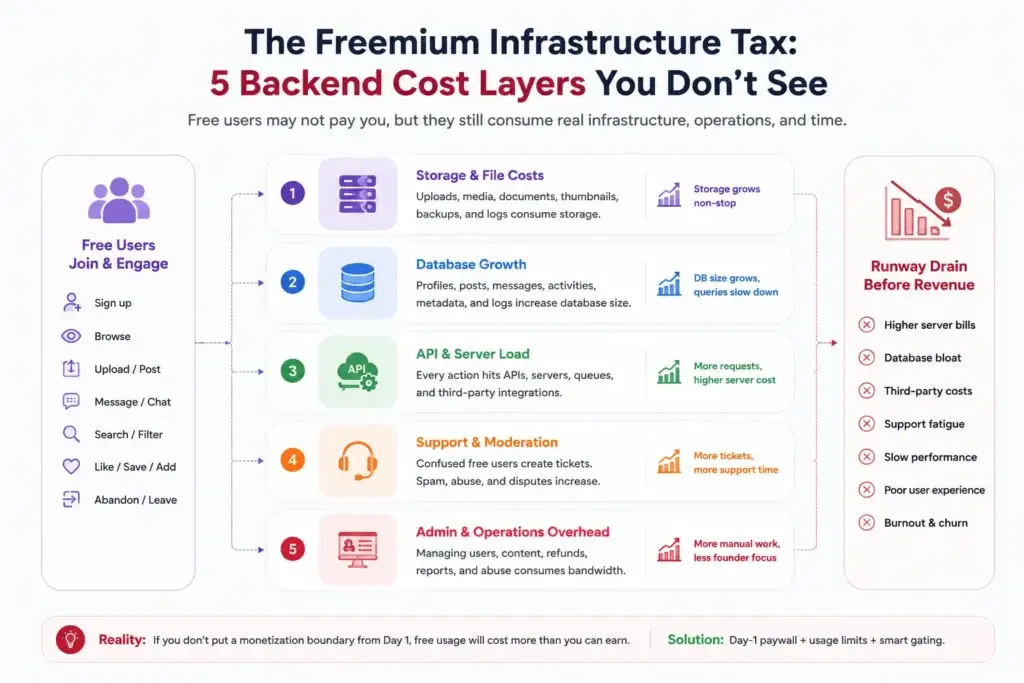
The freemium infrastructure tax is the hidden cost of letting non-paying users behave like revenue users.
It usually shows up in five layers.
1. Storage Cost From Low-Intent Uploads
Media-heavy app clones are especially vulnerable.
Short video apps, marketplace apps, dating apps, social platforms, creator apps, ecommerce apps, and service marketplace apps all allow users to upload something. Images, videos, documents, listing photos, profile media, verification files, and chat attachments can quickly fill storage.
When upload access is free and unlimited, low-intent users can create storage cost without commercial value.
A better approach is to gate high-cost uploads. For example, users may create a basic profile for free, but publishing multiple listings, uploading long videos, unlocking portfolio space, or hosting premium content should require a paid plan, coin purchase, vendor activation fee, or subscription.
2. Database Growth From Dormant Accounts
Not every user who signs up becomes active.
Ungated freemium creates a large number of dormant accounts. These users still occupy database rows, profile fields, device tokens, activity logs, referral records, and email sequences. If your admin dashboard treats all users equally, your team may waste time reviewing, segmenting, or supporting accounts that never had commercial intent.
A Day-1 paywall creates cleaner segmentation.
Paid users, trial users, inactive users, vendors awaiting activation, and high-intent leads can be separated early. This makes admin decisions sharper and reduces noise inside reporting.
3. API and Notification Waste
Free users still trigger system events.
They request OTPs. They receive email verification links. They trigger push notifications. They load maps. They request search results. They refresh feeds. They call recommendation logic. They test checkout. They abandon transactions.
Each action may be small, but repeated free usage creates avoidable API cost.
A monetization-ready app clone should have usage limits built into these areas. For example, free users may receive limited search access, limited messages, limited swipes, limited quote requests, or limited creator tools before a payment prompt appears.
4. Support Tickets From Users With No Revenue Intent
A free user can consume as much support attention as a paid user.
Sometimes more.
Free users may ask basic setup questions, request exceptions, complain about limits, submit incomplete vendor profiles, or expect premium-level help without paying. For a small team, this turns support into a runway leak.
The solution is not ignoring free users. The solution is tiered support logic.
Free users should receive self-serve documentation, automated onboarding, limited ticket access, or community-style support. Paid users should receive priority help, faster responses, advanced onboarding, and account-level support.
This distinction must be built into the admin panel and support workflow from the beginning.
5. Admin Dashboard Overload
When every user enters the same backend workflow, the admin panel becomes noisy.
A marketplace operator may see hundreds of unverified sellers. A dating platform may see inactive profiles in moderation. A creator platform may see abandoned uploads. A delivery app may see restaurant accounts that never complete setup. A service marketplace may see providers who create listings but never subscribe.
This overload creates manual work.
A strong admin dashboard should include monetization filters: paid status, subscription tier, activation stage, feature access, usage limit, payout status, commission status, and upgrade opportunity.
This is where white-label app development becomes useful for founders who want to avoid building every monetization control from zero.
Read More: Food Delivery App Development Guide: Features, Cost, Process & Business Insights
Eliminating Friction: Implementing Atomic Onboarding Paywall Engines
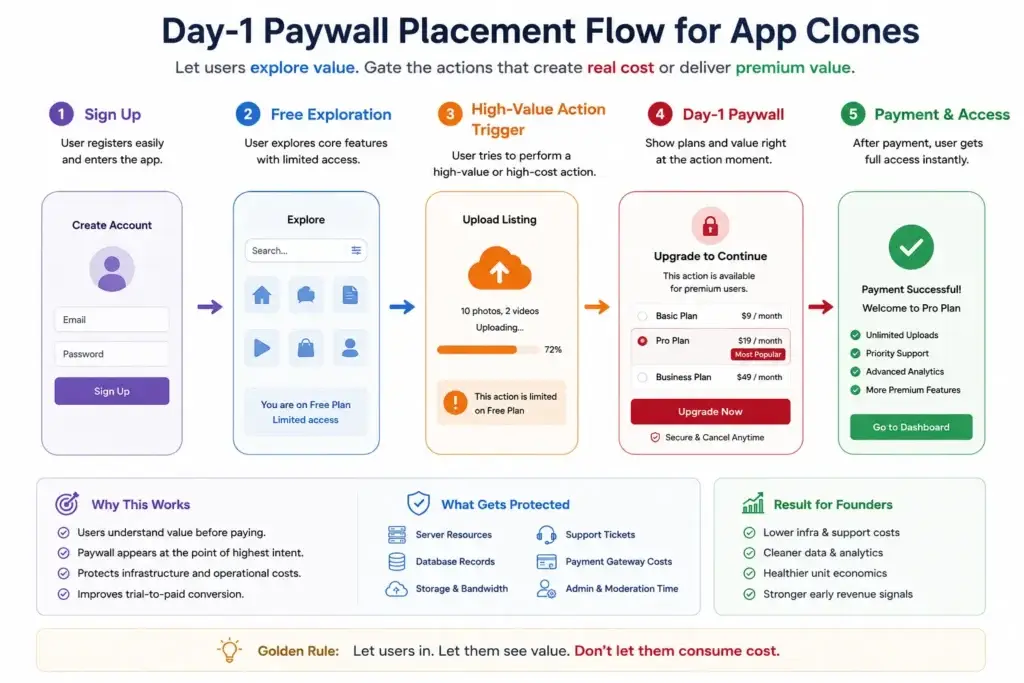
A Day-1 paywall does not mean forcing users to pay before they understand the product.
That is a common mistake.
The right approach is an atomic onboarding paywall engine. “Atomic” means the paywall is attached to specific high-value or high-cost actions, not thrown randomly across the user journey.
The paywall should appear at the moment when the user is about to consume business-critical resources or unlock measurable value.
For example:
| App Clone Type | Free Action | Day-1 Paywall Trigger | Business Logic |
|---|---|---|---|
| Dating clone | Create profile and browse limited matches | Send more messages, boost profile, unlock filters | Monetizes high-intent interaction |
| Marketplace clone | Browse listings | Post listing, contact seller, promote item | Converts sellers and serious buyers |
| Food delivery clone | Browse restaurants | Vendor activation, promoted placement, commission setup | Monetizes merchant-side operations |
| Short video clone | Watch feed and create profile | Upload longer videos, access creator tools, buy coins | Controls media and creator infrastructure cost |
| Freelance marketplace clone | Browse services | Submit proposals, unlock leads, feature profile | Monetizes transaction intent |
| OTT clone | Watch trailers or previews | Access full content, premium catalog, PPV events | Protects content and streaming cost |
| Social app clone | Create profile and follow users | Advanced groups, premium visibility, ad-free feed | Monetizes power users |
This kind of paywall is not only a pricing feature. It is an operational control layer.
It helps the platform answer three questions:
- Which user action creates real value?
- Which user action creates operational cost?
- Which user action deserves a payment gate before it scales?
The best paywall is not the loudest one. It is the one placed where user intent and infrastructure cost meet.
Read More: Offline Video Streaming App Development
Why Pre-Configured Monetization Wrappers Help Founders Survive Early Launch
Many founders delay monetization because they assume payment logic can be added later.
Technically, it can.
Operationally, that delay is expensive.
Adding monetization after launch often means changing onboarding, restructuring feature access, updating database permissions, rebuilding admin controls, integrating payment gateways, adjusting user roles, migrating existing users, handling complaints, and rewriting support flows.
That is a lot of work after the product is already live.
A pre-configured monetization wrapper solves this by packaging revenue logic into the product foundation. Depending on the app type, this may include:
- Subscription plans
- Commission rules
- Vendor activation fees
- Paid profile boosts
- Coin or wallet systems
- Usage-based limits
- Pay-per-view access
- Premium listings
- Transaction fees
- Featured placement
- Creator subscriptions
- Admin-controlled coupons
- Trial expiry rules
- Paid support tiers
This matters because monetization is not only what users pay. It is how the system behaves before, during, and after payment.
A monetization-ready app clone should know:
- What a free user can do
- What a paid user can do
- What happens when a plan expires
- Which admin can override access
- Which user roles can receive payouts
- Which activities count toward usage limits
- Which features are visible but locked
- Which payment failures trigger notifications
- Which plans appear during onboarding
- Which actions require verification before payment
This is why Miracuves positions ready-made and white-label app solutions around more than speed. A launch-ready foundation should include admin control, monetization workflows, branding flexibility, and source-code ownership so founders can adjust the business model as the market responds.
Read More: Why Time to Market Matters More Than Ever in App Development
Founder Decision Signals: When Freemium Is Too Risky
Freemium is not always wrong.
It can work when the product has near-zero marginal cost, strong viral loops, low support burden, high upgrade intent, and enough runway to carry a large free user base. But most early-stage app clones do not start with those advantages.
They start with limited budget, limited traffic quality, limited support capacity, and a need to prove revenue quickly.
Speed
If you need to validate demand quickly, do not wait months to discover whether users will pay. Add monetization gates during onboarding and early high-value actions.
Cost
If free users consume uploads, messaging, maps, video, AI, support, or vendor workflows, your free tier is not free. It is an operating cost center.
Scalability
If your database, storage, logs, and admin queues grow faster than revenue, your app is scaling operational weight instead of business value.
Market Fit
If users refuse every reasonable paywall, the issue may not be pricing. It may be weak value, wrong audience, or poor offer timing.
How Day-1 Paywalls Should Work Without Killing Onboarding
A poor paywall creates friction.
A strategic paywall creates clarity.
The mistake is asking for payment before the user understands value. The stronger approach is to let users reach a small “aha” moment, then ask for payment when they try to unlock the next meaningful action.
For example, a user can browse a marketplace and save a few listings. But contacting sellers, posting listings, or promoting products should require payment. A creator can create an account and preview the upload flow. But publishing high-storage media, unlocking analytics, or accessing monetization tools should require a plan. A vendor can start onboarding. But going live on the marketplace should require activation.
This structure protects both sides.
The user sees enough value to decide. The founder avoids unlimited free consumption.
A good Day-1 paywall should be:
- Clear about what is free
- Honest about what is paid
- Triggered by high-intent action
- Connected to real user value
- Easy to manage from admin
- Flexible enough to test pricing
- Supported by payment failure handling
- Linked to feature permissions
- Visible in onboarding, not hidden until frustration appears
For app clones, this is especially important because users already understand the category. They know how dating apps, delivery apps, creator apps, marketplaces, and streaming apps work. The question is not whether they understand the product pattern. The question is whether your platform gives them enough reason to pay.
Read More: Clone App Development: The Fastest Way to Validate a Market Without Starting From Zero
Mistakes Founders Should Avoid With Freemium App Clones
Opening Every Feature for Free
This creates usage without revenue. High-cost actions such as uploads, messaging, vendor activation, lead access, live streaming, and premium analytics should be limited or gated.
Adding Monetization After Launch
Retrofitting payments later can require changes to onboarding, permissions, database rules, admin workflows, and user communication. Build monetization logic into the foundation.
Confusing Signups With Validation
A signup proves curiosity. Payment proves stronger intent. Early-stage founders need revenue signals, not vanity metrics alone.
Ignoring Admin Control
If the admin panel cannot manage plans, limits, coupons, commissions, upgrades, refunds, and user access, the founder becomes dependent on developers for every pricing adjustment.
What a Monetization-Ready App Clone Should Include
A monetization-ready app clone is not just an app with a payment gateway.
It is a platform where revenue logic is connected to user roles, feature access, admin permissions, operational limits, and reporting.
At minimum, founders should look for:
| Monetization Layer | What It Controls | Why It Matters |
| Onboarding paywall | When users first see pricing | Sets commercial expectation early |
| Feature permissions | What free and paid users can access | Prevents unlimited resource consumption |
| Usage limits | Messages, uploads, listings, swipes, requests, views | Controls infrastructure cost |
| Subscription plans | Recurring access tiers | Builds predictable revenue |
| Commission engine | Platform fee from transactions | Supports marketplace monetization |
| Wallet or coin system | Prepaid in-app spending | Useful for creator, dating, gaming, and social apps |
| Admin pricing control | Plan, coupon, fee, and access management | Reduces developer dependency |
| Payment failure handling | Failed, expired, refunded, or cancelled payments | Protects access and revenue accuracy |
| Analytics dashboard | Revenue, conversion, churn, usage, upgrades | Helps founders make better pricing decisions |
This is where a white-label app solution can reduce avoidable execution risk. Instead of building core monetization, role access, and admin controls from zero, founders can start from a launch-ready foundation and customize the business model around their market.
Read More: The True Cost of Waiting : Why Fast App Development Beats Long Timelines
Miracuves Perspective: Build the Revenue Gate Before the Traffic Arrives
Traffic without monetization is pressure.
It pressures your servers. It pressures your support team. It pressures your database. It pressures your runway. Most importantly, it pressures the founder into making emotional decisions based on usage instead of revenue quality.
The stronger founder decision is to build the revenue gate before the traffic arrives.
That does not mean blocking learning. It means defining which actions are valuable enough to pay for and which actions are too expensive to offer without limits.
Miracuves helps founders launch app clones with ready-made and white-label foundations that can support branded design, admin dashboards, monetization workflows, payment integrations, source-code ownership, and faster deployment. For many founders, this is more practical than spending months building the same registration, payment, permission, and admin-control layers from scratch.
If your app clone depends on monetization, do not treat paywalls as decoration. Treat them as survival infrastructure.
Final Thoughts: Freemium Is Not a Growth Strategy If It Burns the Engine
Freemium can work for mature products with strong margins, low serving costs, high conversion data, and enough runway to carry non-paying users.
But for early-stage app clones, ungated freemium is often a trap.
It creates the feeling of growth while quietly increasing infrastructure cost, database weight, support load, and admin complexity. The founder sees signups. The system absorbs the damage.
A Day-1 paywall changes the discipline of the product. It forces the business to define value early, protect expensive actions, and separate curious users from serious users. It also helps founders learn faster because payment behavior is a stronger signal than free activity.
The real question is not whether users should get anything for free.
The real question is: which actions are you willing to subsidize before revenue exists?
Founders who answer that question early build cleaner platforms, stronger pricing logic, and better operational control. Founders who avoid it often discover too late that their free tier was not a marketing strategy. It was an infrastructure bill wearing a growth costume.
FAQs
What is app clone monetization?
App clone monetization is the strategy for earning revenue from a clone app through subscriptions, commissions, paid listings, in-app purchases, wallet systems, advertising, boosts, pay-per-view access, or transaction fees.
Why is freemium risky for early-stage app clones?
Freemium is risky when free users consume server resources, storage, support, database capacity, and admin attention without converting into paying customers.
What is a Day-1 paywall?
A Day-1 paywall is a monetization gate built into the app from launch. It can appear during onboarding or when users try to perform high-value actions such as messaging, uploading, posting, booking, boosting, or accessing premium tools.
Does a Day-1 paywall mean every user must pay immediately?
No. A smart Day-1 paywall allows users to experience basic value first, then gates high-cost or high-intent actions. The goal is to protect runway without destroying onboarding.
What app clone features should be monetized early?
Messaging, uploads, vendor activation, premium listings, creator tools, advanced search, lead access, profile boosts, wallet credits, subscriptions, and pay-per-view access are strong candidates for early monetization.
How does database bloat happen in freemium apps?
Database bloat happens when large numbers of free users create accounts, profiles, logs, uploads, messages, abandoned carts, device tokens, and support records that remain in the system without generating revenue.
Can Miracuves help build monetization-ready app clones?
Yes. Miracuves helps founders launch ready-made and white-label clone app solutions with admin dashboards, monetization workflows, payment integrations, branded design, and source-code ownership.
Can AI help me build an app myself?
Yes, AI can help with code generation, planning, documentation, prototyping, and debugging. But AI does not automatically solve production architecture, security, app store readiness, payment flows, admin controls, or long-term maintenance.
Miracuves is an independent software development company. We are not affiliated with, connected to, sponsored by, or endorsed by any company or product named in this article.
Terms such as “X Clone” are used descriptively. It is how the software industry refers to building a platform with functionality comparable to a known service, and how clients search for it.
The entire design and codebase of our products is built by our own team. Our products contain no code, design, graphics, or content originating from any third-party website or applications.
All third-party names and marks referenced in this article are the property of their respective owners, referenced solely to identify the services discussed.