


Key Takeaways
- A checkout screen can show success while the database stays empty.
- AI-generated frontends often hide weak backend transaction logic.
- Orders, payments, inventory, and delivery tasks must stay connected.
- Frontend success should never replace backend confirmation.
- Silent checkout failures create refunds, lost orders, and support chaos.
Checkout Failure Signals
- Verify payment status before creating final order success.
- Link every payment attempt to an order or checkout ID.
- Use backend states for pending, failed, confirmed, and refunded orders.
- Update inventory only through controlled checkout logic.
- Log failed writes, delayed webhooks, retries, and admin alerts.
Real Insights
- Your checkout is not successful until the database confirms it.
- A green success message is not an order record.
- Missing orders damage customer, merchant, and delivery trust.
- Idempotency helps prevent duplicate payments and order confusion.
- Miracuves builds ecommerce and delivery apps with checkout-safe backend workflows.
An ecommerce or delivery app can look perfect on the surface.
The product page loads.
The cart updates.
The payment button works.
The checkout screen shows a green success message.
Then the founder opens the admin dashboard and sees nothing.
No order.
No inventory movement.
No merchant notification.
No delivery task.
No customer support trail.
No reliable proof that the platform has captured the transaction properly.
This is the silent checkout crash.
It is not the kind of failure that looks dramatic in a demo. The app does not freeze. The button does not break. The user is not shown a red error screen. Instead, the frontend tells the customer that everything worked while the backend quietly fails to write the order to the database.
For ecommerce and delivery app founders, this is more dangerous than a visible crash. A visible crash stops the user. A silent failure lets the business keep operating with broken records.
That is why AI-generated app development becomes risky when it creates polished frontend workflows without a transaction-safe backend. The screen can lie. The database cannot.
Miracuves builds ready-made and white-label ecommerce and delivery app foundations with backend workflows, admin control, order management, payment gateway integration, and inventory sync as part of the operational product layer. Its ecommerce app development page specifically positions cart, payment gateway, order management, inventory sync, customer apps, vendor apps, and admin apps as part of the ecommerce foundation.
The UI Illusion: When the App Looks Working But the Database Is Empty
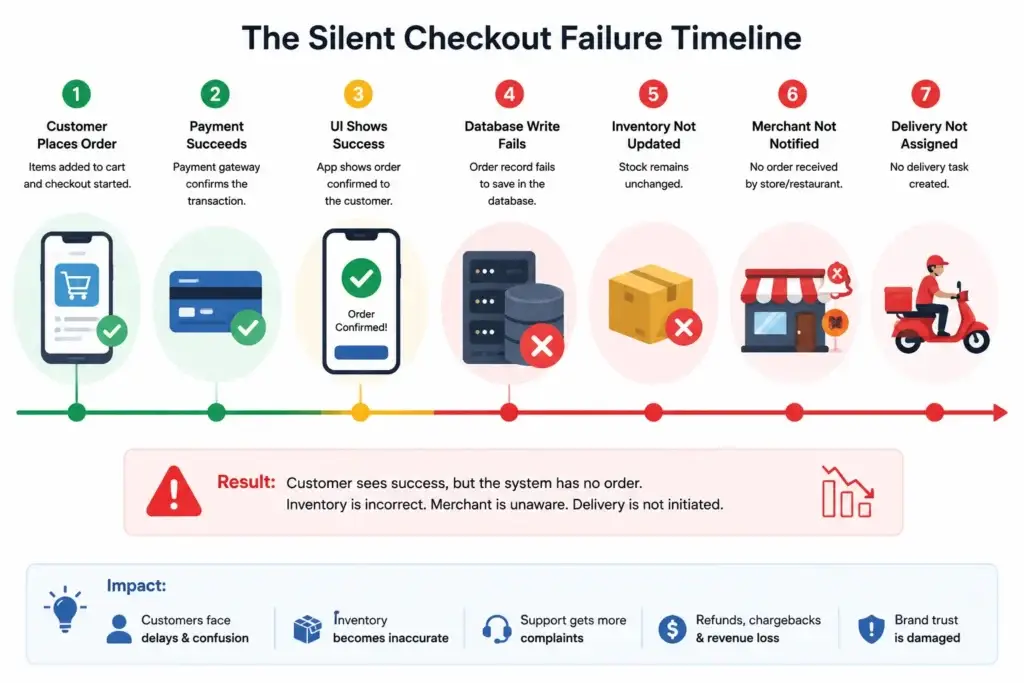
Image Source: AI-generated visual by Miracuves
AI app builders are very good at producing interfaces that look complete.
They can generate checkout pages, cart flows, confirmation screens, order summaries, login forms, product cards, coupon fields, and even attractive dashboards. For a founder reviewing the first version, this can feel like progress.
But ecommerce and delivery apps are not judged by how convincing the UI looks. They are judged by whether the system can safely complete business-critical actions.
A checkout is not just a button click. It is a chain of dependent operations:
| Checkout Layer | What Must Happen | Business Risk If It Fails |
|---|---|---|
| Cart validation | Confirm items, quantity, pricing, tax, fees, coupon, and availability | Wrong order value or unavailable products |
| Payment initiation | Create a payment session or transaction reference | Payment mismatch or duplicate charge risk |
| Payment confirmation | Verify payment status from the gateway | Fake success screen or unpaid order |
| Order creation | Save the order to the database | No operational record |
| Inventory update | Reserve or reduce stock | Overselling or lost inventory |
| Merchant notification | Alert store, restaurant, warehouse, or vendor | Order never prepared |
| Delivery assignment | Create delivery task or dispatch workflow | No fulfilment action |
| Admin logging | Record transaction state and failure events | No audit trail or reconciliation path |
A weak AI-generated MVP may visually simulate this chain without enforcing it technically.
The app can show:
Payment Successful
Order Confirmed
Thank you for shopping with us
while the backend has failed at:
INSERT INTO orders
UPDATE inventory
CREATE delivery_task
WRITE payment_status
That gap between screen success and database truth is where operational disaster begins.
Read More: Stripe Payments Not Reconciling? Fix the Webhook Desync Breaking Your AI App Revenue
Case Breakdown: The Asynchronous Database Write Failure
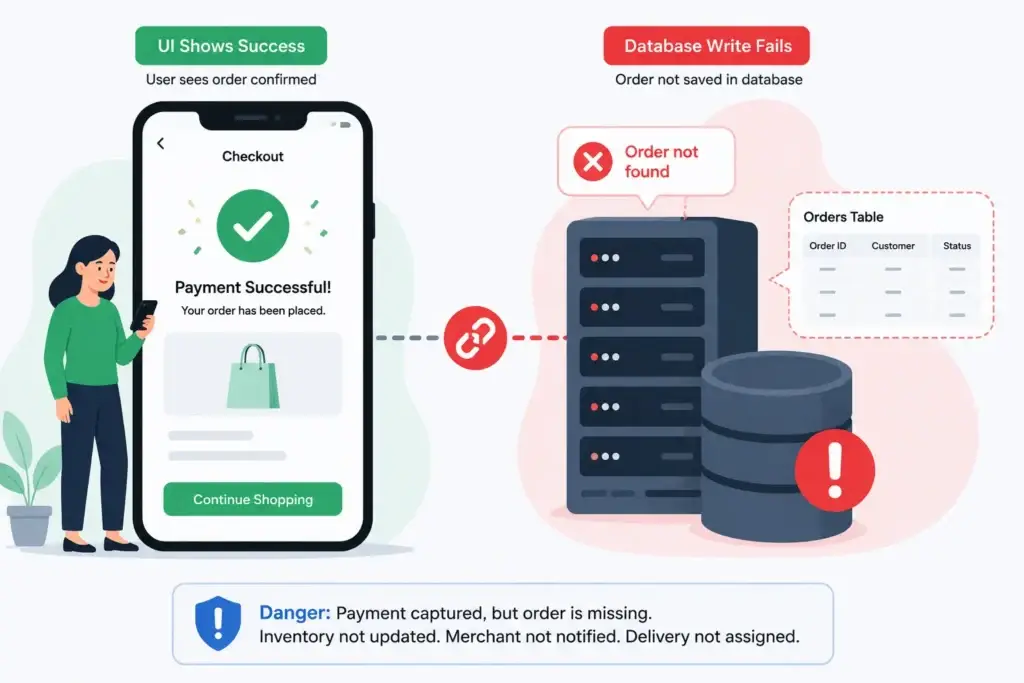
Image Source: AI-generated visual by Miracuves
This teardown is a realistic operational scenario, not a named real-client claim.
Imagine a founder launches an AI-generated grocery delivery MVP. The UI looks clean. The checkout flow works during manual testing. The founder places two test orders, sees the success screen, and assumes the system is ready for early customers.
On launch day, a customer orders groceries.
The payment gateway authorizes the payment. The frontend receives a positive response. The app immediately displays the success screen.
But behind the scenes, the order write is handled asynchronously.
The frontend has already told the customer:
Your order has been placed successfully.But the backend still has unfinished work:
Create order record
Attach customer ID
Attach payment reference
Reduce stock
Create merchant task
Create delivery task
Send notification
Then one database write fails.
Maybe the inventory table is locked.
Maybe the order payload is missing a required field.
Maybe the payment webhook arrives late.
Maybe the delivery address object is malformed.
Maybe the AI-generated backend did not await the database promise.
Maybe there is no retry queue.
Maybe there is no transaction rollback.
Maybe the error is caught and ignored.
The customer sees success.
The database has no complete order.
The warehouse has no picking task.
The delivery partner has no assignment.
The admin dashboard has no reliable record.
The founder only discovers the issue when customers start asking, “Where is my order?”
This is not a testing inconvenience. It is an operations failure.
Why Silent Checkout Failures Are Worse Than Visible App Crashes
A visible crash is embarrassing, but at least it is honest.
The customer sees the failure.
The support team can reproduce it.
The founder knows something broke.
The payment may not proceed.
The system has a clear stopping point.
A silent checkout failure is worse because every stakeholder believes a different truth.
The customer believes the order was placed.
The payment gateway may believe the payment was authorized.
The inventory system may still show the item as available.
The admin panel may show no order.
The merchant may receive no preparation request.
The delivery team may receive no route task.
This creates operational split-brain.
In ecommerce and delivery platforms, split-brain operations create expensive consequences:
- Customers demand refunds for orders the admin cannot find.
- Inventory becomes inaccurate because stock was shown as sold but not reserved.
- Merchants lose trust because order notifications are inconsistent.
- Delivery partners remain idle while customers wait.
- Support teams waste time manually tracing payment references.
- Founders cannot trust revenue, order volume, or fulfilment dashboards.
The real problem is not that the app failed. The real problem is that the app failed silently.
The Technical Root Cause: Frontend Confirmation Without Backend Commitment
A safe checkout system should not treat frontend completion as business completion.
The UI should only show final success after the backend confirms that the transaction state is consistent enough to operate. In practical terms, that means the system should know whether the order is:
- Created
- Payment pending
- Payment authorized
- Payment failed
- Payment captured
- Inventory reserved
- Merchant notified
- Delivery task created
- Cancelled
- Refunded
- Failed and queued for review
Weak AI-generated apps often skip this state discipline. They may connect screens directly to API calls without enough backend control. The system becomes optimistic instead of transactional.
A common fragile pattern looks like this:
const payment = await processPayment(cart);

showSuccessScreen();

createOrder(cart, payment);
updateInventory(cart.items);
notifyMerchant(order);
The dangerous part is obvious: the success screen appears before the order, inventory, and merchant workflow are safely confirmed.
A stronger pattern treats checkout as a controlled transaction:
const checkout = await createCheckoutAttempt(cart);

const payment = await confirmPayment(checkout.paymentReference);

const order = await commitOrderTransaction({
  checkoutId: checkout.id,
  paymentReference: payment.id,
  cart,
  customer,
  address
});

if (order.status === "CONFIRMED") {
  showSuccessScreen(order.id);
} else {
  showPendingOrFailureState();
}
The difference is not cosmetic. It changes who is allowed to declare success.
In fragile AI MVPs, the frontend declares success.
In production-grade systems, the backend declares success.
That distinction decides whether your business can trust its own orders.
Read More: Failing the Audit: How an AI-Built MVP Leaked PII and Why the White-Label Rescue Worked
Why Idempotency Matters in Payment and Order Workflows
Payment systems also need protection against duplicate attempts, retries, network delays, and customer double-clicks.
Idempotency is one of the core concepts used to prevent duplicate financial actions. Payment documentation commonly describes idempotency as a way to ensure duplicate requests for the same transaction do not create multiple charges, authorizations, or refunds.
For ecommerce and delivery apps, idempotency helps answer questions like:
- Did this customer already attempt payment for this order?
- Is this a retry or a new order?
- Should the system return the original payment result?
- Should the system block duplicate charges?
- Can support trace a payment to a specific order reference?
A safe checkout engine should not rely on “click once and hope.” It should use stable identifiers such as order IDs, payment references, checkout attempt IDs, and transaction keys.
Without that discipline, the same customer action can produce multiple payments, missing orders, duplicate orders, or inconsistent refunds.
Why Database Transactions Matter for Ecommerce and Delivery Apps
A checkout flow touches multiple pieces of data. The order record, payment reference, inventory quantity, merchant task, customer notification, delivery task, and admin log must stay aligned.
That is why transactional thinking matters.
Databases and backend systems use transaction concepts to ensure related changes are handled consistently. MongoDB, for example, states that transactions can support atomicity across multiple operations, collections, databases, documents, and shards, and that distributed transactions either apply all data changes or roll them back. AWS also describes PostgreSQL as ACID-compliant, where ACID refers to atomicity, consistency, isolation, and durability, and notes that incomplete changes are not stored under ACID transaction behavior.
For founders, the lesson is simple:
The order should not be half-real.
Either the checkout commits into a reliable operational state, or the system should mark it as pending, failed, or requiring manual review.
What should never happen is this:
Customer sees success.
Payment reference exists.
Order database row is missing.
Inventory is unchanged.
Admin has no alert.
That is the silent checkout crash.
Synchronous Guarantees: The Miracuves Transactional Standard
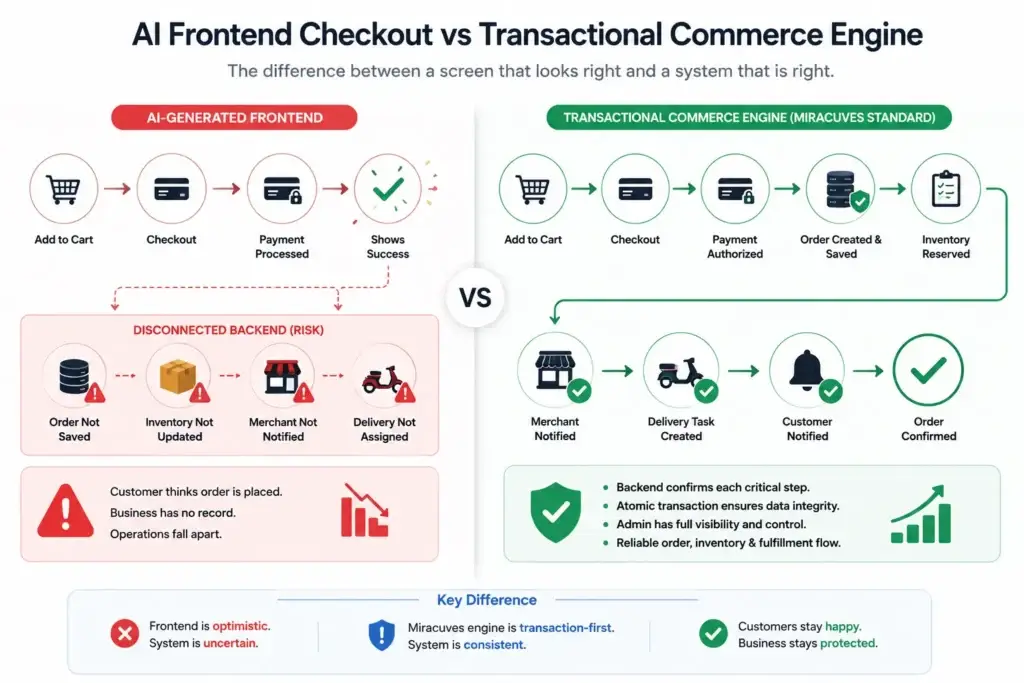
Image Source: AI-generated visual by Miracuves
Miracuves’ ready-made and white-label ecommerce and delivery app approach is built around the operational flows founders actually need after launch: customers, vendors or merchants, delivery partners where relevant, and admin control.
For ecommerce, Miracuves positions customer, vendor, and admin ecommerce apps with cart, payment gateway, order management, and inventory sync. Across its wider solution ecosystem, Miracuves lists 90+ readymade clone app solutions across 35+ industries and describes a 6-day branded deployment model for ready-made solutions with source code ownership.
The important difference is that a founder does not only need a checkout screen. A founder needs a transaction engine.
A production-oriented ecommerce or delivery system should include:
| Operational Standard | What It Means | Why It Matters |
| Backend-confirmed checkout | The backend confirms order state before final success | Prevents false UI success |
| Payment reference mapping | Every payment attempt is linked to an order or checkout attempt | Enables reconciliation |
| Inventory reservation logic | Stock is reserved or updated through controlled workflows | Reduces overselling and stock mismatch |
| Admin visibility | Failed, pending, confirmed, cancelled, and refunded states are visible | Gives operators control |
| Idempotency handling | Retries do not create duplicate charges or duplicate orders | Protects customers and revenue |
| Error logging | Failures are captured instead of silently ignored | Helps teams fix issues quickly |
| Notification reliability | Merchant, customer, and delivery notifications are tied to order state | Prevents fulfilment gaps |
| Source-code ownership | The business can inspect, modify, and extend the system | Reduces vendor lock-in |
This is the difference between a demo app and a launch-ready product foundation.
A demo app tries to impress the founder.
A launch-ready system protects the business.
Read More: What 70%+ of AI-Built Apps Get Wrong About Security — And Why Users Can See Each Other’s Data
Founder Decision Signals
Speed
If your market window is short, a ready-made ecommerce or delivery foundation can help you launch faster than building every checkout, order, inventory, and admin workflow from zero.
Cost
The cheapest-looking AI MVP can become expensive when failed orders, refunds, reconciliation work, and emergency engineering fixes begin after launch.
Scalability
A scalable platform needs reliable transaction states, payment references, inventory logic, admin dashboards, and operational logs before marketing drives real traffic.
Market Fit
Founders can only validate demand when the app records real transactions correctly. Broken checkout data creates false market signals.
AI-Generated Frontend vs Transactional Commerce Engine
AI-generated code is not automatically bad. It can help with prototypes, interface drafts, workflow exploration, and early product thinking.
The risk begins when founders mistake a generated interface for a business-ready platform.
| Layer | AI-Generated Frontend Risk | Transactional Commerce Engine Standard |
| Checkout UI | Shows success after button click | Shows success after backend confirmation |
| Payment flow | Stores only basic payment response | Maps gateway reference to order state |
| Order creation | May run after UI confirmation | Must complete before final confirmation |
| Inventory | May update separately or not at all | Updates through controlled reservation logic |
| Error handling | May suppress failed API/database calls | Logs, retries, alerts, or marks pending state |
| Admin dashboard | May show only completed records | Shows confirmed, pending, failed, refunded, and cancelled states |
| Fulfilment | May not trigger merchant or delivery workflows reliably | Creates merchant and delivery tasks from confirmed order state |
| Support | Hard to trace missing orders | Searchable by order ID, payment ID, user ID, and status |
For a founder, the question is not, “Does the checkout page look complete?”
The better question is:
Can the system survive real checkout uncertainty?That uncertainty includes slow networks, duplicate taps, delayed payment webhooks, inventory conflicts, payment retries, gateway failures, database errors, and admin reconciliation.
What Ecommerce and Delivery Founders Should Check Before Launch
Before launching an AI-generated ecommerce or delivery MVP, founders should pressure-test the checkout system.
Ask these questions:
- Does the app create an order only after payment status is verified?
- Does the app show a pending state when the payment gateway response is delayed?
- Does every payment attempt have a unique reference?
- Can the admin search by payment ID, customer ID, order ID, and transaction status?
- What happens if the payment succeeds but the order write fails?
- What happens if the order is created but inventory update fails?
- What happens if the user taps the payment button twice?
- What happens if the payment webhook arrives after the user closes the app?
- Is there a retry queue for failed notifications?
- Is there an audit log for checkout state changes?
- Can support manually reconcile payment references with orders?
- Does the system prevent duplicate charges and duplicate orders?
- Does the merchant or vendor dashboard receive confirmed order events only?
- Does the delivery workflow begin only after the order is valid?
- Does the frontend ever show success before the backend confirms success?
If the answer to the last question is yes, the app is not ready for real transactions.
Checkout Failure Modes Founders Must Test
| Failure Mode | What It Looks Like | Founder Impact |
|---|---|---|
| Payment success but order missing | User sees confirmation, but admin cannot find the order. | Refund disputes, customer anger, and manual reconciliation. |
| Order created but inventory not updated | Product remains available even after purchase. | Overselling, fulfilment delays, and merchant complaints. |
| Duplicate payment retry | User taps again after timeout and creates another payment attempt. | Duplicate charge risk and support escalations. |
| Webhook delay | Payment gateway confirms later than the app expects. | Wrong order status and confused customer communication. |
| Notification failure | Order exists, but merchant or delivery partner is not alerted. | Unfulfilled orders despite successful checkout. |
Mistakes Founders Should Avoid When Using AI-Generated Apps
Trusting UI success as business success
A green success message is not proof that the order, payment, inventory, merchant notification, and delivery workflow are correctly recorded. Business success must come from backend state, not frontend display.
Launching without payment reconciliation
If the admin cannot match payment references with order records, support teams will struggle to resolve refunds, failed orders, and customer disputes.
Ignoring pending and failed states
Many weak MVPs only design for success. Real ecommerce systems need pending, failed, cancelled, refunded, expired, and manual-review states.
Separating checkout from inventory logic
If inventory updates are not controlled by checkout state, the platform can oversell, undercount, or lose visibility into stock movement.
Where Miracuves Fits for Ecommerce and Delivery Founders
Founders do not need to reject AI completely. But they should not rely on AI-generated frontend code as the foundation for real checkout, order, inventory, and delivery operations.
A serious ecommerce or delivery app needs:
- Customer app
- Vendor or merchant app
- Delivery partner workflows where relevant
- Admin dashboard
- Payment gateway integration
- Order management
- Inventory sync
- Refund and cancellation states
- Notification workflows
- Secure API handling
- Role-based admin access
- Audit logs
- Source-code ownership
- Post-launch flexibility
Miracuves helps founders launch faster using ready-made and white-label clone app foundations that can be customized for ecommerce, food delivery, grocery delivery, pharmacy delivery, courier delivery, and marketplace models.
For founders comparing an AI-generated prototype against a production-ready app foundation, the decision is not only about speed. It is about whether the system can handle the operational truth of real commerce.
A checkout is not a design element.
It is a business contract between the customer, the platform, the payment gateway, the merchant, and the fulfilment system.
Final Thoughts: Your Checkout Is Not Successful Until the Database Says So
The silent checkout crash is the kind of failure that founders rarely fear early enough.
A visible bug is easy to understand. A broken button is easy to report. A failed page load is easy to reproduce.
But a checkout that looks successful while the database stays empty is different. It damages operations quietly. It creates false confidence. It makes the founder believe the product is working while customers, merchants, delivery partners, and support teams experience the opposite.
The real lesson is simple:
Do not let the frontend declare victory before the backend has committed the truth.
For ecommerce and delivery founders, the stronger path is not just a faster-looking MVP. It is a launch-ready product foundation where checkout, payment, inventory, order management, admin visibility, and fulfilment workflows are built to work together.
Miracuves helps founders move faster with ready-made, white-label, source-code-owned app solutions designed for practical execution, business model clarity, and operational control.
FAQs
What is an AI frontend database failure?
An AI frontend database failure happens when an AI-generated app interface shows that an action succeeded, but the backend database does not correctly save the business record. In ecommerce, this can mean the user sees an order confirmation even though the order is missing from the admin dashboard.
Why is a silent checkout failure dangerous for ecommerce apps?
A silent checkout failure is dangerous because the customer may believe the order was placed while the business has no complete order record. This can lead to unfulfilled orders, refund disputes, inaccurate inventory, and manual support work.
Can AI-generated apps handle ecommerce checkout safely?
AI-generated apps can help prototype interfaces, but checkout safety depends on backend architecture, payment reconciliation, database transactions, inventory logic, admin visibility, and error handling. Founders should not rely only on generated frontend flows for real transactions.
What should happen if payment succeeds but the order is not saved?
The system should not silently ignore the failure. It should log the event, mark the transaction for review, expose it in the admin dashboard, preserve the payment reference, and provide a reconciliation path for support or operations.
Why does idempotency matter in ecommerce checkout?
Idempotency helps prevent duplicate charges, duplicate refunds, or duplicate order actions when users retry payments or experience network delays. It allows the system to recognize repeated attempts for the same transaction and return a consistent result.
What is the difference between a checkout screen and a transaction engine?
A checkout screen is the user-facing interface. A transaction engine is the backend system that verifies payment, creates the order, updates inventory, triggers merchant or delivery workflows, logs events, and controls final order status.
How can delivery app founders avoid silent order failures?
Delivery app founders should ensure that payment confirmation, order creation, merchant notification, delivery assignment, and admin logging are connected through reliable backend states. The frontend should only show final success after the backend confirms a valid operational state.
How does Miracuves help ecommerce and delivery founders launch faster?
Miracuves offers ready-made and white-label app foundations for ecommerce, delivery, marketplace, and clone app models. These solutions can include source code, admin dashboards, branded design, payment workflows, order management, and faster deployment depending on the selected solution scope.f
Miracuves is an independent software development company. We are not affiliated with, connected to, sponsored by, or endorsed by any company or product named in this article.
Terms such as “X Clone” are used descriptively. It is how the software industry refers to building a platform with functionality comparable to a known service, and how clients search for it.
The entire design and codebase of our products is built by our own team. Our products contain no code, design, graphics, or content originating from any third-party website or applications.
All third-party names and marks referenced in this article are the property of their respective owners, referenced solely to identify the services discussed.