
Key Takeaways
- Blinkit is a quick-commerce grocery delivery app.
- Orders are delivered in 10–20 minutes.
- Dark stores power its rapid fulfillment model.
- Real-time tracking improves customer convenience.
- Speed and inventory accuracy drive its success.
How It Works
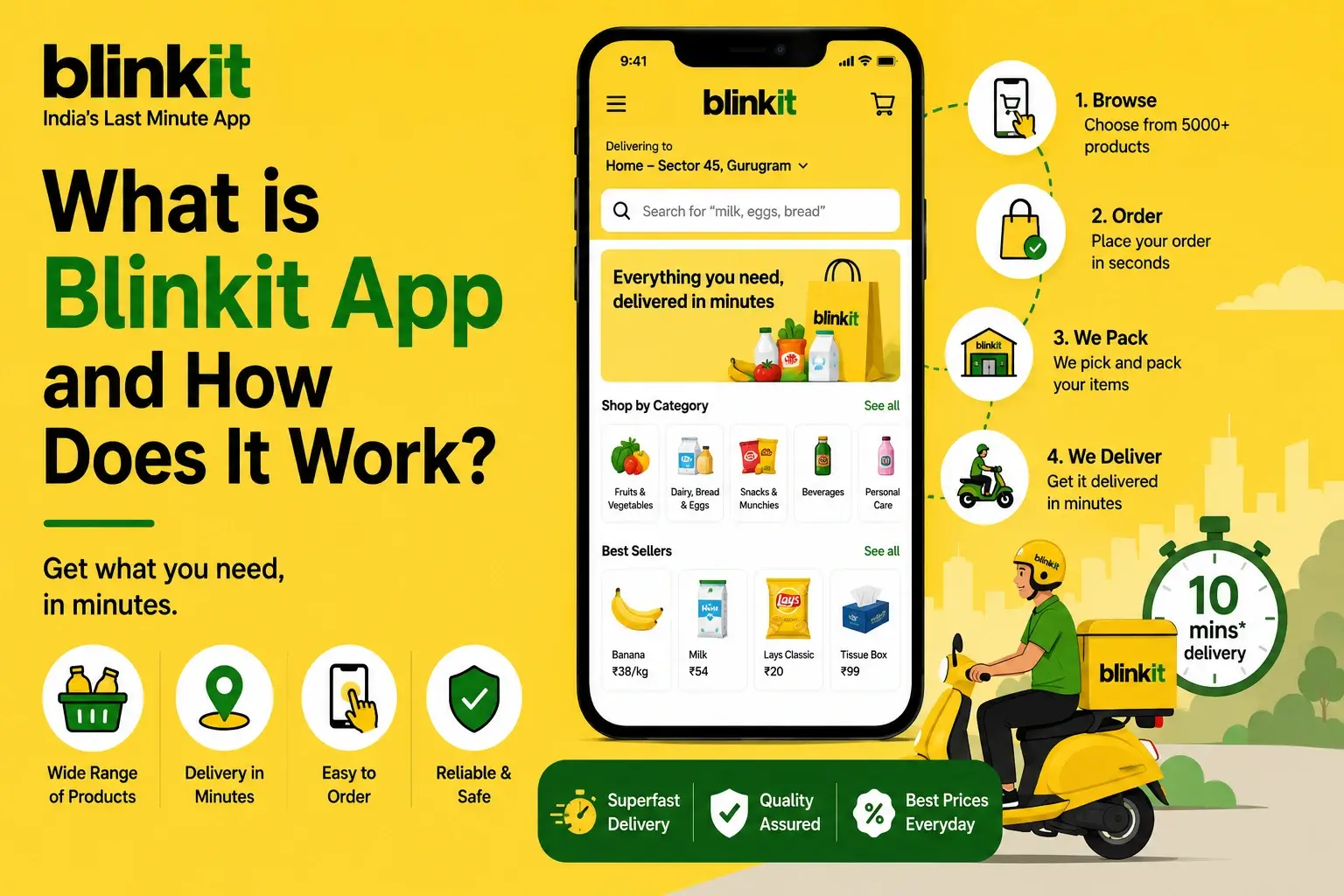
- Users browse products and place orders.
- Orders are routed to the nearest dark store.
- Items are picked, packed, and dispatched quickly.
- Delivery partners complete last-mile fulfillment.
- Customers track orders in real time.
Real Insights
- Quick commerce has changed consumer expectations.
- Dark stores require strong inventory planning.
- Delivery speed directly affects retention.
- Data and logistics are core competitive advantages.
- A Blinkit clone needs technology and operational efficiency.
Imagine this: It’s 10 PM. You’re halfway through cooking your favorite pasta and suddenly realize you’re out of garlic. Nightmare, right? A few years ago, you’d either run to the nearest store or go without it. But today? Blinkit to the rescue. Within minutes, garlic arrives at your doorstep, almost like magic.
That’s the kind of convenience our fast-paced digital lives now demand. For entrepreneurs, this shift creates a strong opportunity to build a Blinkit clone app that delivers groceries, essentials, and daily-use products quickly through dark stores, smart logistics, real-time inventory, and efficient delivery management.
For creators, entrepreneurs, and digital business owners, services like Blinkit aren’t just apps; they represent a whole shift in consumer expectations. Instant gratification is no longer a luxury—it’s the baseline. So, understanding how Blinkit works can spark ideas for your next startup, hustle, or side-project.
This blog will unpack the magic behind Blinkit, how it works, and why it’s winning hearts (and grocery budgets) across India. Plus, if you’re dreaming of building your own instant delivery empire, Miracuves can help you bring that idea to life.
What is Blinkit?
Blinkit (formerly Grofers) is an Indian quick-commerce platform that promises ultra-fast delivery of groceries and essentials—typically within 10-20 minutes. Born out of the hyperlocal delivery boom, it focuses on speed, convenience, and smart tech to meet rising consumer demands.
Founded in 2013, Blinkit pivoted in 2021 to the 10-minute delivery model. Today, it’s backed by Zomato and operates in major Indian metros. Think of it as the Uber for onions, or the Swiggy of soap.
Related Entities Mentioned:
- Zomato (Investor/Parent Company)
- Zepto, Instamart (Competitors)
Launch your own Blinkit-style grocery delivery app — partner with our expert grocery app development company for speed, scalability, and success.
How Does Blinkit Work?
The Backend Magic
Blinkit operates on a dark store model. These are mini-warehouses strategically placed in dense urban pockets. When you place an order, it gets routed to the nearest dark store, picked, packed, and dispatched to your location instantly.
These dark stores aren’t open to the public but are optimized for speed and efficiency. It’s like an express grocery backroom designed for robots (and a few humans too).
The Frontend User Experience
On the user side, Blinkit has a clean, fast, and intuitive app interface. Users:
- Open the app (iOS/Android or web)
- Browse through categories like groceries, personal care, electronics
- Add items to the cart
- Check out with online payment or cash
- Track delivery in real-time
UX Highlights:
- Smart search filters
- Predictive product suggestions
- Real-time delivery tracker with rider location
Tech Stack Snapshot (Simplified)
- Frontend: React Native (Mobile), Vue.js/React (Web)
- Backend: Node.js, Python, Go
- Databases: MongoDB, PostgreSQL
- Cloud: AWS + CDNs for low latency
- AI/ML: Predictive demand forecasting, smart routing
Key Features That Make Blinkit Tick
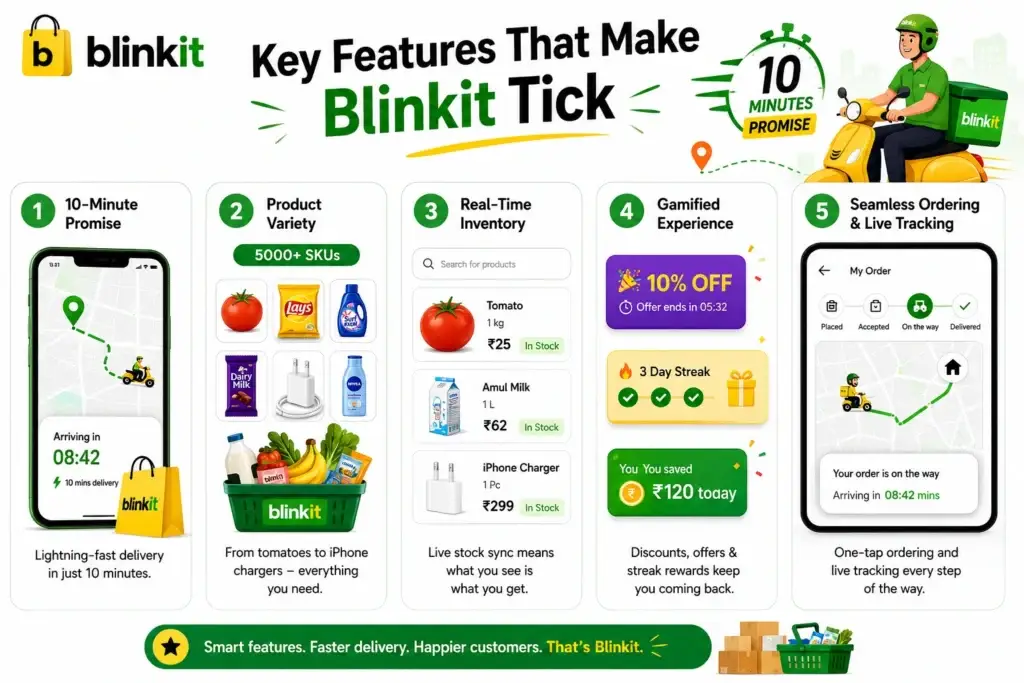
10-Minute Promise
This isn’t a gimmick—it’s their USP. Blinkit has structured everything, from logistics to location, to make this promise real.
Product Variety
From tomatoes to iPhone chargers, the catalog includes over 5,000+ SKUs (stock-keeping units), making it more than just a grocery app.
Real-Time Inventory
Dark stores sync stock data with the app in real-time. What you see is what you get—literally.
Gamified Experience
Users often receive discount badges, time-based offers, and streak rewards for frequent usage.
From one-tap ordering to live delivery tracking — see how Blinkit’s core features drive customer satisfaction, and get them in your own custom-built grocery app.
Blinkit’s Business Model Breakdown
Blinkit generates revenue through:
Product Margin
They buy at wholesale rates and sell at MRP or just below.
Delivery Fees
For small basket sizes or urgent orders, users pay a premium.
Brand Partnerships
FMCG brands pay for placement or visibility inside the app.
Ads and Sponsored Listings
You’ll see “Top Picks” often filled by advertisers.
Blinkit’s journey to quick commerce leadership — combining a robust business model with an aggressive, results-driven marketing plan.
Why Entrepreneurs are Eyeing the Blinkit Model
The Blinkit model is replicable. Whether it’s groceries, pet supplies, medicine, or fashion accessories—the dark store + hyperlocal delivery combo is gold.
Startups are now cloning this model for:
- Hyperlocal bookstores
- Instant kitchenware
- Emergency baby products
And here’s the kicker: you don’t need a billion-dollar budget to enter the space. All you need is the right tech partner.
Challenges Blinkit Faces (And How It Solves Them)
Inventory Overhead
Dark stores are capital-intensive. Blinkit tackles this via data-driven stocking and partnering with wholesalers.
Delivery Optimization
The last-mile is the toughest mile. Blinkit uses ML-based route optimization and microzones to reduce ETAs.
User Retention
With fierce competition, Blinkit keeps retention high with gamification, loyalty discounts, and excellent customer service.
Cost Factors & Pricing Breakdown
PHP/Laravel is often the most practical choice for launching a Blinkit-like app quickly and affordably. Node.js/Python fits better when real-time inventory, live order flows, and heavier platform activity become more important, while Go microservices are better suited for enterprise-scale quick commerce platforms with higher concurrency and more complex infrastructure needs.
Miracuves Blinkit-Like App Solution Cost and Tech Stack
Get a fully developed, deployment-ready quick commerce platform modeled after Blinkit. Built on a stable PHP foundation, this complete package includes everything you need to launch and scale:
Core Workflows: Customer registration, grocery product listing, category management, cart checkout, order placement, store/dark-store management, delivery assignment, order tracking, and customer notifications.
Built-in Revenue Logic: Product margins, delivery fees, service charges, surge pricing, sponsored listings, subscription plans, promo codes, and partner commission setup.
Management Hub: Centralized admin dashboard, customer management, store/vendor management, product approval, inventory control, order monitoring, payment records, refund handling, and delivery analytics.
Launch-Ready: Fully prepared for your custom branding, configuration, payment gateway setup, location-based delivery settings, store onboarding, product category setup, and immediate market entry.
Why Is Blinkit-Like App Development More Affordable?
Most quick commerce apps become expensive when businesses choose fully custom development from scratch. Building separate workflows for customers, stores, delivery partners, admins, payments, inventory, live tracking, refunds, and notifications can increase cost, timeline, and technical complexity.
We took a smarter, more practical approach:
You Aren’t Paying for Ground-Up Development: Our quick commerce delivery engine is already developed, tested, and ready to deploy. You skip the inflated cost and long waiting period usually required for building a Blinkit-style platform from scratch.
The Power of PHP: We built this solution on a reliable and cost-effective PHP architecture. This keeps the upfront price affordable while supporting essential grocery ordering, product management, delivery assignment, inventory control, payment workflows, and admin operations.
You get a launch-ready Blinkit-like quick commerce platform with practical grocery delivery features, source code access, and faster deployment without the high custom development price tag.
Note: This cost is for the solution, re-branding, deployment, and source code only.
Find the right Blinkit clone script for your business — and get a clear breakdown of Blinkit app development costs to plan your launch.
Conclusion
Apps like Blinkit have redefined what customers expect from grocery delivery. What once felt normal as a 2-day wait has now become a 10-minute expectation, powered by dark stores, hyperlocal inventory, smart routing, and real-time order management.
For entrepreneurs, this shift opens a new playground of possibilities. A Blinkit-style app is not just a grocery delivery platform; it is a quick commerce business model built around speed, convenience, and repeat customer behavior. The opportunity lies in choosing the right location strategy, managing inventory efficiently, building a strong delivery network, and using technology to keep every order moving fast.
If you are planning to enter the quick commerce space, the goal should not be to copy Blinkit blindly. The smarter move is to understand how the model works, customize it for your target market, and launch with a scalable app foundation that supports customers, stores, delivery partners, payments, and admin control from day one.
Want to replicate Blinkit’s model for a niche market? Or reinvent it with a twist? The opportunity is ripe.
At Miracuves, we help innovators launch high-performance app clones that are fast, scalable, and monetization-ready. Ready to turn your idea into reality? Let’s build together.
FAQs
Is Blinkit available in all cities?
Nope, it currently operates in selected urban areas, primarily metro cities.
What does Blinkit deliver?
Everything from groceries and snacks to electronics, personal care, and even toys.
How does Blinkit deliver so fast?
They use dark stores and a smart logistics network optimized for speed.
Can I build an app like Blinkit?
Absolutely. With the right team (like Miracuves), it’s very doable.
What’s Blinkit’s revenue model?
A mix of product margins, delivery charges, brand partnerships, and sponsored listings.
Who owns Blinkit?
Blinkit is owned by Zomato, which acquired it in 2022.
Related Articles:-
Miracuves is an independent software development company. We are not affiliated with, connected to, sponsored by, or endorsed by any company or product named in this article.
Terms such as “X Clone” are used descriptively. It is how the software industry refers to building a platform with functionality comparable to a known service, and how clients search for it.
The entire design and codebase of our products is built by our own team. Our products contain no code, design, graphics, or content originating from any third-party website or applications.
All third-party names and marks referenced in this article are the property of their respective owners, referenced solely to identify the services discussed.