
Key Takeaways
What You’ll Learn
- Gojek is a multi-service super app that combines ride-hailing, food delivery, parcel delivery, digital payments, and other on-demand services in one platform.
- The app works through a simple super app flow where users choose a service, place a request or order, make payment, and track fulfillment inside the same ecosystem.
- Its core value comes from convenience and service integration, helping users handle multiple daily needs through one unified app experience.
- Gojek is more than a ride app because it also supports delivery, payments, logistics, and merchant-connected services through a single platform model.
- The platform succeeds by combining local relevance, high-frequency use cases, and strong digital convenience into one scalable super app ecosystem.
Stats That Matter
- Super apps grow by solving multiple daily-use problems in one place, which increases repeat usage and strengthens customer stickiness.
- The Gojek model supports multiple service categories such as transport, food delivery, parcel logistics, and digital wallet-based payments within one ecosystem.
- Integrated wallet and payment flow make transactions faster and smoother across different services inside the app.
- Real-time tracking, service coordination, and partner operations are essential because the platform depends on smooth execution across many service types.
- A strong super app performs better when customer demand, merchant or provider supply, and operational control stay balanced across each service module.
Real Insights
- Gojek became valuable because it turned multiple disconnected services into one connected digital lifestyle product, making everyday tasks easier inside a single app.
- The platform works best when all services feel unified, because users expect the same convenience, trust, and payment simplicity across every category.
- Convenience alone is not enough, since service quality, provider availability, local execution, and payment reliability also shape long-term retention.
- For startups, this model is attractive because it is modular and scalable, allowing founders to launch with selected services first and expand later.
- Long-term success depends on combining strong technology, local market fit, integrated payments, and reliable multi-service operations into one seamless super app experience.
Imagine you’re in Jakarta, traffic is wild, your stomach’s growling, your bike’s out of gas, and you need a quick delivery done yesterday. What do you do? You open Gojek — a humble app-turned-lifesaver that Indonesians swear by. It’s like a genie in your smartphone, granting you rides, food, payments, massages, and more — all with a couple of taps.
Now, if you’re an entrepreneur or a startup founder, you’re probably already seeing dollar signs. This isn’t just about solving everyday chaos — it’s about building an all-in-one digital economy platform. Gojek (often confused with the now-rebranded GoTo ecosystem) started as a motorbike-hailing service. Today? It’s the Indonesian cousin of Grab and Uber, on steroids.
This blog isn’t a love letter to Gojek (okay, maybe a little). It’s your blueprint to understanding what makes it tick, and more importantly — how Miracuves can help you build your very own super app.
What Exactly Is Gojek?
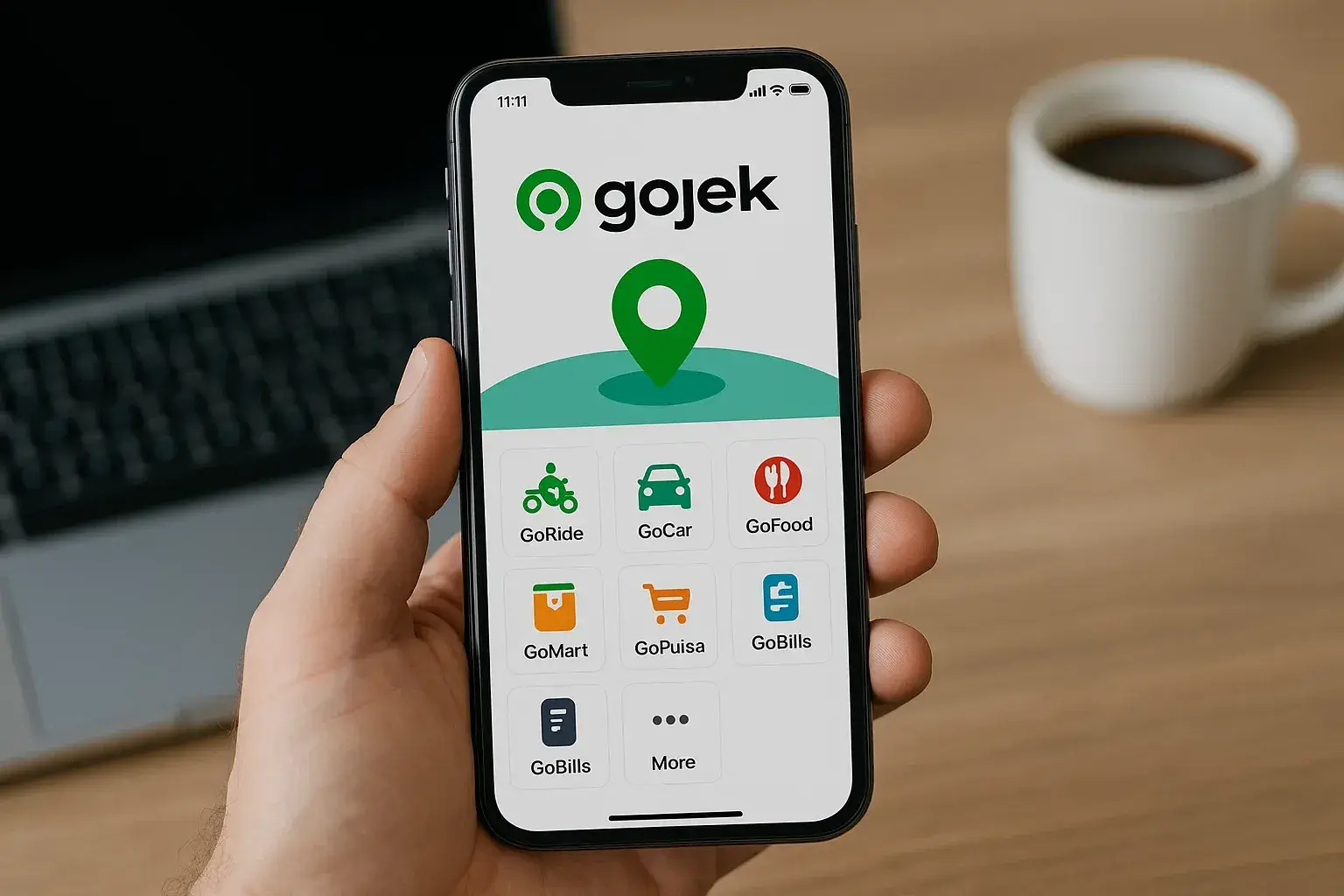
At its core, Gojek is a super app — a platform that integrates multiple services like ride-hailing, food delivery, e-payments, logistics, and more. It began in 2010 with just 20 motorbike drivers in Jakarta. Fast forward to today, it’s one of Southeast Asia’s most iconic mobile app brands with millions of users and a massive driver-partner ecosystem.
Core Services Include:
- GoRide – Bike taxi service to beat the traffic blues
- GoCar – Affordable 4-wheeler rides
- GoFood – Food delivery from your favorite warung to big chains
- GoSend – Same-day courier service
- GoPay – Digital wallet and payment gateway
- GoMart, GoMed, GoMassage – Groceries, medicine, and even home massage services
Market Impact
According to Statista, Gojek reached over 38 million monthly active users in Indonesia alone. That’s not just traction — it’s dominance.
How Gojek Works ?
The beauty of Gojek lies in its modular architecture. Every feature — rides, food, payments — works as a microservice but connects through one unified user experience.
User Flow – Seamless & Sticky
- Open the app (clean UI with fast-loading screens)
- Select service (ride, food, courier, etc.)
- Input details (pickup location, order, payment method)
- Track live status (real-time driver tracking)
- In-app payment via GoPay
- Rate and review post-service
Tech Stack Insights (for Founders & Developers)
- Frontend: React Native for iOS & Android
- Backend: Node.js with microservice architecture
- Payments: GoPay integration, QR code system, e-wallet KYC layers
- Real-time tracking: Google Maps API, socket.io
- AI & ML: Used in driver dispatching and user recommendations
Want to create your own super app? Explore our Super App Clone Development solutions at Miracuves.
Why Gojek Succeeded: Lessons for Founders
1. Localization Beats Globalization
Gojek focused deeply on local user behavior — like cash payments, bike taxis over cars, and hyperlocal restaurants — instead of copying global models blindly.
2. Solving Multiple Pain Points
By bundling services, they reduced app fatigue — users didn’t need 10 different apps for food, rides, and money transfers.
3. Driver Empowerment Model
They onboarded thousands of motorcycle drivers, provided insurance, training, and incentives — turning them into loyal micro-entrepreneurs.
Win in emerging markets by seeing how our Gojek clone solves real-world problems while empowering entrepreneurs to dominate the multi-service space.
Gojek’s Revenue Model: How Does It Make Money?
1. Commission on Rides & Deliveries
Takes 20–30% commission from drivers and restaurants per transaction.
2. GoPay Fees & Financial Products
Earns from transaction fees, float interest, and value-added financial tools like loans and insurance.
3. Advertising & Promotions
Partners pay for in-app placements, coupons, and banner ads to boost visibility.
4. API Integrations & B2B Solutions
Their SDKs and payment APIs are monetized via B2B partnerships with merchants and platforms.
Want to Build a Gojek-Style Super App?
You’re not alone. The “super app” trend is exploding in emerging markets — from India to Nigeria to Latin America. But here’s the kicker — you don’t have to build everything from scratch.
With Miracuves, you can launch your Gojek Clone App with:
- Pre-built modules for ride-sharing, food delivery, and payments
- Scalable backend with microservice logic
- Fully customizable design
- Payment gateway integrations (Stripe, Razorpay, etc.)
- AI-based driver matching and logistics algorithms
Cost Factors & Pricing Breakdown
Building a Gojek-style multi-service super app from scratch typically requires multi-module architecture (ride-hailing + deliveries + services), real-time tracking, merchant/driver/provider apps, dispatch + admin control panels, payments/wallet, and multiple third-party integrations—making scope and cost highly dependent on how many services you launch on Day 1.
PHP / Laravel is usually the most practical choice for launching a Gojek-like super app quickly and affordably. Node.js / Python works better for platforms that rely more on real-time workflows and advanced service logic, while Go microservices are generally chosen for enterprise-scale ecosystems with higher traffic and infrastructure complexity.
Cost-Effective Gojek-Like Super App Development with Miracuves
Miracuves Pricing for a Gojek-Like Super App developed in PHP/Laravel with Flutter Apps for $4,599 USD (One-Time Price) in just 6 days
Launch a fully developed, deployment-ready platform inspired by the Gojek model. Built on a dependable PHP/Laravel backend with Flutter mobile apps, this package is designed to help entrepreneurs enter the multi-service market faster with a stable and scalable foundation.
- Core Service Flows: Ride-hailing, on-demand delivery, and multi-service module support.
- Built-in Operations: Wallet-ready logic, pricing controls, and payout workflow structure.
- Admin Management: Centralized backend for managing users, providers, services, and platform activity.
- Launch-Ready Setup: Prepared for your branding, deployment, and go-to-market execution.
Why is it so affordable?
Building a Gojek-style super app from scratch with advanced real-time architectures often increases engineering complexity, team costs, and delivery timelines. That is why many custom-built super apps quickly move into a much higher budget range. Miracuves takes a more practical approach by offering a pre-built, proven multi-service engine that removes the heavy cost of starting from zero.
We took a smarter and faster path:
- You Are Not Paying for Ground-Up Development: Our Gojek-like engine is already structured, tested, and deployment-ready, helping you save both time and cost.
- The Strength of PHP / Laravel: This stack is reliable, widely adopted, and easier to maintain over time. It also makes future customizations more affordable because of the large global developer ecosystem available for PHP-based platforms.
- Built for Practical Scale: You get a strong business-ready foundation for launching and growing a super app without the premium cost of fully custom enterprise engineering.
You receive a robust, entrepreneur-friendly solution that balances affordability, functionality, and speed to launch.
Note: This cost is for the solution, re-branding, deployment, and source code only.
Conclusion
Gojek isn’t just an app. It’s a digital lifestyle packed into a smartphone. If you’ve ever dreamed of building the next big thing for your region — a one-stop platform that rides the gig economy wave and empowers users daily — now’s the time to move.
Super apps are booming, localization is key, and user stickiness is gold. The road to building one? Not as bumpy as you think.
At Miracuves, we help innovators launch high-performance app clones that are fast, scalable, and monetization-ready. Ready to turn your idea into reality? Let’s build together.
FAQs
What is the Gojek app used for?
Gojek is a super app used for ride-hailing, food delivery, package delivery, and digital payments — all in one mobile app.
Is Gojek available outside Indonesia?
Gojek started in Indonesia but has since expanded regionally through the GoTo group. However, the core experience remains tailored to Southeast Asian markets.
How does GoPay work in Gojek?
GoPay is Gojek’s in-app digital wallet. Users top it up and use it for seamless payments across all services, QR transactions, and even offline merchants.
Can I build my own Gojek-style app?
Yes! With clone solutions like Miracuves’ Gojek Clone App, you can launch your own super app with modular services, local payment gateways, and custom branding.
What makes Gojek different from Grab or Uber?
Unlike Uber (which is ride-focused) or Grab (which is also a super app), Gojek’s strength lies in hyperlocal services and deep market penetration in Indonesia.
How much does it cost to build a Gojek-like app?
Get your Gojek clone with Miracuves starting at $4,599 – a powerful, ready-to-launch super app built for multi-service scalability, seamless performance, and business growth.
Related Articles :-
Miracuves is an independent software development company. We are not affiliated with, connected to, sponsored by, or endorsed by any company or product named in this article.
Terms such as “X Clone” are used descriptively. It is how the software industry refers to building a platform with functionality comparable to a known service, and how clients search for it.
The entire design and codebase of our products is built by our own team. Our products contain no code, design, graphics, or content originating from any third-party website or applications.
All third-party names and marks referenced in this article are the property of their respective owners, referenced solely to identify the services discussed.