

Key Takeaways
- On-demand food delivery vs multi-category delivery platform models differ mainly in product scope, supplier types, inventory complexity, fulfillment rules, delivery economics, and operational coordination.
- Food delivery focuses on restaurant meals and short delivery windows, while multi-category delivery can include groceries, pharmacy items, retail products, parcels, and other local goods.
- The broader multi-category model creates more revenue and cross-selling opportunities, but it also requires more flexible catalog, inventory, dispatch, pricing, fulfillment, and settlement systems.
Business Model Difference Signals
- Food delivery depends heavily on restaurant preparation time, menu availability, rider assignment, meal freshness, delivery zones, commissions, and fast last-mile fulfillment.
- Multi-category delivery may add SKU-level inventory, store picking, substitutions, scheduled delivery, different package sizes, category-specific fees, merchant types, and varied delivery requirements.
- Both models can monetize through commissions, delivery fees, subscriptions, service charges, promotions, and advertising, but revenue margins and operating costs can vary by category and fulfillment model.
Founder Planning Insights
- Founders should compare local demand, merchant density, category complexity, average order value, delivery radius, rider capacity, repeat purchase frequency, and operational margins before selecting a model.
- Multi-category expansion should be planned carefully because adding new verticals can change catalog management, dispatch logic, compliance needs, refunds, customer support, pricing, and settlement workflows.
- Miracuves develops customizable delivery platforms with restaurant and merchant management, customer ordering, rider operations, dispatch, payments, commissions, tracking, multi-category workflows, analytics, and admin controls.
A delivery startup can look simple from the outside. A customer places an order, a merchant prepares it, a rider delivers it, and the platform earns from the transaction.
But the business model changes completely when the platform moves from food-only delivery to multiple categories such as groceries, pharmacy, essentials, retail items, flowers, pet supplies, parcels, and convenience products.
That is the real decision founders need to understand.
An on-demand food delivery platform is usually built around restaurant orders, meal preparation, peak-hour demand, and fast fulfilment. A multi-category delivery platform is built around broader local commerce, multiple seller types, different fulfilment rules, and more complex operational control.
Both models can work. The right choice depends on your market, supply network, delivery capacity, monetization strategy, and how much operational complexity you are ready to manage.
This guide breaks down the difference in a practical way so founders can decide whether to start focused with food delivery or build toward a wider delivery ecosystem.
What Is an On-Demand Food Delivery Platform?
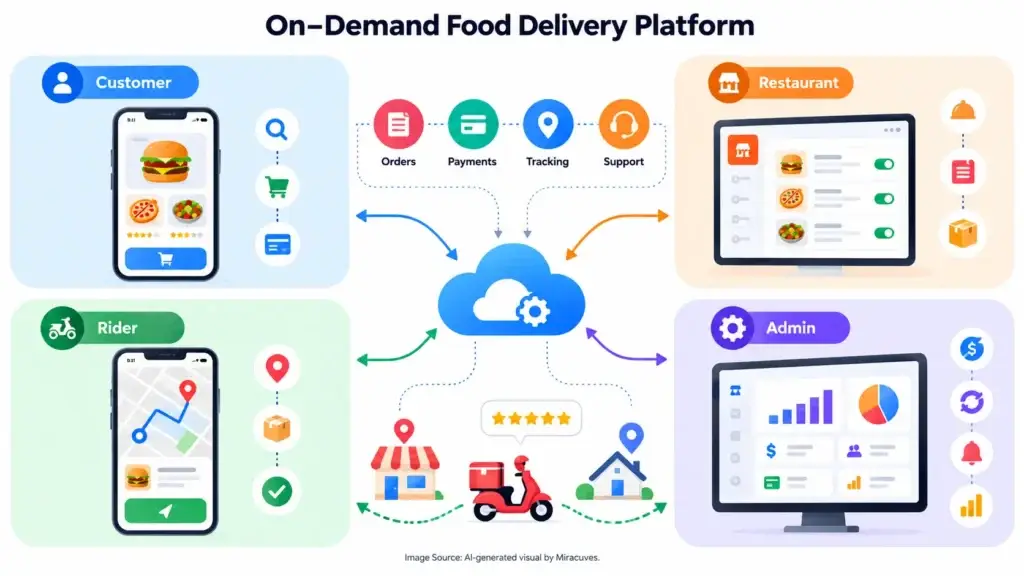
An on-demand food delivery platform connects customers, restaurants, and delivery partners through a digital ordering system. Customers browse restaurants, select dishes, place orders, make payments, track delivery, and rate the experience. For founders planning a focused restaurant ordering product, Miracuves’ food delivery app development service can support the customer, merchant, rider, and admin workflows needed for a launch-ready delivery business.
The platform operator usually manages restaurant onboarding, commission rules, delivery partner allocation, customer support, promotions, refunds, and reporting.
Food delivery works well because the customer intent is clear. People open the app because they want a meal now or soon. That creates strong order urgency, repeat usage, and high habit potential.
A food delivery platform usually includes:
- Customer app or web ordering flow
- Restaurant panel for menus, orders, availability, and payouts
- Delivery partner app for pickup, navigation, and delivery proof
- Admin dashboard for commissions, payments, users, restaurants, offers, and support
- Real-time order tracking
- Ratings and reviews
- Refund and cancellation workflows
- Payment gateway integration
- Push notifications and order status updates
The advantage is focus. The platform does not need to handle every possible product type from day one. It can optimize deeply around food ordering, restaurant operations, delivery timing, and repeat customer habits.
What Is a Multi-Category Delivery Platform?
A multi-category delivery platform allows customers to order from different types of local merchants through one app. Instead of only restaurants, the platform may support grocery stores, pharmacies, convenience stores, flower shops, pet supply stores, cloud kitchens, retail outlets, or parcel delivery partners.
The platform still connects customers, merchants, delivery partners, and the operator, but each category brings different rules.
A grocery order may require item substitution. A pharmacy order may need document verification. A retail order may need stock checks. A parcel order may need pickup instructions. A food order needs speed and freshness.
That means the platform cannot simply add more categories visually. It needs a stronger operational layer behind the scenes.
A multi-category delivery platform usually needs:
- Category-wise merchant onboarding
- Different product catalogue structures
- Delivery radius rules by category
- Separate commission settings
- Inventory or availability controls
- Multiple payment methods
- Refund rules based on product type
- Proof of delivery
- Rider assignment logic
- Category-specific reporting
- Role-based admin control
- Customer support workflows for different order types
This model can increase revenue potential because the platform is not dependent on meal orders alone. But it also requires more planning, better backend control, and clearer category strategy.
Food Delivery Platform vs Multi-Category Delivery Platform: Core Difference
The biggest difference is operational depth.
A food delivery platform is usually optimized for fast restaurant fulfilment. A multi-category delivery platform is optimized for local commerce across different seller types.
| Comparison Point | On-Demand Food Delivery Platform | Multi-Category Delivery Platform |
|---|---|---|
| Main focus | Restaurant meals and prepared food | Food, grocery, pharmacy, essentials, retail, parcels, and more |
| Customer intent | Immediate meal ordering | Everyday local delivery needs |
| Merchant type | Restaurants, cafes, cloud kitchens | Restaurants, stores, pharmacies, retailers, service points |
| Catalogue complexity | Menus, add-ons, variations | Products, SKUs, units, substitutions, category rules |
| Peak demand | Lunch, dinner, weekends, late-night cravings | Spread across meals, grocery, essentials, medicine, retail, errands |
| Delivery logic | Fast pickup and drop-off | Category-based dispatch, pickup rules, proof, handling requirements |
| Refund complexity | Missing item, wrong dish, delay, cancellation | Wrong item, damaged product, substitution issue, expiry, prescription mismatch |
| Revenue potential | Strong within food ordering | Broader, but more operationally complex |
| Best for | Focused restaurant delivery launch | Founders planning a wider local commerce ecosystem |
For founders, the key question is not “Which model is bigger?” The better question is: “Which model can my team operate with quality from day one?”
How Their Revenue Models Differ
Both platform types can earn from commissions, delivery fees, subscriptions, ads, and merchant promotions. But the way those revenue streams behave is different.
Food delivery revenue usually depends on order frequency, restaurant commissions, delivery margin, sponsored listings, and customer loyalty. Since food ordering is habit-driven, the platform can grow through repeat usage, restaurant variety, and localized offers.
Multi-category delivery revenue has more layers. The operator may earn from restaurant commissions, grocery margins, pharmacy delivery fees, retail listings, merchant subscriptions, featured placements, courier charges, and category-specific service fees.
That sounds attractive, but every added revenue stream also adds operational responsibility.
Founders comparing commissions, delivery fees, subscriptions, merchant promotions, and category-based charges can also review this delivery platform revenue model breakdown for deeper monetization planning before choosing a food-only or multi-category approach.
Common Revenue Streams in Food Delivery
A focused food delivery platform can earn through:
- Restaurant commission per order
- Delivery fee or delivery margin
- Customer service fee
- Subscription plans for free or discounted delivery
- Restaurant promotions and sponsored placements
- Featured menu campaigns
- Surge or small-order fees where suitable
- Loyalty-driven repeat ordering
This model is easier to explain, easier to operate, and easier to optimize early.
Common Revenue Streams in Multi-Category Delivery
A multi-category delivery platform can earn through:
- Commission from restaurants and stores
- Delivery margin across categories
- Merchant subscription plans
- Featured category placements
- Priority listing fees
- Retail campaign fees
- Convenience fees
- Parcel delivery charges
- Category-specific service fees
- Membership plans for customers
- Wallet-based retention and cashback campaigns
The earning potential can be broader, but only if the platform operator can manage category-level economics. Grocery margins are different from restaurant commissions. Pharmacy fulfilment is different from food delivery. Retail products may involve returns. Parcel delivery may involve distance-based pricing.
A strong admin dashboard becomes essential because the operator needs control over rates, zones, commissions, payouts, delivery fees, and category rules.
Why Food Delivery Is Often Easier to Launch First
Food delivery is usually the simpler entry point because the product behavior is predictable. Customers browse, order, pay, track, receive, and reorder. Restaurants understand the workflow. Delivery partners understand pickup and drop-off.
This makes food delivery suitable for founders who want to validate one clear market before expanding.
Food delivery also has strong habit potential. A user may order lunch during work, dinner at home, snacks at night, or meals on weekends. If the app has enough restaurant variety and reliable delivery, the customer has reasons to return.
The challenge is competition and operational pressure. Food delivery users expect speed, live tracking, good packaging, accurate orders, and smooth refunds. Even a focused model needs strong execution.
For founders who want a faster launch, a ready-made food delivery foundation can reduce time spent rebuilding standard ordering, restaurant, rider, and admin flows from zero. A white-label food delivery platform can also help founders validate restaurant demand quickly before expanding into grocery, pharmacy, essentials, or wider local commerce categories.
Why Multi-Category Delivery Can Create a Bigger Ecosystem
A multi-category delivery platform becomes powerful when customers start using the same app for more than meals. Food may bring daily engagement, while groceries, essentials, medicine, retail, and parcels can expand the app’s usefulness.
The advantage is demand diversification.
Meal orders may peak at certain hours. Grocery and essentials can spread demand into mornings, afternoons, and weekends. Pharmacy orders may be urgent but less frequent. Retail and gifting may spike during festivals or occasions. Parcel delivery may serve both consumers and small businesses.
This creates more ways to earn from the same customer base and delivery network.
However, founders should not assume that adding categories automatically improves profitability. Each category needs the right supply, pricing, operational rules, customer support process, and delivery handling.
A multi-category platform works best when the operator has a clear expansion sequence, not when every category is launched at once without control.
Operational Complexity: The Part Founders Should Not Ignore
The visible app may look similar in both models, but the operational backend is very different.
In food delivery, the main operational questions are:
- Is the restaurant open?
- Is the menu available?
- Can a rider reach the restaurant quickly?
- Can the order be delivered hot and on time?
- How should refunds and cancellations be handled?
In multi-category delivery, the operator must answer more questions:
- Is the item in stock?
- Can substitutions be approved?
- Does this category need proof or verification?
- Can this item be carried with food?
- Should this merchant use the same commission as restaurants?
- Does this category need a different delivery radius?
- Should cash payment limits vary by category or zone?
- How should damaged or missing products be resolved?
- Can the same rider handle this order type?
As categories expand, founders should also plan for delivery platform security and trust controls around payments, refunds, proof of delivery, user verification, rider permissions, merchant access, and admin-level activity tracking.
This is why admin control matters so much. A platform operator should be able to manage categories, vendors, pricing, commissions, zones, refunds, and reporting without depending on developers for every operational change.
Feature Differences Founders Should Plan For
A food delivery platform needs a strong ordering experience. A multi-category delivery platform needs a strong operating system.
Before expanding from food into multiple categories, founders should review a practical delivery platform feature checklist covering customer ordering, merchant workflows, rider operations, payments, tracking, admin control, and category management.
| Feature Area | Food Delivery Need | Multi-Category Delivery Need |
|---|---|---|
| Catalogue | Menus, add-ons, dish variations | Product categories, SKUs, units, availability, substitutions |
| Merchant dashboard | Orders, menus, timings, payouts | Catalogue, stock, category rules, fulfilment notes, payouts |
| Delivery workflow | Pickup, live tracking, drop-off | Pickup rules, item handling, proof, distance/category pricing |
| Admin controls | Restaurants, riders, users, orders, commissions | Categories, merchants, zones, category fees, commissions, refunds, reports |
| Customer experience | Fast ordering and reorder flow | Multi-category search, filters, saved addresses, order history |
| Payments | Cards, wallets, cash, refunds | Category-level payment rules, wallet, cash limits, partial refunds |
| Support | Delay, cancellation, wrong item | Substitution, damaged item, missing item, verification, returns |
The more categories you add, the more your platform needs configuration instead of hard-coded rules.
Founder Decision Signals: Which Model Should You Choose?
Choose Food Delivery If
You want to launch faster, focus on restaurant partnerships, validate local order demand, and keep operations simpler in the first phase.
Choose Multi-Category If
You already understand local merchant supply, want multiple revenue streams, and can manage different fulfilment rules across categories.
Start Focused If
Your team is small, your delivery fleet is new, or your first goal is to build repeat usage before adding operational complexity.
Expand Carefully If
You have demand from existing users, enough merchant supply, and admin controls that let you manage category-specific pricing, refunds, and dispatch.
A Practical Expansion Path for Delivery Startups
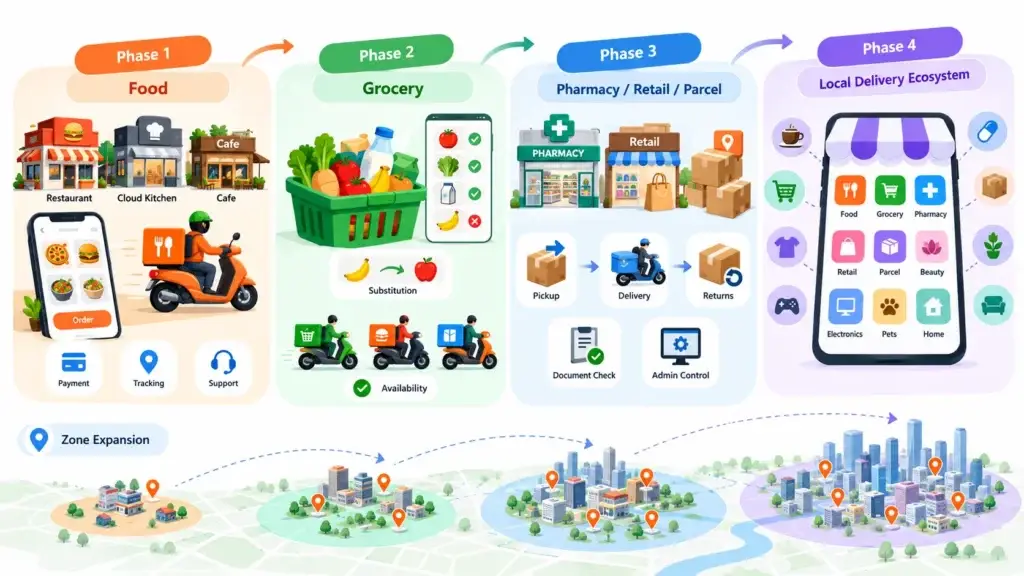
Many founders do not need to choose between food delivery and multi-category delivery forever. The smarter approach is often phased expansion.
A practical path may look like this:
Phase 1: Launch Food Delivery
Start with restaurants, cloud kitchens, and cafes. Build customer trust around ordering, payment, tracking, delivery speed, and support.
At this stage, the main goal is to prove that customers will order repeatedly and merchants are willing to participate.
Phase 2: Add Grocery or Essentials
Once food delivery demand is active, add categories that fit the same local delivery network. Grocery, convenience products, and essentials can increase daytime orders and make better use of rider availability.
This phase needs catalogue control, item availability, substitution rules, and stronger refund handling.
Phase 3: Add Pharmacy, Retail, or Parcel Delivery
These categories need more careful workflows. Pharmacy may require document checks depending on market rules. Retail may involve product returns. Parcel delivery needs pickup and drop-off instructions.
This phase works best when the platform already has stable operations, reliable tracking, and admin control.
Once the platform moves beyond the first launch market, founders also need a clear zone expansion plan. This delivery app marketing strategy guide can support planning around customer acquisition, local visibility, repeat orders, and expansion into new service areas.
Phase 4: Build a Full Local Delivery Ecosystem
At this stage, the platform becomes more than a food ordering app. It becomes a local commerce and logistics layer where customers can access multiple daily-use categories through one branded platform.
This is where a strong multi-market delivery foundation becomes valuable. Founders who want this path can explore a ready-made multi-market delivery platform that supports food-first and category expansion use cases with admin control and white-label flexibility.
What Actually Drives Platform Cost and Complexity?
The cost of a delivery platform is not only based on screens. It depends on workflows.
A basic food delivery platform needs customer, restaurant, rider, and admin modules. A multi-category platform needs those modules plus category logic, merchant differences, catalogue complexity, delivery variations, and reporting depth.
Important cost drivers include:
- Number of user roles
- Customer app, merchant app, rider app, and web storefront requirements
- Admin dashboard depth
- Category-specific workflows
- Payment gateway integrations
- Wallet and loyalty features
- Real-time tracking
- Dispatch rules
- Multi-zone delivery setup
- Multi-language support
- Refund and dispute workflows
- Reporting and analytics
- Custom branding
- Source-code ownership
- Post-launch support
Founders should avoid comparing platforms only by visible features. Two apps may both have “delivery tracking,” but one may support only basic rider location while another supports zone-based allocation, proof of delivery, cash handling, and category-specific delivery rules. For a more detailed planning view, this guide on delivery app development cost factors explains how modules, integrations, customisation, admin depth, and platform scope influence the final build.
That backend difference is what shapes long-term scalability.
Mistakes Founders Should Avoid
Adding Too Many Categories Before Validating Demand
More categories can make the app look stronger, but they also increase merchant onboarding, support issues, refunds, and operational confusion. Start with categories your team can fulfil well.
Using One Commission Rule for Every Merchant Type
Restaurants, grocery stores, pharmacies, and retailers do not operate with the same margins. A scalable platform should allow flexible commission and fee settings.
Ignoring Admin Control
If every pricing, category, zone, or payout change needs developer support, the platform becomes slow to operate. Strong admin control helps founders respond to market changes faster.
Treating Multi-Category Delivery as Just a Bigger Menu
A multi-category platform is not simply a food app with more listings. It needs different rules for stock, substitutions, refunds, proof, delivery handling, and reporting.
Where Miracuves Fits Into This Decision
Miracuves helps founders move from idea to launch with ready-made and white-label delivery platforms that can be customized for the selected business model.
If your plan is food-first, Miracuves can help you launch with customer ordering, merchant workflows, delivery partner operations, real-time tracking, payments, offers, reporting, and admin control. Founders who want expert execution can work with a delivery app development team that understands food-first launches, multi-category expansion, admin control, and faster deployment.
If your plan is to expand into grocery, pharmacy, essentials, retail, or parcel delivery, the platform foundation should be flexible enough to support multiple categories, zones, commission models, delivery rules, and merchant workflows.
For ready-made delivery solutions, Miracuves can support a 6-day launch where the selected scope fits the existing product foundation. This helps founders validate faster without spending months rebuilding common delivery modules from zero.
You can also review Miracuves’ multi-category delivery platform foundation if your business roadmap includes food delivery today and wider local commerce tomorrow.
Which Business Model Is Better?
There is no single answer.
A food delivery platform is better when the founder needs speed, focus, and operational simplicity. It is also better when the market has strong restaurant demand and enough delivery density to create repeat orders.
A multi-category delivery platform is better when the founder wants broader customer utility, multiple revenue streams, and a stronger local commerce ecosystem. But it requires more control, better planning, and stronger operational discipline.
For many founders, the best path is not to launch every category at once. The better approach is to start with one high-demand category, build delivery reliability, understand local user behavior, and then expand into categories that improve order density and revenue diversity.
Final Thoughts: The Real Decision Is Focus vs Ecosystem
The difference between an on-demand food delivery platform and a multi-category delivery platform is not only what customers can order. It is how the business earns, operates, scales, and controls complexity.
Food delivery gives founders a focused route to market. Multi-category delivery gives founders a wider ecosystem opportunity.
The right model depends on your launch stage, supply network, operating team, category strategy, and revenue goals.
If you want to start faster, validate demand, and keep control of your delivery business, Miracuves can help you build a white-label, source-code-owned delivery platform aligned with your market. For founders planning category expansion, a ready-made multi-market delivery foundation can reduce development risk and support a faster launch path.
FAQs
What is the difference between a food delivery platform and a multi-category delivery platform?
A food delivery platform focuses mainly on restaurant meals, menus, ordering, pickup, and delivery tracking. A multi-category delivery platform supports several local commerce categories such as groceries, pharmacy, essentials, retail, flowers, pet supplies, or parcels. The second model has broader revenue potential but needs stronger category control and operational workflows.
Is it better to launch a food delivery app first or a multi-category delivery app?
For most new founders, food delivery is easier to validate first because the customer intent is clear and the operational model is focused. A multi-category platform can be a better fit when the founder already has merchant supply, delivery capacity, and a plan for managing different category rules.
How does a multi-category delivery platform make money?
A multi-category delivery platform can earn through merchant commissions, delivery fees, delivery margin, customer service fees, subscriptions, featured listings, ads, category promotions, parcel delivery charges, and membership plans. The exact model depends on the categories, market, and operator strategy.
Why is admin control important in a delivery platform?
Admin control helps the platform operator manage users, merchants, riders, commissions, zones, payments, refunds, offers, payouts, and reporting. In a multi-category platform, admin control becomes even more important because each category may need different pricing, delivery, and refund rules.
Can a food delivery platform expand into grocery and pharmacy later?
Yes, but the original platform foundation should support category expansion. Grocery and pharmacy workflows may need product catalogues, stock status, substitution handling, verification steps, category-wise delivery rules, and stronger reporting. Planning this early can reduce rework later.
What features should a multi-category delivery platform include?
A multi-category delivery platform should include customer ordering, merchant dashboards, rider apps, admin controls, category management, payment integration, real-time tracking, delivery zones, commission settings, payout management, refunds, notifications, and reporting. Depending on the category, it may also need inventory control, proof of delivery, or verification workflows.
How fast can Miracuves help launch a delivery platform?
Miracuves supports ready-made and white-label delivery platform deployment in 6 days where the selected solution scope fits the existing product foundation. Custom requirements, special integrations, or advanced category workflows may affect the final timeline.
What type of founder should consider a multi-category delivery platform?
A multi-category delivery platform is suitable for founders who want to build a local commerce ecosystem, serve multiple merchant types, improve rider utilization, and create several revenue streams from one branded platform. It works best when the founder has a clear category rollout plan instead of trying to launch everything at once.
Miracuves is an independent software development company. We are not affiliated with, connected to, sponsored by, or endorsed by any company or product named in this article.
Terms such as “X Clone” are used descriptively. It is how the software industry refers to building a platform with functionality comparable to a known service, and how clients search for it.
The entire design and codebase of our products is built by our own team. Our products contain no code, design, graphics, or content originating from any third-party website or applications.
All third-party names and marks referenced in this article are the property of their respective owners, referenced solely to identify the services discussed.