Zomato Clone App - Restaurant Discovery & Ordering Platform
Build your own Zomato-style discovery and ordering platform with a ready-made, white-label solution by Miracuves. Customers search by dish, restaurant or cuisine, filter by rating, price and delivery time, and browse a home feed whose offers and placement you decide rather than an algorithm nobody can explain.
It arrives complete: discovery and search, ordering, ratings, live tracking, 13 payment gateways, wallets, loyalty, coupons, a built-in till, automatic payouts and full reporting, on an indexable storefront of 33 routed pages so search engines can reach your restaurants as easily as your customers can.
Go Live in 6 Days with Search & FiltersRatingsHome FeedOrderingOrganic ReachWhite-Label
⚡ Platform at a Glance
33
Storefront Pages
crawlable routes, not an app behind a login
4
Ways to Search
dish, restaurant, cuisine and category
3
Ranking Filters
rating, price and delivery time
727
App Source Files
36 feature modules in the app people browse
Discovery Is Read-Heavy by Design
Most traffic never places an order, it browses. The storefront is shaped for that reality, so the common case is cheap to serve and the write path stays narrow and guarded.
Organic Search Is a First-Class Channel
Thirty-three routed pages with policies, registration funnels and tracking mean a restaurant can be found through a search engine rather than only reached through a link you paid to place.
🚀 Ready to launch your own restaurant discovery platform?






Live in Action
Zomato Clone Demo - Discovery, Store Panel, Console & Android
Every surface below is the shipped build running on live infrastructure. Start where a real customer starts: search for a dish rather than a restaurant, sort by rating, and see how the list narrows to what actually delivers to the address you set.
CUSTOMER EXPERIENCE
Zomato Clone - Search, Filters, Ratings & Ordering
Where discovery happens. Customers search by dish, restaurant or cuisine, narrow by rating, price or delivery time, browse categories and a home feed you curate, and only then order. Ratings and reviews sit against the restaurants they belong to, so the list means something.
-
Open the web storefront in your browser
-
Login with the customer credentials below
-
Explore: Search, Filters, Ratings, Checkout
-
Try: user@demo.com | User_321
STORE PANEL
Zomato Clone - Listing, Menu, Orders & Payouts
What a listed restaurant controls. Its own profile and photos, its own menu with variations and add-ons, its own hours and holidays, orders accepted and prepared with printed tickets, and payout statements showing exactly what was charged.
-
Open the store panel in your browser
-
Login with the store credentials below
-
Explore: Listing, Menu, Orders, Disbursements
-
Try: restaurant@demo.com | Restaurant_$321
OPERATOR CONSOLE
Zomato Clone - Feed, Categories, Placement & Reports
Where you shape what people see. Categories and cuisine taxonomy, the home feed and its offers, featured placement you can sell, restaurant approval, and the reporting that tells you which of those levers actually moved orders rather than impressions.
-
Open the admin console in your browser
-
Login with the operator credentials below
-
Explore: Feed, Categories, Placement, Reports
-
Try: admin@demo.com | Admin_$321
ANDROID BUILDS
Zomato Clone - Customer, Store & Delivery Apps
Three separate Android builds, each its own application with its own permissions and release path. The customer build is the largest of the three at 727 Dart files, which is what a discovery-led product looks like when browsing is the main event.
-
Download the build you want to try
-
Install on an Android device
-
Login with the credentials below
-
Try: delivery1@demo.com / +919876543201 | Delivery_$321
Watch It Work
Zomato Clone Video Demo: Search, Filters & the Home Feed
A walkthrough of the discovery path specifically, rather than a feature reel. It starts the way a real customer starts: a search for a dish rather than for a restaurant, on a server-rendered page that a search engine could have sent them to. An address is entered and the list narrows to what actually delivers there, then sorts by rating, by price and by delivery time so you can watch a long list become a short and trustworthy one. From there it moves into the console to curate the home feed, schedule an offer and place a featured restaurant, which is the moment the front page stops being a default sort and becomes a commercial surface you can sell. The same order is then opened to show the commission taken and the payout it settles in, and a rating is left so you can see it feed straight back into the filters the next customer sorts by. If a particular part of that sequence matters more to you than the rest, book a call and we will open it with real data in it.
Every Screen Mapped
Zomato Clone App Flows - Customer, Store, Delivery & Console
Every screen your customers, restaurants and riders will actually use. On the customer side, which is where the weight sits on a discovery product: search across dishes, restaurants and cuisines, category browsing, filters for rating, price and delivery time, restaurant profiles with photos, hours and full menus carrying sizes, extras and allergens, a checkout handling delivery, collection or a table with scheduled times, tips, coupons and loyalty points, live tracking and chat, and the wallet behind it. On the restaurant side: the order board, the menu and profile editor, the till for counter orders, staff logins and payout history. On the road: assigned jobs, the delivery code and a running cash total.

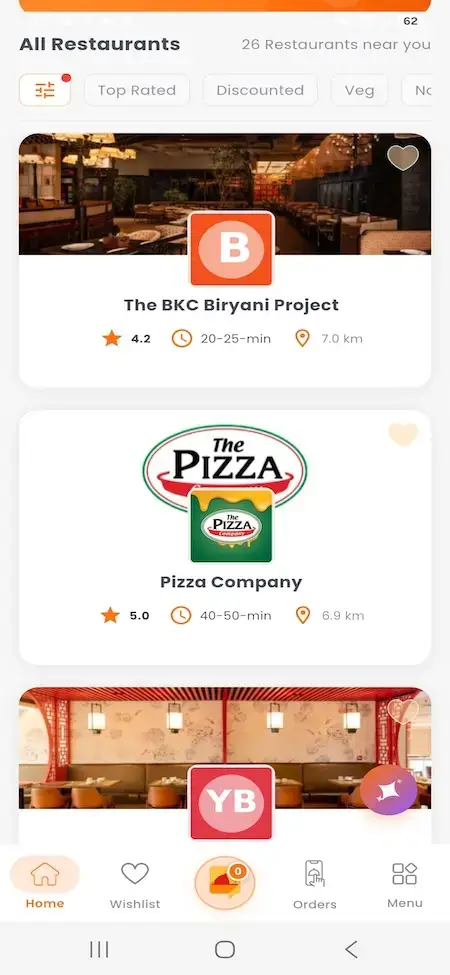
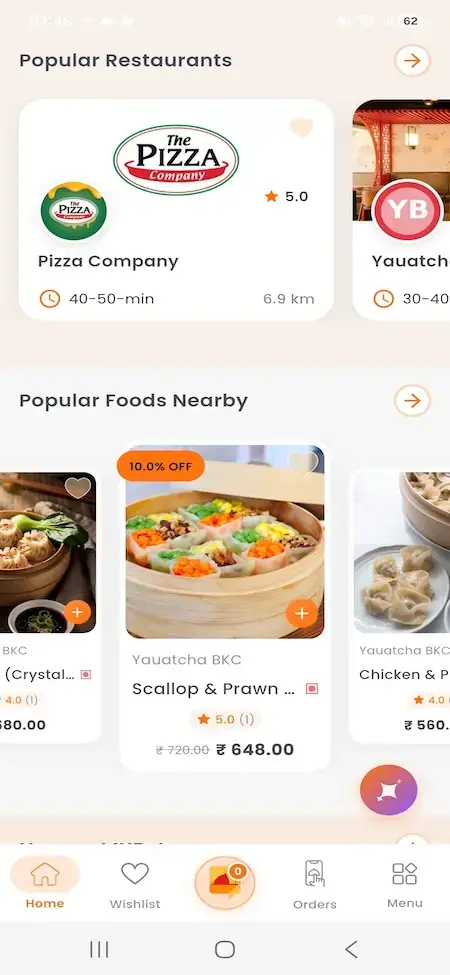
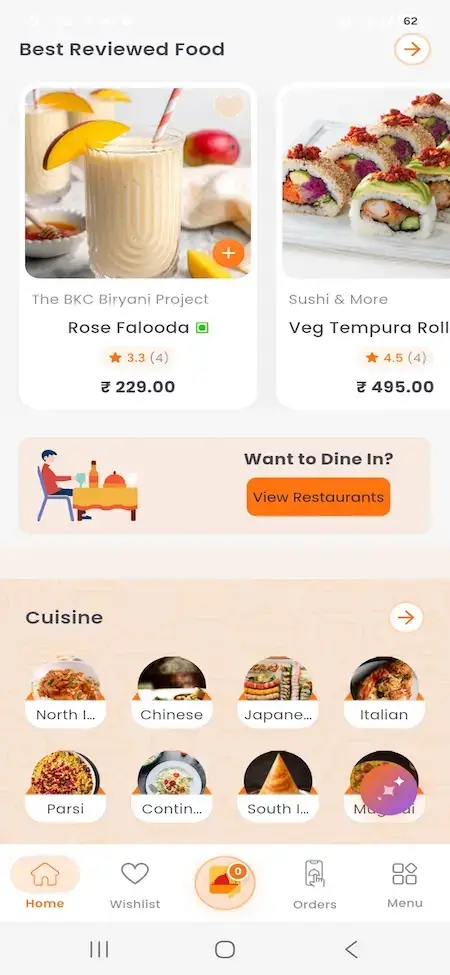
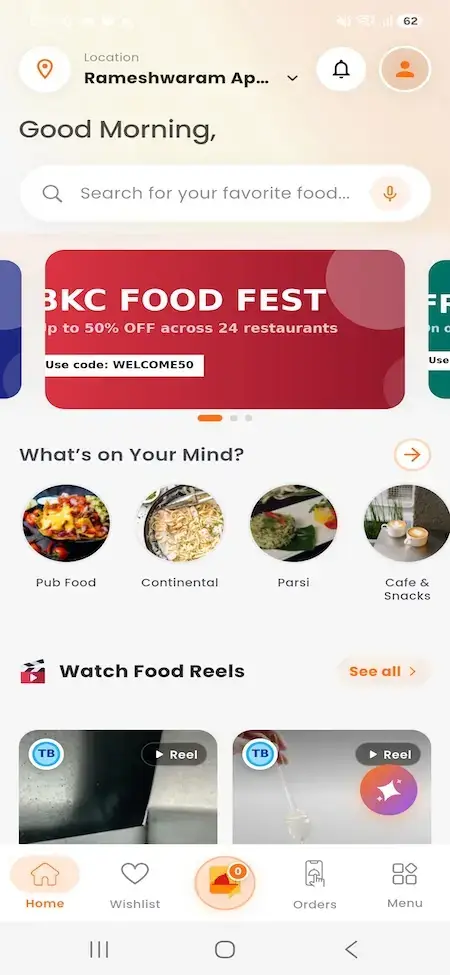
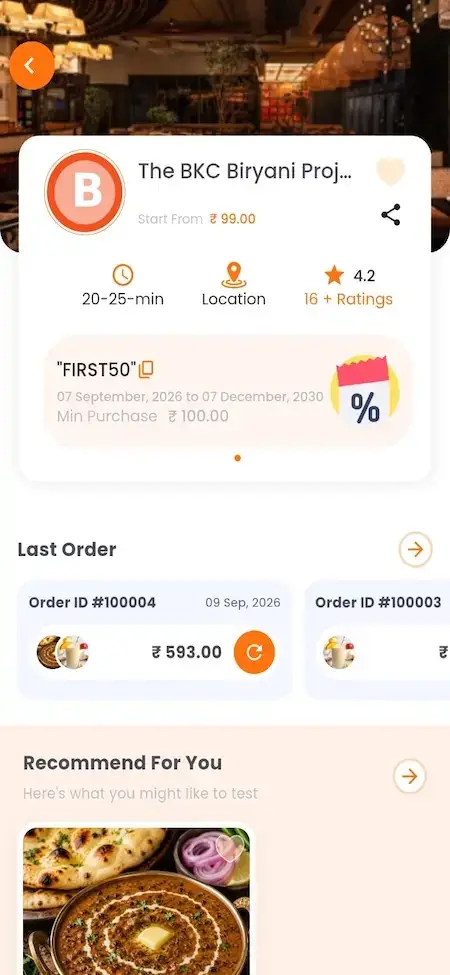
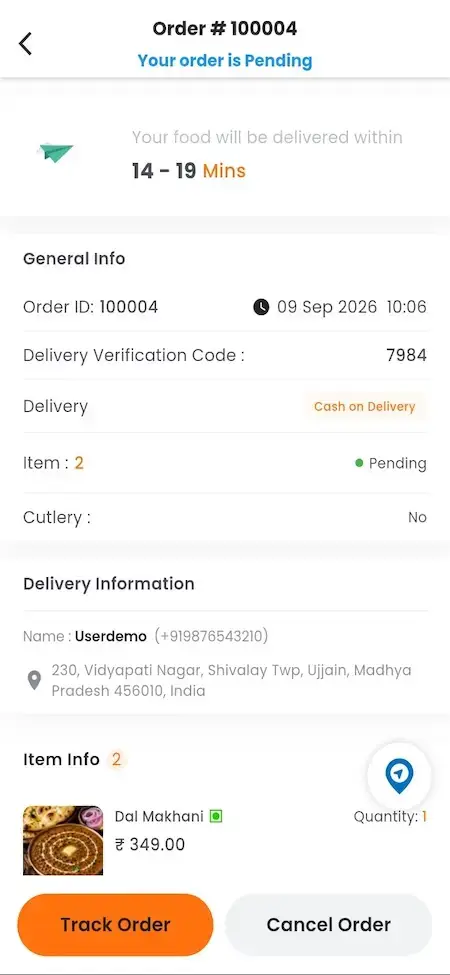
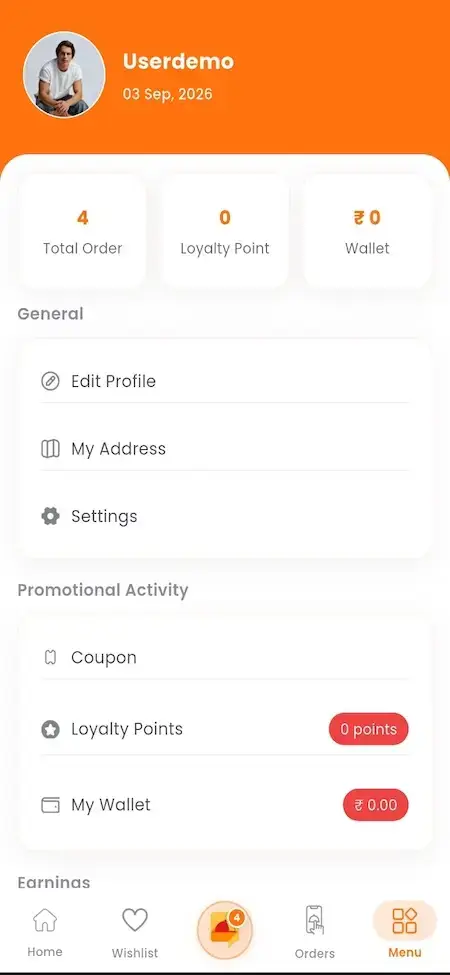
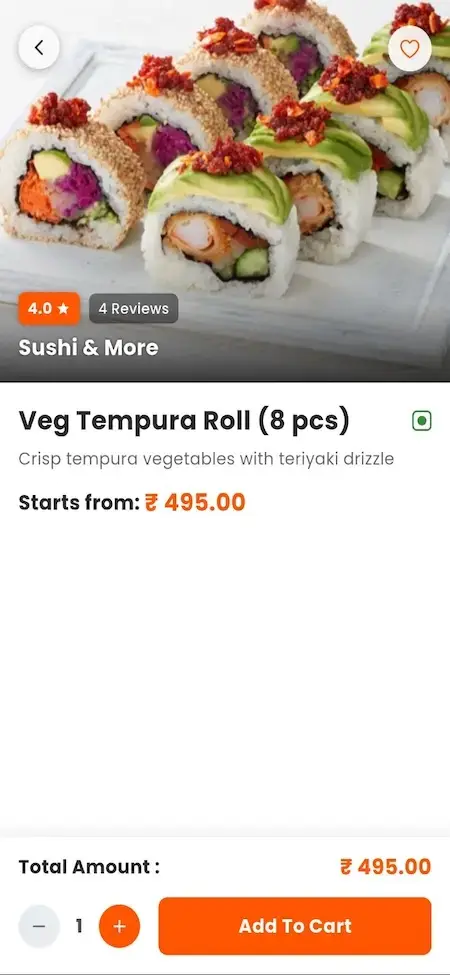
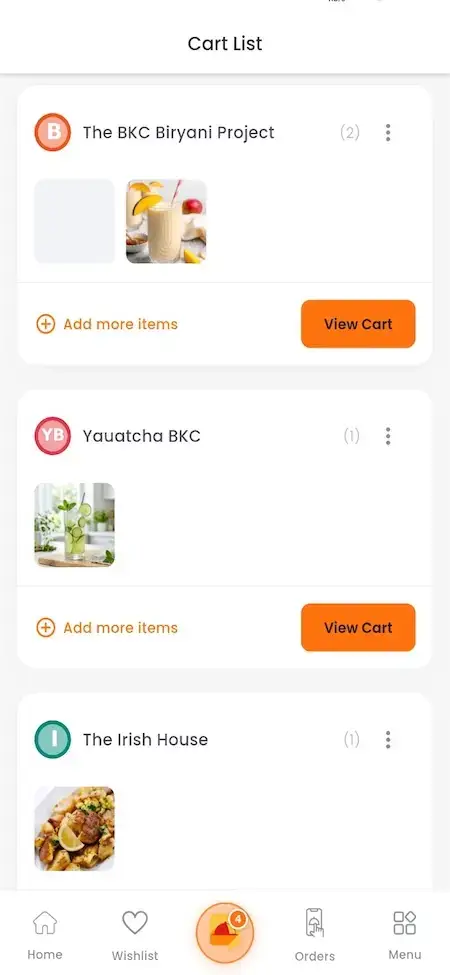
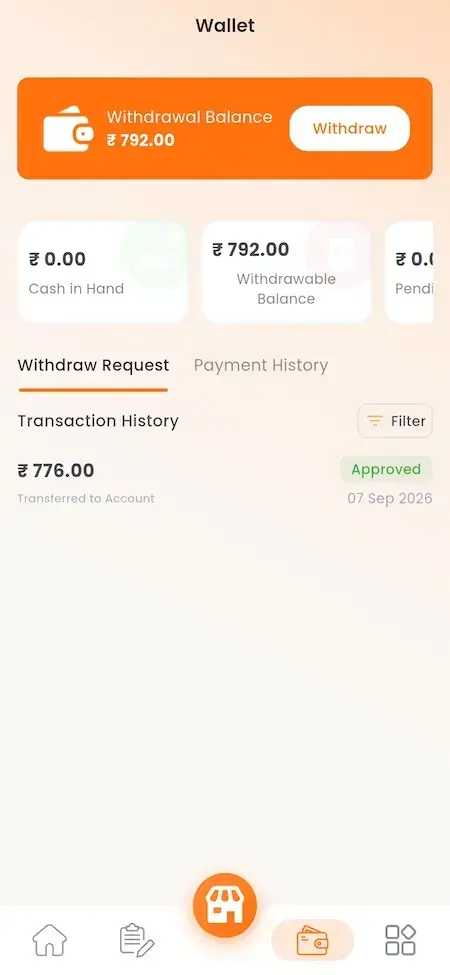
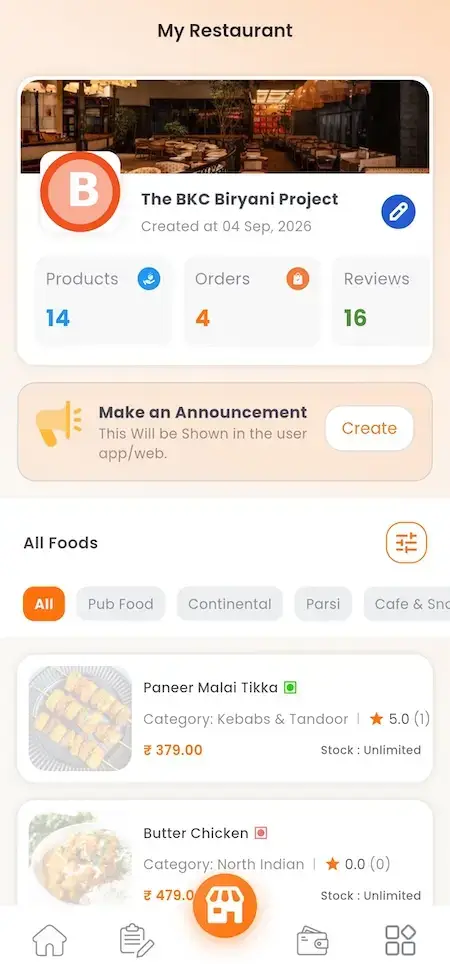
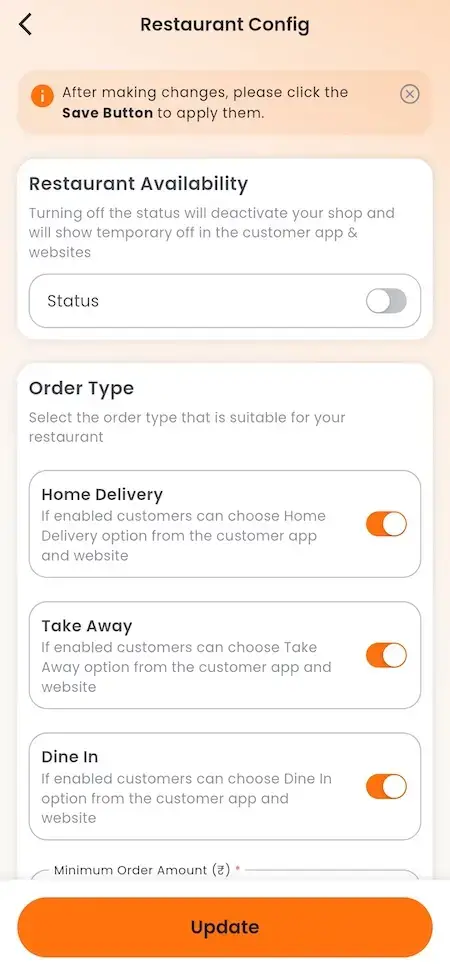
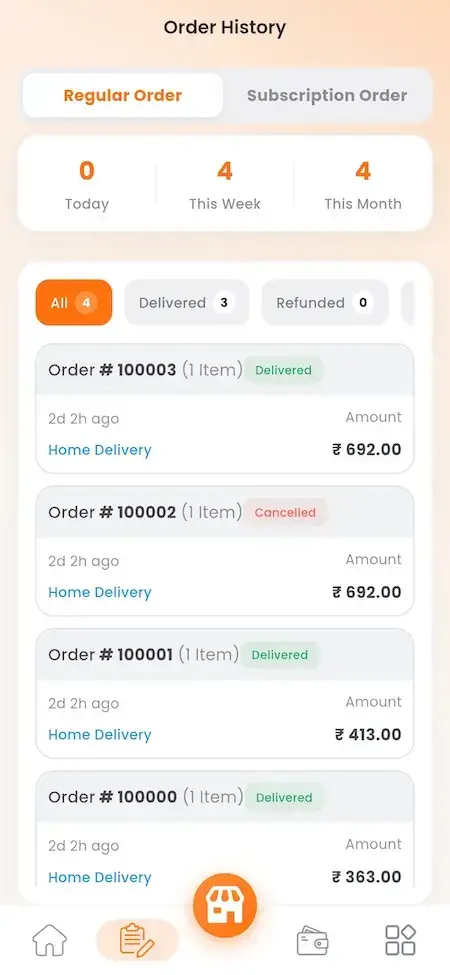
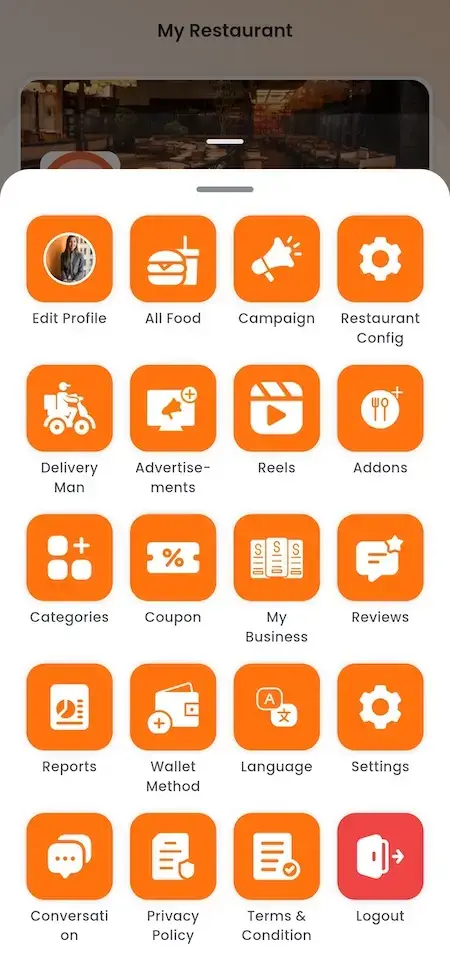
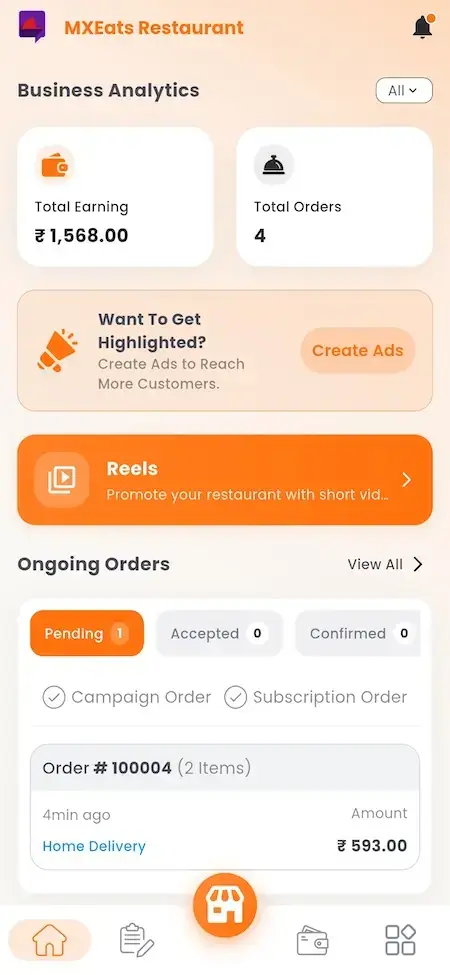
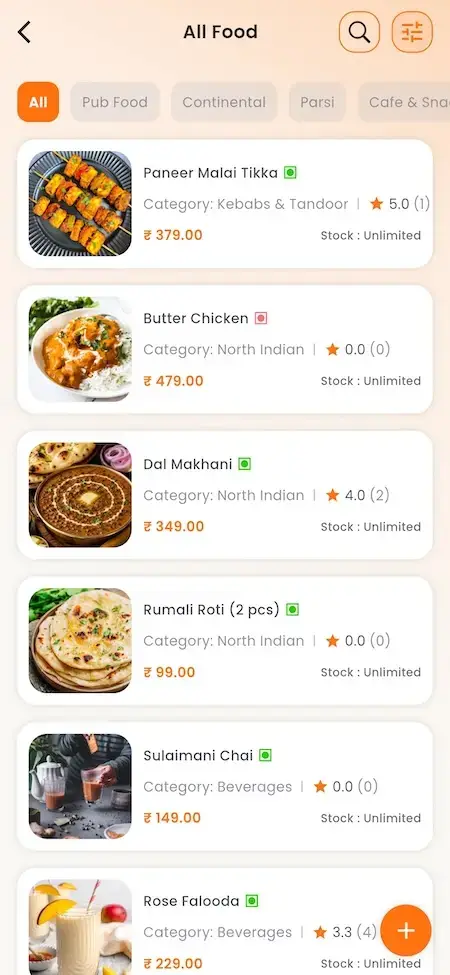
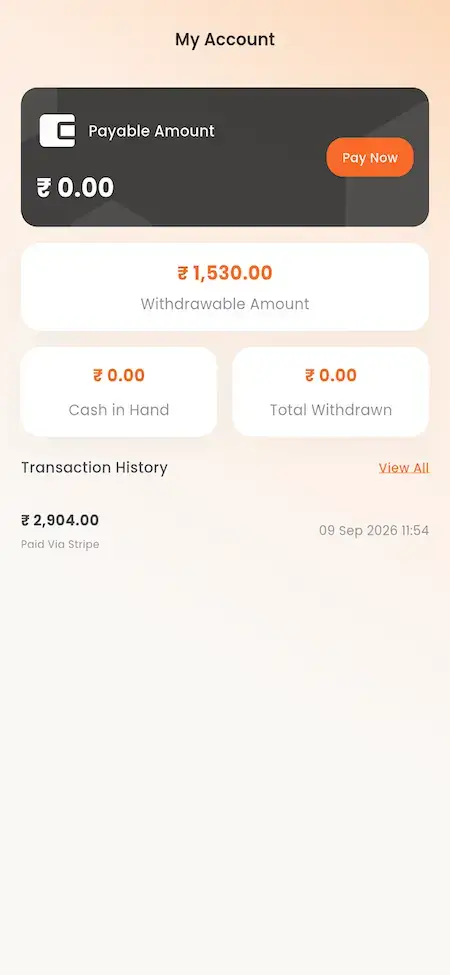
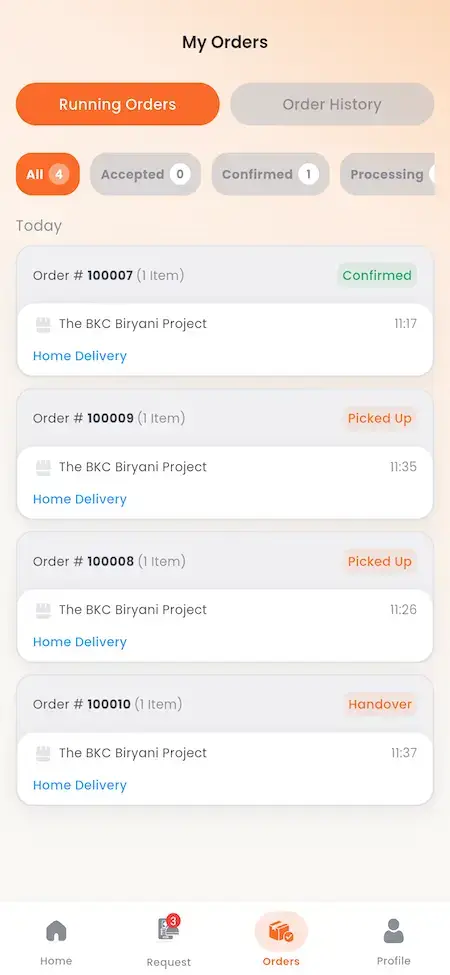
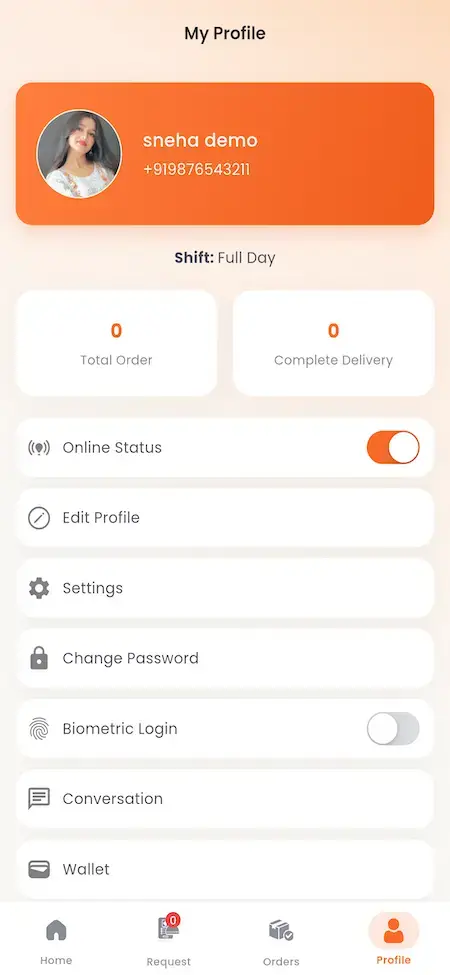
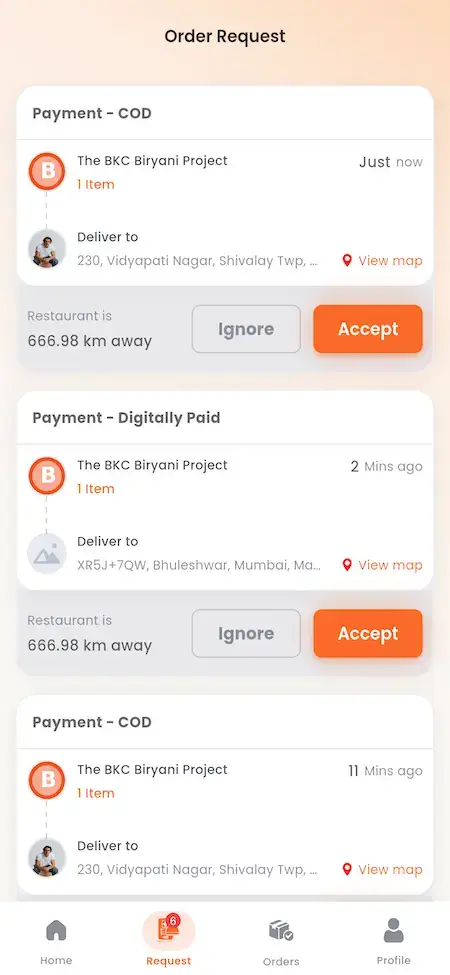
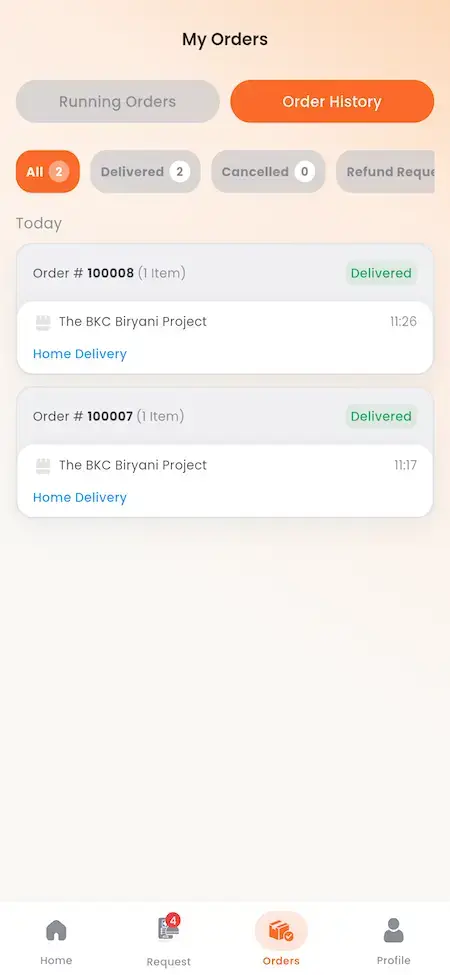
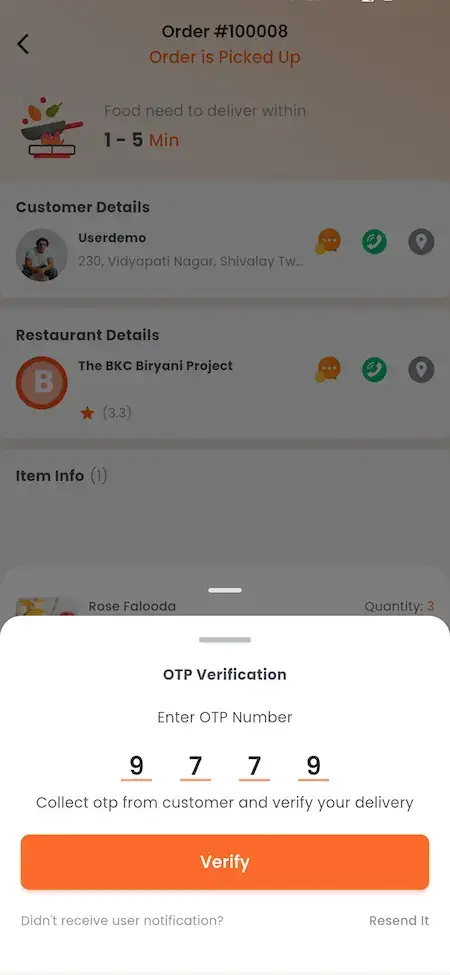
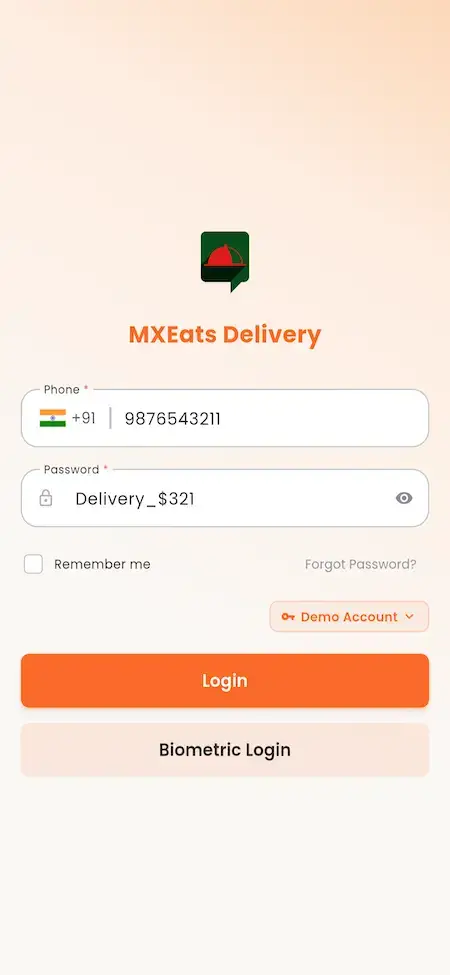
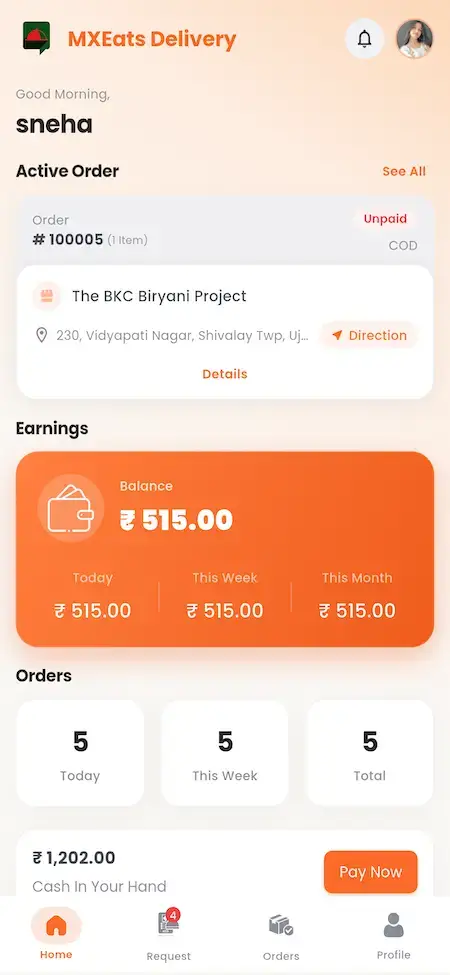
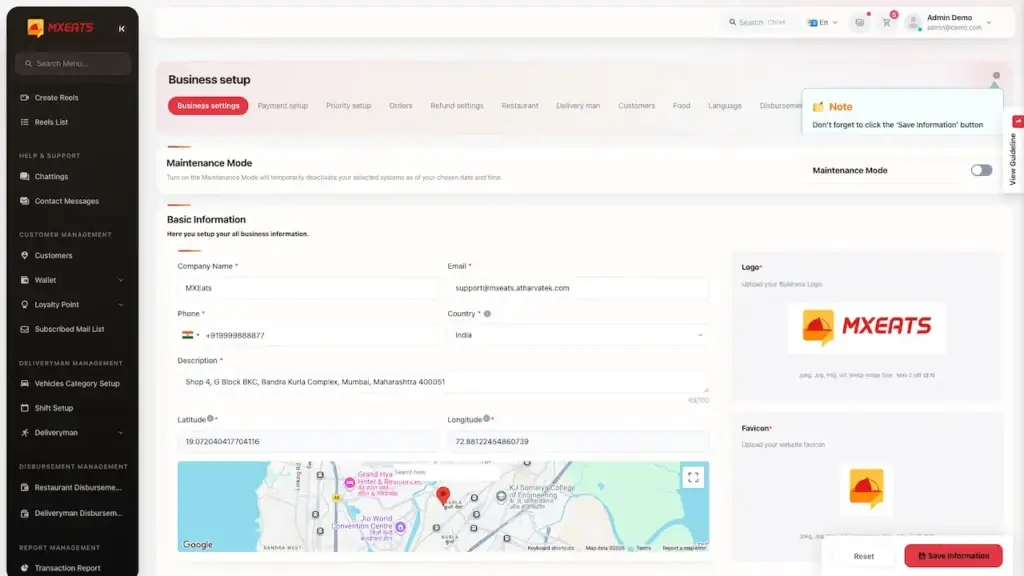
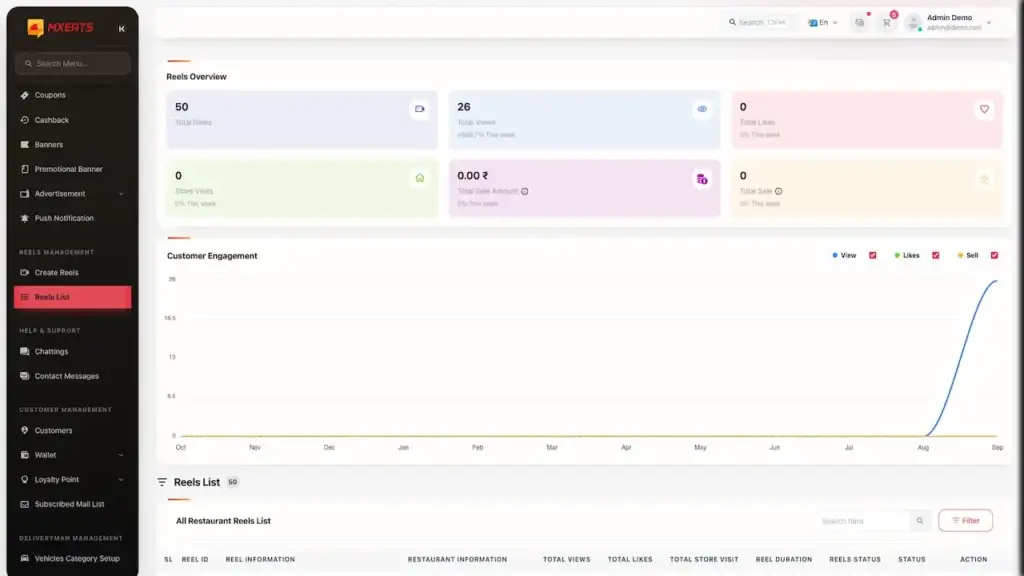
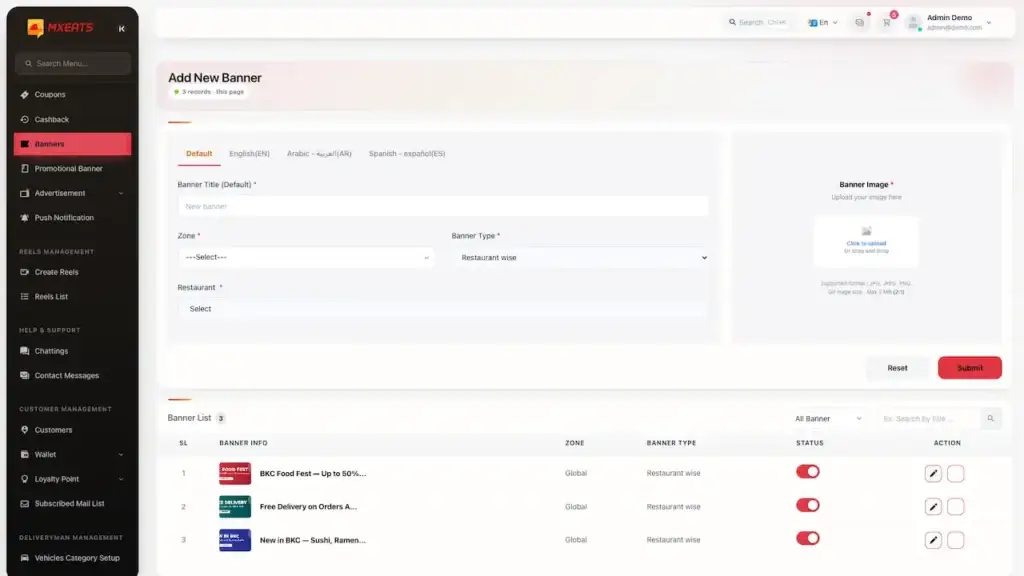
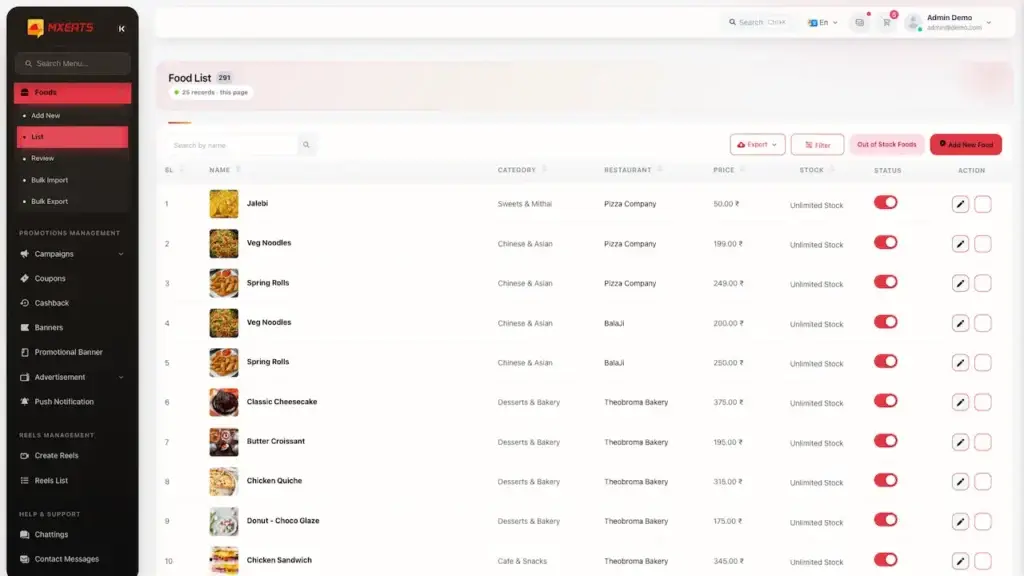
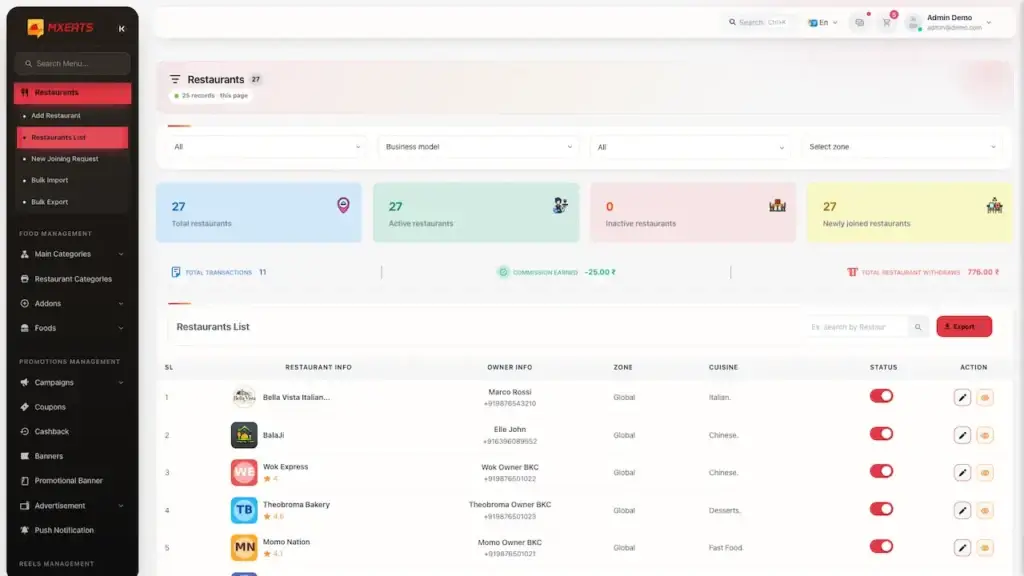
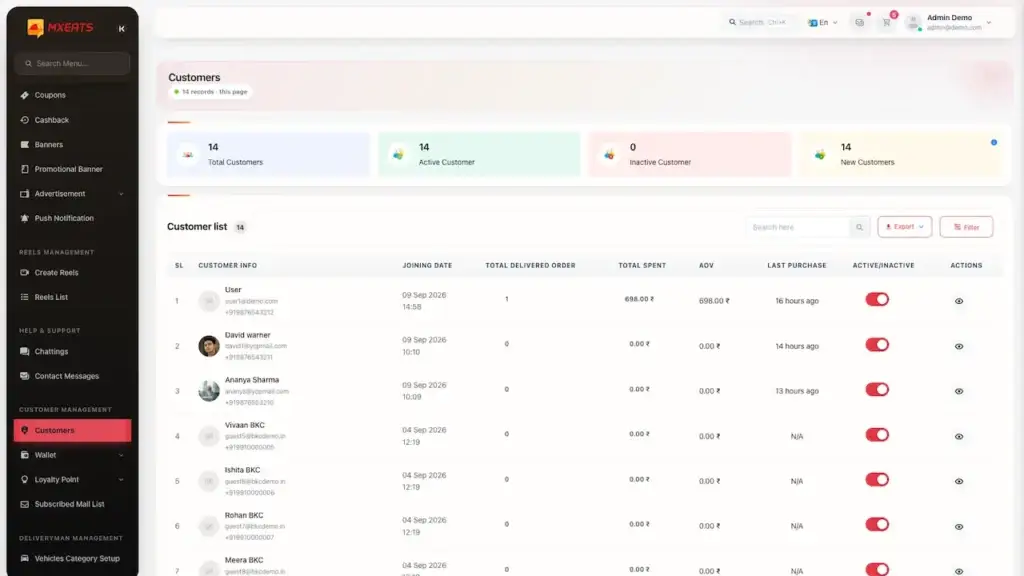
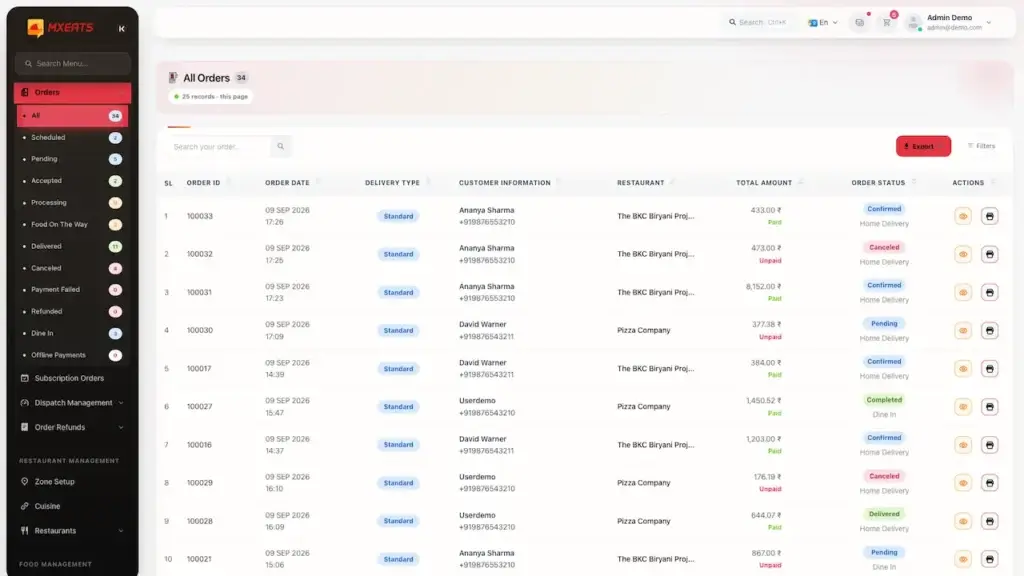
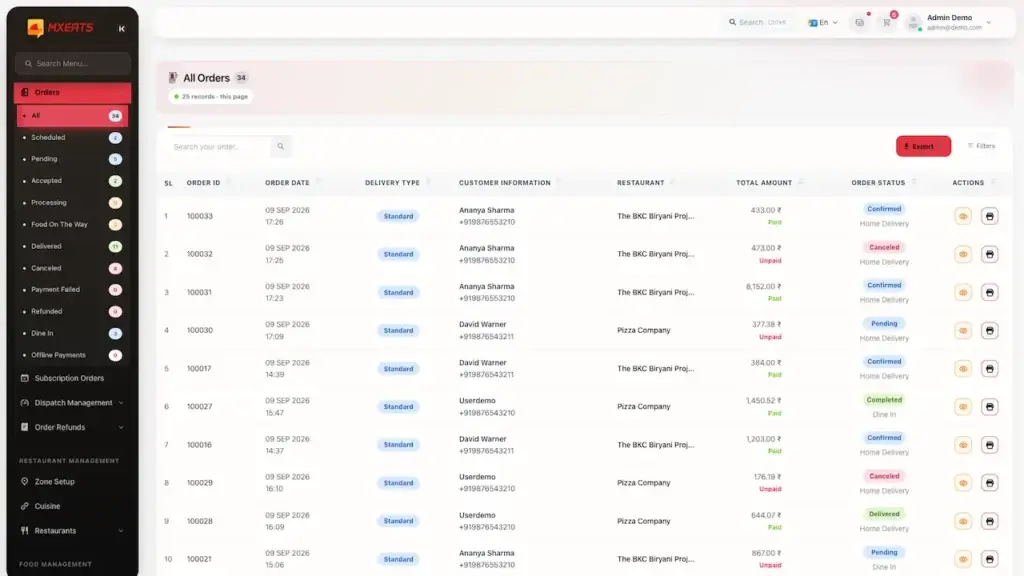
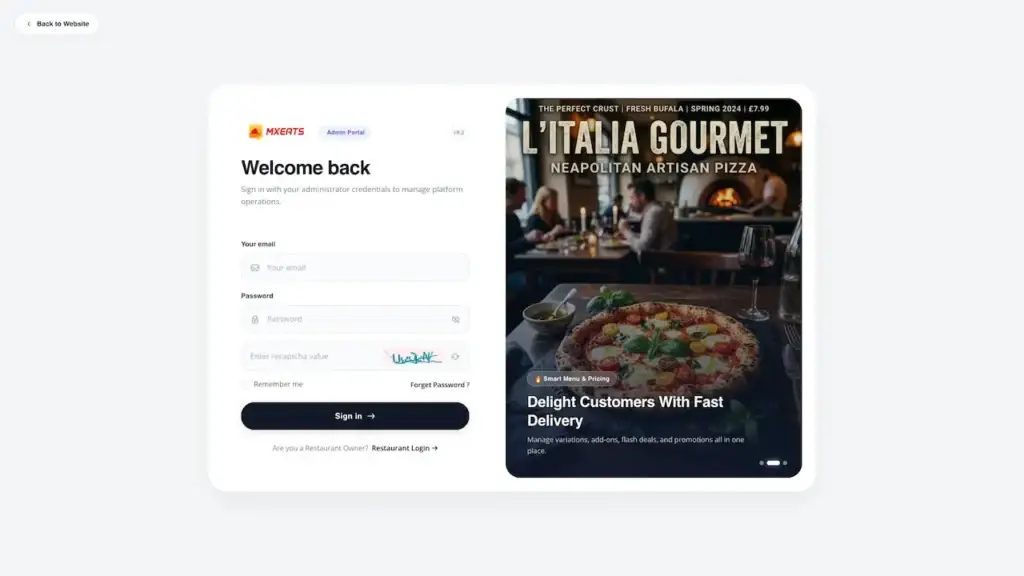
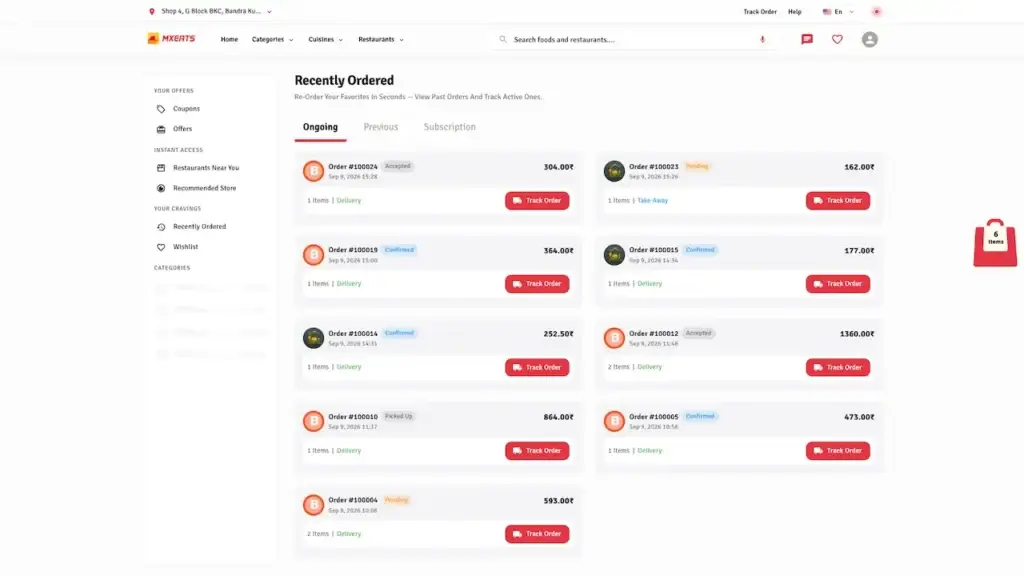
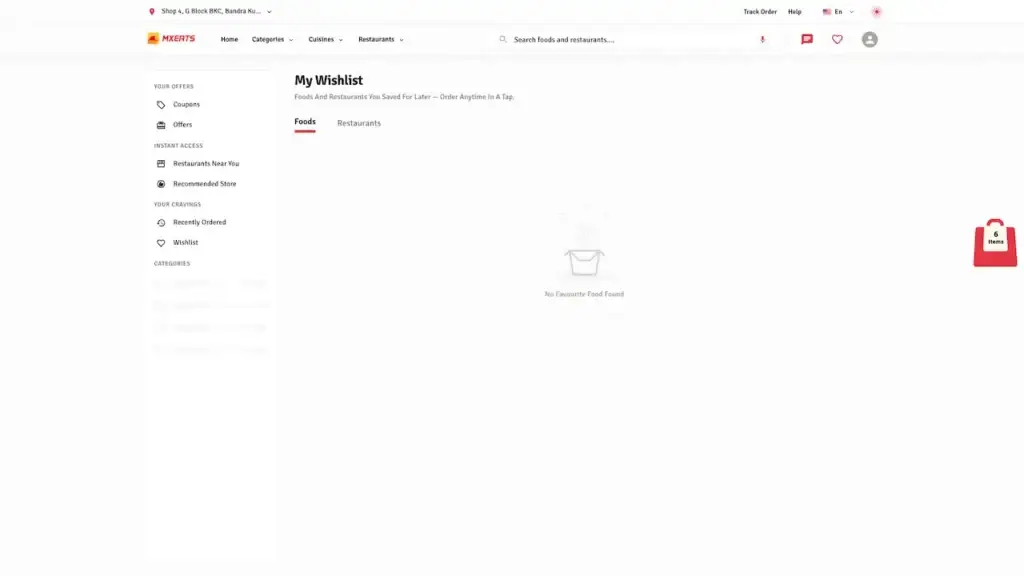
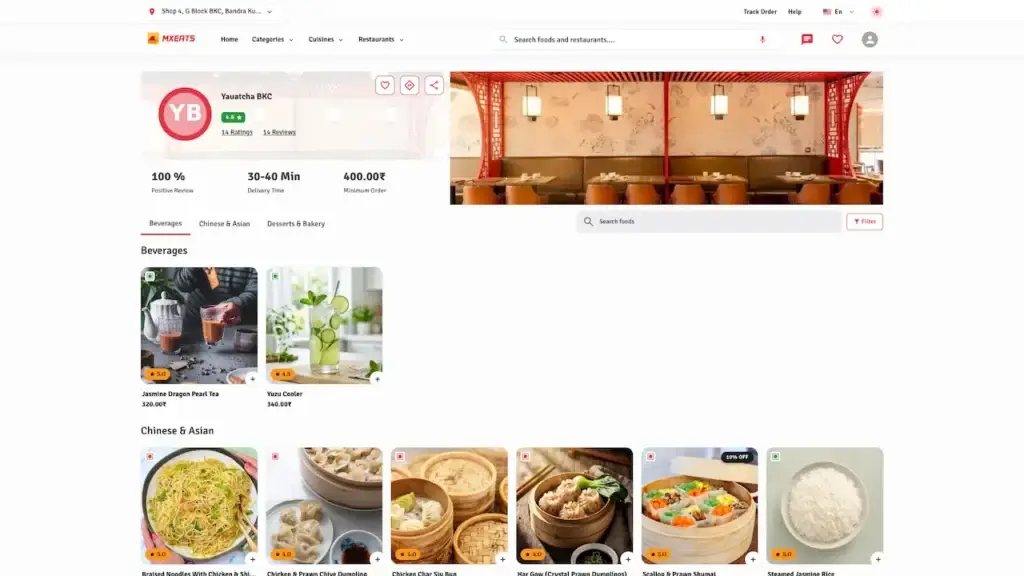
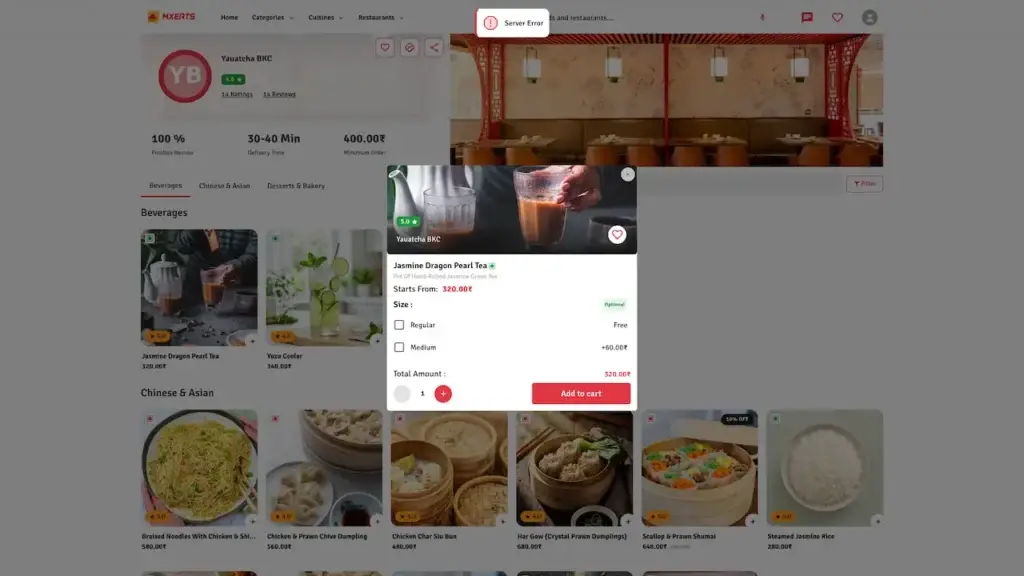
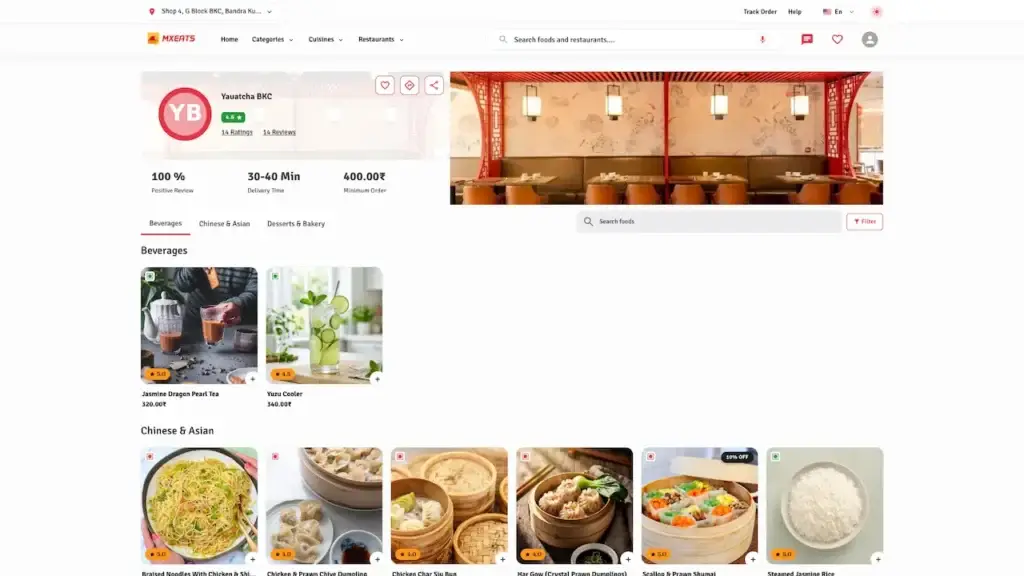
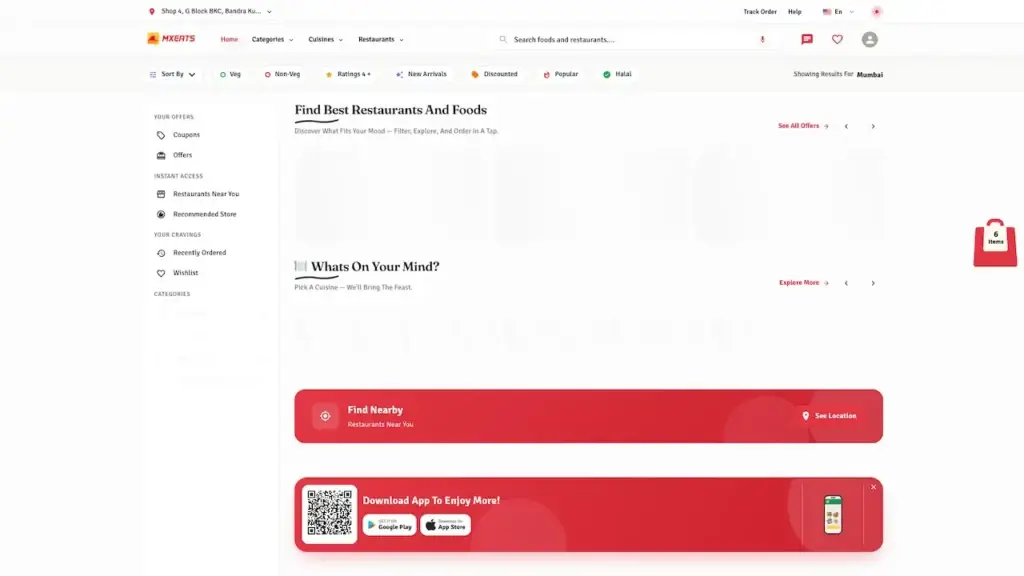
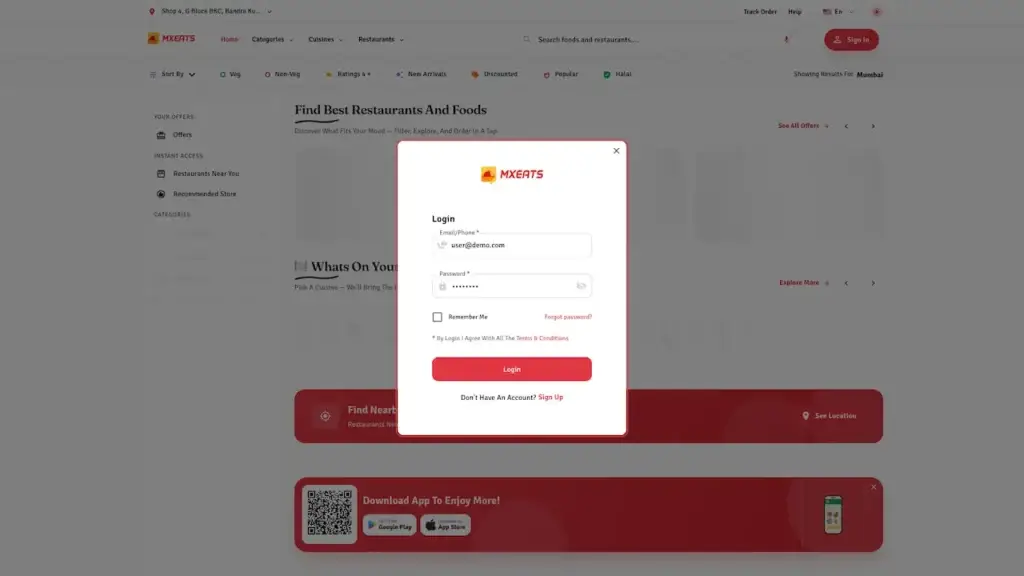
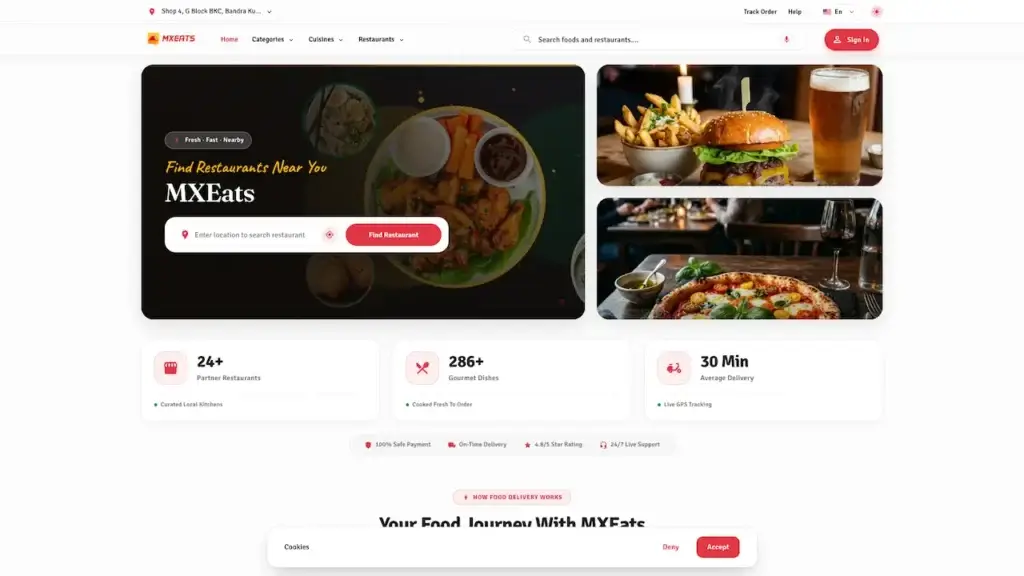
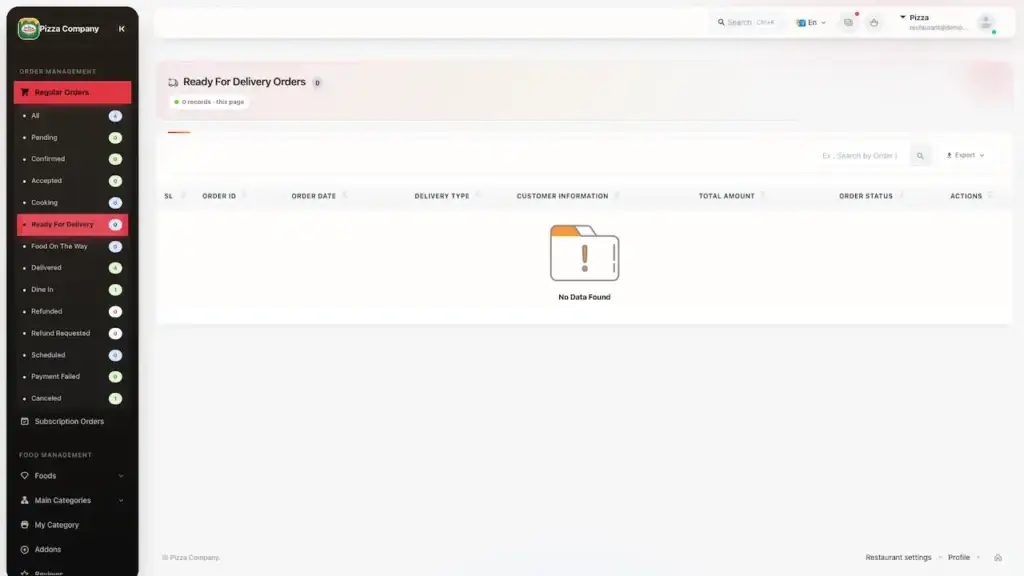
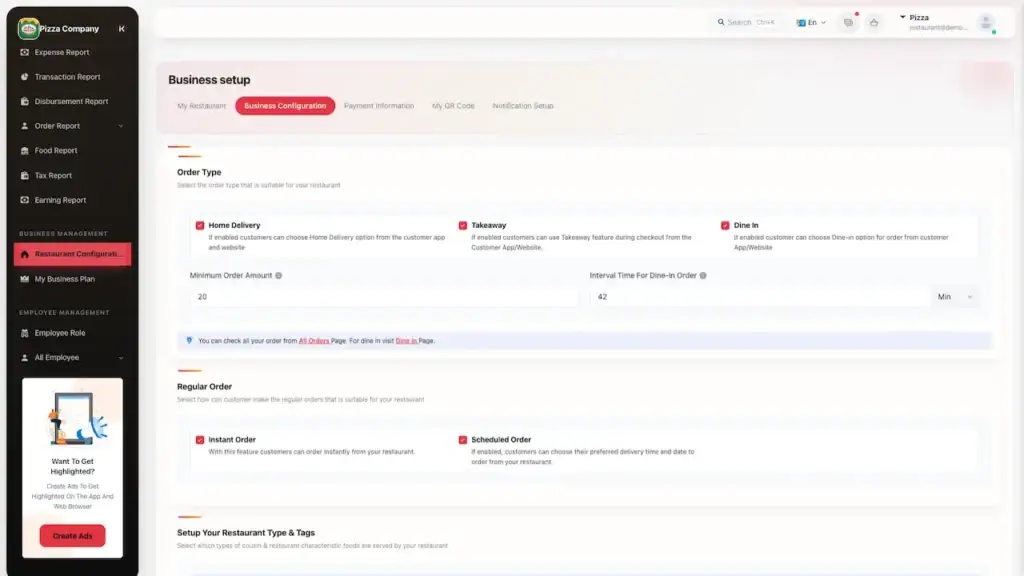
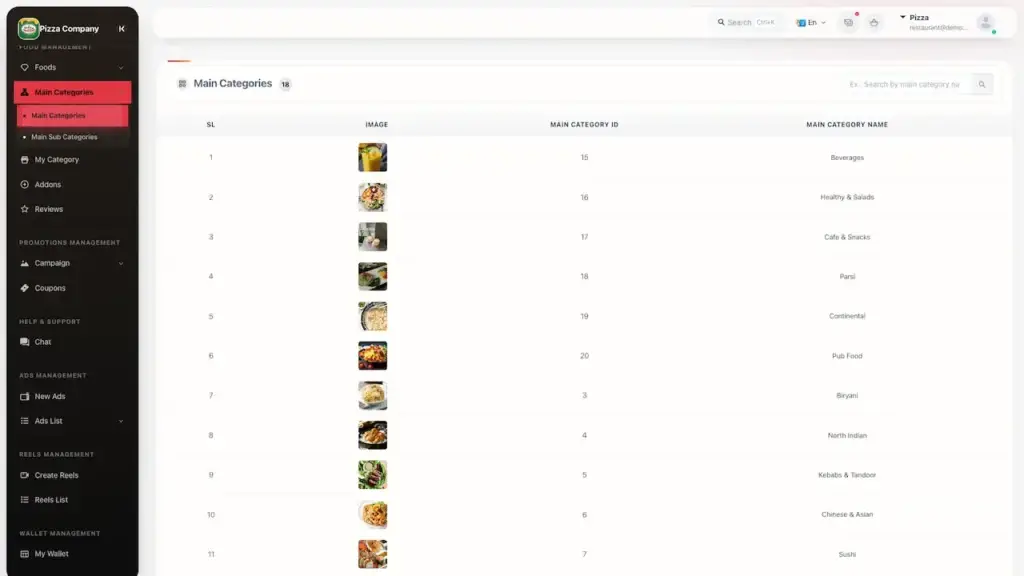
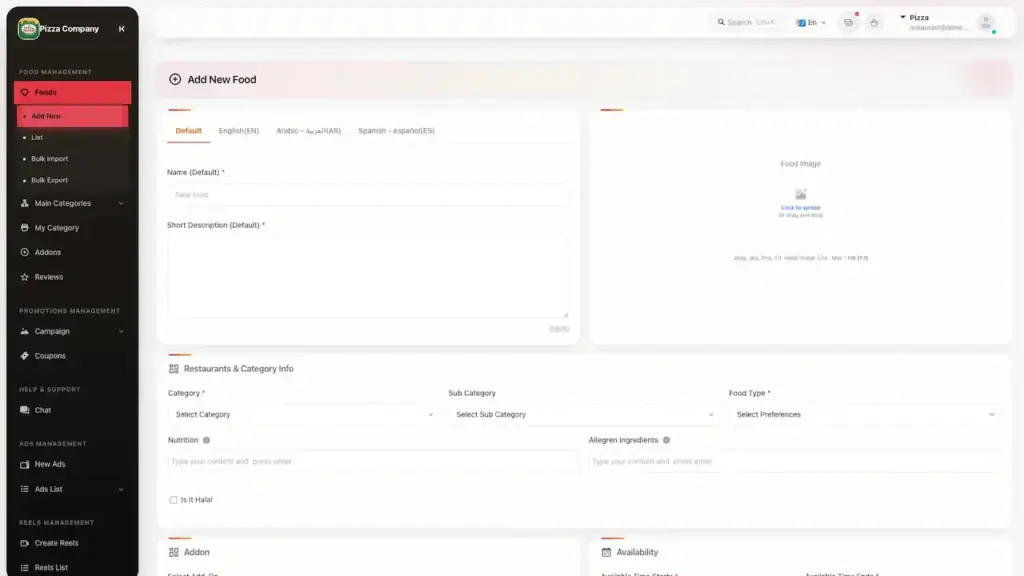
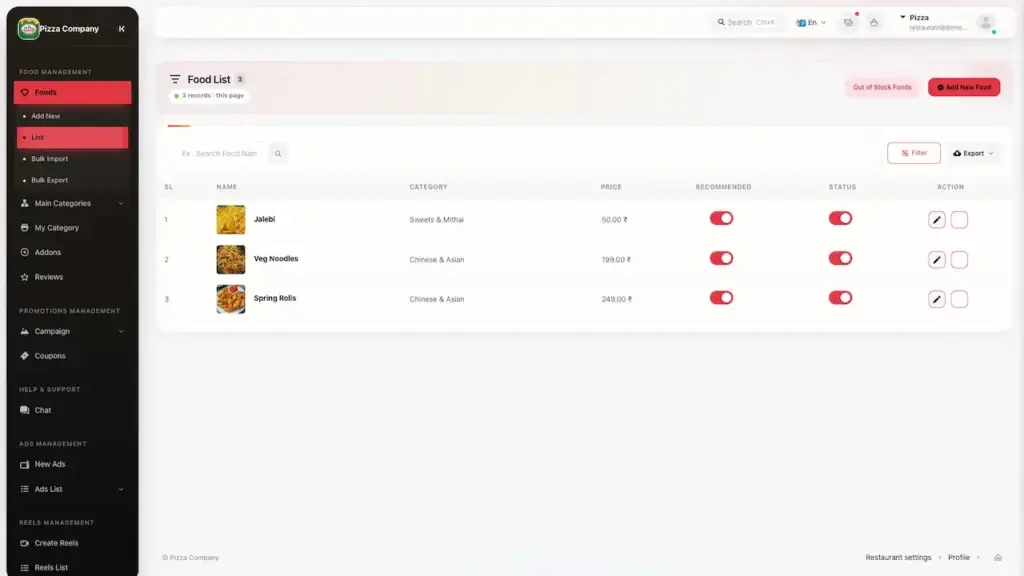
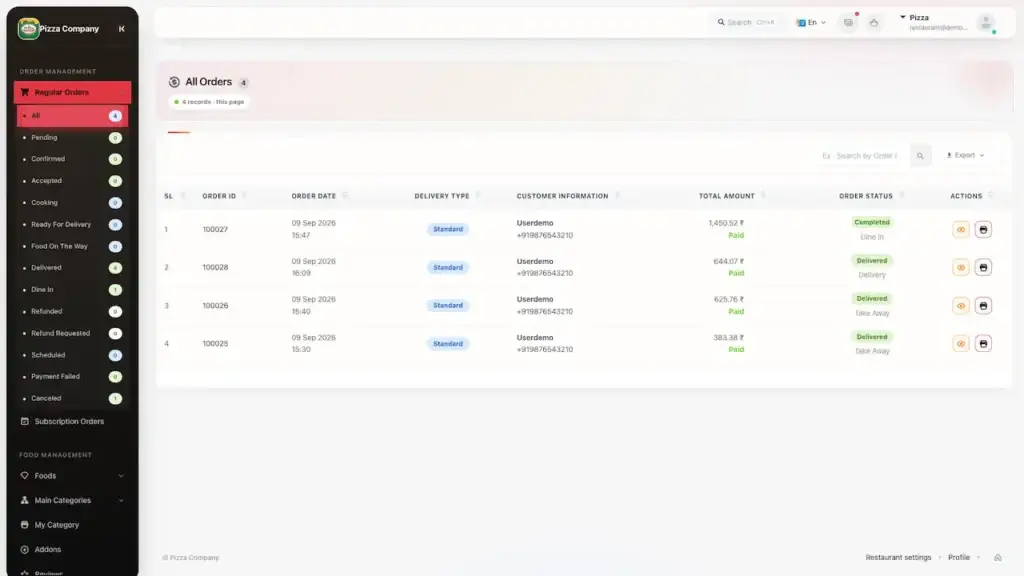
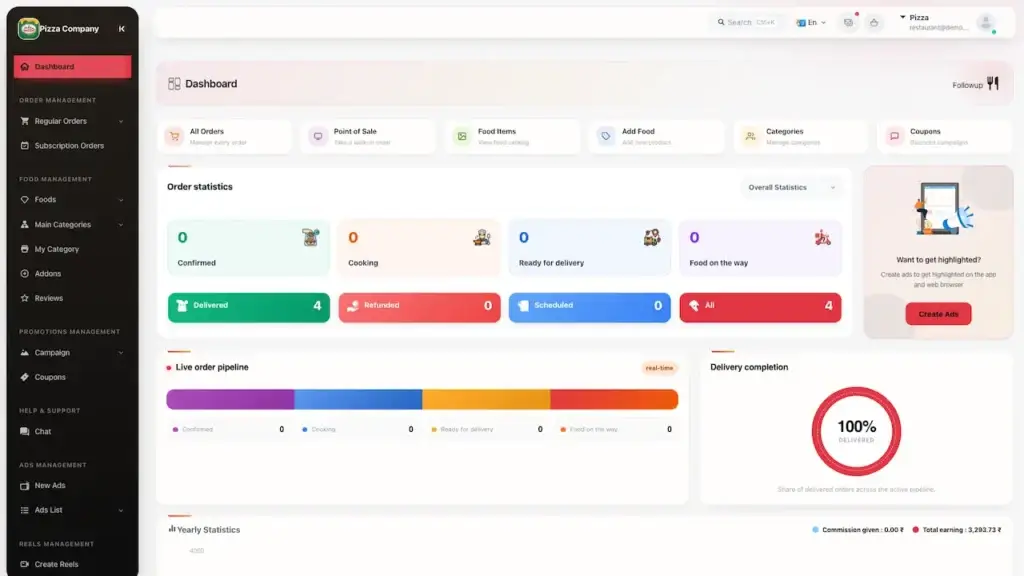
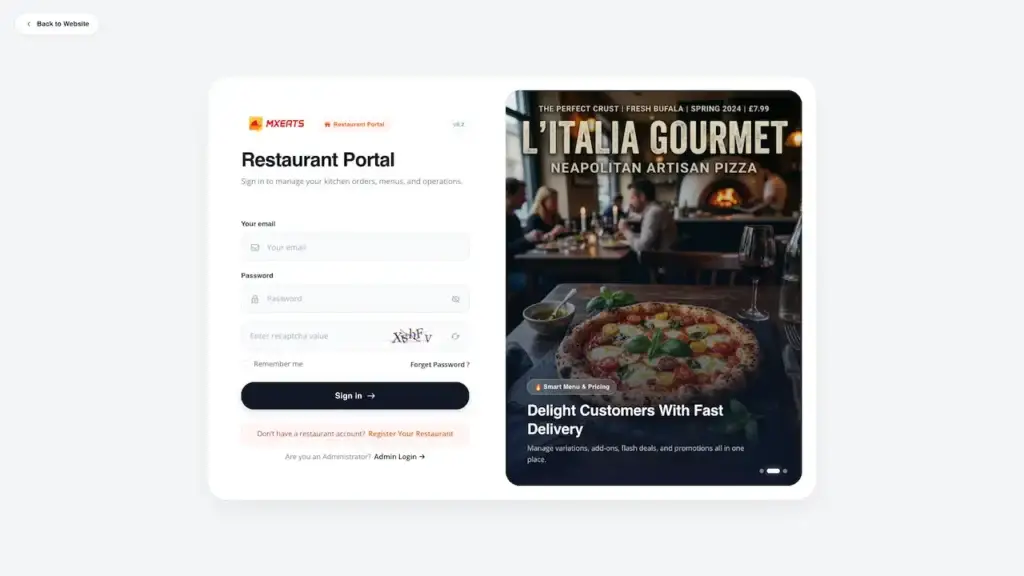
Follow a customer from a search for a dish through to a delivered order, a rating left, and that rating appearing in the filters the next customer uses. Follow a restaurant owner from editing their listing to accepting an order to the payout it lands in. Follow a delivery partner from assignment to proof of drop-off. Follow yourself from arranging the home feed to the placement revenue it earns. The customer application is the largest of the three at 727 Dart files across 36 feature modules, against 503 and 234 for the store and delivery builds, which is what a discovery-led product looks like when browsing is the main event rather than a step before checkout. Every one of these is a real, separate application rather than the same screens reskinned four times, and all of them are in the live demo right now.
Client Voices
Zomato Clone Client Reviews - Real Platforms, Real Results
Operators who launched their own discovery and delivery platforms, in their own markets, on their own infrastructure. These are real engagements from the Miracuves client list rather than composed quotes.
A Real Engagement
Flyereats - A Multi-Vendor Food Ordering Platform We Delivered
A real client build rather than a modelled scenario. Flyereats came to us with a platform the business had outgrown, and the engagement replaced it without a rebuild pause. The figures below are what the engagement delivered.
Flyereats
Multi-Vendor Food Ordering Platform
A multi-vendor food ordering platform built to Flyereats specification after a free feasibility review.
- Order confirmation lagging behind what customers expected to see
- Vendors onboarded and managed by hand as the platform outgrew itself
- Customers with no way to see where their order actually was
- Replace a platform the business had outgrown, without a rebuild pause
- Put vendor management on rails instead of on somebody desk
- Give customers order visibility from confirmation through to arrival
- Three applications shipped, each with its own permissions and release path
- Six integrations, each isolated so one failure cannot take the rest down
- Three environments: development, staging and production
- Seventeen platform modules reused unchanged, four decisions built for Flyereats
- Source code transferred in full to the client own account at handover
Every figure here is what the engagement delivered. Flyereats was a custom build rather than a template deployment.
The Basics
What Is a Zomato Clone App?
A Zomato clone app is a restaurant discovery and ordering platform: customers search and browse to decide where to eat, then order from the same place. Restaurants are listed with menus, photos and ratings, delivery partners carry, and the operator runs the catalogue and the feed.
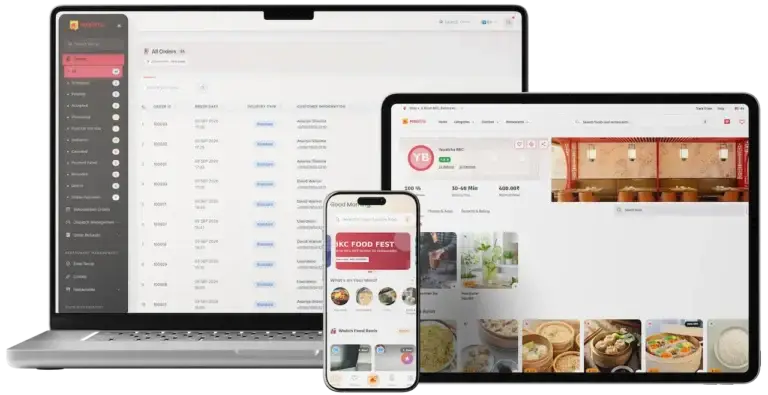
Built for Android, iOS & Web
One platform covers customer apps, a restaurant app, a delivery partner app, a genuinely indexable storefront and your console, so the catalogue you curate serves an app screen and a web page from the same source.
Ratings Are Part of the Catalogue
Ratings ship with the platform and sit against the restaurants they describe, feeding the filters customers actually use. A discovery product without them is a menu list rather than a way of choosing.
The Feed Is an Operator Decision
Categories, offers, featured positions and what appears on the home feed are yours to set from the console. Placement becomes something you can sell rather than something a ranking model decides on your behalf.
Discovery Then Ordering
Why Browsing Shapes the Build
The distinction from a pure delivery marketplace is the order of events. Here finding the restaurant is the product, and ordering is what happens after the decision. That changes what has to be fast, what has to be indexable, and what the operator actually controls.
-
Search by dish, restaurant, cuisine or category
-
Filters for rating, price and delivery time
-
A home feed and placement you control
-
33 crawlable pages for organic discovery
-
Full source code, no revenue share back to us
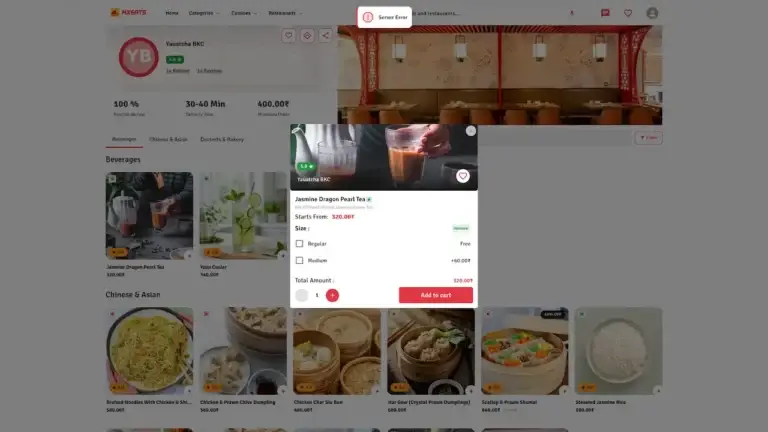
It also changes the traffic shape. Most sessions on a discovery platform end without an order, which sounds like a problem until you realize it is the whole funnel: browsing is how a first-time visitor becomes a customer, and how a search engine finds you at all.
Everything Included
Zomato Clone Features - Search, Filters, Ratings & Ordering
Every feature listed below is already built and working in the live demo. The order of this list follows the order a customer meets them, which on a discovery platform means search comes a long way before checkout.
Restaurant Discovery & Search
Help customers find the right restaurant fast, with search by dish or cuisine, category browsing, filters for rating, price and delivery time, and a home feed you control.
- Search by dish, restaurant or cuisine
- Category browsing across the catalogue
- Filters for rating, price and delivery time
- Only shows restaurants that deliver to them
Ratings in the Filters
Ratings ship as part of the catalogue and feed the sort customers actually use, so the ordering of a list reflects experience rather than only proximity.
- A home feed you curate from the console
- Offers and campaigns placed where you choose
- Featured positions you can sell to restaurants
- Cuisine and category taxonomy you define
The Home Feed You Curate
Offers, campaigns and featured positions arranged from the console, which turns the front page into a commercial surface you can sell rather than a default sort order.
- Ratings against restaurants and orders
- Feeding the filters customers sort by
- Visible in listings and on the profile
- Part of the catalogue, not a bolt-on
Cuisine and Category Taxonomy
Define the categories and cuisines your market actually uses. A taxonomy that matches how people describe food locally is most of what makes search feel native.
- Restaurant profiles with photos and hours
- Menus with sizes, crusts, toppings and extras
- Allergen and nutrition information
- Item availability and scheduling
An Indexable Storefront
Thirty-three server-rendered routes with policies, registration funnels and tracking, so restaurants surface in search results rather than sitting behind an application shell.
- 33 routed pages built to be crawled
- Policies, registration funnels and tracking
- Server-rendered rather than an app shell
- A restaurant findable without a paid link
Restaurant Profiles
Photos, hours, holidays, delivery radius and the full menu, all edited by the restaurant itself, so listings stay current without a support ticket to you.
- Order now or schedule for later
- Table ordering for dine-in guests
- Repeat weekly orders on autopilot
- Takeaway and collection supported
Menu, Variations & Add-Ons
Sizes, crusts, toppings, extras and allergen notes modelled as variations rather than separate products, with availability and scheduling per item.
- Live status updates at every step
- Map view of the delivery partner
- Proof of delivery capture
- In-order chat between customer, store and rider
Delivery, Takeaway & Dine-In
Let customers order the way they want, whether delivered to the door, collected in person, or ordered at the table as a seated guest.
- 13 payment gateways included
- Cash on delivery with limits you set
- Wallet credit and instant refunds
- Split tender reconciled on the order
Live Tracking & Chat
Status at every step, a map view of the rider, proof of delivery and in-order chat between customer, store and rider on the same realtime spine.
- Loyalty points earned and redeemed
- Discount codes and first-order offers
- Free delivery above a basket value
- Customer membership with member pricing
Offers, Loyalty & Membership
Discount codes, first-order offers, free delivery thresholds, loyalty points and a customer membership carrying member pricing as a demand-side recurring line.
- Commission per order, platform-wide or per store
- Monthly plans billed and invoiced for you
- Automatic payouts on your schedule
- Tax computed per order and reportable
AI Assistant & Video Feed
An assistant that helps customers order and a short-video feed for food discovery, both shipped as platform modules owning their own tables rather than quoted as later phases.
- Approve restaurants and delivery partners
- Set delivery areas, fees and commission
- Step into a live order and reassign it
- Roughly 120 settings keys across eleven tabs
Commission, Plans & Payouts
Per-order commission with per-store overrides, monthly subscription plans, and automatic disbursement computed from what was charged at the time.
- AI assistant that helps customers order
- Short-video feed for food discovery
- Both shipped as platform modules
- Each owning its own tables
Every message the platform sends, from order confirmations to promotional pushes, is text you can edit yourself in any language you support, so the platform sounds like your brand rather than ours.
How Operators Earn
Zomato Clone Revenue Models - Commission, Ads, Plans & Membership
This is the question this brand audience arrives asking, so it is answered directly rather than left to a blog. Seven revenue lines ship switched on and configurable, and on a discovery-led platform two of them behave differently from a pure delivery marketplace.
Advertising and Placement
The lever discovery unlocks. Featured positions, promoted campaigns and home-feed placement sold to restaurants competing for attention on a surface you control and price yourself.
Commission per Order
A percentage of every order, set platform-wide or negotiated per restaurant, with your most valuable partners on their own rate and every rate frozen onto the transaction at settlement.
Customer Membership
A demand-side recurring line carrying free or reduced delivery and member pricing. On a platform people browse habitually, membership converts attention that was never going to become commission.
Store Subscription Plans
Charge restaurants a monthly fee instead of commission, with plans you build and price, running alongside commission across different restaurants rather than instead of it.
Delivery Fee Margin
The difference between what the customer pays for delivery and what the run costs you, set per zone, and independent of whatever the restaurant is charged.
Packaging and Service Charges
Per-order charges you configure, including the small fixed lines that are invisible individually and material across volume.
Advertising and placement are worth more here, because you own the surface people browse before they choose. Membership is worth more too, because a platform people open to look at is a platform they open often. Both are levers you set rather than rates deducted before you see them.
Run It Without a Dev Team
Zomato Clone Admin Console - Feed, Catalogue, Placement & Payouts
On a discovery platform the console is a merchandising tool as much as an operations one. What appears on the home feed, which cuisines exist, which restaurant is featured this week and what that position costs are all decisions you make here rather than requests you file.
What You Actually Operate
The Home Feed
Arrange what customers see first: offers, campaigns, categories and featured restaurants, scheduled and priced by you, so the front page is a commercial surface rather than a default ordering.
Category and Cuisine Taxonomy
Define the vocabulary your market uses to describe food. Search quality on a discovery platform is mostly taxonomy quality, and it is admin data here rather than a code change.
Featured Placement
Sell positions to restaurants, schedule them, and report on what each one delivered, so placement revenue is measurable rather than anecdotal.
Listing Approval
Applications, document checks and approval as a recorded workflow, so who approved a listing and when is a query rather than a memory.
The Settings Surface
Roughly 120 named keys across business, customer, delivery-partner, order, store, disbursement, payment, mail, theme, policy and third-party tabs, all read at request time.
Delivery Areas
Draw each area you deliver to on a map and give it its own charges, cash ceiling and rules, so coverage and pricing resolve from geometry rather than a declared city.
Reports and Exports
Sales, commission, placement, payout and tax reports you can export, each showing what was charged at the time so a later rate change never rewrites your old numbers.
Notification Content
Push, mail and SMS wording lives in editable templates keyed by message and user type, so tone and language are admin data rather than code.
Order Oversight
Watch live orders, reassign a rider, approve a refund, and read cycle time from the named timestamps every order already carries.
- Curate the home feed and its offers
- Define cuisine and category taxonomy
- Sell and schedule featured placement
- Approve restaurants and their listings
Staff Access
Console roles scoped so editorial, support and finance each reach their own surface and nobody reaches everything by default.
- Set delivery areas, fees and commission
- Step into a live order and reassign it
- Approve or reject refund requests
- Run disbursement and export the statements
Got a team? Create staff accounts with exactly the access each person needs, so a content editor curates the feed, finance sees payouts, and nobody sees more than they should.
Transparent Pricing
How Much Does It Cost to Build an App Like Zomato in 2026?
One fixed figure for the whole platform: every application, the indexable storefront, the operator console, the full source code and deployment on your infrastructure. Not a licence, not a per-listing fee, and not a percentage of anything you go on to earn.
Not sure which option
is right for you?
Talk to us - we'll understand your goals, timeline, and budget, and point you to exactly what you need. No upselling, just honest advice.
The Full Package
What's Included - Zomato Clone Source Code, Apps & Deployment
A single figure, and everything named below arrives with it. No component is held back as a premium tier and nothing here converts into a recurring charge once you are live.
Full Source Code
The Laravel backend, the Next.js storefront, three Flutter applications and the console, transferred outright with no encrypted modules and no revenue share.
- Source for all five surfaces at handover
- Readable code, nothing obfuscated
- Fork it, rebrand it, or sell it on
- No callback to us, ever
The Discovery Surface
Search, filters, categories, ratings and the home feed, with the taxonomy held as data so your market vocabulary is a configuration rather than a rebuild.
- A catalogue built for browsing at volume
- Search across dishes, restaurants and cuisines
- Filter and sort logic you can extend
- Taxonomy defined as data, not constants
An Indexable Storefront
Thirty-three server-rendered routes with policies, funnels and tracking, which is what makes organic search a channel rather than an aspiration.
- Thirty-three server-rendered routes
- Crawlable by search engines out of the box
- Policy pages, funnels and tracking wired
- Next.js 15 on React 18, MUI and Redux Toolkit
Four Applications
Customer, restaurant and delivery partner apps in Flutter source, plus your operator console, all reading one versioned API.
- Customer build at 727 Dart files, 36 modules
- Store build at 503 files, 29 modules
- Rider build at 234 files, 17 modules
- Three release paths, three store listings
Database and Migrations
Roughly 300 tables under 378 migrations in strict date order, with 136 Eloquent models, so the schema history is legible rather than mysterious.
- Ratings wired into listings and filters
- Home feed, offers and featured placement
- AI ordering assistant as a platform module
- Short-video discovery feed included
Payments and Payouts
Thirteen gateways plus wallet, cash and offline methods, with commission frozen at settlement and disbursement runs that cannot double-pay.
- Around 300 tables, 378 migrations in date order
- 136 models across eleven business domains
- 764 routes behind the operator console
- MySQL as the system of record
Branding and Deployment
Your name, palette and assets across every surface, installed on your infrastructure under your domains with your own store accounts and payment credentials.
- Thirteen gateways, wallet, cash and offline
- Commission fixed onto each settled order
- Scheduled disbursement with locks against repeats
- Per-order tax computation and reporting
Handover and Documentation
Source, schema and the operational runbook, handed over in full, so a different development team could pick it up without calling us.
- Stood up on infrastructure you own
- Branded across every surface before launch
- Handover docs plus the security control map
- Six working days from kickoff to live
The quickest way to test any of it is to search for a dish rather than a restaurant in the live demo, then sort by rating, and see whether the result reads like a product you would ship. Credentials are on this page.
Explore Every Angle of the Zomato Clone
Four deeper guides covering features, cost, choosing a builder, and how a discovery platform earns from visitors who browse long before they order.
Features
Most visitors browse, and the build knows it: 33 storefront pages, four ways to search, three ranking filters and 727 customer app source files.
See the full breakdown→Development Cost
$2,799 with 33 crawlable routes and the catalogue yours; a dedicated search engine, table reservations, and third-party content and maps are scoped separately.
See exact pricing→Development Company
Agency, freelancer and Miracuves compared on what separates a catalogue people find from an ordering app with a search box: rendering on the server, and taxonomy as data.
Compare options→Business Model
Attention monetizes twice: six revenue lines, two that earn without an order, led by advertising and placement rather than commission per order.
See the playbook→Know Your Buyer
Who Is Our Zomato Clone App Built For?
This build suits operators whose competitive position is attention rather than logistics: someone who intends to be where people decide what to eat, and who understands that the majority of that audience will browse without ordering for a long time before they convert.
Discovery-Led Marketplace Operators
City and Regional Guides
Operators Competing on Organic Reach
Restaurant Groups With a Catalogue
Multi-Vertical Marketplaces
Operators Who Must Own the Stack
It also suits operators in markets where organic search still decides discovery, because an indexable storefront is worth more there than any amount of in-app merchandising.
Where It Fits
Zomato Clone Use Cases - Discovery, Ratings, Ads & Verticals
The core business this page is written for. Customers arrive to decide rather than to buy, so search across dishes, restaurants and cuisines, category browsing and a curated feed are the product, and ordering is the conversion at the end of it.
Restaurant Discovery
Ratings ship as part of the catalogue and feed the sort customers actually use. On a discovery platform this is not a vanity feature: it is the mechanism by which a long list becomes a short one, and the reason a customer trusts the short one.
Ratings and Sorting
The home feed, offers and featured positions are operator decisions made in the console. That turns your most valuable screen into a merchandising surface you can schedule, price and report on rather than a default ordering nobody chose.
Feed and Merchandising
Advertising is the revenue line discovery unlocks, and it behaves differently from commission: it scales with attention rather than with transactions, which means it earns on the browsing majority who were never going to place an order today.
Advertising Revenue
Dine-in and takeaway are included, so a restaurant that mostly serves seated guests still has a reason to be listed, and table ordering gives it something the listing alone does not.
Dine-In and Takeaway
The same search, filter and taxonomy machinery carries grocery, pharmacy and retail catalogues, which is why discovery-led operators often widen their categories before they widen their geography.
Beyond Restaurants
Because the storefront is 33 server-rendered routes rather than an application shell, the catalogue you build is reachable by search engines, and organic traffic compounds in a way paid placement does not.
And because most of that traffic never orders, the platform is shaped for reads: the common case is cheap to serve, and the write path stays narrow and guarded.
Market Timing
Why Launch a Restaurant Discovery Platform in 2026?
Discovery and delivery have converged into the same application everywhere, but they are still different businesses underneath. A delivery marketplace earns from transactions; a discovery platform earns from attention and then from transactions, which gives it a second revenue engine on the same traffic.
Attention Monetizes Twice
A browsing session that never becomes an order can still become placement revenue or a membership. Commission-only platforms leave that entire majority unmonetised.
Organic Reach Compounds
Thirty-three crawlable routes mean the catalogue you build keeps working after the campaign stops, which is a materially different cost curve from paid acquisition.
You Own the Ranking
What appears first is your decision rather than a model you cannot inspect, which means placement is a product you can sell and a lever you can defend to the restaurants paying for it.
Commission Is Still the Whole Argument
An operator running their own marketplace keeps the percentage an aggregator would take. On thin restaurant margins that difference is not an optimization, it is the business case.
The Catalogue Is the Asset
Listings, menus, photos and ratings accumulate into something an aggregator relationship never transfers, and it is what makes both retention and search visibility possible at all.
You Set Every Rate
Commission, delivery margin, subscription pricing and advertising rates are operator-set, and none of them route a share back to us, so the economics you model before launch are the ones you keep.
The Commercial Case
That second engine is why this shape of platform is worth building rather than joining. An operator running their own catalogue keeps both the commission an aggregator would take and the placement revenue an aggregator would sell against their own restaurants.
Under the Hood
Zomato Clone Tech Stack - Laravel, MySQL, Next.js & Flutter
Chosen to be boring where it matters and fast where the traffic is. A Laravel 12 monolith holds the rules, MySQL holds the catalogue, and a server-rendered Next.js front end puts that catalogue somewhere a search engine can actually read it.
Catalogue and Search
MySQL · taxonomy as data · filters
- Dish, restaurant, cuisine and category all searchable
- Rating, price and delivery-time sorting over the visible set
- Cuisine taxonomy stored as rows rather than constants
- Visibility scoped to the ordering zone before ranking
Application Core
Laravel 12 · PHP 8.2+ · MySQL · Passport
- Around 300 tables beneath 378 date-ordered migrations
- 136 Eloquent models covering eleven business domains
- Pricing and delivery-fee logic living in one seam
- Separate modules for AI, Reels and Tax, each owning its tables
The Read Path
Next.js 15 · React 18 · SSR
- 33 routes rendered on the server, not hydrated shells
- Browsing served cheaply because it is the common case
- Policy pages, funnels and tracking already wired
- MUI and Redux Toolkit, with i18n and RTL available
Client Applications
Flutter · GetX
- Customer build the largest at 727 files, 36 modules
- Store build at 503 files across 29 modules
- Rider build at 234 files across 17 modules
- One versioned API underneath all three
Money and Realtime
13 gateways · FCM · websockets
- Thirteen rails plus wallet, cash and offline methods
- Commission fixed onto the order the moment it settles
- FCM HTTP v1 with per-project service accounts
- Laravel Echo over a Pusher-compatible socket server
Media and Configuration
~120 settings keys · local / S3
- Restaurant and dish imagery on disk or S3, chosen at runtime
- Primary and fallback storage without a migration
- Roughly 120 settings keys read per request
- Feed, taxonomy and policy content held as admin data
Why this stack: Server-rendered pages are the reason a discovery catalogue can be found rather than only browsed, and Laravel with MySQL is the least exotic way to hold the catalogue underneath them.
End to End
How the Zomato Clone Works - Search, Choose, Order & Settle
Six steps from a search box to money in the right account.
The Customer Path

Discover Within a Zone
A customer arrives, often from a search engine rather than from your app, and looks for a dish, a restaurant, a cuisine or a category. The storefront answers on server-rendered pages, so the entry point is a real URL rather than an application that has to boot first.
- Search across dishes, restaurants and cuisines
- Server-rendered routes a crawler can read
- Entry from organic search, not only from the app

Build a Cart
They set an address and the list narrows to restaurants that actually deliver there, then sort by rating, price or delivery time. This is the moment the product either works or does not: a long list becoming a short, trustworthy one.
- Coverage resolved from the delivery zone
- Filters for rating, price and delivery time
- Ratings feeding the sort customers use

Check Out and Pay
Alongside search sits the home feed you curate: categories, offers, campaigns and featured restaurants placed and scheduled from the console. This is your merchandising surface and, when you sell placement on it, a revenue line.
- Categories and offers you arrange
- Featured positions you can sell
- Placement scheduled and reported on

Store Accepts and Prepares
They open a restaurant, read the menu with sizes, extras and allergen notes, apply a coupon or loyalty points, and order for now, for a chosen slot, or as a standing weekly order. Seated guests order at the table through the same system.
- Variations, add-ons and allergen notes
- Now, scheduled, repeating, or at the table
- Coupons, loyalty points and membership pricing

Dispatch and Handover
The order reaches the restaurant panel and its ticket printer. Where you deliver, a partner is assigned from the zone, navigates, and captures proof of delivery, with the customer following status and a map the whole way.
- Accepted, prepared and marked ready
- Zone-scoped assignment and navigation
- Live status and map view for the customer

Settle and Disburse
The customer rates the order, which feeds straight back into the filters the next customer sorts by. Commission, discount split and tax are frozen onto the transaction, and disbursement runs on your schedule without ever paying a cycle twice.
- Ratings returning to the catalogue
- Rates frozen at settlement
- Disbursement runs that cannot double-pay
Each step below maps to routes that exist and records that are written, which is what makes the demo above worth opening rather than a rendering of an idea.
How It's Built
Zomato Clone Platform Architecture & Backend Flow
One Backend, Five Clients
A single Laravel monolith owns every business rule, and the five surfaces are presentation layers over one versioned API. One deploy, one schema, one catalogue behind both an app screen and a web page.
Reads Are the Common Case
Most traffic browses and never orders, so the read path is the one that is optimized and the write path is the one that is guarded. That asymmetry is the defining architectural choice of a discovery product.
Server-Rendered by Intent
The storefront renders on the server so a crawler and a first-time visitor both get content rather than a loading state, which is what makes organic discovery a channel rather than a hope.
Taxonomy as Data
Categories and cuisines are rows rather than constants, so the vocabulary your market uses to describe food is an operator decision rather than a deployment.
Snapshot Columns at Settlement
Commission percentage and discount split are frozen onto the transaction row, and item revenue reads the order line rather than the current menu price, so a rate change never rewrites last quarter.
Surface-Isolated Credentials
Customer tokens cannot reach store routes, store and delivery tokens resolve against their own guards, and the console authenticates on a path of its own behind the full web middleware group.
Performance Targets
Built to Scale - Read Paths, Queue Workers & Object Storage
A discovery platform has a different load profile from a delivery one, and provisioning it as though ordering were the main event is how operators end up paying for the wrong capacity.
Most traffic browses and never orders. The catalogue read is therefore the request you serve most often, and it is the one worth making cheap before anything else is tuned. This is the single most consequential provisioning decision on a discovery product, and it is routinely got wrong. Teams size their infrastructure around checkout because that is where the revenue is, then discover that the requests actually saturating the platform are the ones that earn nothing directly and everything indirectly.
Search and filtering run against a visible set already scoped to the ordering zone, so ranking work is proportional to what a customer can actually order from rather than to the whole catalogue. Because the ranking work happens over an already-scoped set rather than the whole catalogue, sorting cost stays flat as the catalogue grows. A platform that ranks globally and filters afterwards gets slower with every restaurant you sign, which is precisely backwards for a business whose asset is the size of its listing.
Ordering still peaks in two narrow windows a day, and what saturates then is the assignment surface rather than the catalogue, which zone geometry keeps bounded. Ordering peaks still matter, but on a discovery platform they arrive on top of a browsing baseline that never really goes away. Provisioning for the peak alone leaves the ordinary afternoon expensive; provisioning for the baseline alone leaves the evening fragile.
The order tables outgrow everything else over time, so reporting reads snapshot columns and named timestamps instead of recomputing history on demand. Reporting on a discovery platform also has to answer questions ordering platforms never ask, such as what a featured position delivered or how a taxonomy change moved traffic. Reading from snapshot columns rather than recomputing means those answers are queries rather than overnight jobs.
Discovery Is Read-Heavy by Design
Most traffic never places an order, it browses, so the storefront is shaped for reads. Getting this wrong makes the cheapest request on the platform the most expensive one.
Ranking Over a Scoped Set
Search and filters run against restaurants already scoped to the ordering zone, so sorting cost tracks what the customer can order from rather than the size of your entire catalogue.
Photographs Are the Payload
A discovery catalogue is mostly images. Local disk or S3-compatible object storage is selectable at runtime with primary and fallback, so media growth never becomes a migration project.
Assignment Saturates, Not the Catalogue
At the two daily peaks it is dispatch that comes under pressure rather than browsing, and zone geometry is what keeps that bounded.
Order Tables Outgrow Everything
The fastest growing tables are orders and their lines, so reporting reads snapshot columns and named timestamps rather than recomputing history on every request.
Health and Recovery
Failed job capture, export pipelines and health checks ship in code, so the operational surface an enterprise review asks about already exists rather than being promised.
Media, which on a discovery platform means a great many restaurant and dish photographs, sits on local disk or S3-compatible object storage selectable at runtime. On a catalogue of independent restaurants the image volume grows faster than anything else in the system, because every listing wants photographs and every dish wants one too. Selecting object storage at runtime, with a fallback, is what stops that becoming an infrastructure project in your second year.
Notification fan-out runs on FCM HTTP v1 with zone-scoped topics, so a promotional send reaches one city rather than every customer you have.
Built to Be Audited
Zomato Clone Security - OWASP-Mapped and Candidly Documented
The platform ships with its control map written down, including the parts that are not finished. A vendor that lists nothing has usually not looked, and an assessment that starts from an honest inventory is cheaper and shorter than one that starts from a claim.
Test Mode Accepts a Known Code
Staff Sign-In Has One Factor
Cross-Origin Policy Ships Open
No Transport or Frame Headers
Environment Files Hold the Secrets
No Reservation or Booking Engine
Public Catalogue, Guarded Writes
The storefront is meant to be read by anyone, including crawlers. Everything that changes a listing, a price or a rating goes through authenticated, ownership-checked routes rather than the surface that serves the browsing.
Separated Trust Domains
The admin console and store panel are session-guarded applications under their own route prefixes behind the full web middleware group, while customers authenticate against a Passport token API.
Server-Side Policy at Placement
The client cart is the first gate only. The server re-runs cart, stock, discount, tax and payment policy at placement, which is why a client cannot price its own order.
Ratings Tied to Real Orders
A rating belongs to an order that actually happened, which is the structural defence against a listing being talked up or down by accounts that never bought anything.
Rate Limiting Where It Counts
A route-aware limiter plus targeted throttles on panel password resets, with an enforced interval on OTP resend, so the endpoints worth attacking are the ones actually protected.
Documented Control Map
The security posture is published rather than asserted, mapped to OWASP categories, which is what makes an external assessment a review rather than an investigation.
On a discovery platform the exposed surface is unusually large, because most of the catalogue is public by design. That makes the boundary between what is readable and what is writable the control worth examining first.
Go Further
Zomato Clone Add-Ons - Hardening, Search, Integrations & Enterprise
Everything described above arrives in the base package. The items below are quoted separately, and several of them matter specifically to a discovery-led operator, so they are set out here rather than discovered during a rollout.
Hardening Before You Go Public
Confirming live mode, restricting cross-origin access to your own domains, enabling transport and frame headers, rotating credentials and attaching the global limiter. Run with you before the catalogue faces the open web.
A Dedicated Search Engine
Search runs against the database, which is right for most catalogues. Typo tolerance, synonyms, relevance tuning and faceted search at very large scale mean an engine such as Elasticsearch alongside it, and that is a defined piece of work.
Table Reservations
Booking a table in advance, with covers, sittings, floor plans and no-show handling, is a different model from the dine-in ordering that ships. If your product needs it, it is built rather than configured.
Third-Party Content and Maps
Importing listings from an external source, or wiring a paid maps and places provider for richer location data, are integrations shaped by whichever provider you choose.
iOS Builds and Store Releases
The Flutter source builds for both platforms, but signing, store listings and release management are handled as their own piece of work.
Feeding Your Own Warehouse
Console reporting and exports are included. Pushing catalogue, order and placement rows into an analytics stack your team already uses is an integration with its own shape.
Single Sign-On and Two-Factor
Bringing console access under your identity provider and putting a second factor in front of staff sign-in. Neither ships in the base package.
Standing Behind an Assessment
When an acquirer or a partner sends a security questionnaire, or a tester goes at the platform, we answer from the control map already published rather than assembling one under pressure.
Building in Food Discovery? We Have the Whole Market Covered.
Discovery is one shape a food platform takes. If your roadmap runs wider than search and listings, these connect naturally and run on the same operational spine.

UberEats Clone
Food delivery marketplace with multi-vendor ordering, zone-based dispatch and automatic payouts.

Talabat Clone
Multi-country food delivery with per-market pricing, payment gateways and cash-on-delivery rules.

Grubhub Clone
Dispatch-led food delivery with a dedicated rider app, proof of delivery and zone-based assignment.

ChowNow Clone
Commission-free ordering, where restaurants pay a monthly plan and keep their own customers.
The Commercial Case
Marketability, Revenue Potential & Business Prospects
People searching for how these platforms make money are usually asking one question: does the commission cover the cost of the demand. On a discovery platform the honest answer is that commission is only half of it, because the browsing majority monetizes through placement and membership rather than through orders.
Two Engines on One Audience
Commission earns from the minority who order today; placement and membership earn from the majority who are only looking. A platform with one engine leaves the larger group unmonetised.
Organic Reach Is an Asset
A crawlable catalogue keeps returning visitors after the campaign budget stops, which is a fundamentally different cost curve from paid acquisition and the reason discovery businesses defend their listings so hard.
Placement Is Yours to Price
What appears first is an operator decision rather than an opaque ranking, so featured positions are inventory you can sell, schedule and report on.
An Asset on the Balance Sheet
One-time acquisition with source transferred and no per-order royalty, which is a materially different financial object from a tenancy that ends when payments do.
- ads and sponsored content
- coins and gifts
- subscriptions
- brand collaborations
- affiliate and commerce revenue
- live and premium events
A well-run Zomato-style platform can become:
- a media asset
- a creator economy hub
- a commerce channel
- an owned engagement ecosystem
Example Revenue Scenarios
The three configurations below are illustrative shapes rather than promises or client figures. Each names the levers so you can substitute your own numbers, and every rate in them is one you set rather than one deducted before you see it.
Catalogue First
City Listed
Listings and search live, ordering switched on behind them.
An operator building the catalogue before the transactions: restaurants listed with menus, photos and hours across one city, search and filters working, and the storefront indexed so organic traffic starts accumulating. Commission is live but small, because the asset being built at this stage is the catalogue and the search visibility rather than this month order volume.
Attention Monetized
Revenue Lines Live
Commission, placement and membership running on the same traffic.
A platform with enough browsing volume that attention is worth selling. Featured positions and promoted campaigns priced and scheduled from the console, a customer membership carrying member pricing, and commission continuing underneath both. The important shift is that the sessions which never become orders now carry revenue of their own.
Multi-Category Catalogue
Rebuilds Needed
Restaurants, grocery, pharmacy and retail through one search surface.
The end state of a discovery-led product. The same search, filter and taxonomy machinery carries a wider catalogue, so adding a category is a settings pass rather than a second platform. Organic reach compounds across all of it, and placement inventory grows with the number of merchants competing for attention rather than with order volume alone.
Why Miracuves
Miracuves vs Other Zomato Clone Developers
Why Operators Choose Us
The Difference
The Storefront Is Actually Indexable
Thirty-three server-rendered routes with policies, funnels and tracking. Vendors shipping a client-rendered shell give you an app that works and a catalogue no search engine can read, which is half the business missing.
Taxonomy Is Data, Not Constants
Categories and cuisines are rows you edit. Where they are hardcoded, the vocabulary your market uses to describe its own food becomes a development ticket every time it changes.
Ratings Are Tied to Orders
A rating belongs to a transaction that happened. Ratings that anyone can leave are worth nothing to the customer sorting by them and are a liability to the restaurants being sorted.
The Payout Run Ships, It Is Not Quoted
Automatic commission, scheduled payouts, refunds and tax handling all arrive built. Elsewhere these turn up as a change request after launch, usually once the first payout has already gone out wrong.
The Gaps Are Written Down
Test-mode OTP, permissive CORS, absent security headers, no operator two-factor and no reservation engine are all named. A vendor who lists nothing has usually not looked.
Full Source, No Revenue Share
Everything transfers at handover and nothing routes a percentage back to us. The catalogue you build and the platform it sits on are both assets you own.
Compare & Discover Why Clients Choose Us as
#1 Ready-Made Clone Solution Partner
| Criteria | Miracuves Zomato Clone | Generic Clone Script | Custom Dev Agency |
|---|---|---|---|
| Time to Launch | 6 days (Production) | Unknown / DIY | 6-9+ months |
| Source-Code Ownership | ✔ Full | Often limited / encrypted | Usually yes |
| Feature Depth (Zomato-like) | High (search, ratings & placement) | Basic (ordering & feed only) | Depends on budget |
| Security & Compliance | Strong (ISO mindset, GDPR-ready) | Minimal | Varies widely |
| Scalability & Performance | Cloud & CDN-optimized | Rarely considered | Depends on architecture |
| Monetization Options | Multiple (ads, gifts, subs) | Limited / needs custom work | Custom (more time & cost) |
| Admin & Analytics | Full-fledged dashboard | Very basic or missing | Custom build (extra cost) |
| Cost vs Speed vs Quality | Balanced | Cheap but risky | High cost, slow |
| Ongoing Support & Updates | Available with clear plans | Usually none | Depends on contract |
What separates a discovery platform that can be found from an ordering app with a search box in it.
Industries
Industries We Serve
The Zomato Clone suits anyone whose customers browse a large catalogue of independent sellers before deciding what to buy. Discovery marketplaces compete on being the place people look, and keep the commission that would otherwise leave their market. City guides and listing publishers already have the audience and the catalogue, and add ordering to a discovery product rather than the reverse. Restaurant groups with several brands use the same search, taxonomy and ratings machinery to make their own estate browsable. Grocery and quick-commerce businesses reuse the catalogue, variation and stock tools with a different setup around units and delivery windows. Pharmacies rely on the order notes and the delivery code for the proof a regulated category needs. Cloud kitchens and franchise networks run many outlets under shared brands, where per-outlet listings and reporting matter as much as the public marketplace around them.
- 🍔 Restaurant Discovery
- 🥡 Takeaway & Dine-In
- 🛒 Grocery & Quick Commerce
- 💊 Pharmacy & Essentials
- 🍱 Cloud Kitchens
- 🏬 Retail & Convenience
- 🍷 Beverages & Liquor
- 🌸 Flowers & Gifting
- 🐾 Pet Supplies
- 🏢 Corporate Catering
- 🏪 Franchise Networks
- 🚚 Courier & Parcel
The Miracuves Zomato Clone is built as a discovery and ordering platform that adapts to any browsable category, earning through commission, placement or monthly plans as your business requires, and branded entirely as your own.
Changelog
Zomato Clone Release Log - Version History & Updates
| Version | Date | What's New |
|---|---|---|
| v2026.1 | Sep 2026 | Rebuilt on the current design. Search and filters, ratings, a curated home feed, sellable placement, 33 indexable routes and a full admin dashboard. |
Blog & Resources
Zomato Clone App - Latest Insights & Guides
Research, build notes and commercial analysis on running a restaurant discovery platform, from search and taxonomy design through to how listing businesses actually earn.
How to Keep Restaurants, Riders, and Customers Happy Simultaneously
Last Updated on April 16, 2026 by sakshi Key Takeaways What You’ll Learn Food delivery…

Last Updated on October 1, 2026 by Yash Narayan Key Takeaways A restaurant discovery and…

Last Updated on October 1, 2026 by Yash Narayan Key Takeaways Trust and security should…

Zomato Clone Script: Restaurant Discovery Features, Pricing and Catalogue
Last Updated on September 22, 2026 by miracuves Key Takeaways Catalogue structure is the one…

Zomato vs Swiggy: Two Restaurant Discovery Growth Strategies Compared
Last Updated on September 22, 2026 by sakshi Key Takeaways Two platforms can serve the…

FAQ
Zomato Clone FAQ - Discovery, Ratings, Revenue & Deployment
The questions discovery-platform buyers actually ask, answered without hedging.
It is a restaurant discovery and ordering platform: customers search and browse to decide where to eat, then order from the same place. Restaurants are listed with menus, photos and ratings, delivery partners carry, and the operator runs the catalogue, the feed and the economics. The Miracuves build ships as a Laravel backend, a 33-page server-rendered Next.js storefront, three Flutter applications and a console covering 764 admin routes. The distinction from a pure delivery marketplace is the order of events: here finding the restaurant is the product and ordering is what happens after the decision. That changes what has to be fast, what has to be indexable and what the operator actually controls on the front page.
It is the same platform at the same price, and we would rather say that plainly than invent a distinction. The two pages are written for different buyers. The UberEats Clone page is for an operator building a delivery marketplace and reading the whole feature set. This page is for an operator whose competitive position is attention rather than logistics, so it leads on search, filters, ratings, the curated feed and organic reach. Both are the same build. If you are choosing between the two pages, choose on where you expect to compete. If your advantage is logistics and supply, the marketplace framing fits better. If it is being the place people look before they choose, this one does, and the software is identical either way.
Seven lines ship switched on: per-order commission with per-restaurant overrides, monthly subscription plans for restaurants, a margin on delivery fees, advertising and featured placement, a customer membership, packaging and service charges, and wallet float. On a discovery-led platform the interesting ones are placement and membership, because they earn from the browsing majority who were never going to place an order that day. Every rate is one you set, and none of them route a share back to us. Worth being blunt about the split: on a discovery platform commission earns from the minority who order today, while placement and membership earn from the browsing majority who were only ever looking. Platforms shipping with commission alone leave that larger group entirely unmonetised, which is why advertising revenue eventually rivals transaction revenue on mature discovery products.
Customers search by dish, restaurant, cuisine or category, and filter by rating, price and delivery time over a set already scoped to what delivers to their address. That runs against the database, which is the right answer for most catalogues. If you need typo tolerance, synonyms, relevance tuning or faceted search at very large scale, a dedicated engine such as Elasticsearch alongside it is scoped work rather than something already in the box. What database-backed search does well is exact and partial matching over a catalogue already scoped to what delivers to an address, which is the common case. Where it struggles is misspellings, synonyms across languages and relevance tuning at very large scale. If your catalogue runs to tens of thousands of items, budget for the dedicated engine at the outset rather than discovering the ceiling later.
Ratings ship as part of the catalogue and feed the filters customers sort by. Structurally the important part is that a rating belongs to an order that actually happened, which is the defence against listings being talked up or down by accounts that never bought anything. Free-form review moderation at scale, with the tooling that implies, is worth scoping separately if reviews are central to your product. It is also worth deciding early how much weight ratings carry in your default sort, because that single decision shapes which restaurants win on your platform and therefore which ones invest in being on it. Because ranking is yours to set rather than a model you cannot inspect, that is a commercial decision you can defend to a partner who asks.
Yes, and this is one of the real advantages of owning the platform. The home feed, categories, offers and featured positions are arranged, scheduled and priced from the console. Ranking is your decision rather than a model you cannot inspect, which is also what makes placement something you can sell to restaurants and defend to them afterwards. The practical consequence is that placement becomes inventory. A featured position you schedule, price and report on is something a restaurant can buy with a clear idea of what it bought, which is a much easier sale than asking them to trust an opaque ranking that occasionally favours them.
That is what the 33 server-rendered routes are for. The storefront returns real content to a crawler rather than a loading state, with policy pages, registration funnels and tracking already wired, so organic search is a first-class channel rather than a retrofit. What we cannot promise is ranking, which depends on your content, your market and your competition rather than on the software. It is worth separating the two things a discovery platform needs from search engines: your own pages ranking for category and location queries, and individual restaurant pages ranking for their own names. The 33 routed pages, policies and funnels serve the first; the second depends largely on how much unique content each listing carries, which is a content operation rather than a software feature.
No, and it is worth being precise because the brand name invites the assumption. The platform ships table ordering for guests who are already seated, alongside delivery and takeaway. Reserving a table in advance, with covers, sittings, floor plans and no-show handling, is a different model that is not built and not implied anywhere on this page. If you need it, we scope it as its own piece of work. If reservations are central to your product, say so at kickoff rather than after launch. Retrofitting covers, sittings and a floor plan onto an ordering data model is one of the more expensive changes in this category, because availability stops being a property of an item and becomes a property of time.
Yes, and discovery-led operators usually widen categories before they widen geography. The same search, filter and taxonomy machinery carries grocery, pharmacy, retail and gifting catalogues, with the item shape and the compliance layer differing rather than the platform. Adding a category is a settings pass rather than a second deployment. In practice the taxonomy is what decides whether a wider catalogue feels coherent or chaotic. Because categories and cuisines are rows rather than constants, you can restructure the vocabulary as the catalogue grows without a deployment, which is the part operators most often wish they had when a second category arrives.
No. The source code transfers to you outright at handover and runs on your own infrastructure. Commission, delivery fee margin, subscription pricing, placement rates and membership pricing are all numbers you set, and none of them route a share back to us, so the economics you model before launch are the ones you still have at scale. On a discovery platform this matters twice over, because both the commission on an order and the placement revenue on a browsing session stay with you. An aggregator takes a percentage of the first and sells the second against your own restaurants.
Six working days to a branded platform running on your infrastructure, covering branding, configuration, your domains, payment credentials and the Android builds. Anything scoped as an integration sits outside that, so a dedicated search engine, a reservations model, an external content import and iOS store release are separate. Larger custom work runs two to eight weeks quoted in writing before it starts. What sits outside those six days is anything changing the shape of the data model rather than its configuration, which is why reservations and a dedicated search engine are quoted separately. Branding, taxonomy, feed curation and the initial catalogue import are all inside it.
Named plainly rather than implied: publishing to the Apple App Store on your behalf, a dedicated search engine for very large catalogues, a table reservation and floor-plan model, importing listings from an external content provider, connecting an outside courier company if you do not run your own riders, two-step login for your admin staff, and warehouse feeds for your own reporting stack. The platform also ships with a test-mode OTP, permissive CORS and no security headers by default, all of which the pre-launch hardening pass closes before the catalogue is public. It is worth flagging one thing that is included and often assumed absent: the AI ordering assistant and the short-video discovery feed both ship as platform modules owning their own tables, rather than being quoted as later phases. If either matters to your product, they are already there to evaluate in the demo.
Let's turn your idea into
a live platform.
Get a free consultation, a clear timeline, and honest answers. We'd rather earn your trust than rush a sale.
Go deeper on this platform
The detail pages, the guides behind it, and where it fits.
Food delivery app development
See the service→ ProductDevelopment Company
Agency, freelancer and Miracuves compared on what separates a catalogue people find from an ordering app with a search box: rendering on the server, and taxonomy as data.
Compare options→Business model
How this kind of platform is structured and where its revenue comes from.
Read the guide→ ProductFeatures
Most visitors browse, and the build knows it: 33 storefront pages, four ways to search, three ranking filters and 727 customer app source files.
See the full breakdown→ ProductBusiness Model
Attention monetizes twice: six revenue lines, two that earn without an order, led by advertising and placement rather than commission per order.
See the playbook→Food and beverage
See the industry→ GuideHow it works
The user journey, the core mechanics and what sits behind them.
Read the guide→ GuideFeatures and pricing
What a ready-made script includes and what it costs.
Read the guide→Development Cost
$2,799 with 33 crawlable routes and the catalogue yours; a dedicated search engine, table reservations, and third-party content and maps are scoped separately.
See exact pricing→ GuideRevenue model
The income streams and fee structure, broken down.
Read the guide→ Talk to an expert →Miracuves is an independent software development company. We are not affiliated with, connected to, sponsored by, or endorsed by Zomato.
“Zomato Clone” is used descriptively. It is how the software industry refers to building a platform with functionality similar to Zomato, and how clients search for it.
The entire design and codebase is built by our own team. The product contains no code, design, graphics, or content originating from the Zomato website or applications.
Zomato and all other third-party names and marks are the property of their respective owners, referenced here solely to describe the category of software offered.