


Key Takeaways
- Source code ownership gives founders full control over their app’s future development, customization, infrastructure, and scalability decisions.
- Without source code ownership, businesses may become dependent on a single vendor for updates, bug fixes, hosting, feature changes, and long-term platform maintenance.
- A proper ownership agreement should clearly define source code access, licensing rights, deployment permissions, modification rights, and transfer policies.
- Founders should also verify admin access, database ownership, API credentials, hosting control, and documentation before signing development contracts.
- Long-term product flexibility depends on transparent ownership, clean code architecture, deployment freedom, and scalable technical infrastructure.
Ownership & Control Signals
- Full source code access allows businesses to switch developers, scale infrastructure, audit security, and customize workflows without platform lock-in.
- Clear ownership agreements reduce risks around hidden licensing restrictions, encrypted code, blocked deployments, or limited modification rights.
- Code repositories, deployment credentials, server access, and technical documentation are important operational assets alongside the app itself.
- Scalable app ownership should include backend access, admin control, database portability, cloud deployment flexibility, and API management rights.
- Development complexity changes based on app architecture, third-party dependencies, white-label licensing terms, hosting setup, and post-launch maintenance workflows.
Real Insights
- Source code ownership is not only a legal issue; it directly affects product scalability, investor confidence, operational freedom, and long-term business control.
- Many startups face growth problems later because they launch quickly without understanding deployment restrictions or vendor dependency risks.
- Founders should review contracts carefully to confirm whether the app includes editable source code, reusable licensing rights, and unrestricted deployment access.
- The strongest app businesses maintain control over their codebase, infrastructure, analytics, payment systems, and product roadmap decisions.
- The best app development strategy combines source code ownership, scalable architecture, deployment flexibility, transparent agreements, and long-term technical independence.
Most founders ask the wrong question when hiring an app development agency.
They ask, “Can you build the app?”
A better question is, “After you build it, do I actually own it?”
That difference matters more than most first-time founders realize. In app development, the app screen is not the asset. The asset is the source code, product logic, backend workflows, admin control, documentation, and the ability to change direction without asking permission from the original vendor.
After 9 years in the app development industry, one pattern is impossible to ignore: the biggest risk is not always bad development. It is hidden dependency.
A business can survive a delayed feature. It can survive a redesign. It can survive a difficult launch. But it becomes far harder to scale when the founder discovers that the codebase, architecture, deployment access, customization rights, or source code ownership are controlled by someone else.
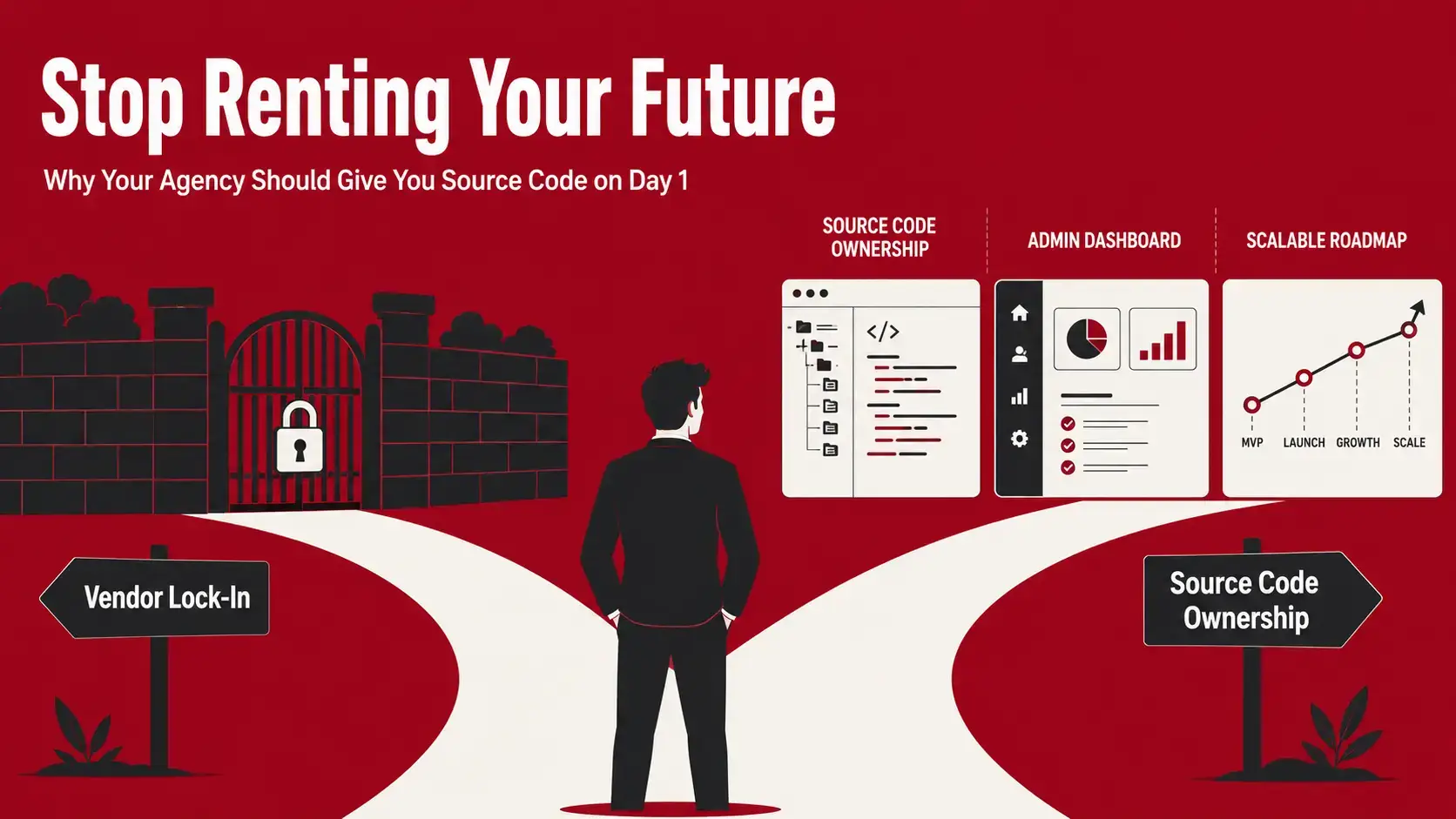
That is the “walled garden” trap.
At Miracuves, we believe source code transparency is not a nice-to-have feature. Source code ownership is a business protection layer. Our ready-made and white-label app solutions are built around a simple principle: founders should not rent the future of their own product.
The “Walled Garden” Trap in App Development
A walled garden is not always obvious at the start.
In the beginning, everything looks fine. The agency shows demos. The screens look polished. The proposal says “customizable.” The founder sees progress and assumes the product belongs to them.
The problem appears later.
You want to add a new payment flow, but the vendor says it is not supported. You want to move hosting, but access is restricted. You want another developer to audit the code, but repository access is unavailable. You want to pause the support contract, but the app cannot be maintained without the original provider.
That is vendor lock-in.
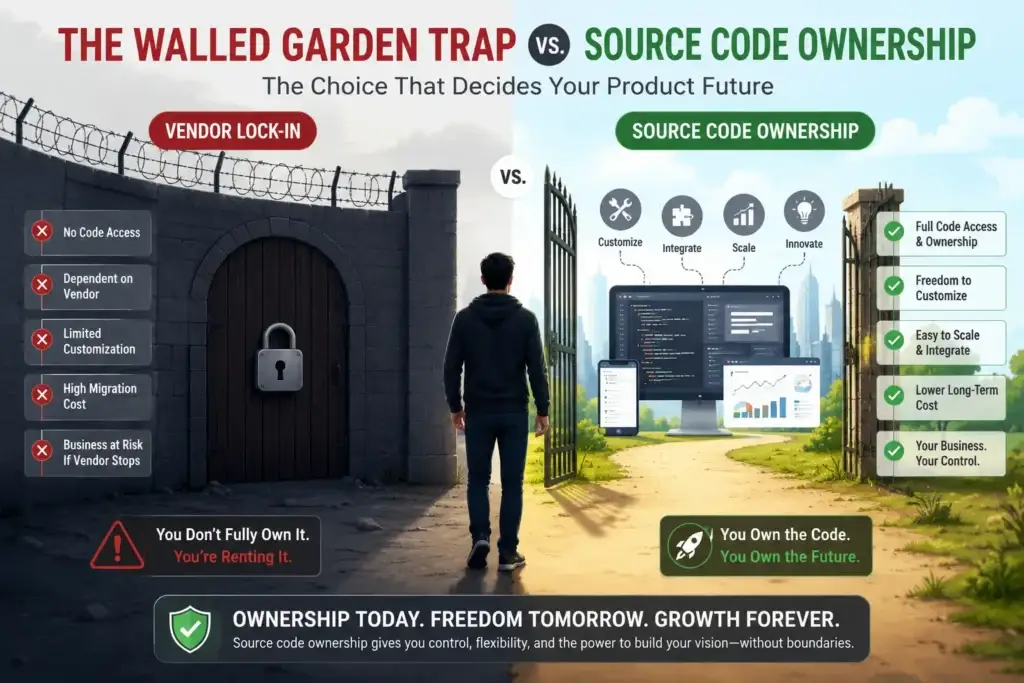
In simple terms, vendor lock-in means switching away from a provider becomes difficult, expensive, risky, or operationally painful. In low-code and platform-based development, this often happens because of proprietary APIs, limited export options, lack of code ownership, and data migration barriers.
In app development, the lock-in can show up in several ways:
| Lock-In Area | What It Looks Like | Business Risk |
|---|---|---|
| Source code restriction | You do not receive full codebase access | You cannot independently modify or scale the app |
| Hosting dependency | The vendor controls server access | Migration becomes slow, risky, or costly |
| Closed admin logic | Critical operations depend on vendor-side tools | You lack operational independence |
| Licensing dependency | You use the app only while paying the vendor | Your business continuity depends on contract terms |
| Poor documentation | Another team cannot understand the codebase | Future development becomes expensive |
| Third-party account control | APIs, app store, payment, or cloud accounts sit with the vendor | Ownership and compliance become unclear |
The dangerous part is that many founders discover these issues only after launch.
By then, marketing has started. Users are onboarded. Vendors or drivers may be active. Payments may be running. Investors may be asking for product updates. At that stage, switching vendors is no longer a simple procurement decision. It becomes a business continuity problem.
Read more : The True Cost of Waiting : Why Fast App Development Beats Long Timelines
Source Code Ownership Is Not a Technical Detail. It Is Strategic Control.
Source code is the human-readable foundation developers use to build, modify, debug, and extend software. Without source code, a founder may have access to an app interface but not true control over the product’s future.
That distinction matters.
When you own your source code, you can:
- Customize the product based on user feedback.
- Hire another developer or internal team later.
- Audit the architecture and security approach.
- Move infrastructure when required.
- Add integrations without depending entirely on the original vendor.
- Protect your business from sudden pricing, support, or licensing changes.
- Build long-term product value that belongs to your company.
When you do not own the source code, your app may look like an asset but behave like a rental.
This is especially important for founders building marketplace, delivery, fintech, creator, ecommerce, healthcare, mobility, or on-demand platforms. These products do not stay fixed. They evolve with user behavior, regulation, payments, logistics, monetization, and market competition.
A founder who cannot control the code cannot fully control the business model.
Why “We’ll Give You the Code Later” Is a Red Flag
Some agencies treat source code like a bargaining chip.
They may say:
“We will provide the source code after the final payment.”
“We can give source code under a higher package.”
“You do not need the code because we manage everything.”
“The app is yours, but the core framework is ours.”
“Source code transfer is available only if you continue maintenance.”
Not every version of this is automatically unethical. Some vendors do use proprietary frameworks, shared modules, or licensed engines. The issue is transparency.
A serious agency should explain ownership terms before the project starts.
Founders should know:
| Question | Why It Matters |
|---|---|
| Who owns the final source code? | Defines long-term product control |
| When is repository access provided? | Prevents end-stage dependency |
| Are there shared modules or proprietary components? | Clarifies what can and cannot be transferred |
| Who controls hosting, app store, and API accounts? | Protects operational independence |
| Is documentation included? | Helps future teams maintain the product |
| Can another team work on the code later? | Reduces switching risk |
| Are third-party licenses clearly listed? | Prevents legal and technical confusion |
A founder should never have to guess what they own.
Why We Don’t Believe in Vendor Lock-In
Vendor lock-in may look profitable for an agency in the short term. It keeps clients dependent. It makes switching difficult. It turns support into a control mechanism.
But it is bad for serious founders.
A good development partner should win trust through product quality, support, clarity, and execution — not through dependency.
At Miracuves, we do not believe founders should feel trapped just because they chose us as a technology partner. Our business model is built around ready-made and white-label app foundations that give founders speed without sacrificing ownership. That includes source-code ownership, branded design, admin dashboard control, and customization support where relevant.
The logic is simple.
If the app truly belongs to the founder, the source code should not be hidden behind a wall.
This does not mean every founder should immediately manage code themselves. Many founders still want ongoing support, maintenance, feature development, cloud management, security updates, and technical guidance. That is normal.
But support should be a choice, not a trap.
The Miracuves Commitment: Transparency as a Feature
Transparency is usually discussed as a communication value. We see it as a product feature.
A transparent app development model should include:
- Clear ownership terms before development begins.
- Source code access based on agreed scope.
- Admin dashboard control for day-to-day operations.
- Branded design that belongs to the business.
- Documentation that helps future maintenance.
- Clear separation of custom code, third-party tools, and licensed services.
- Practical guidance on hosting, deployment, updates, and integrations.
This matters because app businesses change.
A delivery founder may need new commission rules. A fintech founder may need stronger KYC workflows. A marketplace founder may need better dispute management. A creator platform may need moderation and payout controls. A ride-hailing app may need pricing changes by city.
Without source code control, every strategic shift becomes a vendor negotiation.
With source-code ownership, the founder has options.
Founder Decision Signals
Speed
A ready-made foundation helps founders launch faster, but speed should not come at the cost of future control.
Cost
The lowest upfront quote can become expensive if migration, customization, or vendor switching is difficult later.
Scalability
Source code access allows future teams to improve architecture, add integrations, and optimize performance as usage grows.
Market Fit
Founders need the freedom to adjust features, pricing, user flows, and monetization after real market feedback.
What Happens When You Don’t Own Your App Source Code?
Not owning source code may feel harmless at first because the app still runs.
The real cost appears when the business needs change.
1. Every Customization Becomes Permission-Based
If the vendor controls the codebase, even a simple workflow change may require their approval, pricing, and timeline. This slows execution and weakens the founder’s ability to respond to users.
For example, a marketplace founder may want to test a new commission model. A delivery app founder may want to change the order allocation logic. A fintech founder may want to add new verification layers.
Without code access, these are not product decisions. They are vendor requests.
2. Migration Becomes Risky
Moving from one development partner to another is much harder when the codebase is inaccessible, undocumented, incomplete, or tied to proprietary infrastructure.
Legal experts have noted that disputes can arise when a customer needs access to unfinished or completed source code and the supplier refuses to provide it.
Founders should not wait for a conflict to discover whether they control the product.
3. Technical Debt Becomes Invisible
Technical debt is easier to ignore when no one outside the original vendor can review the code. But hidden technical debt eventually affects performance, security, scalability, and update speed.
Software engineering research has also linked code ownership and developer familiarity with maintenance efficiency. In low-quality codebases, developers with low ownership or limited familiarity can take significantly longer to resolve issues.
For founders, this means poor code visibility can become a future cost multiplier.
4. Investor and Acquisition Conversations Become Harder
A serious investor, acquirer, or technical advisor may ask:
- Who owns the IP?
- Where is the repository?
- Can the code be audited?
- Are there third-party licensing restrictions?
- Can another team maintain it?
- Is the backend transferable?
- Is the app dependent on one vendor?
Weak answers reduce trust.
Source code ownership does not guarantee investment, but lack of ownership can create avoidable friction.
5. Your Roadmap Becomes Dependent on Someone Else’s Priorities
Agencies serve multiple clients. Platforms change policies. Support teams shift capacity. Pricing models change.
When the vendor controls the code, your roadmap depends on their availability.
When you own the code, you still may work with the same agency — but you are doing it by choice.
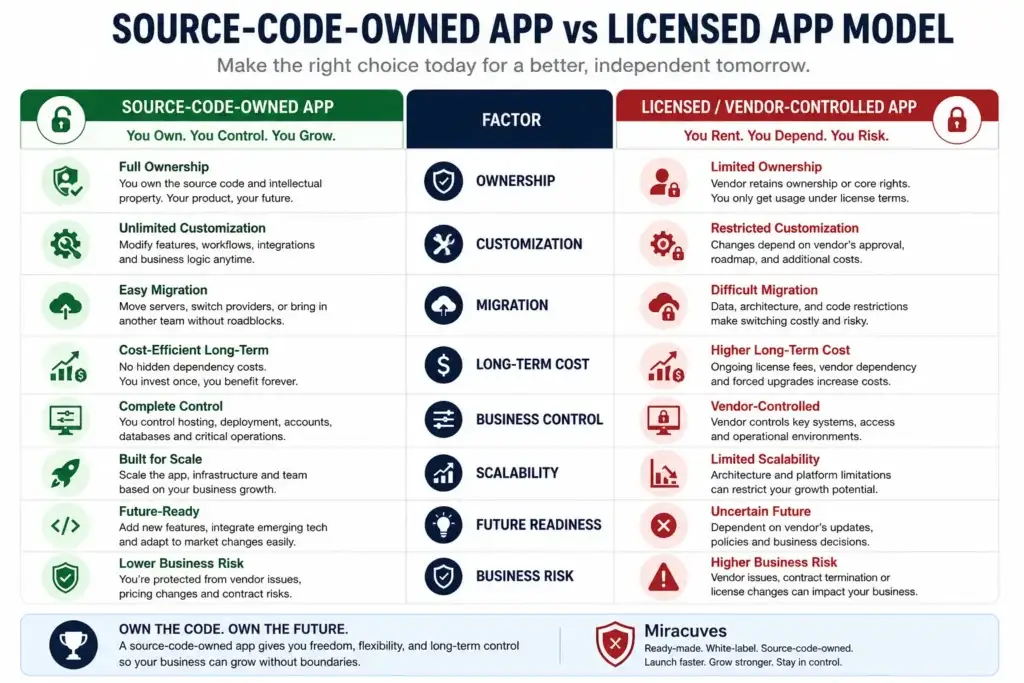
Source-Code-Owned vs Licensed App Model
Source-Code-Owned App vs Licensed App Model
| Factor | Source-Code-Owned App | Licensed or Vendor-Controlled App |
|---|---|---|
| Ownership | The founder receives agreed source code rights and can build future product value. | The vendor may retain core ownership while the founder uses the app under license terms. |
| Customization | Future teams can modify features, workflows, integrations, and business logic. | Customization may depend on vendor roadmap, pricing, and technical permission. |
| Migration | The app can be moved or maintained by another qualified team with proper documentation. | Migration may be difficult if code, hosting, or database access is restricted. |
| Investor Confidence | Clear ownership supports technical due diligence and product control discussions. | Unclear ownership can create concerns around IP, continuity, and scalability. |
| Long-Term Cost | May require responsible maintenance, but avoids dependency-based pricing pressure. | Can appear cost-efficient early but become expensive when switching or scaling. |
What Founders Should Ask Before Signing With an App Development Agency
Do not ask only about features, design, or delivery timeline.
Ask ownership questions early.
Source Code Questions
- Will I receive the full source code?
- When will repository access be provided?
- Is source code included in the base scope or priced separately?
- Are there any modules I cannot modify?
- Are there third-party licenses inside the product?
- Can my internal team work on the code later?
Infrastructure Questions
- Who owns the cloud account?
- Who controls the database?
- Who owns app store accounts?
- Who manages payment gateway credentials?
- Can the app be deployed on my infrastructure?
- Are environment files and deployment documentation included?
Product Control Questions
- Can I change commission rules, pricing, categories, content, user roles, and workflows through the admin panel?
- What requires developer support?
- What requires vendor support?
- What can be modified by my team after handover?
Contract Questions
- Does the agreement clearly mention IP transfer?
- Are source code rights written into the proposal?
- Are maintenance terms separate from ownership terms?
- What happens if I stop support?
- What happens if I hire another development team?
A trustworthy agency will not avoid these questions.
Read more: Clone App Development: The Fastest Way to Validate a Market Without Starting From Zero
Mistakes Founders Should Avoid
Mistakes Founders Should Avoid
Assuming “customizable” means “owned”
Customization access and source code ownership are not the same. A vendor may allow limited changes while still controlling the core codebase.
Waiting until launch to ask for source code
Ownership terms should be agreed before payment milestones begin. Late-stage negotiation gives the vendor more leverage.
Ignoring repository and deployment access
Source code alone is not enough. Founders also need clarity around repositories, hosting, databases, app stores, credentials, and documentation.
Choosing the lowest quote without checking lock-in risk
A low upfront cost can become expensive if future development, migration, or maintenance depends entirely on one provider.
Why Source Code Ownership Matters Even More for Ready-Made Apps
Ready-made app development is powerful because it reduces the time and risk of building from zero.
But not every ready-made model is equal.
Some white-label solutions are effectively rentals. You get branding, screens, and limited configuration, but the vendor keeps the engine. That may be acceptable for some short-term use cases, but it is risky for founders building serious businesses.
A ready-made app becomes much stronger when it includes source-code ownership.
That combination gives founders:
- Faster launch without starting from zero.
- Business-specific branding and customization.
- Admin control for operations.
- Future flexibility for new modules and integrations.
- Reduced dependency on one vendor.
- A stronger foundation for scaling.
This is where Miracuves positions its app development model differently. The goal is not just to help founders launch faster. The goal is to help them launch with control.
For businesses exploring multiple app categories, the <a href=”https://miracuves.com/solutions/”>Miracuves solutions hub</a> is a useful starting point for reviewing ready-made and white-label app foundations across industries.
Source Code Transparency Should Be Part of the Product Experience
A founder should not need to be technical to demand transparency.
They do not need to read every file. They do not need to manage every deployment. They do not need to become the CTO overnight.
But they do need to know that the business is not trapped.
Source code transparency means the agency is confident enough to show its work. It means the relationship is built on clarity, not dependency. It means the founder can continue with the same partner because the partner is valuable — not because leaving is impossible.
That is the development relationship serious founders should look for.
Final Thoughts: Own the Product, Not Just the Interface
The real question is not whether an agency can build your app.
Many agencies can build screens. Many can launch features. Many can show demos.
The stronger question is whether the agency gives you control over the product future you are paying to create.
Source code ownership protects that future.
It gives founders flexibility, leverage, continuity, and confidence. It makes future customization easier. It improves vendor independence. It supports investor conversations. It reduces the risk of being trapped inside someone else’s system.
At Miracuves, we believe the best app development relationship is not built on dependency. It is built on transparency, source-code ownership, admin control, and a product foundation that founders can actually own.
FAQs
What is source code ownership in app development?
Source code ownership means the client has agreed rights to the codebase used to build the app. This allows the business to modify, maintain, audit, migrate, or extend the product without being fully dependent on the original agency.
Why should an app development agency give source code on day one?
Day-one clarity prevents confusion later. Even if full transfer happens through agreed milestones, the ownership terms, repository access process, and handover conditions should be clear from the start.
What is vendor lock-in in app development?
Vendor lock-in happens when a business becomes too dependent on one agency, platform, license, or infrastructure setup. This can make switching providers expensive, slow, or risky.
Is source code ownership always included in white-label apps?
No. Some white-label apps are licensed models where the vendor keeps the core source code. Others include source code rights. Founders should confirm this before signing.
Can I hire another developer if I own the source code?
Yes, source code ownership makes it easier to bring in another developer or internal team, provided the code is documented, accessible, and not restricted by hidden licenses.
Does owning source code mean I do not need maintenance support?
No. Source code ownership gives control, but apps still need updates, security patches, hosting management, performance monitoring, and feature improvements. The difference is that support becomes a choice, not a dependency.
What should I check in an app development contract?
Check IP ownership, source code transfer, repository access, documentation, third-party licenses, hosting control, maintenance terms, and what happens if the relationship ends.
How does Miracuves reduce vendor lock-in?
Miracuves supports founders with ready-made and white-label app solutions built around source-code ownership, branding, admin control, customization, and faster deployment. This helps founders launch faster without giving up long-term product control.