




Key Takeaways
- AI-weighted matching improves freelancer discovery.
- Ranking should prioritize quality over lowest bids.
- Skills, reputation, and success history improve recommendations.
- Better matching increases project completion rates.
- AI ranking creates a healthier freelance marketplace.
Matching Signals
- Score freelancers using skills and experience.
- Include ratings, reviews, and project success.
- Detect spam bids and low-quality proposals.
- Continuously improve rankings with marketplace data.
- Provide transparent recommendation criteria.
Real Insights
- Quality matching improves client satisfaction.
- AI reduces manual freelancer screening.
- Fair ranking strengthens marketplace trust.
- Smart recommendations increase repeat platform usage.
- Miracuves builds Upwork Clone platforms with AI-powered freelancer matching.
Most freelance marketplace founders think the hardest part of building an Upwork-style platform is adding profiles, job posts, proposals, messaging, payments, and reviews.
That is only the visible layer. The real test begins when the marketplace becomes active enough to create pressure. One enterprise job post goes live. Thousands of freelancers see it. Proposals arrive almost at the same time. The database starts receiving simultaneous writes. The client dashboard becomes noisy. The admin panel slows down. The employer sees too many profiles and too little clarity.
That is where a simple job board breaks.
In this case study, we look at how Miracuves deployed a white-label Upwork clone designed to handle massive bid concurrency. The platform processed 10,000 concurrent freelancer proposals on a single enterprise job post and used an AI-Weighted Matchmaking layer to instantly rank and surface the top 3 most relevant freelancer profiles. The result was not just technical stability. It reduced client hiring time by 60%, based on the deployment metric provided in the project brief.
The Bidding War Bottleneck: Why Standard Job Boards Crash
A basic freelance website can manage low-volume proposal activity. A client posts a job, a few freelancers submit bids, and the platform stores those proposals in a database table.
That model works until the marketplace becomes attractive.
When a high-value enterprise job post appears, freelancers marketplace rush to submit proposals. The system suddenly needs to handle simultaneous actions across profile validation, job eligibility checks, bid submission, notification triggers, ranking updates, employer dashboard refreshes, and admin logs.
The bottleneck is not one feature. It is the chain reaction.
A weak bidding system usually creates four problems:
| Problem | What Happens | Business Impact |
|---|---|---|
| Database write pressure | Thousands of proposal records hit the same job post at once | Slow submissions, failed bids, duplicate entries |
| Employer dashboard overload | Every proposal appears in chronological order | Client cannot identify the right freelancer quickly |
| Poor filtering logic | Skill and budget filters run after the database is already overloaded | Slow search and frustrating hiring experience |
| No ranking intelligence | All proposals look equally important | Client decision paralysis increases |
This is why a commodity “freelance website like Upwork” is not enough for serious marketplace founders. The founder does not only need proposal submission. They need proposal control.
The Marketplace Challenge: One Enterprise Job, 10,000 Freelancer Proposals
The project brief was clear: the platform had to support a high-volume freelance marketplace where an enterprise job post could receive thousands of proposals almost instantly.
The business risk was equally clear.
If 10,000 freelancers apply and the system only displays a long proposal list, the client still has a hiring problem. They now have too many options, no clear ranking, and no reason to trust the platform’s matching intelligence.
For recruitment agencies and B2B SaaS operators, this creates a dangerous gap. High supply should be an advantage, but without intelligent ranking, it becomes noise.
The Miracuves engineering objective was to solve three problems at once:
- Keep proposal submission stable under massive concurrent activity.
- Prevent database locking and slow dashboard responses.
- Use AI-weighted ranking to surface the top 3 most relevant freelancer profiles immediately.
The goal was not to replace human hiring judgment. The goal was to reduce the first screening burden so the client could focus on the most qualified candidates faster.
Why Traditional Proposal Sorting Breaks Under Load
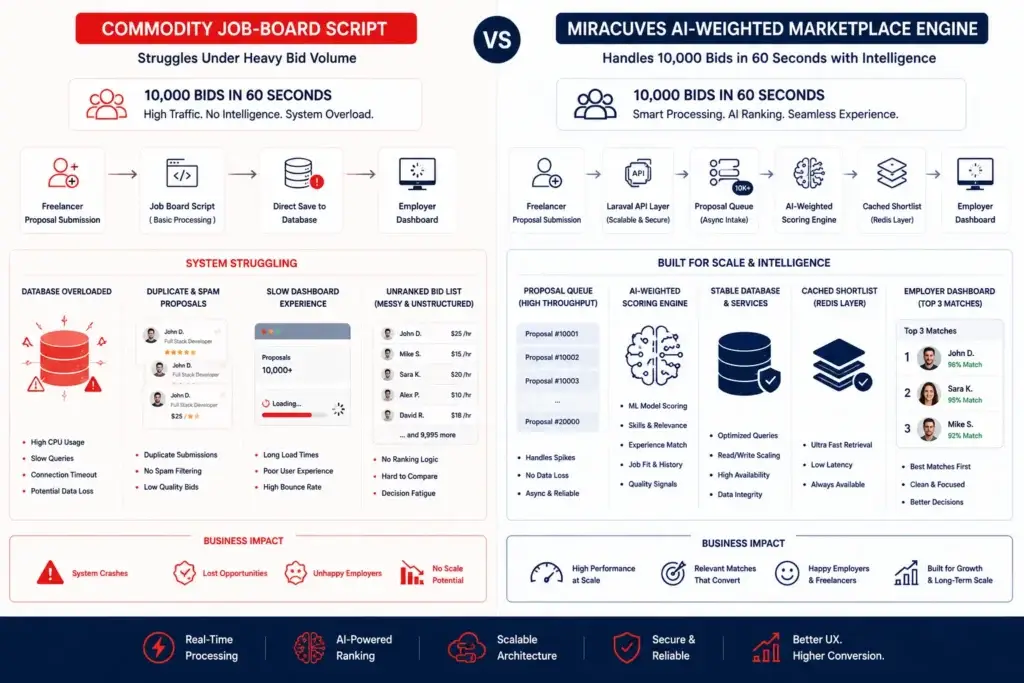
Many freelance marketplace scripts are built around simple proposal storage. A freelancer submits a bid. The system stores the proposal. The client sees a list.
That flow becomes fragile at scale.
When 10,000 freelancers submit proposals on one job post, the system has to manage repeated write operations against the same job context. If the platform calculates proposal counts, ranking, notifications, dashboard updates, and search filters synchronously, the database starts doing too much at once.
The common technical failure points include:
- Proposal table locking during simultaneous writes.
- Slow job-detail pages because proposal counts are recalculated repeatedly.
- Employer dashboards timing out when loading unranked proposals.
- Notification queues flooding email and in-app alert systems.
- Search filters becoming expensive because ranking is calculated too late.
- Admin panels slowing down due to real-time activity logs.
A scalable Upwork clone must treat bidding as an event-heavy workflow, not a simple form submission.
Miracuves’ Upwork Clone solution already includes core freelance marketplace workflows such as project posting, bidding, secure escrow payments, milestone tracking, private communication, reviews, admin dashboards, and AI-powered matching capabilities. The case study challenge was to make that marketplace logic stable under extreme bid volume.
Read more : Upwork Clone Revenue Model: How Upwork Makes Money in 2026
Engineering the AI Matchmaking Algorithm on Laravel
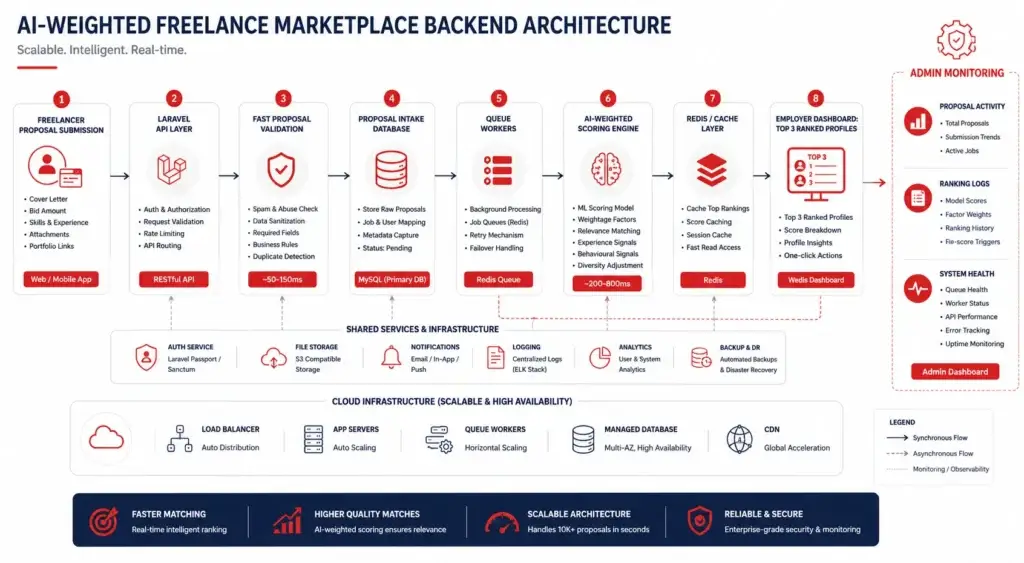
The backend was engineered around a Laravel marketplace architecture with proposal intake, queue-based processing, ranking-weight calculation, cache-supported dashboard views, and admin-side monitoring.
The key decision was to separate proposal acceptance from proposal intelligence.
A proposal should be accepted quickly, validated safely, and stored without forcing the system to calculate everything immediately. The ranking layer can then process proposal signals asynchronously and update the client dashboard with the most relevant profiles.
Core architecture logic
| Layer | Role in the System | Why It Matters |
|---|---|---|
| Laravel API layer | Handles proposal submission, validation, authentication, and job eligibility | Keeps freelancer actions controlled and secure |
| Proposal intake table | Stores submitted proposals with normalized job and freelancer references | Prevents unstructured bid data from slowing the system |
| Queue workers | Process scoring, ranking, notifications, and activity updates separately | Reduces synchronous database pressure |
| Redis/cache layer | Stores hot job-post counters, ranked proposal previews, and top-profile snapshots | Keeps dashboards fast during heavy bidding |
| AI-weighted scoring engine | Assigns relevance score based on job and freelancer variables | Converts proposal volume into decision-ready ranking |
| Employer dashboard | Displays top-ranked profiles, proposal groups, and decision signals | Reduces client screening fatigue |
| Admin control layer | Monitors proposal spikes, abuse signals, and marketplace activity | Gives platform operators operational visibility |
This structure prevented the platform from behaving like a basic job board. Instead of forcing the client to scroll through 10,000 proposals, the system transformed the proposal flood into a ranked decision layer.
The AI-Weighted Matchmaking Variable
The differentiator was the AI-Weighted Matchmaking variable.
A standard platform asks, “Who applied first?”
A better freelance marketplace asks, “Who is most relevant to this job?”
The algorithm evaluated proposal quality using weighted marketplace signals. These signals can vary by marketplace model, but the core logic included:
| Matching Signal | What It Evaluates | Founder Value |
|---|---|---|
| Skill relevance | Whether freelancer skills match the job requirements | Improves candidate quality |
| Category fit | Whether the freelancer belongs to the right service category | Reduces irrelevant applications |
| Budget alignment | Whether freelancer pricing matches the client’s budget range | Prevents mismatched expectations |
| Past completion strength | Whether the freelancer has credible completion indicators | Builds client trust |
| Availability | Whether the freelancer can realistically start within the required window | Improves hiring speed |
| Proposal quality | Whether the proposal addresses the job context meaningfully | Filters low-effort bids |
| Profile completeness | Whether the freelancer profile has enough decision-ready information | Reduces client uncertainty |
| Client preference signals | Whether the profile matches hidden or selected client priorities | Supports personalized hiring |
The result was a ranking model that did not simply reward speed. It rewarded relevance.
For marketplace founders, that distinction matters. If the platform rewards only fast bidders, serious clients may see low-quality proposals first. If the platform rewards relevance, the marketplace becomes more useful as proposal volume increases.
Read more : Best Upwork Clone Script in 2026: Features & Pricing Compared
How the Platform Handled 10,000 Concurrent Freelancer Proposals
The most important engineering decision was to avoid treating every proposal as a dashboard event that had to be instantly calculated in full.
Instead, the platform used a staged processing model.
Stage 1: Fast proposal intake
When freelancers submitted proposals, the system focused on essential validation first:
- Is the freelancer authenticated?
- Is the job open?
- Has the freelancer already applied?
- Does the proposal meet required fields?
- Is the bid within allowed marketplace rules?
This kept the first write operation lean.
Stage 2: Queue-based enrichment
After proposal acceptance, background workers handled heavier tasks:
- AI-weight calculation.
- Profile relevance scoring.
- Notification preparation.
- Admin activity logging.
- Proposal grouping.
- Employer dashboard updates.
This prevented expensive ranking operations from blocking proposal submission.
Stage 3: Cached top-profile snapshots
Instead of forcing the employer dashboard to scan every proposal every time, the system maintained cached ranked snapshots for the job post.
That allowed the client to see the most relevant candidates quickly while the full proposal list remained available for deeper review.
Stage 4: Admin visibility and operational control
The admin panel gave the platform operator visibility into proposal volume, matching quality, and user activity. That matters because marketplace operators need more than frontend features. They need control over the ecosystem.
A freelance marketplace with admin control can monitor spam, low-quality proposals, suspicious activity, payment disputes, profile verification, and category-level performance.
The 60% Time-to-Hire Reduction: Curing Client Decision Paralysis
The platform did not win because it accepted 10,000 proposals.
It won because it made those proposals usable.
Without ranking, a client sees volume. With AI-weighted matchmaking, the client sees a shortlist.
In this deployment, the system surfaced the top 3 most relevant freelancer profiles from the bid pool, reducing client hiring time by 60%, based on the provided deployment metric.
That improvement came from three practical changes:
| Before AI-Weighted Ranking | After AI-Weighted Ranking |
|---|---|
| Client manually reviews a long proposal list | Client starts with the top 3 ranked profiles |
| First-screening time increases with every proposal | First-screening time stays manageable |
| Fastest bidders may appear first | Most relevant freelancers are prioritized |
| Client confidence depends on manual filtering | Client receives structured decision signals |
| Marketplace feels noisy at scale | Marketplace feels intelligent at scale |
This is the difference between a bidding platform and a hiring engine.
For a recruitment agency, this can improve recruiter productivity. For a B2B SaaS operator, it can improve enterprise account retention. For a marketplace founder, it can increase the chance that clients return after their first hiring experience.
Why Laravel Worked for This Marketplace Architecture
Laravel was used because the project needed a structured, maintainable backend foundation for marketplace workflows.
A scalable freelance marketplace is not only about handling traffic. It must coordinate users, proposals, projects, payments, notifications, dashboards, disputes, reviews, and admin controls.
Laravel supports this type of workflow when it is engineered properly with:
- Route-level separation between proposal intake and dashboard rendering.
- Queue workers for asynchronous marketplace events.
- Database indexing for high-volume job and proposal queries.
- Cache layers for repeated dashboard reads.
- Role-based access control for clients, freelancers, and admins.
- Modular marketplace services for bidding, matching, messaging, and payments.
The key is not simply choosing Laravel. The key is designing Laravel around marketplace pressure.
A poorly structured Laravel script can still crash. A properly architected Laravel marketplace can separate writes, reads, scoring, notifications, and admin activity so each layer performs its role without blocking the rest of the system.
Architecture Layers That Kept the Platform Stable
A high-volume Upwork clone needs more than frontend screens. It needs a backend designed around marketplace events.
1. Proposal submission control
The proposal flow was designed to prevent duplicate submissions, invalid bids, and unnecessary repeated writes. This matters because bid storms often create duplicate records when users refresh, retry, or resubmit under load.
2. Database indexing
Proposal queries were structured around job ID, freelancer ID, category, status, and ranking score. Proper indexing helped the system avoid expensive full-table scans during high activity.
3. Queue-first ranking
AI-weighted scoring did not block the freelancer’s proposal submission. It ran as a background process, allowing the platform to accept proposals while ranking was calculated separately.
4. Cached shortlist views
The employer dashboard did not need to rebuild the top candidates from scratch on every page load. Cached shortlist snapshots helped keep the client experience responsive.
5. Admin monitoring
Admins needed visibility into proposal volume, ranking performance, suspicious behavior, and job-level activity. Without admin visibility, platform operators cannot manage trust at scale.
6. Secure payment and milestone foundation
Freelance marketplaces also need payment trust. Miracuves’ Upwork Clone page highlights secure escrow payments and milestone tracking as part of the platform’s core workflow. For enterprise hiring, this matters because the marketplace must support not only discovery but also transaction confidence.
Why This Matters for Marketplace Founders and B2B SaaS Operators
Marketplace founders often obsess over supply acquisition. They want more freelancers, more proposals, more activity, and more listings.
That is understandable, but incomplete.
A marketplace can fail from too little activity. It can also fail from too much unstructured activity.
If clients are overwhelmed, they do not celebrate having 10,000 proposals. They ask, “Who should I hire?”
That is why AI-weighted matchmaking becomes a business feature, not just a technical feature.
For different audiences, the value is clear:
| Audience | Why This Architecture Matters |
|---|---|
| Marketplace founders | Helps convert freelancer supply into client-ready hiring decisions |
| Recruitment agencies | Reduces manual screening and improves recruiter productivity |
| B2B SaaS operators | Adds intelligent matching as a product differentiator |
| Enterprise talent platforms | Supports high-volume jobs without dashboard overload |
| Niche freelance platforms | Helps rank specialized talent more accurately |
| Agencies launching white-label platforms | Provides a scalable base for branded hiring marketplaces |
White-Label Upwork Clone vs Commodity Job-Board Script
Not every freelance platform foundation is equal.
A commodity job-board script focuses on listings. A scalable Upwork clone focuses on marketplace workflows.
| Capability | Commodity Job-Board Script | AI-Weighted Upwork Clone |
|---|---|---|
| Job posting | Basic listings | Structured hiring workflows |
| Freelancer proposals | Simple form submission | Validated, ranked, and monitored proposal flow |
| Matching | Manual filters | AI-weighted relevance scoring |
| Concurrency handling | Often limited | Queue-supported proposal processing |
| Client dashboard | Chronological list | Ranked shortlist and decision signals |
| Admin control | Basic content management | Users, jobs, proposals, disputes, payments, activity |
| Monetization | Listing fees or simple plans | Commission, subscriptions, featured profiles, job boosts, transaction fees |
| Scalability | Suitable for low-volume boards | Designed for active marketplace behavior |
For founders, the strategic question is simple: are you launching a directory, or are you launching a hiring marketplace?
If the goal is to build a serious freelance ecosystem, the architecture must support matching, trust, payments, moderation, and scale.
How Miracuves Helps Launch Scalable Freelance Marketplaces
Miracuves helps founders and operators launch ready-made, white-label freelance marketplace platforms with source-code ownership, branded design, admin control, and scalable marketplace workflows.
The Miracuves Upwork Clone includes core marketplace features such as project posting, bidding, AI-powered matching, escrow payments, milestone tracking, private communication, profile reviews, and admin management. The page also references a 6-day launch option, source code, rebranding, white-labeling, and support deliverables for the ready-made solution.
For founders planning a freelance marketplace, this means the base product can already support essential workflows while custom engineering can focus on the differentiators that matter most: niche logic, AI matching, enterprise hiring flows, premium monetization, or advanced admin controls.
Miracuves also offers freelance services platform development for businesses looking to create scalable freelancer-client ecosystems with project management, payment processing, collaboration tools, security, escrow, and dispute-resolution workflows.
Final Thoughts: The Future of Freelance Marketplaces Is Ranked, Not Listed
The next generation of freelance marketplaces will not compete only on how many freelancers they attract.
They will compete on how intelligently they match those freelancers to client needs.
A platform that receives 10,000 proposals but leaves the client overwhelmed is not scalable in a business sense. It may have traffic, but it does not have decision clarity.
The Miracuves AI-weighted Upwork clone deployment showed a different path: accept high-volume bidding, keep the backend stable, rank proposals intelligently, and help clients act faster.
For marketplace founders, recruitment agencies, and B2B SaaS operators, the lesson is clear. Do not build a freelance job board. Build a hiring engine.
FAQs
What is an AI-weighted Upwork clone?
An AI-weighted Upwork clone is a freelance marketplace platform that uses intelligent scoring to rank freelancer proposals based on relevance, skills, profile strength, availability, budget alignment, and client hiring signals instead of showing proposals only by submission time.
Why do standard freelance job-board scripts fail during high bid volume?
Standard job-board scripts often treat proposals as simple database entries. When thousands of freelancers bid at the same time, the platform may face database locking, slow dashboards, delayed notifications, duplicate submissions, and poor client filtering.
How did Miracuves handle 10,000 concurrent freelancer proposals?
The platform used a staged backend architecture with fast proposal intake, queue-based AI scoring, cached shortlist views, indexed proposal queries, and admin monitoring. This helped the platform accept large bid volume while keeping the client dashboard usable.
What is the benefit of surfacing the top 3 freelancer profiles?
Surfacing the top 3 profiles reduces client decision fatigue. Instead of manually reviewing thousands of proposals, the client can begin with the most relevant candidates and then expand the review if needed.
Is Laravel suitable for a scalable Upwork clone?
Yes, Laravel can support a scalable Upwork clone when the architecture uses proper indexing, queues, caching, role-based access, modular services, and asynchronous processing. The framework alone is not enough; the marketplace logic must be engineered for concurrency.
Can a white-label Upwork clone include AI matchmaking?
Yes. A white-label Upwork clone can include AI matchmaking if the platform is designed to capture the right freelancer, job, proposal, and client-side signals. The ranking model should be customized around the marketplace’s niche and hiring logic.
How does AI matchmaking reduce hiring time?
AI matchmaking reduces hiring time by filtering and ranking proposals before the client manually reviews them. This shortens the first-screening stage and helps clients focus on better-fit freelancers faster.
Is this better than building a freelance marketplace from scratch?
For many founders, a ready-made white-label foundation is faster and more cost-efficient than building every workflow from zero. Custom development may still be useful for advanced matching logic, niche workflows, enterprise integrations, and unique monetization models.